Emil Kapaun
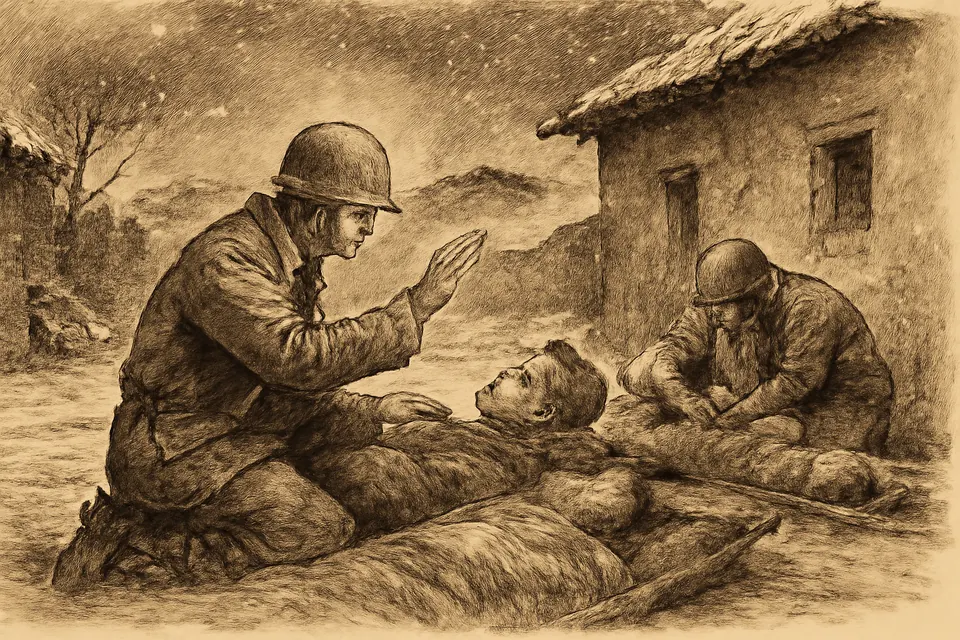
Emil Kapaun (1916–1951) was a Catholic priest from Pilsen, Kansas, and a U.S. Army chaplain who chose to stay with his wounded men at the Battle of Unsan in 1950, was captured, and died as a prisoner of war in North Korea on May 23, 1951. He received the Medal of Honor in 2013, and in 2025 the Church declared him Venerable. He is not yet Blessed or a saint.
Emil Kapaun was a farm boy from Kansas who became a parish priest and then an Army chaplain, and who gave his life for the men around him in a North Korean prison camp in 1951. Soldiers of every faith and none who survived the camp came home talking about him, and they kept talking for sixty years, until he received the Medal of Honor. In 2025 the Church declared him Venerable, recognizing that he freely offered his life for others out of love for Christ.
He was thirty-five when he died. His last words to his friends, as the guards carried him away, were a promise to pray for them. Let us come to know him, and ask him to keep that promise for us too.
Who was Emil Kapaun?
Emil Joseph Kapaun was born on April 20, 1916, which was Holy Thursday that year, in the farmhouse on his family's 160 acres near Pilsen, a small Czech Catholic community in Marion County, Kansas. His parents, Enos and Elizabeth "Bessie" Kapaun, were farmers of Czech descent, and he had one younger brother, Eugene. He was baptized on May 9, 1916, at St. John Nepomucene Church in Pilsen.
He grew up doing farm work and serving at the altar of that parish church. Teachers and neighbors remembered a quiet, practical boy who could fix anything, and a serious student. He went to Conception Abbey's school and seminary in Missouri and then to Kenrick Seminary in St. Louis.
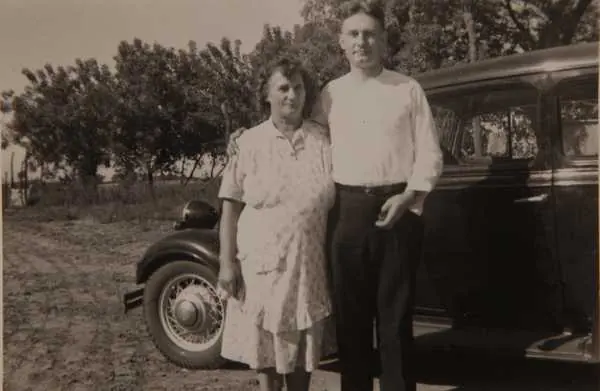
Priest of the Diocese of Wichita
Bishop Christian Winkelmann ordained him a priest for the Diocese of Wichita on June 9, 1940, in St. John's Chapel on the campus of Sacred Heart College in Wichita (now Newman University). Eleven days later he offered his first Mass at St. John Nepomucene in Pilsen, with about 1,200 guests crowding in and around the church. He was named assistant pastor of his home parish, and later its pastor.

During the early years of the Second World War he also offered Mass for the soldiers at the Army airfield at nearby Herington. Their company drew him toward the military chaplaincy. With his bishop's permission he joined the Army Chaplain Corps in 1944.

Army chaplain in Burma and Korea
In March 1945 the Army sent him to the China-Burma-India theater. He spent the last months of the war and the year after it traveling enormous distances by jeep, and sometimes by plane, to bring the sacraments to scattered units. He was promoted to captain on January 3, 1946.
The Army paid for further study, and from October 1946 he studied at the Catholic University of America in Washington, earning a master's degree in education in early 1948. Bishop Mark Carroll then made him pastor of the small Bohemian parish at Timken, Kansas. Six months later Father Kapaun asked to return to the Army. He reported to Fort Bliss, Texas, in late 1948 and was sent to Japan in January 1950 with the 1st Cavalry Division.

The first months in Korea
When North Korea invaded the South in June 1950, his regiment, the 8th Cavalry, was among the first American units sent in. It landed in Korea on July 11, 1950. For the next four months Father Kapaun followed the men from one battle to the next. He said Mass on the hood of his jeep, heard confessions in foxholes and helped carry the wounded and the dead off the field. On August 2, near Kumchon, he earned the Bronze Star for rescuing a wounded soldier under machine-gun fire.
His jeep and trailer of Mass supplies were lost early on, so he took to riding a bicycle from unit to unit.
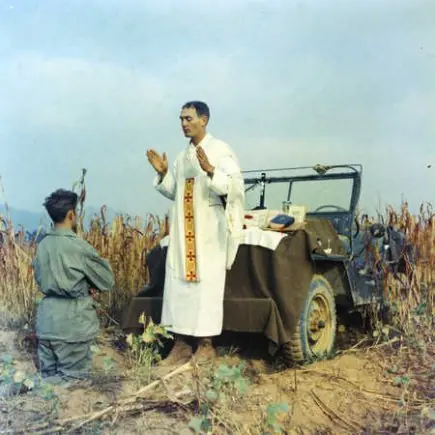
That photograph, taken by his regiment's commanding officer on October 7, 1950, is the best-known image of him. The altar is the hood of the jeep, the field is dry grass, and one soldier kneels to serve. A few weeks later almost everyone around him would be dead or captured.
The Battle of Unsan and his capture
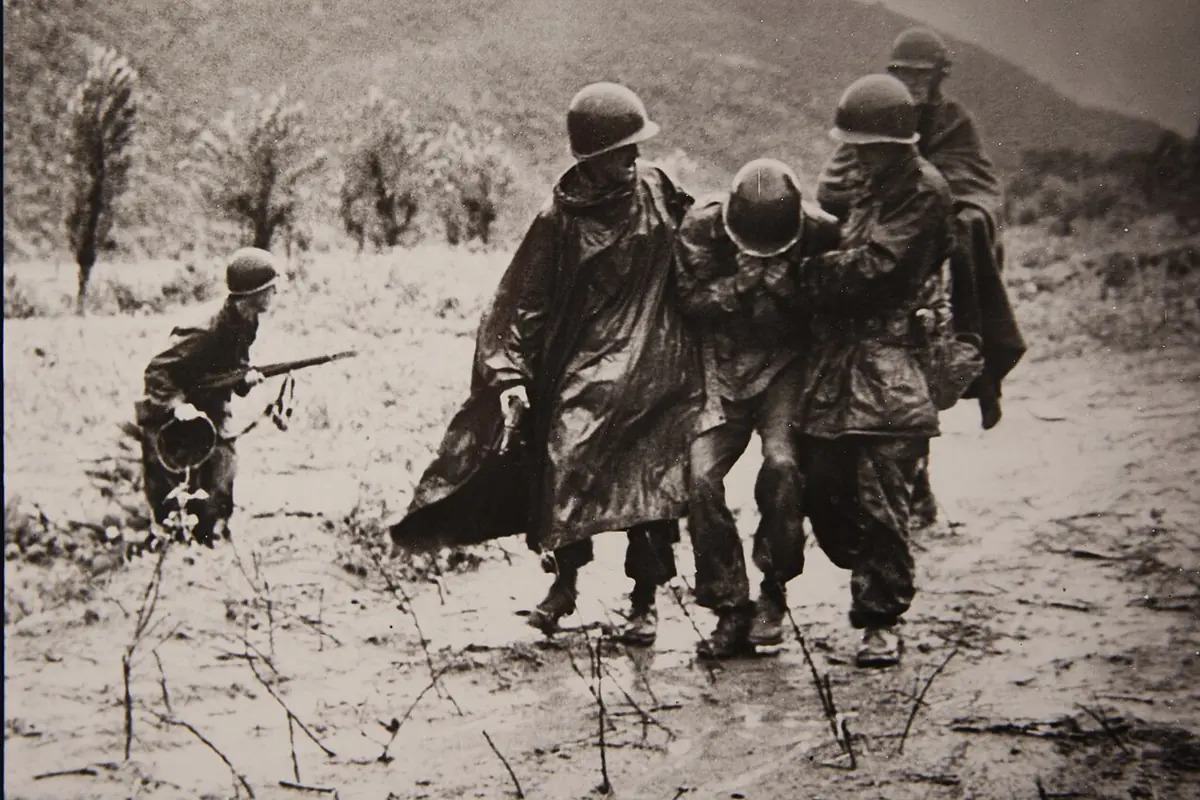
By late October 1950 the war seemed nearly won, and the soldiers expected to be home by Thanksgiving. They were still in summer uniforms. Then, on the night of November 1, Chinese forces who had crossed into North Korea in secret struck the 8th Cavalry near the town of Unsan. Father Kapaun's battalion, the 3rd, was surrounded.
The Medal of Honor citation, approved more than sixty years later, tells what he did through that night and the next day. He walked through heavy fire to reach the wounded, gave them comfort and first aid, and dragged men back from no-man's land. When the officers decided that the men who could still move should try to break out, he chose to stay behind with the wounded, knowing he would be captured. He found a wounded Chinese officer among the casualties and persuaded him to help arrange the safe surrender of the trapped Americans. And when an enemy soldier stood over Sgt. First Class Herbert Miller, wounded and lying in a ditch, ready to shoot him, Father Kapaun pushed the soldier aside, lifted Miller and carried him.
He and Army doctor Clarence Anderson were taken prisoner on November 2, 1950.
The march north
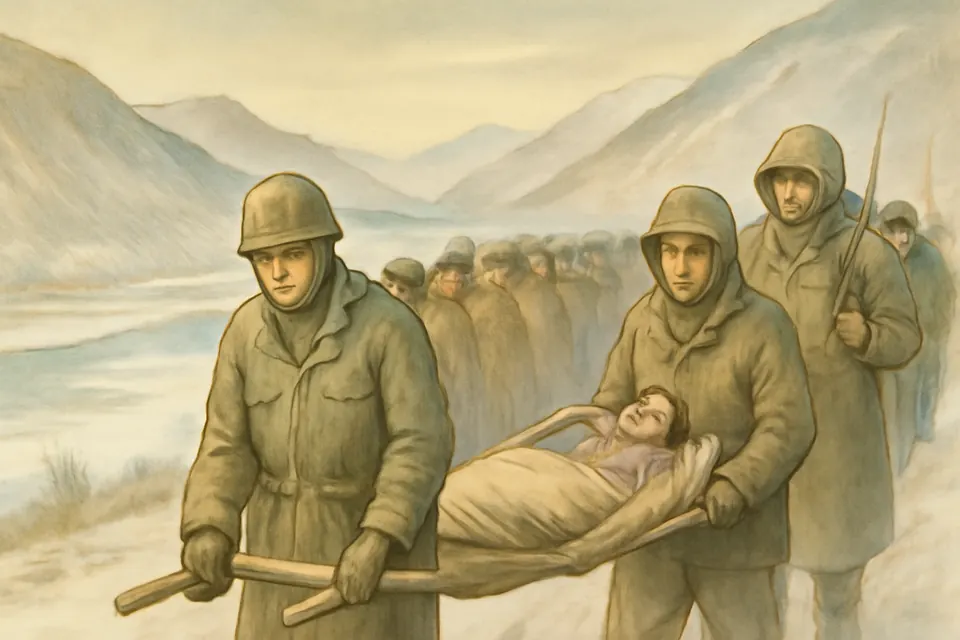
Within days the prisoners were marched north, sixty to a hundred miles, to a camp near Pyoktong on the Yalu River. Men who fell out of the column were often shot. Father Kapaun carried Herb Miller for miles, and he urged and sometimes ordered the stronger prisoners to take turns carrying the wounded on makeshift litters so that no one would be left behind. Miller lived and came home.
The prison camp at Pyoktong
Camp 5 at Pyoktong was a cluster of mud houses in a valley above the frozen Yalu. The winter of 1950–51 was one of the coldest in memory, with nights near 28 degrees below zero, and the prisoners had no winter clothes and almost no food. More than half of them died that winter, mostly from hunger, cold, dysentery and pneumonia.
In those months Father Kapaun became, in the words of the men who survived, the reason they lived. He did not preach much. He worked.
- He slipped out at night to steal food from the guards' stores and the fields and shared everything he took. He prayed to St. Dismas, the good thief crucified beside Jesus, before his raids, and the men called him the "Great Thief."
- He tore down part of a fence for firewood and boiled water in a pan he had hammered out of scrap metal, so the men could drink without catching dysentery, and he brought them hot water or something like coffee in the mornings.
- He volunteered for burial details, picked lice off the sick and washed the filthy clothes of men too weak to wash their own.
- He led the men in prayer, gave absolution to the dying and kept a quiet watch over those who had given up.
The communist guards held daily lectures to break the prisoners' faith and loyalty. Father Kapaun answered the instructors calmly and politely, and he would not give way. The guards came to see him as the camp's ringleader.

Easter Sunday, 1951
On Easter morning, March 25, 1951, Father Kapaun did what the guards had forbidden. At dawn, in front of the ruins of a bombed church in the camp, he led a sunrise service. He had no bread or wine for Mass, but he led the Easter prayers, preached, and the prisoners sang. Other prisoners across the valley heard the singing and joined in. Mike Dowe, a lieutenant who survived the camp, later called his sermon that morning "a fantastic sermon." The guards came but did not stop it.

His death in the camp
By then he was terribly weak. He had a blood clot in his leg, then dysentery, then pneumonia. His friends nursed him through the worst, and he began to recover, but in May the guards decided to move him to the camp "hospital," a building the prisoners called the death house, where the sick were left without food or care. His friends protested, and the guards brought soldiers with bayonets.
As they carried him out, Father Kapaun blessed his captors. To Mike Dowe, who was weeping, he said:
Mike, don't cry. I'm going where I've always wanted to go. And when I get there, I'll be saying a prayer for all of you.
He also gave a message for his bishop: "Tell my bishop I died a happy death." He died alone in the death house on May 23, 1951. The prisoners buried him in a mass grave near the camp.
After the armistice in 1953, the surviving prisoners told his story at every chance. One of them, Maj. Jerry Fink, a Jewish officer, carved a wooden crucifix in Father Kapaun's memory. A Muslim prisoner, Fezi Bey, is remembered for saying of him, "He is not of my religion, but he is a man of God."
The Medal of Honor
In 1951 the Army awarded Chaplain Kapaun the Distinguished Service Cross for his actions at Unsan. His friends were sure he deserved more, and for decades the veterans of Camp 5 wrote letters and lobbied Congress. Congress finally cleared the way, and on April 11, 2013, President Barack Obama presented the Medal of Honor to his nephew, Ray Kapaun, in the East Room of the White House. Herb Miller, the man he had saved from execution, was in the audience with other former prisoners.

The next day he was inducted into the Pentagon's Hall of Heroes. His fellow prisoners, by then men in their eighties, wept through the ceremony.

Coming home to Kansas
For seventy years his body lay unidentified. After the war the remains from the Pyoktong camp were returned and buried as unknowns at the National Memorial Cemetery of the Pacific, the "Punchbowl," in Honolulu. In recent years the Defense POW/MIA Accounting Agency has been exhuming and identifying the Korean War unknowns, and on March 2, 2021, the Army announced that one of them was Father Emil Kapaun, identified through dental records and DNA.
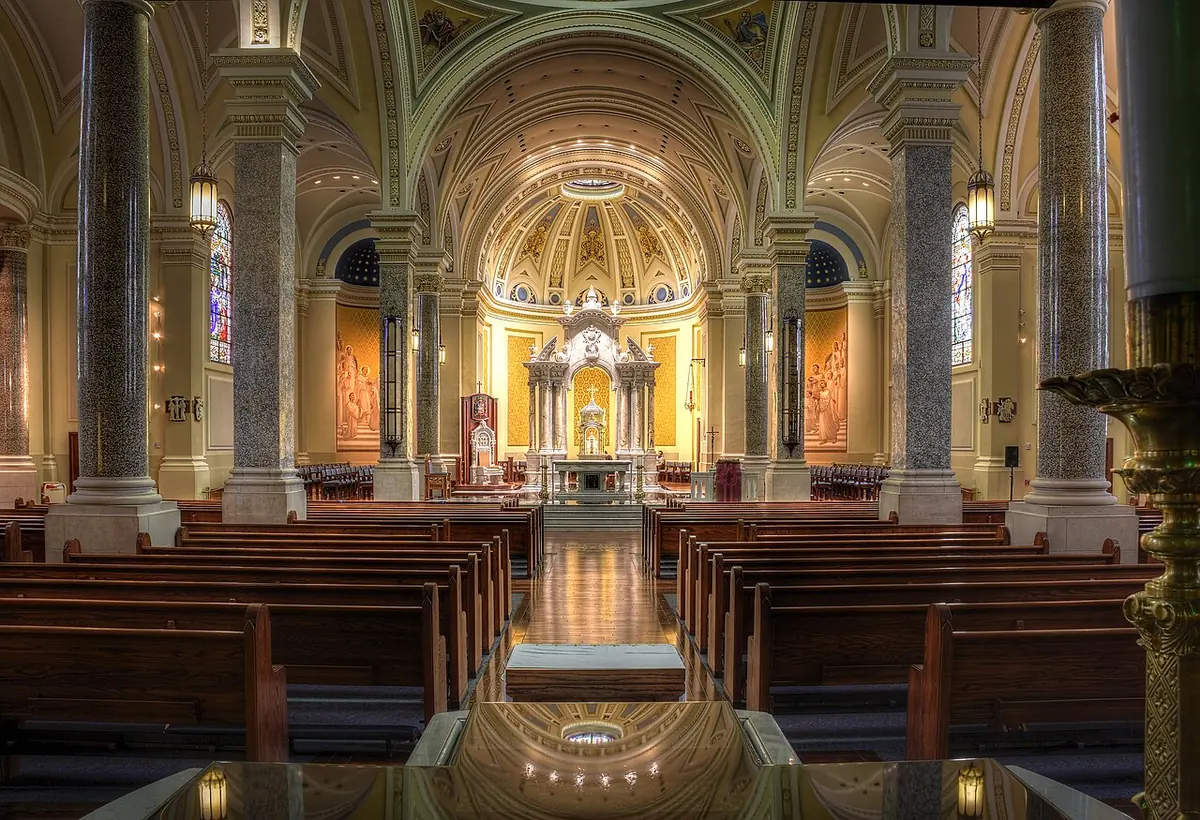
He came home to Wichita in September 2021. After a funeral Mass on September 29, a horse-drawn caisson carried his casket through downtown Wichita, and he was buried with military honors in a tomb inside the Cathedral of the Immaculate Conception, where pilgrims now come to pray.
Is Emil Kapaun a saint? His cause for canonization
Not yet. Here are the steps of his cause so far.
- 1993: The Diocese of Wichita opened his cause, and he received the title Servant of God in July 1993.
- The 2000s: The diocese gathered testimony from surviving prisoners and others and studied reported healings. In 2009 the Vatican sent an investigator, Andrea Ambrosi, to interview families in Wichita.
- 2017: Pope Francis created a new path to beatification, the offering of life, for Christians who freely give up their lives for others out of charity and persevere in that offering until death. It is distinct from martyrdom and from heroic virtue, and Father Kapaun's cause was presented under it.
- February 24, 2025: Pope Francis authorized the Dicastery for the Causes of Saints to publish the decree on Father Kapaun's offering of life. He became Venerable.
Beatification now requires one miracle through his intercession, investigated by doctors and theologians and approved by the Pope. Canonization would require a second miracle after beatification. You can read more about these steps on our pages on what Venerable means, beatification and how someone becomes a saint.
Reported miracles
No miracle has been approved yet. The healings below are reported: documented claims that the Church is still studying.
- Chase Kear: A 20-year-old pole vaulter from Colwich, Kansas, fell during practice and fractured his skull from ear to ear, with bleeding on the brain. His doctors told his parents they "didn't have a lot of hope." His family and parish asked Father Kapaun's intercession. He survived surgery and walked out of the hospital a few weeks later, and his doctors could not explain the recovery. In 2009 the Vatican's investigator, Andrea Ambrosi, came to Wichita to interview his family and doctors.
- Other healings: The diocese has studied other reported recoveries of gravely ill people whose families prayed to Father Kapaun.
In 2025 the diocese said it had received testimony of several more healings, some recent, and that one or two would be sent to Rome for study.
Why he is loved: a model for chaplains, soldiers and prisoners
Father Kapaun is not a patron saint of anything yet, since only the saints and blessed are given patronages. But military chaplains, soldiers, veterans and families of prisoners of war already ask for his prayers, and so do many who are suffering in hospitals or in captivity of any kind. The Army named its chapel at Camp Humphreys in South Korea for him, and Kapaun Mt. Carmel Catholic High School in Wichita carries his name.
What draws people is that his holiness was so plain. He did not have visions or work wonders in his lifetime. He picked lice off sick men, stole corn, boiled water and refused to leave the wounded. He reminds every one of us that charity is mostly done with the hands. Our page on the patron saints of soldiers tells of St. Michael, St. Martin of Tours, St. Joan of Arc and others whom soldiers have long asked for help. Father Kapaun belongs in the same company as St. Maximilian Kolbe, the priest who gave his life for another prisoner at Auschwitz, and as Blessed Stanley Rother, the Oklahoma farm boy turned priest who would not leave his people in Guatemala.
Pilsen and the Kapaun pilgrimage
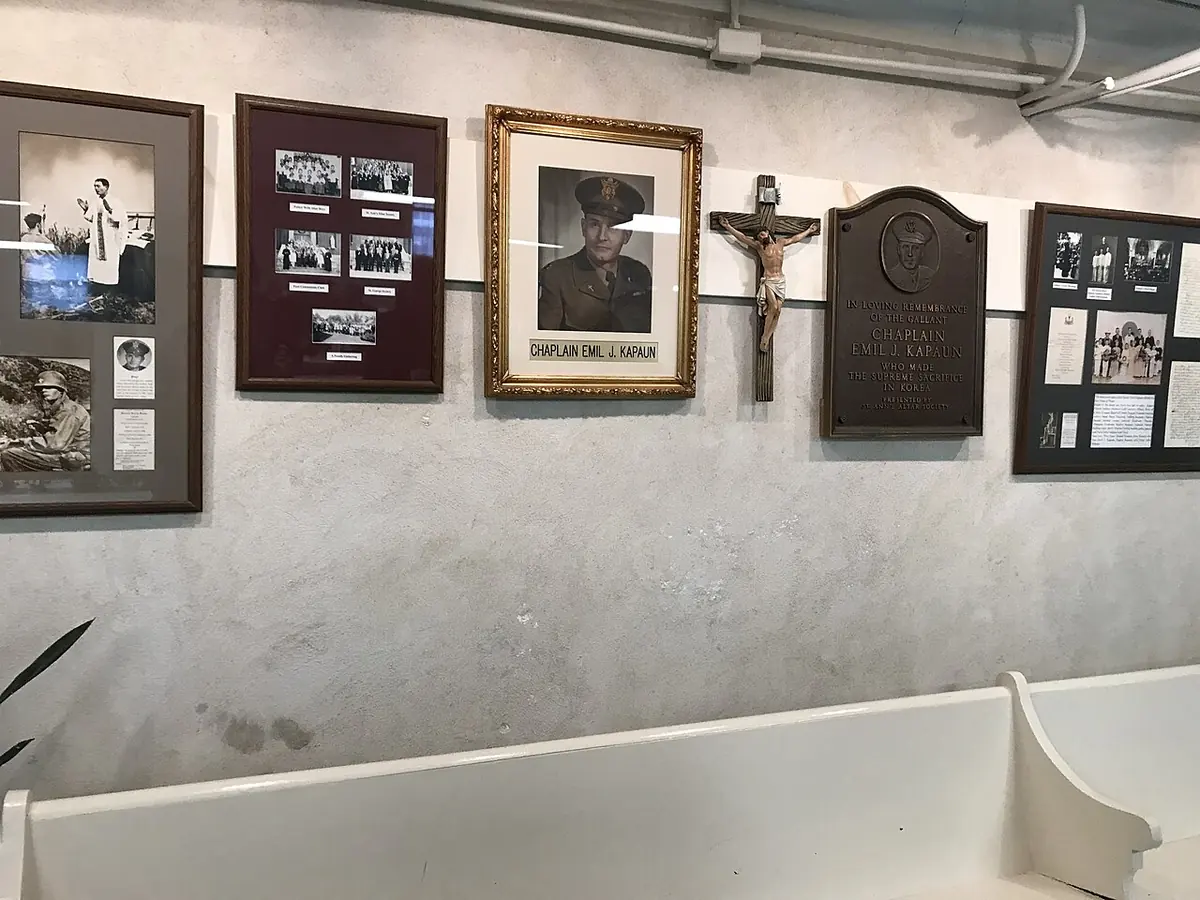
St. John Nepomucene Church in Pilsen keeps a small museum and memorial to its most famous son, with photographs and mementos of his life.
Each summer pilgrims walk about sixty miles across the Kansas prairie to Pilsen, praying for his cause and for their own needs. The diocese also offers a novena of Masses on the first nine days of each month for everyone who asks his intercession.
Praying with Father Kapaun
Since he is Venerable, there is no public feast or Mass in his honor yet. But we may ask him, privately, to pray for us, as he promised his friends he would, and every favor received helps his cause. The Diocese of Wichita publishes this Prayer for the Canonization of Venerable Kapaun:
Lord Jesus,
in the midst of the folly of war,
your servant, Chaplain Emil Kapaun,
spent himself in total service to you
on the battlefields and in the prison camps of Korea,
until his death at the hands of his captors.
We now ask you, Lord Jesus, if it be your will,
to make known to all the world
the holiness of Chaplain Kapaun
and the glory of his complete sacrifice for you
by signs of miracles and peace.
In your name, Lord, we ask,
for you are the source of peace,
the strength of our service to others,
and our final hope. Amen.
Venerable Emil Kapaun, pray for us!
The same site has a prayer for his intercession, a nine-day novena on the Beatitudes with his own reflections, and a form for reporting favors received. A line attributed to him on the cause's prayer page fits him well: "No sincere prayer is ever wasted."

Let us ask Father Kapaun to pray for all soldiers and chaplains, for prisoners and the forgotten, and for us, that we may serve the people God puts in front of us with the same plain, stubborn love.
Frequently asked questions
Is Emil Kapaun a saint?
Not yet. On February 24, 2025, Pope Francis approved a decree recognizing that Fr. Kapaun freely offered his life for others, which makes him Venerable. Beatification requires one miracle approved by the Church, and canonization a second miracle after beatification.
Why was Emil Kapaun declared Venerable?
His cause was presented under the "offering of life," a path Pope Francis created in 2017 for Christians who freely gave their lives for others out of charity and persevered in that choice until death. The Dicastery for the Causes of Saints judged that Kapaun did this by staying with the wounded at Unsan and by his daily charity as a prisoner.
What did Father Kapaun do to earn the Medal of Honor?
At Unsan, Korea, on November 1–2, 1950, he crossed open ground under fire to rescue and comfort wounded soldiers, chose to stay with them when the able-bodied men were ordered out, persuaded a wounded Chinese officer to help arrange the surrender of the trapped Americans, and pushed aside an enemy soldier about to shoot Sgt. Herbert Miller. President Obama presented the medal on April 11, 2013.
How did Emil Kapaun die?
He died on May 23, 1951, at the prison camp at Pyoktong, North Korea, at age 35, weakened by hunger, pneumonia and a blood clot in his leg. The guards had moved him to a building the prisoners called the death house, where the sick were left without care.
Where is Father Kapaun buried?
In the Cathedral of the Immaculate Conception in Wichita, Kansas. His remains were identified in March 2021 among unknown soldiers buried at the National Memorial Cemetery of the Pacific in Honolulu, and he was laid to rest in the cathedral after a funeral Mass on September 29, 2021.
What miracles are attributed to Emil Kapaun?
None has been approved yet. The Diocese of Wichita has gathered testimony about several healings reported through his intercession, including the recovery of Chase Kear, a 20-year-old pole vaulter from Colwich, Kansas, whose skull was fractured in a fall. These are reported cases still under study.
Is there a prayer to Father Kapaun?
Yes. The Diocese of Wichita publishes a Prayer for the Canonization of Venerable Kapaun and a prayer for his intercession, both on the official cause website, along with a nine-day Beatitude novena. Since he is Venerable, we may ask his intercession privately, but there is no public feast or Mass in his honor.
When is Father Kapaun's feast day?
He has no feast day yet; the Church gives one only after beatification. Many people remember him on May 23, the anniversary of his death, and the cause holds an annual pilgrimage to his hometown of Pilsen, Kansas.
Sources
- Vatican News: Pope Francis paves the way for new saints (February 25, 2025). The offering-of-life decree and the category's purpose
- Venerable Emil Kapaun: Cause for Sainthood. Servant of God in July 1993; cause presented as an offering of life (Oblatio vitae)
- Venerable Emil Kapaun: Meet Emil Kapaun. Birth, baptism, ordination, first Mass and the Korean War dates
- Venerable Emil Kapaun: Prayer. Text of the prayer for his canonization
- U.S. Army: Medal of Honor Citation for Chaplain (Capt.) Emil J. Kapaun
- U.S. Army: Medal of Honor awarded to Army chaplain (2013). The "Great Thief," the winter of 1950–51, the Easter service and Mike Dowe's account of his last words
- U.S. Army: Recognizing Father Kapaun on the anniversary of the establishment of the Medal of Honor. Identification of his remains in Hawaii in March 2021
- Catholic News Agency: Vatican investigator finds 'compelling case' for miracle in Wichita (July 3, 2009). The reported healing of Chase Kear and the visit of the Vatican investigator Andrea Ambrosi
- Dwight G. Duncan, The miracle of Father Kapaun (The Pilot, Boston, April 26, 2013). Jerry Fink's crucifix and Fezi Bey's words