First Friday devotion
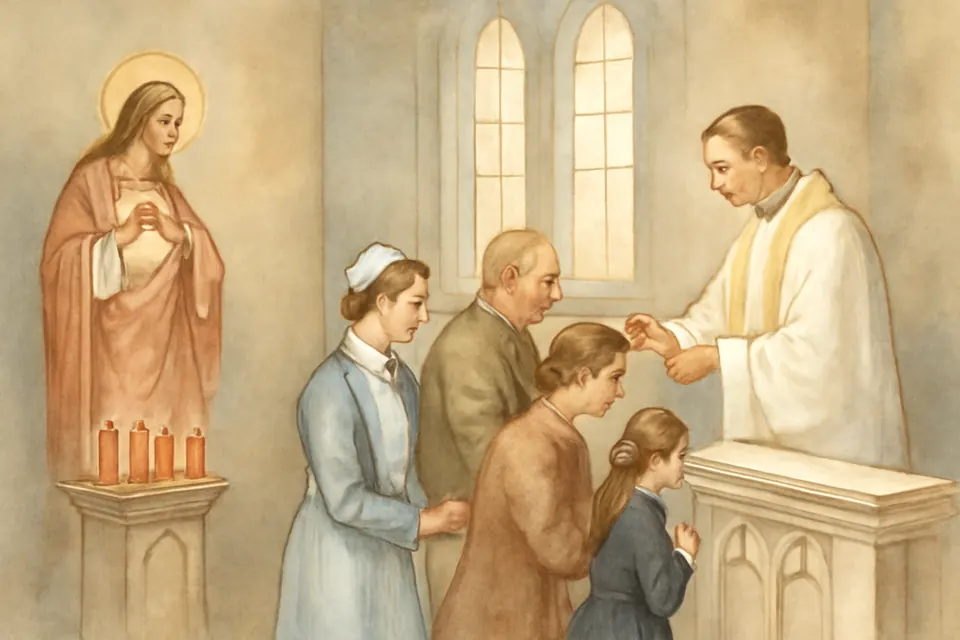
The First Friday devotion is the Catholic practice of receiving Holy Communion on the first Friday of the month in honor of the Sacred Heart of Jesus and in reparation for sin. Making it for nine consecutive months, the Nine First Fridays, rests on the Great Promise St. Margaret Mary reported: the grace of final repentance.
On the first Friday of every month, Catholics around the world go to Mass and receive Holy Communion in honor of the Sacred Heart of Jesus. Many keep it for nine months in a row, trusting a promise Our Lord made to a French nun more than three hundred years ago. Here is what the First Friday devotion is, how to make the Nine First Fridays, and what the Church says about the promise behind them.
What is the First Friday devotion?
The First Friday devotion is a monthly Communion of reparation. On the first Friday of the month we receive Our Lord in the Eucharist with a particular intention: to honor his Heart, which loves us so much, and to console it for the coldness, neglect and sin that wound it.
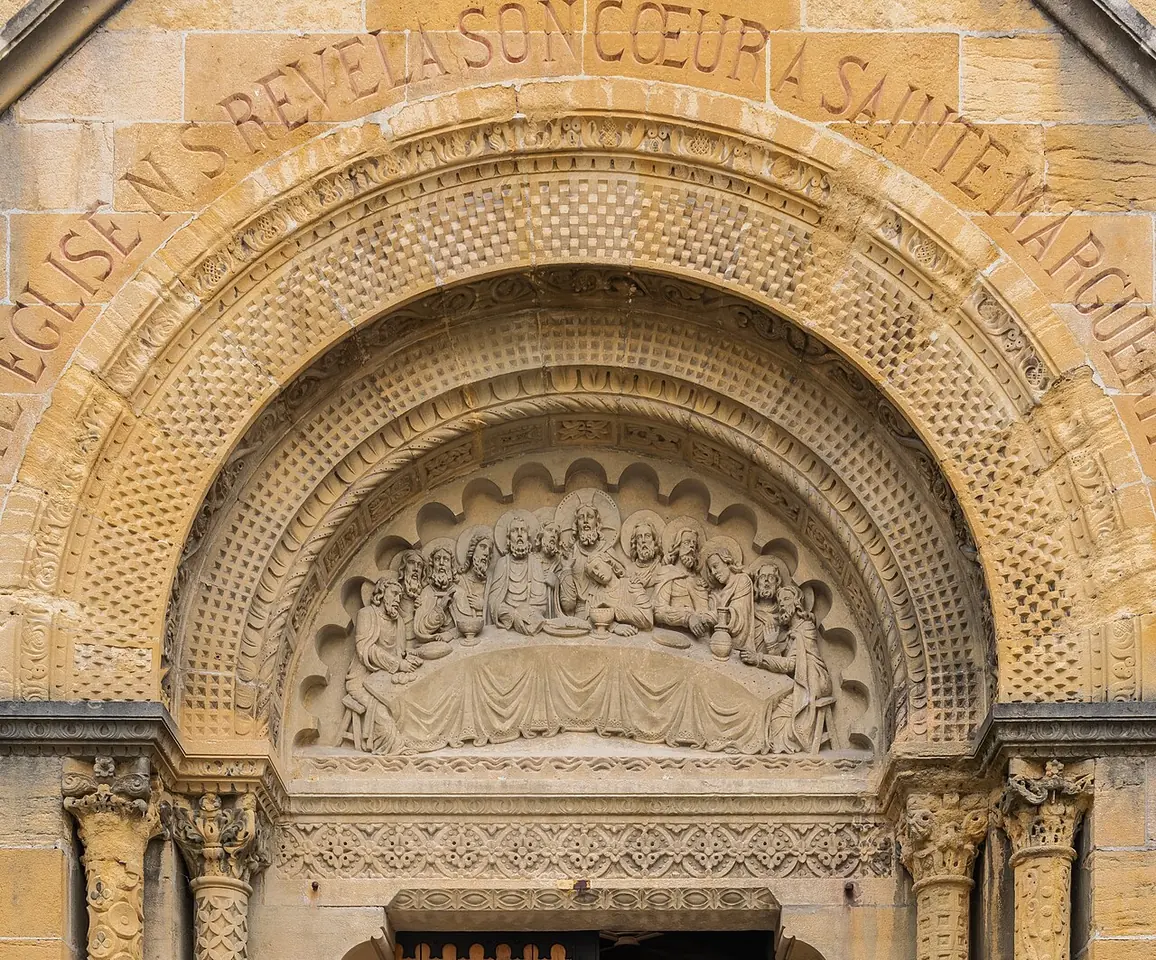
It began at Paray-le-Monial in Burgundy. Between 1673 and 1675 St. Margaret Mary Alacoque, a young nun of the Visitation order, reported a series of visions in which Christ showed her his Heart. According to the Catholic Encyclopedia (1910), he asked her to receive Communion on the first Friday of every month and to keep a Holy Hour, praying from eleven to midnight on the Thursday night before, to share the sadness he felt when his Apostles abandoned him in his Agony.
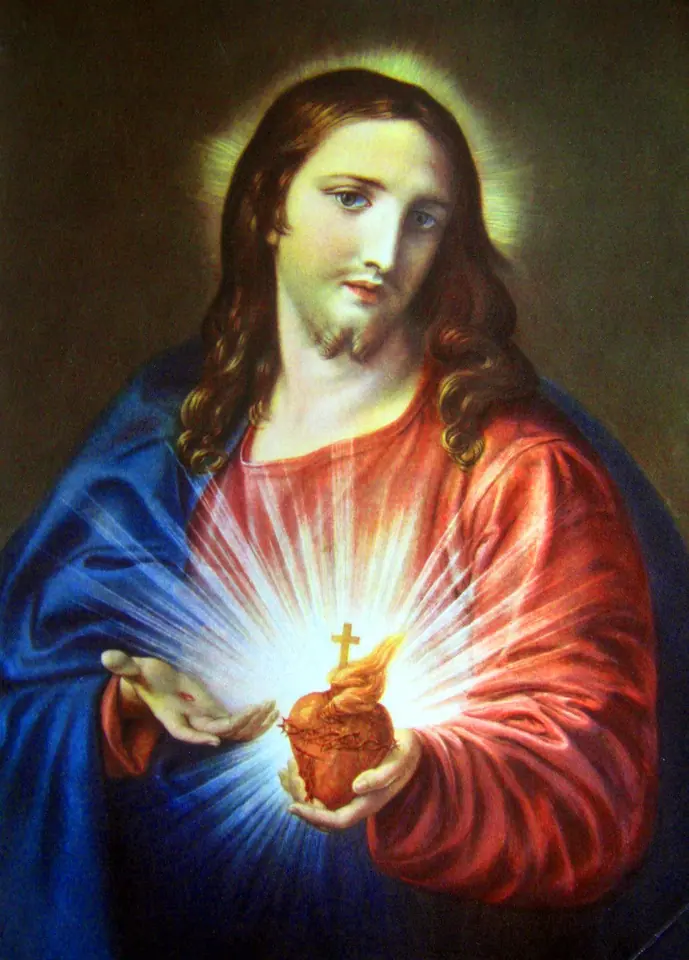
Friday is the day of the Passion, the day his Heart was pierced by the soldier's lance. The first Friday makes it a monthly appointment.
The Great Promise
The twelfth of the promises St. Margaret Mary recorded is called the Great Promise, and it is the reason so many make nine First Fridays in a row. Fr. Edward McNamara, a professor of liturgy in Rome, quotes it from her writings:
On Friday during Holy Communion, He said these words to His unworthy slave, if I mistake not: I promise you in the excessive mercy of my Heart that its all-powerful love will grant to all those who receive Holy Communion on nine first Fridays of consecutive months the grace of final repentance; they will not die under my displeasure or without receiving their sacraments, my divine Heart making itself their assured refuge at the last moment.
Notice her humility: "if I mistake not." She reported what she believed she heard, and she entrusted it to her superiors and her confessors.
What kind of promise is it?
We should be honest and clear about its status. The Great Promise is part of a private revelation. The Church examined St. Margaret Mary's life, revelations and writings with what the Catholic Encyclopedia calls "the most severe and minute examination" before Pius IX beatified her in 1864, and Benedict XV canonized her in 1920. The Church found nothing in them contrary to faith and has encouraged the devotion ever since.
Still, a private revelation is not part of the deposit of faith. Pope Francis wrote in Dilexit nos (2024) that the visions of saints who spread devotion to the Sacred Heart "are not something that the faithful are obliged to believe as if they were the word of God," while calling them "rich sources of encouragement." He adds, quoting Pius XII, that the devotion itself cannot be said "to owe its origin to private revelations": its roots are in the Gospel, in the pierced side of Christ.
So the First Fridays are approved, praised by popes and freely open to all. The promise attached to them is one we receive with trust in God's mercy, as the Church receives it, without making it an article of faith.
How to make the Nine First Fridays
- Choose your start. Begin on the first Friday of any month.
- Be in a state of grace. If you are conscious of serious sin, go to confession beforehand. Many parishes hear confessions on Thursday evening or before the First Friday Mass for this reason.
- Go to Mass and receive Holy Communion on the first Friday of the month. Fr. McNamara notes that the promise speaks of Communion, not of Mass as such, though receiving within Mass is always preferable when you can.
- Make the intention. Receive in honor of the Sacred Heart and in reparation for sins against his love: our own and the world's.
- Repeat for nine consecutive months. If you miss one, the common teaching is to start again.
- Optional but fitting: keep a Holy Hour on the Thursday night before, pray before the Blessed Sacrament, or make an act of consecration to the Sacred Heart.
Keeping it from becoming mechanical
Fr. McNamara lists the conditions that teachers of the devotion have always attached, "so as to avoid this holy practice becoming something automatic or magical." The Communions must be made on the day Our Lord chose and in nine consecutive months. They must be made in honor of his Heart, by people who love him. Our Lord "does not say that those who make the nine Fridays will be dispensed from any of their obligations"; rather, he promises the graces to keep them. And the nine months help us "acquire the habit of frequent Communion, which Our Lord eagerly desires."
That last point is the heart of it. The Nine First Fridays are a beginning. Most people who finish them keep going.
The twelve promises of the Sacred Heart
The Great Promise is the last of twelve. Here they are as Fr. McNamara gives them:
- "I will give them all the graces necessary in their state of life."
- "I will establish peace in their homes."
- "I will comfort them in their afflictions."
- "I will be their secure refuge during life, and above all in death."
- "I will bestow a large blessing upon all their undertakings."
- "Sinners shall find in my Heart the source and the infinite ocean of mercy."
- "Tepid souls shall grow fervent."
- "Fervent souls shall quickly mount to high perfection."
- "I will bless every place where a picture of My Heart shall be set up and honored."
- "I will give to priests the gift of touching the most hardened hearts."
- "Those who shall promote this devotion shall have their names written in My Heart, never to be blotted out."
- The Great Promise, given above.

The list has a history of its own. Fr. McNamara explains that the promises are not found as a numbered list in St. Margaret Mary's writings. They are "scattered about these writings in different forms and dates," and she usually wrote in indirect speech ("Our Lord has made known to me that..."). The list was first printed in a French booklet in 1863. In 1882 Philip Kemper, a businessman in Dayton, Ohio, began printing it on cards in some 238 languages, and in 1895 Leo XIII blessed his work as "pious" and "useful." The wording was tidied along the way, but the meaning of the promises, above all the twelfth, is hers.
How the First Fridays spread
St. Margaret Mary needed a defender, and she found one in her Jesuit confessor, St. Claude La Colombière. When he learned of her experiences, Pope Francis writes, he "immediately undertook her defence and began to spread word of the apparitions." After her death the Visitation nuns and the Jesuits carried the devotion across France and then the world.

By 1928 Pius XI could write in Miserentissimus Redemptor of "the custom of receiving Holy Communion on the first Friday of every month at the desire of Christ Jesus, a custom which now prevails everywhere." He recalled that Our Lord had asked for "a Communion of Reparation" and the Holy Hour, and said that "these pious exercises have been approved by the Church."
Pope Francis gives the reason it mattered so much. In the age of Jansenism, he writes, many people "had stopped receiving communion because they were no longer confident of God's mercy and forgiveness and regarded communion as a kind of reward for the perfect." The First Fridays taught them that Jesus wants us at his table. He adds that the practice can help us in a different way now, amid "the frenetic pace of today's world," when "we forget to nourish our lives with the strength of the Eucharist."
Prayers for the First Friday
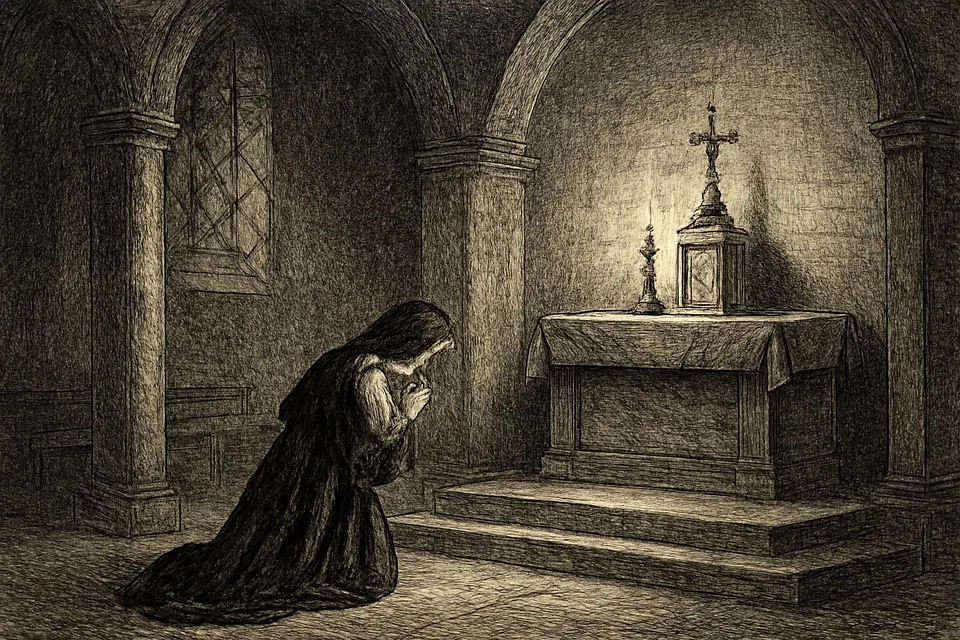
The best prayer of the First Friday is the Communion itself, followed by a few quiet minutes of thanksgiving. After that, many people pray one of the classic prayers to the Sacred Heart: an act of consecration, an act of reparation, or the Litany of the Sacred Heart. You will find them, with their sources, on our page of Sacred Heart prayers.
The shortest prayer of all is one the Church has kept for centuries and lists in its handbook of indulgences, the Enchiridion Indulgentiarum, among the invocations that carry a partial indulgence:
Cor Iesu sacratissimum, miserere nobis.
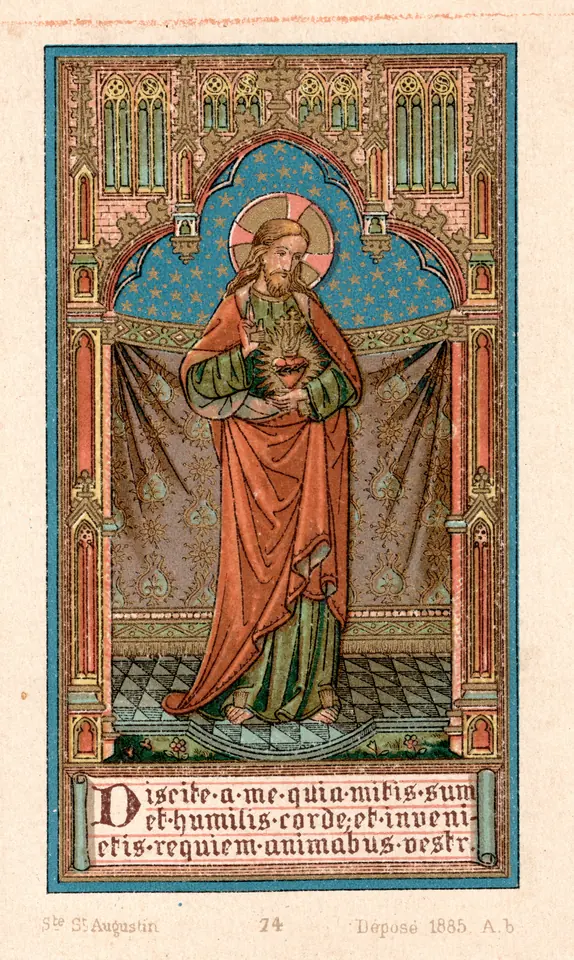
"Most Sacred Heart of Jesus, have mercy on us." The same list includes Cor Iesu, in te confido, "Heart of Jesus, I trust in you." Let us say them after Communion this First Friday, and on the way home, and whenever we pass a church.
First Fridays and First Saturdays
The Church loves to pair the two Hearts. In 1925 Our Lady asked the visionary of Fátima for a parallel devotion of reparation to her Immaculate Heart on the first Saturday of five consecutive months. Since the first Saturday so often falls the day after the first Friday, many parishes keep both together. Read about it on our page for the First Saturday devotion and about Mary's heart on our page for the Immaculate Heart of Mary.
If you have never made the Nine First Fridays, begin with the next one. Go to confession if you need to, receive Our Lord with love, and ask him for the grace to come back next month. Sacred Heart of Jesus, we place all our trust in you.
Frequently asked questions
What is the First Friday devotion?
It is the practice of receiving Holy Communion on the first Friday of each month in honor of the Sacred Heart of Jesus and to make reparation for the sins that wound his love. Jesus asked for it, St. Margaret Mary Alacoque reported, in her visions at Paray-le-Monial between 1673 and 1675.
What are the nine First Fridays?
Nine First Friday Communions in a row, one each month for nine consecutive months. They come from the twelfth promise of the Sacred Heart, the Great Promise, which offers those who make them the grace of final repentance and the sacraments at the end of life.
Do I have to go to confession on the First Friday?
The promise asks for Communion, so what is required is to receive worthily, in a state of grace. Many people go to confession in the days before, often on Thursday evening or Friday morning, but the Great Promise itself doesn't name confession.
What happens if I miss a First Friday?
The promise speaks of nine consecutive months, so the usual answer is to begin again. Fr. Edward McNamara, a liturgy professor in Rome, says the Fridays must be consecutive. If there is no Mass because the first Friday falls on Good Friday, he judges that receiving Communion at the Good Friday liturgy is enough.
Is the Great Promise a guarantee of heaven?
No. It is a promise of grace, not a ticket. Writers on the devotion stress that it must be made out of love for Christ, that it doesn't excuse anyone from the duties of a Christian life, and that its purpose is to draw us into frequent Communion and lasting friendship with Jesus.
Is the First Friday devotion approved by the Church?
Yes. St. Margaret Mary was canonized in 1920 after her revelations were closely examined, and popes from Pius XI to Francis have praised First Friday Communion. Her visions remain private revelation, which no Catholic is obliged to believe, but the devotion itself is fully approved and widely practiced.
When is the next First Friday?
The first Friday of every calendar month. Many parishes add confession times, an extra morning or evening Mass and Eucharistic adoration that day.
Sources
- EWTN: First Friday Devotion and First Friday (Fr. Edward McNamara, LC, ZENIT)
- Catholic Encyclopedia (1910): St. Margaret Mary Alacoque
- Pius XI, Miserentissimus Redemptor (1928), nos. 3 and 12
- Pope Francis, Dilexit nos (2024), nos. 83 and 84
- Apostolic Penitentiary, Enchiridion Indulgentiarum, 4th edition (2004)