Pedro Arrupe
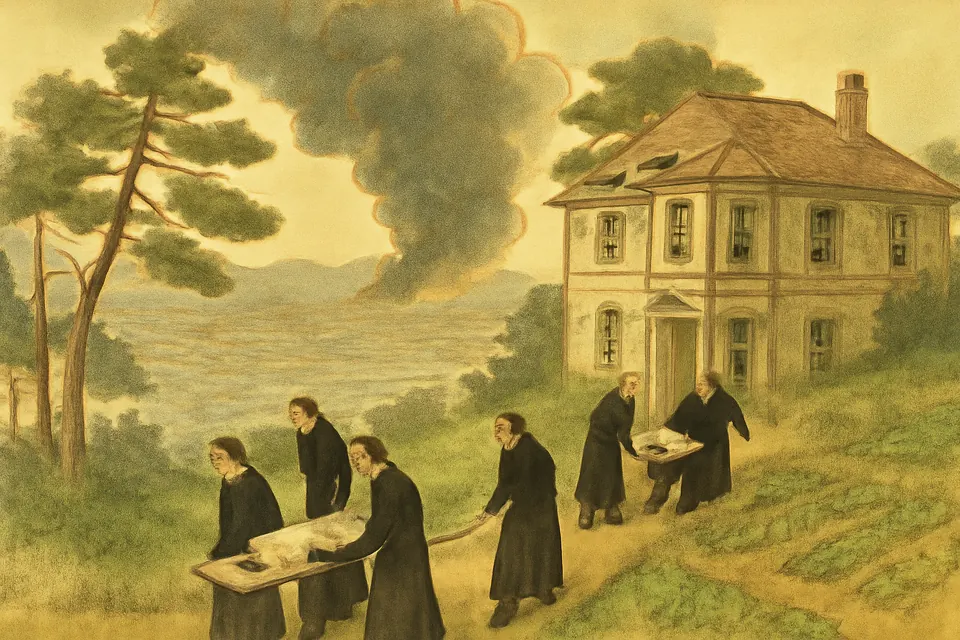
Pedro Arrupe (1907–1991) was a Spanish Jesuit priest who turned his novitiate outside Hiroshima into a field hospital after the atomic bomb of 1945, then served as Superior General of the Society of Jesus from 1965 to 1983 and founded the Jesuit Refugee Service. His cause opened in 2019, so the Church calls him Servant of God.
Pedro Arrupe was a Basque medical student who became a Jesuit, a missionary to Japan, a healer in the ruins of Hiroshima and, for eighteen years, the Superior General of the Society of Jesus. Jesuits sometimes call him their second founder, because he led them back to the fire of St. Ignatius of Loyola in the turbulent years after the Second Vatican Council. He spent the last ten years of his life paralyzed and almost unable to speak, entirely, as he said, "in the hands of God." Today the Church calls him Servant of God, and his cause for canonization is under study in Rome.
Let us walk through his life, and ask him to pray for us as we go.
Who was Pedro Arrupe?
Pedro Arrupe y Gondra was born in Bilbao, in the Basque Country of northern Spain, on November 14, 1907. He was a gifted student and went to Madrid to study medicine. A visit to Lourdes, where as a medical student he saw a cure that the doctors could not explain, shook him deeply; the Irish Jesuit Brian Grogan calls it the catalyst of his vocation. In 1927 he left medicine and entered the Jesuit novitiate in Spain.

He had barely begun his formation when the Spanish Republic expelled the Jesuits in 1932. Arrupe continued his studies in exile, in Belgium, the Netherlands and the United States, and was ordained a priest in 1936. For ten years he had asked his superiors to send him to Japan, the land where St. Francis Xavier had preached. In 1938 they finally said yes, and on June 7, 1938, he began his ministry there.
Prisoner in Japan
He learned Japanese in Hiroshima and became pastor of a small congregation at Yamaguchi. After Pearl Harbor, in December 1941, the Japanese police arrested him as a suspected spy and held him in solitary confinement. He expected to be executed. Instead he was released, and he later said that his time in that cell filled him with a calm, radical trust in God that never left him. In 1942 he was appointed master of novices at Nagatsuka, on a hillside about 6 kilometers from the center of Hiroshima, with 35 young Jesuits in his care.
Pedro Arrupe and the atomic bomb at Hiroshima
At 8:15 on the morning of August 6, 1945, an American bomber dropped the atomic bomb on Hiroshima. At the novitiate, a flash lit the sky and a blast of wind and noise knocked Arrupe to the floor, smashed the windows and tore doors from their hinges. When he got up and went outside, the whole city below was burning.
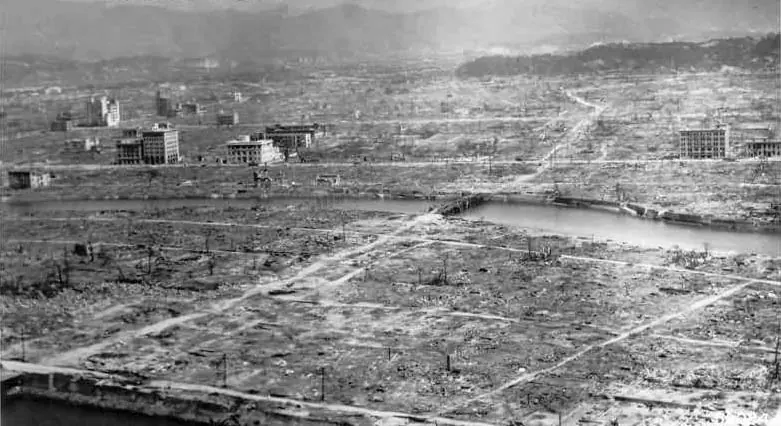
The roads into the city were blocked by fire. Arrupe went into the half-wrecked chapel to pray, and came out with a decision: the novitiate would become a hospital. He had studied medicine years before and had almost nothing to work with, but he set the novices to work. Farmers brought what food they had. He cleaned wounds, picked out shards of glass, and that evening led the Jesuits into the city to carry more of the injured back up the hill. He wrote in his journal of what they saw: "a group of young women, eighteen or twenty years old, clinging to one another as they dragged themselves along the road."
The next morning a farmer gave him a sack holding about 15 kilograms of boric acid. With it, and with bandages torn from the house's sheets, Arrupe treated burns that the Japanese doctors said they had never seen before. "We had in the house 150 people of whom one-third or one-half had open wounds," he wrote. According to the Jesuit curia's historian, of the roughly two hundred wounded he treated, only two died.
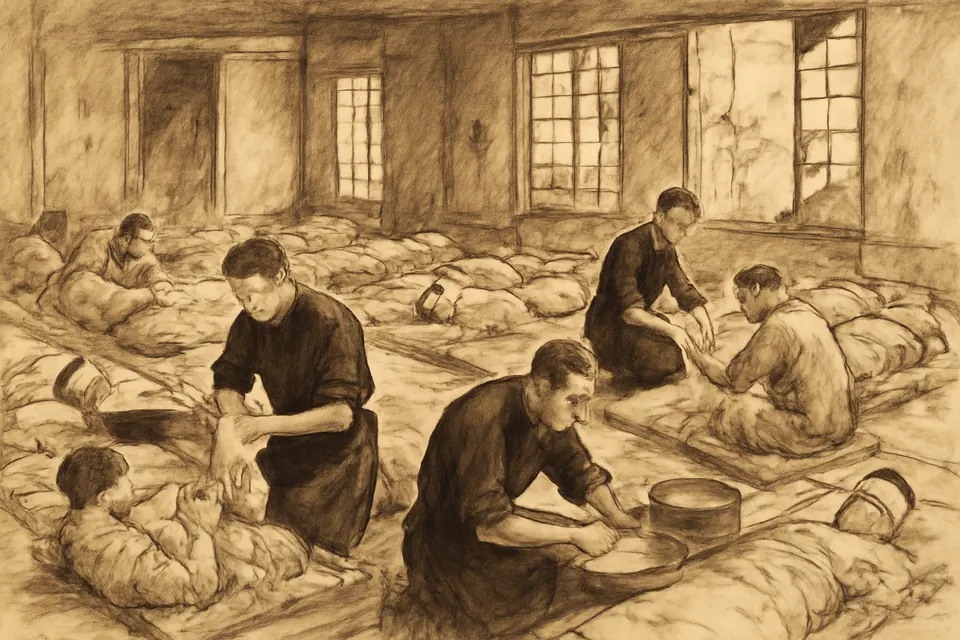
He also went down into the ruins to bury and burn the dead, knowing the city was full of radiation, because, as he put it, "a priest cannot remain outside the city just to preserve his life." Several of those he nursed later asked for baptism, and one, a fourteen-year-old boy named Tadashi Hasegawa, became a priest.
Father General of the Jesuits
After the war Arrupe rebuilt the Jesuit mission in Japan. In 1958 he became the first Jesuit Provincial of Japan, and the province grew to about 300 Jesuits from 30 nations. On May 22, 1965, the 31st General Congregation of the Society of Jesus elected him Superior General, the 28th successor of St. Ignatius. Less than seven months later the Second Vatican Council ended, and it fell to him to lead the Jesuits through the renewal the Council asked of every religious family.
He asked Jesuits to return to the sources: the Spiritual Exercises, discernment, and the poverty of Christ. He also asked them to go to the poor. The 32nd General Congregation of 1975 described the Jesuit mission as "the service of faith and the promotion of justice," and Arrupe saw the two as one thing: a faith that does justice. He traveled constantly, visiting Jesuits on every continent, and he always prayed first.
"Men for others"
On July 31, 1973, he spoke to the alumni of Jesuit schools of Europe gathered in Valencia, Spain. He asked them a hard question, whether the Jesuits had educated them for justice, and admitted that the honest answer was no. Then he gave the line that every Jesuit school now knows:
Today our prime educational objective must be to form men-for-others; men who will live not for themselves but for God and his Christ—for the God-man who lived and died for all the world
He went on to say that love of God "which does not issue in justice for men is a farce." The phrase, widened later to "men and women for others," became the motto of Jesuit education worldwide.
The Jesuit Refugee Service
In the late 1970s, the faces of the Vietnamese boat people on television moved Arrupe as Hiroshima had. He wrote to the whole Society that "this situation constitutes a challenge to the Society we cannot ignore," and that the help needed "is not only material." On November 14, 1980, his seventy-third birthday, he founded the Jesuit Refugee Service. Today JRS accompanies refugees and displaced people in dozens of countries, and in Rome its Centro Astalli serves migrants close to his tomb.
In the hands of God
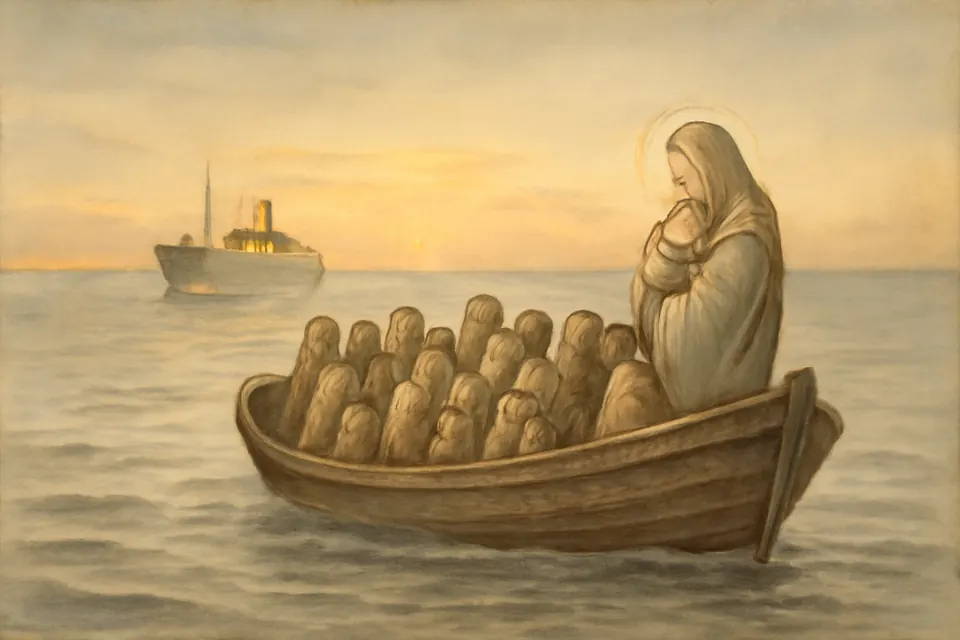
On August 7, 1981, returning to Rome from a visit to Jesuits in the Philippines, Arrupe suffered a stroke. It left him partly paralyzed and soon almost completely unable to speak. Pope John Paul II named a personal delegate to guide the Society until a new General could be elected, and Arrupe accepted the decision with obedience and peace. In 1983 he became the first Superior General in Jesuit history to resign. After the stroke he left these words:
More than ever I find myself in the hands of God. This is what I have wanted all my life from my youth. But now there is a difference; the initiative is entirely with God.
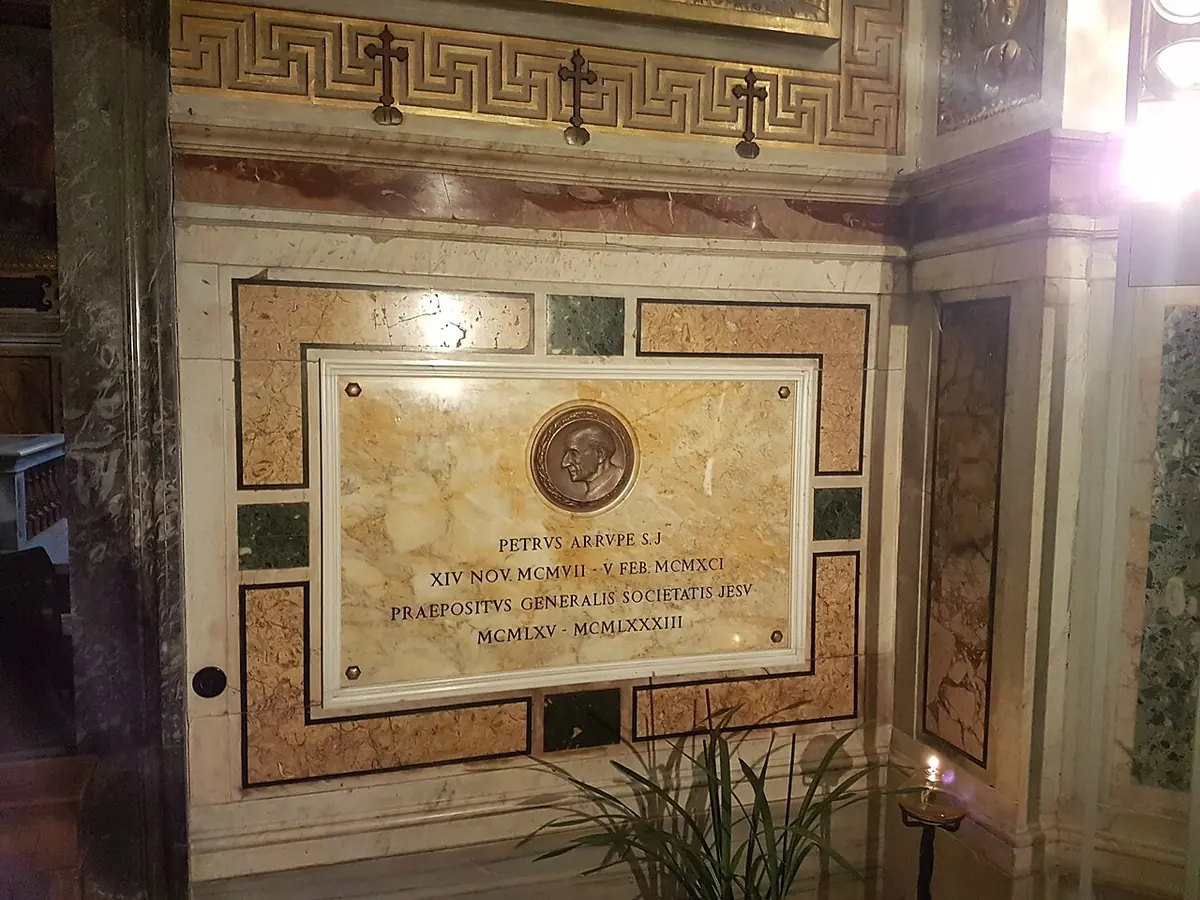
He lived nearly eight more years in the infirmary of the Jesuit headquarters in Rome, praying for the Society he had led. He died on February 5, 1991, the anniversary of the day in 1597 when St. Paul Miki and his companions were martyred at Nagasaki. He was buried in the Church of the Gesù, the mother church of the Jesuits, where St. Ignatius also lies.

Is Pedro Arrupe a saint? His canonization cause
Not yet. Pedro Arrupe is a Servant of God, the first title in a cause for canonization.
- February 5, 2019: On the 28th anniversary of his death, the Diocese of Rome opened his cause, and he became a Servant of God.
- 2019 to 2024: A diocesan tribunal gathered testimony from witnesses who knew him and studied his writings.
- November 14, 2024: On what would have been his 117th birthday, Archbishop Baldo Reina, the Pope's vicar for Rome, presided at the closing session in the Lateran Palace. The boxes of evidence were sealed with wax and sent to the Dicastery for the Causes of Saints.
- The Roman phase: The Jesuit postulation must now prepare the positio, the formal study of his life and virtues, for the Dicastery's historians, theologians, cardinals and bishops. As of October 2026 no decree on his virtues has been announced.
If the Church judges that he lived the Christian virtues to a heroic degree, he will be declared Venerable. Beatification would then require a miracle through his intercession, investigated and approved by the Church; canonization would require a second. No miracle has been approved yet. To learn how each step works, see our pages on beatification and how someone becomes a saint.
Praying with Pedro Arrupe
Because he is a Servant of God, the Church does not allow public veneration: there is no feast day, liturgy or public shrine in his honor. But we may ask him, privately, to pray for us, and the Society of Jesus encourages the faithful to do so. The official prayer for his cause begins, "O God, loving Father: in baptism you clothed with Christ your servant Pedro Arrupe," and asks that he be recognized "as a model of evangelical life and prophetic witness in the world." You can find the full text on the Jesuits' website.
One prayer often printed under his name, "Fall in Love," which begins "Nothing is more practical than finding God," is now believed to be the work of another Jesuit, Fr. Joseph Whelan. Arrupe's own words are the ones he left after his stroke, quoted above. They are a fine prayer for anyone who is sick, old or no longer in control of their own life.
Let us ask Pedro Arrupe to pray for refugees and for all who have lost their homes, for the sick and the dying, for doctors and nurses, and for every young person learning to live for others. And with him, let us put ourselves, more than ever, in the hands of God.
His life touched many saints: St. Ignatius of Loyola, whose Society he led; St. Francis Xavier, who first brought the faith to Japan; and the martyrs of Nagasaki, St. Paul Miki and companions, who died on the same date in 1597. For another 20th-century witness on the road to the altars, see Dorothy Day.
Frequently asked questions
Is Pedro Arrupe a saint?
Not yet. His cause for canonization opened in Rome on February 5, 2019, the anniversary of his death, so the Church calls him Servant of God. The diocesan inquiry closed on November 14, 2024, and the evidence went to the Dicastery for the Causes of Saints. If the Church declares that he lived the virtues heroically, he will be called Venerable; beatification would then need an approved miracle.
What did Pedro Arrupe do at Hiroshima?
He was master of novices at the Jesuit novitiate in Nagatsuka, about 6 kilometers from the center of Hiroshima, when the atomic bomb fell on August 6, 1945. The house survived, and he turned it into a field hospital, using the medical training he had before he became a Jesuit. Jesuit historians count about two hundred wounded treated there; only two of them died.
Did Pedro Arrupe say "men and women for others"?
Yes, in its original form. In an address to Jesuit alumni in Valencia, Spain, on July 31, 1973, he said, "Today our prime educational objective must be to form men-for-others." Jesuit schools later widened the phrase to "men and women for others."
Did Pedro Arrupe write the "Fall in Love" prayer?
Probably not. The famous lines beginning "Nothing is more practical than finding God" are usually credited to him, but the Jesuits of Canada and the United States say they are believed to come from Fr. Joseph P. Whelan, SJ, an American Jesuit who died in 1994. Arrupe's own best-known prayer is the short reflection "More than ever I find myself in the hands of God," written after his stroke.
What is the Jesuit Refugee Service?
JRS is the Jesuit ministry to refugees and displaced people that Arrupe founded on November 14, 1980, in response to the flight of the Vietnamese boat people. It now works in dozens of countries, accompanying, serving and advocating for people forced from their homes.
Where is Pedro Arrupe buried?
In the Church of the Gesù in Rome, the mother church of the Jesuits, where a marble slab marks his tomb. St. Ignatius of Loyola is buried in the same church.
Sources
- Vicariate of Rome via Holy See Press Office: Closure of the diocesan phase of the cause for beatification of Father Pedro Arrupe Gondra (October 30, 2024). His life in brief; the opening of the cause on February 5, 2019
- Society of Jesus: One step closer to beatification of Fr Pedro Arrupe SJ (November 19, 2024). The closing session of November 14, 2024, and the prayer for his cause
- Society of Jesus: Father Arrupe and Hiroshima, 81 years after the atomic bomb (August 6, 2026). The 35 novices, the boric acid, about two hundred treated and two deaths, Tadashi Hasegawa
- Society of Jesus: A man of conviction, a General of peace (November 13, 2024). His arrival in Japan on June 7, 1938, and quotations from his Hiroshima journal
- Pedro Arrupe, Men for Others (Valencia, July 31, 1973), Institute for Advanced Jesuit Studies, Boston College
- Society of Jesus: Honouring Fr Pedro Arrupe, SJ, visionary founder of JRS (November 14, 2024)
- IgnatianSpirituality.com: In the Hands of God, by Pedro Arrupe, SJ
- Jesuits in Ireland: Pedro Arrupe's path to sainthood. The Lourdes cure as the catalyst of his vocation, his solitary confinement in Japan
- Jesuits of Canada and the United States: Falling in Love. The prayer's attribution to Fr. Joseph P. Whelan, SJ