Prayer before Mass
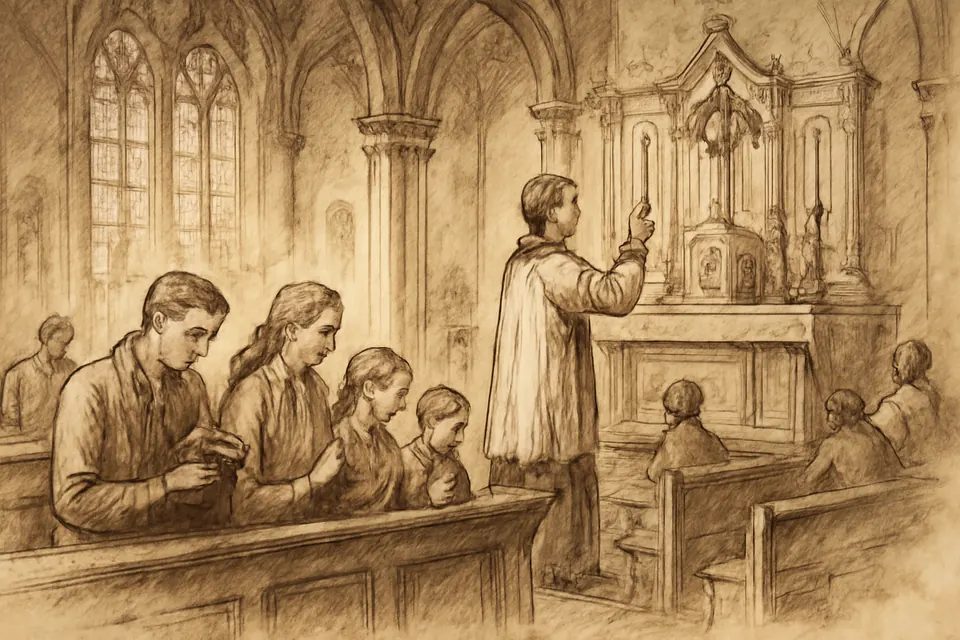
The classic Catholic prayer before Mass is the one the Missal gives to St. Ambrose, "O gracious Lord Jesus Christ, I, a sinner, nothing presuming on my own deserts," together with St. Thomas Aquinas's "Almighty, Everlasting God, lo, I draw near to the Sacrament of Thine Only-begotten Son." Both prepare us to receive Holy Communion worthily.
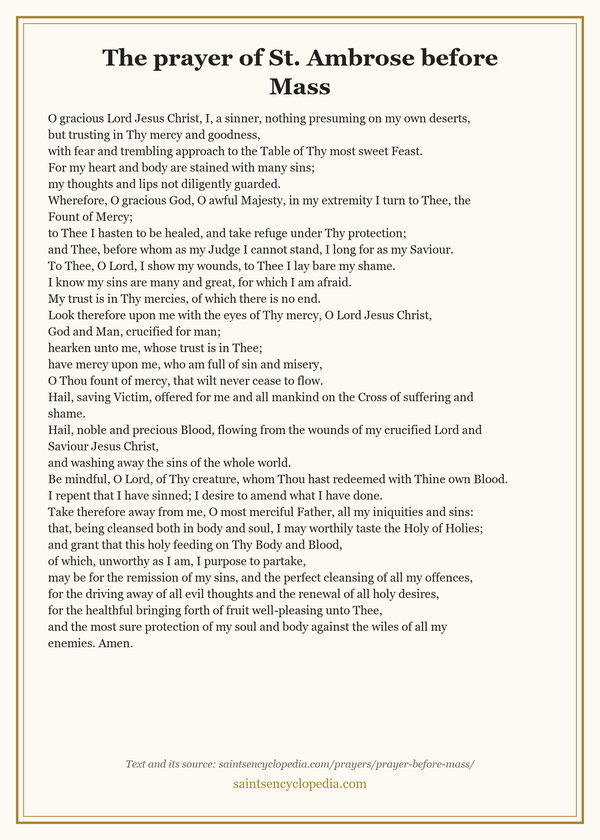 Free printable prayer card 5 × 7 inch PDF, ready to print, frame or tuck in a missal.
The few minutes before Mass begins can change the whole hour. The saints prepared for the Holy Sacrifice with care, and they left us their prayers. Two have been printed in missals and prayer books for centuries: the prayer that bears the name of St. Ambrose of Milan and the prayer of St. Thomas Aquinas. Both are below in full, in public-domain translations, followed by a short offering of the Mass for the start of the liturgy and a simple way to prepare.
The prayer of St. Ambrose before Mass
In Latin it begins Ad mensam dulcissimi convivii tui, pie Domine Iesu Christe, "To the table of thy most sweet banquet, O loving Lord Jesus Christ." The New Raccolta (1903) prints it as the "Prayer of S. Ambrose to Our Lord Jesus Christ." This is the English of the 1888 Manual of Prayers, prepared by order of the Third Plenary Council of Baltimore:
O gracious Lord Jesus Christ, I, a sinner, nothing presuming on my own deserts, but trusting in Thy mercy and goodness, with fear and trembling approach to the Table of Thy most sweet Feast. For my heart and body are stained with many sins; my thoughts and lips not diligently guarded. Wherefore, O gracious God, O awful Majesty, in my extremity I turn to Thee, the Fount of Mercy; to Thee I hasten to be healed, and take refuge under Thy protection; and Thee, before whom as my Judge I cannot stand, I long for as my Saviour. To Thee, O Lord, I show my wounds, to Thee I lay bare my shame. I know my sins are many and great, for which I am afraid. My trust is in Thy mercies, of which there is no end. Look therefore upon me with the eyes of Thy mercy, O Lord Jesus Christ, God and Man, crucified for man; hearken unto me, whose trust is in Thee; have mercy upon me, who am full of sin and misery, O Thou fount of mercy, that wilt never cease to flow. Hail, saving Victim, offered for me and all mankind on the Cross of suffering and shame. Hail, noble and precious Blood, flowing from the wounds of my crucified Lord and Saviour Jesus Christ, and washing away the sins of the whole world. Be mindful, O Lord, of Thy creature, whom Thou hast redeemed with Thine own Blood. I repent that I have sinned; I desire to amend what I have done. Take therefore away from me, O most merciful Father, all my iniquities and sins: that, being cleansed both in body and soul, I may worthily taste the Holy of Holies; and grant that this holy feeding on Thy Body and Blood, of which, unworthy as I am, I purpose to partake, may be for the remission of my sins, and the perfect cleansing of all my offences, for the driving away of all evil thoughts and the renewal of all holy desires, for the healthful bringing forth of fruit well-pleasing unto Thee, and the most sure protection of my soul and body against the wiles of all my enemies. Amen.
The prayer is honest. It does not pretend we are worthy; it names our sins and runs to the only one who can heal them. "Thee, before whom as my Judge I cannot stand, I long for as my Saviour" is a whole theology of grace in one line. And it turns at the center from fear to greeting: "Hail, saving Victim... Hail, noble and precious Blood."

Who wrote it?
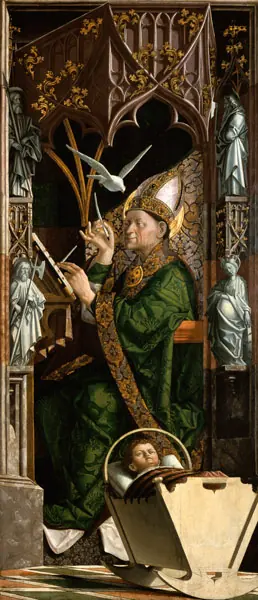
St. Ambrose, bishop of Milan from 374 to 397, was a great teacher of the Eucharist. His instructions to the newly baptized, On the Mysteries and On the Sacraments, are among the earliest Christian explanations of the Real Presence, and it was he who baptized St. Augustine. For that reason medieval copyists placed several prayers for the Mass under his name. The Missal and the Raccolta give this one to him, and the Church has prayed it as his for centuries.
Historians are more cautious about the authorship of these prayers. The long prayer of preparation for priests, the Summe Sacerdos et vere Pontifex, which the Missal divided into parts for each day of the week as "the prayers of St. Ambrose," is now generally credited to John of Fécamp, a Benedictine abbot in Normandy who died in 1079. The author of the Ad mensam is likewise uncertain. None of that changes the prayer. It has prepared bishops, priests and lay people for Communion for close to a thousand years.

The prayer of St. Thomas Aquinas before Mass
The Missal's second prayer of preparation is by St. Thomas Aquinas. The New Raccolta titles it "Prayer of S. Thomas Aquinas to the Eternal Father." The Latin begins Omnipotens sempiterne Deus, ecce accedo ad Sacramentum unigeniti Filii tui. The 1888 Manual of Prayers gives it as a prayer "to be said daily" before Communion:
Almighty, Everlasting God, lo, I draw near to the Sacrament of Thine Only-begotten Son, our Lord Jesus Christ. As sick, I approach to the Physician of Life; unclean, to the Fountain of Mercy; blind, to the Light of eternal Brightness; poor and needy, to the Lord of heaven and earth. I implore Thee, therefore, out of the abundance of Thy boundless mercy, that Thou wouldst vouchsafe to heal my sickness, to wash my defilements, to enlighten my blindness, to enrich my poverty, and to clothe my nakedness; that I may receive the Bread of Angels, the King of kings, the Lord of lords, with such reverence and humility, such contrition and devotion, such purity and faith, such purpose and intention, as is expedient for the health of my soul. Grant, I beseech Thee, that I may receive not only the Sacrament of the Body and Blood of the Lord, but also the whole grace and virtue of that Sacrament. O most merciful God, grant me so to receive the Body of Thine Only-begotten Son, our Lord Jesus Christ, which He took of the Virgin Mary, that I may be found worthy to be incorporated into His mystical Body, and accounted among His members. And, O most loving Father, grant that whom now I purpose to receive under a veil I may at last behold with unveiled face, even Thy beloved Son. Who with Thee and the Holy Ghost ever liveth and reigneth, one God, world without end. Amen.
This is a prayer for anyone who feels unworthy, which is all of us. We come as the sick come to a doctor, the poor to a king. Thomas asks for more than the sacrament itself: he asks for its "whole grace and virtue," to be made a living member of the Body of Christ. And he ends where every Communion points, to the day we will see without the veil the One we now receive under the appearance of bread.

St. Thomas's prayer for after Mass, Gratias tibi ago, is on our page of prayers after Communion.
A prayer at the beginning of Mass
The old prayer books gave lay people a prayer to say as the priest begins Mass, offering the Sacrifice for its four ends: adoration, remembrance of the Passion, thanksgiving, and pardon and every grace. This one is from the 1888 Manual of Prayers:
O Almighty Lord of Heaven and earth, behold I, a wretched sinner, presume to appear before Thee this day, to offer up unto Thee, by the hands of our High-Priest, Jesus Christ, Thy Son, the Sacrifice of His Body and Blood, in union with that Sacrifice which He offered to Thee upon the Cross: first, for Thine own honor, praise, adoration, and glory; secondly, in remembrance of His Passion and Death; thirdly, in thanksgiving for all Thy blessings bestowed upon Thy whole Church, whether triumphant in heaven or militant on earth, and especially for those bestowed upon me, the most unworthy of all; fourthly, for obtaining pardon and remission of all my sins, and of those of all others, whether living or dead, for whom I ought to pray (here mention their names); and, lastly, for obtaining all graces and blessings both for myself and for Thy whole Church (here mention your particular requests). Oh, be Thou pleased to assist me by Thy grace, that I may behave myself this day as I ought to do in Thy divine Presence, and that I may so commemorate the Passion and Death of Thy Son as to partake most plentifully of the fruits thereof. Through the same Jesus Christ, our Lord. Amen.
The same book begins its devotions for Mass with the invocation of the Holy Spirit:
Come, Holy Ghost, fill the hearts of Thy faithful, and kindle in them the fire of Thy love. V. Send forth Thy Spirit, and they shall be created. R. And Thou shalt renew the face of the earth.

The Morning Offering
On weekdays many of us come to Mass straight from home, and the day's first prayer is the Morning Offering, which offers "my prayers, works and sufferings of this day" to the Sacred Heart "in union with the Holy Sacrifice of the Mass throughout the world". It is a natural prayer to make again in the pew, since the Mass is the very sacrifice the offering joins.
How to prepare for Mass
The prayers are the heart of it, but the old catechisms also taught a few simple habits.
- Keep the Eucharistic fast. The Church asks us to abstain from food and drink, except water and medicine, for at least one hour before receiving Holy Communion (Code of Canon Law, canon 919). The elderly, the sick and their caregivers are excused.
- Examine your conscience. Anyone aware of serious sin goes to confession before receiving. Our examination of conscience walks through the commandments.
- Come a few minutes early. Bless yourself with holy water, genuflect to the tabernacle, and kneel.
- Pray one of the prayers above slowly, and name your intentions: who and what you are bringing to the altar today.
- Read the day's readings if you can, so the Word of God is already in your mind when it is proclaimed.
- Keep the silence of the church. Others are praying too.

Prayers before Mass for priests
The traditional Missal contained a whole Praeparatio ad Missam for the priest: the antiphon Ne reminiscaris with Psalms 83, 84, 85, 115 and 129, versicles and collects, the prayers of St. Ambrose for each day of the week, the prayer of St. Thomas Aquinas, the Ad mensam, a prayer asking all the angels and saints to intercede that the priest may offer the Sacrifice worthily, and a prayer to the saint whose Mass is said. The 1910 English Raccolta lists every one of these as indulgenced. Priests still pray them, and lay people have always been free to borrow them.
Related prayers and saints
- Prayer after Communion: St. Thomas Aquinas's thanksgiving, St. Bonaventure's Transfige and the En ego.
- The Anima Christi and the act of spiritual communion.
- Acts of faith, hope and love, the oldest catechism prayers of preparation.
- St. Ambrose, feast December 7, and St. Thomas Aquinas, feast January 28.
- St. Tarcisius, patron of altar servers and first communicants.
Lord, make us worthy to come to your altar. St. Ambrose and St. Thomas, pray for us.
Frequently asked questions
What prayer do you say before Mass?
Any prayer that turns the heart to God is good, but the Church's tradition gives two classic prayers before Mass and Communion: the prayer the Missal attributes to St. Ambrose, Ad mensam dulcissimi convivii ("to the table of thy most sweet feast"), and St. Thomas Aquinas's Omnipotens sempiterne Deus, ecce accedo. Both are printed in full above.
Did St. Ambrose write the prayer before Mass?
The Missal and the Raccolta give it his name, and that is the name the Church has prayed it under for centuries. Its true author is not known for certain. The longer companion prayer, Summe Sacerdos, also once credited to Ambrose, is now usually attributed by scholars to John of Fécamp, an 11th-century Benedictine abbot.
How early should you arrive before Mass?
The Church sets no rule. Coming five or ten minutes early gives time to bless yourself with holy water, genuflect to the tabernacle, kneel and say one of the prayers on this page, and read the day's Scripture readings. The church before Mass is a place of prayer, so we keep our conversation for afterward.
How long do you have to fast before Communion?
One hour. The Code of Canon Law (canon 919) says that a person who is to receive the Eucharist abstains "for at least one hour before holy communion from any food and drink, except for only water and medicine." The elderly, the sick and those who care for them are excused from the fast.
What should I pray for at Mass?
The old prayer books teach the four ends of the Mass: adoration of God, thanksgiving, atonement for sin, and petition for our needs and the whole Church. Before Mass begins, bring your own intentions too: the people you love, the sick, the dead, and whatever you are carrying that day.
Is there a prayer before Mass for priests?
Yes. The Missal has long contained a Praeparatio ad Missam for priests, with psalms, the prayers of St. Ambrose for each day of the week (the Summe Sacerdos), St. Thomas Aquinas's prayer, a prayer to all the angels and saints, and a formula of intention beginning Ego volo celebrare Missam. Lay people can pray the same prayers, as the old prayer books encouraged.
Sources
- A Manual of Prayers for the Use of the Catholic Laity, prepared by order of the Third Plenary Council of Baltimore (1888), Prayers before Mass (pp. 89–91) and Devotions for Holy Communion (pp. 311–319), Internet Archive
- The New Raccolta (Philadelphia: Peter F. Cunningham & Son, 1903), Prayers to be said by priests before Mass: the prayers of St. Ambrose and St. Thomas Aquinas in Latin, Internet Archive
- The Raccolta (London: Burns & Oates, 1910), table of indulgenced prayers in preparation for Mass and in thanksgiving, p. 403, Internet Archive
- Les Enluminures, TM 1370: Augustinian prayerbook and manual, with the Summe Sacerdos attributed to St. Ambrose (manuscript description). On the modern attribution of the Summe Sacerdos to John of Fécamp
- Code of Canon Law (1983), Book IV, canon 919 on the Eucharistic fast