Acts of faith, hope and love

The Act of Faith, the Act of Hope and the Act of Love (also called the Act of Charity) are short Catholic prayers that put the three theological virtues into words. The Baltimore Catechism taught every child to know them by heart, and the Church still grants a partial indulgence for making them.
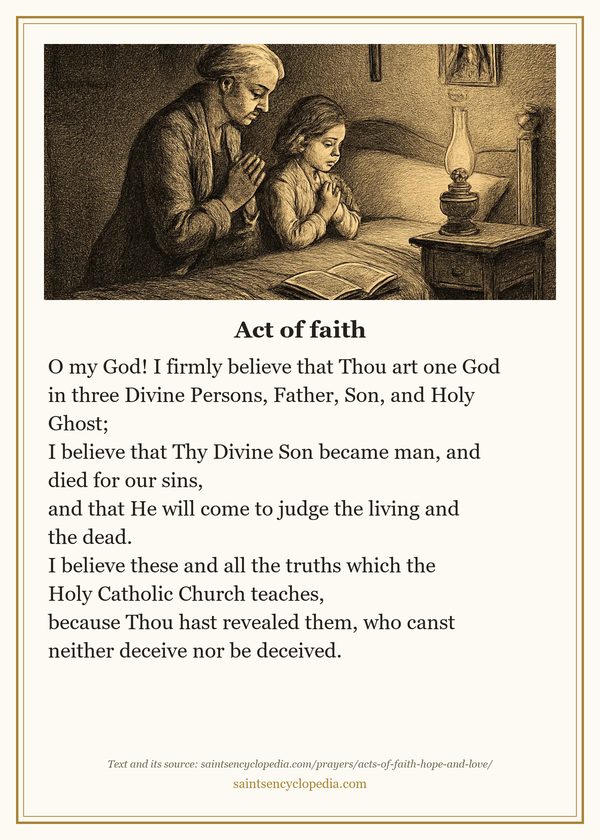 Free printable prayer card 5 × 7 inch PDF, ready to print, frame or tuck in a missal.
Three short prayers have been on the lips of Catholic children for centuries: the Act of Faith, the Act of Hope and the Act of Love. They are the first prayers after the Our Father, Hail Mary and Creed that many of us ever memorized, and they are worth coming back to as adults. Each one takes a theological virtue, a gift God gave us at baptism, and turns it into a deliberate act of the will. Here they are as the Baltimore Catechism printed them, with their history and how to pray them.
The Act of Faith, Act of Hope and Act of Love
These are the texts of A Catechism of Christian Doctrine No. 2, the Baltimore Catechism approved in 1885 by order of the Third Plenary Council of Baltimore, the catechism from which generations of American Catholics learned their faith.
Act of faith
O my God! I firmly believe that Thou art one God in three Divine Persons, Father, Son, and Holy Ghost; I believe that Thy Divine Son became man, and died for our sins, and that He will come to judge the living and the dead. I believe these and all the truths which the Holy Catholic Church teaches, because Thou hast revealed them, who canst neither deceive nor be deceived.
The Act of Faith names the two great mysteries at the center of the faith, the Holy Trinity and the Incarnation, and then accepts everything else God has revealed. Its last line gives the reason we believe: not because the doctrine seems reasonable to us, though it is never against reason, but because God himself has spoken, and he "canst neither deceive nor be deceived."
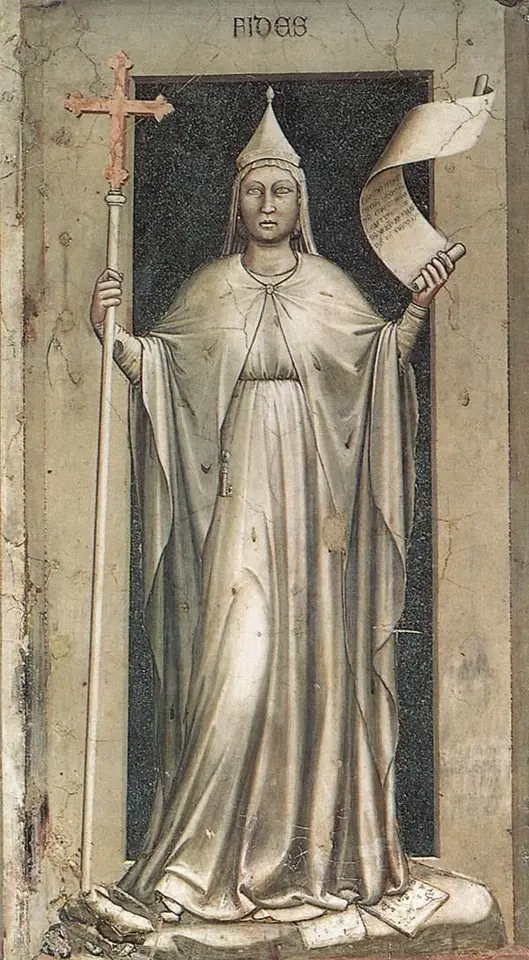
Act of hope
O my God! relying on Thy infinite goodness and promises, I hope to obtain pardon of my sins, the help of Thy grace, and life everlasting, through the merits of Jesus Christ, my Lord and Redeemer.
Hope is not optimism. It is a sure trust that God will give us heaven and everything we need to reach it. The Act of Hope asks for three things in order: forgiveness, grace for the road, and eternal life. It rests them on two foundations, God's goodness and his promises, and on one Mediator, Jesus Christ. Later printings, such as Father Thomas Kinkead's Explanation of the Baltimore Catechism, read "relying on Thy almighty power and infinite goodness and promises," adding God's power to the reasons we hope.
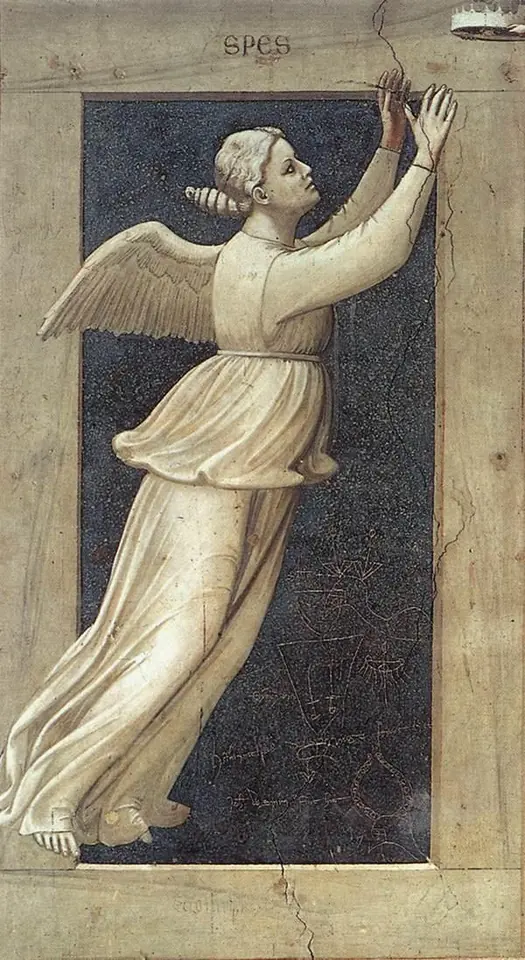
Act of love
O my God! I love Thee above all things, with my whole heart and soul, because Thou art all-good and worthy of all love. I love my neighbor as myself for the love of Thee. I forgive all who have injured me, and ask pardon of all whom I have injured.
The Act of Love is the two great commandments in prayer form (Matthew 22:37-39). It ends with a line that is easy to say and hard to mean: "I forgive all who have injured me." Said honestly, it is a daily examination of conscience in one sentence.
Act of charity
The Act of Love and the Act of Charity are the same prayer. The Baltimore Catechism No. 3 (1891) asks the question directly:
Q. 103. Do an "Act of Love" and an "Act of Charity" mean the same thing? A. An "Act of Love" and "Act of Charity" do mean the same thing, because Charity means love, or it means an act of kindness that comes from love.
Charity, in the Church's language, is the theological virtue "by which we love God above all things for His own sake, and our neighbor as ourselves for the love of God" (Q. 467). Many prayer books title the prayer "Act of Charity," others "Act of Love." Both are correct.
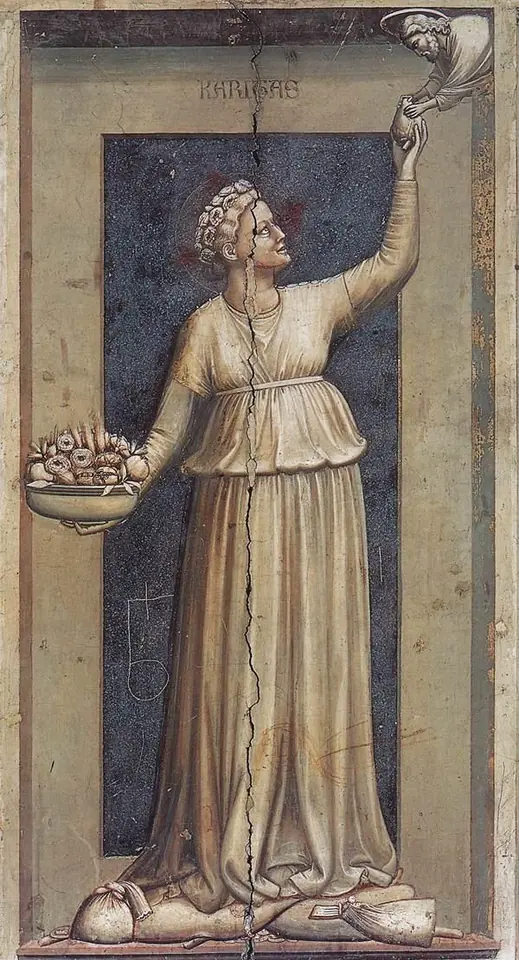
What the three acts mean
Faith, hope and charity are the three theological virtues; how they stand with the four cardinal virtues is explained on our page on the seven virtues.
Faith, hope and charity are the theological virtues, so called because they have God himself for their object. The Baltimore Catechism No. 3 explains that they are "infused; that is, poured into our souls, because they are strictly gifts of God and do not depend upon our efforts to obtain them." They come to us at baptism. A virtue, though, is a habit, and a habit grows by acting on it. That is what these prayers do: they take the gift and use it.
St. Paul named the three together: "And now there remain faith, hope, and charity, these three: but the greater of these is charity" (1 Corinthians 13:13, Douay-Rheims). Faith and hope belong to this life; in heaven we will see and possess God, and only charity will remain.
The Catechism of the Catholic Church ties the three acts to the First Commandment: "The acts of faith, hope, and charity enjoined by the first commandment are accomplished in prayer" (no. 2098). To believe in God, hope in him and love him above all things is simply what it means to have no other gods before him.

The history of the acts
The older Raccolta versions
The acts as we know them grew out of the catechisms and prayer books of the 17th and 18th centuries. The Roman versions, translated in the 1878 English Raccolta, are longer and lay out the motive of each virtue explicitly. The Act of Faith there begins:
I most firmly believe, because God, who is the infallible truth, hath so revealed to the holy Catholic Church, and through the Church to us, that there is one only God in three divine persons, equal and distinct, Father, Son, and Holy Ghost...
The Act of Charity in the same book is short and strong:
My God, because thou art the highest and most perfect good, I love thee with my whole heart, and above all things; and, rather than offend thee, I am ready to lose all things else; and for thy love I love and desire to love my neighbor as myself.
The indulgence of Benedict XIII and Benedict XIV
Pope Benedict XIII attached an indulgence to these acts on January 15, 1728. His successor Benedict XIV, the great canonist, confirmed and extended it by a decree of the Sacred Congregation of Indulgences on January 28, 1756. The Raccolta explains why: Benedict XIV considered it "not only useful, but also truly necessary, for the eternal salvation of Christians, that they should make frequent acts of the theological virtues." He granted a plenary indulgence once a month to those who made the acts daily, a plenary indulgence at the hour of death, and a partial indulgence every time they were said "with heartfelt devotion."
He also made a declaration that explains why the acts appear in so many versions. To gain the indulgence, he said, "it is not necessary to make use of any set form of words," and anyone may use any expressions he pleases, "provided it expresses and explains the particular motive of each of the three theological virtues."
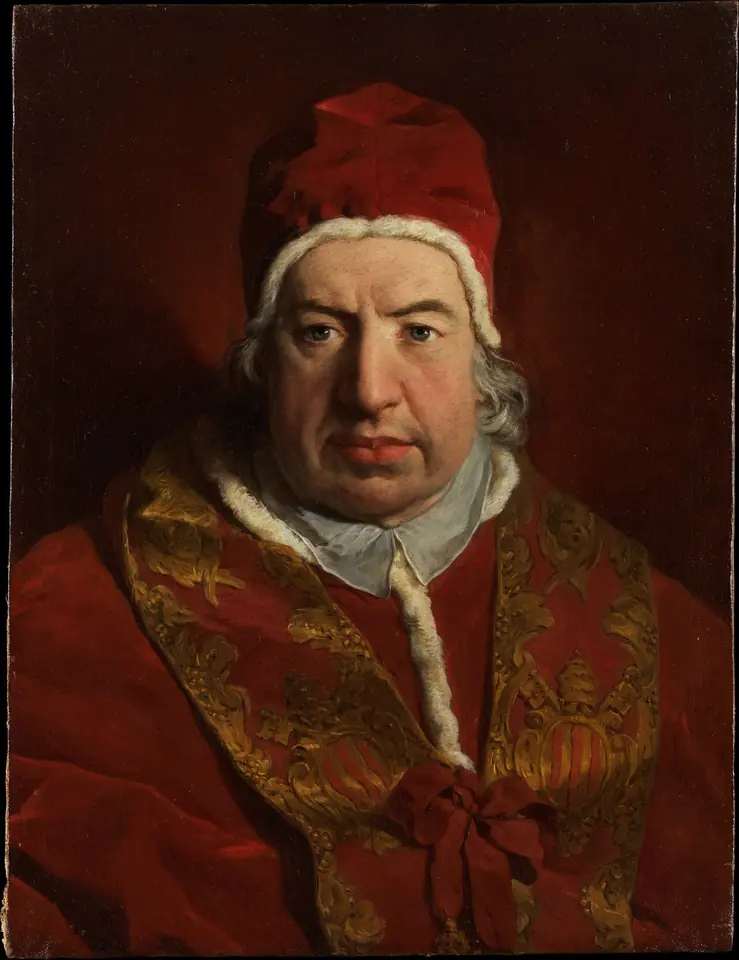
The acts in the Baltimore Catechism
When the bishops of the United States commissioned the Baltimore Catechism in 1884, they put the acts in its list of prayers every Catholic should know, between the Confiteor and the Act of Contrition. Question 1112 of the Baltimore Catechism No. 3 names "the Acts of Faith, Hope, Love, and Contrition" among "the prayers most recommended to us." Generations of children recited them in parish classrooms. Modern prayer books often print the same texts with "you" in place of "Thou"; the prayers are otherwise unchanged.

The indulgence today
When Pope Paul VI reformed indulgences in 1967, the old counts of days and years were dropped. The current Enchiridion Indulgentiarum (2004), under concession 28, "Profession of faith and acts of the theological virtues," grants a partial indulgence to the faithful who devoutly make acts of faith, hope and charity quavis legitima formula, in any legitimate formula. Benedict XIV's principle still holds: the words may vary, as long as the prayer truly expresses the virtue. See indulgences for what an indulgence is and how one is gained.
When to pray the acts of faith, hope and love
The Baltimore Catechism No. 3 teaches that "we are bound from time to time during our lives to make Acts of Faith, Hope and Love; otherwise we risk our salvation." In practice, Catholic tradition has woven them into the day:
- Morning and evening prayers. Old prayer books place them right after the Creed, so the day begins and ends with an explicit act of faith, hope and love. Pair them with the Morning Offering and night prayer.
- Before and after Holy Communion. The Baltimore Catechism teaches that to receive Communion fruitfully we "should make acts of lively faith, of firm hope and ardent love." See prayer before Mass and prayer after Communion.
- With the Act of Contrition after an examination of conscience and before confession; our page on prayer for forgiveness prints the traditional text.
- In temptation and doubt. When faith feels weak, the simplest remedy the saints gave was to make an act of faith anyway.
- At the bedside of the dying. The old indulgence at the hour of death made these acts a standard part of prayer for the dying.
Teach them to children the way the catechism did: one act each night until all three are known by heart. Let us make them now: O my God, I believe in you, I hope in you, I love you above all things.
Frequently asked questions
What is the Act of Faith prayer?
In the Baltimore Catechism it reads: "O my God! I firmly believe that Thou art one God in three Divine Persons, Father, Son, and Holy Ghost; I believe that Thy Divine Son became man, and died for our sins, and that He will come to judge the living and the dead. I believe these and all the truths which the Holy Catholic Church teaches, because Thou hast revealed them, who canst neither deceive nor be deceived."
Is the Act of Love the same as the Act of Charity?
Yes. The Baltimore Catechism No. 3 asks this very question and answers that an Act of Love and an Act of Charity "do mean the same thing, because Charity means love." Charity is the theological virtue by which we love God above all things for his own sake, and our neighbor as ourselves for the love of God.
Why are there different versions of the Act of Faith?
Because any wording that expresses the virtue is valid. The Baltimore Catechism explains that some acts state more fully than others what God has revealed. Pope Benedict XIV declared in 1756 that no set form of words is required, provided the prayer expresses the motive of each virtue.
When should Catholics say the acts of faith, hope and love?
Traditionally every morning and evening, before and after Holy Communion, in times of temptation, and at the hour of death. The Baltimore Catechism teaches that we are bound to make them "from time to time during our lives," and the Catechism of the Catholic Church says these acts, enjoined by the First Commandment, are accomplished in prayer.
Is there an indulgence for the acts of faith, hope and charity?
Yes. The current Enchiridion Indulgentiarum (2004), concession 28, grants a partial indulgence to the faithful who devoutly make acts of faith, hope and charity in any legitimately approved formula. The older plenary and day-count indulgences of Benedict XIII and Benedict XIV were replaced by this simpler grant after 1967.
What are the three theological virtues?
Faith, hope and charity. They are called theological because they have God as their object, and infused because God pours them into the soul at baptism; we cannot acquire them by our own effort. St. Paul names them together: "And now there remain faith, hope, and charity, these three: but the greater of these is charity" (1 Corinthians 13:13).
Sources
- A Catechism of Christian Doctrine No. 2 (the Baltimore Catechism, 1885), Prayers: Act of Faith, Act of Hope, Act of Love, Project Gutenberg
- A Catechism of Christian Doctrine No. 3 (Baltimore Catechism, 1891), Q. 94–105 and 466–471, Project Gutenberg
- Thomas L. Kinkead, An Explanation of the Baltimore Catechism of Christian Doctrine, Project Gutenberg
- The Raccolta, or Collection of Prayers and Good Works (Woodstock College, 1878), no. 10, Acts of the Theological Virtues, pp. 15–17, Internet Archive
- Apostolic Penitentiary, Enchiridion Indulgentiarum, 4th edition (2004), concession 28
- Catechism of the Catholic Church, nos. 2095–2098: the First Commandment and prayer