Order of the Mass
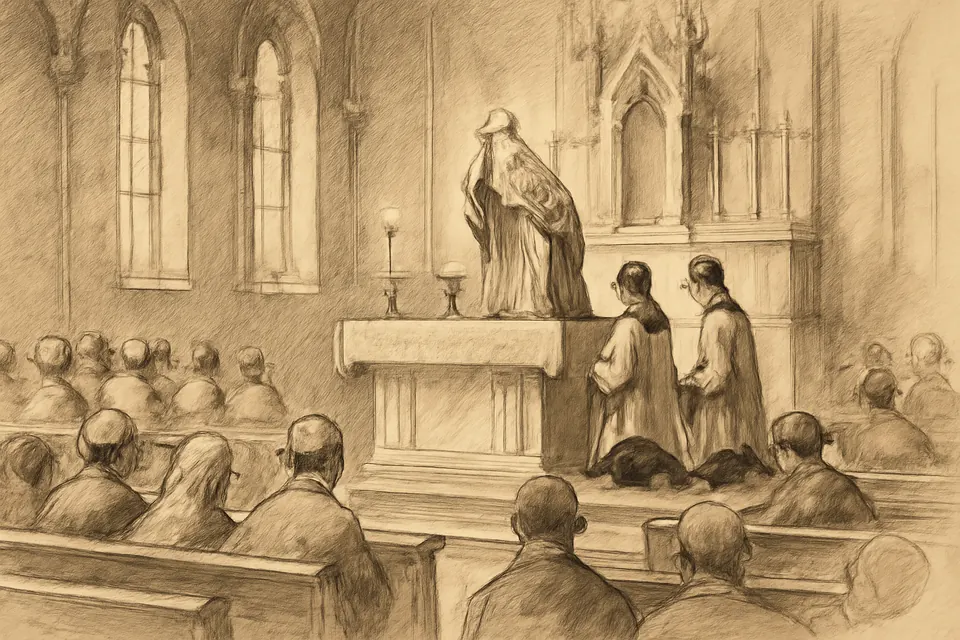
The order of the Mass has four parts: the Introductory Rites (Entrance, greeting, Penitential Act, Kyrie, Gloria, Collect), the Liturgy of the Word (readings, Psalm, Gospel, homily, Creed, Universal Prayer), the Liturgy of the Eucharist (Preparation of the Gifts, Eucharistic Prayer, Communion Rite) and the Concluding Rites (blessing and dismissal).
The order of the Mass is the shape of the Church's greatest prayer: the same sequence of words and actions in every Catholic parish in the world, whether the Mass is said in English, Spanish, Tagalog or Latin. Once you know the order, the Mass stops being something that happens in front of you and becomes something you pray. This guide walks through every part of the Mass in order, from the Entrance to the dismissal, with what each part means, where it comes from, what we say or do, and when we sit, stand and kneel.
A word about the texts. The English words we hear at Mass come from the Roman Missal translation approved in 2011, which is under copyright, so this page describes each part and quotes only a few words. Where it helps we give the Latin of the Roman Missal, which belongs to the whole Church, and the Scripture behind each prayer from the Douay-Rheims Bible.
The order of the Mass at a glance
Introductory Rites
- Entrance chant and procession; the priest reverences the altar
- Sign of the Cross and greeting
- Penitential Act (or, on some Sundays, the sprinkling with holy water)
- Kyrie, Lord, have mercy
- Gloria (Sundays outside Advent and Lent, solemnities and feasts)
- Collect, the opening prayer
Liturgy of the Word
- First Reading
- Responsorial Psalm
- Second Reading (Sundays and solemnities)
- Gospel Acclamation, the Alleluia
- Gospel
- Homily
- Profession of Faith, the Creed (Sundays and solemnities)
- Universal Prayer, or Prayer of the Faithful
Liturgy of the Eucharist
- Preparation of the Gifts and the altar (the Offertory)
- Prayer over the Offerings
- Eucharistic Prayer: Preface dialogue, Preface, Holy, Holy, Holy, epiclesis, the consecration, the Mystery of Faith, the offering and intercessions, and the final doxology with the Great Amen
- Communion Rite: the Lord's Prayer, the Sign of Peace, the Lamb of God and the breaking of the Host, Holy Communion, silence, the Prayer after Communion
Concluding Rites
- Announcements, if any
- Greeting and final blessing
- Dismissal
- The priest kisses the altar, and the procession goes out
The General Instruction of the Roman Missal, the Church's rulebook for the Mass, sums it up in one sentence: "The Mass is made up, as it were, of two parts: the Liturgy of the Word and the Liturgy of the Eucharist," so closely joined "that they form but one single act of worship," with rites that open and close it (no. 28).
Before Mass begins
The Mass starts before the first note of the entrance hymn. We bless ourselves with holy water at the door, a reminder of our Baptism, and genuflect toward the tabernacle before entering the pew. The minutes before Mass are for prayer, not conversation. Many Catholics use the classic prayer before Mass of St. Ambrose or St. Thomas Aquinas, or simply read the day's Scripture readings. Anyone who will receive Communion keeps the one-hour fast from food and drink (water and medicine excepted).
The Introductory Rites
The opening rites have "the character of a beginning, introduction, and preparation," says the General Instruction (no. 46). Their purpose is to make a crowd of separate people into one praying assembly, ready to hear God's word.
Entrance and veneration of the altar
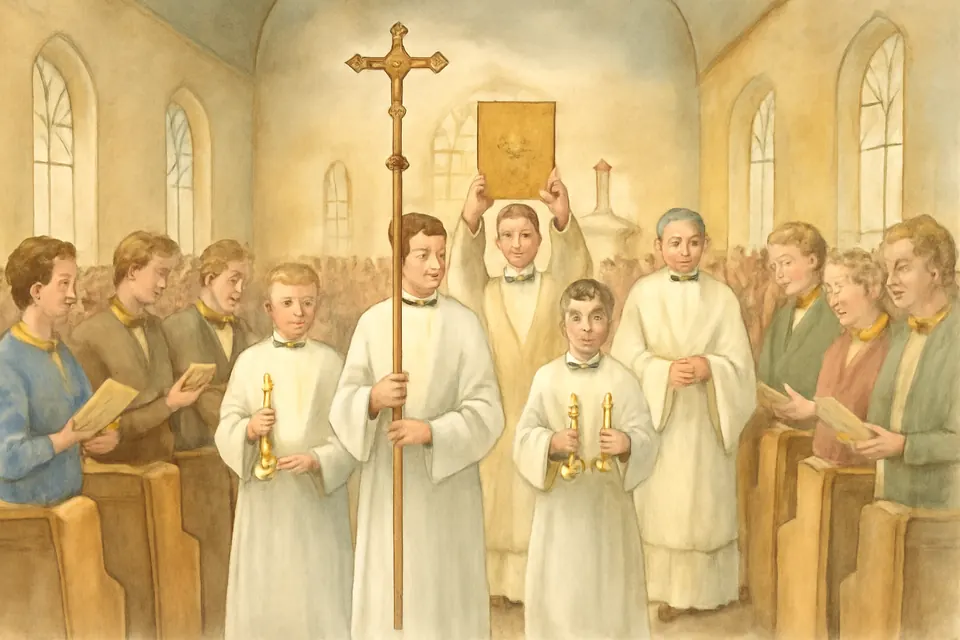
We stand as the Entrance chant begins. In Latin this chant is the Introit, a short antiphon and Psalm verse proper to each day, and many parishes now sing a hymn in its place. The procession comes up the aisle: a server with the cross, servers with candles, the deacon or a lector carrying the Book of the Gospels, and the priest last. On solemn days a server leads with the thurible, trailing incense.
At the altar the priest and deacon bow and kiss the altar. The altar is Christ, the stone on which his sacrifice is offered, and in most churches it holds relics of martyrs, so the kiss greets both the Lord and his saints. On solemn days the priest then incenses the cross and the altar.
The Sign of the Cross and the greeting
Mass begins as every Catholic prayer begins: In nomine Patris, et Filii, et Spiritus Sancti, "In the name of the Father, and of the Son, and of the Holy Spirit," and we answer Amen. Then the priest greets us. The simplest greeting is the oldest: Dominus vobiscum, "The Lord be with you." Boaz used the same words to greet his reapers in the fields of Bethlehem: "The Lord be with you. And they answered him: The Lord bless thee" (Ruth 2:4, Douay-Rheims). We reply Et cum spiritu tuo, "And with your spirit," a phrase from St. Paul's letters that honors the grace of ordination in the priest.
The Penitential Act
Before we hear God's word and approach his altar, we admit our need of mercy. The priest invites us to recall our sins, a brief silence follows, and we confess together, most often with the Confiteor (I confess to almighty God and to you, my brothers and sisters...), striking our breast at the words "through my fault." The rite ends with the priest's prayer for God's forgiveness. The General Instruction is careful to say that this absolution "lacks the efficacy of the Sacrament of Penance" (no. 51): it forgives venial sins through the prayer of the Church, but anyone in mortal sin needs Confession before Communion.
On Sundays, especially in Easter time, the priest may instead bless water and sprinkle the people with it, recalling our Baptism. In the older form of the Mass this is the Asperges, sung with the words of Psalm 50:9: Asperges me, Domine, hyssopo, et mundabor, "Thou shalt sprinkle me with hyssop, O Lord, and I shall be cleansed."
Kyrie eleison
Kyrie, eleison. Christe, eleison. Kyrie, eleison. "Lord, have mercy. Christ, have mercy. Lord, have mercy." These are the only Greek words left in the Roman Mass, a memory of the centuries when the Church of Rome prayed in Greek. The Kyrie is both a cry for mercy and an acclamation of Christ as Lord, which is why it may be sung even when the Confiteor has been said.
Gloria
On Sundays outside Advent and Lent, and on solemnities and feasts, the Church bursts into the Gloria, which the Missal calls "a very ancient and venerable hymn" (no. 53). It begins with the song of the angels over Bethlehem: "Glory to God in the highest; and on earth peace to men of good will" (Luke 2:14, Douay-Rheims), in Latin Gloria in excelsis Deo, et in terra pax hominibus bonae voluntatis. Its silence through Advent and Lent makes its return at Christmas and the Easter Vigil all the more joyful. (See our pages on Advent and Lent.)
The Collect
"Let us pray," says the priest, and then he pauses. That silence matters: it gives each of us time to bring our own intentions before God. The priest then "collects" them into one prayer, which is why it is called the Collect. It changes with each day and feast, is addressed to the Father, and ends with the long Trinitarian conclusion, in Latin Per Dominum nostrum Iesum Christum Filium tuum, qui tecum vivit et regnat in unitate Spiritus Sancti, Deus, per omnia saecula saeculorum. Our Amen makes it ours. Then we sit.
The Liturgy of the Word
"When the Sacred Scriptures are read in the Church, God himself speaks to his people, and Christ, present in his own word, proclaims the Gospel" (General Instruction, no. 29). We sit and listen, not to a lecture about God but to God himself.
First Reading, Psalm and Second Reading
On Sundays the First Reading usually comes from the Old Testament (from the Acts of the Apostles in Easter time) and is chosen to echo the Gospel. The reader ends, "The word of the Lord," and we answer, "Thanks be to God," in Latin Verbum Domini. Deo gratias.
The Responsorial Psalm follows, ideally sung, with the people repeating a short refrain between the verses. It is not a filler song. It is the inspired word of God turned into our prayer, the same Psalms Christ himself prayed.
On Sundays and solemnities a Second Reading follows, from the letters of the Apostles or the Book of Revelation. Sunday readings run on a three-year cycle (Years A, B and C, following Matthew, Mark and Luke), so a faithful Sunday Mass-goer hears most of the Bible's great passages every three years. Weekdays have their own two-year cycle with one reading before the Gospel.
The Gospel
We stand for the Gospel, because now Christ himself speaks. The Alleluia greets him, Hebrew for "praise the Lord." During Lent the Alleluia falls silent and another acclamation takes its place. The deacon (or the priest) announces the Gospel, and we trace three small crosses with the thumb, on the forehead, the lips and the heart, asking that the word be in our minds, on our lips and in our hearts. On solemn days candles flank the book and it is incensed. At the end the reader kisses the book, saying quietly in Latin Per evangelica dicta deleantur nostra delicta, "Through the words of the Gospel may our sins be wiped away."

The homily
The homily is not a speech on any subject the preacher likes. It explains the readings and the prayers of the day and applies them to our lives. It is required at Sunday and holy day Masses and given only by a priest or deacon.
The Profession of Faith
On Sundays and solemnities we stand and profess the faith in the Nicene Creed, Credo in unum Deum, the creed of the councils of Nicaea (325) and Constantinople (381). At the words about the Incarnation, et incarnatus est, everyone bows; on Christmas and the Annunciation we kneel. In Lent and Easter time, and at Masses with children, the Apostles' Creed may be used instead.
The Universal Prayer
The Liturgy of the Word ends with the Universal Prayer, or Prayer of the Faithful. Having been fed by the word, we pray for the needs of the Church, for public authorities and the salvation of the world, for those in any trouble, and for the local community, including the sick and the dead. Each petition ends with a response such as "Lord, hear our prayer." St. Justin described this moment in the year 155: after the homily "we all rise together and pray."
The Liturgy of the Eucharist
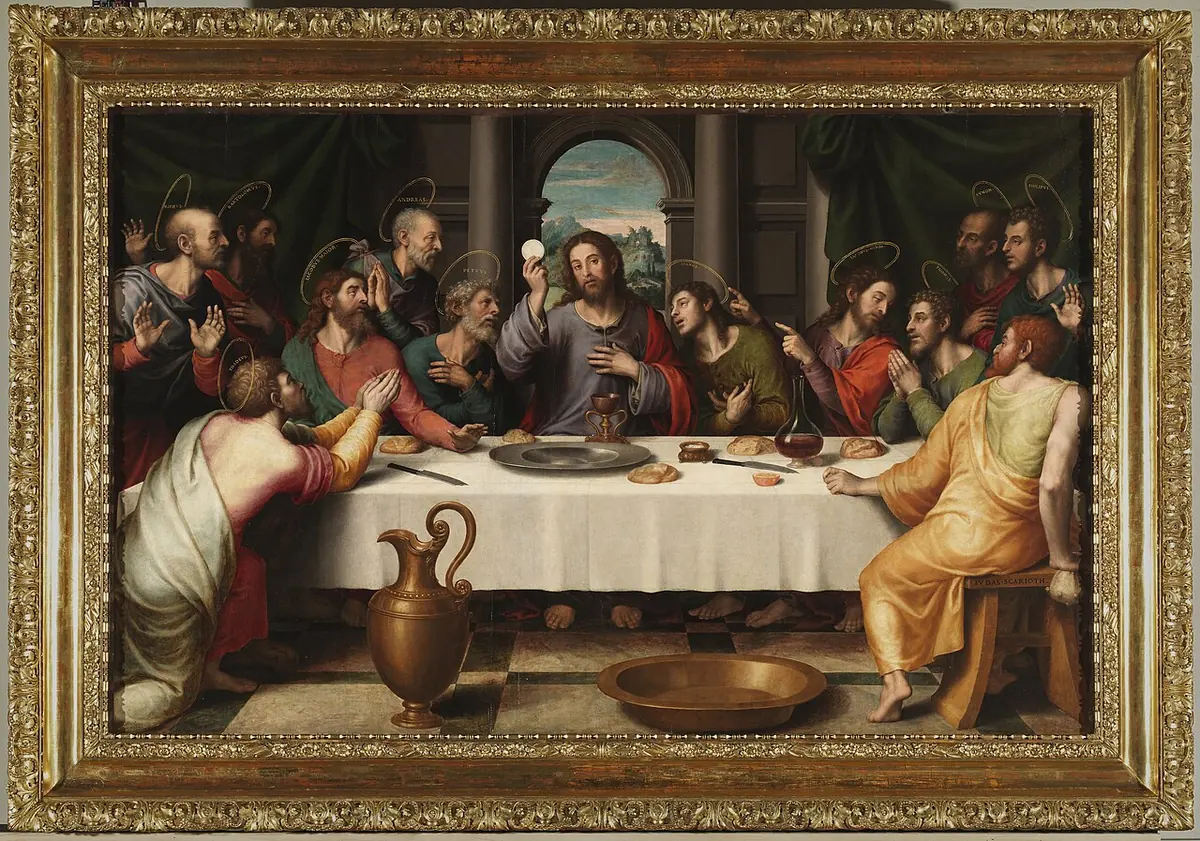
Now the Mass moves from the ambo to the altar. The General Instruction explains that the Church has arranged this whole part of the Mass to match exactly what Christ did at the Last Supper: he took the bread and the cup, gave thanks, broke the bread, and gave it to his disciples (no. 72). So the gifts are brought to the altar (he took), the Eucharistic Prayer is prayed (he gave thanks), the Host is broken (he broke), and we receive Communion (he gave).
Preparation of the Gifts (the Offertory)
We sit. The altar is prepared with the corporal (a square linen cloth), the purificator, the chalice and the Missal. While the collection is taken, members of the parish bring the bread and wine up the aisle, together with the gifts for the poor and the Church. The bread and wine are "the same elements that Christ took into his hands" (no. 72).
The priest raises the paten with the bread and then the chalice, saying prayers of blessing drawn from Jewish table blessings; if no hymn is sung we answer, "Blessed be God for ever." Before the wine is offered, the deacon or priest adds a few drops of water to it, praying quietly that we may share in the divinity of Christ, who humbled himself to share in our humanity. On solemn days the gifts, the cross, the altar, the priest and the people are incensed.
Then the priest washes his hands at the side of the altar, the Lavabo, praying in words from Psalm 50 for inner cleansing; the older Mass used Psalm 25, "I will wash my hands among the innocent" (Psalm 25:6, Douay-Rheims). He turns to us and says, Orate, fratres, "Pray, brethren," asking that his sacrifice and ours be acceptable to the Father, and we stand to answer that the Lord may accept it for his glory and our good. He prays the Prayer over the Offerings, which changes daily.
The Eucharistic Prayer
Now begins what the Missal calls "the center and summit of the entire celebration" (no. 78). The Eucharistic Prayer is one long prayer of thanksgiving and consecration, spoken by the priest alone in the name of us all, and we join it by listening with reverence and by our sung acclamations.
The Preface dialogue is among the oldest words in the Mass, found already in the third-century Apostolic Tradition attributed to St. Hippolytus: Dominus vobiscum. Et cum spiritu tuo. Sursum corda. "Lift up your hearts." Habemus ad Dominum. "We lift them up to the Lord." Gratias agamus Domino Deo nostro. "Let us give thanks to the Lord our God." The word Eucharist means thanksgiving.
The Preface follows, a hymn of thanks that changes with the season and feast, and ends by joining our voices to the angels.
Holy, Holy, Holy (the Sanctus) is that song of the angels. Its first half is the seraphim's cry in Isaiah's vision: "Holy, holy, holy, the Lord God of hosts, all the earth is full of his glory" (Isaiah 6:3, Douay-Rheims). Its second half is the crowd's welcome to Christ on Palm Sunday: "Hosanna to the son of David: Blessed is he that cometh in the name of the Lord: Hosanna in the highest" (Matthew 21:9). In the United States we kneel after it until the Great Amen (General Instruction, no. 43).
The epiclesis. The priest holds his hands over the bread and wine and calls down the Holy Spirit so that they may become the Body and Blood of Christ. A server often rings a bell here, to tell us the consecration is near.
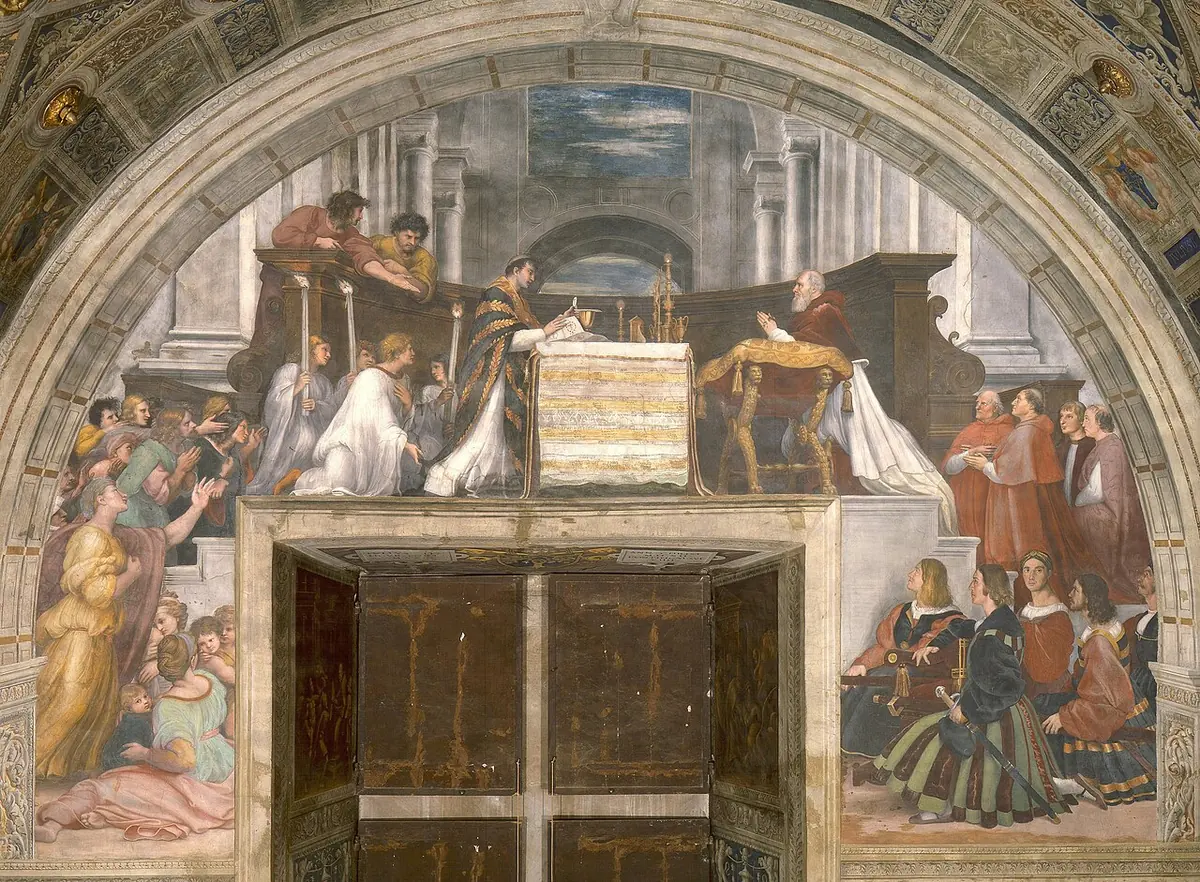
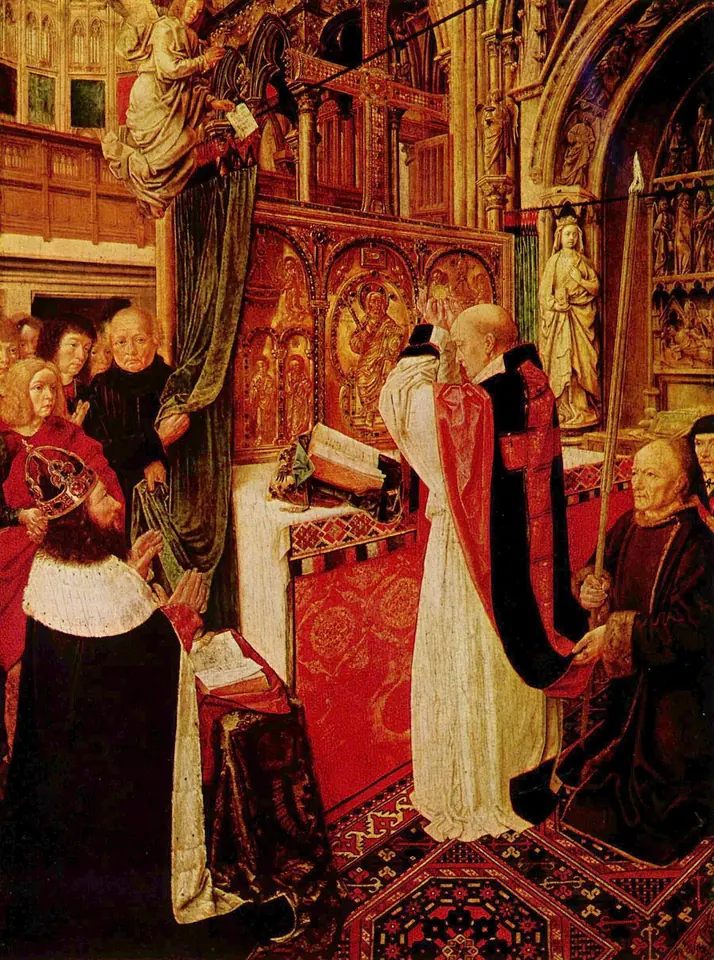
The institution narrative and consecration. The priest takes the bread and speaks Christ's own words from the Last Supper: "This is my body, which is given for you. Do this for a commemoration of me" (Luke 22:19, Douay-Rheims). Then he takes the chalice and says the words over the wine. By the power of these words of Christ and of the Holy Spirit, the bread and wine become the Body and Blood of Christ (Catechism 1353). The priest raises the Host and then the chalice for us to adore, and genuflects after each. The bells ring, and in many churches the thurible is swung at each elevation. This is the moment to look up and say in your heart, with St. Thomas the Apostle, "My Lord and my God."
The Mystery of Faith. The priest proclaims Mysterium fidei, "The mystery of faith," and we answer with one of three acclamations of Christ's death, Resurrection and coming again, echoing St. Paul: "For as often as you shall eat this bread, and drink the chalice, you shall shew the death of the Lord, until he come" (1 Corinthians 11:26, Douay-Rheims).
Memorial, offering and intercessions. The prayer recalls Christ's Passion, Resurrection and Ascension and offers his sacrifice to the Father. Then it prays for the whole Church in heaven and on earth: for the pope and the local bishop by name, for the living, for the dead, and in communion with the Virgin Mary, St. Joseph, the Apostles and the saints.
The final doxology and Great Amen. The priest lifts the Host and chalice together and sings, Per ipsum, et cum ipso, et in ipso, "Through him, and with him, and in him...," and the whole Church answers with the Great Amen. St. Justin noticed this already in the second century: "all the people present express their assent by saying Amen."
The Roman Missal has four main Eucharistic Prayers. Eucharistic Prayer I, the Roman Canon, is the ancient prayer of the Church of Rome, in use since at least the sixth century. It names the saints of the early Roman Church, among them St. Clement, St. Lawrence, Sts. Cosmas and Damian, and in its second list St. Stephen, St. Agnes, St. Lucy, St. Agatha, St. Cecilia and Sts. Perpetua and Felicity. Eucharistic Prayer II, the shortest, is modeled on the prayer in the Apostolic Tradition. Eucharistic Prayers III and IV were composed for the 1970 Missal from Eastern and Western sources.
The Communion Rite
We stand. The rites that follow lead us "directly to Communion" (General Instruction, no. 80).
The Lord's Prayer. The priest invites us, and we pray together the prayer Christ taught us, the Our Father, Pater noster. Its petition for "our daily bread" now points to the Bread on the altar. The priest alone continues with a prayer called the embolism (Libera nos, "Deliver us, Lord, we pray, from every evil..."), and we close with an ancient doxology, Quia tuum est regnum, et potestas, et gloria in saecula, praising God's kingdom, power and glory.
The Sign of Peace. The priest recalls Christ's words to the Apostles, "Peace I leave with you, my peace I give unto you" (John 14:27), and prays for the peace and unity of the Church. Then, if invited, we offer one another a sign of peace, a handshake or bow to those nearby. The gesture is meant to be brief and simple, since the Lord himself is on the altar.
The Lamb of God and the fraction. The priest breaks the large Host, as Christ broke the bread, and drops a small piece into the chalice, the commingling. Meanwhile we sing or say the Agnus Dei: Agnus Dei, qui tollis peccata mundi, miserere nobis... dona nobis pacem. "Lamb of God, you take away the sins of the world, have mercy on us... grant us peace." The words come from St. John the Baptist: "Behold the Lamb of God, behold him who taketh away the sin of the world" (John 1:29, Douay-Rheims). In the United States we kneel after the Lamb of God.
"Lord, I am not worthy." The priest raises the Host, and we answer with the words of the Roman centurion who asked Jesus to heal his servant: "Lord, I am not worthy that thou shouldst enter under my roof: but only say the word, and my servant shall be healed" (Matthew 8:8, Douay-Rheims). The Missal adapts the last words to "my soul shall be healed." In Latin: Domine, non sum dignus, ut intres sub tectum meum: sed tantum dic verbo, et sanabitur anima mea.
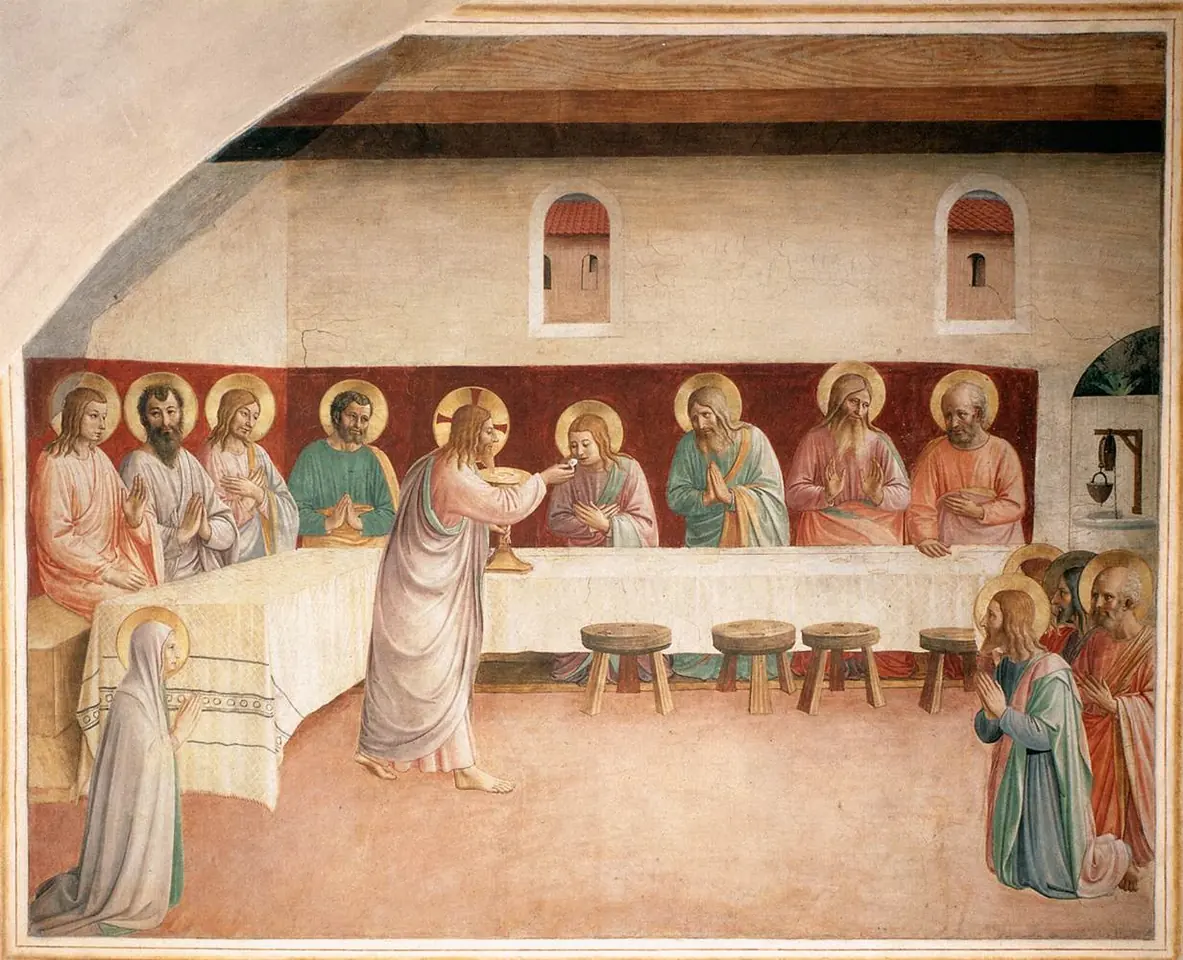
Holy Communion. We come forward in procession. The priest or minister holds up the Host and says, "The Body of Christ," and we answer Amen, an act of faith: yes, this is the Lord. We may receive on the tongue or, where the bishops allow, in the hand, and in many parishes we may also receive from the chalice. Catholics who are properly prepared (in a state of grace, having kept the hour's fast) receive Communion; others may come forward with arms crossed for a blessing or remain in the pew and make a spiritual communion.

Silence and the Prayer after Communion. After Communion there is a time of silence or a hymn of praise. This is the most intimate moment of the Mass, the Lord within us, and many Catholics kneel and pray a prayer after Communion such as the Anima Christi. Then we stand for the Prayer after Communion, which asks that the Sacrament bear fruit in our lives.
The Concluding Rites
The ending is short, because the point of the Mass is now to be lived. Brief announcements may be made. The priest greets us once more, "The Lord be with you," and blesses us in the name of the Father, the Son and the Holy Spirit; on some days and seasons he uses a solemn blessing or a prayer over the people, and a bishop blesses with a special formula. Then the deacon or priest dismisses us with one of four formulas, all with the same sense: go out into the world. We answer, "Thanks be to God," Deo gratias.
The Latin dismissal is Ite, missa est. It gave the Mass its name. The Catholic Encyclopedia traces how missa, "dismissal" or "sending," came by the sixth century to mean the whole Eucharistic celebration. The Mass ends by sending us out, the way the Apostles were sent.
The priest and deacon kiss the altar again, bow, and process out, usually during a closing hymn. It is good to stay and kneel for a moment of thanksgiving before leaving.
Sit, stand, kneel: the postures of the Mass
The postures are part of the prayer, and the General Instruction sets them out (no. 43). In the United States:
- Stand from the Entrance until the end of the Collect; for the Alleluia and the Gospel; for the Creed and the Universal Prayer; from the Orate, fratres through the Preface and the Holy, Holy, Holy; and from the Lord's Prayer to the Lamb of God, and again for the Prayer after Communion and the end of Mass.
- Sit for the readings before the Gospel, the Responsorial Psalm, the homily, the Preparation of the Gifts, and if you wish during the silence after Communion.
- Kneel after the Holy, Holy, Holy until the Great Amen, and after the Lamb of God. Those who cannot kneel make a deep bow when the priest genuflects after the consecration.
Other gestures: a bow of the head at the names of Jesus, Mary and the saint of the day; a profound bow at the words of the Creed about the Incarnation; and a bow or genuflection before receiving Communion.
Where the order of the Mass comes from
The Mass did not grow up by accident. Its two-part shape goes back to the beginning. Around the year 155, St. Justin Martyr wrote a defense of the Christians for the Emperor Antoninus Pius and described their Sunday worship:
And on the day called Sunday, all who live in cities or in the country gather together to one place, and the memoirs of the apostles or the writings of the prophets are read, as long as time permits; then, when the reader has ceased, the president verbally instructs, and exhorts to the imitation of these good things. Then we all rise together and pray, and, as we before said, when our prayer is ended, bread and wine and water are brought, and the president in like manner offers prayers and thanksgivings, according to his ability, and the people assent, saying Amen; and there is a distribution to each, and a participation of that over which thanks have been given, and to those who are absent a portion is sent by the deacons.
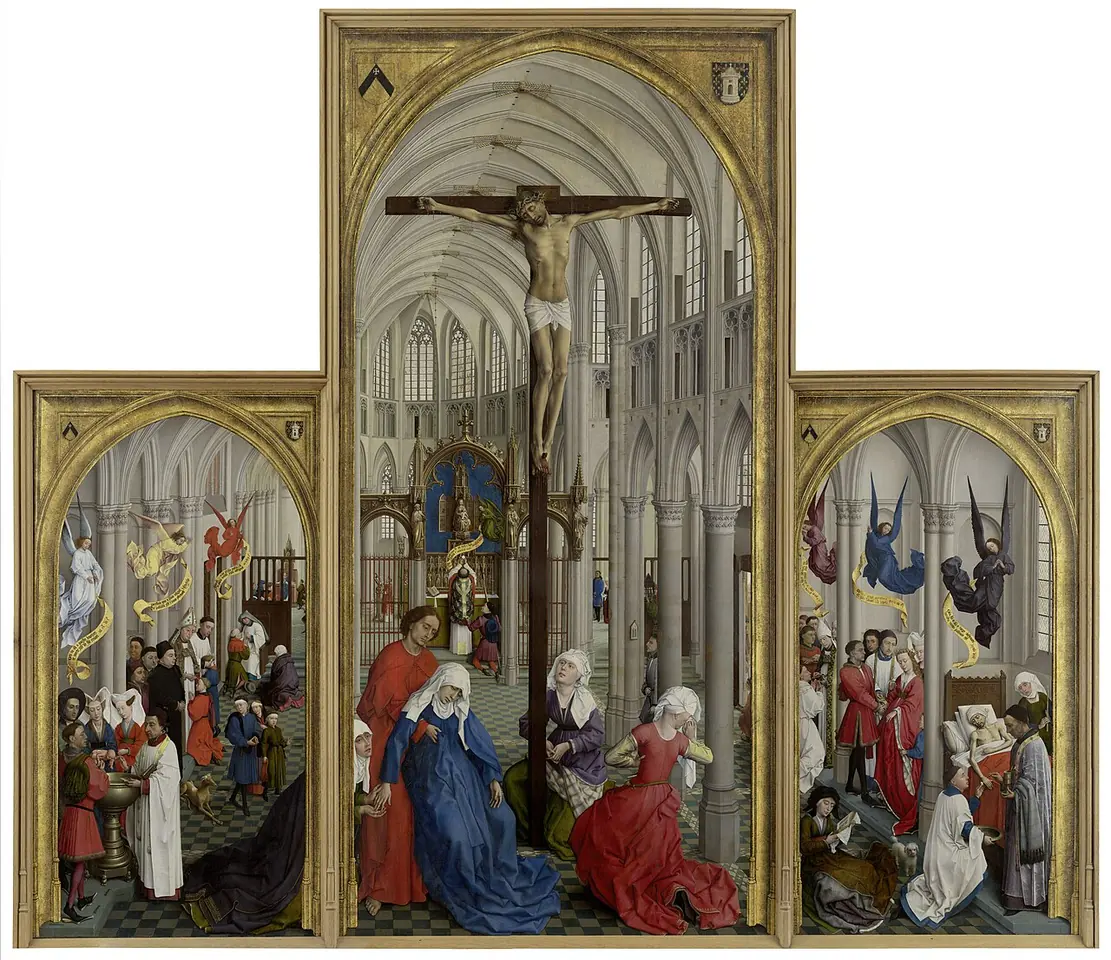
Readings, homily, prayers, the bringing of bread and wine, the thanksgiving prayer, the Amen, Communion: the Catechism quotes this passage (no. 1345) because it is still the order of every Mass.

Over the centuries the Roman Mass gathered its chants, prayers and ceremonies. St. Gregory the Great (d. 604) shaped the Roman Canon and its chants; after the Council of Trent, St. Pius V issued the Roman Missal of 1570 for the whole Latin Church. After the Second Vatican Council, St. Paul VI promulgated a revised Missal in 1969 and 1970, with more Scripture, the Universal Prayer restored, new Eucharistic Prayers and the vernacular. This is the ordinary form of the Mass today. The older form, the Mass of the 1962 Missal, is explained on our page on the Latin Mass; its order is the same in outline, with the priest's prayers at the foot of the altar at the start and the Last Gospel (John 1:1-14) at the end.
Sunday, weekday and solemn Masses
The order of the Mass is always the same, but not every part is used every day:
- Weekday Masses usually have no Gloria (except on feasts), one reading before the Gospel, often a short homily, no Creed, and few or no hymns.
- Sunday Masses have two readings before the Gospel, the Gloria (except in Advent and Lent), the homily and the Creed.
- Solemnities add the Gloria and Creed even on weekdays and often incense, as on Christmas, Easter and the holy days of obligation.
- Special Masses add their own rites: blessing and distribution of ashes on Ash Wednesday after the homily, the palm procession on Palm Sunday, the washing of feet on Holy Thursday, and the sacraments of Baptism, Confirmation and Marriage celebrated after the homily.
The color the priest wears tells you what the Church is celebrating; our guide to priest vestments explains each vestment and color, and the feast days and Church calendar page explains the seasons. After Mass, the Host consecrated at the altar may be placed in a monstrance for adoration, so that our prayer before the Lord continues outside the Mass.
A prayer to offer the Mass
Before Mass begins, it is a good habit to offer it consciously for someone you love. This short prayer is by Pastor Lyvers:
Heavenly Father, I unite myself to this holy Mass and to every Mass offered today throughout the world. With the priest at your altar I offer you Jesus, your Son, for your glory, in thanksgiving for every gift, in reparation for my sins, and for the needs of [name the intention]. Open my ears to your word and my heart to your Son, and send me out to live what I receive. Amen.
Frequently asked questions
What is the order of the Mass?
The order of the Mass is the fixed sequence of the Catholic Mass. It opens with the Introductory Rites (Entrance, Sign of the Cross and greeting, Penitential Act, Kyrie, Gloria on Sundays and feasts, Collect), continues with the Liturgy of the Word (readings, Responsorial Psalm, Gospel, homily, Creed, Universal Prayer) and the Liturgy of the Eucharist (Preparation of the Gifts, Eucharistic Prayer, Lord's Prayer, Sign of Peace, Lamb of God, Communion), and ends with the Concluding Rites (blessing and dismissal).
What are the four parts of the Mass?
The Introductory Rites, the Liturgy of the Word, the Liturgy of the Eucharist and the Concluding Rites. The two central parts, the Word and the Eucharist, are so closely joined that the Church calls them "one single act of worship" (General Instruction of the Roman Missal, no. 28).
What is the Penitential Act at Mass?
The Penitential Act comes right after the greeting. The priest invites us to call our sins to mind, there is a short silence, and we confess together, usually with the Confiteor ("I confess to almighty God...") or with the threefold Kyrie. The priest's words of absolution that follow ask God's mercy but do not take the place of the sacrament of Confession for mortal sin.
What happens during the Liturgy of the Word?
God speaks to his people. On Sundays we hear a reading from the Old Testament (or Acts in Easter time), sing a Psalm, hear a reading from the New Testament letters, stand for the Gospel, and listen to the homily. Then we profess the Creed and pray the Universal Prayer for the Church and the world.
What happens during the Liturgy of the Eucharist?
The bread and wine are brought to the altar, the priest prays the Eucharistic Prayer, and at the words of Christ they become his Body and Blood. Then comes the Communion Rite: the Our Father, the Sign of Peace, the breaking of the Host with the Lamb of God, and Holy Communion.
Why is it called the Mass?
The word comes from the Latin dismissal at the end, Ite, missa est ("Go, it is the sending"). In the early centuries missa meant a dismissal; by the sixth century it had become the name for the whole Eucharistic celebration.
What is the most important part of the Mass?
The Eucharistic Prayer, which the Missal calls "the center and summit of the entire celebration" (General Instruction, no. 78). In it Christ's sacrifice on the Cross is made present and the bread and wine become his Body and Blood. Still, the whole Mass is one act of worship, and the Word prepares us for the Sacrament.
How long does Mass last?
A Sunday Mass usually takes 45 minutes to an hour; a weekday Mass, without a Gloria, Creed or second reading, often 25 to 35 minutes. Solemn liturgies like the Easter Vigil can last two to three hours.
Sources
- General Instruction of the Roman Missal (2002, with U.S. adaptations), nos. 28, 43, 46–90, 276–277
- Catechism of the Catholic Church, nos. 1345–1355: The liturgical celebration of the Eucharist
- St. Justin Martyr, First Apology, chapters 65–67 (Ante-Nicene Fathers translation, 1885)
- Catholic Encyclopedia (1910): Liturgy of the Mass. History of the word Missa and of the parts of the Mass
- Catholic Encyclopedia (1908): Canon of the Mass. The saints named in the Roman Canon