Prayer to St. Anne
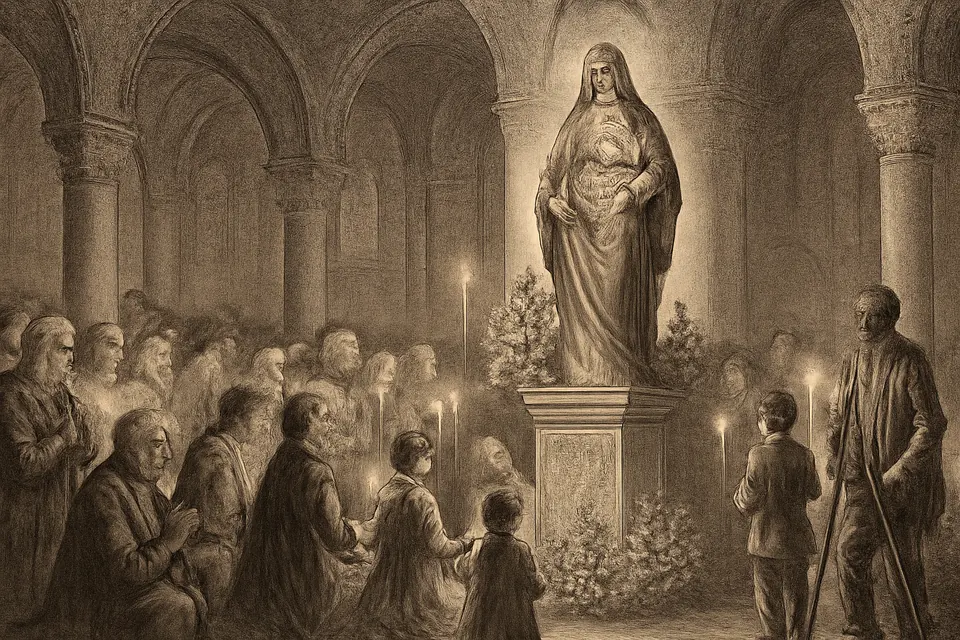
The best-known prayer to St. Anne is the one Pope Leo XIII indulgenced in 1886: "With deep and heartfelt veneration I prostrate myself before thee, O glorious St. Anne." Catholics pray to St. Anne, the mother of the Virgin Mary and grandmother of Jesus, for mothers, grandparents, families and the sick, often in a novena from July 17 to 25 before her feast.
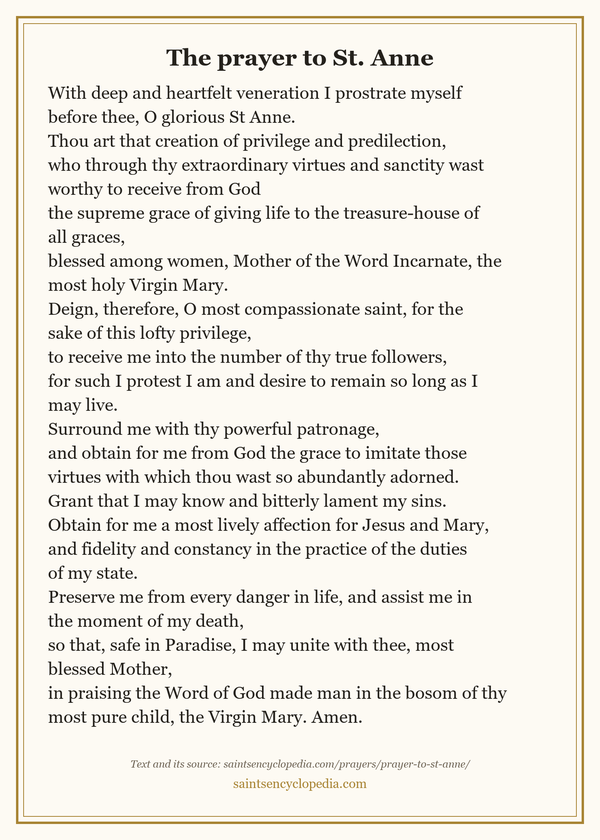 Free printable prayer card 5 × 7 inch PDF, ready to print, frame or tuck in a missal.
"Good St. Anne," the French settlers of Canada called her, la bonne sainte Anne, and generations of mothers and grandmothers have spoken to her as to a member of the family. She is the mother of the Blessed Virgin Mary and the grandmother of Jesus. The prayers below come from the Church's own books and from the old pilgrims' manuals of her great shrine at Beaupré, with the novena and how to pray it.
The prayer to St. Anne
This prayer was indulgenced by Pope Leo XIII on March 20, 1886, and printed in the English Raccolta of 1910 (no. 319), the Holy See's collection of indulgenced prayers:
With deep and heartfelt veneration I prostrate myself before thee, O glorious St Anne. Thou art that creation of privilege and predilection, who through thy extraordinary virtues and sanctity wast worthy to receive from God the supreme grace of giving life to the treasure-house of all graces, blessed among women, Mother of the Word Incarnate, the most holy Virgin Mary. Deign, therefore, O most compassionate saint, for the sake of this lofty privilege, to receive me into the number of thy true followers, for such I protest I am and desire to remain so long as I may live. Surround me with thy powerful patronage, and obtain for me from God the grace to imitate those virtues with which thou wast so abundantly adorned. Grant that I may know and bitterly lament my sins. Obtain for me a most lively affection for Jesus and Mary, and fidelity and constancy in the practice of the duties of my state. Preserve me from every danger in life, and assist me in the moment of my death, so that, safe in Paradise, I may unite with thee, most blessed Mother, in praising the Word of God made man in the bosom of thy most pure child, the Virgin Mary. Amen.
The Raccolta directs that it be followed by the Our Father, Hail Mary and Glory Be, three times each.
The prayer asks what every prayer to a saint should ask: to be taken under her care, to grow in her virtues, to repent of our sins and to love Jesus and Mary more. Everything St. Anne is, she is because of her daughter, and everything her daughter is, she is because of her Son. To pray to St. Anne is to be led, by a grandmother's hand, to Christ.

A novena prayer to St. Anne for a special intention
When we bring St. Anne a particular need, this prayer from St. Ann's Manual, or Pilgrims' Guide (Montreal, 1890), a book carried by English-speaking pilgrims to Beaupré, puts it into words:
Glorious Saint Ann, full of goodness for all those who invoke you, full of compassion for all those who suffer, feeling myself weighed down with grief and anxiety, I cast myself at your feet, humbly beseeching you to take into your hands the business in which I am now concerned...... I recommend it to you most earnestly, and beseech you to lay it before the Most Holy Virgin, your Daughter and our Mother, and before Jesus Christ our Lord, to obtain a favorable issue. Do not, I conjure you, cease to intercede until through the Divine mercy my prayer is granted. Above all, glorious Saint, obtain for me that I may one day see my God face to face, to praise Him, to bless Him, and to love Him with you, with Mary, and with all the elect. Amen.
At the pause, name your intention. Note how the prayer ends: whatever we ask, the request beneath it is always heaven.
The St. Anne novena (July 17 to 25)
St. Ann's Manual gives its novena "to be said nine days preceding... the 26th July, the Feast of St. Ann." Counting back nine days from the feast, the novena runs from July 17 to July 25, with the feast itself on July 26. A novena can of course be prayed at any time of year for a pressing need.
A simple way to make it, drawn from the old manual:
- Begin each day with the Come, Holy Ghost and its prayer, as the manual does.
- Pray the prayer to St. Anne above, with the Our Father, Hail Mary and Glory Be three times.
- Add the novena prayer for your intention.
- Read a short passage about her life or about Our Lady, and end with "Good St. Anne, pray for us."
At the shrine of Sainte-Anne-de-Beaupré the great novena opens on July 17 and closes on the feast itself. The Redemptorists who keep the shrine counted the 2026 novena as the 368th, going back to the first chapel of 1658. Taking part devoutly in a novena prayed publicly carries a partial indulgence today (Enchiridion Indulgentiarum, concession 22). Our novenas page lists others through the year.

The collect of the feast of St. Anne
Before the modern calendar joined St. Anne's feast with St. Joachim's, the Mass of St. Anne on July 26 had its own collect. This is the translation in a 1916 missal for the laity, The Mass Every Day of the Year:
O God, who didst bestow graces on blessed Anne that she might deserve to become mother of the Mother of thy only begotten Son, graciously grant that as we celebrate her feast we may be helped by her patronage. Through the same Jesus Christ, thy Son our Lord, who liveth and reigneth with thee in the unity of the Holy Ghost, God world without end. Amen.
Since 1969 the Church has kept Sts. Joachim and Anne together on July 26. Praying the collect of the day in a saint's honor on the saint's memorial carries a partial indulgence (Enchiridion Indulgentiarum, concession 21).
Who St. Anne is
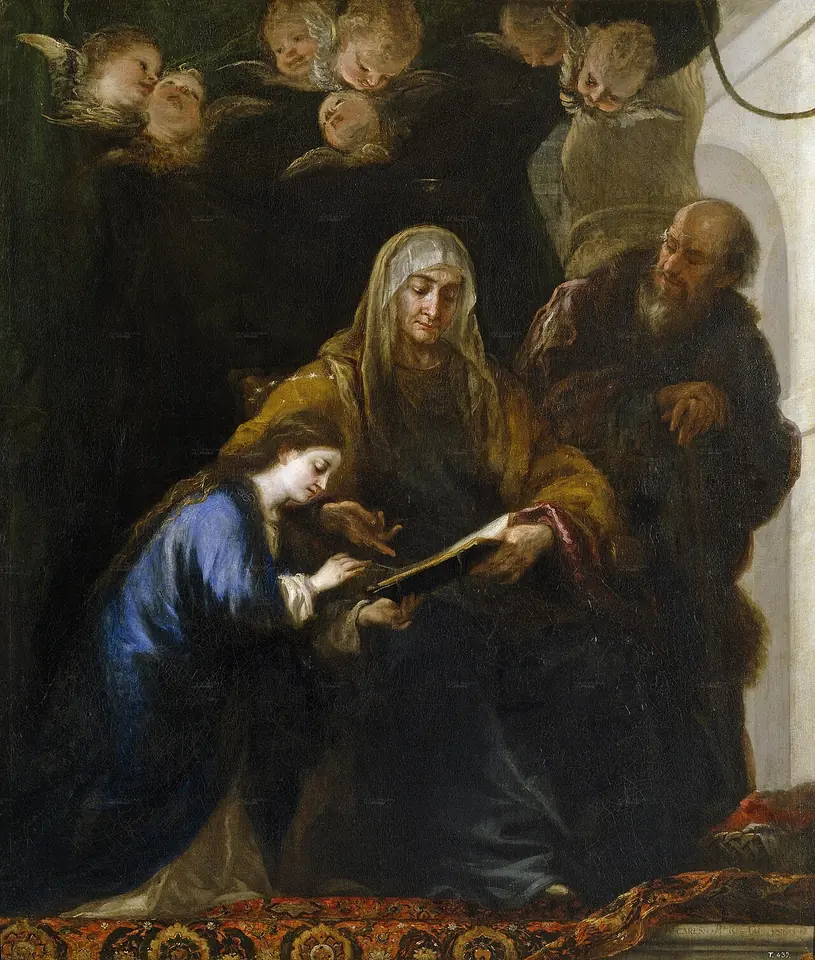
Scripture does not give the names of Mary's parents. Their names, Joachim and Anne, and the story of their long childlessness and Mary's birth come from the Protoevangelium of James, a text of about the year 150. The Catholic Encyclopedia notes that it cannot be accepted "as beyond doubt" on its own authority, but the Church in East and West has honored the grandparents of Jesus for well over a thousand years. Devotion to St. Anne can be traced in the East to the fourth century; in the West her feast spread from the 13th century and was extended to the whole Latin Church in 1584.
Her story, as tradition tells it, is the story of a woman who prayed for a child for years and was answered. That is why mothers, women hoping to conceive and women in labor have always turned to her. The Catholic Encyclopedia calls her "patroness of women in labour." Grandparents claim her too: in 2021 Pope Francis instituted a World Day for Grandparents and the Elderly, kept on the fourth Sunday of July, near her feast. Read her full story in our entry on St. Anne, and see her husband, St. Joachim, and her daughter, the Blessed Virgin Mary.
Sainte-Anne-de-Beaupré: the shrine of Good St. Anne
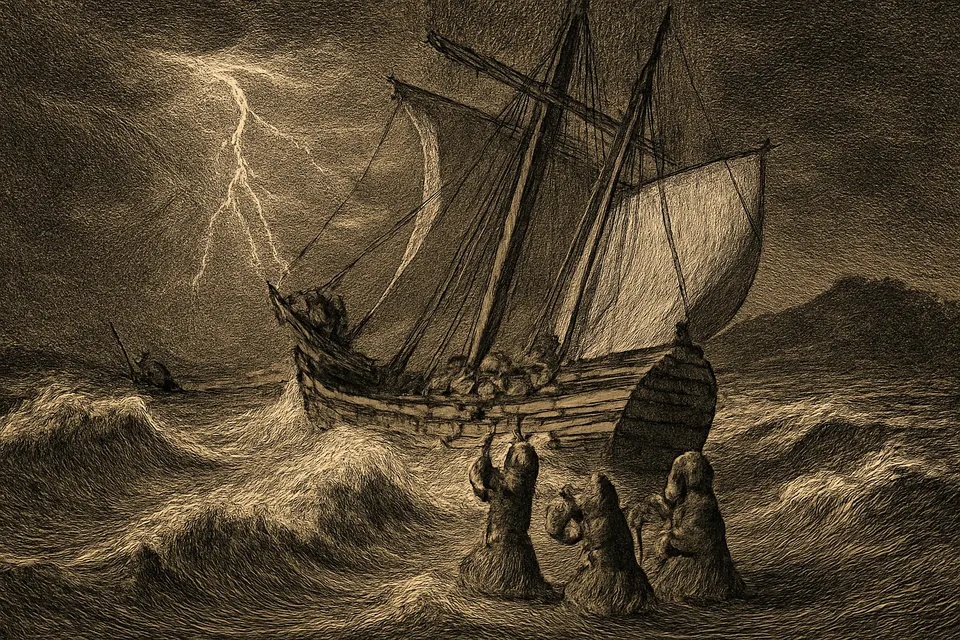
The settlers of New France came mostly from Normandy and Brittany, where St. Anne was loved, and they brought her with them. A Redemptorist guide to the shrine, printed in 1910, records the traditional story of its beginning: around 1650 a crew of Breton sailors, caught in a storm on the St. Lawrence, vowed to build a chapel to St. Anne wherever they came safely ashore, and landed at Beaupré. The guide itself admits it cannot vouch for "the historical value of this tradition."
The documented history begins on March 13, 1658, when the missionary Father Vignal blessed the foundations of a chapel on land given by the settler Étienne Lessard. The Catholic Encyclopedia records the reported cure that same day of Louis Guimont, who "suffered terribly from rheumatism of the loins," laid three stones in the foundation, and "found himself suddenly and completely cured." Pilgrims have come ever since.
A larger church was begun in 1676 and served until 1876. Pope Leo XIII made the new church a minor basilica on May 5, 1887, and the Redemptorists have kept the shrine since 1878. A finger bone of St. Anne arrived from Carcassonne in 1670 at the request of St. François de Laval, the first bishop of Quebec, and a larger relic, a wrist bone, followed in 1892. After a fire destroyed the old basilica in 1922, the present basilica was built on the same ground.
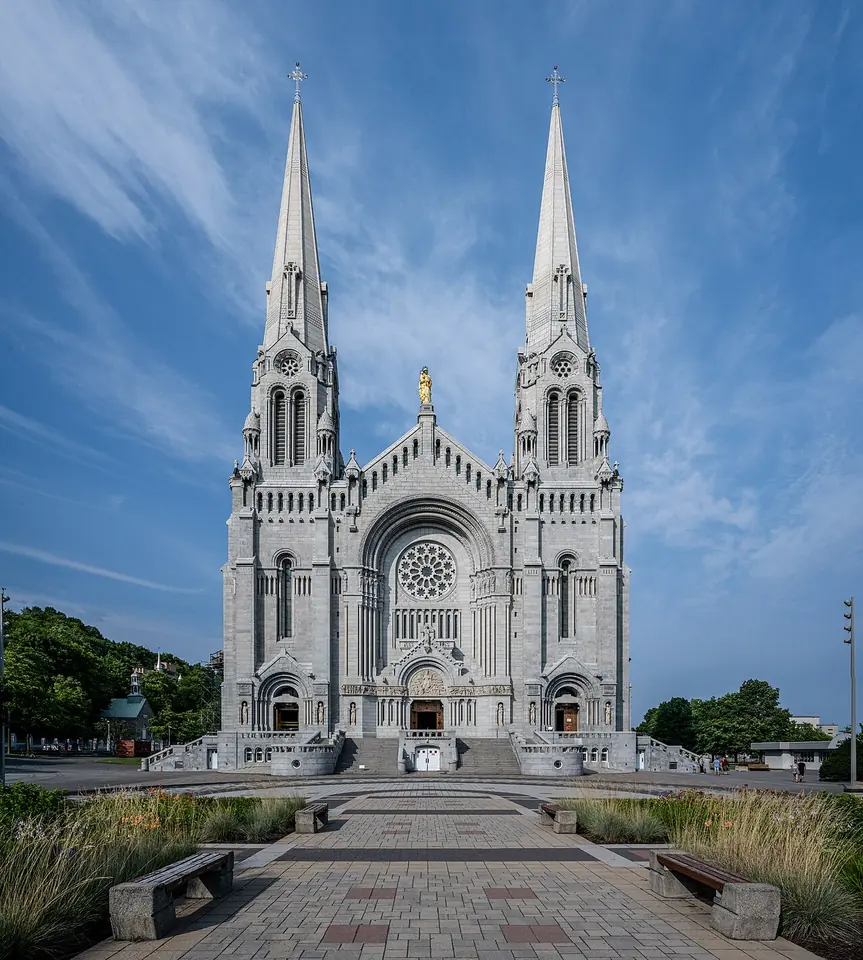
Inside the doors stand the pillars of crutches, canes and braces that astonish every visitor. The 1910 guide explains that they were "left there by pilgrims who, after having fervently prayed to our good Saint, were cured of their infirmity," and that "at least as many more have been given to the flames, as there was no room to accommodate them." These are reported favors, the testimony of grateful pilgrims; the Church has blessed the pilgrimage without examining each cure. By 1910 the shrine was receiving nearly 200,000 pilgrims a year.

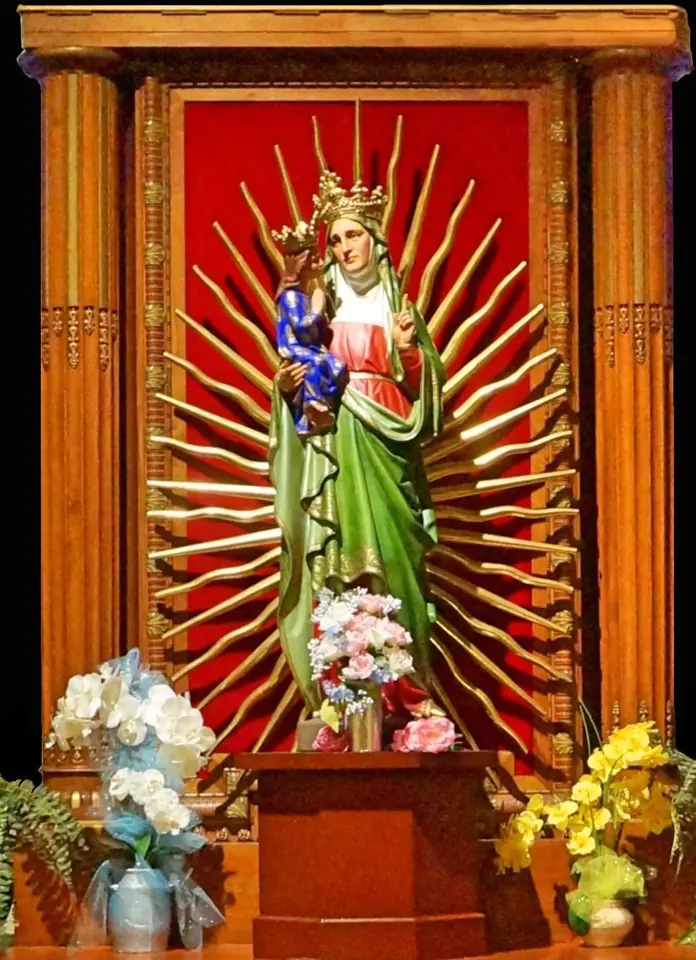
Pilgrims kneel before the crowned miraculous statue of St. Anne holding the child Mary, climb the Scala Santa on their knees, and pray at the relic chapel. Brittany has its own great shrine of Sainte-Anne-d'Auray, also with a Scala Santa.
When to pray to St. Anne
- For mothers and mothers-to-be, for a safe delivery, and for couples hoping for a child. See also the patron saints of mothers and of fertility.
- For grandparents, and by grandparents for their grandchildren's faith.
- For families and for a good marriage. Our prayer for family belongs with these.
- For the sick, as the crutches at Beaupré remember.
- For a happy death, which the Raccolta prayer asks for in its last lines.
Good St. Anne, mother of the Mother of God, pray for us.
Frequently asked questions
What is the prayer to St. Anne?
The traditional indulgenced prayer, approved by Pope Leo XIII on March 20, 1886, begins: "With deep and heartfelt veneration I prostrate myself before thee, O glorious St. Anne." It asks her to take us under her patronage, to obtain the grace to imitate her virtues, and to help us at the hour of death. It is printed in full above.
When is the St. Anne novena?
The novena to St. Anne is prayed for nine days before her feast on July 26, from July 17 to July 25. At the shrine of Sainte-Anne-de-Beaupré in Quebec, the novena runs from July 17 and closes with the feast on July 26; 2026 was its 368th year.
What is St. Anne the patron saint of?
Mothers, grandmothers and grandparents, women in labor and women hoping to have a child, and families. She is the patroness of Quebec and of Brittany, and sailors there have long called on her. Since 2021 the Church has kept a World Day for Grandparents and the Elderly near the feast of Sts. Joachim and Anne.
Who was St. Anne?
St. Anne was the mother of the Blessed Virgin Mary and the wife of St. Joachim, and so the grandmother of Jesus. The Gospels do not name her; her name and story come from the second-century Protoevangelium of James. The Church keeps the feast of Sts. Joachim and Anne on July 26.
Is St. Anne's feast a holy day of obligation?
No. July 26 is an obligatory memorial in the General Roman Calendar, not a holy day of obligation. In Quebec, where she is patroness, it is kept with special solemnity, and the Eastern churches honor her on July 25 and, with St. Joachim, on September 9.
Can I pray to St. Anne for a husband or a baby?
Yes. Catholics have long asked St. Anne's intercession for a good spouse and for the gift of a child, since tradition holds that she waited many years to conceive Mary. The Catholic Encyclopedia calls her the patroness of women in labor. We ask her prayers; every grace comes from God.
Sources
- The Raccolta (London: Burns & Oates, 1910), no. 319, Prayer to St. Anne (Leo XIII, March 20, 1886), pp. 287–288, Internet Archive
- St. Ann's Manual, or Pilgrims' Guide, translated from the French (Montreal: John Lovell & Son, 1890), novena and the prayer to recommend any particular business, Internet Archive
- The Mass Every Day of the Year: The Roman Missal (New York: Home Press, 1916), July 26, Saint Anne, collect, Internet Archive
- Catholic Encyclopedia (1907): Sainte Anne de Beaupré
- The Shrine of Saint Anne at Beaupré: Guide for Pilgrims and Visitors, by a Redemptorist Father (1910), Internet Archive
- Redemptorists of Canada: Activities for the Novena and Feast of Sainte-Anne (2026)
- Apostolic Penitentiary, Enchiridion Indulgentiarum, 4th edition (2004), concessions 21 and 22
- Pope Francis, Angelus of January 31, 2021, announcing the World Day for Grandparents and the Elderly