Prayer to St. Philomena
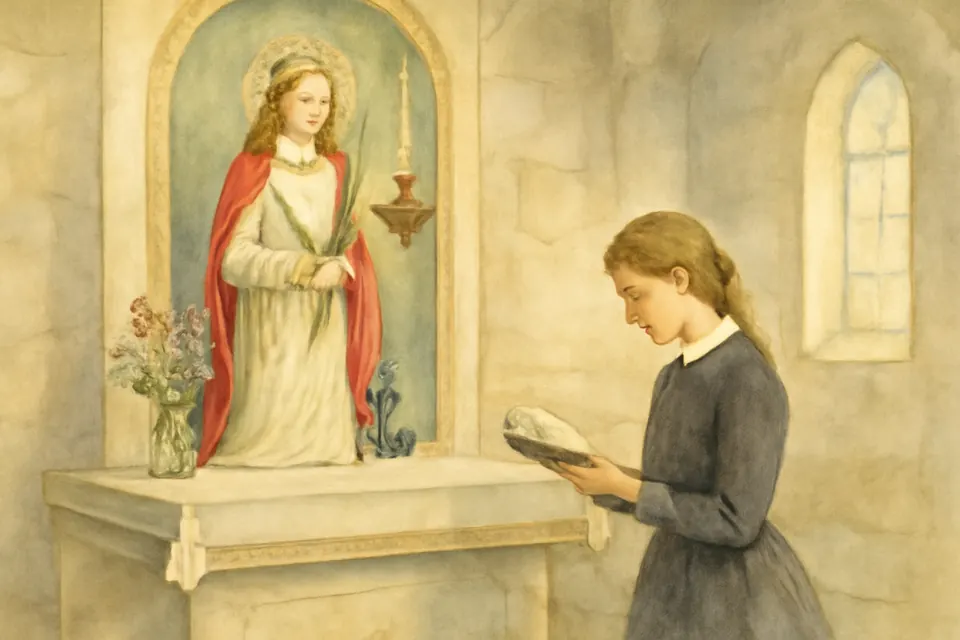
The traditional prayer to St. Philomena begins "O most blessed St. Philomena! the Thaumaturga of our age, behold me prostrate before that throne..." and asks her to comfort us in afflictions and aid us at the hour of death. It was printed in English in an 1863 New York edition of her Life and Miracles, translated from a French book approved in 1834.
St. Philomena came into the Church's life in a strange way. In 1802 workmen in the Catacomb of Priscilla in Rome found the grave of a girl of about thirteen, closed by tiles that seemed to read "Peace be with you, Philomena." Her relics went to the little town of Mugnano del Cardinale, near Naples, in 1805, and within a few years the whole Catholic world was asking her prayers. The prayers below come from those first decades of devotion.
The prayer to St. Philomena
This prayer is printed in The Life and Miracles of Saint Philomena, published in New York by P. O'Shea in 1863. The book was translated from a French work approved by the Bishop of Lausanne and Geneva on July 14, 1834, which drew in turn on Italian books from Mugnano. It appears there as the prayer "for Sunday," the first of a set of prayers "to implore her powerful protection in the tribulations, the temptations, and in all the necessities of life":
O most blessed St. Philomena! the Thaumaturga of our age, behold me prostrate before that throne, upon which the most adorable Trinity has placed and crowned you with the double crown of virginity and martyrdom. I raise my hands in supplication to you. What a glorious spectacle in constancy and strength did you not present, before heaven, and to earth, to angels and men, at the time that the tyrants of the world persecuted the sheep of the Saviour, and deluged the church with their blood! The heavy anchor tied to your neck, even the waters into which you were cast, shook not for an instant the fidelity you had sworn to your heavenly Spouse. The merciless hand of the executioner rending, with its murderous lash, your virginal flesh, from which your pure blood gushed forth, extorted from you neither a tear nor a sigh. The arrows, the chains, the sword that perfected your sacrifice, and placed your sweet soul in the possession of glory, were unable to abate, even for a moment, the ardor of your generous heart, for your Divine Lover. Now, the Lord, in recompense of your anguish for the glory of that lily that you preserved inviolate, amidst the thorns of the world, and to the confusion of this corrupted age, has vouchsafed to glorify you, by the power of your intercession. From the east to the west, from the north to the south, the fame of your wonders is heard; the people crowd to seek refuge under the wings of your protection. It is therefore to you, O illustrious martyr, it is to you that I have recourse; I stretch out to you my suppliant hands. Ah! from the height of the celestial country, vouchsafe to cast a look upon me, your humble servant. O pure virgin! O holy martyr, Philomena, comfort me in my afflictions; strengthen me in temptations; preserve me in persecutions; aid me in all dangers; but above all, aid me at the terrible hour of death, when I shall have to fight with all the powers of hell, and when a dreadful moment shall decide my eternity. In these days of darkness protect the church, which the impious attack with open force; baffle the designs of the wicked, and maintain the faithful in the unity of the Catholic Church. Amen.
Many prayer cards today carry a shorter form of this same prayer. It begins "Illustrious Virgin and Martyr, Saint Philomena, behold me prostrate in spirit before the throne on which it has pleased the Most Holy Trinity to place thee," keeps the plea to "cast a look upon thy humble servant," and adds a place to name a particular intention. Our entry on St. Philomena gives that version from a Benedictine booklet.
What the prayer says, and what it doesn't
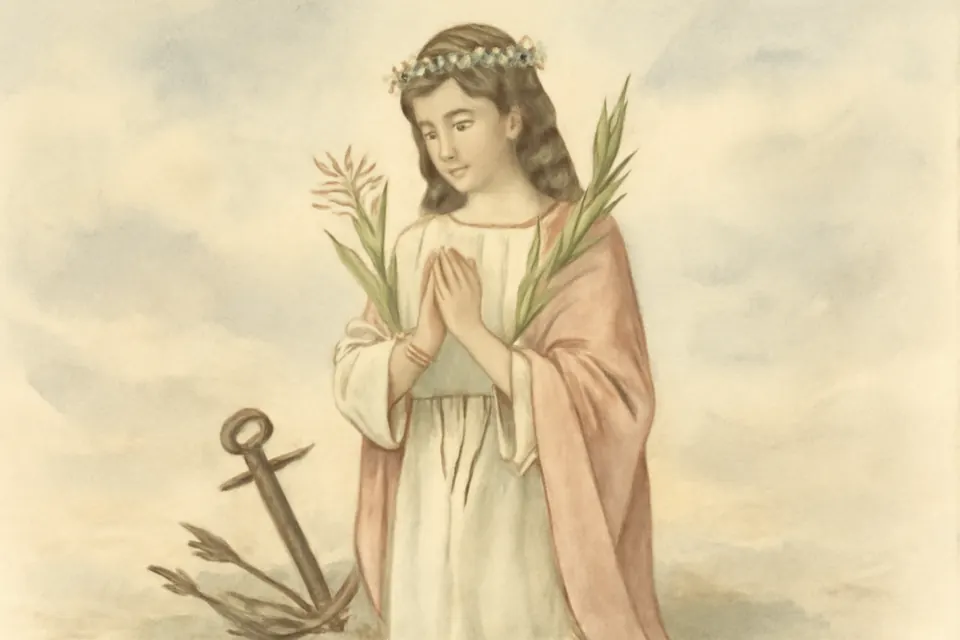
The middle of the prayer retells her martyrdom: the anchor, the river, the scourging, the arrows and the sword. These details are not history. Nothing is known of the girl's life beyond her age and burial. The story comes from a private revelation that a Neapolitan nun, Sister Maria Luisa of Jesus, said she received in 1833, and from readings of the drawings on the tiles. The Church allowed it to be printed but has never declared it true. The prayer uses the story as the devotion of its day knew it, the way a holy card does.
The heart of the prayer stands on firmer ground. It honors a young Christian buried among the martyrs of the early Church. It praises the Trinity, who crowns the saints. And its petitions are the ones every Christian needs: comfort, strength in temptation, protection in danger and, "above all," help at the hour of death. Nothing in it asks Philomena to act in God's place.
The prayer of praise: "Blessed be thou, O holy God"
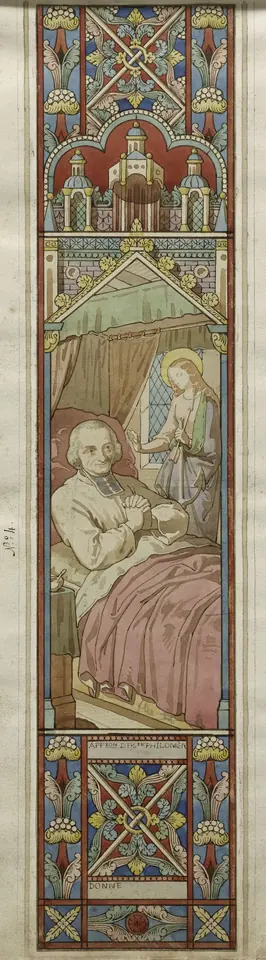
The same book gives a longer prayer for the end of each day's devotion. Each part thanks God for a gift he gave Philomena and closes with the same refrain. This is how it begins and ends:
O faithful Virgin and glorious Martyr, who vouchsafest from heaven, where you are, to pour down so great a number of benefits upon the earth, I bless the Lord for the graces he bestowed on you during your life, and above all, at your death; I glorify him and praise him for the honor and the power with which he crowns you to-day. Blessed be thou, O holy God! O God, admirable in thy saints! O just God! O powerful God! O God of infinite mercy!
The final part turns to our own needs:
O faithful Virgin and glorious Martyr, have compassion on me; exercise upon my soul and upon my body the ministry of salvation, of which God has judged you worthy; you know better than I the multitude and variety of my wants; behold me at your feet, full of poverty and hope; I solicit your charity, O great Saint! hear me graciously; bless me; vouchsafe to render agreeable to my God, the humble petition which I present to you (here one may specify the favor they desire to obtain from the saint). Yes, I have the firm hope, that through your merits, through your ignominy, through your death, united to the merits of the death and passion of our Lord Jesus Christ, I shall obtain what I ask of you, and I will say, in the joy of my heart, Blessed be thou, O holy God! O God, admirable in thy saints! O just God! O powerful God! O God of infinite mercy!
The book ends this exercise with an Our Father and a Hail Mary "for the Pope and for the necessities of the church."
This is a fine model of how the Church prays with the saints. All the praise goes to God, "admirable in his saints" (the phrase is from Psalm 67 in the Vulgate). Philomena's merits are joined to "the merits of the death and passion of our Lord Jesus Christ," the only source of every grace.
The closing prayer of her litany
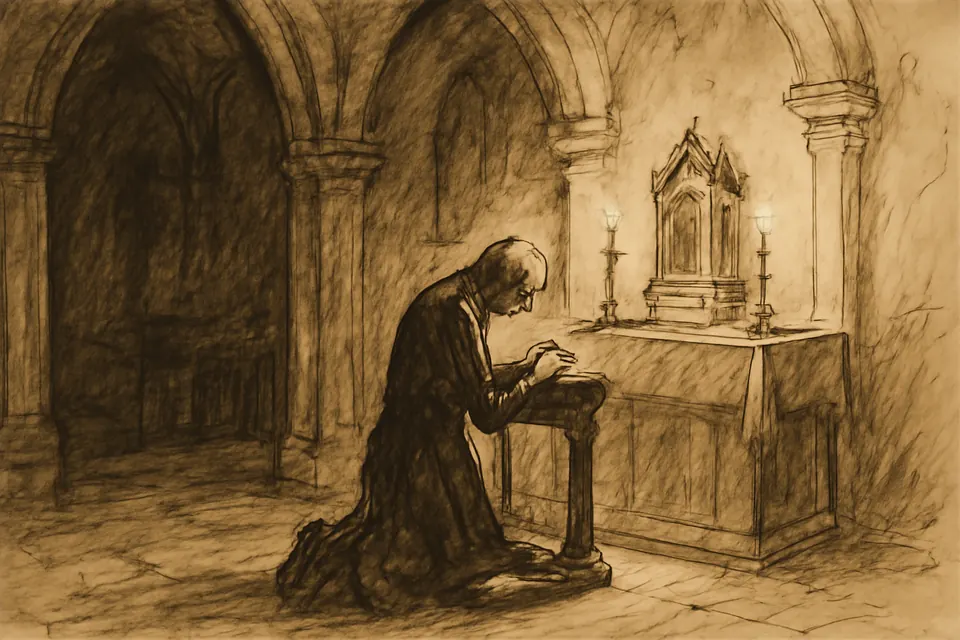
The 1863 book also prints a Litany in honor of St. Philomena, for private use. It ends with this prayer:
O glorious virgin and martyr, whose glory God has been pleased to make known by singular miracles, we address ourselves to thee with entire confidence. Obtain for us, that, by thy example, we may fight courageously against whatever is opposed to the reign of Jesus Christ in our hearts; that we may adorn them with virtue like thine, with that angelical purity, of which thou art a perfect model; and that, inflamed with the love of Jesus, we may continually walk in the way which he has marked out, to the end that we may one day partake of thy everlasting happiness, through our Lord Jesus Christ, who, with the Father and the Holy Ghost, liveth and reigneth one God, in perfect Trinity, for ever and ever. Amen.
The litany is a devotional one; it is not among the litanies approved for public use in the liturgy.
The Cord of St. Philomena and its prayer
The best-known sacramental of her devotion is a thin cord of red and white threads, with two knots at one end, worn under the clothing as a belt. White stands for her virginity and red for her martyrdom. Her sanctuary at Mugnano says Pope Leo XIII approved its use in 1883 and enriched it with indulgences in 1884, and that it is blessed by a priest authorized by the sanctuary's rector, using the Roman Ritual. Like every sacramental, it is not a charm. It is a sign and a prayer, worn as a daily reminder to ask God for purity of heart.
Those who wear it pray each day, in the sanctuary's English translation, that "through your powerful intercession we may obtain that purity of spirit and heart which leads to the perfect love of God."
The sanctuary also blesses an oil, taken from the lamp that burns before her relics. The 1863 book recommends keeping a lamp lit before her image during a novena, "as it were, a mark of your devotion, and of your confidence in the saint," and adds that "more than one miracle has been wrought by means of the oil of these lamps." The sanctuary today says that only the oil blessed at Mugnano on the Feast of the Patronage is its official sacramental.

How to pray to St. Philomena
- In any trouble: pray the prayer to St. Philomena above, then name your need simply.
- For nine days: pray the St. Philomena novena, traditionally from August 1 to 10, ending before the day her devotees keep as her feast, August 11. Her sanctuary keeps August 10, the day her relics reached Mugnano in 1805.
- For young people: she died at about thirteen, and generations of parents have asked her prayers for their children's faith and purity.
- With the cord: wear it, if you like, and say its short prayer each day.
- At the end of any prayer: "Pray for us, O St. Philomena! that we may be made worthy of the promises of Christ."
Why we still ask St. Philomena
In 1961 the Sacred Congregation of Rites removed her feast from every local calendar where it had been kept, because of serious doubts about the tiles on her tomb. That decision concerned the liturgy. It did not forbid private devotion, and her sanctuary still receives pilgrims with the Church's blessing. St. John Vianney, the patron of parish priests, trusted her completely and credited her with the cures at Ars. Padre Pio, Vatican News reports, answered doubters this way: "You can say that she was not called Philomena," but "this saint has worked miracles, and it was not the name that did them!"
The miracles reported through her, including the healing of Blessed Pauline Jaricot at Mugnano in 1835, remain reported ones; she was never canonized by a modern process that examines miracles. We pray to her as the Church has allowed for two centuries, trusting that a young Christian buried among the martyrs prays for us before God.
See also the prayer to St. Rita and the prayer to St. Jude, two other saints we ask in hopeless cases, the young saints, and all our prayers.
Frequently asked questions
What is the prayer to St. Philomena?
The traditional prayer begins, "O most blessed St. Philomena! the Thaumaturga of our age, behold me prostrate before that throne, upon which the most adorable Trinity has placed and crowned you with the double crown of virginity and martyrdom." It asks her to comfort us in afflictions, strengthen us in temptations and aid us at the hour of death. The full text is above.
What does "Thaumaturga" mean?
It is Greek for "wonder-worker," in the feminine. Devotional writers of the 1800s gave St. Philomena the title because of the many cures reported at her shrine in Mugnano and at Ars. Pope Gregory XVI, according to devotional books, called her the "wonder-worker of the nineteenth century."
What is the St. Philomena cord prayer?
Those who wear the red and white Cord of St. Philomena say a short daily prayer asking her intercession "so that through your powerful intercession we may obtain that purity of spirit and heart which leads to the perfect love of God." The cord was approved by Pope Leo XIII in 1883, according to her sanctuary at Mugnano.
Is it all right to pray to St. Philomena after 1961?
Yes. In 1961 the Holy See removed her feast from the local calendars where it had been kept, because of doubts about the inscription on her tomb. That was a liturgical decision. It did not forbid private devotion, and her sanctuary at Mugnano del Cardinale still receives pilgrims and blesses her cord and oil.
What is St. Philomena the patron of?
She is honored especially as a patron of young people and children, of purity, and of causes that seem hopeless. The Curé of Ars, St. John Vianney, called her his "dear little saint" and credited her with the cures worked at Ars.
Is there a St. Philomena novena?
Yes. The traditional novena, from the same 1863 book, has a daily prayer and nine meditations, and is usually prayed from August 1 to 10. It is on our page for the St. Philomena novena.
Sources
- The Life and Miracles of Saint Philomena, Virgin and Martyr, translated from the French (New York: P. O'Shea, 1863; approbation of Bishop Peter Tobias of Lausanne and Geneva, 1834), Internet Archive
- Johann Peter Kirsch, "St. Philomena," Catholic Encyclopedia (1911)
- Sanctuary of St. Philomena, Mugnano del Cardinale: Sacramentals and Devotions in Honor of Saint Philomena
- Gregory DiPippo, "Compendium of the Reforms of the Roman Breviary, 1568–1961," New Liturgical Movement (2010)
- Vatican News: St. Philomena, Virgin and Martyr (August 13)