Green scapular

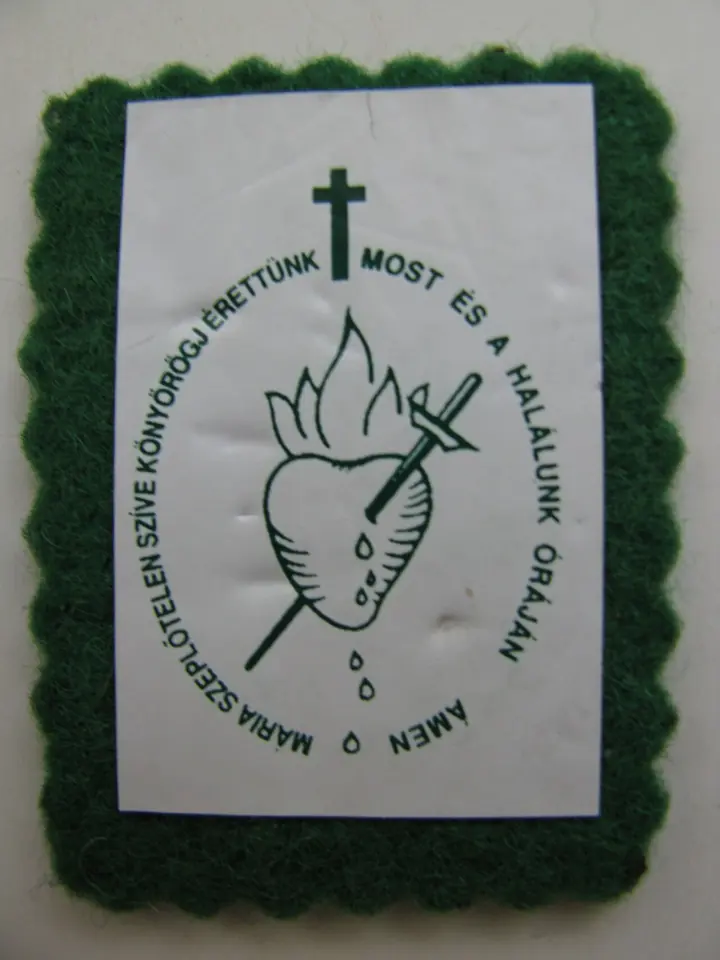
The green scapular is a sacramental of the Immaculate Heart of Mary: a single piece of green cloth on a green cord, with Our Lady on one side and her pierced heart on the other, ringed by the prayer "Immaculate Heart of Mary, pray for us now and at the hour of our death." It comes from visions of Sister Justine Bisqueyburu in 1840 and is given above all for the conversion of souls.
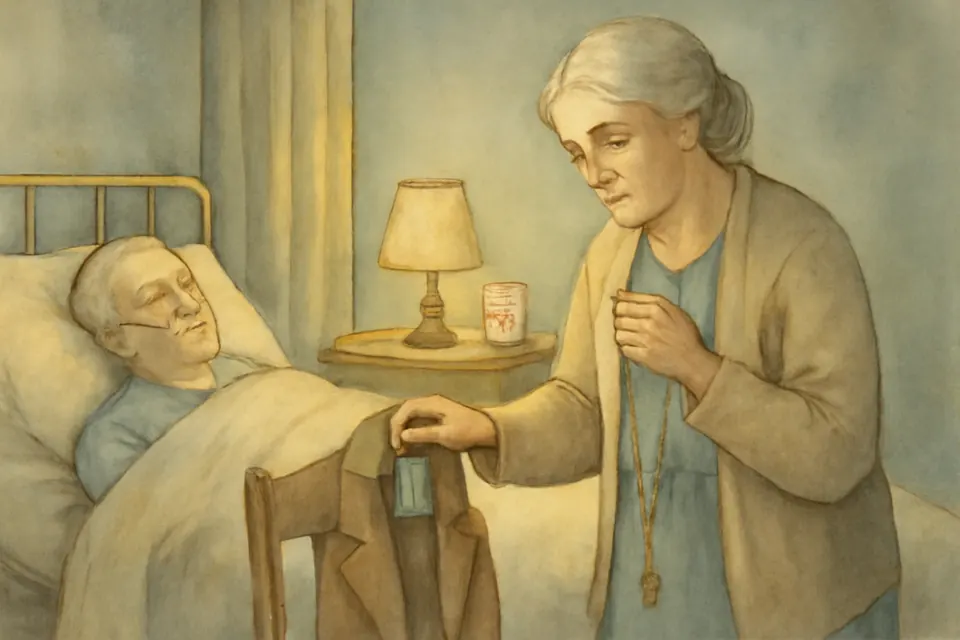
Some people wear it. More often it is tucked, without a word, into the coat pocket of a husband who stopped going to Mass, the pillowcase of a dying grandfather, the glove box of a son who wants nothing to do with the Church. The green scapular is the sacramental we give to someone else. It asks very little: one short prayer a day, said with trust in Our Lady.
What is the green scapular?
The green scapular, also called the scapular of the Immaculate Heart of Mary, is a small square of green cloth hung on a single green cord. On one side is a picture of the Blessed Virgin holding her heart. On the other is her heart pierced by a sword and giving off rays, surrounded by an oval prayer and topped with a cross:
Immaculate Heart of Mary, pray for us now and at the hour of our death.
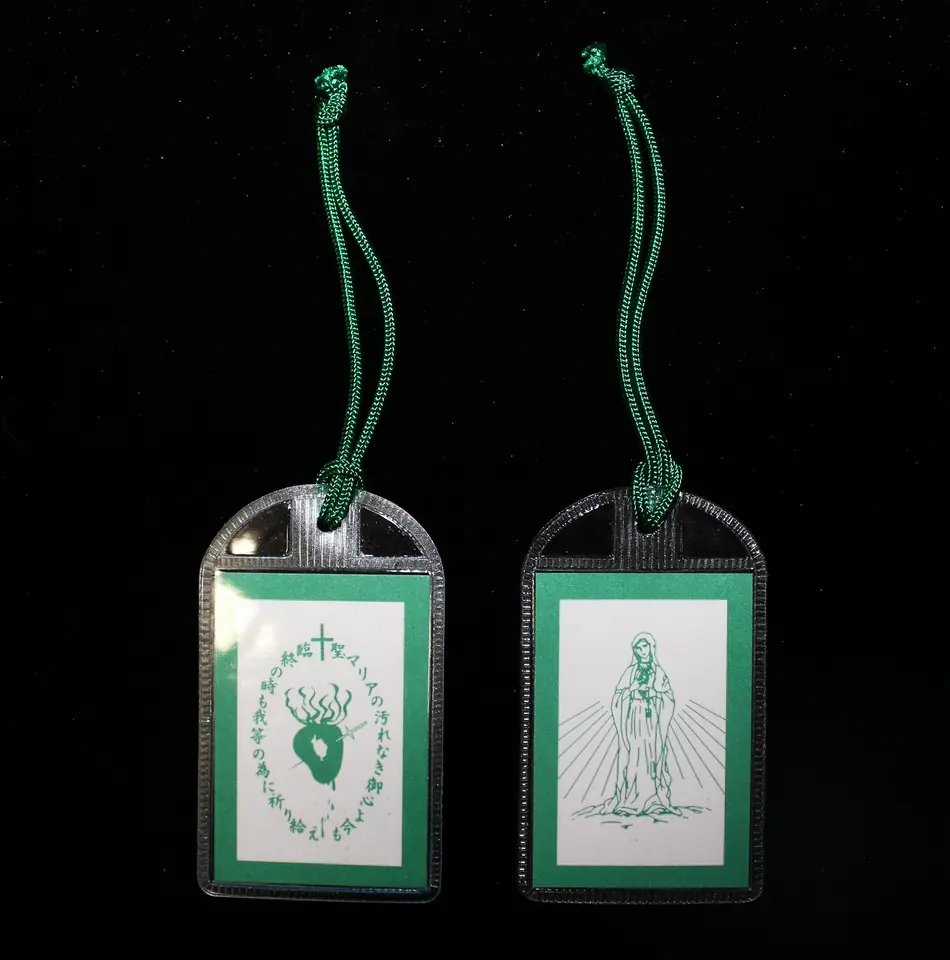
Strictly speaking, it isn't a scapular at all. A 1923 French account published with the approval of the Vincentian Superior General says (in our translation) that it is "improperly called a scapular": it is not the habit of any confraternity, "but simply two holy pictures fixed on a single piece of green cloth." That is why it has only one panel, and why nobody needs to be enrolled in it. Like every sacramental, its worth lies in the prayer it carries, the Church's blessing, and the trust with which it is given and received.
Sister Justine Bisqueyburu and the visions of 1840
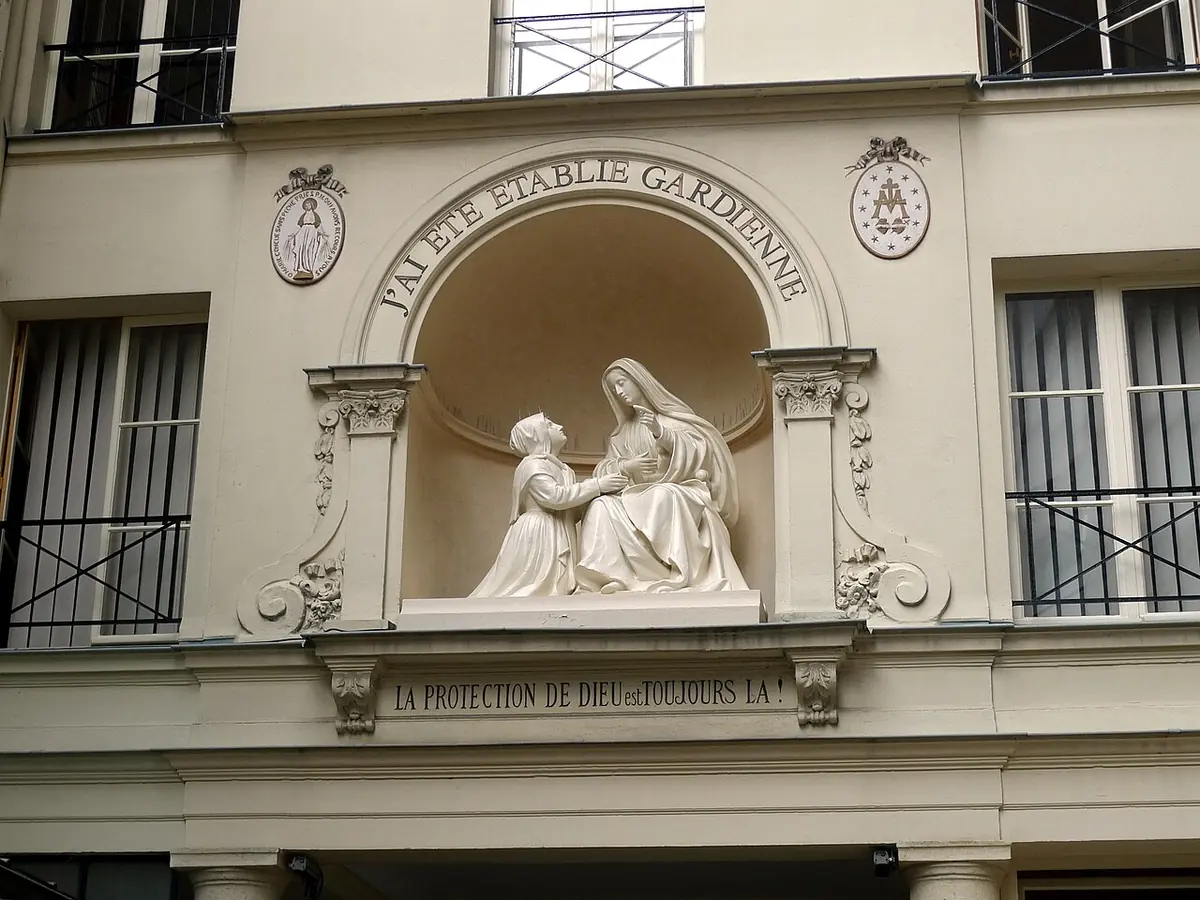
The green scapular belongs to the same religious family, and the same chapel, as the Miraculous Medal. Justine Bisqueyburu was born at Mauléon, in the French Basque country, on November 11, 1817, and was raised by relatives. On November 27, 1839, she entered the seminary (novitiate) of the Daughters of Charity at 140 rue du Bac in Paris. The Vincentian Family notes the date: it was the ninth anniversary of the day Our Lady showed St. Catherine Labouré the medal in that very chapel.
The first visions
On January 28, 1840, during her first retreat, Sister Justine was at prayer when Our Lady appeared to her. The 1950 account published with the imprimatur of the Archbishop of Baltimore describes her "clothed in a long white robe over which hung a bright blue mantle," her hair loose and unveiled, holding her heart in her hands with brilliant rays rising from it. The same vision returned four or five times during the novitiate, on the principal feasts of Mary. At first it seemed meant only to deepen the young sister's own love for the Immaculate Heart. Our Lady said nothing.
September 8, 1840, at Blangy
After she received the habit, Sister Justine was sent to teach the poor at Blangy, in northern France. There, on September 8, 1840, the feast of Mary's Nativity, Our Lady appeared again during prayer. In her right hand she held her heart surrounded by flames. In her left she held "a sort of scapular, consisting of a single piece of green cloth suspended from a cord of the same color." On one side was Mary as she had shown herself before. On the other, in Sister Justine's own words, was "a Heart all inflamed with rays more brilliant than the sun, and clearer than crystal," pierced with a sword and ringed by the prayer.
An interior voice made her understand what the vision meant. The scapular was to be made and spread with confidence, and through it, by Mary's intercession, God would bring to himself those who had no faith, and above all would obtain for them a happy death.

The approval of Pius IX
Sister Justine told only her superior and her spiritual director, Father Jean-Marie Aladel, the Vincentian priest who had also guided St. Catherine Labouré. Father Aladel moved slowly, and for some years nothing was done. According to the 1950 account, Our Lady appeared to Sister Justine several more times between 1840 and 1846 and "complained" of the delay. Once the obstacles were cleared, the sisters began making and giving away the scapulars.
The Daughters of Charity's accounts say that Pope Pius IX approved the green scapular twice, in 1863 and again in 1870, when he said:
Write to these good Sisters that I authorize them to make and distribute it.
We have not been able to find the text of a formal decree; the words come down to us through the Vincentian tradition. What Pius IX approved was the scapular and its use. We know of no formal judgment by the Church on the visions themselves, as there was for Lourdes or Fatima, so we honor them as a private revelation that the Church has allowed the faithful to act on. For how the Church weighs such events, see our page on Marian apparitions.
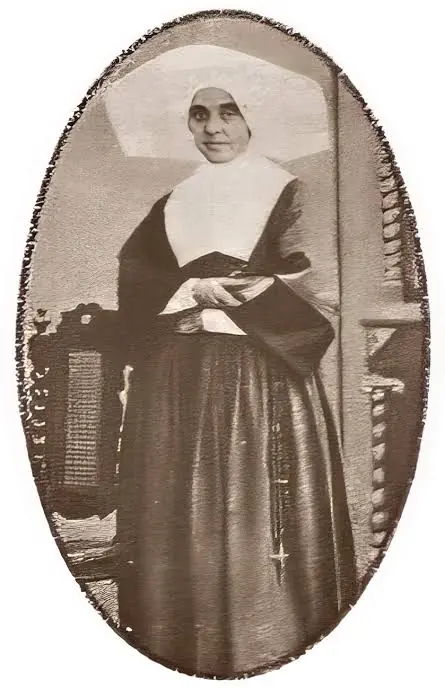
Sister Justine kept her secret for the rest of her life. She nursed soldiers in military hospitals in Constantinople during the Crimean War, at Rennes and in Algiers, served with the papal army in 1867, and from 1868 ran the Hôtel-Dieu hospital at Carcassonne, where she died on September 23, 1903. Her sisters remembered her for her humility and her service to the poor, not for visions.
How to use the green scapular
The way to use it was, the Daughters of Charity say, given with the vision, and it has stayed remarkably simple.
- Have it blessed by a priest. No special formula and no enrollment are needed, because it is not the habit of a confraternity. Any priest can bless it.
- Wear it, carry it, or place it near the person. It can be worn around the neck or pinned inside clothing. If the person it is meant for will not wear it, it may be put in their clothing, their bed or their room, even without their knowledge.
- Pray the prayer every day. "Immaculate Heart of Mary, pray for us now and at the hour of our death." If the person cannot or will not say it, the giver says it for them.
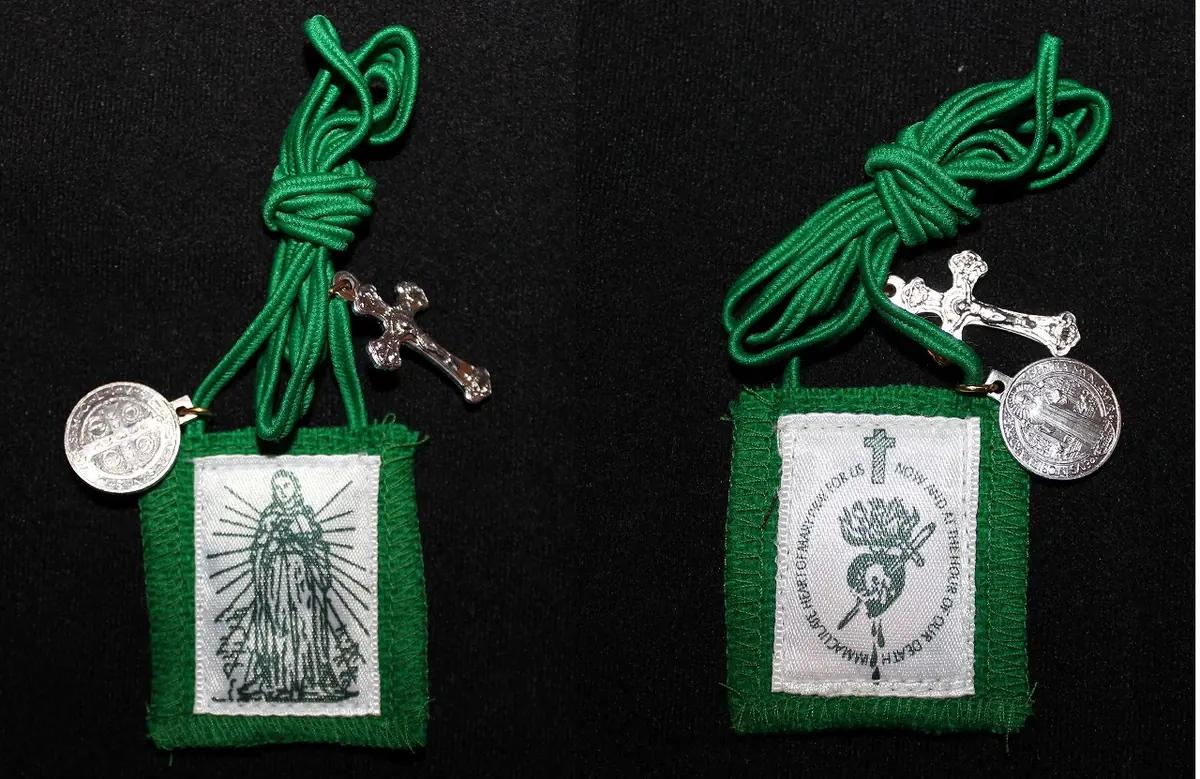
The old instructions add one more line that matters a great deal. The graces, they say, are "proportionate to the confidence with which it is given," shown by the rays of different lengths that streamed from Our Lady's hands in the last visions. The scapular is not a spell cast on another person. It is our prayer for them, placed in Mary's hands.
Green scapular vs. brown scapular
The two are often confused, but they are very different.
- What it is. The brown scapular is a small form of the Carmelite habit: two pieces of brown wool joined by cords, one hanging in front and one behind. The green scapular is one panel of cloth on one cord, really a double holy picture.
- How you receive it. The brown scapular is received once, through enrollment by a priest, and joins the wearer to the spiritual family of Carmel. The green scapular needs only a blessing.
- Who it is for. The brown scapular is a sign of one's own consecration to Mary and is worn by the person enrolled. The green scapular is most often given for someone else, especially for conversion and a happy death.
- What it asks. The brown scapular asks a Christian life of devotion to Mary. The green scapular asks one prayer a day, said by the wearer or for the wearer.
Graces reported through the green scapular
From the 1840s the Daughters of Charity collected accounts of conversions and some bodily cures. These are reported graces, gathered by the sisters and printed in devotional books, not miracles the Church has formally investigated. The 1950 account tells of a sick man, "a declared enemy of all religion," who was thrown into a rage by the mere sight of a priest. He accepted a green scapular on September 19, 1842. Eleven days later he knelt, kissed it in tears, promised Our Lady to go to confession within the week, and received the sacraments the very next day. The same leaflet asked anyone who received such a grace to send an exact account to the Daughters of Charity's Central House at Emmitsburg, Maryland, "with all circumstances of time, place and persons."
Devotional leaflets sometimes list "promises" attached to the scapular: conversion, reconciliation with the Church, a happy death, protection. These describe the graces the Vincentian tradition hopes for through Mary's intercession. No pope ever attached them to the scapular as guarantees, and the Church warns against expecting results from sacred signs "apart from the interior dispositions that they demand" (Catechism, no. 2111).

Praying for those who are far from God
The green scapular is a sacramental for hope. Many of us carry a name in our hearts that we have stopped knowing how to pray for: a child who no longer believes, a parent who has not been to confession in fifty years, a friend dying without God. The green scapular gives us something to do, and something to say every day, and it puts that person in the care of the Mother who stood at the foot of the cross.
Let us pray it now for them:
Immaculate Heart of Mary, pray for us now and at the hour of our death.
For more on the Church's signs and blessings, see our guide to sacramentals and the saint medals Catholics wear. To pray more deeply with Our Lady, learn how to pray the Rosary or pray the Memorare. The Church keeps the memorial of the Immaculate Heart of Mary on the Saturday after the feast of the Sacred Heart; see the feast day calendar.
Frequently asked questions
What is the green scapular?
It is a sacramental of the Immaculate Heart of Mary, a small piece of green cloth on a green cord. One side shows Our Lady holding her heart; the other shows her heart pierced by a sword, with the prayer "Immaculate Heart of Mary, pray for us now and at the hour of our death." It comes from visions of Sister Justine Bisqueyburu, a Daughter of Charity, in 1840.
What is the green scapular prayer?
The prayer is "Immaculate Heart of Mary, pray for us now and at the hour of our death." It is the only prayer asked of those who use the scapular, said at least once a day. If the person who has it cannot or will not pray it, the one who gave it says it for them.
Do you need to be enrolled to wear the green scapular?
No. Unlike the brown scapular, the green scapular is not the habit of a confraternity, so there is no enrollment or investiture. A priest blesses it, and then it can be worn, carried, or kept near the person it is meant for.
Can I give a green scapular to someone without them knowing?
Yes. The Daughters of Charity have taught from the start that it may be placed in a person's clothing, bed or room without their knowledge, as long as the giver prays the prayer for them each day. Families often do this for a loved one who has left the Church or is dying.
Did the Church approve the green scapular?
Yes. According to the Daughters of Charity, Pope Pius IX authorized the scapular in 1863 and again in 1870, saying, "Write to these good Sisters that I authorize them to make and distribute it." That approval concerns the scapular and its use; we know of no formal Church judgment on the visions themselves.
What is the difference between the green and brown scapular?
The brown scapular is a small form of the Carmelite habit, two pieces of wool on cords, received once through enrollment. The green scapular is one cloth panel on one cord, needs only a priest's blessing, and is used chiefly to pray for the conversion and happy death of another person.
Sources
- Fr. R. MacDonald, C.SS.R., Among Mary's Gifts: The Green Scapular (leaflet, imprimatur Archbishop Francis P. Keough of Baltimore, 1950). Account of the 1840 visions, the delays until 1846, the 1842 conversion, the manner of use, and Pius IX's words of 1870
- Le scapulaire vert: son origine, son mode d'emploi, son efficacité (text with nihil obstat of F. Verdier, Superior General of the Congregation of the Mission, 1923), Internet Archive. Calls it "improperly called a scapular," since it is not a confraternity habit
- Vincentian Family (famvin.org): The Green Scapular, the Blessed Virgin appears to Sr. Justine Bisqueyburu, DC. Dates of Sister Justine's birth, entry and death, and the devotional use
- VincentWiki: Justine Bisqueyburu
- Congregation for Divine Worship, Directory on Popular Piety and the Liturgy (2001), nos. 205–206
- Catechism of the Catholic Church, no. 2111: Superstition