St. Christopher medal
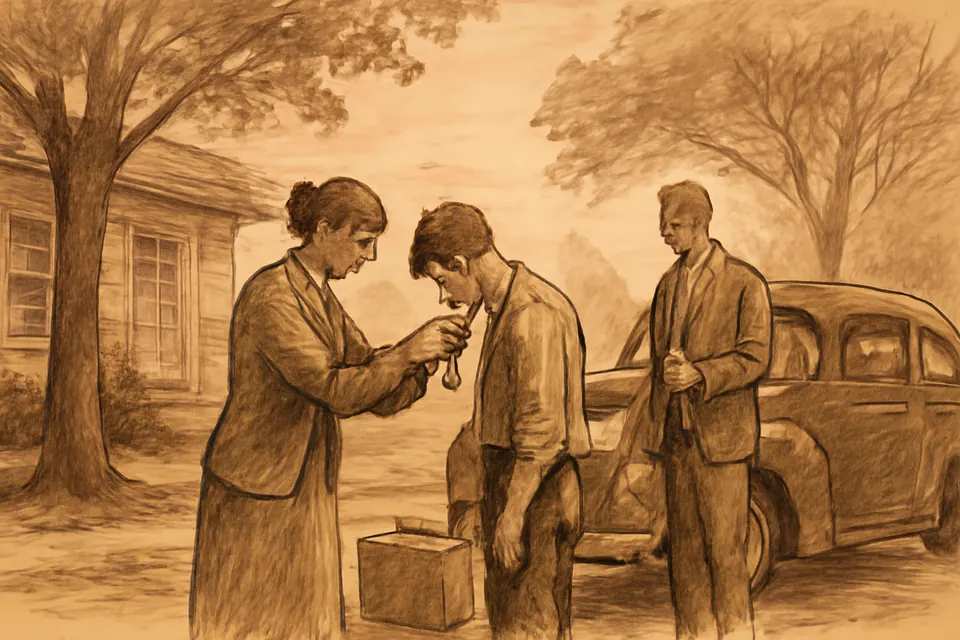
The St. Christopher medal is a sacramental showing St. Christopher carrying the Christ Child across a river, worn to ask his prayers for a safe journey. He is the patron saint of travelers. The 1969 calendar reform did not remove him from the saints; his memorial on July 25 was simply left to local calendars.
Somewhere in a kitchen drawer or a glove compartment, most Catholic families have one: a small round medal of a giant wading through a river with a child on his shoulder. The St. Christopher medal is the oldest travelers' companion we have, given to new drivers, soldiers, students and pilots for generations. Here is what it shows, what each part means, and where the devotion comes from.
What is a St. Christopher medal?
A St. Christopher medal is a sacramental, a blessed sign that asks the prayers of St. Christopher for those who travel. Like every sacramental, it works through faith and the Church's prayer, not by itself. The Catechism teaches that sacramentals "do not confer the grace of the Holy Spirit in the way that the sacraments do, but by the Church's prayer, they prepare us to receive grace and dispose us to cooperate with it." When we put one on before a trip, we are asking a saint to pray for us and placing the journey in God's hands.
Christopher was a martyr, probably of the third century. The Catholic Encyclopedia admits that "almost nothing certain is known about his life or death," but it also shows that his martyrdom is real: a church in his honor existed in Reims by 532, and St. Gregory the Great mentions a monastery of St. Christopher. The famous story on the medal is a later, loving legend.

What the St. Christopher medal shows, and what it means
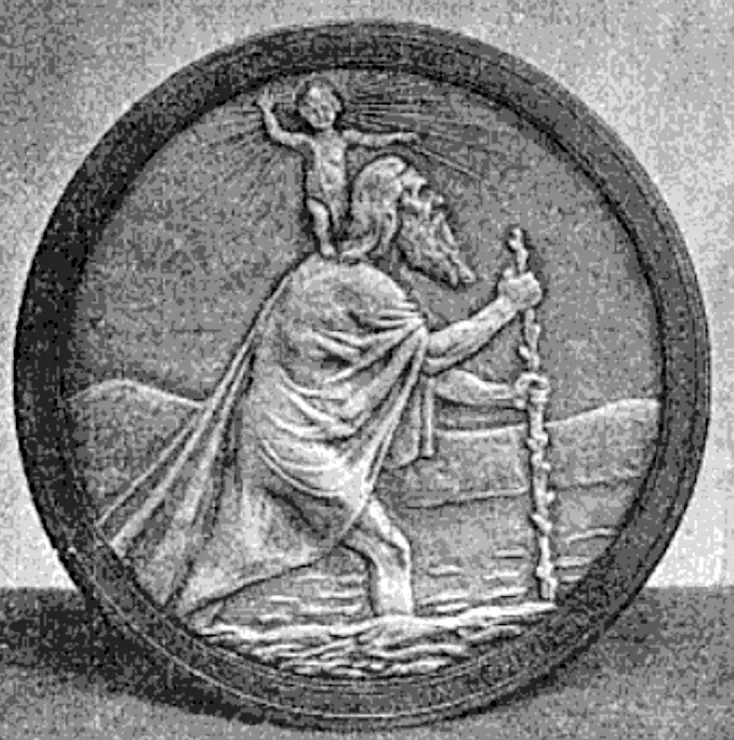
Nearly every St. Christopher medal shows the same scene, taken from the medieval legend of the giant who carried travelers across a river. Each element on the front has a meaning:
- The giant wading through the water. Christopher served Christ by carrying people across a dangerous river for God's sake. The river is every crossing we make, and the Catholic Encyclopedia suggests it also stands for "the trials and struggles of a soul taking upon itself the yoke of Christ in this world."
- The Christ Child on his shoulder. One night a child asked to be carried across and grew so heavy that Christopher felt he bore the whole world. The child revealed himself as "the Creator and Redeemer of the world." Many medals show the Child raising a hand in blessing or holding a globe topped by a cross.
- The staff. The Child told Christopher to plant his staff in the ground, and by morning, the legend says, it had grown into a palm tree bearing fruit. A sprouting staff, or a palm on the far bank, recalls that sign.
- His name. Christophoros is Greek for "Christ-bearer." The Catholic Encyclopedia explains that the name was first understood "in the spiritual sense of bearing Christ in the heart," and only in the twelfth or thirteenth century was it pictured literally. The medal invites the wearer to be a Christ-bearer too.
- The inscription. "St. Christopher protect us" is the usual English wording. French medals often carry "Regarde St Christophe et va-t'en rassuré," "Look at St. Christopher and go on your way reassured."

The back of a St. Christopher medal varies more than the front. Some carry a short prayer or an image of the Sacred Heart or Our Lady; many are left plain so that a name, a date or a few words can be engraved. Those engraved backs often hold the real story of the gift: who gave it, and to whom, before what journey.
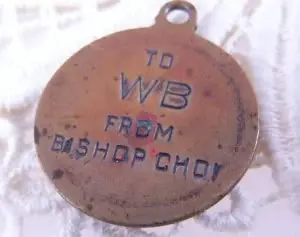
The carrying of the Christ Child is a traditional story. It reached its classic form in the Golden Legend of Jacobus de Voragine around 1260, and the Church has never presented it as history. It is a parable we can pray with: the one who serves the least traveler on the road may find he has been carrying Christ.
The history of the St. Christopher medal
"Shall not faint or fall on that day"
The medal grew out of a medieval custom of looking at Christopher's picture. The Catholic Encyclopedia records that his statues stood "at the entrances of churches and dwellings, and frequently at bridges," often with the inscription: "Whoever shall behold the image of St. Christopher shall not faint or fall on that day." The fear behind it was a sudden death without the sacraments. That is why medieval churches painted him enormous on the wall facing the door, where every traveler leaving Mass would see him.

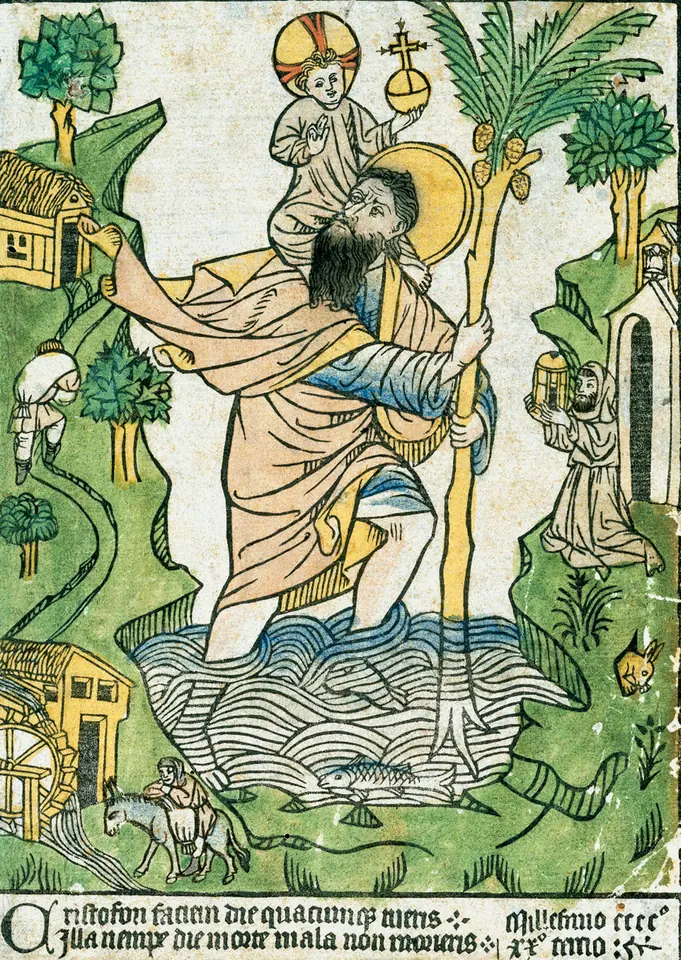
The same devotion produced some of the first European prints. A hand-colored woodcut of Christopher dated 1423, found pasted into a manuscript in the library of the monastery of Buxheim in Swabia in 1769, was long celebrated as the earliest dated piece of Western printing. Scholars at the John Rylands Library in Manchester, which owns it, now point out that it looks nothing like the woodcuts securely dated to the 1420s and was probably made somewhat later.
From pendants to pocket medals
Small images of Christopher to carry or wear followed. The Catholic Encyclopedia notes that coins bearing his image were cast at Würzburg, in Württemberg and in Bohemia, and the guilds and brotherhoods that took his name included one founded in 1386 to guide travelers over the Arlberg Pass in the Alps. The Metropolitan Museum of Art keeps a German pendant of the late fifteenth century, Christopher with the Child on his shoulder, small enough to hang from a cord.

The round medal we know took its modern shape in the nineteenth and twentieth centuries, as railways, cars and airplanes turned the patron of river crossings into the patron of every road and runway. In 1915 the American sculptor Eugenie Shonnard designed a St. Christopher medal for the Gorham silver company. In May 1927, as Charles Lindbergh neared the coast of Ireland on his solo flight across the Atlantic, he reached into his pocket for a handkerchief and found a St. Christopher medal he had not put there. The Missouri Historical Society keeps a medal its staff found in the pocket of his flight suit, stamped for the Confrérie St. Christophe of Châteauroux in France, and believes it is the same one; Lindbergh's biographer A. Scott Berg learned that a schoolteacher from Glen Cove, New York, had slipped it into his pocket before the flight.
Why travelers wear it
The patronage comes straight from the story: a man who carried strangers across a river, and once carried Christ himself, is the saint to ask for a safe crossing. Over the centuries the faithful have also invoked him against storms and sudden death, and he is one of the Fourteen Holy Helpers. Today he is the patron of drivers, pilots, sailors, truckers and anyone who travels for work. Many parishes bless cars on or near his day, July 25, and medals and dashboard statues became a familiar sight in American cars in the twentieth century.

For the other saints the Church gives travelers, including St. Raphael the Archangel, who guided Tobias on his journey, and the Magi, see our page on the patron saint of travelers.
Is St. Christopher still a saint? The 1969 calendar explained
Yes. This is one of the most common misunderstandings about any saint, and it goes back to newspaper stories in 1969.
The Second Vatican Council asked that the calendar of saints be simplified so that the feasts of Christ's saving mysteries would stand out. "Many of them," it said of the saints' feasts, "should be left to be celebrated by a particular Church or nation or family of religious; only those should be extended to the universal Church which commemorate saints who are truly of universal importance" (Sacrosanctum Concilium 111). In 1969 Pope Paul VI approved the new General Roman Calendar, and the official commentary explained the change for July 25 in one sentence:
Memoria S. Christophori, anno circiter 1550 in Calendario romano ascripta, Calendariis particularibus relinquitur: quamvis Acta S. Christophori fabulosa sint, antiqua inveniuntur monumenta eius venerationis; attamen cultus huius Sancti non pertinet ad traditionem romanam.
In English: the memorial of St. Christopher, entered in the Roman calendar around 1550, is left to particular calendars; although his written acts are legendary, there is ancient evidence of devotion to him, but his cult does not belong to the Roman tradition.
That is all that happened. The Church did not declare that Christopher never existed, and it did not "de-canonize" him. Catholic Answers puts it plainly: "The Church never issued any kind of decree saying that Christopher never existed." He remains in the Roman Martyrology, the Church's official list of saints, on July 25. Dioceses, parishes and religious communities may keep his memorial, and every one of us is free to venerate him, wear his medal and ask his prayers.
How the medal is blessed and worn
Ask a priest or deacon to bless the medal; most are glad to do it after Mass in less than a minute, with a short prayer and holy water. The Church grants a partial indulgence to the faithful who devoutly use a medal "properly blessed by any priest," and a plenary indulgence on the feast of Sts. Peter and Paul, June 29, when the medal was blessed by the pope or a bishop and the faithful also make a profession of faith.
There is no rule for wearing it. People wear it on a necklace, clip it to a car visor, hang it from the rearview mirror, set it in a dashboard plaque, carry it in a wallet or keep it on a key ring. Give it with a prayer when someone you love sets out, and say a short prayer yourself when you start the car.
Keep in mind what the medal is. The Catechism warns that attributing the power of sacred signs to "their mere external performance, apart from the interior dispositions that they demand" is superstition. The medal does not replace a careful driver, a rested pilot or the virtue of prudence. It asks a saint's prayers, and it points to the God to whom every road finally leads.
A prayer to St. Christopher
Before 1969 the Church commemorated St. Christopher at Mass on July 25 with the collect for a martyr. This is the English printed in The Mass Every Day of the Year, an American missal of 1916, with his name in place of "N.":
Grant, we beseech thee, almighty God, that as we celebrate the birthday of thy blessed Martyr Christopher; so by his intercession we may grow strong in the love of thy Name. Through Jesus Christ, thy Son our Lord, who liveth and reigneth with thee in the unity of the Holy Ghost, God world without end. Amen.
The "birthday" is the day of his martyrdom, his birth into heaven. More prayers, including the Motorist's Prayer found on many holy cards, are in our entry on St. Christopher, and his day is on the feast day calendar.
St. Christopher, pray for us, and for all who travel.
Frequently asked questions
Is St. Christopher still a saint?
Yes. In 1969 his memorial was taken off the General Roman Calendar, the list of feasts kept by the whole Latin Church, and left to local calendars, because his written acts are legendary and his feast came into the Roman calendar late. He was never removed from the saints. The Roman Martyrology names him as a martyr on July 25, and we may honor him and ask his prayers.
What does the St. Christopher medal mean?
It is a prayer for a safe journey. The medal shows Christopher carrying the Christ Child across a river, the story that made him patron of travelers, and asks his intercession on the road. His name means "Christ-bearer," so the medal also reminds the wearer to carry Christ wherever he goes.
Who wears a St. Christopher medal?
Travelers of every kind. It is a classic gift for a new driver, a student leaving for college, a soldier or sailor shipping out, a pilot, a truck driver, or anyone starting a long trip. Many wear it on a necklace; others clip it to a car visor, hang it from a rearview mirror, or keep it on a key ring.
Does a St. Christopher medal have to be blessed?
It doesn't have to be, but the custom is to ask a priest or deacon to bless it, which takes a minute after Mass. The blessing makes it a sacramental, and the Church grants a partial indulgence to those who devoutly use a medal properly blessed by any priest.
Can a non-Catholic wear a St. Christopher medal?
Yes. St. Christopher medals have long been given to travelers well beyond Catholic families, and the Orthodox venerate him too. Whoever wears it should understand it as a request for a saint's prayers and a reminder to trust God, not as a lucky charm.
What is written on a St. Christopher medal?
The most common English inscription is "St. Christopher protect us." French medals often read "Regarde St Christophe et va-t'en rassuré," "Look at St. Christopher and go on your way reassured." The back is often left plain so a name, a date or a short message can be engraved.
Sources
- Catholic Encyclopedia (1908): St. Christopher
- Calendarium Romanum (Libreria Editrice Vaticana, 1969), commentary on July 25, Internet Archive
- Second Vatican Council, Sacrosanctum Concilium (1963), no. 111
- Catholic Answers: Did the Church declare that St. Christopher is a myth?
- Missouri Historical Society: Saint Christopher Medal Carried by Charles A. Lindbergh on New York to Paris Flight
- The Mass Every Day of the Year: The Roman Missal (1916), Common of a Martyr not a Bishop, Internet Archive
- Catechism of the Catholic Church, paragraphs 1667–1673: Sacramentals
- Paul VI, Apostolic Constitution Indulgentiarum doctrina (January 1, 1967), norm 17