St. Michael medal
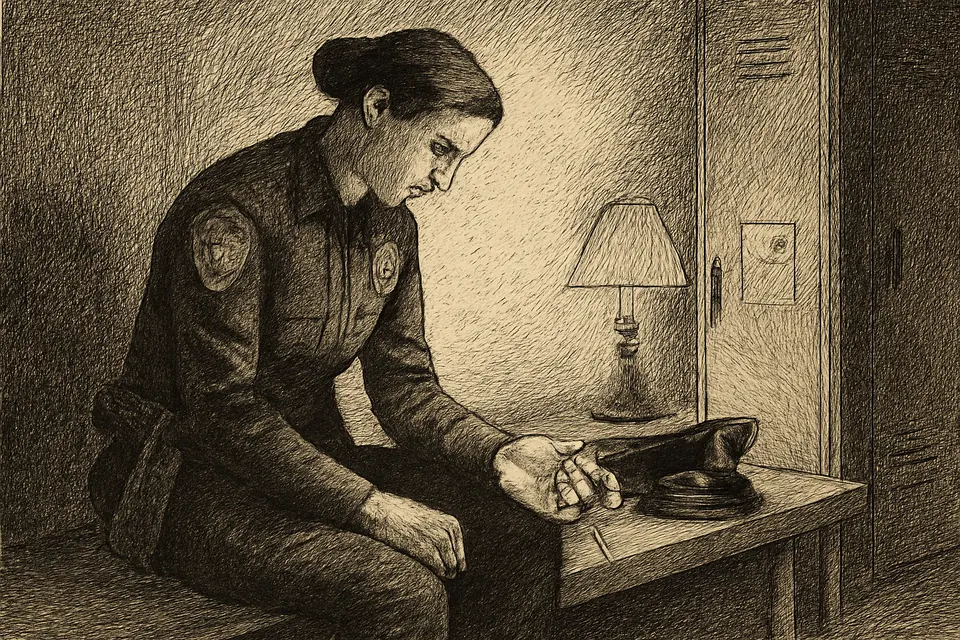
The St. Michael medal is a sacramental showing St. Michael the Archangel in armor, sword raised, casting down Satan as the dragon of Revelation 12. His name means "Who is like God?" (Quis ut Deus). Police officers, soldiers and first responders wear it to ask his protection, and Pius XII named him patron of police in 1949.
Police officers tuck it under their uniform shirts. Soldiers carry it into combat. Parents fasten it on a child's chain before confirmation. The St. Michael medal is one of the most worn medals in the Church, and its image is as clear as any sermon: an angel, sword raised, standing over the defeated enemy of God.
What is the St. Michael medal?
The St. Michael medal is a sacramental that asks the protection of St. Michael the Archangel, the angel who leads the armies of heaven against Satan. Like every sacramental, it has no power by itself. The Catechism teaches that sacramentals "do not confer the grace of the Holy Spirit in the way that the sacraments do, but by the Church's prayer, they prepare us to receive grace and dispose us to cooperate with it." Wearing the medal is a way of saying, every day, that we belong to God's side and ask Michael to fight for us.

What the medal shows, and what each part means
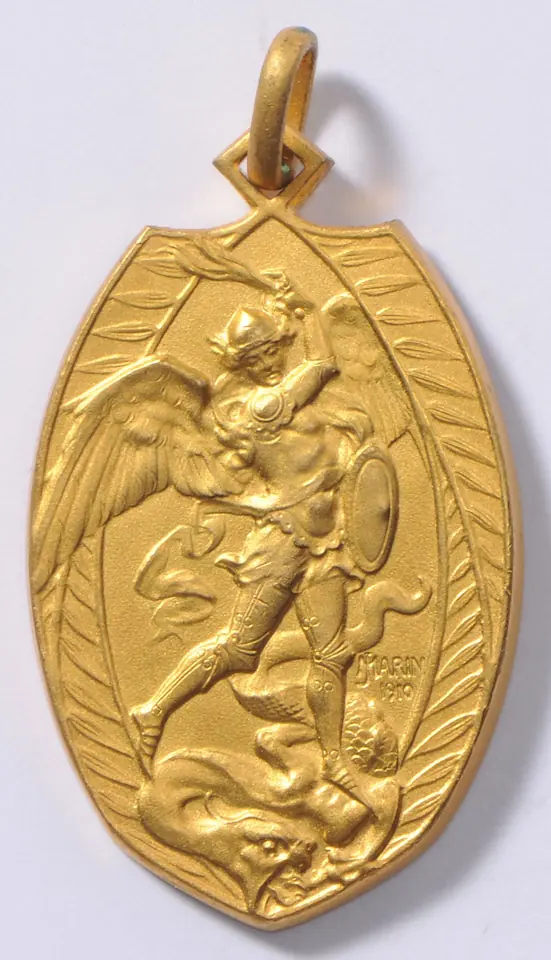
The usual image comes from the Book of Revelation: "And there was a great battle in heaven, Michael and his angels fought with the dragon... And that great dragon was cast out, that old serpent, who is called the devil and Satan, who seduceth the whole world" (Revelation 12:7, 9, Douay-Rheims). Each detail on the front points to that victory.
- Armor and wings. Michael is an angel, a pure spirit, shown as a warrior because he is "the great prince" who stands guard over God's people (Daniel 12:1).
- The sword or lance. God's power driving evil out. Michael wins by God's strength, not his own; in the Letter of Jude he will not even bring a railing accusation against the devil, but says, "The Lord command thee" (Jude 9, Douay-Rheims).
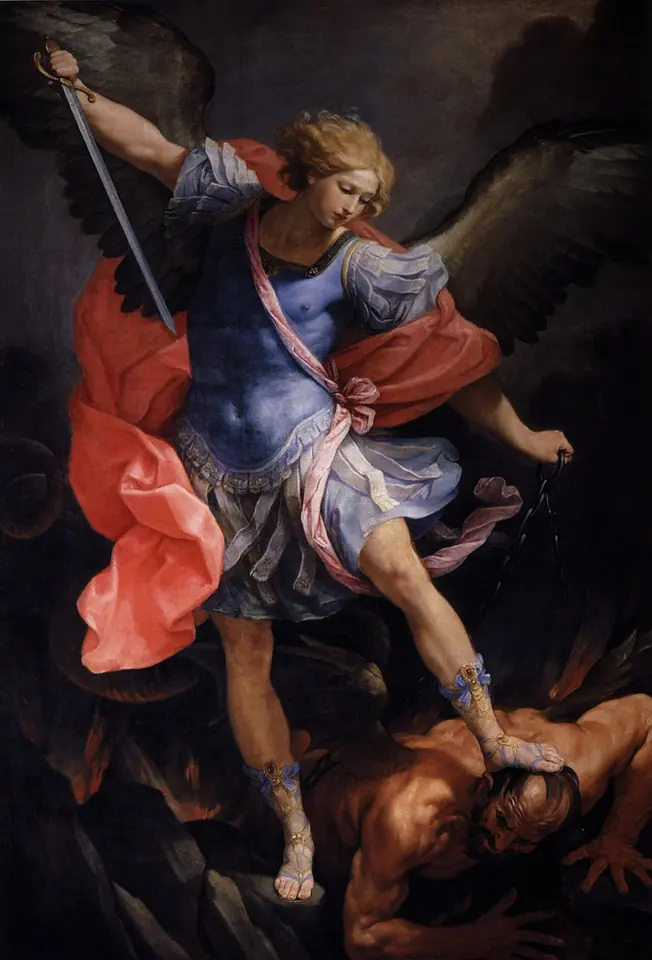
- The dragon or Satan under his feet. The enemy already defeated. Older medals show a dragon or serpent; later ones, following Guido Reni's painting in Rome, show a fallen angel in human form.
- The shield marked Quis ut Deus. His name in Hebrew, Mi-ka-El, means "Who is like God?" The Catholic Encyclopedia calls it "the war-cry of the good angels in the battle fought in heaven." Some medals print it on the shield, others around the rim.
- Scales. Less often, Michael holds a pair of scales, because tradition gives him a part in bringing souls to judgment.

The back usually carries a short prayer: "St. Michael, protect us," "Quis ut Deus," or the whole St. Michael prayer. Medals made for police officers or soldiers may add a badge, a flag or a motto. The 19th-century French medal above asks him, as "protector of France," to "fight for us."
Why police, soldiers and first responders wear it
The Catholic Encyclopedia sums up the four offices Christian tradition gives Michael: to fight against Satan, to rescue the souls of the faithful from the enemy "especially at the hour of death," to be the champion of God's people, and to bring souls to judgment. Each one explains a group that wears his medal.
Police officers. On September 29, 1949, his feast day, Pope Pius XII declared St. Michael the heavenly patron of Italy's whole public security administration. The apostolic letter notes that Christian armies, "by an ancient and praiseworthy custom," choose heavenly patrons to guard every one of them in danger, and that Italy's police had long held Michael as theirs. Police around the world have taken him as their patron, and many officers carry his medal on duty. See our page on the patron saint of police.
Soldiers. Christians have long pictured Michael at the head of armies, and the Catholic Encyclopedia notes that in the Middle Ages he was the patron of the orders of knights. In 1915, with most of Belgium under German occupation, the Belgian medalist Jacques Marin made a medal with the prayer "St. Michel, protégez notre armée," "St. Michael, protect our army."
Firefighters, paramedics and the dying. Anyone who walks toward danger for others has reason to ask Michael's help, and many first responders wear his medal alongside the patron of their own work, such as St. Florian for firefighters. Because tradition gives Michael the care of souls at the hour of death, we also ask his prayers for the sick and the dying, and a St. Michael medal is a fitting gift for someone gravely ill.

How the medal is blessed and worn
Ask a priest or deacon to bless it. The Church grants a partial indulgence to the faithful who devoutly use a medal properly blessed by any priest. Wear it on a chain, keep it in a wallet, or hang it in a patrol car or locker. It makes a fitting gift for confirmation, a graduation from the police or fire academy, enlistment, or deployment.
A medal is never a charm. It does not make anyone bulletproof, and the Church calls it superstition to expect results from sacred signs apart from faith and prayer. What it does is keep before our eyes the truth Michael's name proclaims: no one is like God, and evil does not have the last word.
The St. Michael prayer
Pope Leo XIII composed this prayer and added it to the prayers after Low Mass in 1886. This is the English printed in The Little Month of November, a Catholic booklet published in Boston in 1912:
St. Michael, the Archangel, defend us in battle; be our protection against the malice and snares of the devil. We humbly beseech God to command him; and do thou, O Prince of the heavenly hosts, by the divine power thrust into hell Satan and the other evil spirits who roam through the world seeking the ruin of souls. Amen.
The Latin original, the version most American Catholics know today and the true history of the prayer are on our page for the St. Michael prayer. For a longer devotion, pray the Chaplet of St. Michael. We keep the feast of Michael, Gabriel and Raphael, the archangels, on September 29; see the feast day calendar.
St. Michael the Archangel, pray for us.
Frequently asked questions
What does the St. Michael medal mean?
It asks the protection of St. Michael the Archangel against evil and danger. The image of Michael defeating the dragon comes from Revelation 12, and the words often on the back, "Quis ut Deus," translate his Hebrew name, "Who is like God?" Wearing it says that we trust God's power over evil and ask Michael's prayers.
Why do police officers wear a St. Michael medal?
St. Michael is the patron of police. Pope Pius XII declared him heavenly patron of Italy's whole public security service on September 29, 1949, his feast day, and police around the world have adopted him. He defends the innocent against evil, which is the work officers are sworn to do.
Can firefighters, soldiers and EMTs wear a St. Michael medal?
Yes. St. Michael is a traditional patron of soldiers, and many firefighters, paramedics and other first responders carry his medal as well. Firefighters also have their own patron, St. Florian.
Does a St. Michael medal need to be blessed?
It is best to have it blessed by a priest or deacon; that makes it a sacramental. The Church grants a partial indulgence to those who devoutly use a medal properly blessed by any priest. A medal isn't a charm, though; its value comes from God through the Church's prayer and the faith of the wearer.
What prayer goes with the St. Michael medal?
The prayer to St. Michael composed by Pope Leo XIII, "St. Michael the Archangel, defend us in battle." Many medals have it on the back. Its full text, Latin original and history are on our page for the St. Michael prayer.
Sources
- Revelation 12:7-9, Douay-Rheims (Bible Gateway)
- Catholic Encyclopedia (1911): St. Michael the Archangel
- Pius XII, Apostolic Letter Providentissimi Dei est (September 29, 1949), Acta Apostolicae Sedis 42 (1950), pp. 286-287
- The Little Month of November (Boston, 1912), Prayers after Low Mass, Internet Archive
- Catechism of the Catholic Church, paragraphs 1667–1673: Sacramentals