St. Alfred the Great
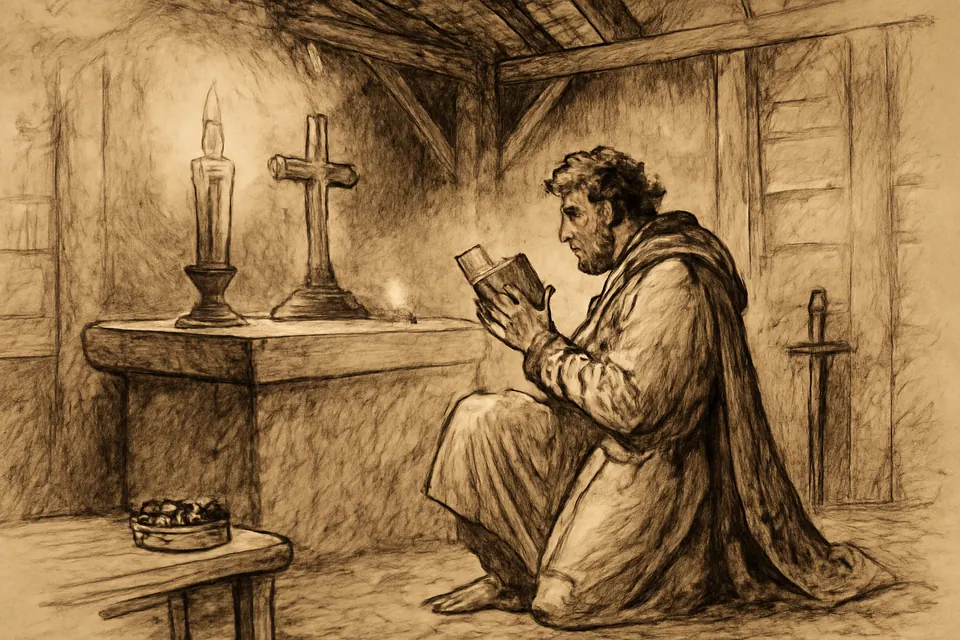
St. Alfred the Great (849–899) was the Christian king of Wessex who saved southern England from the Vikings, stood godfather to the Danish king Guthrum at his baptism, and translated works of St. Gregory the Great and others into English. He died on October 26, 899, the day he is remembered. The Catholic Church has never canonized him; he is honored as a saint by some Orthodox Christians and in Anglican calendars.
Who was St. Alfred the Great?
St. Alfred the Great was the king of the West Saxons, in southern England, from 871 until his death in 899. He is the only English king called "the Great." He held off the Viking armies that had swallowed the other English kingdoms, made peace on terms that brought their leader to baptism, and spent his last years rebuilding churches, schools and monasteries. He did all this as a sick man who prayed the Hours every day, went to Mass daily and slipped into churches at night to pray alone.
We know him well because a Welsh monk, Asser, lived at his court and wrote his life in 893, while the king was still alive. Asser loved him and wrote to honor him, but he wrote from what he saw. Later centuries added legends, and we'll mark those clearly.
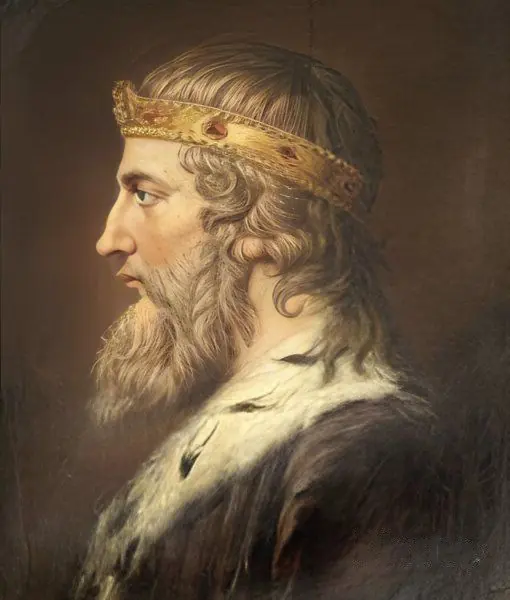
About the title "saint." The Catholic Church has never canonized Alfred, and he has no feast in the Roman calendar. He is remembered on October 26, the day he died, by the Church of England, and some Orthodox Christians in Britain honor him among the saints of the British Isles. Catholics are free to admire him as what he was: a Catholic king of the 9th century, in communion with Rome, who tried to rule as a servant of Christ.
Childhood and the book of poems
Alfred was born in 849 at Wantage, in what is now Oxfordshire, the youngest son of King Æthelwulf and his wife Osburh. The Anglo-Saxon Chronicle records that in 853 his father sent him to Rome, where Pope Leo IV "consecrated him king, and adopted him as his spiritual son." The Catholic Encyclopedia doubts the anointing, and historians think the pope more likely gave the boy an honorary rank. Two years later he went to Rome again, with his father, on pilgrimage.
Asser tells a story from those years. His mother showed her sons a book of English poetry with a beautiful painted initial and promised it to whichever of them could learn it first. Alfred, the youngest, took the book to his teacher, learned it by heart and recited it to her.

Asser adds that the young prince learned "the daily course, that is, the celebration of the hours," along with psalms and prayers, "in a book which he kept day and night in his bosom, as I myself have seen."
A prayer for a different cross
Alfred suffered all his life from a painful illness that Asser describes but no one can now name with certainty. As a young man, fearing the temptations of his age, he rose at cockcrow to pray in churches and at the relics of the saints, asking God to turn his heart fully to Him "by some infirmity such as he might bear." Later, out hunting in Cornwall, he turned aside to pray in the church where St. Gueriir lay (and, Asser adds, "now also St. Neot"). He asked God to exchange the sickness that tormented him for a lighter one, provided it would not show outwardly and make him "useless and despised." Asser says he felt soon after that he had been healed of it. But a worse illness seized him at his wedding feast and tormented him, Asser writes, "from the twentieth to the forty-fifth year of his life."
King in the marshes: Athelney and Edington
Alfred became king in 871, in the middle of a war against the "Great Army" of the Danes. In January 878 the Danes struck the royal estate at Chippenham in a surprise winter attack, and most of Wessex submitted. The Chronicle says the Danes subdued the land "all but Alfred the King," who took a small band into the woods and moors. At Easter he built a fort at Athelney, an island in the Somerset marshes, and raided from there.
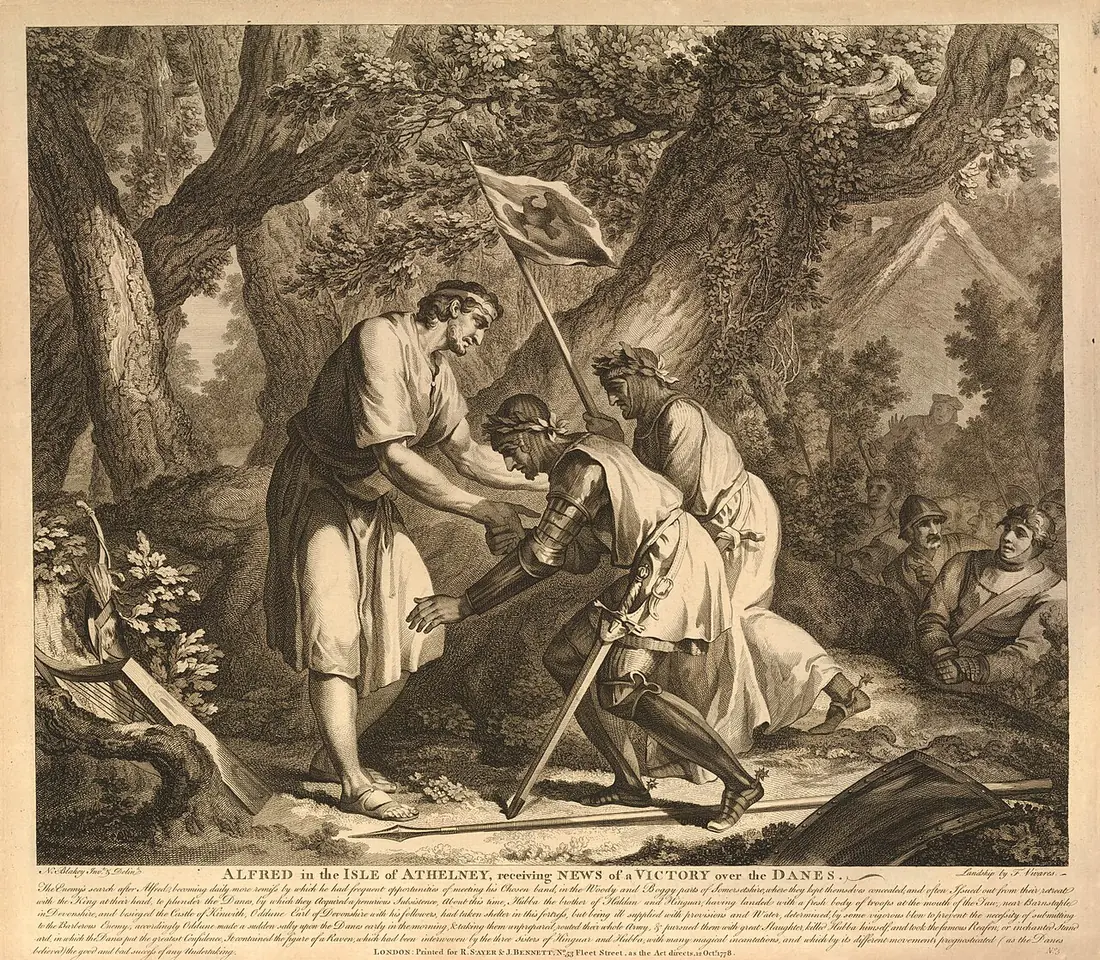
The vision of St. Cuthbert (traditional)
William of Malmesbury, writing in the 1120s, says Alfred liked to tell his friends in later years how he had escaped his dangers at Athelney "by the merits of St. Cuthbert." Alone one day while his men were out fishing, the king fell asleep, and the bishop of Lindisfarne appeared to him. "I am Cuthbert, if ever you heard of me," the saint said, and promised that God, "through the merits of her native saints," was looking on England with mercy. The men came back that day with a great catch of fish from a river locked in ice. A Durham tradition adds that Alfred had shared his last loaf with a poor pilgrim who turned out to be St. Cuthbert. These stories are traditional.

The baptism of Guthrum
In May 878 Alfred gathered the men of Somerset, Wiltshire and Hampshire and defeated the Danes at Edington. The Danish king, Guthrum, gave hostages and promised to accept baptism. Three weeks later, the Chronicle records, Guthrum came with about thirty of his chief men to Aller, near Athelney, "and there the king became his sponsor in baptism." Alfred kept the new Christian with him twelve nights and sent him away with gifts. A war ended with a king and his enemy kneeling together at the font.

A king who gave half to God
Asser describes the rest of Alfred's reign as a long effort to keep a vow. Having seen God repay his tithes many times over, the king "vowed humbly and faithfully to devote to God half his services, by day and by night, and also half of all the wealth" that came to him each year. He divided his income among the poor, the monasteries he founded, a school for noble and poorer boys alike, and churches in Wessex, Mercia and beyond.
To measure the time he had promised, he invented a clock. He had wax weighed against seventy-two pennies and made into six equal candles, each marked in twelve inches, which burned through a day and a night "before the sacred relics of many of God's elect, which always accompanied him wherever he went." When drafts made them burn unevenly, he had a lantern made of wood and thin plates of horn.

His love of Rome was practical. In 883, says the Chronicle, Pope Marinus sent King Alfred a relic of the True Cross, the lignum Domini, and Alfred sent alms to Rome, and even to the shrines of St. Thomas and St. Bartholomew in India. He founded a monastery at Athelney and a convent at Shaftesbury, where his daughter Æthelgivu became abbess.
The scholar king
The Viking raids had nearly wiped out learning in England. Alfred set out to repair it, bringing scholars from Mercia, Wales and the Continent, among them Archbishop Plegmund, Grimbald of Saint-Bertin and Asser himself. Then, in 887, at about thirty-nine, he began reading Latin himself on the feast of St. Martin, and soon he was translating. The Catholic Encyclopedia credits him with English versions of St. Gregory the Great's Pastoral Rule, Bede's Ecclesiastical History, Orosius's world history and Boethius's Consolation of Philosophy; the Dialogues of Gregory were translated at his command. Copies of his Pastoral Rule went out to the bishops, so that priests could learn to be shepherds in their own tongue. His law code, he wrote, gathered what was good in the old laws: "I durst not venture much of mine own to set down."

The Ashmolean Museum in Oxford keeps the Alfred Jewel, found in a field at North Petherton, a few miles from Athelney, in 1693. Its Old English inscription reads AELFRED MEC HEHT GEWYRCAN, "Alfred ordered me to be made," and the museum suggests it was the handle of an æstel, a pointer for following the text of a holy book.
His death and his grave
Alfred died on October 26, 899, about fifty years old. He was buried in the Old Minster at Winchester and moved soon after to the New Minster his son Edward built beside it. In 1110 the monks took his remains, with their relics, to their new Abbey of Hyde outside the city walls. Hyde was dissolved in 1538 and torn down, and the Victoria County History says his grave was probably destroyed when a county jail was built on the site in 1788.

How Alfred is honored today
Alfred's memory is strongest in England. Winchester, his capital, has his great statue. The Church of England lists him in its calendar on October 26 as "Alfred the Great, King of the West Saxons, Scholar." Orthodox Christians in Britain remember him on the feast of All Saints of Britain and Ireland, where Fr. Andrew Phillips describes him as the king who saved his land "from the heathen" and "greatly encouraged learning and monasticism." In the Catholic Church he has never been beatified or canonized, and there is no Catholic feast in his honor.
A prayer attributed to King Alfred
Old prayer collections preserve a prayer under Alfred's name. Its authorship can't be proven, but it is in the spirit of the man Asser knew. This is the text printed in Prayers of the Middle Ages:
Lord God Almighty, shaper and ruler of all creatures, we pray Thee for Thy great mercy, that Thou guide us better than we have done, towards Thee, and guide us to Thy will, to the need of our soul, better than we can ourselves. And steadfast our mind towards Thy will and to our soul's need. And strengthen us against the temptations of the devil, and put far from us all lust, and every unrighteousness, and shield us against our foes, seen and unseen. And teach us to do Thy will, that we may inwardly love Thee before all things, with a pure mind. For Thou art our maker and our redeemer, our help, our comfort, our trust, our hope; praise and glory be to Thee now, ever and ever, world without end. Amen.
Let us pray, with Alfred, for those who govern and for all who carry heavy burdens while sick or tired, that they may give their time and their gifts to God and find in Him their help and their hope.
Frequently asked questions
Is Alfred the Great a saint?
The Catholic Church has never canonized Alfred, and he has no feast in the Roman calendar. Some Orthodox Christians in Britain count him among the saints of the British Isles, and the Church of England remembers him on October 26 as "King of the West Saxons, Scholar." Many people call him St. Alfred out of admiration for his faith.
When is the feast of St. Alfred the Great?
October 26, the anniversary of his death in 899. The Anglo-Saxon Chronicle dates his death "six nights before the mass of All Saints." The Church of England keeps it as a lesser festival on that day.
What did Alfred the Great do for the Church?
He refounded religious life after the Viking raids, building a monastery at Athelney and a convent at Shaftesbury, where his daughter was abbess. He brought scholars from Mercia, Wales and the Continent, translated or had translated St. Gregory's Pastoral Care and Dialogues, Bede's history and Boethius, and sent his alms to Rome every year. Pope Marinus sent him a relic of the True Cross.
Did Alfred really burn the cakes?
Probably not. The story of the king who let a peasant woman's loaves burn while he hid in the marshes is not in Asser's life of Alfred. It came from a later source, the Annals of St. Neots, and cannot be traced to before the Norman Conquest. It is a traditional tale.
Where is Alfred the Great buried?
He was buried first in the Old Minster at Winchester, then moved to the New Minster his son built, and in 1110 to Hyde Abbey outside the city walls. The abbey was destroyed after 1538, and his grave was probably lost when a county jail was built on the site in 1788.
Sources
- Asser's Life of King Alfred, translated by Albert S. Cook (1906; Project Gutenberg). His book of psalms and prayers, his prayer for healing in Cornwall, daily Mass, the vow of half his time and wealth, the candle clock, Athelney and Shaftesbury; the editor's note on the cakes story
- The Anglo-Saxon Chronicle, translated by James Ingram (Project Gutenberg). Rome in 853, Athelney and Guthrum's baptism in 878, Pope Marinus's relic of the Cross and alms to Rome and India in 883, and the day of his death
- William of Malmesbury's Chronicle of the Kings of England, translated by J. A. Giles (Project Gutenberg). The vision of St. Cuthbert at Athelney
- Catholic Encyclopedia (1907): Alfred the Great
- Victoria County History, Hampshire, vol. 2: New Minster, or the Abbey of Hyde (British History Online). His burials at Winchester and the loss of his grave in 1788
- The Church of England: The Calendar (Common Worship)
- Fr. Andrew Phillips, The Synaxis of All Saints of Britain and Ireland (OrthoChristian.com, 2016)
- J. Manning Potts, ed., Prayers of the Middle Ages: Light from a Thousand Years (Project Gutenberg). The prayer attributed to Alfred