St. Neot, Hermit of Cornwall
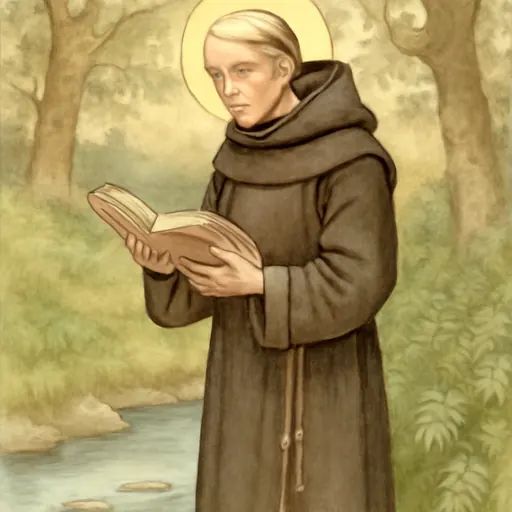
St. Neot was a ninth-century Anglo-Saxon monk of Glastonbury who became a hermit in Cornwall, at the place now called St. Neot. Tradition says he counseled King Alfred the Great. He died about 877, and his relics were later carried to Huntingdonshire, where the town of St. Neots still bears his name. We keep his feast on July 31.
Who was St. Neot?
St. Neot was a ninth-century Anglo-Saxon monk of Glastonbury Abbey who became a hermit in Cornwall. He lived in the wooded valley of the village that now bears his name, St. Neot, near Liskeard, and died there about 877. His name lives on twice over: in that Cornish village and in the market town of St. Neots in Cambridgeshire, where his relics were later taken. We keep his feast on July 31.
He was not a martyr, a bishop or a great founder. He was a humble monk who wanted to pray unseen, and whose holiness drew people to him anyway, King Alfred among them.
What we know and what we don't
The earliest mention of him is a single line in Asser's Life of King Alfred, written in 893. Asser tells how the young Alfred, out hunting in Cornwall, turned aside to pray in a church "in which St. Gueriir rests, and now St. Niot also rests there." The scholar W. H. Stevenson, who edited Asser in 1904, thought the words about Neot were added by a tenth-century copyist, but even so they show his body lay in Cornwall beside that older local saint.
Everything else comes from lives of St. Neot written from the late tenth century on, after his relics had been moved. A history of his parish published in 1906 counts eight medieval manuscript lives. They are lives of a saint, full of wonders, and we should read them as such.
His life according to tradition
The lives say Neot was born into a noble family of Wessex, and some later writers made him King Alfred's brother. He took the monk's habit at Glastonbury, became known for his learning and humility, and was ordained priest and made sacristan of the abbey.
He was remarkably small. When he said Mass he stood on an iron stool, which the monks of Glastonbury kept long afterward. One story says that a visitor once hammered at the locked abbey gate at midday, when the monks were resting. Neot ran to open it but could not reach the lock without his stool, until the lock slid down to the level of his belt.
Fearing praise, he left Glastonbury with one servant, Barius, for the hidden valley in Cornwall. After seven years as a hermit he went on pilgrimage to Rome and then came back to his cell. Disciples gathered around him, a little monastery grew up, and Neot became its abbot.
Counsel to King Alfred
The lives say that Alfred visited him often and took his counsel. Later writers, as the 1906 parish history admits, went much further and credited Neot with advising Alfred on schools and learning. We can't confirm any of this. The one sure link is Asser's story of Alfred praying at the church where Neot's body would lie.
The miracles and legends of St. Neot
All of these are traditional: they come from the medieval lives and were never examined by the Church.
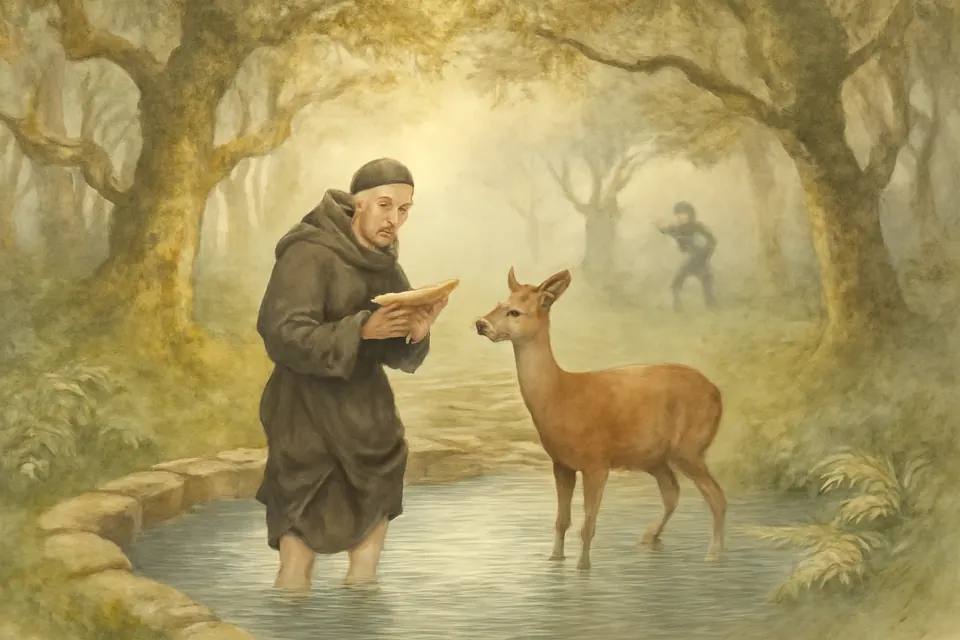
- The well and the psalter. Each day, the lives say, Neot stood in the cold water of a spring near his cell and recited the whole Psalter. One day a hunted doe ran to him and the hounds fell back; the huntsman gave up his horn and became a monk at Bodmin.
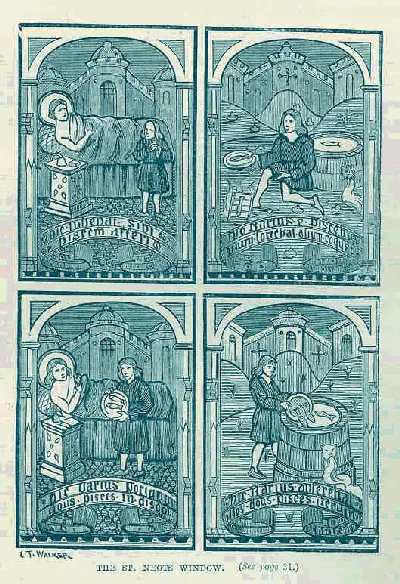
- The three fish. An angel showed him three fish in his well and told him to take only one a day. When Neot was ill, Barius cooked two to tempt him. Neot sent them back, prayed, and the fish were found alive and swimming. One fish, eaten as the angel had said, restored him to health.
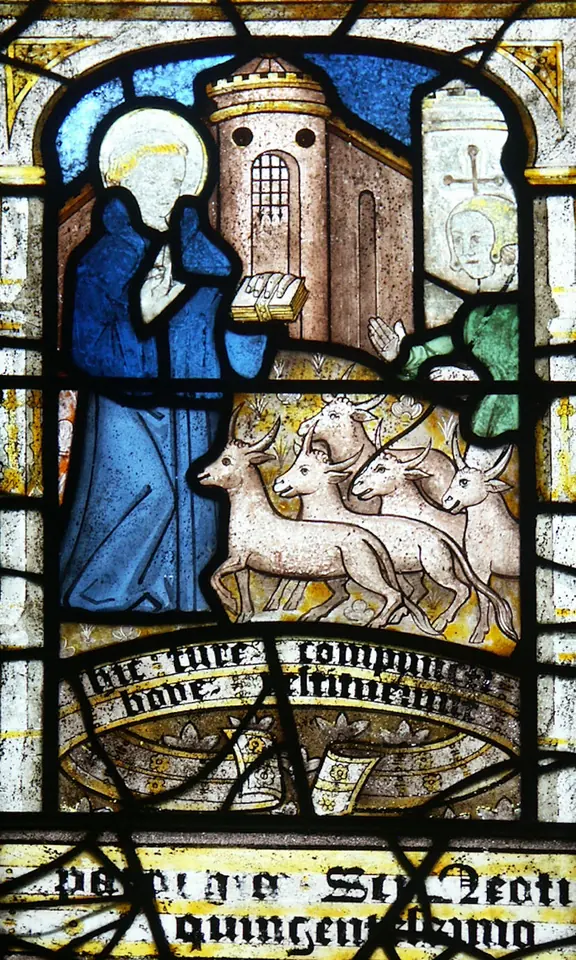
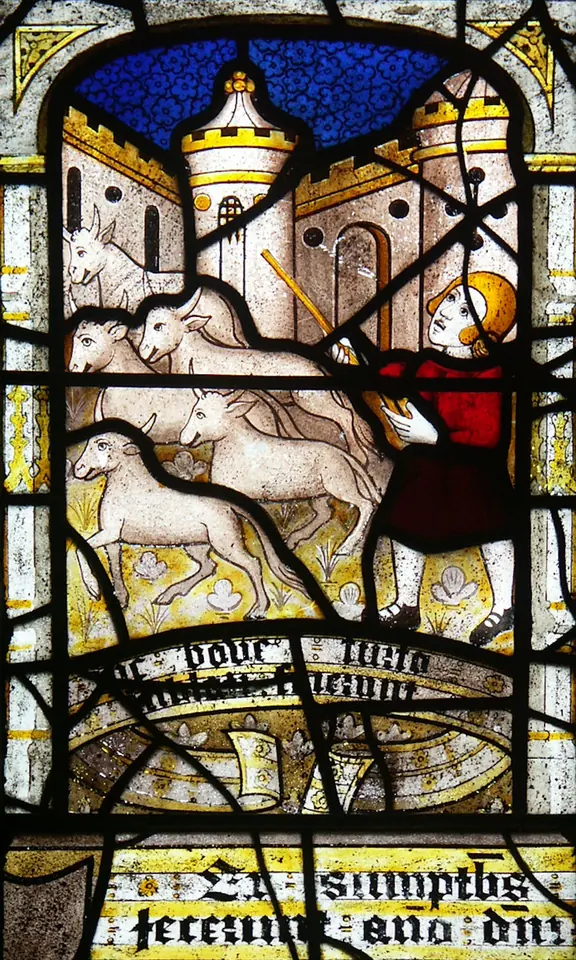
- The stags at the plow. When thieves stole the monastery's oxen, wild stags came out of the forest and let themselves be yoked to the plow. The thieves heard of it, brought back the oxen and became monks.
The St. Neot window
The parish church of St. Neot in Cornwall keeps one of the finest sets of late medieval stained glass in England. The St. Neot window tells his story in twelve scenes, each with a Latin inscription: his giving up a crown, his vows at Glastonbury, the doe at the well, the angel and the three fish, Barius's mistake and its undoing, the stolen oxen and the stags, and his blessing by the Pope in Rome. An inscription at the foot says it was given by "the young men of this parish" in 1528, only a few years before the Reformation reached Cornwall.
From Cornwall to St. Neots
Neot was buried in the church he had built in Cornwall. Later, a noble couple in Huntingdonshire, Earl Ethelric and his wife Ethelfleda, had his relics removed from Cornwall to their foundation at Ernulfsbury, now part of St. Neots. Stevenson, who calls it a "felonious transference," dates it to about the year 1000.
The priory and the town around it became St. Neots. The relics were later carried for a time to Crowland Abbey and brought back again. Medieval writers argued over whether all of the bones had ever left Cornwall. The priory was dissolved under Henry VIII, and nothing is known of the relics today.
Symbols of St. Neot in art
- Monk's habit: he is shown as a Benedictine monk, usually small and slight.
- Psalter or book: for his daily recitation of the psalms.
- The well with three fish: the clearest sign that the monk you are looking at is Neot.
- Stags: yoked to a plow, from the story of the stolen oxen.
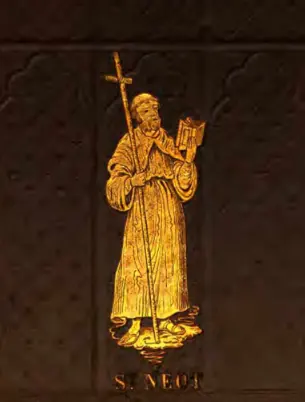
- Staff: a pilgrim's or abbot's staff, sometimes topped with a cross, as on the 1844 engraving.
Feast day, the holy well and prayer
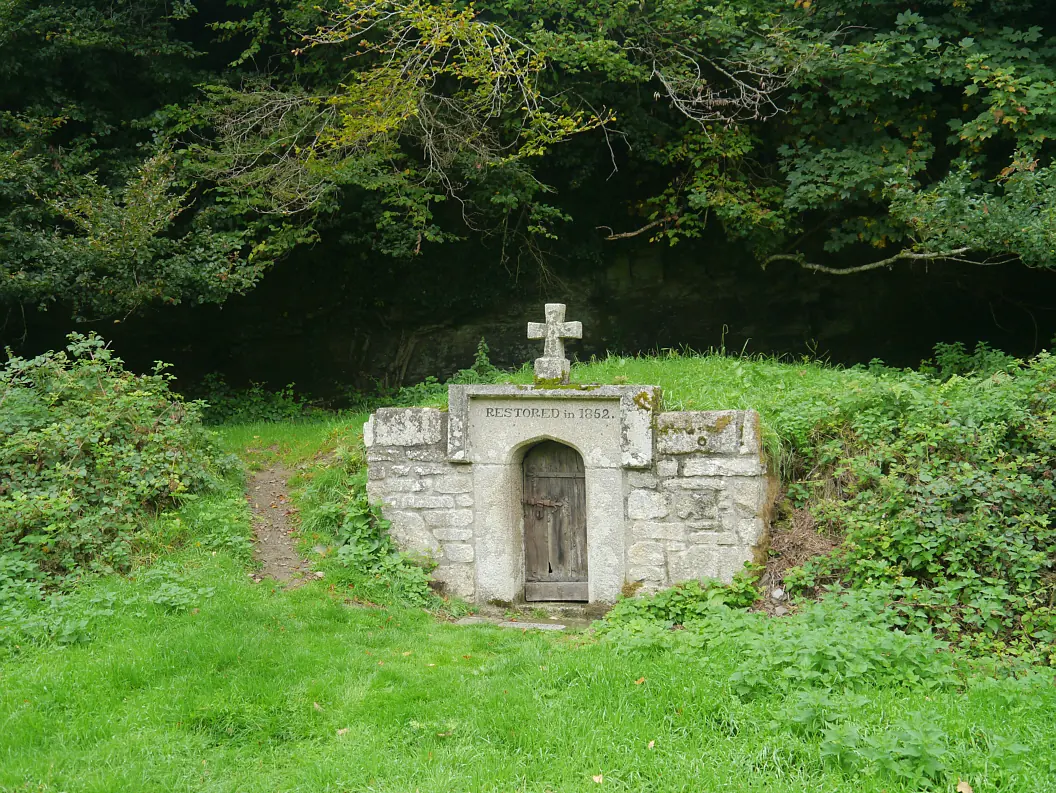
We keep the feast of St. Neot on July 31. His holy well, a quarter-mile west of the church at St. Neot, was restored in 1852; the 1906 history records that children were once brought from as far as Exeter to be bathed in it on the first three mornings of May. See the feast day calendar.
No traditional prayer to St. Neot has come down to us. In our own words, let us ask him to pray for us, that we may love to pray where no one sees, be content to be small, and take each day only the daily bread God gives.
Frequently asked questions
Who was St. Neot?
A monk of Glastonbury, remembered for his humility and his tiny stature, who became a hermit and later abbot of a small community in Cornwall in the ninth century. His legends are told in a famous stained-glass window of 1528 in the church of St. Neot, Cornwall.
When is St. Neot's feast day?
July 31, the day of his death about the year 877.
Is the town of St. Neots named after him?
Yes. His relics were taken from Cornwall to a new priory in Huntingdonshire around the year 1000, and the town that grew up around it became St. Neots, now in Cambridgeshire. The village of St. Neot in Cornwall, where he lived and was first buried, also bears his name.
What is the story of St. Neot and the fish?
According to his medieval lives, an angel showed him three fish in his well and told him to take only one a day, and the supply would never fail. When he was ill, his servant Barius cooked two; Neot sent them back to the well, where they came back to life. It is a legend, shown panel by panel in the St. Neot window.
Keep exploring
Sources
- W. H. Stevenson, ed., Asser's Life of King Alfred (Oxford, 1904), archive.org. Chapter 74 and the note on it: Alfred praying at the church where St. Gueriir rests, 'and now St. Niot also'; Stevenson dates the move of the relics to about 1000
- A Historical Sketch of the Parish of Saint Neot, Cornwall, including the Life of Saint Neot (1906), archive.org. The medieval lives, the legends of the lock, the fish and the stags, the feast on July 31, the holy well, and the twelve panels of the 1528 window with their inscriptions
- Descriptive Sketch of the Windows of the St. Neot Church in Cornwall (1844), archive.org