Venerable Stephen Ferrando
Stephen Ferrando (1895–1978) was an Italian Salesian priest who arrived in Shillong in 1923, became bishop of Shillong in 1935 and led the Church in Northeast India for 33 years. In 1942 he founded the Missionary Sisters of Mary Help of Christians, the region's first congregation of local women. Pope Francis declared him Venerable in 2016; he is not yet beatified.
Who was Stephen Ferrando?
Venerable Stephen Ferrando was a Salesian of Don Bosco who spent almost his whole priestly life in Northeast India. He came to Shillong as a new priest in 1923, trained the first Salesian novices in India, and from 1935 to 1969 was the bishop of Shillong, a diocese that then covered most of the region. He walked from village to village through forests, rice fields and rivers to reach his people, and in the worst years of World War II he founded a congregation of local sisters who carry his work on today.
The Church has recognized that he lived the Christian virtues to a heroic degree. Pope Francis approved the decree on March 3, 2016, and since then he has been called Venerable. He is not a saint or a blessed, and he has no feast day, but we may ask him privately to pray for us and pray for his beatification. You can read what these titles mean in Venerable and Servant of God.
Early life in Italy
Stephen Ferrando was born on September 28, 1895, in Rossiglione, a small town in the hills behind Genoa. He was the second of three children of Augustine Ferrando and Josephine Salvi. Later in life he summed up what his home had given him: "From my family I received a rich heritage; a great love for God and Madonna, spirit of sacrifice and a temperament inclined for joy."

His sisters' biography remembers him as a quiet, serene boy whom other children liked to tease, and who laughed at himself rather than take offense. In 1904 he went to the Salesian boarding school at Fossano, and from 1907 to 1909 he studied at Valdocco in Turin, the oratory St. John Bosco had founded. Many of the Salesians there had known Don Bosco himself, and the boy met men like Fr. Paul Albera and Blessed Philip Rinaldi. Don Bosco's motto, "Give me souls and take away the rest," became his own.

He entered the novitiate at Foglizzo in September 1911 and made his first profession on September 15, 1912. While he was a young teacher at Borgo San Martino, his superiors sent round a form asking each cleric what kind of work he hoped to do as a priest. Stephen wrote one word, in capital letters: MISSIONARY.

A soldier in World War I
Then the war came. Italy entered World War I in 1915, and Stephen spent the next four years at the front with the army's medical service. He was decorated with a silver medal for valor and promoted from sergeant to lieutenant. His sisters' biography calls him an "iron soldier" tested in the furnace of the war, and he kept a soldier's discipline all his life.
The war did not change his mind about the missions. After a year teaching at a Salesian school in Constantinople in 1919, he began theology, made his perpetual vows on December 26, 1920, and was ordained a priest on March 18, 1923.
Missionary to Assam
Soon after his ordination a letter came from Blessed Philip Rinaldi, then head of the Salesians, telling him to lead a group of young novices to the new mission of Assam. On December 2, 1923, he left Venice with one cleric and eight novices. They landed in Bombay on December 18 and reached Shillong on December 22, where it seemed the whole Catholic community had turned out to meet them. He later wrote: "I was happy to have given up that office, to be the Soldier of Christ, as the leader of a missionary group. Now I was leading a spiritual army."
Novice master in Shillong
The first Salesian novitiate in India opened in Shillong on January 20, 1924. When the first novice master fell ill, Fr. Ferrando took his place and held it for about ten years. "I have not yet learnt anything and yet I have to teach others already," he said. "The Lord continues to surprise me."
He did not keep his novices behind walls. He took them walking for miles to the villages, so that they learned the languages and customs of the people firsthand. The many peoples and languages of the hills moved him deeply; he called the mission "a real Pentecost."
Bishop of Krishnagar and of Shillong
On July 9, 1934, Pope Pius XI named him the first bishop of Krishnagar in Bengal, and he was consecrated on November 10, 1934. Within three months he had toured the whole diocese and drawn up a plan of work, in a year of floods, drought and food shortages. His stay was short. On November 26, 1935, the Pope transferred him to Shillong, the land he already thought of as his second home.
He made his solemn entry into Shillong on March 14, 1936. When he arrived, he knelt down and kissed the ground of his new diocese. He renewed the motto he had taken as a priest, On the Cross is Salvation, and set himself a goal for the whole region: "To lead the whole of North East India to Christ."
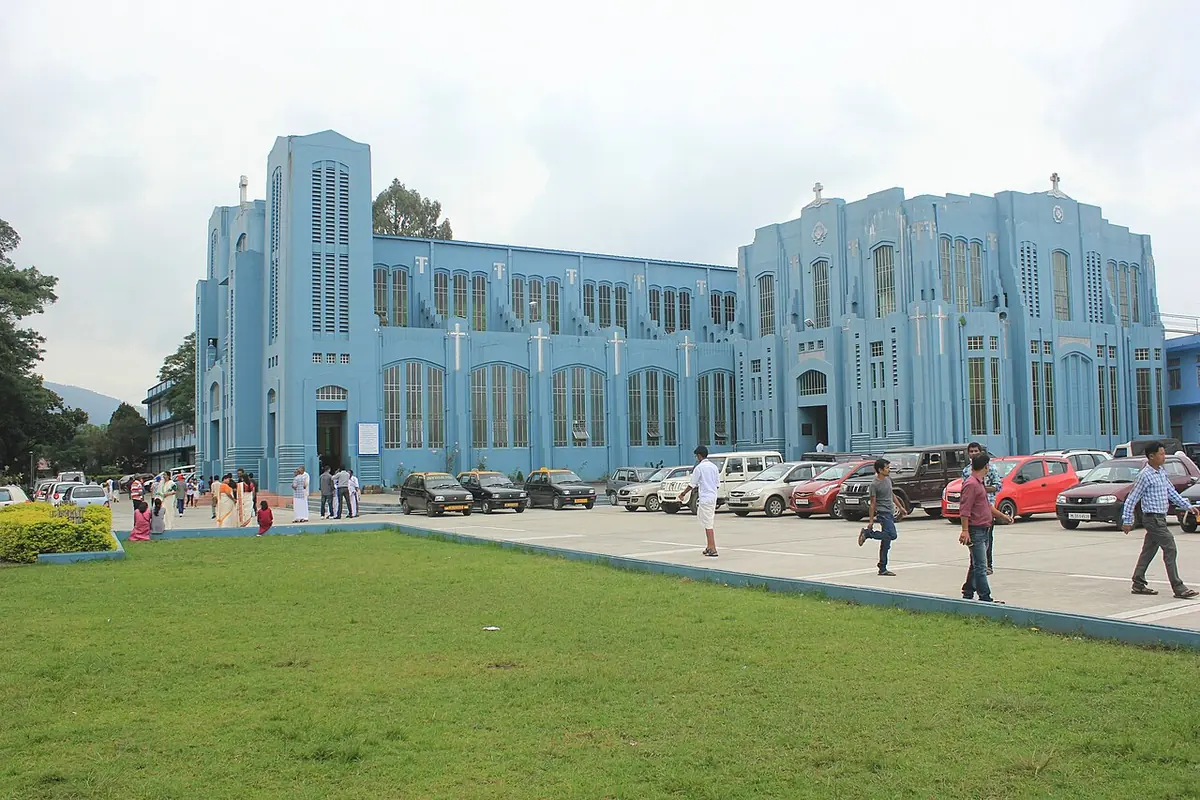
The cross came quickly. On Good Friday, April 10, 1936, a great fire struck the mission in Shillong, and the work of digging the foundations of a new cathedral began that May. The building, dedicated to Mary Help of Christians, rose slowly through the war years. It was dedicated on August 15, 1954, and Bishop Ferrando came back from Italy in the early 1970s to consecrate the finished church.
A bishop on foot
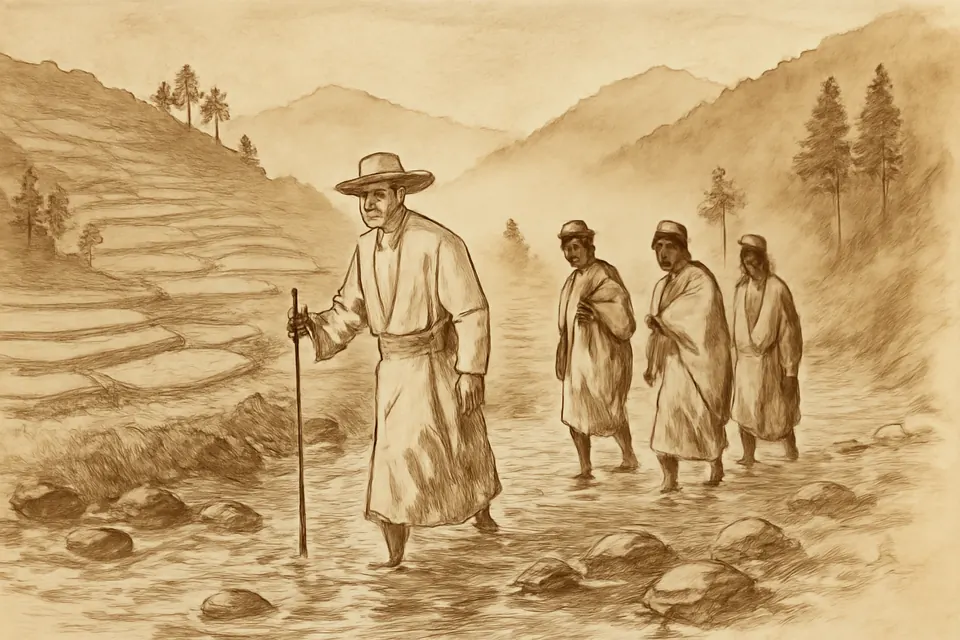
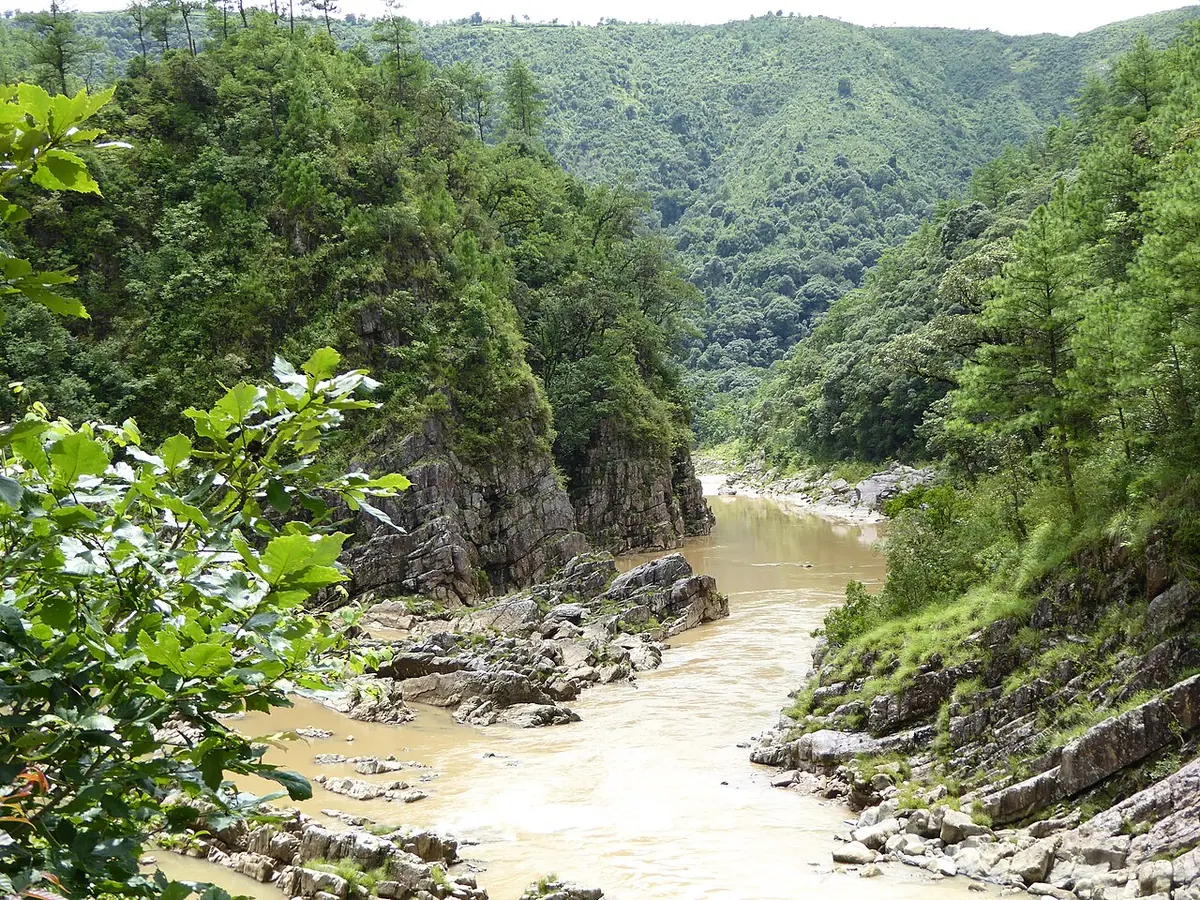
His sisters' biography describes how he visited his flock. He walked for miles through forests and paddy fields, waded rivers, crossed marshes in bad weather, fought off leeches and met wild animals on the way, and spent sleepless nights in village huts fighting the mosquitoes. In each village he heard confessions, taught, and visited the sick in their homes. The people loved him for it.
World War II and the founding of the sisters
When Italy entered World War II on the side of Germany, the British authorities in India interned the Italian and German missionaries who had been in the country less than sixteen years. The order came on February 11, 1942. Bishop Ferrando, who was allowed to stay, suddenly lost a large part of his clergy, his mission stations were left without priests and sisters, and the money from Europe stopped.
He drew a lesson from it: "This terrible war has shown us once again the need for indigenous clergy and to this purpose all our attention should be directed." On April 5, 1942, eight young women of the region received the postulant's medal, and on October 24, 1942, at Guwahati, they entered the novitiate of a new congregation, the Missionary Sisters of Mary Help of Christians. It was the first religious congregation of local women in Northeast India. The first eight sisters made their vows on December 8, 1944.
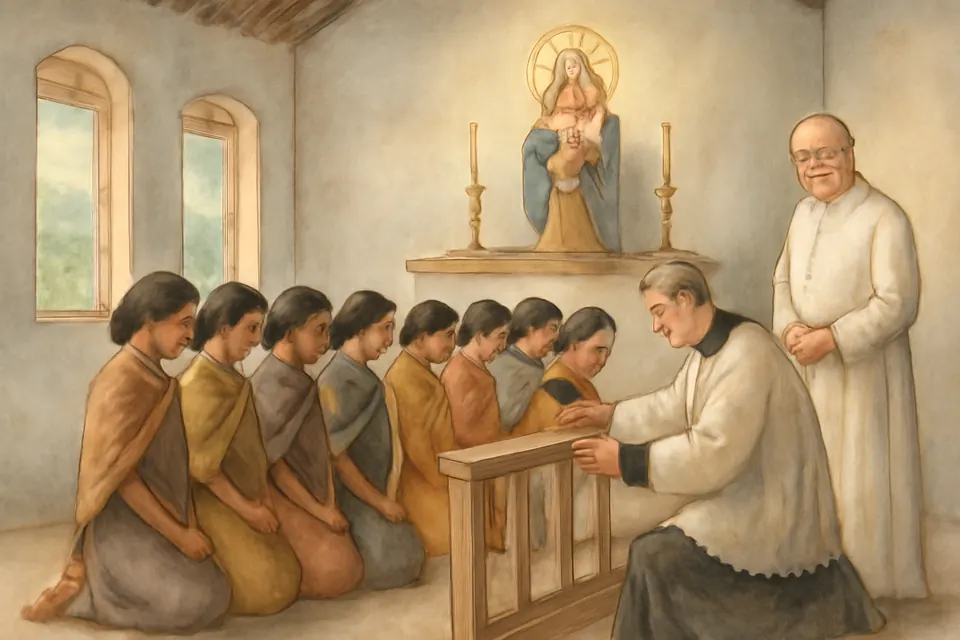
He gave them the work closest to his heart: to make known the love of Jesus, of Mary Help of Christians and of Don Bosco among the poor of the missions. The congregation now has more than 1,400 sisters from about 75 ethnic groups, in six provinces in India and in missions in Africa and Italy, and they still call him "Founder."
He worked just as hard for local priests. In 1962 he opened St. Paul's minor seminary in Shillong for boys of the region who hoped to become diocesan priests.
Leaving India
In 1969, at the age of 73, he resigned his diocese. Pope Paul VI named him titular archbishop of Troina, and he left India for Italy that October. Leaving was the hardest sacrifice of his life. When people in Italy asked how he could walk away after 47 years in Assam, he answered in 1970 that "the Church in India can now stand on its own two feet."
He went back once more, for the Salesians' golden jubilee in Assam, and then retired to the Salesian house at Quarto, near Genoa. He died there after a stroke on June 20, 1978. When a priest from Shillong visited him near the end, he left this message: "I want my bones to be buried in Khasi-Jaintia hills."
His sisters kept that wish. On December 3, 1987, his remains were brought from Italy to Shillong. A requiem Mass was sung in the cathedral on December 12, and he was laid to rest in a tomb in the chapel of St. Margaret's Convent, among the people he had served.
His cause for canonization
The diocesan inquiry into his life and virtues opened in Shillong in October 2003 and closed in August 2006. The evidence went to Rome, and on March 3, 2016, Pope Francis authorized the decree recognizing his heroic virtues. That made him Venerable. The next step, beatification, would need a miracle attributed to his intercession and approved after a medical and theological investigation. None has been approved yet.
A prayer for his canonization
The Missionary Sisters of Mary Help of Christians publish this prayer, which carries the ecclesiastical approval of Archbishop Dominic Jala of Shillong. Let us pray it with them:
Almighty and ever living God, in your merciful love you desire the salvation of all people. Down through the centuries you have called and appointed many men and women to be the heralds of the Good News, to the whole world. In your great love for the people of North East India you consecrated your humble Servant Bishop Stephen Ferrando as our Shepherd. Full of love and compassion for your people and with great zeal for your mission, he carried out your will in humility and simplicity and brought many people to your fold. Just as he did, we seek your will in everything and beg of you Heavenly Father, if it is your will, to raise him to the ranks of the Saints, that his example may draw us to live always in accordance with your will. We ask this in the name of Jesus your beloved Son. Amen.
Favors received through his intercession may be reported to the Postulation of the Cause, MSMHC Generalate, Little Flower Convent, Hatigaon, Guwahati, Assam, India. You may also want to read about St. Francis Xavier, patron of the missions in Asia, and St. Mother Teresa, who served the poor of Bengal in the same years.
Frequently asked questions
Is Stephen Ferrando a saint?
Not yet. Pope Francis approved the decree on his heroic virtues on March 3, 2016, which gave him the title Venerable. To be beatified he needs a miracle attributed to his intercession, and to be canonized, a second one. No miracle has been approved so far.
Who was Bishop Stephen Ferrando?
An Italian Salesian of Don Bosco, born in Rossiglione near Genoa in 1895. After serving as a medic in World War I he was ordained in 1923 and sent to Assam. He trained the first Salesian novices in India, was briefly bishop of Krishnagar in Bengal, and then was bishop of Shillong from 1935 to 1969.
What congregation did Stephen Ferrando found?
The Missionary Sisters of Mary Help of Christians (MSMHC), founded on October 24, 1942, at Guwahati, Assam. It was the first religious congregation of local women in Northeast India. Today it has more than 1,400 sisters from dozens of ethnic groups, working in India and abroad.
Where is Stephen Ferrando buried?
In the chapel of St. Margaret's Convent in Shillong, Meghalaya. He died in Italy in 1978, but he had asked to be buried in the Khasi-Jaintia hills, and in 1987 the sisters he founded brought his remains back to Shillong.
When did Stephen Ferrando die?
On June 20, 1978, at the Salesian house in Quarto, near Genoa, after a stroke. Some references give June 21, but the Salesians and his sisters give June 20.
How do I report a favor received through his intercession?
The postulation of his cause asks that favors and possible miracles be reported to the MSMHC Generalate, Little Flower Convent, Hatigaon, Guwahati, Assam, India.
Sources
- Missionary Sisters of Mary Help of Christians: Our Founder, Bishop Stephen Ferrando. His childhood, the "MISSIONARY" form, the 1923 journey, his motto, his words on indigenous vocations, his burial and the prayer for his canonization
- Salesian Missions: Stephen Ferrando (India). His appointments, his 1970 words about leaving Assam, and the diocesan inquiry (2003–2006)
- Vatican Radio: Pope advances Causes of Elizabeth of the Trinity, 11 others (March 4, 2016). The decree on his heroic virtues
- Bosco News Service: Missionary drive of MSMHC congregation on their 80th anniversary (2022). The founding on October 24, 1942, at Guwahati