Pentecost 2027
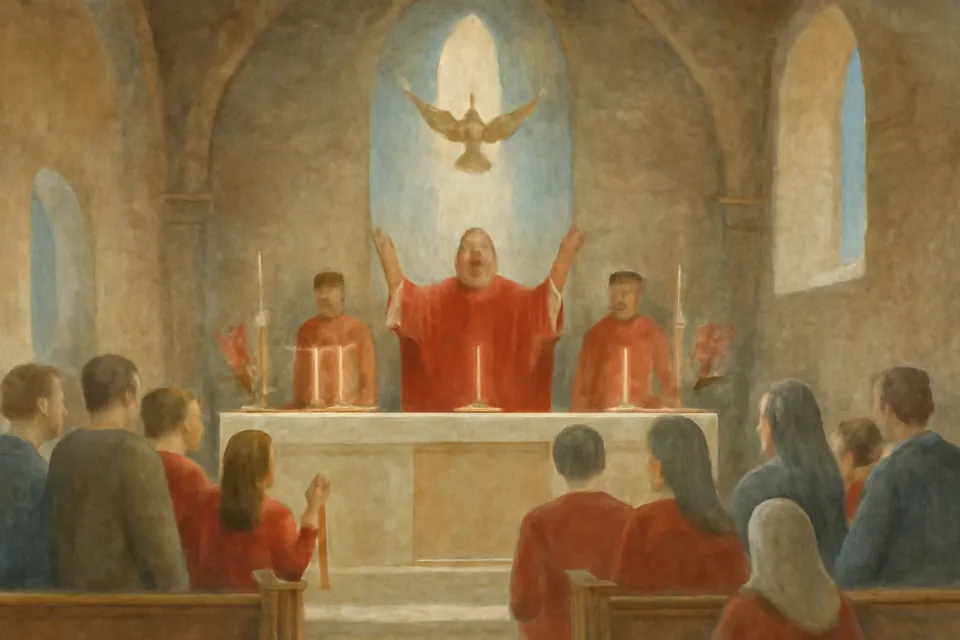
Pentecost 2027 is on Sunday, May 16, 2027, fifty days after Easter (March 28). The Vigil Mass is celebrated on the evening of Saturday, May 15, and the traditional novena to the Holy Spirit runs from Friday, May 7, to May 15. Pentecost closes the Easter season. Orthodox Pentecost falls on June 20, 2027.
Pentecost 2027 falls on Sunday, May 16, 2027. On that day the Church remembers the coming of the Holy Spirit on Mary and the apostles in Jerusalem, the day the Church went out to the world. Here are the dates around it, the story in Scripture, the novena that prepares for it, the two great hymns we sing to the Holy Spirit, and the customs that make it a feast.
Pentecost 2027 at a glance
- Easter Sunday: March 28, 2027
- The Ascension: Thursday, May 6, or Sunday, May 9, where it is transferred
- Novena to the Holy Spirit: Friday, May 7, through Saturday, May 15
- Vigil of Pentecost: Saturday evening, May 15
- Pentecost Sunday: May 16, 2027
- Mary, Mother of the Church: Monday, May 17
- Trinity Sunday: May 23
- Corpus Christi: Sunday, May 30, in the United States
- Sacred Heart of Jesus: Friday, June 4
- Orthodox Pentecost: June 20, 2027
How the date of Pentecost is set
Pentecost is the fiftieth day of Easter, counting Easter Sunday as the first. Its name is simply the Greek for "fiftieth." Since Easter 2027 is March 28, seven weeks of seven days bring us to Sunday, May 16. Pentecost therefore moves every year with Easter, and can fall anywhere from May 10 to June 13.
The feast had a Jewish name and date before it had a Christian one. Pentecost was the Greek name for Shavuot, the Feast of Weeks, the harvest feast seven weeks after Passover (Exodus 34:22, Deuteronomy 16:10). That is why Jerusalem was crowded with pilgrims "out of every nation under heaven" on the morning the Holy Spirit came. The Catholic Encyclopedia notes that the English name Whitsunday comes "from the white garments which were worn by those who were baptised during the vigil," since the Church once baptized on the eve of Pentecost as on the eve of Easter.
The Orthodox churches count the same fifty days from their own Easter, which in 2027 is May 2, so their Pentecost is June 20.
What happened at Pentecost: Acts 2
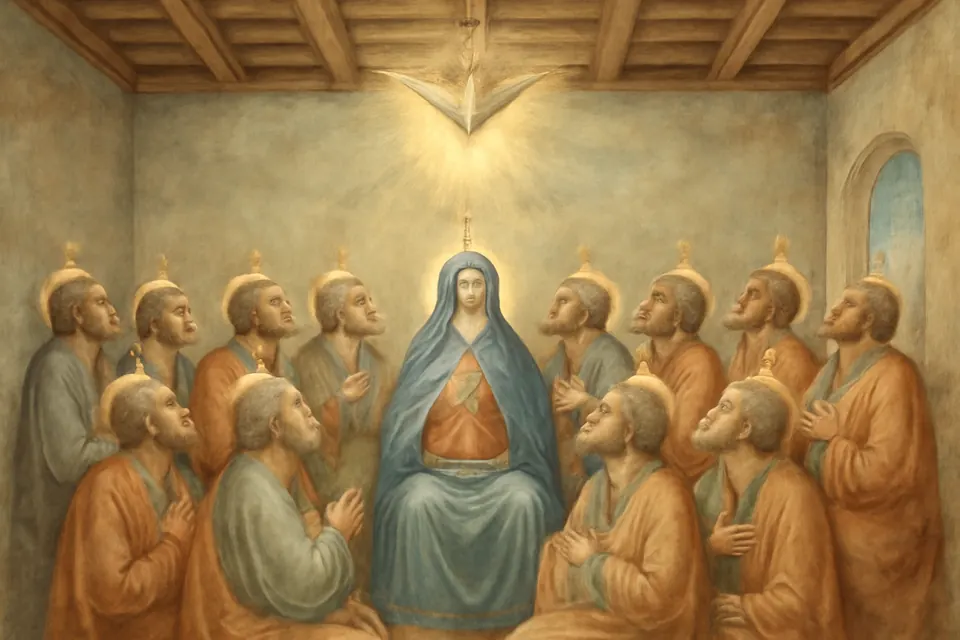
Ten days after the Ascension, the apostles were still in the upper room in Jerusalem, where they had "persevered with one mind in prayer with the women, and Mary the mother of Jesus" (Acts 1:14). St. Luke tells what happened next. This is the Douay-Rheims translation:
And when the days of the Pentecost were accomplished, they were all together in one place:
And suddenly there came a sound from heaven, as of a mighty wind coming, and it filled the whole house where they were sitting.
And there appeared to them parted tongues as it were of fire, and it sat upon every one of them:
And they were all filled with the Holy Ghost, and they began to speak with divers tongues, according as the Holy Ghost gave them to speak. (Acts 2:1–4)
The crowd heard the apostles speak, "every man ... in his own tongue," and some mocked them as drunk. Then St. Peter, the fisherman who had denied the Lord seven weeks before, stood up with the eleven and preached the first Christian sermon: "For these are not drunk, as you suppose, seeing it is but the third hour of the day" (Acts 2:15). He told them that the crucified Jesus was risen and called them to repentance and baptism. "There were added in that day about three thousand souls" (Acts 2:41).
For this reason we call Pentecost the birthday of the Church. The Spirit Christ had promised at the Last Supper came down, and the frightened disciples became witnesses. The tongues of Babel, which scattered mankind, were reversed: one message was understood in every language.
Mary at Pentecost
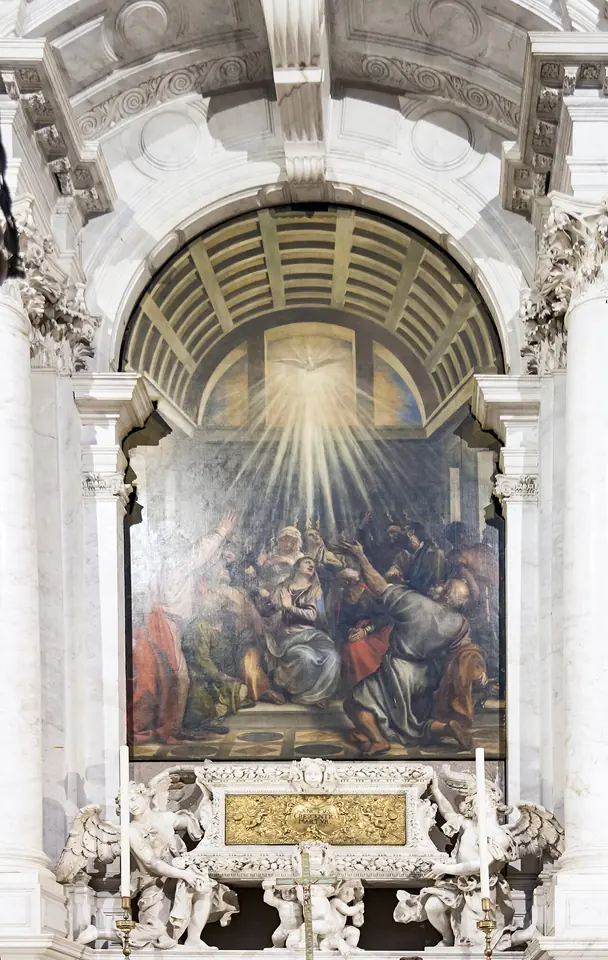
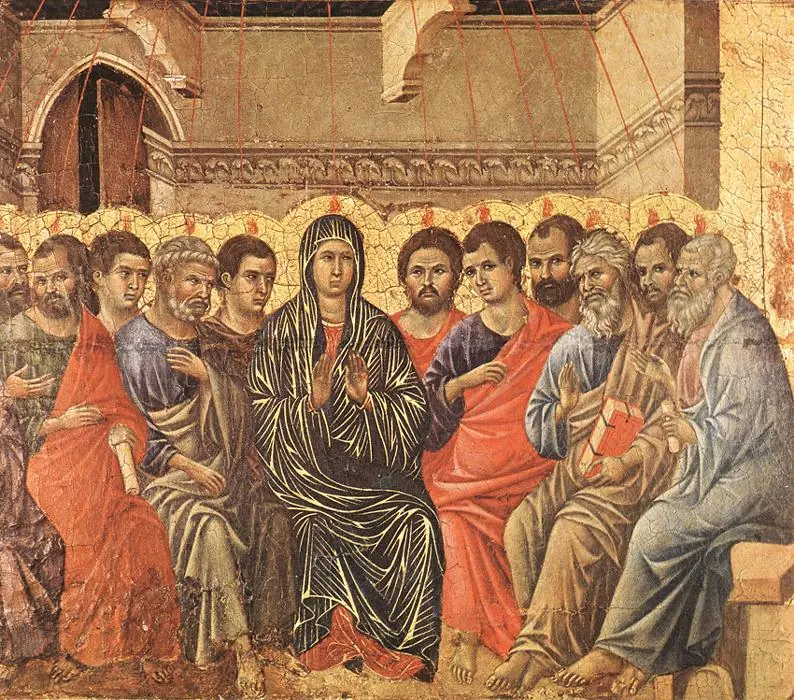
Scripture's last mention of the Blessed Virgin Mary shows her at prayer with the apostles, waiting for the Spirit. Christian art nearly always puts her at the center of the Pentecost scene, as in the Rabbula Gospels and Titian's great altarpiece in Venice. In 2018 Pope Francis added the memorial of the Blessed Virgin Mary, Mother of the Church, to the General Roman Calendar on the Monday after Pentecost. In 2027 it falls on May 17.
The novena to the Holy Spirit, May 7 to 15
The Pentecost novena is the oldest novena of all. After the Ascension the apostles returned to Jerusalem and prayed together for nine days, as the Lord had told them to "wait for the promise of the Father" (Acts 1:4). Every novena the Church has prayed since takes its pattern from those nine days.
In 1897 Pope Leo XIII made the custom universal. In his encyclical on the Holy Spirit, Divinum Illud Munus, he wrote: "We decree and command that throughout the whole Catholic Church, this year and in every subsequent year, a Novena shall take place before Whit-Sunday, in all parish churches." He allowed those who could not get to church to make the novena privately.
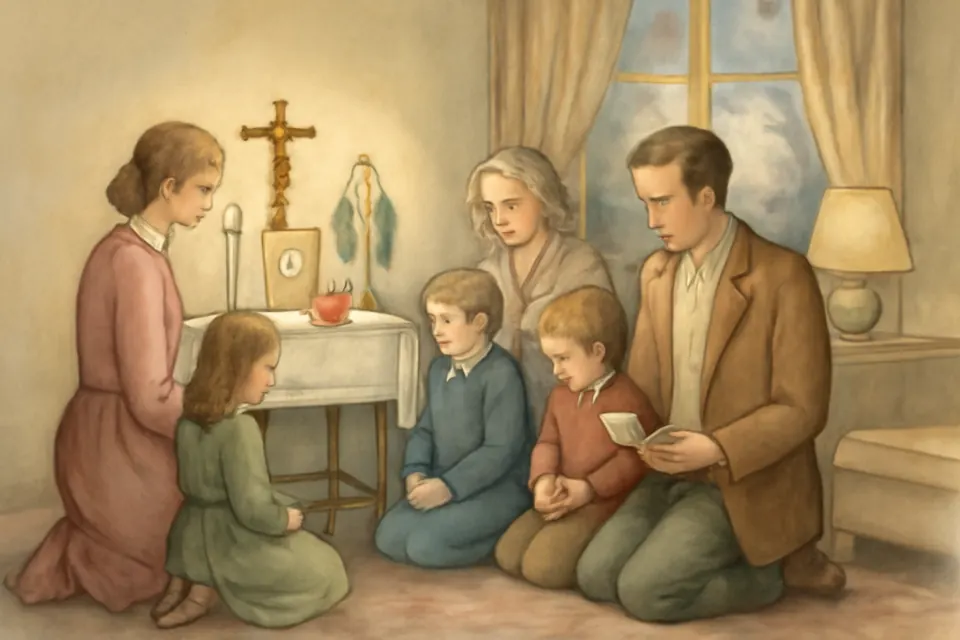
In 2027, begin on Friday, May 7, the day after Ascension Thursday, and finish on Saturday, May 15, the eve of Pentecost. Most families use the Veni Creator or the Veni Sancte Spiritus below as the daily prayer, often with a decade of the rosary and a prayer for one of the seven gifts each day. Let us pray it together this year, asking the Holy Spirit to renew in us the grace of our Confirmation. For how novenas work and others you can pray through the year, see our guide to novenas.
Veni Sancte Spiritus: the Pentecost sequence
Before the Gospel on Pentecost Sunday the Church sings the sequence Veni, Sancte Spiritus, "Come, Holy Spirit." Medieval writers called it the Golden Sequence. It is one of only two sequences that are required in the Roman Rite today, the other being the Easter sequence. Its author is uncertain. The Catholic Encyclopedia judges that the strongest claim is Pope Innocent III's, on the word of the monk Ekkehard V of St. Gall, writing about 1220; others have named Stephen Langton, Archbishop of Canterbury, or King Robert II of France.
The Latin opens:
Veni, Sancte Spiritus, Et emitte coelitus Lucis tuae radium.
This is the English translation by Edward Caswall, from his Lyra Catholica of 1849, the version the Catholic Encyclopedia names as the most popular of all:
Holy Spirit! Lord of light! From thy clear celestial height, Thy pure beaming radiance give:
Come, Thou Father of the poor! Come, with treasures which endure! Come, Thou Light of all that live!
Thou, of all consolers best, Visiting the troubled breast, Dost refreshing peace bestow;
Thou in toil art comfort sweet; Pleasant coolness in the heat; Solace in the midst of woe.
Light immortal! light divine! Visit Thou these hearts of thine, And our inmost being fill:
If Thou take thy grace away, Nothing pure in man will stay; All his good is turn'd to ill.
Heal our wounds—our strength renew; On our dryness pour thy dew; Wash the stains of guilt away:
Bend the stubborn heart and will; Melt the frozen, warm the chill; Guide the steps that go astray.
Thou, on those who evermore Thee confess and Thee adore, In thy sevenfold gifts, descend:
Give them comfort when they die; Give them life with Thee on high; Give them joys which never end.
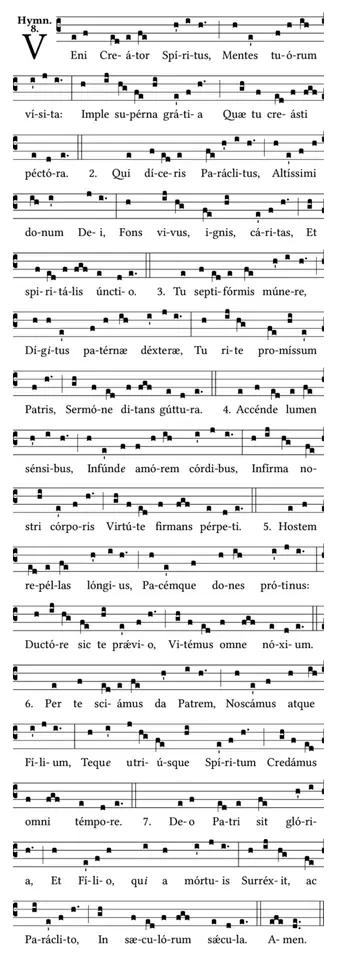
Veni Creator Spiritus
The second great hymn of Pentecost is older. The Veni Creator Spiritus is usually credited to Rabanus Maurus, abbot of Fulda and archbishop of Mainz, who died in 856; the Catholic Encyclopedia finds the manuscript evidence in his favor. It is sung at Terce on Pentecost because the Spirit came "at the third hour," and the Church also sings it whenever she asks for the Spirit's guidance: at the election of a pope, at the ordination of priests and bishops, at the dedication of a church, at councils and synods. At the council of Reims in 1049, with Pope Leo IX presiding, it was sung to open the third session.
This is Caswall's translation from Lyra Catholica (1849):
Come, O Creator Spirit blest! And in our souls take up thy rest; Come, with thy grace and heavenly aid, To fill the hearts which Thou hast made.
Great Paraclete! to Thee we cry: O highest gift of God most high! O fount of life! O fire of love! And sweet Anointing from above!
Thou in thy sevenfold gifts art known; Thee Finger of God's hand we own; The promise of the Father Thou! Who dost the tongue with pow'r endow.
Kindle our senses from above, And make our hearts o'erflow with love; With patience firm, and virtue high, The weakness of our flesh supply.
Far from us drive the foe we dread, And grant us thy true peace instead; So shall we not, with Thee for guide, Turn from the path of life aside.
Oh, may thy grace on us bestow The Father and the Son to know, And Thee through endless times confess'd Of Both th' eternal Spirit blest.
All glory while the ages run Be to the Father, and the Son Who rose from death; the same to Thee, O Holy Ghost, eternally.
The seven gifts of the Holy Spirit
Both hymns pray for the Spirit's "sevenfold gifts." The list comes from Isaiah's prophecy of the Messiah (Isaiah 11:2–3): wisdom, understanding, counsel, fortitude, knowledge, piety and fear of the Lord. The Church teaches that every baptized person receives them, and that Confirmation strengthens them, which is why Pentecost is a natural day to pray for those preparing for that sacrament (see our Confirmation saints guide). Many families pray for one gift on each of the first seven days of the novena.
Why the color red?
On Pentecost the priest wears red, and so do many of the faithful. Red recalls the tongues of fire and the burning love of the Holy Spirit; the Catholic Encyclopedia gives both reasons. It is the same color the Church uses for martyrs, since it was the Spirit who gave the apostles courage to die for Christ. In Italy the day was called Pascha rossa, "red Easter," for the color of the vestments.
Pentecost customs
The old customs of the feast tried to make the Acts 2 story visible and audible. The Catholic Encyclopedia records that in Italian churches rose petals were scattered from the ceiling to recall the tongues of fire, so that in Sicily the feast was called Pascha rosatum, "Easter of roses." In Rome the custom survives at the Pantheon, where red petals fall through the open oculus at the end of the Pentecost Mass. In France trumpets were blown during the liturgy to recall the "mighty wind." In England Whitsun was a week of holidays, fairs and processions, and in Russia people carried flowers and green branches to church.
Some customs are simpler and easy to keep at home: a red tablecloth and a dove-shaped cake, a birthday cake for the Church, or a red candle on the family altar during the novena.

Pentecost in the Eastern churches
In the Byzantine tradition, Pentecost is also Trinity Sunday. Churches and homes are decorated with green branches and flowers, and at Vespers of the feast the faithful kneel for the first time since Easter for the long Kneeling Prayers. The Pentecost icon shows the apostles in a semicircle, often with an empty place in the middle for Christ, and below them an old crowned king called Kosmos, the world, holding twelve scrolls: the world waiting for the apostles' preaching.

Saints of Pentecost
Several saints are bound up with this feast. St. Peter preached its first sermon. St. Luke wrote the account of it in the Acts of the Apostles. St. Philip Neri was praying in the catacomb of San Sebastiano a few days before Pentecost in 1544 when, his biographers write, a globe of fire seemed to enter his heart, a reported grace he carried for the rest of his life. St. Seraphim of Sarov taught that "the acquisition of the Holy Spirit" is the whole aim of the Christian life. And the twelve themselves, whose stories and deaths are told in the 12 apostles and how the apostles died, went out from that room to the ends of the earth.
Come, Holy Spirit, fill the hearts of your faithful, and kindle in them the fire of your love. To see where Pentecost fits in the year, see feast days and the Church calendar and the holy days of obligation for 2027.
Frequently asked questions
When is Pentecost 2027?
Pentecost 2027 is Sunday, May 16, 2027. It comes fifty days after Easter Sunday, counting Easter as the first day, and Easter 2027 is March 28. The Vigil Mass of Pentecost is on the evening of Saturday, May 15.
When is Orthodox Pentecost 2027?
Orthodox Pentecost (Trinity Sunday in the Eastern churches) is June 20, 2027, fifty days after Orthodox Easter on May 2.
When should I start the Pentecost novena in 2027?
Begin on Friday, May 7, 2027, the day after Ascension Thursday, and pray one day each through Saturday, May 15, the eve of Pentecost. If your diocese moves the Ascension to Sunday, May 9, the novena still keeps its traditional dates.
Why do Catholics wear red on Pentecost?
Red is the liturgical color of the day, recalling the tongues of fire that came down on the apostles and the fire of God's love. Many parishes ask the faithful to wear red to Mass as well.
Is Pentecost a holy day of obligation?
Pentecost always falls on a Sunday, so the Sunday obligation applies. It is one of the greatest solemnities of the year and closes the fifty days of Easter.
What is the sequence for Pentecost?
The sequence is the Veni Sancte Spiritus, "Come, Holy Spirit," sung or recited before the Gospel. It is one of only two sequences the Church requires, the other being the Easter sequence.
What day is Pentecost Monday 2027?
Monday, May 17, 2027. Since 2018 the Church keeps that day as the memorial of the Blessed Virgin Mary, Mother of the Church.
Sources
- Douay-Rheims Bible: Acts of the Apostles, chapter 2
- Leo XIII, Divinum Illud Munus (1897), on the Holy Spirit, decreeing the annual novena before Pentecost
- Catholic Encyclopedia: Pentecost (Whitsunday)
- Catholic Encyclopedia: Veni Creator Spiritus
- Catholic Encyclopedia: Veni Sancte Spiritus
- Edward Caswall, Lyra Catholica (London, 1849), source of both English hymn texts