54 day rosary novena
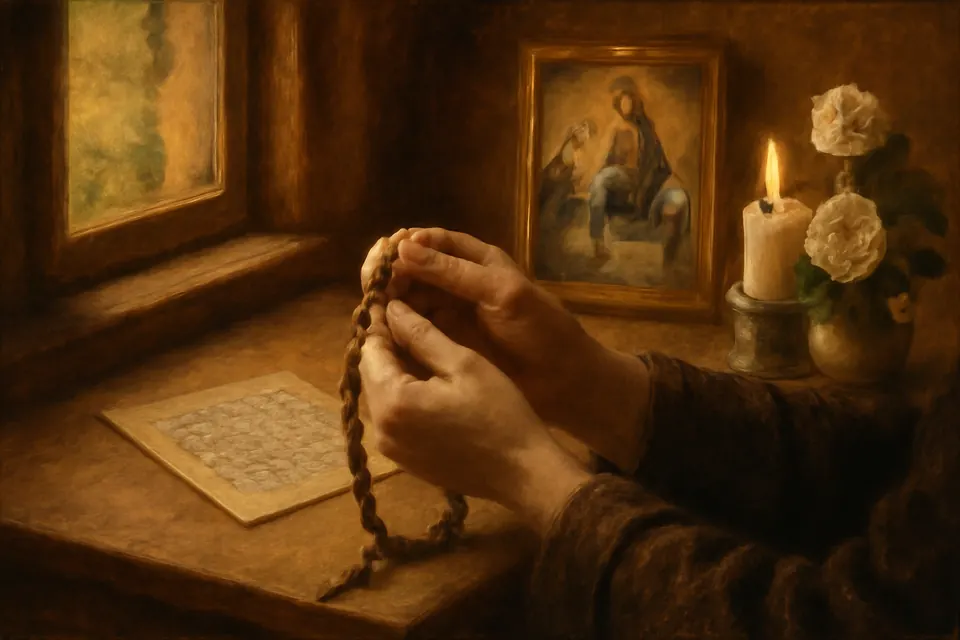
The 54 day rosary novena is six novenas of the rosary prayed back to back: five decades a day for 27 days in petition, then 27 days in thanksgiving, whether or not the favor has come. It traces to an apparition of Our Lady of the Rosary of Pompeii reported in Naples in 1884 by a sick girl, Fortuna Agrelli.
Fifty-four days is a long time to pray for one thing. That is part of the point. The 54 day rosary novena asks us to keep knocking for nearly eight weeks, and then, before we know the answer, to spend half that time saying thank you.
The 54 day rosary novena prayers
The novena itself is simply the rosary: five decades a day. The form most people use comes from Charles V. Lacey's booklet Rosary Novenas to Our Lady, first published by Benziger in New York in 1926. Before each day's rosary, after the Sign of the Cross and a Hail Mary, Lacey's booklet has this offering. This is the version for the Joyful Mysteries:
In petition
>
Hail, Queen of the Most Holy Rosary, my Mother Mary, hail! At thy feet I humbly kneel to offer thee a Crown of Roses, snow-white buds to remind thee of thy joys, each bud recalling to thee a holy mystery; each ten bound together with my petition for a particular grace.
>
O Holy Queen, dispenser of God's graces, and Mother of all who invoke thee! thou canst not look upon my gift and fail to see its binding. As thou receivest my gift, so wilt thou receive my petition; from thy bounty thou wilt give me the favor I so earnestly and trustingly seek.
>
I despair of nothing that I ask of thee. Show thyself my Mother!
In thanksgiving
>
Hail, Queen of the Most Holy Rosary, my Mother Mary, hail! At thy feet I gratefully kneel to offer thee a Crown of Roses, snow-white buds to remind thee of thy joys, each bud recalling to thee a holy mystery; each ten bound together with my petition for a particular grace.
>
O Holy Queen, dispenser of God's graces, and Mother of all who invoke thee! thou canst not look upon my gift and fail to see its binding. As thou receivest my gift, so wilt thou receive my thanksgiving; from thy bounty thou hast given me the favor I so earnestly and trustingly sought.
>
I despaired not of what I asked of thee, and thou hast truly shown thyself my Mother.
On Sorrowful days the "snow-white buds" become "blood-red roses to remind thee of the passion of thy divine Son," and on Glorious days "full-blown roses." After the five decades, Lacey's booklet has a Spiritual Communion and then this offering:
In petition: Sweet Mother Mary, I offer thee this Spiritual Communion to bind my bouquets in a wreath to place upon thy brow. O my Mother! look with favor upon my gift, and in thy love obtain for me (name your request). Hail Mary...
>
In thanksgiving: Sweet Mother Mary, I offer thee this Spiritual Communion to bind my bouquets in a wreath to place upon thy brow in thanksgiving for (name your request) which thou in thy love hast obtained for me. Hail Mary...
The booklet ends each day with the closing rosary prayer, "O God, whose only-begotten Son...", printed in full on our page on how to pray the rosary.

How to pray the 54 day novena
- Choose your intention and write it down, with the date you begin.
- Days 1 to 27, in petition. Pray five decades of the rosary each day, with the petition offering before and after.
- Days 28 to 54, in thanksgiving. Go straight on, with no break, and pray the same rosary with the thanksgiving offering, whether or not your prayer has been answered.
- Rotate the mysteries. Lacey's method is Joyful on the first day, Sorrowful on the second, Glorious on the third, and around again, so each set is prayed eighteen times. If you prefer, follow the weekday schedule of the Joyful, Luminous, Sorrowful and Glorious Mysteries.
Lacey's own advice still holds: "A laborious Novena, but a Novena of Love." He wrote that if the favor does not come, "be assured that the Rosary Queen, who knows what each one stands most in need of, has heard your prayer." And he urged frequent Holy Communion along the way.
Where the 54 day novena comes from
The novena rests on a story from Naples in 1884, and it is a reported apparition: the Church never examined it formally, and the books that first told it in English say so themselves.
Lacey prints the account as he found it in an earlier booklet, The Rosary, My Treasure, from the Benedictine convent at Clyde, Missouri. Fortuna Agrelli, the daughter of a Neapolitan officer called Commander Agrelli, had suffered for thirteen months from "dreadful sufferings and torturous cramps," and the best doctors had given her up. On February 16, 1884, she and her family began a novena of rosaries. On March 3, the account continues, the Queen of the Holy Rosary appeared to her, seated on a high throne with the Child on her lap and a rosary in her hand, with St. Dominic and St. Catherine of Siena beside her. Fortuna begged to be cured. The Virgin answered that because the girl had called her "Queen of the Holy Rosary," a title "most precious and dear to me," she could not refuse: "Make three novenas, and thou shalt obtain all." In a second appearance she gave the rule that became the 54 day novena: "Whoever desires to obtain favors from me should make three novenas of the prayers of the Rosary, and three novenas in thanksgiving." Fortuna, the account says, was healed.

Bartolo Longo and the Pompeii periodical
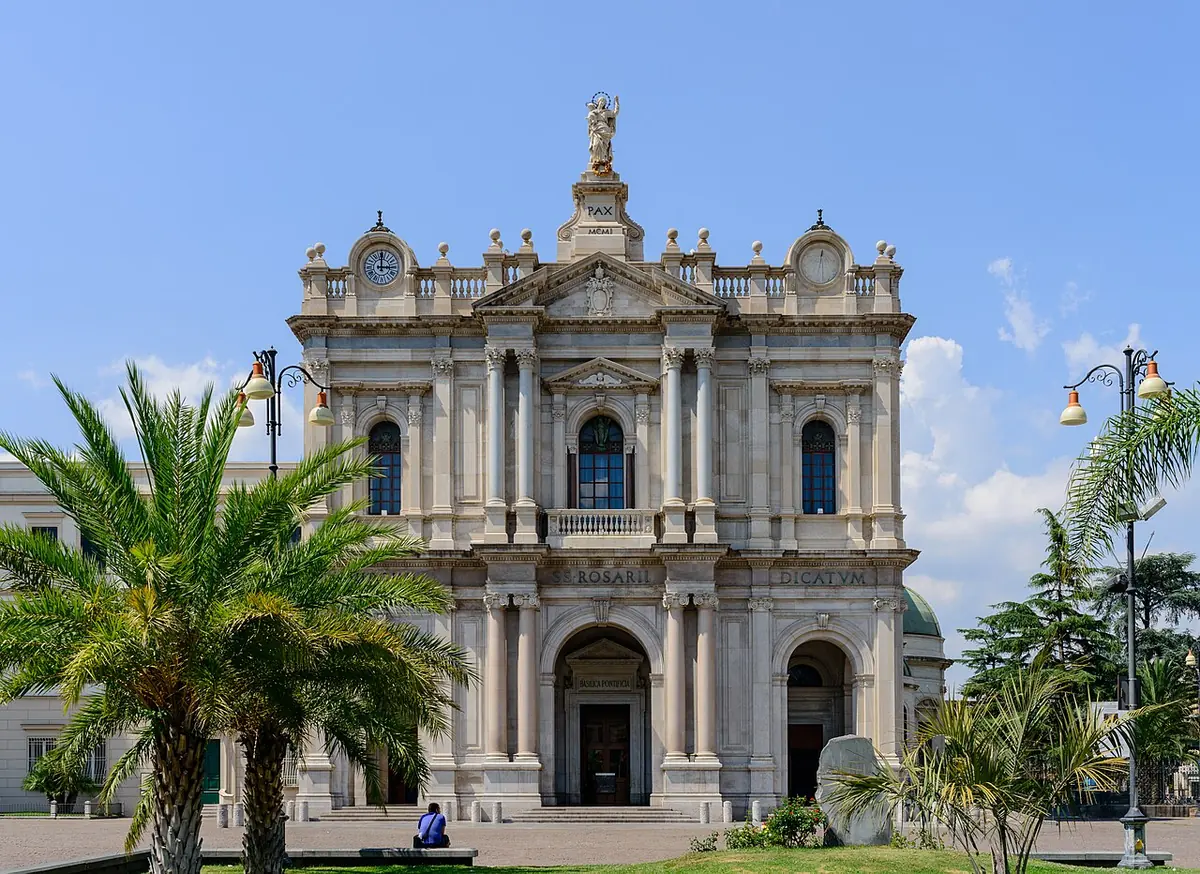
The story spread through St. Bartolo Longo, the lawyer from Apulia who had dabbled in spiritualism, came back to the faith, and from 1872 gave his life to spreading the rosary in the valley of Pompeii. With Countess Marianna De Fusco, whom he later married, he built the Shrine of Our Lady of the Rosary there around an old, worn painting of the Virgin with St. Dominic and St. Catherine that a Dominican in Naples had given him. The shrine's corner stone was laid on May 8, 1876.
A shrine booklet by Fr. J. W. Levaux, printed at Valle di Pompei in the 1890s with its rights reserved to Longo, says that the Virgin spoke to "Fortunatina Agrelli" in 1884 and that Longo's periodical, Il Rosario e la Nuova Pompei, published the account, after which "very many people" made the novena and reported graces. Lacey's source adds that the cure moved Pope Leo XIII, who in those years wrote encyclical after encyclical urging the rosary.

What the Church says
Both early books carry the protest required by the decrees of Pope Urban VIII. Lacey writes that "no higher authority is claimed than that which is due to all authentic human testimony," and Levaux that what is said "about miracles and apparitions, has but human authority." That is the honest status of the Agrelli apparition today: a reported grace, never formally approved or rejected. The novena itself is simply the rosary, which the Church has commended for centuries, and Lacey's booklet has been reprinted with an imprimatur since 1926. St. John Paul II called Longo "a true apostle of the Rosary" in Rosarium Virginis Mariae and borrowed his image of the beads as a "chain" that links us to God.
A novena of trust
Many people begin the 54 day novena for something heavy: a sick child, a marriage, a job, a soul far from God. The thanksgiving half is what makes it different from other novenas. We thank Our Lady before we know how God will answer, as an act of trust that He has heard us and will give what is best. Let us ask the Queen of the Holy Rosary to pray for us, today and every one of the fifty-four days. For other prayers of this kind, see our novenas, and for the October 7 feast, Our Lady of the Rosary.
Frequently asked questions
How do you pray the 54 day rosary novena?
Pray five decades of the rosary every day for 54 days in a row. The first 27 days are in petition for your intention, the last 27 in thanksgiving, whether or not you have received what you asked. Lacey's traditional booklet rotates the mysteries, Joyful on day one, Sorrowful on day two, Glorious on day three, and so on, and adds a short offering prayer before and after each rosary.
What if I miss a day of the 54 day novena?
The devotion has no official rule. Most people who miss a day simply make it up, or begin again if they want to keep the novena unbroken. A novena is an act of love and perseverance, not a formula that fails on a technicality; Our Lady sees the effort.
Can I use the Luminous Mysteries in the 54 day novena?
Yes. The traditional booklets were written before 2002 and rotate the three older sets, which comes out evenly over 54 days (eighteen times each). Some people now follow the weekday schedule of St. John Paul II instead, including the Luminous Mysteries on Thursdays. Either way is a faithful rosary.
Has the Church approved the 54 day novena?
The novena is a private devotion, printed for a century with the Church's imprimatur. The 1884 apparition to Fortuna Agrelli behind it was never the subject of a formal Church judgment, and the early books themselves say that what they narrate rests only on human testimony.
Sources
- Charles V. Lacey, Rosary Novenas to Our Lady (New York: Benziger, first published 1926), origin, method and prayers, Internet Archive
- J. W. Levaux, History, Novenas and Prayers of Our Lady of the Rosary of Pompeii (Valle di Pompei, 1890s; rights reserved to Bartolo Longo), Internet Archive
- John Paul II, Apostolic Letter Rosarium Virginis Mariae (2002), nos. 8, 15, 36 and 43 on Bartolo Longo