Joyful mysteries
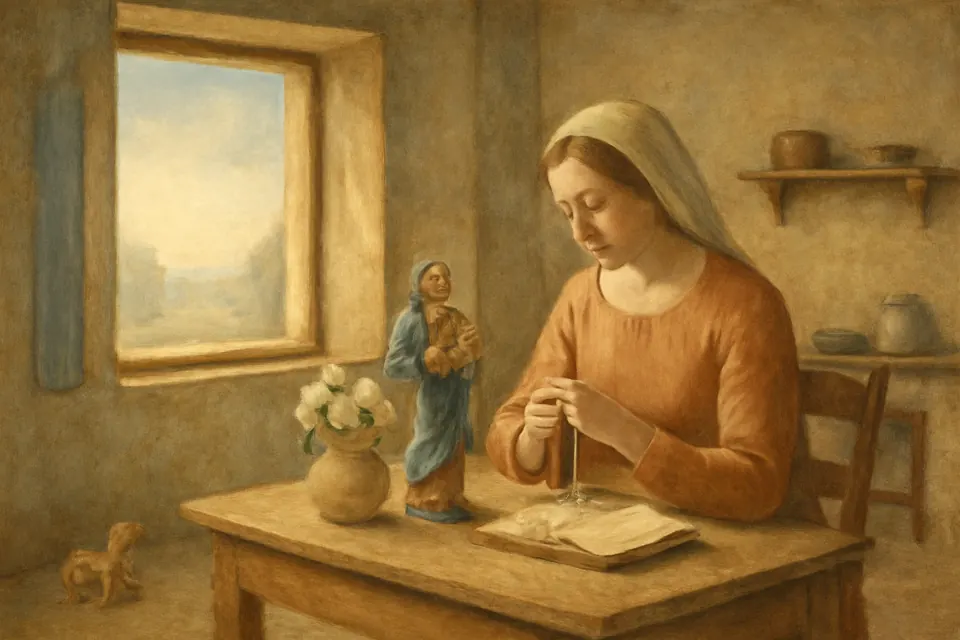
The joyful mysteries are the five decades of the Rosary that contemplate the Incarnation and the childhood of Jesus: the Annunciation, the Visitation, the Nativity, the Presentation in the Temple and the Finding of Jesus in the Temple. Following St. John Paul II's Rosarium Virginis Mariae (2002), we pray them on Mondays and Saturdays.
The joyful mysteries take us back to the beginning: to a girl in Nazareth, a visit in the hill country, a baby in a manger, and a twelve-year-old lost for three days in Jerusalem. All five come from the first two chapters of St. Luke. As we pray them, Mary leads us by the hand into the hidden years of her Son, and we learn, as St. John Paul II put it, "the secret of Christian joy."
New to the beads? Start with our guide on how to pray the Rosary. The other sets of mysteries are the luminous mysteries, the sorrowful mysteries and the glorious mysteries.
When to pray the joyful mysteries
We pray the joyful mysteries on Mondays and Saturdays. This weekly plan comes from St. John Paul II's apostolic letter Rosarium Virginis Mariae, published on October 16, 2002. Before then the joyful mysteries belonged to Monday and Thursday. When the Pope proposed the new luminous mysteries, he needed a free day for them, so he suggested moving the second joyful day to Saturday. "Saturday has always had a special Marian flavour," he wrote, and Mary's presence "is especially pronounced" in these five mysteries (no. 38). Thursday went to the mysteries of light.
He was careful to add that the plan "is not intended to limit a rightful freedom in personal and community prayer." So nothing stops us from praying the joyful mysteries all through Advent and the Christmas season, or on a feast like the Annunciation, whatever the day. The Holy See's own guide to the Rosary repeats the Monday and Saturday plan.
How to pray each decade
For each mystery we announce it ("The first joyful mystery: the Annunciation"), pause for a moment, then pray one Our Father, ten Hail Marys and one Glory Be. Many add the Fatima prayer after each decade. St. John Paul II recommended reading a short passage of Scripture after announcing each mystery, because "no other words can ever match the efficacy of the inspired word," and then keeping a short silence (nos. 30–31). That is the pattern of this page: Scripture from the Douay-Rheims Bible, a brief meditation, and the fruit of the mystery.
The fruits are the graces we ask for in each decade. They aren't fixed by any Church document. They come from long devotional practice. St. Louis de Montfort taught the faithful to offer each decade for "one of the virtues that is most evident in that particular mystery," beginning with "profound humility" for the Annunciation, and old American prayer books such as Charles V. Lacey's Rosary Novenas to Our Lady (1926) name a virtue for every decade. Where the traditions differ, we give both.
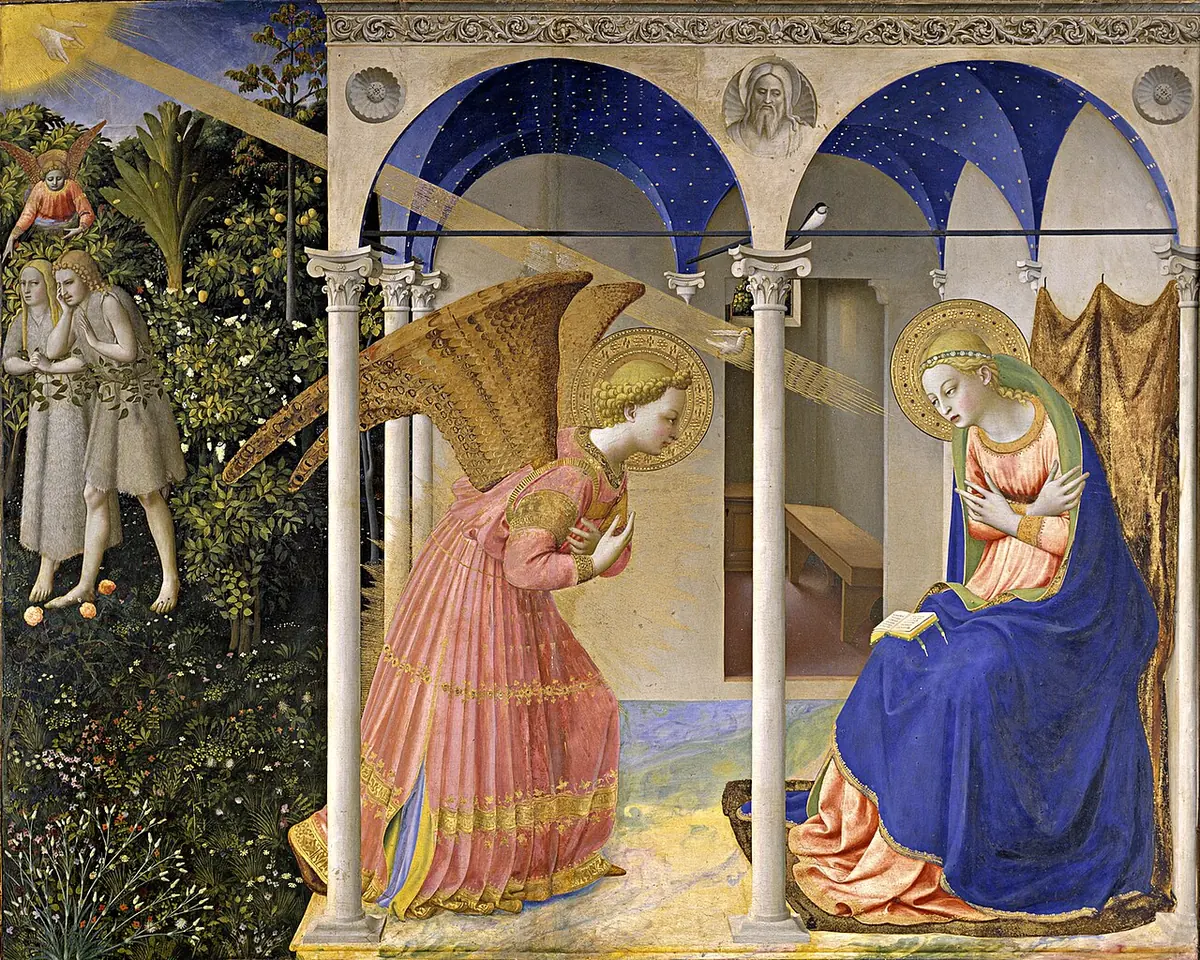
The first joyful mystery: the Annunciation
And the angel being come in, said unto her: Hail, full of grace, the Lord is with thee: blessed art thou among women... And the angel said to her: Fear not, Mary, for thou hast found grace with God. Behold thou shalt conceive in thy womb, and shalt bring forth a son; and thou shalt call his name Jesus... And Mary said: Behold the handmaid of the Lord; be it done to me according to thy word. (Luke 1:28, 30–31, 38)
Let us stand quietly in the little house at Nazareth. The angel Gabriel brings news no one could have imagined, and a young woman, troubled and wondering, asks one honest question and then gives her whole life to God. In that moment the Word became flesh in her womb. Every Hail Mary we pray begins with Gabriel's own greeting. As we pray this decade, let us ask Our Lady to teach us her "yes," so that when God asks something of us, we answer as she did: be it done to me according to thy word.
Fruit of the mystery: humility.
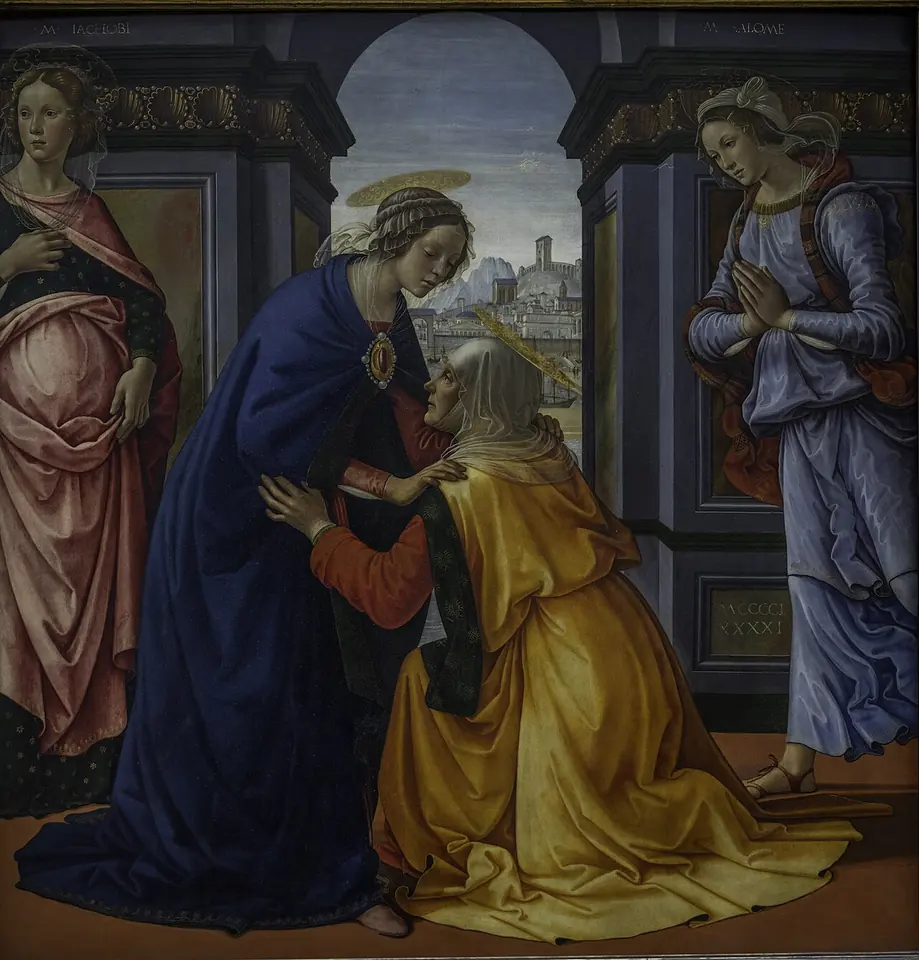
The second joyful mystery: the Visitation
And Mary rising up in those days, went into the hill country with haste into a city of Juda. And she entered into the house of Zachary, and saluted Elizabeth. And it came to pass, that when Elizabeth heard the salutation of Mary, the infant leaped in her womb. And Elizabeth was filled with the Holy Ghost: And she cried out with a loud voice, and said: Blessed art thou among women, and blessed is the fruit of thy womb. (Luke 1:39–42)
Mary does not stay home to guard her secret. She sets out "with haste" over the hills to help her elderly cousin St. Elizabeth, who is six months along. Jesus, hidden in his mother, goes with her, and the unborn John the Baptist leaps for joy at his coming. Elizabeth's cry gives us the second line of the Hail Mary, and Mary answers with the Magnificat. Let us ask for a heart like hers, quick to notice who needs us and glad to bring Christ to them, often simply by showing up.
Fruit of the mystery: charity toward our neighbor.
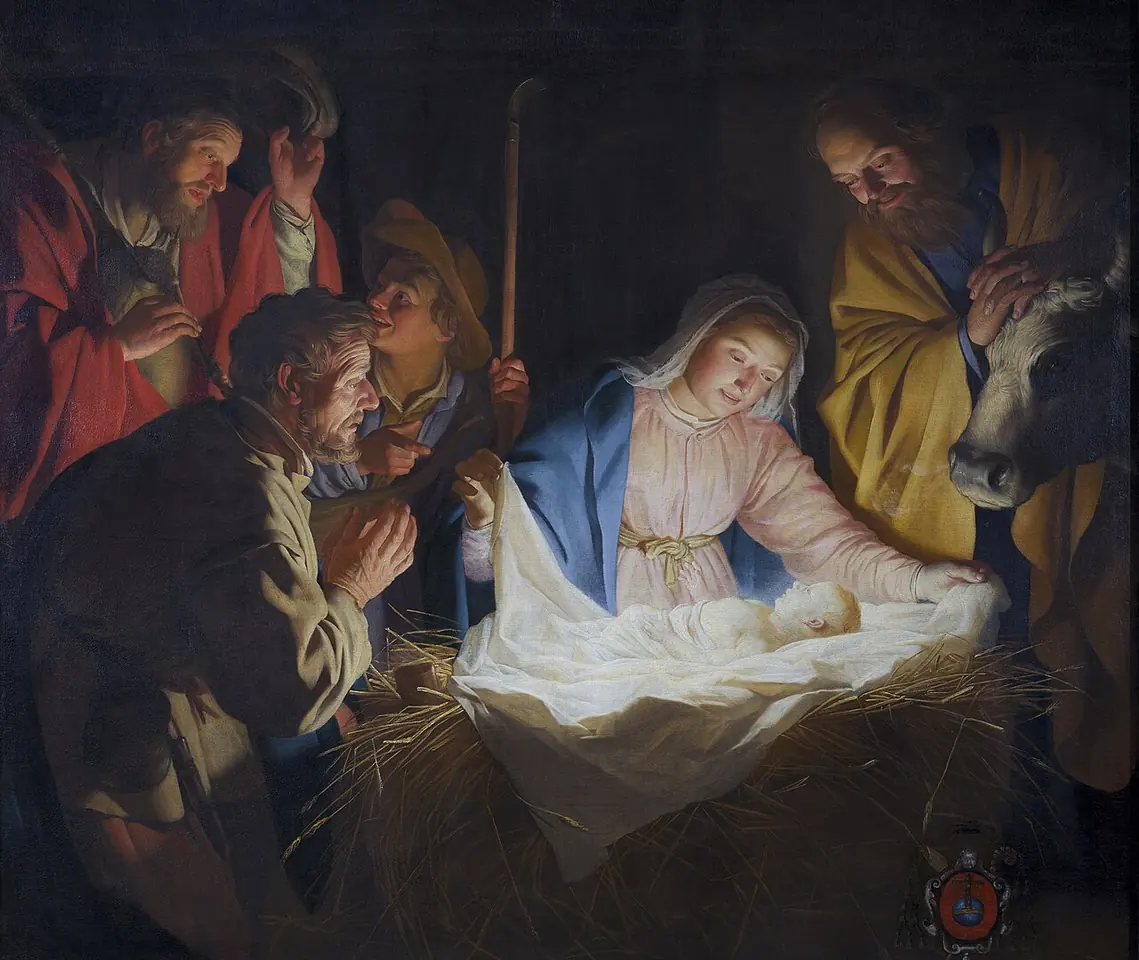
The third joyful mystery: the Nativity of Our Lord
And she brought forth her firstborn son, and wrapped him up in swaddling clothes, and laid him in a manger; because there was no room for them in the inn... And the angel said to them: Fear not; for, behold, I bring you good tidings of great joy, that shall be to all the people: For, this day, is born to you a Saviour, who is Christ the Lord, in the city of David. (Luke 2:7, 10–11)
The Son of God is born where the animals feed, because there was no room anywhere else. Mary and St. Joseph have nothing to give him but their love, and the first visitors are shepherds still smelling of the fields. God chose poverty on purpose. Let us kneel at the manger with them and let go, in our hearts, of whatever we cling to more than him. Then let us simply adore: "Glory to God in the highest; and on earth peace to men of good will."
Fruit of the mystery: detachment from the things of this world, or poverty of spirit.
The fourth joyful mystery: the Presentation in the Temple
And after the days of her purification, according to the law of Moses, were accomplished, they carried him to Jerusalem, to present him to the Lord... He also took him into his arms, and blessed God, and said: Now thou dost dismiss thy servant, O Lord, according to thy word in peace; Because my eyes have seen thy salvation... And Simeon blessed them, and said to Mary his mother: Behold this child is set for the fall, and for the resurrection of many in Israel, and for a sign which shall be contradicted; And thy own soul a sword shall pierce. (Luke 2:22, 28–30, 34–35)
Forty days after his birth, Mary and Joseph carry Jesus to the Temple and obey the Law to the letter, offering the gift of the poor, two turtledoves. The old man Simeon, who had waited his whole life, takes the child in his arms and sings his song of peace. Then he turns to Mary and speaks of a sword. Joy and sorrow meet here, as St. John Paul II noted. Let us offer ourselves to the Father with Jesus, holding nothing back, and ask Mary to keep us faithful when the sword comes.
Fruit of the mystery: purity of heart and obedience. Lacey's booklet asks for purity; Montfort, for great purity of body and soul.

The Church keeps this mystery on February 2, the feast of the Presentation of the Lord, better known as Candlemas.
The fifth joyful mystery: the Finding of Jesus in the Temple
And it came to pass, that, after three days, they found him in the temple, sitting in the midst of the doctors, hearing them, and asking them questions... And his mother said to him: Son, why hast thou done so to us? behold thy father and I have sought thee sorrowing. And he said to them: How is it that you sought me? did you not know, that I must be about my father's business? (Luke 2:46, 48–49)
Any parent can feel those three days. Mary and Joseph search the roads and the city, and when they finally find their boy, he is calmly teaching the teachers. His answer puzzles them, and Luke tells us that "they understood not." Yet Jesus goes home with them "and was subject to them," and his mother "kept all these words in her heart" (Luke 2:50–51). Let us pray for anyone who has lost Jesus, or who feels he has gone quiet, and ask for the grace to seek him until we find him, and to put the Father's business first.
Fruit of the mystery: obedience to the will of God (Lacey) or true wisdom (Montfort); many simply pray for the joy of finding Jesus.

The joyful mysteries in the Church's year
Each of these mysteries has its own place in the liturgy, which makes the Rosary a little echo of the Church's calendar. The Annunciation is kept on March 25, nine months before Christmas. The Visitation falls on May 31. The Nativity is Christmas Day, December 25. The Presentation of the Lord is February 2. The Finding in the Temple has no feast of its own, but its Gospel (Luke 2:41–52) is read on the feast of the Holy Family in Year C. To see what falls this week, visit our feast days calendar.
Pilgrims to Nazareth pray the first mystery in the place where tradition holds it happened: the grotto beneath the Basilica of the Annunciation. A Latin inscription on its altar reads Verbum caro hic factum est, "Here the Word was made flesh."

Ending the Rosary
When the five decades are finished, the Holy See's guide suggests closing with the Litany of Loreto or another Marian prayer. Most of us end with the Hail, Holy Queen. The Blessed Virgin Mary lived each of these mysteries before we ever prayed them, and October 7 is the feast of Our Lady of the Rosary. Let us ask her, who "kept all these words, pondering them in her heart" (Luke 2:19), to help us keep them too.
Frequently asked questions
What are the five joyful mysteries?
The Annunciation, the Visitation, the Nativity of Jesus, the Presentation of Jesus in the Temple, and the Finding of Jesus in the Temple. All five come from the first two chapters of St. Luke's Gospel.
What days are the joyful mysteries prayed?
Mondays and Saturdays. St. John Paul II proposed this in Rosarium Virginis Mariae (2002), moving the second weekly joyful day from Thursday to Saturday to make room for the luminous mysteries. He added that the plan is not meant to limit a rightful freedom in personal and community prayer.
What are the fruits of the joyful mysteries?
The fruits most often given are humility (Annunciation), charity toward our neighbor (Visitation), detachment from the world or poverty of spirit (Nativity), purity and obedience (Presentation), and obedience to God's will or true wisdom (Finding in the Temple). They come from devotional tradition, such as St. Louis de Montfort's way of offering each decade, not from a Church decree.
Why are they called the joyful mysteries?
Because each one is marked by the joy of the Incarnation. St. John Paul II pointed out that the first mystery opens with Gabriel's greeting, "Rejoice," and that the last two already mix that joy with signs of the sorrow to come.
Can I pray the joyful mysteries on other days?
Yes. The weekly plan is a custom, not a rule. It fits to pray the joyful mysteries during Advent and Christmastide, or on a feast such as the Annunciation, whatever the day of the week.
Sources
- St. John Paul II, Rosarium Virginis Mariae (October 16, 2002)
- The Holy See: The Mysteries of the Rosary
- Douay-Rheims Bible: The Gospel According to St. Luke, chapter 1
- Douay-Rheims Bible: The Gospel According to St. Luke, chapter 2
- Charles V. Lacey, Rosary Novenas to Our Lady (1926), at the Internet Archive. Virtue petitioned in each decade
- J. C. Laurenceau, "Rosary," in Jesus Living in Mary: Handbook of the Spirituality of St. Louis de Montfort (EWTN). Montfort's method of offering each decade for a virtue