Luminous mysteries
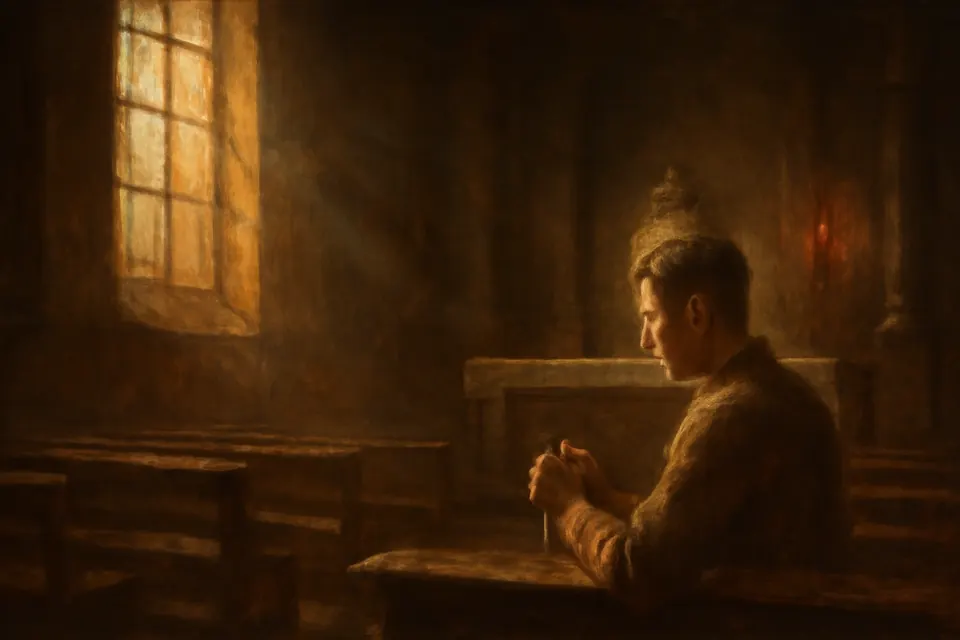
The luminous mysteries, or mysteries of light, are the five decades of the Rosary that contemplate Christ's public ministry: his Baptism in the Jordan, the Wedding at Cana, the Proclamation of the Kingdom, the Transfiguration and the Institution of the Eucharist. St. John Paul II added them in Rosarium Virginis Mariae (October 16, 2002), and we pray them on Thursdays.
The luminous mysteries are the youngest part of the Rosary, and among the most loved. For more than four hundred years the beads carried us from the boy Jesus in the Temple straight to his agony in Gethsemane, skipping everything in between. In 2002 St. John Paul II filled that gap with five "mysteries of light" from Christ's public life: the years when he was baptized, worked his first sign, preached, shone with glory on the mountain, and gave us himself in the Eucharist.
New to the beads? Start with our guide on how to pray the Rosary. The other sets are the joyful mysteries, the sorrowful mysteries and the glorious mysteries.
When to pray the luminous mysteries
We pray the luminous mysteries on Thursdays. Before 2002 Thursday belonged to the joyful mysteries. St. John Paul II proposed moving the second joyful day to Saturday, a day with "a special Marian flavour," so that "Thursday would then be free for meditating on the 'mysteries of light'" (Rosarium Virginis Mariae, no. 38). The Holy See's guide to the Rosary now lists them for Thursday. It is a fitting choice: Thursday is the day of the week on which the Lord gave us the Eucharist, the last of these mysteries.
The Pope added that this plan "is not intended to limit a rightful freedom in personal and community prayer," so the luminous mysteries also suit the Christmas season's close at the Baptism of the Lord, the feast of the Transfiguration, and Corpus Christi.
Why St. John Paul II added the luminous mysteries
St. John Paul II published Rosarium Virginis Mariae on October 16, 2002, the day he began the twenty-fifth year of his pontificate. He opened it by recalling that, in 1978, he had called the Rosary his favorite prayer, and he proclaimed October 2002 to October 2003 the Year of the Rosary. His reasons for the new mysteries are set out in no. 19:
- The Rosary had a gap. Its fifteen mysteries had been set by "the origin of the prayer, which was based on the number 150, the number of the Psalms." They moved from the hidden life at Nazareth directly to the Passion.
- He wanted the whole Gospel. Adding "the mysteries of Christ's public ministry between his Baptism and his Passion" would help the Rosary "become more fully a 'compendium of the Gospel'" and bring out its "Christological depth."
- The public life is a mystery of light. Christ himself said, "While I am in the world, I am the light of the world" (John 9:5), and in these years his glory shone most openly.
- He wanted to renew the prayer. The addition, "without prejudice to any essential aspect of the prayer's traditional format, is meant to give it fresh life and to enkindle renewed interest."
He also kept Mary at the heart of the new mysteries. She appears directly only at Cana, he admitted, but her words there, "Do whatever he tells you," are "the great maternal counsel which Mary addresses to the Church of every age" and form "the Marian foundation of all the 'mysteries of light'" (no. 21). He offered them as a proposal, "left to the freedom of individuals and communities," not as a command. Today the Holy See's own guide to the Rosary lists them alongside the joyful, sorrowful and glorious mysteries.
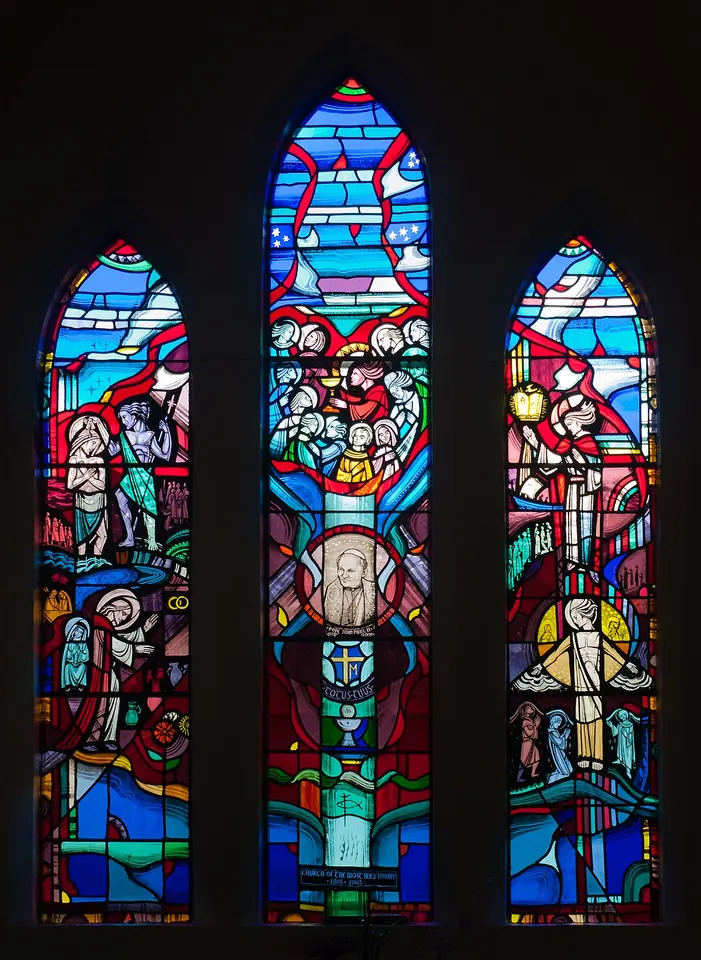
How to pray each decade
Announce the mystery ("The first luminous mystery: the Baptism in the Jordan"), pause, then pray one Our Father, ten Hail Marys and one Glory Be, with the Fatima prayer if you like. The Pope asked that each announcement be followed by a Scripture passage and a moment of silence (nos. 30–31). Below, each mystery has its passage from the Douay-Rheims Bible and a short meditation.
Because these mysteries are new, they have no centuries-old list of fruits like the other sets. The graces suggested below are the ones devotional guides commonly offer, and each grows straight out of how St. John Paul II described the mystery in no. 21.
The first luminous mystery: the Baptism in the Jordan
Then cometh Jesus from Galilee to the Jordan, unto John, to be baptized by him. But John stayed him, saying: I ought to be baptized by thee, and comest thou to me? And Jesus answering, said to him: Suffer it to be so now. For so it becometh us to fulfill all justice. Then he suffered him. And Jesus being baptized, forthwith came out of the water: and lo, the heavens were opened to him: and he saw the Spirit of God descending as a dove, and coming upon him. And behold a voice from heaven, saying: This is my beloved Son, in whom I am well pleased. (Matthew 3:13–17)
The sinless One gets in line with sinners. John the Baptist protests, and Jesus goes down into the water anyway. Then the heavens open, the Spirit descends, and the Father speaks. The whole Trinity is revealed at the river. St. John Paul II saw the Spirit coming "to invest him with the mission which he is to carry out." At our own baptism we too were named God's children. Let us thank God for that day, renew our baptismal promises in our hearts, and ask the Holy Spirit to lead us into the mission he has for us.
Suggested fruit: openness to the Holy Spirit, and gratitude for our baptism.

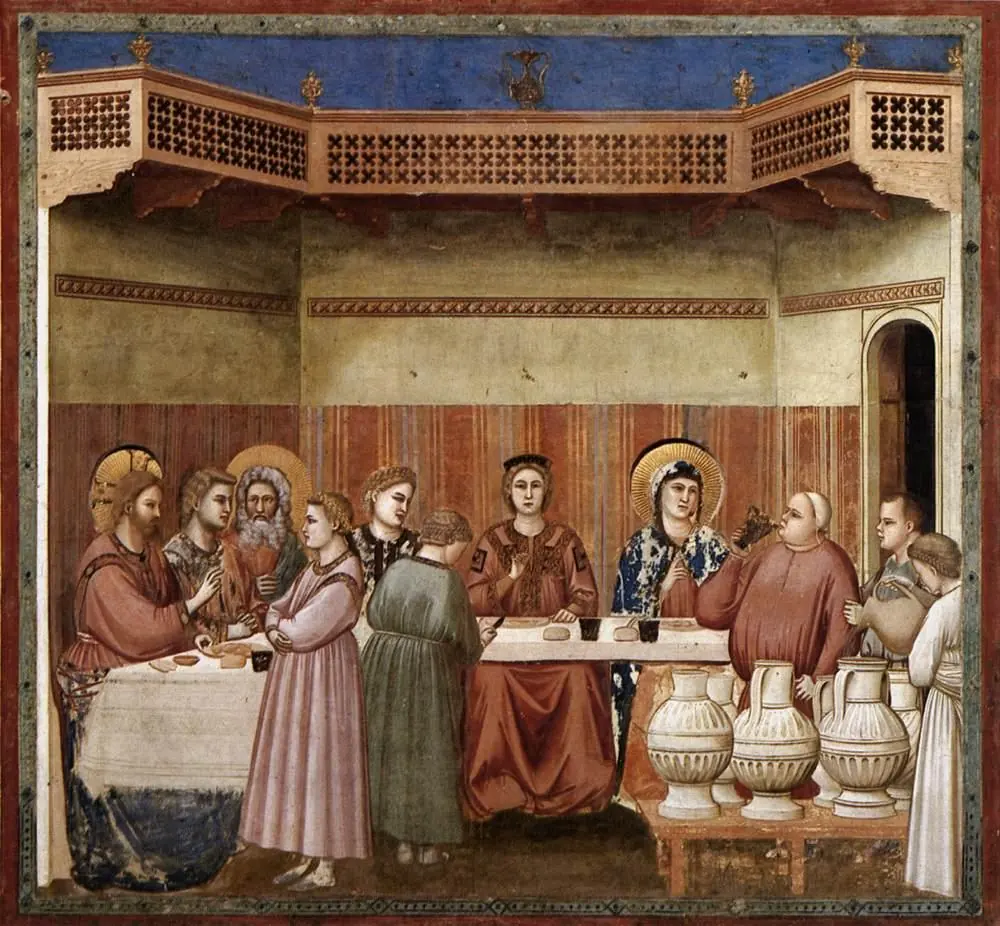
The second luminous mystery: the Wedding at Cana
And the third day, there was a marriage in Cana of Galilee: and the mother of Jesus was there. And Jesus also was invited, and his disciples, to the marriage. And the wine failing, the mother of Jesus saith to him: They have no wine... His mother saith to the waiters: Whatsoever he shall say to you, do ye... This beginning of miracles did Jesus in Cana of Galilee; and manifested his glory, and his disciples believed in him. (John 2:1–3, 5, 11)
A young couple is about to be embarrassed in front of the whole village, and the only one who notices is Mary. She doesn't make a speech. She tells her Son, "They have no wine," and tells the servants, "Whatsoever he shall say to you, do ye." Six stone jars of water become the best wine of the feast, and the disciples believe. Let us bring to Mary whatever has run dry in our lives and our marriages, and then do what she asks: whatever he tells us.
Suggested fruit: trust in Jesus, through Mary.
The third luminous mystery: the Proclamation of the Kingdom
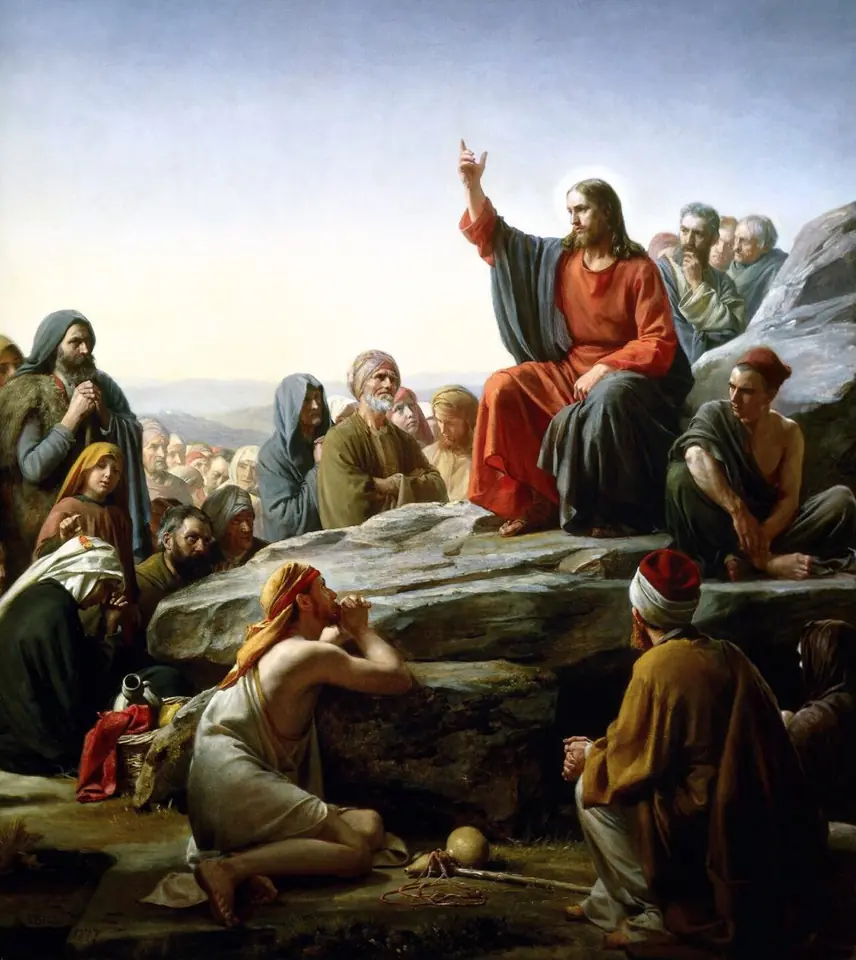
And after that John was delivered up, Jesus came into Galilee, preaching the gospel of the kingdom of God, And saying: The time is accomplished, and the kingdom of God is at hand: repent, and believe the gospel. (Mark 1:14–15)
This mystery holds three years of preaching: the Beatitudes, the parables, the healings, the meals with sinners. St. John Paul II pointed especially to the mercy in it, how Jesus "forgives the sins of all who draw near to him in humble trust," a ministry of mercy "which he continues to exercise until the end of the world, particularly through the Sacrament of Reconciliation." Let us hear his first words as spoken to us: repent, and believe. And let us ask for a true conversion, and perhaps the courage to make a good confession soon.
Suggested fruit: conversion of heart, and trust in God's mercy.
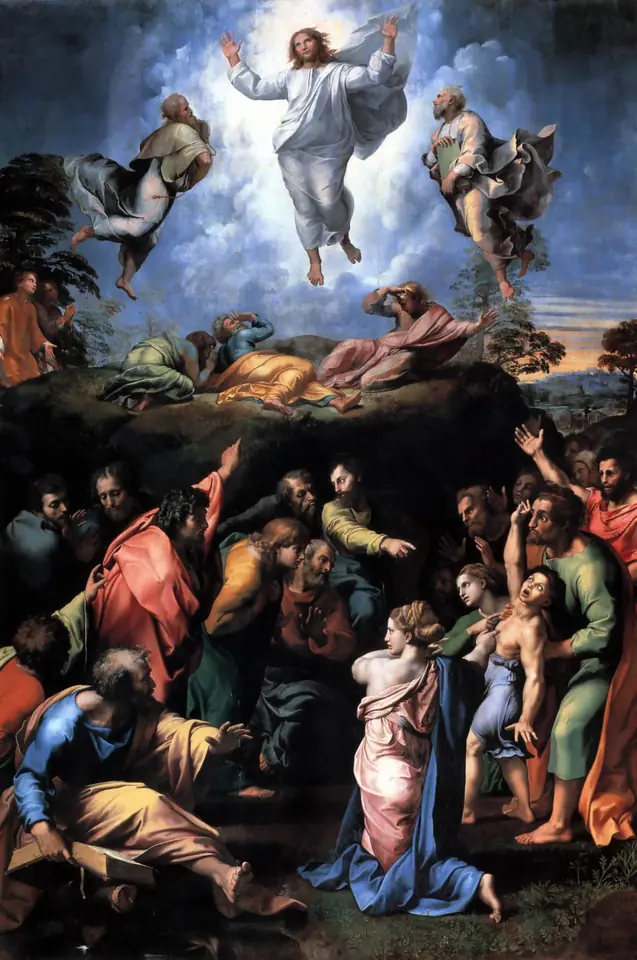
The fourth luminous mystery: the Transfiguration
And after six days Jesus taketh unto him Peter and James, and John his brother, and bringeth them up into a high mountain apart: And he was transfigured before them. And his face did shine as the sun: and his garments became white as snow. And behold there appeared to them Moses and Elias talking with him... And lo, a voice out of the cloud, saying: This is my beloved Son, in whom I am well pleased: hear ye him. (Matthew 17:1–3, 5)
St. John Paul II called this "the mystery of light par excellence." On a high mountain, traditionally Mount Tabor, Peter, James and John see their friend's face shine like the sun, with Moses and Elijah beside him. Peter wants to stay forever. But the Father's command is simple, "hear ye him," and the glory is meant to carry them through the darkness of the Passion ahead. Let us listen to Jesus in this decade, and ask for a real desire to be holy, transfigured little by little into his likeness.
Suggested fruit: desire for holiness, and attentive listening to Christ.
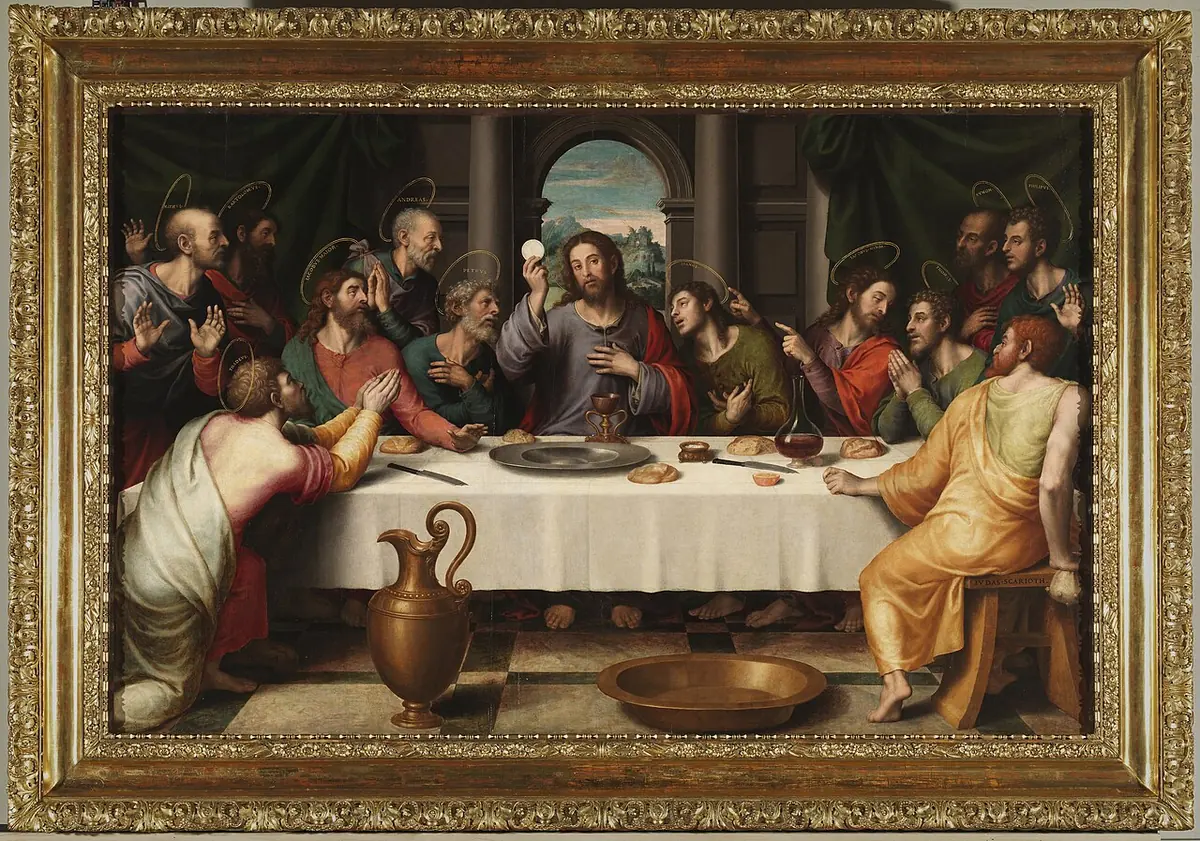
The fifth luminous mystery: the Institution of the Eucharist
And taking bread, he gave thanks, and brake; and gave to them, saying: This is my body, which is given for you. Do this for a commemoration of me. In like manner the chalice also, after he had supped, saying: This is the chalice, the new testament in my blood, which shall be shed for you. (Luke 22:19–20)
On the night before he died, Jesus took bread and wine and changed them into his own Body and Blood, and he told his apostles to do the same in memory of him. Every Mass since makes present that one sacrifice. St. John Paul II wrote that here Christ "testifies 'to the end' his love for humanity." He is truly present on the altar and in the tabernacle, Body, Blood, soul and divinity. Let us adore him in this decade, thank him for every Communion we have received, and if we cannot receive today, make a spiritual communion.
Suggested fruit: love for Jesus in the Eucharist, and adoration.
The luminous mysteries in the Church's year
The Baptism of the Lord closes the Christmas season in January, usually on the Sunday after the Epiphany (see our page on the Epiphany house blessing). The Gospel of Cana is read on the Second Sunday in Ordinary Time in Year C. The Transfiguration is kept on August 6 and is also the Gospel of the Second Sunday of Lent. The Eucharist is honored on Holy Thursday and again on Corpus Christi. For wonders reported around the Blessed Sacrament and the Church's judgment on them, see our page on Eucharistic miracles.
Ending the Rosary
When the five decades are finished, the Holy See's guide suggests the Litany of Loreto or another Marian prayer; most of us close with the Hail, Holy Queen. Let us pray it with gratitude to the Blessed Virgin Mary, who still tells us at every Rosary what she told the servants at Cana, and let us ask the intercession of St. John Paul II, whose motto, Totus tuus, gave everything to her.
Frequently asked questions
What are the five luminous mysteries?
The Baptism of Jesus in the Jordan, his self-revelation at the Wedding at Cana, his Proclamation of the Kingdom of God with the call to conversion, the Transfiguration, and the Institution of the Eucharist at the Last Supper.
What day are the luminous mysteries prayed?
Thursday. St. John Paul II proposed it in Rosarium Virginis Mariae (no. 38), moving the second weekly joyful day to Saturday so Thursday would be free. The Holy See's guide to the Rosary uses the same plan.
When and why did St. John Paul II add the luminous mysteries?
On October 16, 2002, in the apostolic letter Rosarium Virginis Mariae. He wanted the Rosary to become more fully a "compendium of the Gospel" by adding the years of Christ's public ministry between his Baptism and his Passion, and to give the prayer "fresh life." He left their use to the freedom of individuals and communities.
Do I have to pray the luminous mysteries?
No. St. John Paul II offered them "while left to the freedom of individuals and communities." The Holy See's own guide to the Rosary now includes them among the four sets, and we warmly encourage them, but the traditional fifteen mysteries remain a true Rosary.
What are the fruits of the luminous mysteries?
Because the mysteries are new, there is no centuries-old list. Devotional guides drawing on Rosarium Virginis Mariae commonly suggest openness to the Holy Spirit (Baptism), trust in Jesus through Mary (Cana), conversion and repentance (Proclamation), desire for holiness (Transfiguration), and love for Christ in the Eucharist (Institution of the Eucharist).
Are there 15 or 20 mysteries of the Rosary?
Twenty since 2002, namely five joyful, five luminous, five sorrowful and five glorious. For more than four centuries before that, the Rosary had fifteen, which is why older prayer books and the traditional 150 Hail Marys reflect only three sets.