Glorious mysteries
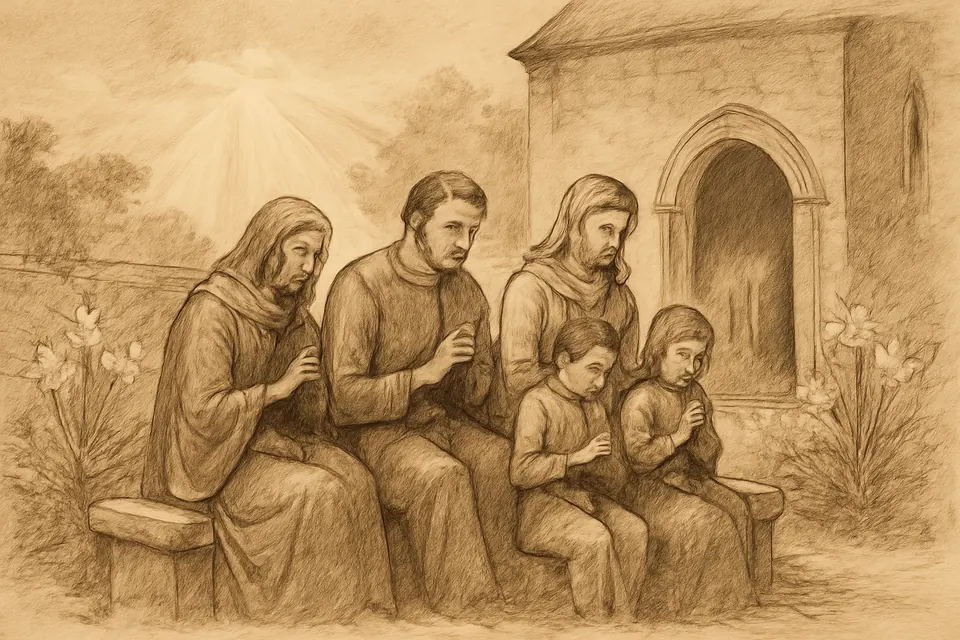
The glorious mysteries are the five decades of the Rosary that contemplate the glory of Christ and his Mother: the Resurrection, the Ascension, the Descent of the Holy Spirit, the Assumption of Mary and the Coronation of Mary as Queen of Heaven. Following St. John Paul II's Rosarium Virginis Mariae (2002), we pray them on Wednesdays and Sundays.
 Free printable prayer card 5 × 7 inch PDF, ready to print, frame or tuck in a missal.
The glorious mysteries begin at an empty tomb and end with a crown. They are the Rosary's Easter: Christ risen and ascended, the Spirit poured out on the Church, and Mary, the first disciple, taken body and soul into the glory her Son promised to all who follow him. As St. John Paul II wrote, "The contemplation of Christ's face cannot stop at the image of the Crucified One. He is the Risen One!"
New to the beads? Start with our guide on how to pray the Rosary. The other sets are the joyful mysteries, the luminous mysteries and the sorrowful mysteries.
When to pray the glorious mysteries
We pray the glorious mysteries on Wednesdays and Sundays. Before 2002 they had three days, Wednesday, Saturday and Sunday. In Rosarium Virginis Mariae (October 16, 2002), St. John Paul II proposed giving Saturday to the joyful mysteries so that Thursday could be free for the new luminous mysteries (no. 38). Sunday, "the day of Resurrection," as he called it, keeps the glorious mysteries, and the Holy See's guide to the Rosary gives the same plan.
The weekly pattern "is not intended to limit a rightful freedom in personal and community prayer," the Pope added. The glorious mysteries are a natural choice through the fifty days of Easter, on the Assumption, and at a funeral vigil, when we most need to remember where we are going.
How to pray each decade
Announce the mystery ("The first glorious mystery: the Resurrection"), pause, and pray one Our Father, ten Hail Marys and one Glory Be, adding the Fatima prayer if you wish. St. John Paul II recommended following each announcement with a passage of Scripture and a short silence (nos. 30–31). Below, each mystery has its passage from the Douay-Rheims Bible, a short meditation, and its fruit.
The fruits are the graces we ask for in each decade. No Church document fixes them. St. Louis de Montfort taught the faithful to offer each decade for "one of the virtues that is most evident in that particular mystery," and old prayer books such as Charles V. Lacey's Rosary Novenas to Our Lady (1926) name one for every decade. Where they differ, we give both.
The first glorious mystery: the Resurrection
And in the end of the sabbath, when it began to dawn towards the first day of the week, came Mary Magdalen and the other Mary, to see the sepulchre... And the angel answering, said to the women: Fear not you; for I know that you seek Jesus who was crucified. He is not here, for he is risen, as he said. Come, and see the place where the Lord was laid. (Matthew 28:1, 5–6)
The women come at dawn with spices for a dead body and find an open tomb and an angel. "He is not here, for he is risen." Within hours Mary Magdalene has met him in the garden, Peter and John have run to see the empty grave, and before long even doubting Thomas is on his knees: "My Lord, and my God." Death is beaten. Let us pray this decade with Easter joy, and ask the risen Lord for a living faith, the kind that changes how we face every loss and every grave.
Fruit of the mystery: faith (Lacey); Montfort asks for a deeper love of God and fervor in his service.
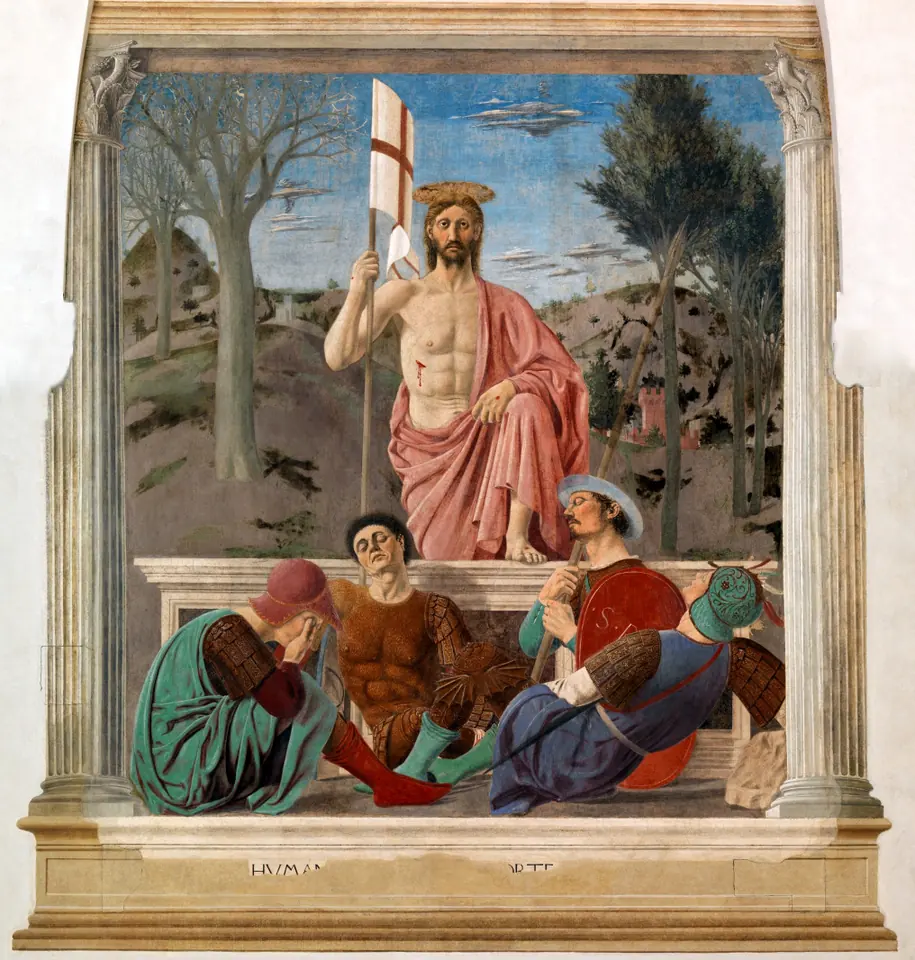
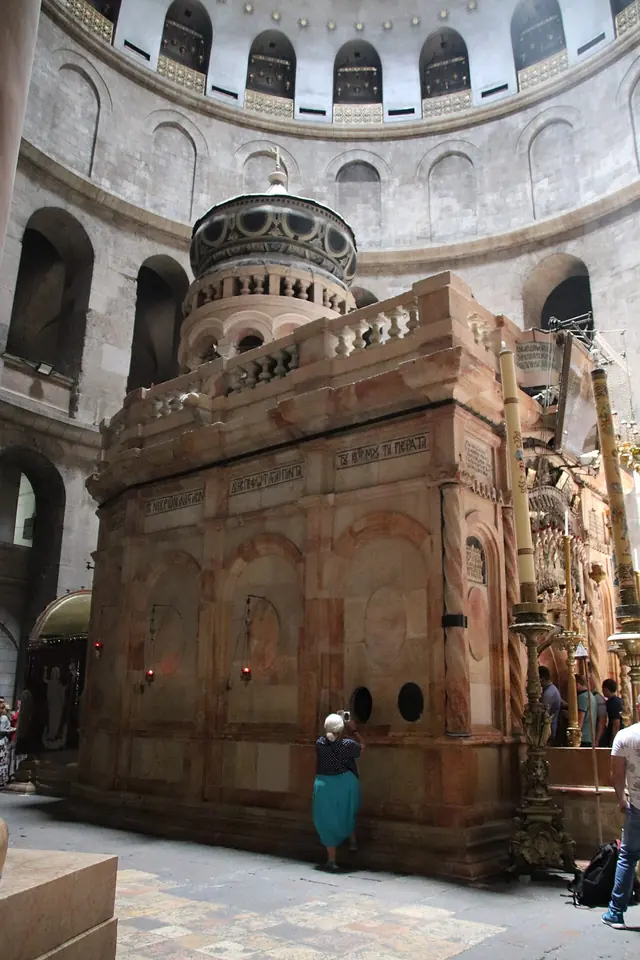
Pilgrims in Jerusalem pray this mystery at the tomb itself, enclosed in the small shrine called the Aedicule inside the Church of the Holy Sepulchre.
The second glorious mystery: the Ascension
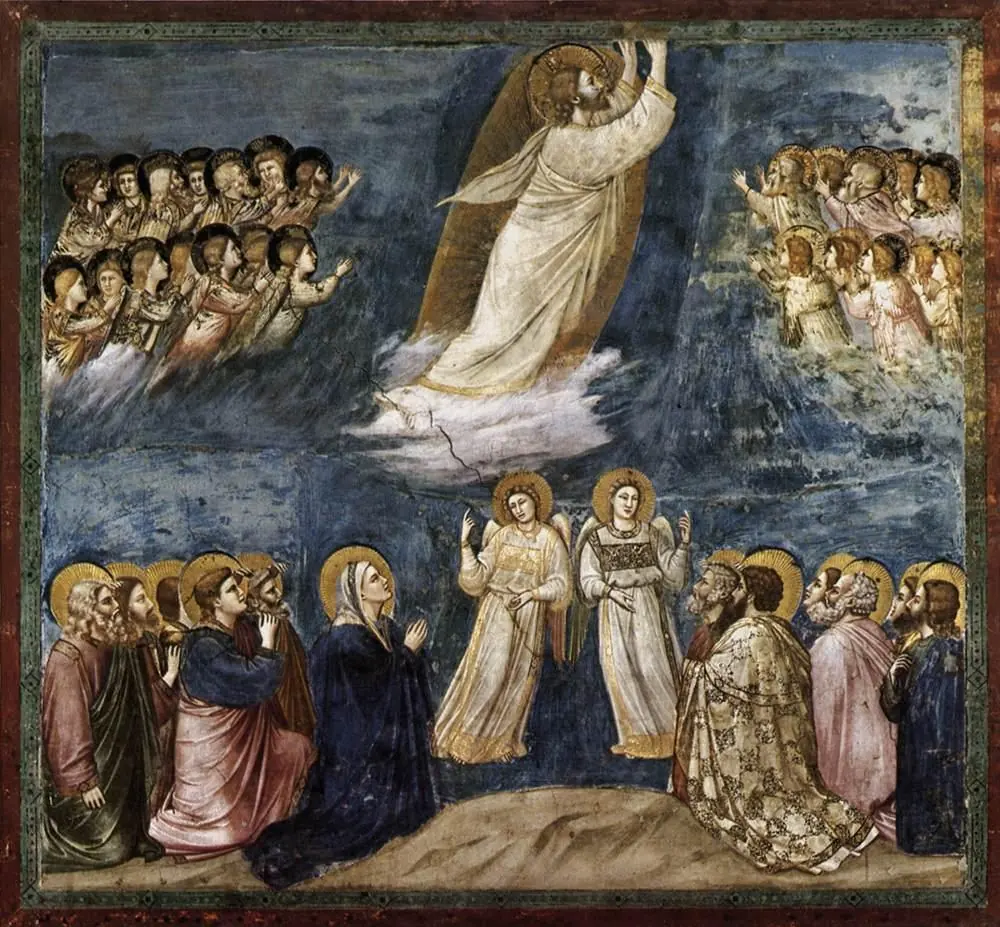
And when he had said these things, while they looked on, he was raised up: and a cloud received him out of their sight. And while they were beholding him going up to heaven, behold two men stood by them in white garments. Who also said: Ye men of Galilee, why stand you looking up to heaven? This Jesus who is taken up from you into heaven, shall so come, as you have seen him going into heaven. (Acts 1:9–11)
Forty days after Easter, Jesus leads his friends out toward Bethany, lifts his hands to bless them, and is taken up into heaven. St. Luke says they went back to Jerusalem "with great joy" (Luke 24:52). That surprises us until we understand that he has not left them. Our human nature, in him, is now at the Father's right hand, and he has gone to prepare a place for us. Let us lift our hearts to heaven in this decade and ask for a firm hope, one that keeps our eyes on our true home while our hands keep working here.
Fruit of the mystery: hope (Lacey) and an ardent desire for heaven (Montfort).
The third glorious mystery: the Descent of the Holy Spirit
And when the days of the Pentecost were accomplished, they were all together in one place: And suddenly there came a sound from heaven, as of a mighty wind coming, and it filled the whole house where they were sitting. And there appeared to them parted tongues as it were of fire, and it sat upon every one of them: And they were all filled with the Holy Ghost, and they began to speak with divers tongues, according as the Holy Ghost gave them to speak. (Acts 2:1–4)
For nine days the apostles had prayed in the upper room "with Mary the mother of Jesus" (Acts 1:14), the pattern of every novena since, with St. Matthias newly chosen to take Judas's place. Then the Spirit comes in wind and fire, and frightened men become fearless preachers. St. John Paul II wrote that Pentecost "reveals the face of the Church as a family gathered together with Mary, enlivened by the powerful outpouring of the Spirit and ready for the mission of evangelization." Let us ask the Holy Spirit to come into our own hearts and set them alight with love of God.
Fruit of the mystery: charity, the love of God (Lacey); Montfort asks simply for the coming of the Holy Spirit into our souls.

The fourth glorious mystery: the Assumption of Mary
And a great sign appeared in heaven: A woman clothed with the sun, and the moon under her feet, and on her head a crown of twelve stars. (Apocalypse 12:1)
Scripture does not narrate the end of Our Lady's earthly life, but the Church has always believed that the body that bore the Son of God did not see corruption. On November 1, 1950, Pope Pius XII defined it as a dogma of faith: "the Immaculate Mother of God, the ever Virgin Mary, having completed the course of her earthly life, was assumed body and soul into heavenly glory." The East keeps the same feast as the Dormition, Mary's "falling asleep." Where Mary has gone, we hope to follow; she is, St. John Paul II wrote, a foretaste of "the destiny reserved for all the just at the resurrection of the dead." Let us ask her to bring us safely home, and to be with us at the hour of our death.
Fruit of the mystery: union with Christ (Lacey) or a tender devotion to Mary (Montfort); many also pray here for the grace of a holy death.

The fifth glorious mystery: the Coronation of Mary as Queen of Heaven
The queen stood on thy right hand, in gilded clothing; surrounded with variety. (Psalm 44:10; Psalm 45 in most modern Bibles)
And Mary said: My soul doth magnify the Lord... for behold from henceforth all generations shall call me blessed. (Luke 1:46, 48)
The girl who called herself "the handmaid of the Lord" is crowned Queen of Heaven and earth. Her queenship is a mother's, never a rival to her Son's kingship but a share in it, given for our sake. Pius XII wrote in Ad Caeli Reginam (1954) that Christians have long believed "she of whom was born the Son of the Most High" is rightly called Queen, and he gave her queenship a feast of its own. Let us honor her as our Queen and Mother, entrust to her everyone we love, and ask for the grace to persevere until we share her crown.
Fruit of the mystery: union with Mary and trust in her intercession (Lacey) or perseverance in grace and the crown of glory (Montfort).

The glorious mysteries in the Church's year
Every glorious mystery has its feast. Easter is the greatest day of the year (see Easter 2027 for the dates). The Ascension comes forty days later, though in many dioceses it is moved to the following Sunday. Pentecost closes the Easter season on the fiftieth day. The Assumption on August 15 is a holy day of obligation in the United States in most years, and the Queenship of Mary follows on August 22. Pius XII first set the Queenship for May 31; the calendar reform after the Second Vatican Council moved it to its present place, a week after the Assumption.
Ending the Rosary
When the five decades are finished, the Holy See's guide suggests the Litany of Loreto or another Marian prayer. After the glorious mysteries the Hail, Holy Queen fits perfectly: we greet the Blessed Virgin Mary as Queen, the very title we have just contemplated. Her feast as Our Lady of the Rosary is October 7.
Frequently asked questions
What are the five glorious mysteries?
The Resurrection of Jesus, his Ascension into heaven, the Descent of the Holy Spirit at Pentecost, the Assumption of Mary into heaven, and the Coronation of Mary as Queen of Heaven and earth.
What days are the glorious mysteries prayed?
Wednesdays and Sundays. Before 2002 they were also prayed on Saturdays; St. John Paul II moved the Saturday Rosary to the joyful mysteries when he added the luminous mysteries in Rosarium Virginis Mariae. Sunday, the day of the Resurrection, keeps the glorious mysteries.
What are the fruits of the glorious mysteries?
The fruits usually given are faith (Resurrection), hope and desire for heaven (Ascension), love of God and the gifts of the Holy Spirit (Pentecost), union with Christ, devotion to Mary or the grace of a holy death (Assumption), and perseverance and trust in Mary's intercession (Coronation). They come from devotional tradition, including St. Louis de Montfort's method, not from a Church decree.
Where is the Assumption in the Bible?
Scripture does not describe it. The Church holds it as part of the apostolic faith, and Pope Pius XII solemnly defined it on November 1, 1950. The Mass of the Assumption reads Revelation 12, the woman "clothed with the sun," which the Church has long applied to Mary.
When is the Queenship of Mary celebrated?
On August 22, a week after the Assumption. Pope Pius XII established the feast in his 1954 encyclical Ad Caeli Reginam, originally for May 31; the calendar reform after the Second Vatican Council moved it to August 22.
Sources
- St. John Paul II, Rosarium Virginis Mariae (October 16, 2002)
- The Holy See: The Mysteries of the Rosary
- Pius XII, Munificentissimus Deus (November 1, 1950)
- Pius XII, Ad Caeli Reginam (October 11, 1954)
- Douay-Rheims Bible: The Acts of the Apostles, chapter 2
- Charles V. Lacey, Rosary Novenas to Our Lady (1926), at the Internet Archive. Virtue petitioned in each decade
- J. C. Laurenceau, "Rosary," in Jesus Living in Mary: Handbook of the Spirituality of St. Louis de Montfort (EWTN). Montfort's method of offering each decade for a virtue