Catholic prayer for the dying
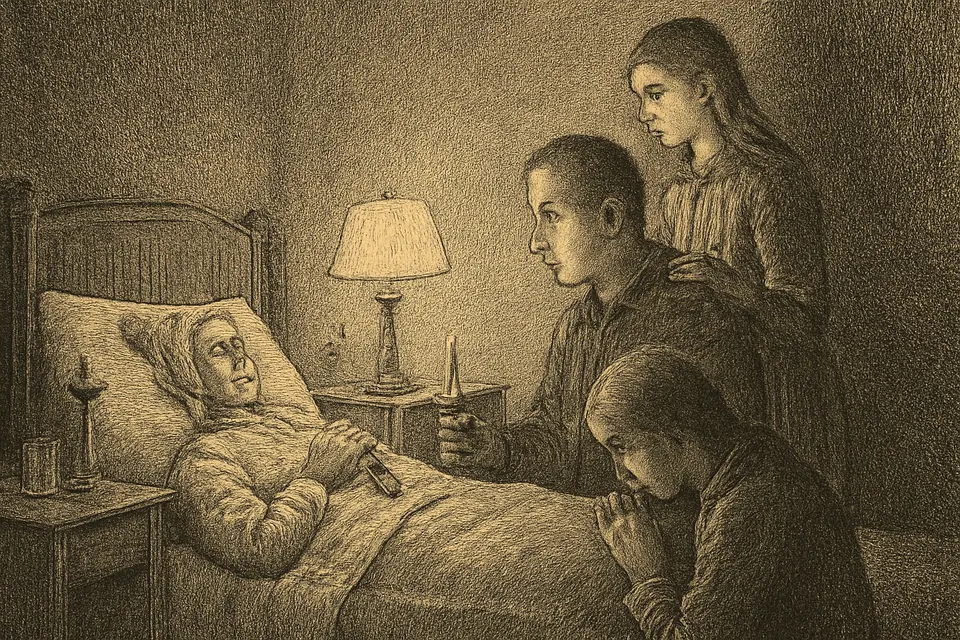
The traditional Catholic prayer for the dying is the Church's commendation of the soul, which begins: "Go forth, Christian soul, from this world, in the name of God the Father almighty, who created thee." First call a priest for confession, the Anointing and Viaticum, then pray at the bedside to St. Joseph, patron of a happy death, and pray the Divine Mercy chaplet.
 Free printable prayer card 5 × 7 inch PDF, ready to print, frame or tuck in a missal.
Sitting with someone we love while they die is one of the hardest and holiest hours of life. We don't have to find the words ourselves. The Church has prayed at deathbeds for well over a thousand years, and she gives us her own prayers for the dying, the sacraments for the last journey, and the saints to keep us company. Here are those prayers in full, from the traditional English books, with what to do first.
The commendation of the soul: "Go forth, Christian soul"
This is the Church's own prayer for the dying, the Proficiscere, named for its first Latin word. In the old Ritual it is part of the Recommendation of a Departing Soul, and the Catechism (no. 1020) still quotes it. Any of us may pray it at the bedside, priest or not. The translation is from The Garden of the Soul (1872):
Go forth, Christian soul, from this world, in the name of God the Father almighty, who created thee; in the name of Jesus Christ, the Son of the living God, who suffered for thee; in the name of the Holy Ghost, who was poured out upon thee; in the name of the Angels and Archangels; in the name of the Thrones and Dominations; in the name of the Principalities and Powers; in the name of the Cherubim and Seraphim; in the name of the Patriarchs and Prophets; in the name of the holy Apostles and Evangelists; in the name of the holy Martyrs and Confessors; in the name of the holy Monks and Hermits; in the name of the holy Virgins and of all the Saints of God: may thy place be this day in peace, and thine abode in holy Sion. Through Christ our Lord. Amen.
The Ritual goes on with another prayer that is one of the most beautiful in the Church's books. It sees the whole court of heaven coming out to meet the soul:
I commend thee to almighty God, dearest brother, and commit thee to him whose creature thou art: that, when thou shalt have paid the debt of humanity by death, thou mayest return to thy Maker, who formed thee of the dust of the earth. As thy soul goeth forth from the body, may the bright company of Angels meet thee; may the judicial senate of Apostles greet thee; may the triumphant army of white-robed Martyrs come out to welcome thee; may the band of glowing Confessors, crowned with lilies, encircle thee; may the choir of Virgins, singing jubilees, receive thee; and the embrace of a blessed repose fold thee in the bosom of the Patriarchs: mild and festive may the aspect of Jesus Christ appear to thee, and may he award thee a place among those that stand before him for ever.
Say "sister" for a woman. In the old order of prayers a short litany of the saints comes first ("Holy Mary, pray for him... St. Joseph, pray for him..."), and after the commendation comes a long series of petitions, "Deliver, O Lord, the soul of thy servant, as thou deliveredst Noah from the flood," naming Enoch and Elias, Abraham, Job, Isaac, Lot, Moses, Daniel, the three children in the furnace, Susanna, David, and Peter and Paul out of prison. If there is time, pray them all. If not, the opening lines are enough.
First, call a priest: the last rites
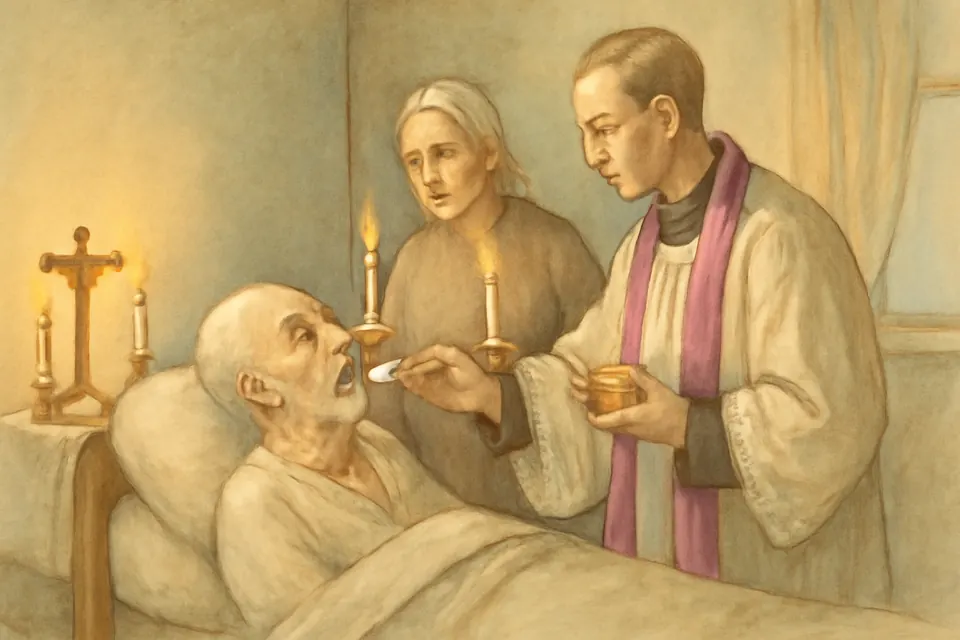
Before anything else, call the parish or the hospital chaplain. Don't wait for the last hour, and don't worry about bothering him; this is why he was ordained. The Catechism (no. 1525) says that Penance, the Anointing of the Sick and the Eucharist as Viaticum make up "at the end of Christian life 'the sacraments that prepare for our heavenly homeland.'"
- Confession, if the dying person can make one. If not, the priest can still absolve.
- The Anointing of the Sick. Canon law (can. 1006) says it is given to the sick who at least implicitly asked for it while they were able, and (can. 1005) that it is to be given even when the priest is in doubt whether the person is dangerously ill or has already died. An unconscious Catholic can be anointed.
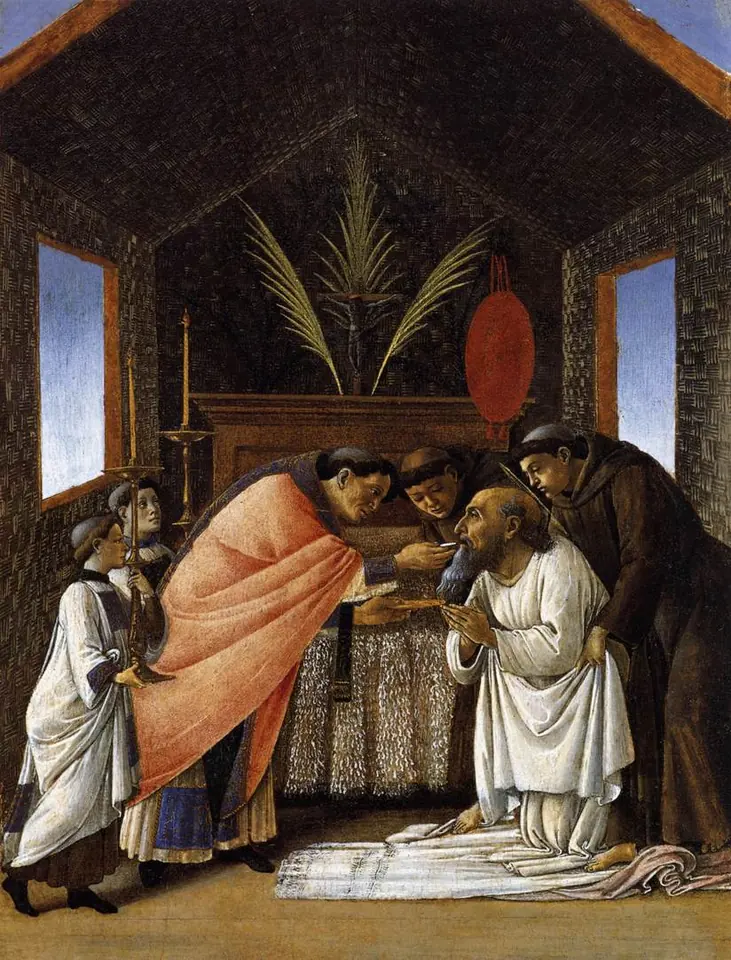
- Viaticum, Holy Communion for the journey. The Catechism (no. 1524) calls it "the seed of eternal life and the power of resurrection."
- The apostolic pardon, the blessing with a plenary indulgence at the hour of death. When no priest can come, the Church herself grants that indulgence to anyone rightly disposed who prayed in some way during life; see our page on the plenary indulgence.
Have a crucifix, a candle, holy water and a glass of water ready, and a small table covered with a white cloth if the priest will bring Communion. For more on the sacrament itself, see the Anointing of the Sick on our prayer for the sick page.
Prayers to St. Joseph, patron of a happy death
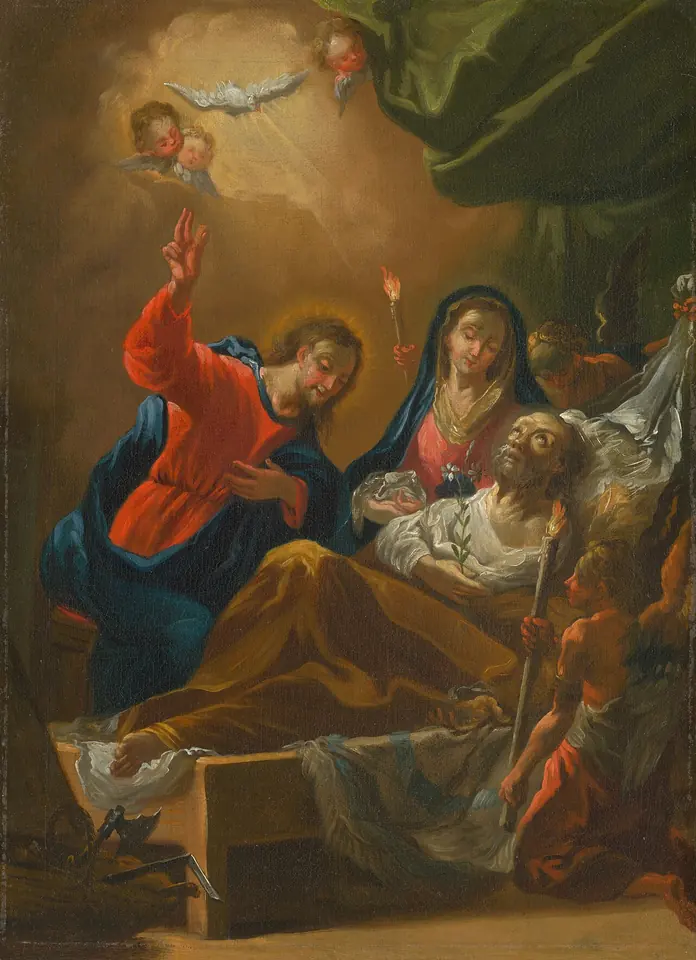
St. Joseph is the patron of the dying because, as tradition holds, he died with Jesus and Mary beside him. No Christian could ask for a better death. The Catechism (no. 1014) names him directly, telling us "to entrust ourselves to St. Joseph, the patron of a happy death."
Pope Leo XIII indulgenced this prayer for those in their agony in 1884. Pray an Our Father, Hail Mary and Glory Be after each part. The text is the Raccolta of 1910 (no. 307):
Eternal Father, by the love which Thou bearest to St Joseph, chosen by Thee from among all men to represent Thee on earth, have pity on us and on poor souls in their agony.
Eternal and divine Son, by the love which Thou bearest to St Joseph, thy most faithful guardian on earth, have pity on us and on all poor souls in their agony.
Eternal and divine Spirit, by the love Thou bearest to St Joseph, who with so great solicitude watched over most holy Mary the Spouse of thy predilection, have pity on us and on all poor souls in their agony.
And the three short prayers every Catholic child once learned, to be said by the dying or for them (Raccolta, no. 427):
Jesus, Mary, Joseph, I give you my heart and my soul. Jesus, Mary, Joseph, assist me in my last agony. Jesus, Mary, Joseph, may I breathe forth my soul in peace with you.
For the full prayer of Leo XIII, the Litany of St. Joseph and his novena, see the St. Joseph prayer page and his entry, St. Joseph.

A prayer for a dying loved one
When someone you love is dying, you can pray the Church's own Mass prayer "for one near death." It asks for the one thing that matters now. The collect, from a 1916 American missal:
O almighty and everlasting God, who hast bestowed on the human race the remedies of salvation and the rewards of everlasting life, mercifully regard thy servant afflicted with sickness of the body, and refresh the soul which thou hast created that at his last hour, he may deserve to be presented without stain of sin, to thee his Creator by the hands of the holy Angels. Through Jesus Christ, thy Son our Lord. Amen.
Better still, ask a priest to offer that Mass for them. And remember the many people dying today with no one beside them. Leo XIII's Raccolta (no. 399) gives this offering for them:
My God, I offer Thee all the Masses which are being celebrated to-day throughout the whole world, for sinners who are in their agony and who are to die this day. May the Precious Blood of Jesus their Redeemer, obtain mercy for them.
The Divine Mercy chaplet at the bedside
Many families now pray the Divine Mercy chaplet at the bedside of the dying, on ordinary rosary beads. It comes from the Diary of St. Faustina, in which Jesus attached a special promise to the chaplet said in the presence of the dying (Diary, no. 1541). The Sanctuary of Divine Mercy in Kraków notes that when Faustina herself prayed by the bedside of the dying, "sometimes it was enough when she said the Chaplet once in order to obtain the grace of a happy and peaceful death," and at other times she had to pray it many times over (Diary, no. 1035). It takes about fifteen minutes. If the dying person can no longer pray, pray it for them, slowly, close to their ear.

Short prayers to whisper to the dying
At the very end, long prayers are too much. The old prayer books give short acts to say slowly, a few at a time, with pauses. From The Garden of the Soul (1872):
Into thy hands, O Lord, I commend my spirit. Lord Jesus, receive my soul. O sweet Jesus, receive me into thine arms in this day of my distress; hide me in thy wounds, bathe my soul in thy precious blood. Holy Mary, Mother of grace. Mother of mercy, do thou defend me from the enemy, and receive me at the hour of death. O holy Angel of God, who art my guardian, stand by me and assist me.
If the person you are caring for can still pray, this is a prayer to make together, written in their voice. Leo XIII indulgenced it in 1902 (Raccolta, no. 137):
Jesus, while adoring thy last breath, I pray Thee to receive mine. In the uncertainty whether I shall have the command of my senses, when I shall depart out of this world, I offer Thee from this moment my agony and all the pains of my passing away. Thou art my Father and my Saviour, and I give back my soul into thy hands. I desire that my last moment may be united to the moment of thy death, and that the last beat of my heart may be an act of pure love of Thee. Amen.
Hold the crucifix where they can see it, or place it in their hands. Sprinkle them with holy water. Tell them you love them, that you forgive them and ask their forgiveness, and that they may go to God.
The saints of the dying
We don't keep this vigil alone. These are the saints we ask to stand with us:
- St. Joseph, patron of a happy death.
- St. Benedict, patron of the dying. St. Gregory the Great writes that he received Communion in his chapel and died standing, held up by his monks, with his hands raised in prayer.
- St. Barbara, invoked against a sudden death. Her Raccolta prayer (no. 381) asks that "armed with the Sacraments of Penance, the Holy Eucharist, and Extreme Unction, we may be able to pass without fear to everlasting glory."
- St. Dismas, the Good Thief, who heard on his own cross, "This day thou shalt be with me in paradise."
- St. Camillus de Lellis, who founded an order to nurse the sick and to stay with the dying.
- St. Mother Teresa, who opened a home in Calcutta so that the poor could die cared for and loved.
- Our Lady, whom we ask fifty times in every rosary to pray for us "now and at the hour of our death."
Scripture for the last hour
The Twenty-Second Psalm (23 in most modern Bibles) has been prayed at more deathbeds than any other. In the Douay-Rheims:
The Lord ruleth me: and I shall want nothing. He hath set me in a place of pasture. He hath brought me up, on the water of refreshment: He hath converted my soul. He hath led me on the paths of justice, for his own name's sake. For though I should walk in the midst of the shadow of death, I will fear no evils, for thou art with me. Thy rod and thy staff, they have comforted me. (Psalm 22:1–4)
And Our Lord's promise at the Last Supper (John 14:2–3):
In my Father's house there are many mansions. If not, I would have told you: because I go to prepare a place for you. And if I shall go, and prepare a place for you, I will come again, and will take you to myself; that where I am, you also may be.
When death comes, pray the Eternal Rest at once, and keep praying for the soul in the days after. Our pages of prayers for the dead and the Catholic prayer for grief will help you through the funeral and the months that follow. Holy Mary, Mother of God, pray for us sinners, now and at the hour of our death. Amen.
Frequently asked questions
What is the Catholic prayer for the dying called?
It is the commendation of the soul, in Latin the Proficiscere after its first word, "Go forth." In the old Ritual it was called the Recommendation of a Departing Soul: a litany of the saints, then "Go forth, Christian soul, from this world," then prayers that ask God to receive the soul. The Catechism (no. 1020) quotes it.
What are the last rites?
The last rites are the sacraments the Church gives at the end of life: confession, the Anointing of the Sick and Holy Communion as Viaticum, "food for the journey." The Catechism (no. 1525) calls Penance, the Anointing and Viaticum "the sacraments that prepare for our heavenly homeland." A priest also gives the apostolic pardon, a plenary indulgence at the hour of death.
Can a priest anoint someone who is unconscious?
Yes. Canon law (can. 1006) says the sacrament is given to the sick who at least implicitly asked for it while they could, and (can. 1005) that it is to be given when there is doubt whether the person is dangerously ill, or even whether they have already died. Call the priest anyway; don't decide for him.
Who is the patron saint of the dying?
St. Joseph, the patron of a happy death, because tradition holds that he died with Jesus and Mary at his side. The Catechism (no. 1014) itself tells us to entrust ourselves to him. We also ask St. Benedict, St. Barbara against sudden death, the Good Thief St. Dismas, and St. Mother Teresa, who opened a home for the dying in Calcutta.
What should I say to a dying Catholic?
Short words are best: "Jesus, Mary and Joseph, I give you my heart and my soul." "Into thy hands, O Lord, I commend my spirit." "Lord Jesus, receive my soul." Hospice nurses often say the dying can hear long after they stop answering, so pray aloud, tell them you love them, and give them permission to go to God.
What prayer do you say when someone has just died?
Pray the Eternal Rest: "Eternal rest grant unto him, O Lord, and let perpetual light shine upon him. May he rest in peace. Amen." Then call the priest if he has not yet come, and begin praying for the soul. Our page of prayers for the dead has more.
Sources
- The Garden of the Soul (1872), The Recommendation of a Departing Soul, Internet Archive
- The Raccolta, or Collection of Indulgenced Prayers and Good Works (Burns & Oates, 1910), nos. 137, 307, 399 and 427, Internet Archive
- The Mass Every Day of the Year: The Roman Missal (New York: Home Press, 1916), Votive Mass for one near death, Internet Archive
- Catechism of the Catholic Church, no. 1014 (preparing for death)
- Catechism of the Catholic Church, nos. 1524-1525 (Viaticum, the last sacraments)
- Code of Canon Law, Book IV, cann. 1004-1007 (who may receive the Anointing of the Sick)
- Sanctuary of Divine Mercy, Kraków: The Chaplet of the Divine Mercy