Who was the first saint?
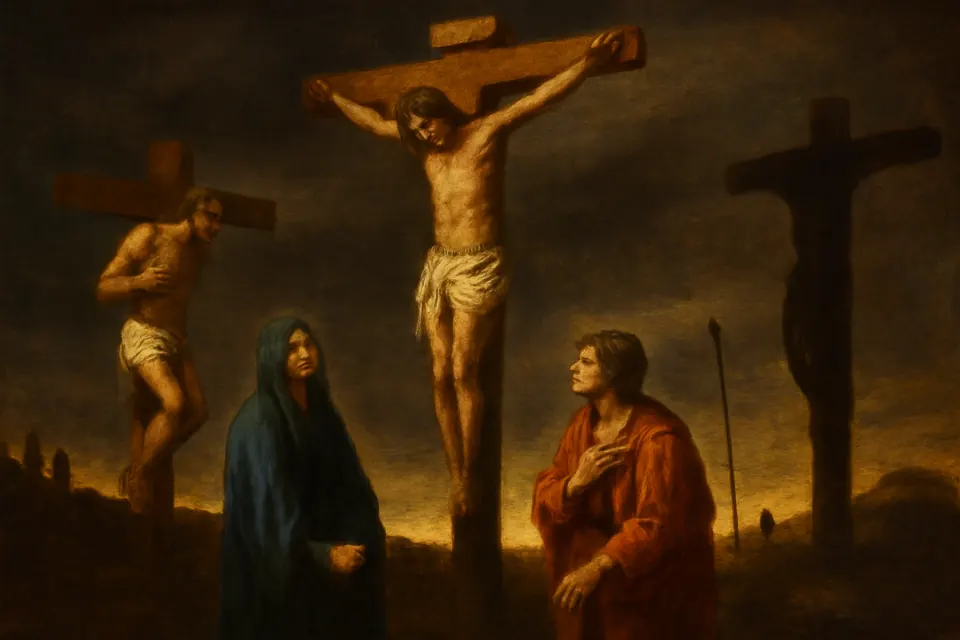
Who was the first saint? It depends on what you mean. The first person Jesus himself promised heaven was the Good Thief, St. Dismas (Luke 23:43). The first Christian to die for Christ was St. Stephen, the protomartyr. The first saint known to be canonized by a pope was St. Ulrich of Augsburg, by John XV in 993.
"Who was the first saint?" sounds like a trivia question, but it has more than one true answer, and each one teaches something about what a saint is. If you mean the first person Christ promised heaven, the answer is a criminal dying on a cross. If you mean the first to give his life for Jesus, it's a young deacon named Stephen. And if you mean the first saint canonized by a pope, it's a German bishop who died nearly a thousand years after both of them.
The first saint promised heaven: the Good Thief
On Calvary two criminals were crucified with Jesus. One mocked him. The other rebuked his companion and turned to the Lord. St. Luke gives his words:
And he said to Jesus: Lord, remember me when thou shalt come into thy kingdom. And Jesus said to him: Amen I say to thee, this day thou shalt be with me in paradise.
Luke 23:42–43 (Douay-Rheims)
No one in the Gospels receives so direct a promise. That is why the Church has always honored the Good Thief as a saint, though no pope or bishop ever declared him one. The Gospel gives no name; tradition, drawing on the apocryphal Gospel of Nicodemus, calls him St. Dismas, and the Roman Martyrology remembers him on March 25.
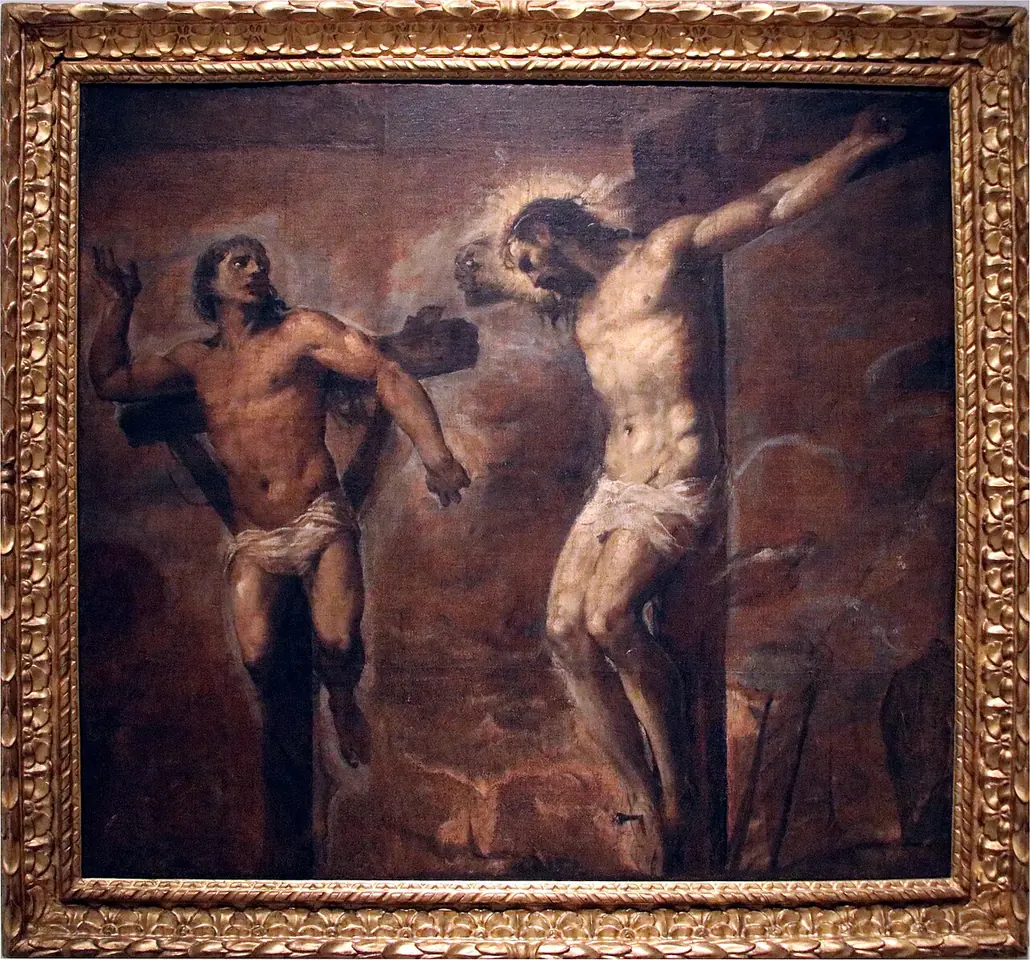
There is great hope in this answer. The first soul we know to have entered paradise with Christ had nothing to offer but a few words of faith and a plea for mercy at the very end. He is the patron of prisoners and of every sinner who thinks it is too late.
Strictly speaking, others were holy before him. The Church honors the patriarchs and prophets, St. John the Baptist, who died before Christ, and the Holy Innocents, the infants killed by Herod and honored as martyrs. Above them all is the Blessed Virgin Mary, Queen of All Saints. But the Good Thief is the first person whose salvation we hear Christ himself announce.
The first martyr: St. Stephen
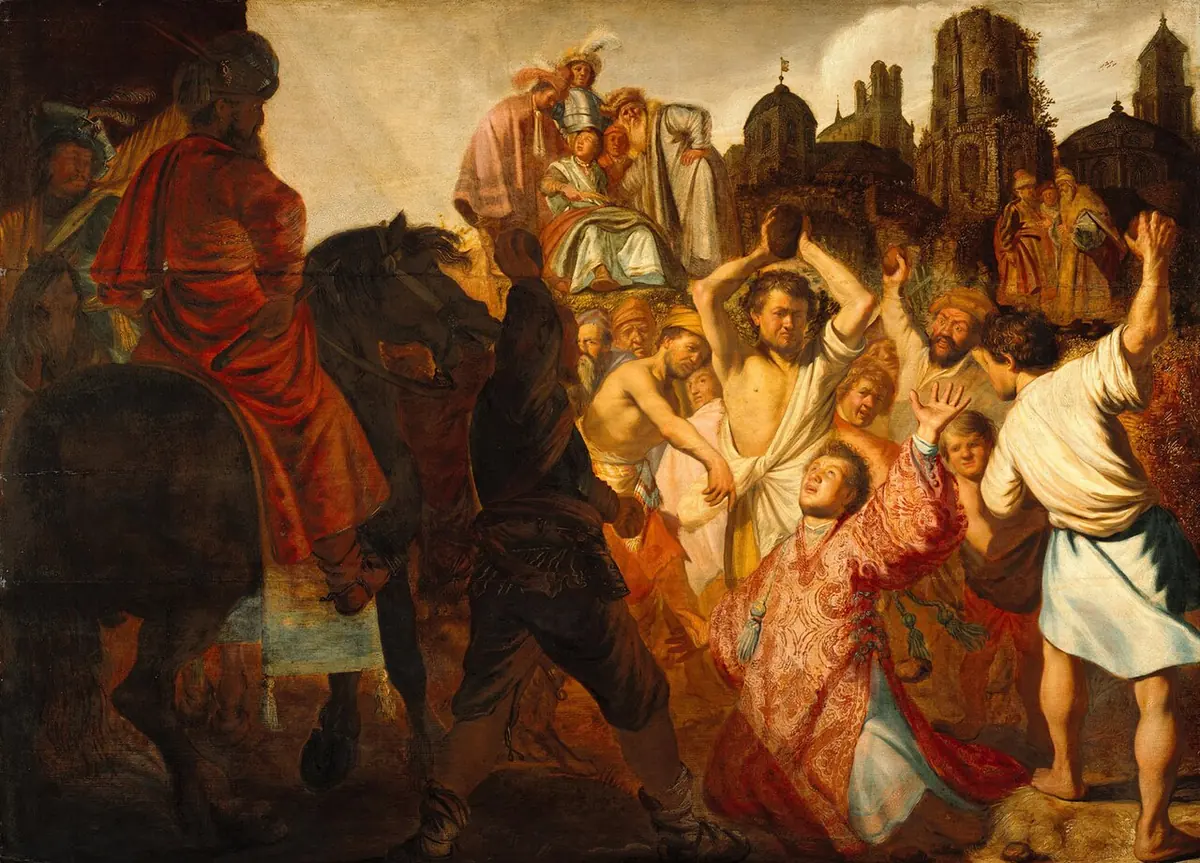
After Pentecost the apostles chose seven men "of good reputation, full of the Holy Ghost and wisdom" to serve the widows and the poor of the Jerusalem church (Acts 6:3). The first named was Stephen, "full of grace and fortitude," who "did great wonders and signs among the people" (Acts 6:8).

His preaching brought him before the Sanhedrin, and his long defense, the longest speech in Acts, ended with a vision. Acts tells it this way:
But he, being full of the Holy Ghost, looking up steadfastly to heaven, saw the glory of God, and Jesus standing on the right hand of God.
And they stoned Stephen, invoking, and saying: Lord Jesus, receive my spirit. And falling on his knees, he cried with a loud voice, saying: Lord, lay not this sin to their charge. And when he had said this, he fell asleep in the Lord.
Acts 7:55, 58–59 (Douay-Rheims)
The witnesses laid their cloaks at the feet of a young man named Saul, the future St. Paul. Stephen is the protomartyr, the first of the countless men and women who would die for Christ, and his feast falls on December 26, the day after Christmas. The Catholic Encyclopedia adds that his tomb was forgotten until 415, when a priest named Lucian was led to his relics at Caphar Gamala, north of Jerusalem.
How the martyrs became the first saints
For the first Christians, a martyr was a saint without question. The oldest account we have of a martyr's feast comes from Smyrna, after St. Polycarp was burned around 155. His people wrote that they gathered his bones, "more precious than the most exquisite jewels," and laid them in a fitting place where the Lord would grant them "to celebrate the anniversary of his martyrdom." That annual gathering at the tomb is the seed of every feast day on our calendar.

For the next thousand years, saints were recognized the same way. The faithful honored a martyr or a holy bishop, the local bishop approved, and the name went into the calendar. There was no ceremony in Rome.
The first canonized saint: St. Ulrich of Augsburg
That changed with Ulrich, bishop of Augsburg in southern Germany. Born in 890 and schooled at the abbey of St. Gall, he was made bishop in 923 and gave fifty years to his diocese, visiting parishes, building churches and caring for the poor. When the Magyars besieged Augsburg in 955, his courage held the city until Emperor Otto arrived.
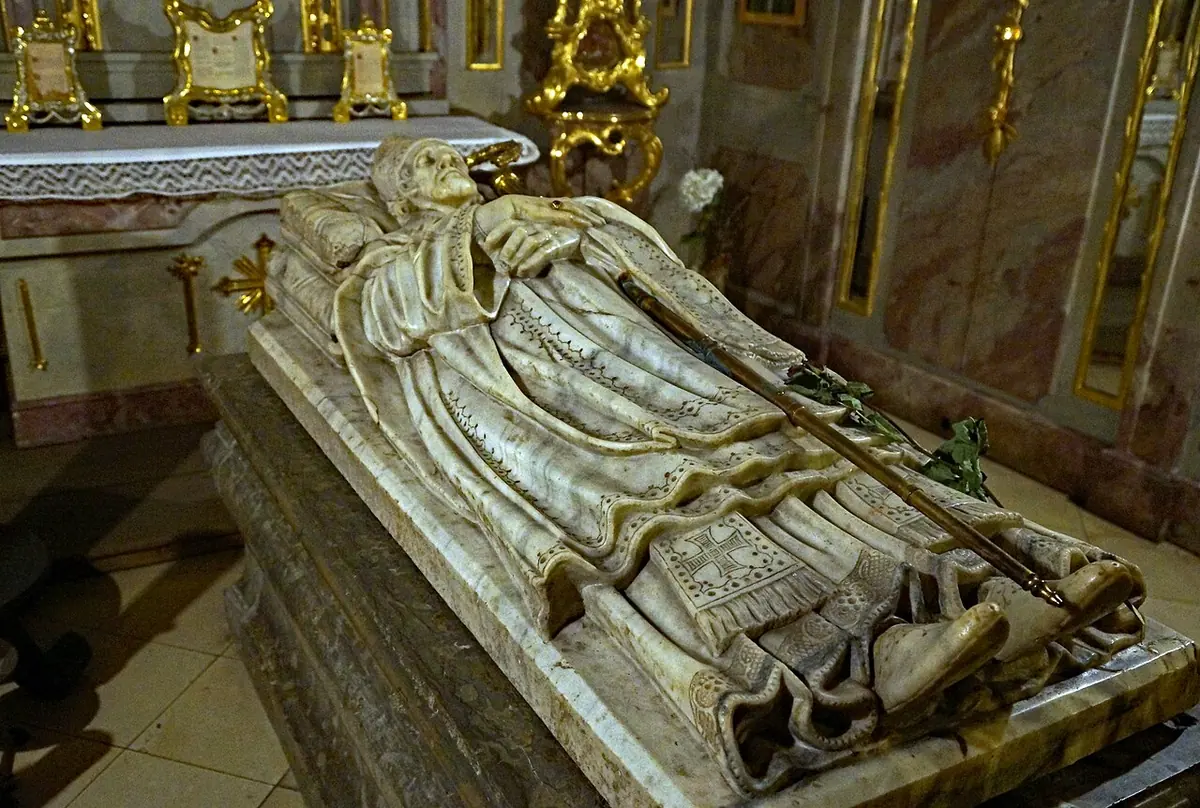
He died at dawn on July 4, 973, lying on ashes strewn in the shape of a cross while his clergy sang the Litany of the Saints. "Many miracles were wrought at his grave," the Catholic Encyclopedia records, "and in 993, he was canonized by John XV." Pope John XV proclaimed him a saint at a synod in Rome, and for the first time we know of, a saint's honor came by papal decree.
Bishops kept recognizing saints locally for another two centuries. Then Pope Alexander III (1159–1181), told of a man venerated as a saint though he had died drunk, ruled that no one could be revered as a saint "unless with the authority of the Roman Church." From the 13th century on, canonization belonged to the pope alone. Our page on how someone becomes a saint tells the rest of the story, and how many saints there are gives the count pope by pope.
Three answers, one lesson
The Good Thief, St. Stephen and St. Ulrich could hardly be more different: a criminal saved at the last hour, a young deacon who died forgiving his killers, and a bishop who served a long lifetime. What they share is the one thing that makes any saint: they belonged wholly to Christ at the end. St. Dismas, St. Stephen and St. Ulrich, pray for us.
Frequently asked questions
Who was the first canonized saint?
St. Ulrich, bishop of Augsburg, who died in 973. The Catholic Encyclopedia records that "Many miracles were wrought at his grave; and in 993, he was canonized by John XV." He is the first saint known to have been declared a saint by a pope.
Is the Good Thief really a saint?
Yes. No pope ever canonized him, but no one needed to. Christ himself told him, "this day thou shalt be with me in paradise" (Luke 23:43). The Roman Martyrology remembers him on March 25, and tradition calls him St. Dismas.
Who was the first Christian martyr?
St. Stephen, one of the seven deacons, stoned outside Jerusalem a few years after the Resurrection (Acts 7). The Church calls him the protomartyr, the first martyr, and keeps his feast on December 26, the day after Christmas.
Was Mary the first saint?
In holiness, yes. Our Lady was preserved from all sin from her conception, and the Church honors her as Queen of All Saints, above every other saint. She was never canonized, because no canonization was ever needed. See our page on the Blessed Virgin Mary.
Sources
- Douay-Rheims Bible: Luke 23
- Douay-Rheims Bible: Acts 7
- Catholic Encyclopedia (1912): St. Stephen. The finding of his relics at Caphar Gamala in 415
- Catholic Encyclopedia (1912): St. Ulrich. His death on July 4, 973, and canonization by John XV in 993
- Catholic Encyclopedia (1907): Beatification and Canonization. Alexander III's decretal reserving canonization to the Holy See
- The Martyrdom of Polycarp, chapter 18 (New Advent)