True Cross
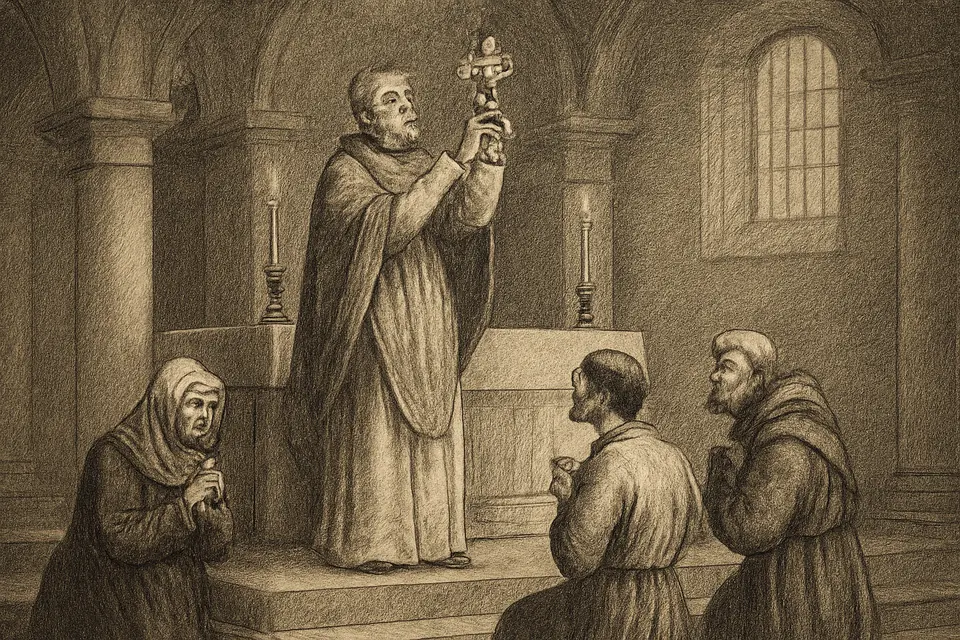
The True Cross is the wood on which Jesus Christ was crucified. Tradition holds that St. Helena, mother of Constantine, found it in Jerusalem around 327; the pilgrim Egeria saw it venerated there on Good Friday about 380. Fragments spread across the Christian world, the largest in Rome and Spain. The Church honors it on September 14, the Exaltation of the Holy Cross.
"Behold the wood of the cross on which the salvation of the world did hang. Come, let us adore." Every Good Friday the Church sings those words as a cross is unveiled and carried to the people, and we come forward one by one to kneel and kiss it. The rite began in Jerusalem in the fourth century, before a real piece of wood that Christians believed was the Cross itself. This page tells the story of that relic, the True Cross: how tradition says St. Helena found it, what the earliest witnesses saw, how it was lost and won back, where its fragments are kept, and what the Church asks us to believe about them.
St. Helena and the finding of the Cross
Around 327 St. Helena, the aged mother of Emperor Constantine, made a pilgrimage to the Holy Land. Bishop Macarius of Jerusalem was then excavating the place of Calvary and the tomb of Christ, which had lain under a pagan temple since Hadrian's day. The Catholic Encyclopedia puts it simply: "it was in the course of these excavations that the wood of the Cross was recovered."
The sources come in layers, and it helps to keep them apart.
- History. Eusebius, who knew Constantine, describes the uncovering of the tomb and Helena's journey but says nothing of the Cross. St. Cyril of Jerusalem, preaching at Golgotha around 347, speaks of the sacred wood as already venerated there and says that "the whole inhabited earth is full of relics of the wood of the Cross." An inscription of 359 found near Sétif in North Africa lists a relic "de ligno crucis" among the treasures of a church.
- Tradition. St. Ambrose, in his funeral sermon for Emperor Theodosius in 395, is the first to name Helena as the finder. He says she recognized Christ's cross by its title and adored the King, not the wood. A few years later Rufinus added the story that three crosses were found and the true one was known when it healed a dying woman. Later legends, such as that of the Jew Judas Cyriacus who revealed the hiding place, are traditional and grew with each retelling.
The Church, East and West, honors St. Helena as the finder of the Cross by long tradition. The full story of her life and the sources is on her page.
What Egeria saw on Good Friday
Our clearest early witness is a woman pilgrim named Egeria, probably from Spain or Gaul, who kept a travel diary in Jerusalem around 380. She describes the Good Friday rite in a chapel beside Golgotha. A silver-gilt casket was brought to the bishop and opened, "and both the wood of the Cross and the title are placed upon the table." Then, in McClure's 1919 translation:
the people, both faithful and catechumens, come one by one and, bowing down at the table, kiss the sacred wood and pass through. And because, I know not when, some one is said to have bitten off and stolen a portion of the sacred wood, it is thus guarded by the deacons who stand around, lest any one approaching should venture to do so again.
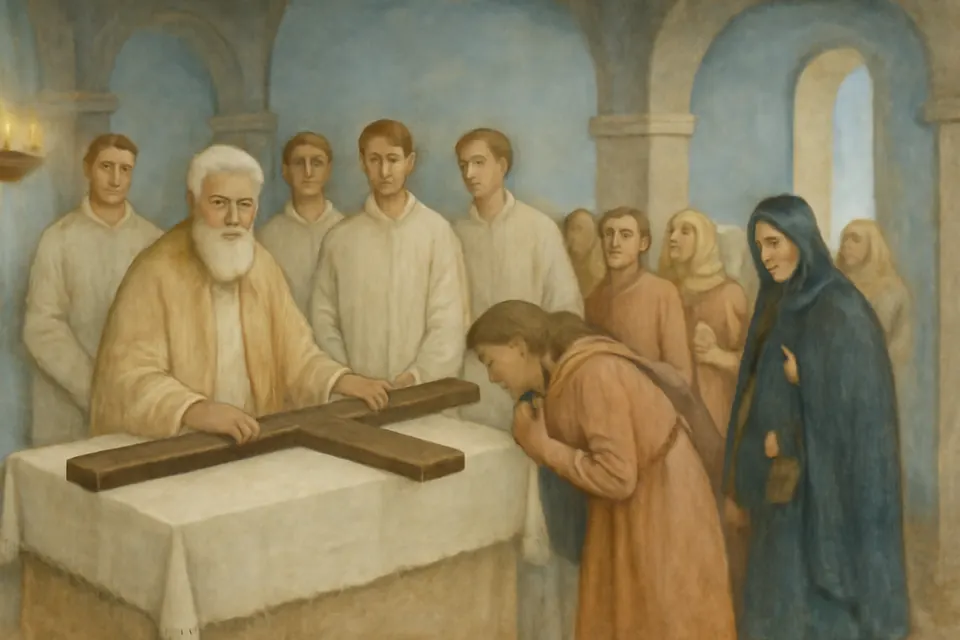
That small, very human detail about the stolen splinter tells us how much the relic was loved. Our own Good Friday veneration of the Cross descends directly from this rite.
The Exaltation of the Holy Cross, September 14
Constantine's great churches at Golgotha, the Anastasis over the tomb and the Martyrium beside it, were dedicated on September 13 and 14, 335. Egeria explains why the date was chosen: the churches were consecrated on the anniversary of the finding, "because the Cross of the Lord was found on this same day." The feast lasted eight days and drew monks and bishops from Egypt, Syria and Mesopotamia. From Jerusalem it passed to Constantinople and, by the late 600s, to Rome. We still keep the Exaltation of the Holy Cross on September 14. Until 1960 the Roman calendar also had a separate feast of the Finding of the Cross on May 3. See the feast day calendar.
Heraclius and the return of 630
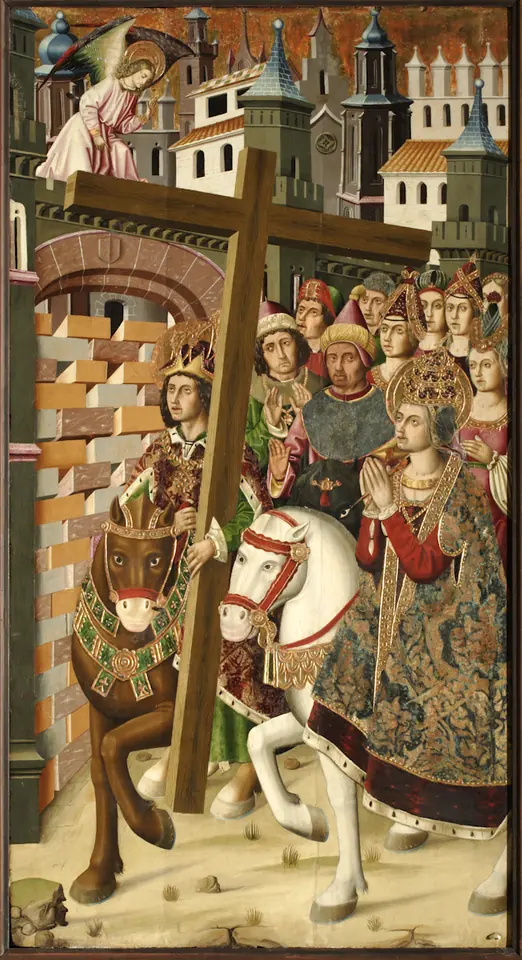
In 614 the Persian army of Khosrow II sacked Jerusalem and carried the Cross away to Persia, along with Patriarch Zacharias. Emperor Heraclius fought for years to win it back, and after his victory over the Persians the relic was returned. Around 630 he carried it into Jerusalem himself. The Orthodox Church tells what happened at the gate: Heraclius, in crown and purple, could go no further until the patriarch told him to take off his royal robes and walk barefoot, as Christ had. This part of the story is traditional, and the Golden Legend spread it across the medieval West. In the West the September feast came to recall this return above all.

Santa Croce in Gerusalemme and the spread of the relics
Helena's palace in Rome, the Sessorium, became the basilica of Santa Croce in Gerusalemme, "Holy Cross in Jerusalem." The Liber Pontificalis says Constantine gave it a portion of the Cross, a report the Catholic Encyclopedia accepts with caution. Today its Chapel of the Relics, opened in 1930 and finished in 1952, leads pilgrims along the Stations of the Passion to three fragments of the Cross, a nail, thorns from the crown and the wooden title, the Titulus Crucis, rediscovered walled up in the church in 1492. A radiocarbon test in 2002 dated the title to the 10th to 12th centuries; others defend it on paleographic grounds.

Other fragments went out early and far. St. Paulinus of Nola sent a sliver to Sulpicius Severus around 400. Juvenal of Jerusalem sent one to Pope St. Leo the Great about 455. In 569 Queen Radegund received a relic for her convent at Poitiers, and Venantius Fortunatus wrote for the occasion the hymn we still sing in Holy Week, the Vexilla Regis: "The royal banners forward go." St. Gregory the Great sent pieces to the Lombard queen Theodelinda and to King Recared of Spain. Byzantine goldsmiths made small enamel boxes, called staurothekes, to carry them.
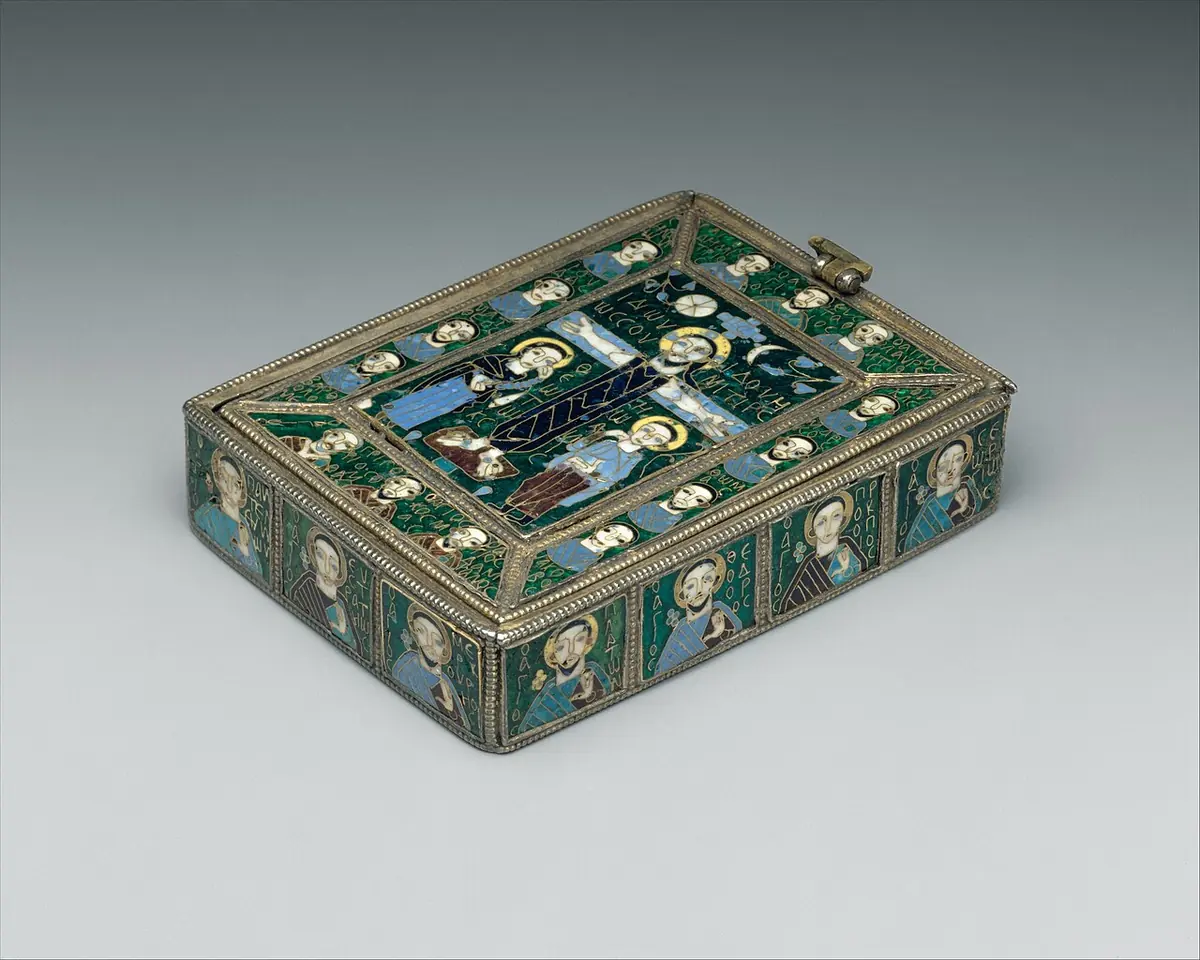
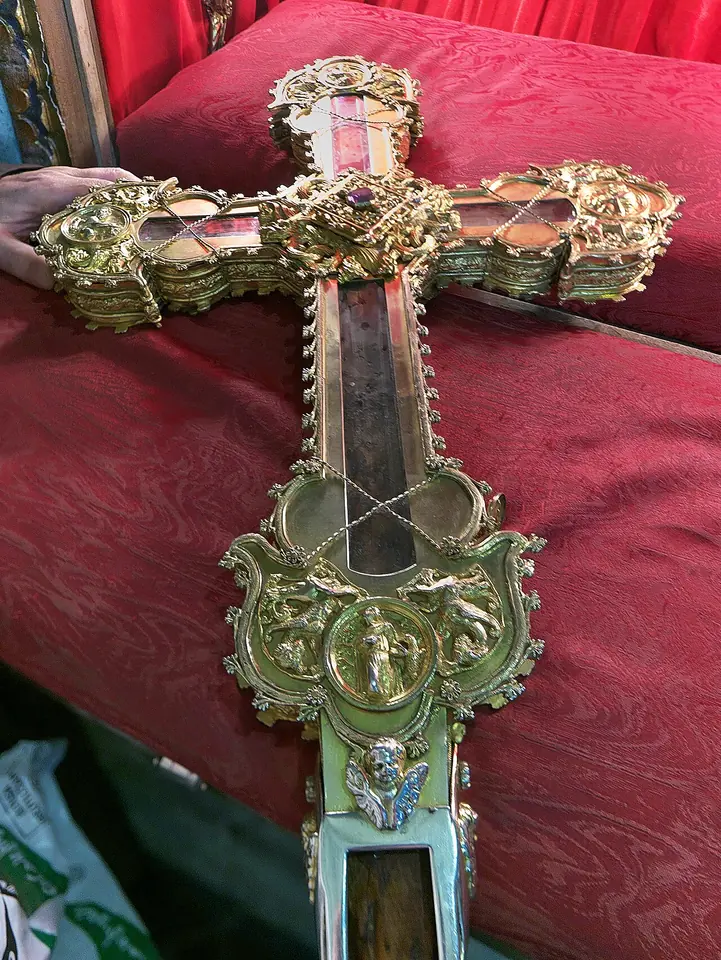
St. Peter's Basilica has kept its own relic of the Cross since 1629, in the chapel above the statue of St. Veronica, where it is shown with the other relics of the Passion in Holy Week. In Spain, the Franciscan monastery of Santo Toribio de Liébana keeps a piece set in a gilded silver cross of 1679, measuring by the monastery's account about 63 by 39 centimeters, which it calls the largest surviving relic of the Cross.
"Enough wood to build a ship"
An old jibe, repeated since the sixteenth century, says that if all the relics of the True Cross were gathered they would build a ship. In 1870 the French architect Charles Rohault de Fleury set out to test it. He catalogued every relic of the Cross he could trace in churches across Europe and measured them. As the Catholic Encyclopedia reports his findings, a pine cross of normal size, three or four meters high and weighing about 75 kilograms, would contain some 178,000,000 cubic millimeters of wood. All the known relics together came to a little over 4,000,000. Allow generously for lost or overlooked pieces, and the total is still a small fraction of a single cross.
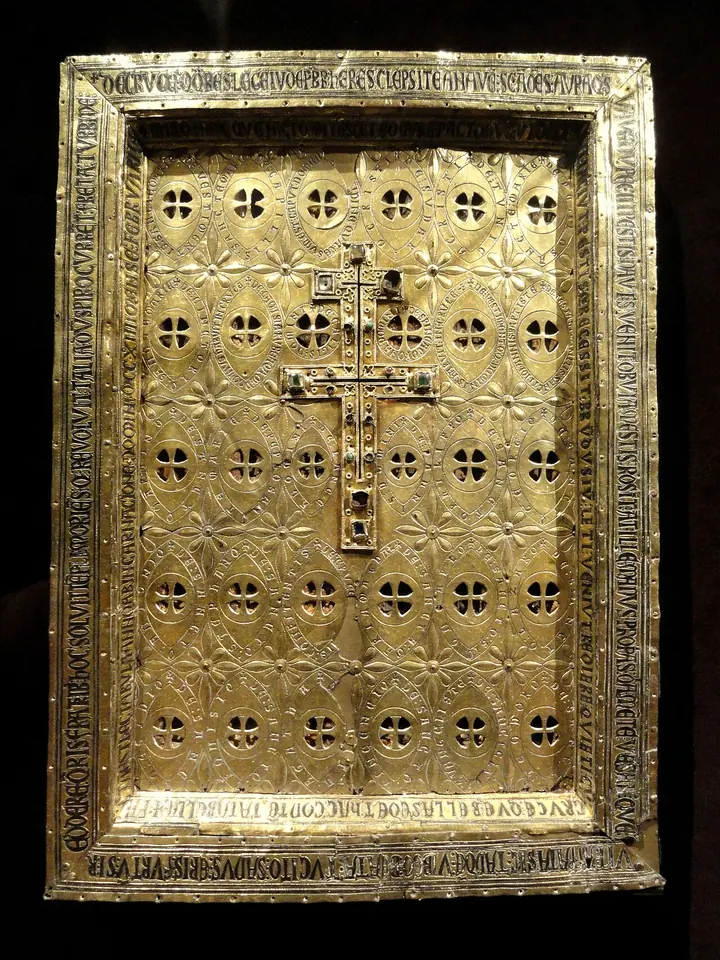
Most relics of the Cross are slivers no bigger than a grain of rice, set in large and splendid frames. The frame makes the relic look large; the wood itself is tiny.
What the Church teaches about the True Cross
The Church venerates the True Cross as the first among all relics, because of the One who hung on it. The Second Council of Nicaea (787) taught that the honor given to the "precious and vivifying cross" passes to Christ himself, and that adoration in the strict sense belongs to God alone. When we sing "Come, let us adore" on Good Friday, it is Christ we adore.
The Church does not claim to prove the history of every fragment. What history can say is that a relic believed to be the Cross was venerated in Jerusalem by the 340s and was being divided and sent abroad within a generation. Some relics surely came from that source; others cannot be traced. A relic in a church today should carry a certificate from Church authority, and canon law forbids selling it. Read more about relics and how the Church treats them, and about other relics of the Passion: the Shroud of Turin, the Holy Lance and the Veil of Veronica.
We adore you, O Christ, and we bless you, because by your holy Cross you have redeemed the world.
Frequently asked questions
Who found the True Cross?
Tradition credits St. Helena, the mother of Emperor Constantine, during her pilgrimage to Jerusalem around 327. The earliest writer to name her is St. Ambrose, in 395. Earlier, St. Cyril of Jerusalem (about 348) already spoke of the wood of the Cross venerated at Golgotha and found in Constantine's reign, without naming who found it.
Where is the True Cross today?
It was divided into many fragments in the first centuries. The best known are in the Chapel of the Relics at Santa Croce in Gerusalemme in Rome, in St. Peter's Basilica, and at the monastery of Santo Toribio de Liébana in northern Spain, which keeps what it says is the largest surviving piece. Countless churches hold small slivers.
Is there really enough True Cross wood to build a ship?
No. In 1870 the French architect Charles Rohault de Fleury catalogued every known relic of the Cross. He estimated the whole cross at about 178,000,000 cubic millimeters of wood, and all the known relics together at a little over 4,000,000, less than a fortieth of it.
When is the feast of the True Cross?
The Exaltation of the Holy Cross is kept on September 14 in East and West. It goes back to the dedication of Constantine's churches at Golgotha on September 13 and 14, 335, and later also recalled Emperor Heraclius's return of the Cross to Jerusalem around 630. Before 1960 the Roman calendar also kept the Finding of the Cross on May 3.
Are True Cross relics authentic?
The Church cannot prove the history of each fragment, and does not claim to. Relics of the Cross were venerated in Jerusalem by the 340s and were being sent abroad soon after. A relic in a church today should carry a document from Church authority, and it is honored for the sake of Christ, whatever the uncertainty of its path.
Sources
- Catholic Encyclopedia (1908): The True Cross
- The Pilgrimage of Etheria, translated by M. L. McClure and C. L. Feltoe (1919)
- Charles Rohault de Fleury, Mémoire sur les instruments de la Passion de N.-S. J.-C. (Paris, 1870)
- Vatican News: Il Titulus Crucis, dal Calvario a Roma (February 27, 2023)
- Orthodox Church in America: The Universal Exaltation of the Precious and Life-Giving Cross
- Giovanni Giuliani, Guide to Saint Peter's Basilica: The Four Relics