Crucifix

A crucifix is a cross that bears the figure of Christ crucified, called the corpus (Latin for body). A plain cross proclaims the victory of the cross; a crucifix shows us the One who died on it for love of us. The Church requires a crucifix on or near every altar where Mass is offered, and blesses crucifixes as sacramentals for the home and for private prayer.
Walk into any Catholic church and the first thing your eyes find, above or beside the altar, is the crucifix. It hangs in hospital rooms and schoolrooms, over the beds of children and in the hands of the dying. The crucifix is the simplest summary of our faith: God so loved the world that he gave his only Son, and the Son loved us to the end. This page explains what a crucifix is, how it differs from a cross, what INRI means, the most famous crucifixes in the world, and two special crucifixes many people ask about, the St. Benedict crucifix and the Pardon Crucifix.
What is a crucifix?
A crucifix is a cross bearing the figure of Christ crucified. The figure is called the corpus, Latin for body. It may be carved in wood, cast in metal or painted on a flat panel, and it usually carries a small sign above Christ's head with the letters INRI.
The Church counts the crucifix among the sacramentals, "sacred signs which bear a resemblance to the sacraments" (Catechism 1667). Like every sacramental, it has no power of its own. Its worth comes from Christ, whose Passion it shows, and from the prayer of the Church that blesses it, received by those who pray before it with faith. A crucifix is never a charm. It is a window onto Calvary.
Crucifix vs. cross
A cross is the bare shape. A crucifix adds the body of the Lord. Both are holy, and the Church uses both: the plain or jeweled cross speaks of Christ's victory, the "triumph of the cross," while the crucifix keeps before us the cost of that victory.
Why keep the corpus? St. Paul answers: "But we preach Christ crucified, unto the Jews indeed a stumblingblock, and unto the Gentiles foolishness" (1 Corinthians 1:23, Douay-Rheims). The crucifix does not forget Easter. The risen Christ still bears his wounds (John 20:27), and the Mass makes present the one sacrifice of Calvary. When we look at a crucifix we see how far God's love was willing to go, and we learn to bring our own sufferings to his.
A short history of the crucifix
The first Christians were slow to picture their Lord on the cross. Crucifixion was still a living punishment, shameful and cruel, and the Catholic Encyclopedia notes how much "circumspection was necessary in proceeding to a direct portrayal of the Lord's actual Crucifixion." They used veiled signs instead: an anchor, a lamb, a fish.
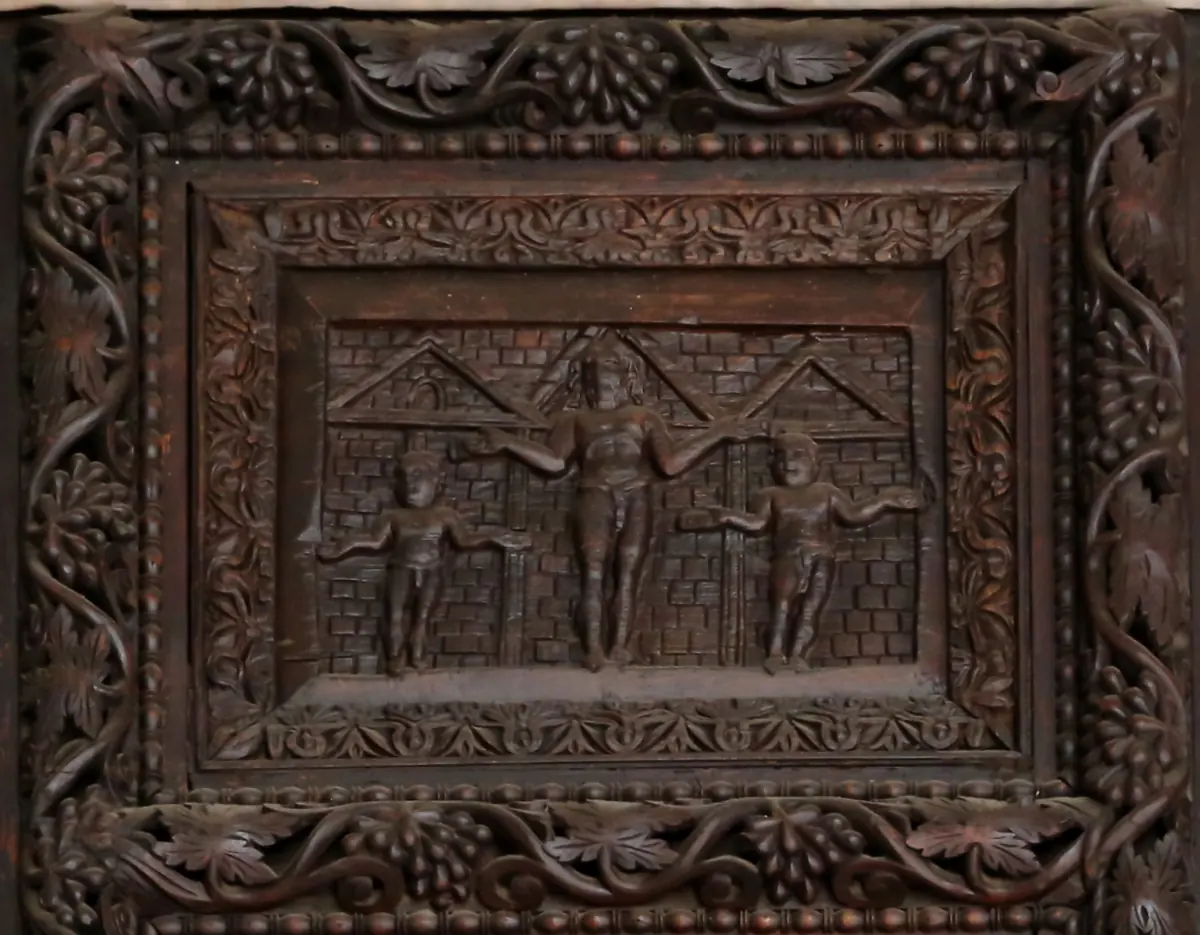
The open cross appears early in the fifth century, after the peace of Constantine, and one of the oldest surviving pictures of Christ on the cross is the carved panel on the doors of the Roman basilica of Santa Sabina. Even there Christ stands with arms outstretched as if in prayer, the cross itself barely shown. Crucifixes became common from the sixth and seventh centuries. Early images show Christ alive and crowned, reigning from the cross; from about the 12th and 13th centuries Western art dwells more on his suffering and death.
For centuries the cross was carried to the altar only for Mass. The Catholic Encyclopedia traces the permanent altar crucifix to the later Middle Ages, and today the General Instruction of the Roman Missal (no. 308) requires that "there is also to be a cross, with the figure of Christ crucified upon it, either on the altar or near it, where it is clearly visible to the assembled congregation."

INRI: the title on the cross
St. John records: "And Pilate wrote a title also, and he put it upon the cross. And the writing was: JESUS OF NAZARETH, THE KING OF THE JEWS. This title therefore many of the Jews did read: because the place where Jesus was crucified was nigh to the city: and it was written in Hebrew, in Greek, and in Latin" (John 19:19-20, Douay-Rheims).
INRI is the Latin title shortened to its initials: Iesus Nazarenus Rex Iudaeorum. Pilate meant it as a mockery or a warning. The Church reads it as the truth: the crucified Jesus is the King. Velázquez painted the whole title in all three languages above his Christ Crucified.

Famous crucifixes
The San Damiano Cross
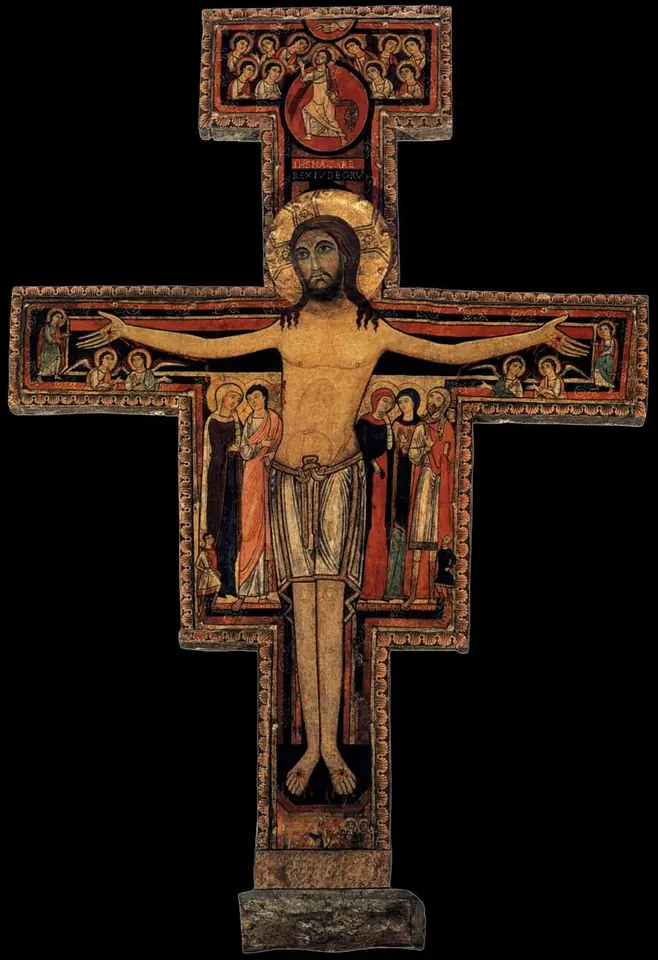
Around 1205, the young St. Francis of Assisi was praying in the half-ruined chapel of San Damiano before a painted crucifix when he heard a voice from it: "Go, Francis, and repair my house, which as you see is falling into ruin." He began by rebuilding the chapel with his own hands and went on to renew the Church. The voice from the cross is a reported event, told by Francis's early biographers. The crucifix, painted in the 12th century in the Byzantine style, shows Christ upright with open eyes, surrounded by Mary, St. John, the holy women and the centurion. When St. Clare's sisters moved into Assisi they brought it with them, and it hangs today in the Basilica of St. Clare.
The Gero Cross, Cologne
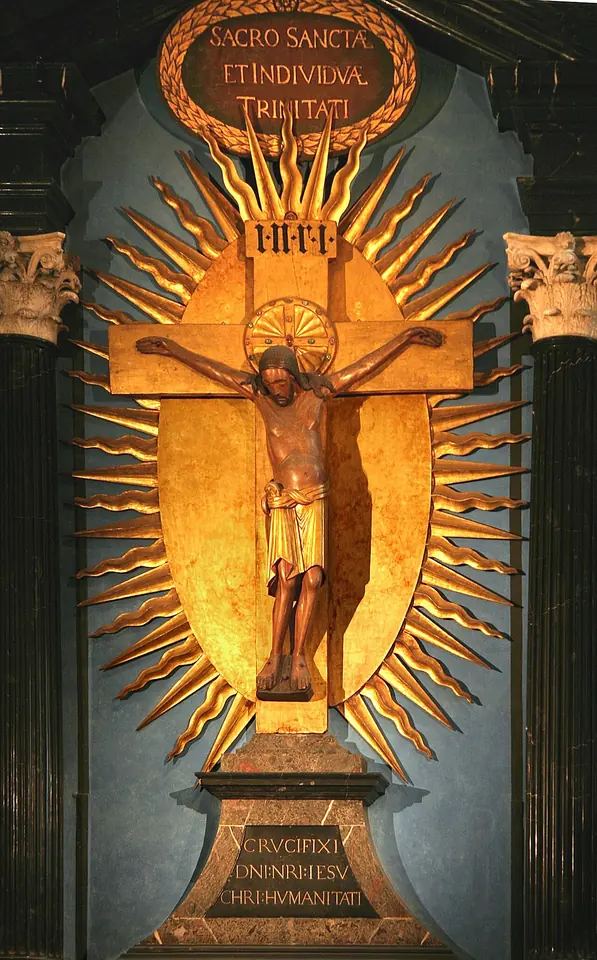
Archbishop Gero of Cologne gave his cathedral a large carved oak crucifix around 970. It shows Christ dead, his head fallen forward and his body sagging, one of the oldest large crucifixes of its kind in Europe. It still hangs in Cologne Cathedral, now framed by a Baroque golden sunburst.
Cimabue's crucifix, Santa Croce
The Florentine painter Cimabue painted a great crucifix for the Franciscan church of Santa Croce in the late 13th century, with Christ's body bending in a long curve of grief. The Arno flood of November 1966 badly damaged it, and its long restoration made it a symbol of Florence's recovery.

Crucifixes in the lives of the saints
Many saints met Christ before a crucifix. At Naples in 1273, witnesses said a voice from the crucifix told St. Thomas Aquinas, "You have spoken well of me, Thomas," and he asked for nothing "but Yourself, Lord" (reported). St. Catherine of Siena received the stigmata at Pisa in 1375 while praying before a crucifix (reported). Other famous crucifixes, such as the Volto Santo of Lucca and the Cristo de Limpias in Spain, draw pilgrims to this day.
The crucifix in Catholic life
On the altar and in church
The crucifix at the altar reminds us that the Mass is the sacrifice of Calvary made present. Processions are led by a crucifix, and on Good Friday the Church unveils the cross and the faithful come forward one by one to kneel and kiss it.
In the home
A blessed crucifix in the home marks it as a Christian household. Many families hang one in the room where they pray together and one in each bedroom, and tuck the blessed palm from Palm Sunday behind it. Children learn to make the Sign of the Cross before it at night. Any priest can bless a crucifix, and the old Roman Ritual includes a blessing for crosses and images.
At the hour of death
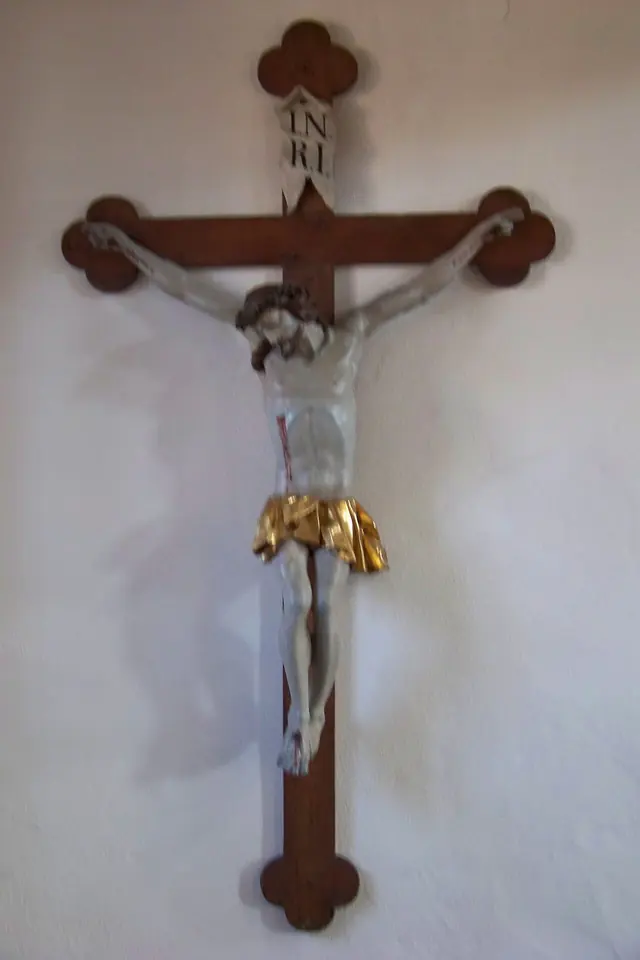
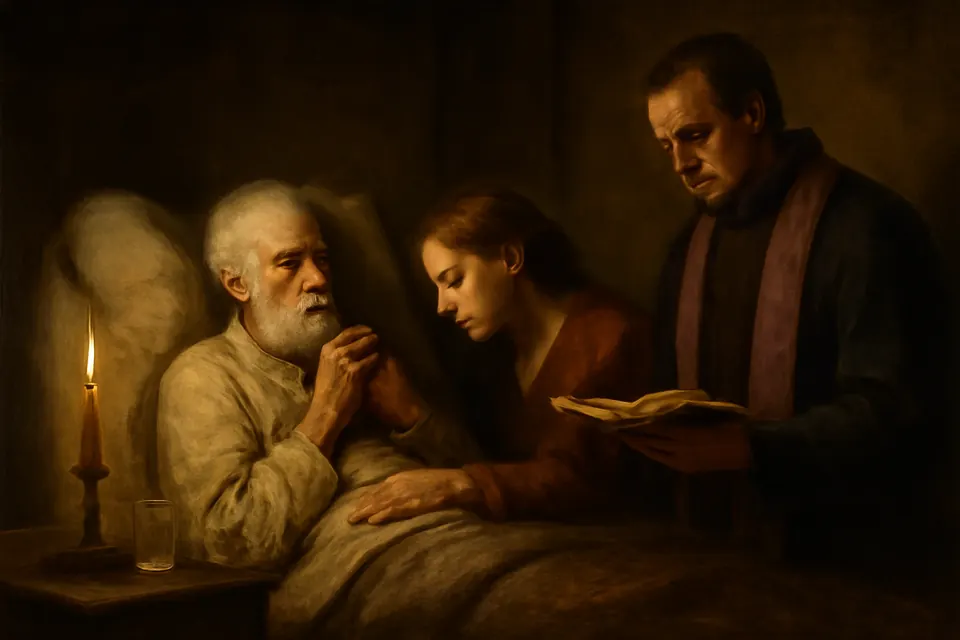
The Church has long placed a crucifix in the hands of the dying. Pope Paul VI's 1967 norms on indulgences grant a plenary indulgence at the point of death to any of the faithful who are properly disposed and have been in the habit of praying during life, even when no priest can be present, and add: "To use a crucifix or cross in connection with the acquisition of this plenary indulgence is a laudable practice."
The St. Benedict crucifix
A St. Benedict crucifix is an ordinary crucifix with the medal of St. Benedict set into it, usually where the beams cross. The medal carries the image of St. Benedict and, on its back, the initials of the Latin prayer against evil, Crux sacra sit mihi lux ("May the holy cross be my light") and Vade retro Satana ("Begone, Satan"). Pope Benedict XIV approved the medal in 1741 and 1742, and the 19th-century book by Abbot Prosper Guéranger called it "the Medal or Cross of St. Benedict," because its prayer is all about the cross.
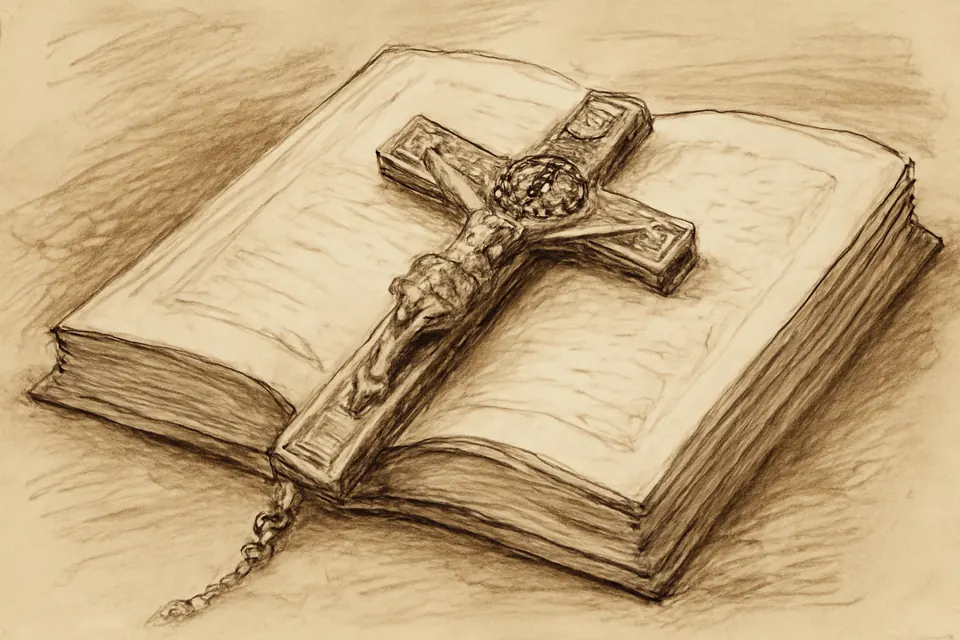
The St. Benedict crucifix joins two signs of Christ's victory over evil. It is a sacramental, a prayer in metal, never a talisman. For the full text and meaning of the medal's prayer, see our page on the St. Benedict prayer.
The Pardon Crucifix
The Pardon Crucifix is a small crucifix design that spread from France in the early 20th century. It usually spells out the title "Jesus of Nazareth, King of the Jews" in full and, on the back, shows the Sacred Heart with the words "Father, forgive them" and "Behold this Heart which has so loved men."
The devotional literature that spread with it says Pope St. Pius X granted indulgences to a Pious Union of the Pardon Crucifix in 1905, including a plenary indulgence at death for those who kiss it, ask God's pardon for their sins and forgive their neighbor. We could not locate the original rescript, so we report those grants as the devotion's own account.
What is certain is the present law. Paul VI's 1967 apostolic constitution Indulgentiarum Doctrina reorganized all indulgences and declared that indulgences "attached to the use of religious objects which are not mentioned above cease" three months after its publication. The special Pardon Crucifix grants, like the old special grants for many medals and crosses, ended then. Today a Pardon Crucifix carries the same indulgences as any crucifix:
- The faithful who devoutly use a crucifix "properly blessed by any priest, can acquire a partial indulgence."
- If it was blessed by the pope or a bishop, they can also gain a plenary indulgence on the feast of Sts. Peter and Paul (June 29), with a profession of faith and the usual conditions.
The heart of the Pardon Crucifix is still worth keeping: to kiss the image of the crucified Lord, ask his pardon and forgive those who have hurt us. That is the Gospel itself.
Praying before a crucifix
St. Paul wrote, "But God forbid that I should glory, save in the cross of our Lord Jesus Christ" (Galatians 6:14, Douay-Rheims). Let us take a few minutes before a crucifix today: look at the wounds, thank him, tell him our sorrows, and say with the Church, "We adore you, O Christ, and we bless you, because by your holy cross you have redeemed the world." For more on how the saints are shown in art, see saints' symbols in art, and for the Church's year of feasts, our feast days calendar.
Frequently asked questions
What is the difference between a crucifix and a cross?
A cross is the bare shape, an upright beam with a crossbeam. A crucifix is a cross with the figure of Christ crucified on it, called the corpus. Both are holy signs; the plain cross speaks of the victory of Christ, and the crucifix keeps before our eyes the love with which he suffered and died.
Why do Catholics have Jesus on the cross?
Because St. Paul says, "we preach Christ crucified" (1 Corinthians 1:23, Douay-Rheims). The crucifix does not deny the Resurrection. It shows the price of our redemption and the depth of God's love, so that we never forget what our salvation cost.
What does INRI mean on a crucifix?
INRI stands for the Latin Iesus Nazarenus Rex Iudaeorum, "Jesus of Nazareth, the King of the Jews." Pilate had this title written in Hebrew, Greek and Latin and fixed to the cross (John 19:19-20).
What is a Pardon Crucifix?
A small crucifix design that spread from France in the early 20th century, usually with the Sacred Heart and the words "Father, forgive them" on the back. Devotional literature says Pope Pius X granted it special indulgences in 1905. Those special grants ended with the 1967 reform of indulgences; today it carries the same indulgences as any crucifix blessed by a priest.
Where should I hang a crucifix in my home?
There is no fixed rule. Many families hang one in the main room where they pray together, and one in each bedroom, often above the bed or the door. Have it blessed by a priest, and keep it in a place of honor rather than among ordinary decorations.
Does a crucifix need to be blessed?
A crucifix is a holy image whether or not it is blessed, but the Church's blessing makes it a sacramental, set apart for prayer. The faithful who use a crucifix blessed by a priest with devotion can gain a partial indulgence under the Church's current norms.
Sources
- Catechism of the Catholic Church, nos. 1667–1679: Sacramentals
- Paul VI, Apostolic Constitution Indulgentiarum Doctrina (January 1, 1967), norms 17–18
- General Instruction of the Roman Missal, no. 308 (the cross at the altar)
- Catholic Encyclopedia (1908): Archaeology of the Cross and Crucifix
- Catholic Encyclopedia (1908): The Cross and Crucifix in Liturgy
- Catholic Encyclopedia (1912): Medal of Saint Benedict
- 1 Corinthians 1, Douay-Rheims Bible
- John 19, Douay-Rheims Bible