Holy Saturday 2027
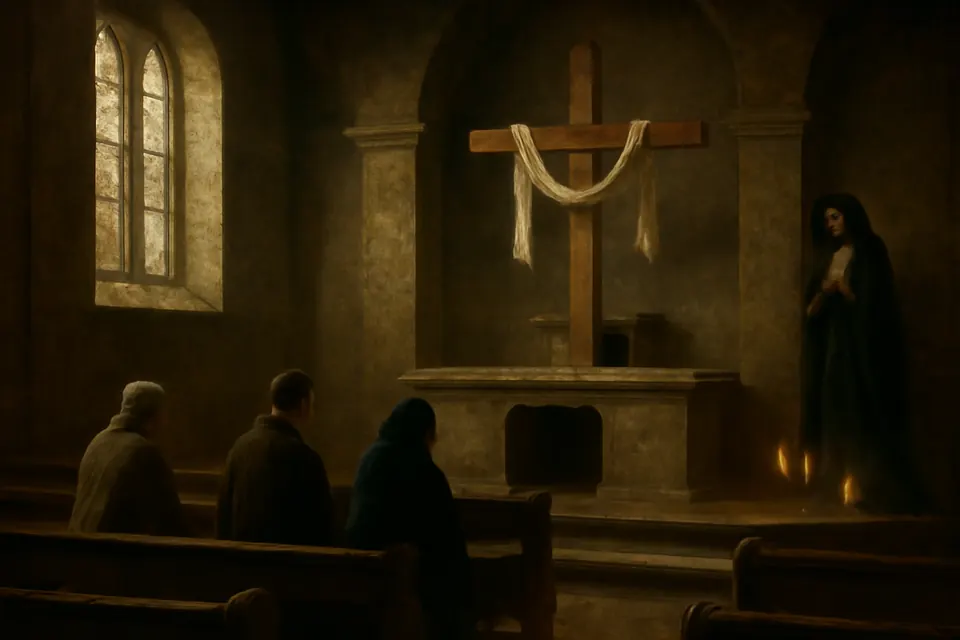
Holy Saturday 2027 is Saturday, March 27, 2027, the day the Church keeps watch at the Lord's tomb. No Mass is celebrated during the day. Fasting is not required but is recommended as the "paschal fast." After nightfall the Easter Vigil begins Easter, which falls on Sunday, March 28.
Holy Saturday 2027 falls on Saturday, March 27, between the Lord's death on Good Friday and his rising on Easter morning. It is the quietest day of the Christian year. Here is what the Church does and doesn't do on this day, how families keep it, and what to expect at the Easter Vigil that night.
Holy Saturday 2027 at a glance
- Date: Saturday, March 27, 2027
- Mass: none during the day; the Easter Vigil begins after nightfall
- Fasting: not required, but the paschal fast from Good Friday is recommended until the Vigil
- Confession: allowed, and many parishes offer it in the morning
- Easter Sunday: March 28. See Easter 2027.
- Orthodox Great and Holy Saturday: May 1, 2027
Holy Saturday is the second full day of the Easter Triduum, which runs from the evening Mass of the Lord's Supper on Holy Thursday through Evening Prayer on Easter Sunday. Lent itself ended on Holy Thursday, as our Lent 2027 page explains, but nobody treats Holy Saturday as a day off. It belongs to the same three days as the Cross and the empty tomb.
The Church waits at the tomb
The Church's 1988 letter on the Easter feasts describes the day in one sentence: "On Holy Saturday the Church is as it were at the Lord's tomb, meditating on his passion and death, and on his descent into hell, and awaiting his resurrection with prayer and fasting."
So the church building looks empty on purpose. The altar has been bare since Holy Thursday night. The tabernacle stands open, because the Blessed Sacrament was removed after the Good Friday liturgy and is reserved elsewhere only for the dying. There are no flowers, no bells and no organ. The same letter allows an image of Christ crucified or lying in the tomb, or of the descent into hell, or of the sorrowful Virgin Mary, to be set out for the faithful to pray before.

The Gospels tell us little about the day itself. St. Joseph of Arimathea had laid the body in his own new tomb, and St. Nicodemus had brought about a hundred pounds of myrrh and aloes (John 19:39). The women, St. Mary Magdalene among them, "rested on the sabbath day, according to the commandment" (Luke 23:56), waiting to finish the anointing. The chief priests asked Pilate for a guard at the tomb (Matthew 27:62–66). Then silence.
Christ's descent to the dead
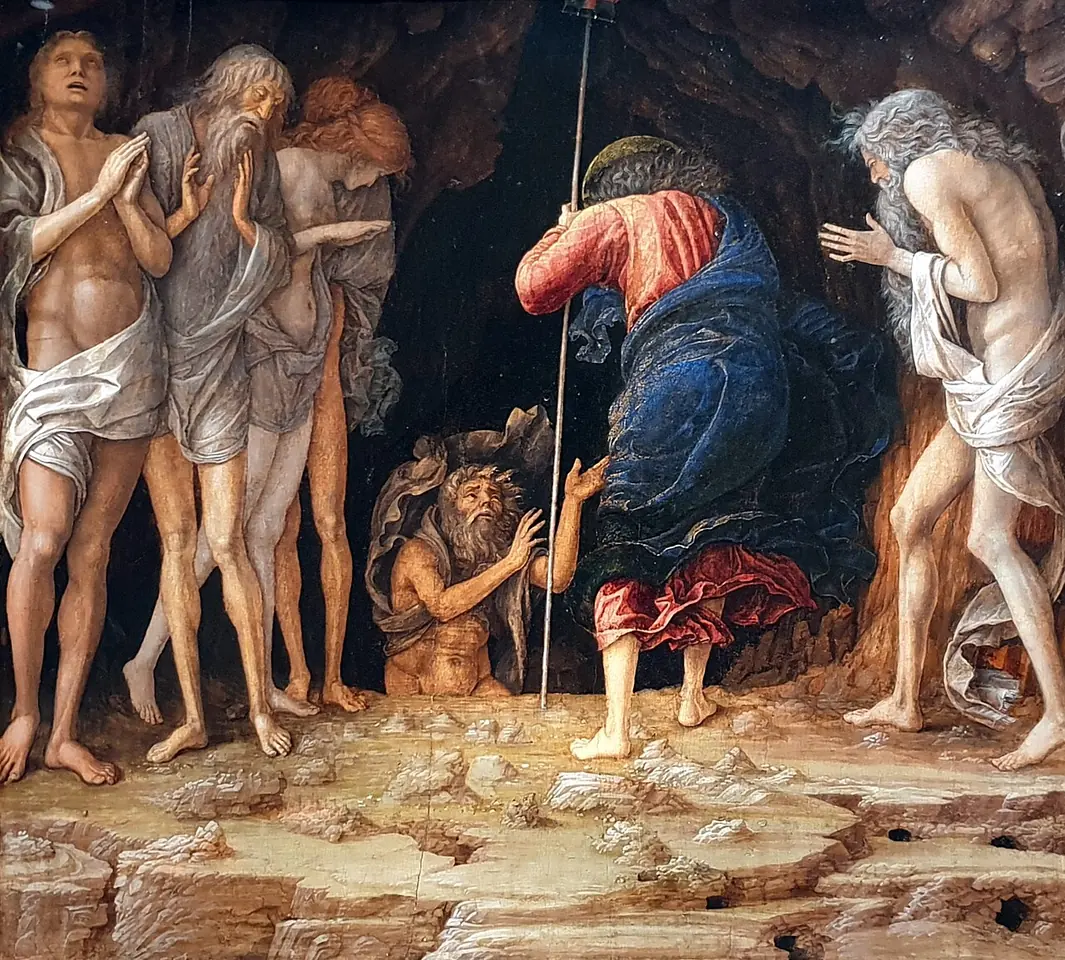
The silence on earth is not the whole story. In the Apostles' Creed we profess that Christ "descended into hell." The Catechism explains that this "hell" is the realm of the dead, Sheol or Hades, and that Jesus did not go there to free the damned but to open heaven to the just who had died before him (nos. 632–633). St. Peter writes that Christ "preached to those spirits that were in prison" (1 Peter 3:19).
The Office of Readings for Holy Saturday gives us an ancient homily on this mystery, by an unknown Father of the Church. The Catechism quotes it (no. 635). The homilist announces a great silence on earth, because the King is asleep, and says God has fallen asleep in the flesh and gone to search for Adam, our first father, "as for a lost sheep."

The Eastern churches give this mystery its own icon, the Anastasis. Christ stands on the shattered doors of Hades, keys and bolts scattered beneath him, and pulls Adam and Eve up by the wrists. Kings David and Solomon and St. John the Baptist wait their turn. In the West the same scene is called the Harrowing of Hell, or the descent into Limbo, the "limbo of the fathers" where the righteous of the Old Covenant awaited redemption.
Keeping vigil with Our Lady
From very early times Christians have pictured the Blessed Virgin Mary on this day as the one who kept faith while the apostles were scattered. The Vatican's Directory on Popular Piety (no. 147) commends the devotion called the Ora di Maria, the Hour of Mary, in which the faithful keep company with her "as she waits near the Lord's tomb." In Spain and Latin America the same devotion appears as the Soledad, Our Lady of Solitude, and as El Pésame, when people come to offer the Mother their condolences.
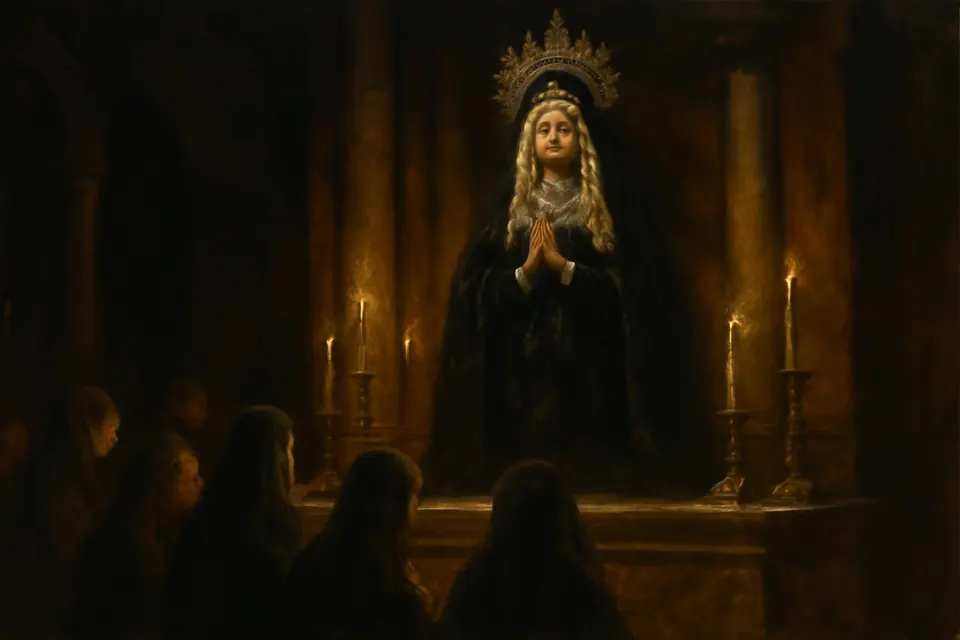
A simple way to keep the day is to pray the sorrowful mysteries of the Rosary or the Seven Sorrows Rosary with Our Lady of Sorrows, whose last three sorrows are the Crucifixion, the taking down from the Cross and the burial of her Son.
Is Holy Saturday a fast day?
Holy Saturday is not a day of obligatory fasting or abstinence. The required days are Ash Wednesday and Good Friday, as our page on the Catholic fasting and abstinence rules explains.
The Church does ask for more where we can give it. The Second Vatican Council wrote in Sacrosanctum Concilium (no. 110) that the paschal fast should be "prolonged throughout Holy Saturday, so that the joys of the Sunday of the resurrection may be attained with uplifted and clear mind." The US bishops repeat this: if possible, the Good Friday fast continues until the Easter Vigil.
The ancient Church took this very seriously. The Catholic Encyclopedia notes that from the time of St. Irenaeus, many Christians kept an absolute fast from all food for the forty hours before Easter, and that in the early Church this was the only Saturday of the year on which fasting was allowed.
Blessing Easter food baskets
The best-loved custom of Holy Saturday in many American parishes came from Poland. On Wielka Sobota, Great Saturday, families bring baskets of the food for their Easter breakfast to church to be blessed: hard-boiled and painted eggs, bread, sausage and ham, salt, horseradish, butter shaped like a lamb, and a sprig of greenery, all under a white linen cloth. The blessing is called Święconka. Slovak, Ukrainian, Croatian and Slovenian Catholics keep similar blessings, and the food is not eaten until Easter morning.

The blessing belongs to the waiting. The Directory on Popular Piety (no. 146) asks that festive customs once kept on Holy Saturday, from the centuries when Easter was anticipated that morning, be saved for the Vigil and Easter Sunday. So the basket is blessed on Saturday, but the feast waits for the Resurrection.

What happens on Holy Saturday in church
The day has no Mass, but it has prayer.
- Office of Readings and Morning Prayer. The 1988 letter asks that these be prayed with the people where possible. In some cathedrals and parishes they are sung publicly, the descendant of the old Tenebrae.
- Confession. All sacraments are forbidden on Holy Saturday "except those of Penance and the Anointing of the Sick."
- Rites for the elect. Adults preparing for baptism at the Vigil may gather in the morning for the "Ephphatha" rite and the recitation of the Creed they will profess that night.
- Easter food blessings, where that is the custom.
- Communion only as Viaticum. Holy Communion may be brought to the dying, but it is not distributed otherwise. Marriages may not be celebrated.
Families can make the day a true Sabbath: keep the house quiet, go to confession if you haven't yet made your Easter confession, read the burial accounts in the Gospels, and ready the house and the table for Easter.
Great and Holy Saturday in the Eastern churches
For Orthodox Christians and many Eastern Catholics, Great and Holy Saturday 2027 falls on May 1, because Orthodox Easter is May 2. In the Byzantine rite the Lamentations around the Epitaphios, the embroidered shroud of Christ, are sung on Friday night. On Saturday morning comes Vespers with the Divine Liturgy of St. Basil the Great, with fifteen Old Testament readings. Partway through, the dark vestments are changed for bright ones, and in Greek churches the priest scatters bay leaves through the church as the choir sings "Arise, O God, judge the earth," a first announcement of the Resurrection.
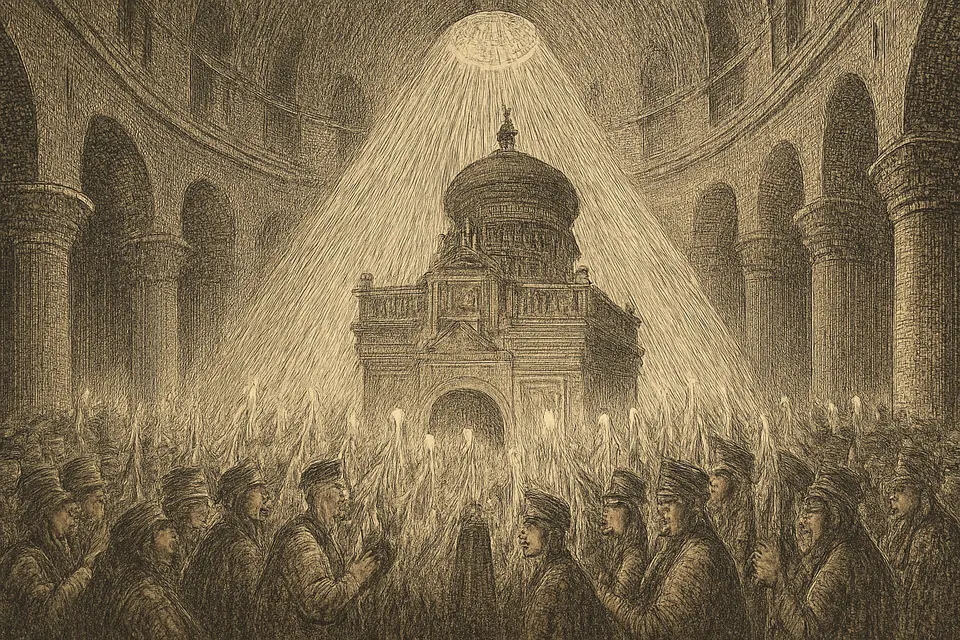
In Jerusalem, the Greek Orthodox Patriarch enters the Edicule over Christ's tomb in the Church of the Holy Sepulchre on Great Saturday and comes out with lit candles, the Holy Fire, which is passed through the crowd and flown to Orthodox countries. Orthodox faithful regard it as a miracle; the Catholic Church has never ruled on it, so we count it as reported. The ceremony has been kept for centuries.
The Easter Vigil on the night of March 27
The waiting ends at night. The 1988 letter calls the Easter Vigil the "mother of all holy vigils," and its first rule is strict: the Vigil "should not begin before nightfall; it should end before daybreak on Sunday." In most of the United States that means a start time around 8 or 9 p.m. on March 27, 2027.
This was not always so. The Catholic Encyclopedia describes how the Vigil drifted earlier over the centuries, first to Saturday afternoon and then to Saturday morning, so that the new fire was blessed in daylight. Pope Pius XII restored it to the night, first experimentally in 1951 and then for the whole Latin Church with the reform of Holy Week in 1955.
The Vigil has four parts:
- The service of light. A new fire is kindled outside the darkened church and the paschal candle is lit from it. The deacon carries it in, singing "The Light of Christ" three times, and the flame spreads to the candles of the people.
- The Easter Proclamation. By candlelight the deacon or priest sings the Exsultet. The Catholic Encyclopedia dates it to between the fifth and seventh centuries. It is the hymn of the felix culpa, the "happy fault" that won so great a Redeemer, and in medieval southern Italy it was sung from long illuminated parchment rolls, unrolled over the ambo so that the people could see the pictures as the deacon sang.
- The Liturgy of the Word. Up to seven Old Testament readings trace salvation history from Creation through the Exodus to the prophets, then the Gloria rings out with the bells, Romans 6 is read, the Alleluia returns after the long silence of Lent, and the Gospel of the empty tomb is proclaimed.
- Baptism and the Eucharist. Catechumens are baptized and confirmed, the faithful renew their baptismal promises and are sprinkled with the new Easter water, and the first Mass of Easter is offered.
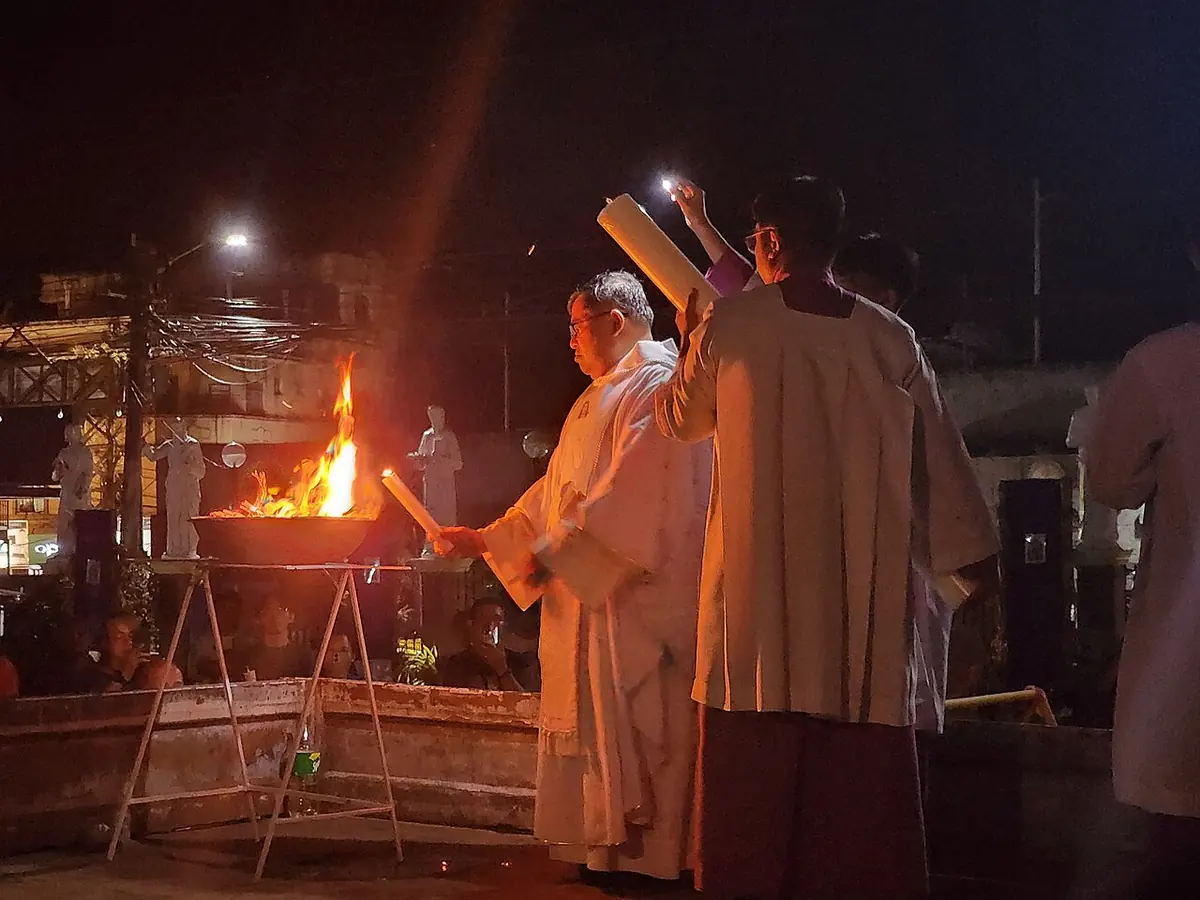

In the ancient Church the Vigil was the great night of baptism. The Catholic Encyclopedia records that in the year St. John Chrysostom was driven from Constantinople, 3,000 catechumens were waiting for baptism in his church alone on this night. Many American parishes still welcome new Catholics at the Vigil every year.
Let us keep this Holy Saturday as Our Lady kept it, quietly and in faith, until the candle is lit and the Church sings Alleluia. The full guide to the feast that follows is on our Easter 2027 page.
Frequently asked questions
When is Holy Saturday 2027?
Holy Saturday 2027 is Saturday, March 27, the day after Good Friday (March 26) and the day before Easter Sunday (March 28). For Orthodox Christians and Eastern Catholics who follow the Julian reckoning of Easter, Great and Holy Saturday falls on May 1, 2027.
Is there Mass on Holy Saturday?
Not during the day. The Church's 1988 letter on the Easter feasts says that on this day "the Church abstains strictly from the celebration of the Sacrifice of the Mass," and Holy Communion may be given only as Viaticum to the dying. The first Mass of Easter is the Easter Vigil, which may not begin before nightfall.
Do Catholics have to fast on Holy Saturday?
No. The required fast days are Ash Wednesday and Good Friday. The Second Vatican Council asked that the Good Friday fast be "prolonged throughout Holy Saturday" where possible, and the US bishops encourage this paschal fast until the Easter Vigil, but it is a recommendation, not a law. Abstaining from meat on Holy Saturday is likewise a pious custom, not an obligation.
Does the Easter Vigil count for Easter Sunday Mass?
Yes. Under canon 1248, the Sunday obligation is fulfilled by Mass on the day itself or on the evening of the preceding day, so attending the Easter Vigil on the night of March 27 fulfills the obligation to attend Mass on Easter.
Can I go to confession on Holy Saturday?
Yes. The 1988 circular letter forbids the celebration of the sacraments on Holy Saturday "except those of Penance and the Anointing of the Sick." Many parishes hear confessions on Holy Saturday morning for people preparing for Easter.
What does "he descended into hell" mean?
The Creed means the realm of the dead, called Sheol or Hades in Scripture, not the hell of the damned. The Catechism (nos. 632–635) teaches that Christ, really dead, went to the righteous who had died before him to open heaven to them. This is the mystery Holy Saturday recalls.
Sources
- Congregation for Divine Worship, Circular Letter on the Preparation and Celebration of the Easter Feasts (1988), nos. 73–80, via EWTN
- Catechism of the Catholic Church, nos. 632–637: Christ descended into hell (Vatican)
- Congregation for Divine Worship, Directory on Popular Piety and the Liturgy (2001), nos. 145–147
- Second Vatican Council, Sacrosanctum Concilium, no. 110 (the paschal fast)
- Catholic Encyclopedia (1910): Holy Saturday
- Catholic Encyclopedia (1909): Exultet