Advent wreath prayers
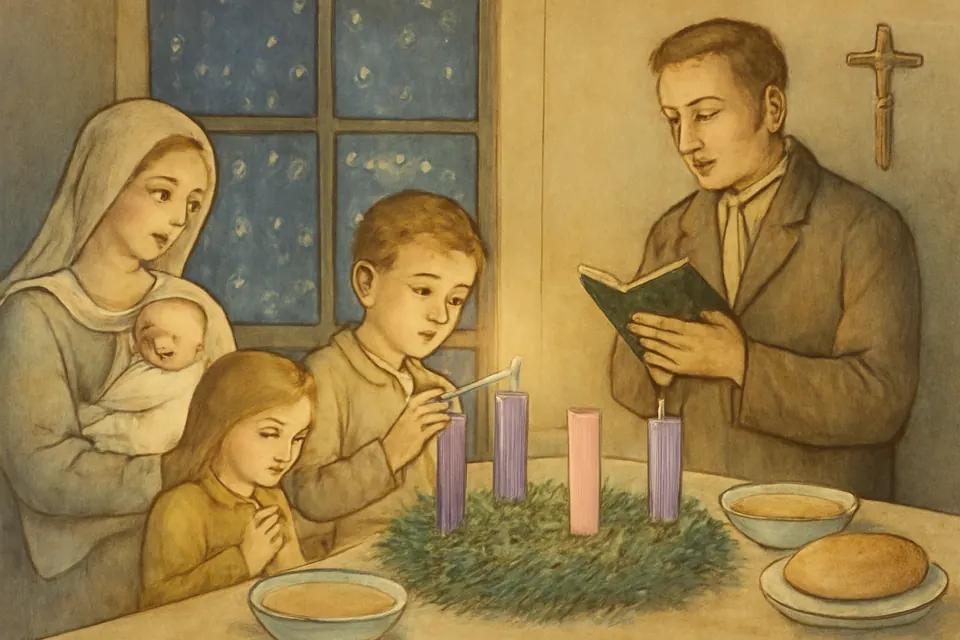
Advent wreath prayers are the short prayers we say as we light the candles each Sunday of Advent. The Church's Book of Blessings asks us to pray the opening prayer of that Sunday's Mass, such as "Exert, we beseech thee, O Lord, thy power and come." The wreath is blessed on the First Sunday of Advent or the evening before.
Each Sunday of Advent we light one more candle, and each Sunday the Church gives us a prayer to say as we do it. Here are the four traditional Advent wreath prayers, one for each week, followed by the blessing of the wreath, the meaning of the candles and the story of how a candlelit wagon wheel in a Hamburg orphanage became part of Catholic homes all over the world.
The Advent wreath prayers for each week
The Book of Blessings, the Church's official book for blessings, says that when the wreath is used at home, "the opening prayer of the Sunday Mass is recited when the candles are lighted." These are the opening prayers, or collects, of the four Sundays of Advent as the Roman Missal gave them for centuries. The English is the translation of Laurence Shepherd in Dom Prosper Guéranger's The Liturgical Year (Dublin, 1870).
First week: light one violet candle
Exert, we beseech thee, O Lord, thy power and come; that by thy protection we may be freed from the imminent dangers of our sins, and be saved by thy mercy; who livest and reignest God, world without end. Amen.
Second week: light two violet candles
Stir up, O Lord, our hearts to prepare the ways of thy Only Begotten Son; that by his coming, we may be enabled to serve thee with pure minds; who livest and reignest God, world without end. Amen.
Third week (Gaudete Sunday): light two violet candles and the rose candle
Bend thine ear, O Lord, we beseech thee, to our prayers, and enlighten the darkness of our minds by the grace of thy visitation; who livest and reignest God, world without end. Amen.
Fourth week: light all four candles
Exert, we beseech thee, O Lord, thy power and come; and succour us by thy great might; that by the assistance of thy grace, thy indulgent mercy may hasten what is delayed by our sins; who livest and reignest God, world without end. Amen.
Three of the four prayers begin with the Latin word Excita, which Shepherd translates "Exert" in the first and fourth and "Stir up" in the second. The collect of the last Sunday before Advent begins with the same word, which is why the English nicknamed that day "Stir-up Sunday." Advent is the season when we ask God to rouse himself and come, and to rouse us.
The Latin originals
Excita, quaesumus, Domine, potentiam tuam, et veni: ut ab imminentibus peccatorum nostrorum periculis, te mereamur protegente eripi, te liberante salvari. Qui vivis et regnas Deus, per omnia saecula saeculorum. Amen.
That is the first Sunday's collect. The second begins Excita, Domine, corda nostra; the third, Aurem tuam, quaesumus, Domine; and the fourth, Excita, quaesumus, Domine, potentiam tuam, et veni, et magna nobis virtute succurre.
A prayer to Our Lady for every evening of Advent
Guéranger recommends adding the Church's Advent prayer in honor of the Mother of God, and many families close the lighting with it:
O God, who wast pleased that thy Word, when the Angel delivered his message, should take flesh in the womb of the Blessed Virgin Mary: give ear to our humble petitions, and grant that we who believe her to be truly the Mother of God, may be helped by her prayers. Through the same Christ our Lord. Amen.

The blessing of the Advent wreath
The wreath is blessed on the First Sunday of Advent or on the evening before. In a parish the priest or deacon blesses it at Mass. At home, the Book of Blessings says, "it is appropriate that it be blessed by a parent or another member of the family." The full text of the rite is copyrighted, so we describe it here and link to it. The US bishops publish the home form as Blessing of an Advent Wreath, and Catholic Culture reprints the whole order.
The shorter home rite goes like this:
- All make the Sign of the Cross, and the leader says, "Our help is in the name of the Lord." All answer, "Who made heaven and earth." (The words are Psalm 123:8 in the Douay-Rheims numbering.)
- Someone reads a short passage of Scripture. The book's example is Isaiah 9, the prophecy of the great light and the Child who is born to us. In the Douay-Rheims, Isaiah 9:2 reads: "The people that walked in darkness, have seen a great light: to them that dwelt in the region of the shadow of death, light is risen."
- The leader prays the prayer of blessing: a priest or deacon with hands outstretched, a parent or other lay leader with hands joined. The book offers two prayers. One asks God to pour out his blessings "as we light the candles of this wreath," and the other praises Christ as "Emmanuel, the hope of the peoples."
- The first violet candle is lit, and many families sing a verse of "O Come, O Come, Emmanuel."
On the following Sundays there is no new blessing. We simply light the candles and pray that Sunday's collect. The book suggests making the lighting "a part of the evening meal," which is how most families keep it.

Scripture for each week
The Sunday collects can be followed by a verse or two of Scripture. These come from the traditional Advent Masses, in the Douay-Rheims translation:
- First week: "The night is passed, and the day is at hand. Let us therefore cast off the works of darkness, and put on the armour of light" (Romans 13:12).
- Second week: "And there shall come forth a rod out of the root of Jesse, and a flower shall rise up out of his root" (Isaiah 11:1).
- Third week: "Rejoice in the Lord always; again, I say, rejoice. Let your modesty be known to all men. The Lord is nigh" (Philippians 4:4–5).
- Fourth week: "Drop down dew, ye heavens, from above, and let the clouds rain the just: let the earth be opened, and bud forth a saviour" (Isaiah 45:8).
In the last week, from December 17, the Church sings the seven O Antiphons at Evening Prayer. They make a beautiful addition to the wreath: one each night, with the candles lit.
What the Advent wreath means
The Directory on Popular Piety and the Liturgy (2001) explains the wreath in a single paragraph. Its four candles, lit "Sunday after Sunday, until the Solemnity of Christmas," recall "the various stages of salvation history prior to Christ's coming." They are also "a symbol of the prophetic light gradually illuminating the long night prior to the rising of the Sun of justice," Christ himself (Malachi 4:2; Luke 1:78).
The circle of evergreen is the oldest and simplest part. A ring has no end, and evergreen stays alive through the winter. Neither meaning is laid down in any Church document, but both have been taught in Catholic homes for generations, and they fit the season well.
The candle colors
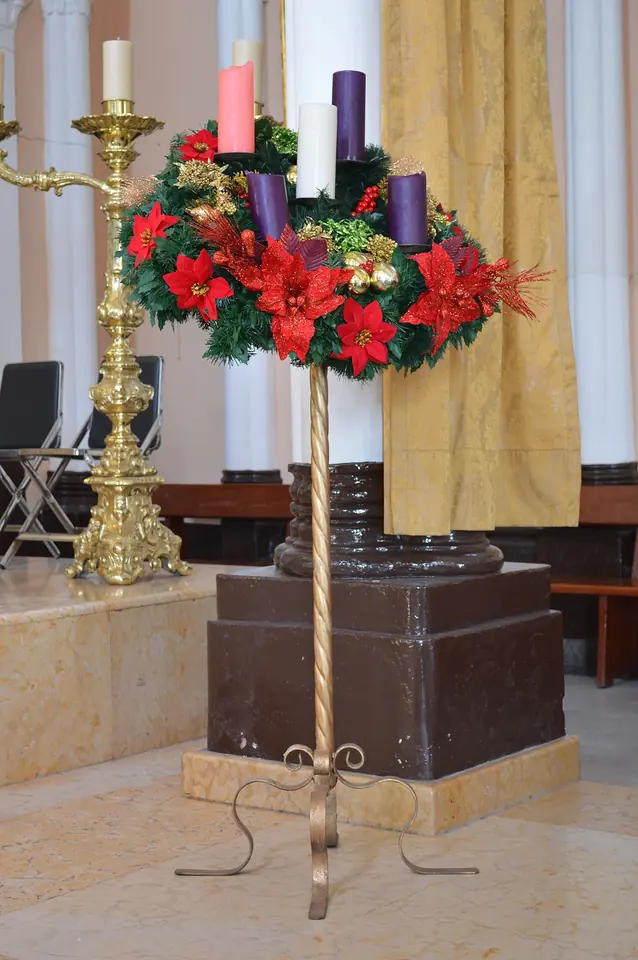
The Book of Blessings (no. 1510) describes the custom: "three of the candles are violet and the fourth is rose." Violet is the color of Advent vestments, the color of waiting and penance. Rose belongs to the Third Sunday, Gaudete Sunday, named for the first word of that day's entrance antiphon, Gaudete, "Rejoice." The priest may wear rose vestments that day, and we light the rose candle. In 2026 Gaudete Sunday falls on December 13.
The same paragraph allows "four violet or white candles," so a wreath of four white candles is perfectly proper. The red candles common in Germany and Scandinavia go back to Wichern's own wreath, not to any liturgical rule. Many families add a fifth, white candle in the middle and light it at Christmas. That is a devotional custom, not part of the rite.
Names for the candles (Hope, Peace, Joy and Love, or the Prophets', Bethlehem, Shepherds' and Angels' candles) also come from popular custom. The Book of Blessings says only that "the candles represent the four weeks of Advent."
The history of the Advent wreath
Many books say the Advent wreath comes from pre-Christian winter fires or Germanic light wheels. There is no document that connects them. What we do have is a clear starting point.
Johann Hinrich Wichern and the first wreath, 1839
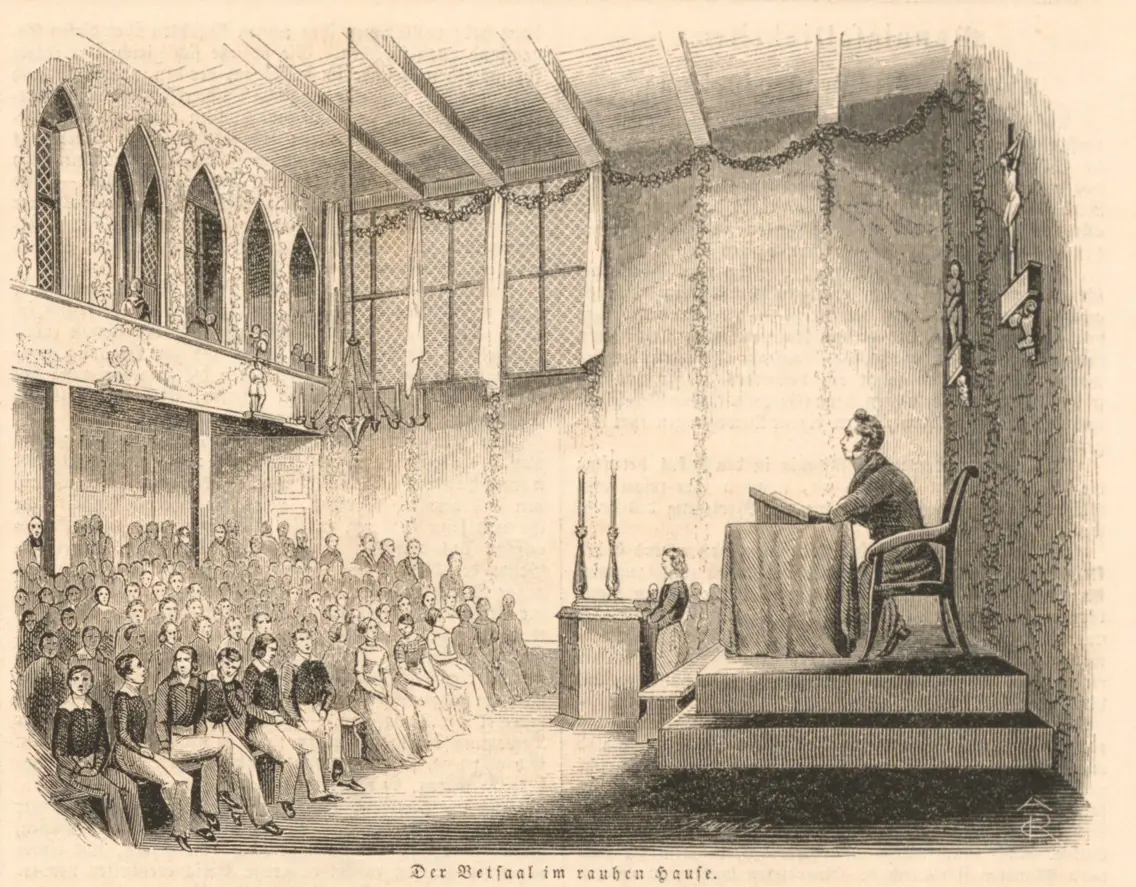
In 1833 a young Hamburg theologian named Johann Hinrich Wichern opened a home for poor and neglected boys in an old farmhouse in the village of Horn, outside the city. It was called the Rauhes Haus. Wichern was a Lutheran, and he later founded the Inner Mission, the German Protestant charity network. The foundation he started is still at work today.
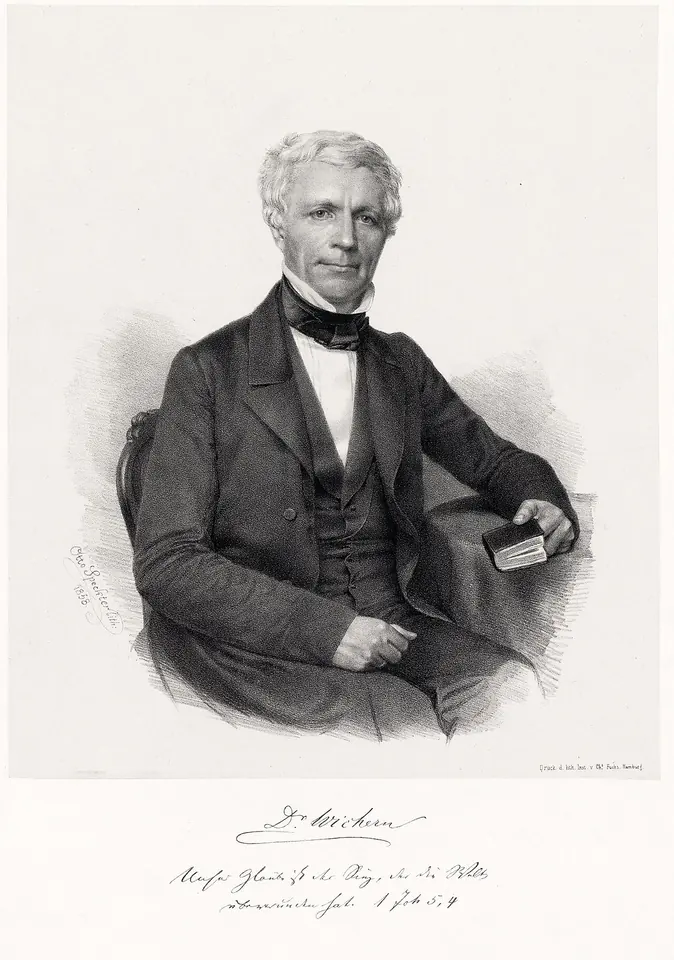
According to the Rauhes Haus, in 1839 Wichern set up the first Advent wreath in the home's prayer hall. The children kept asking how long it was until Christmas. His answer was a wooden wheel hung from the ceiling, with one candle for every day from the First Sunday of Advent to Christmas Eve, lit one more each day at the evening devotion. In his memoirs Wichern described the children looking up at the chandelier on the first day, where "the first light" was burning.
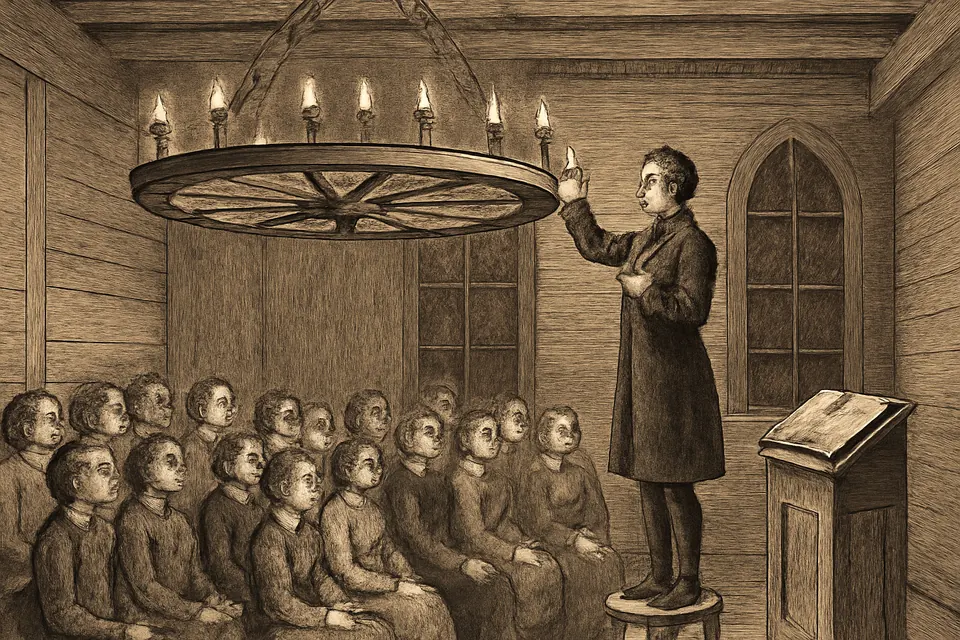
The familiar picture of that first wreath, with four large white candles for the Sundays and small red ones for the weekdays, may be later than Wichern. In 2020 a spokesman for the Rauhes Haus told the Protestant press agency that there is no evidence for different candles at the start. The only picture in the foundation's archive shows candles all the same size. The evergreen came later too. Fir branches decorated the hall from 1851, and around 1860 they were first wound around the wheel itself.
From Hamburg to Catholic homes
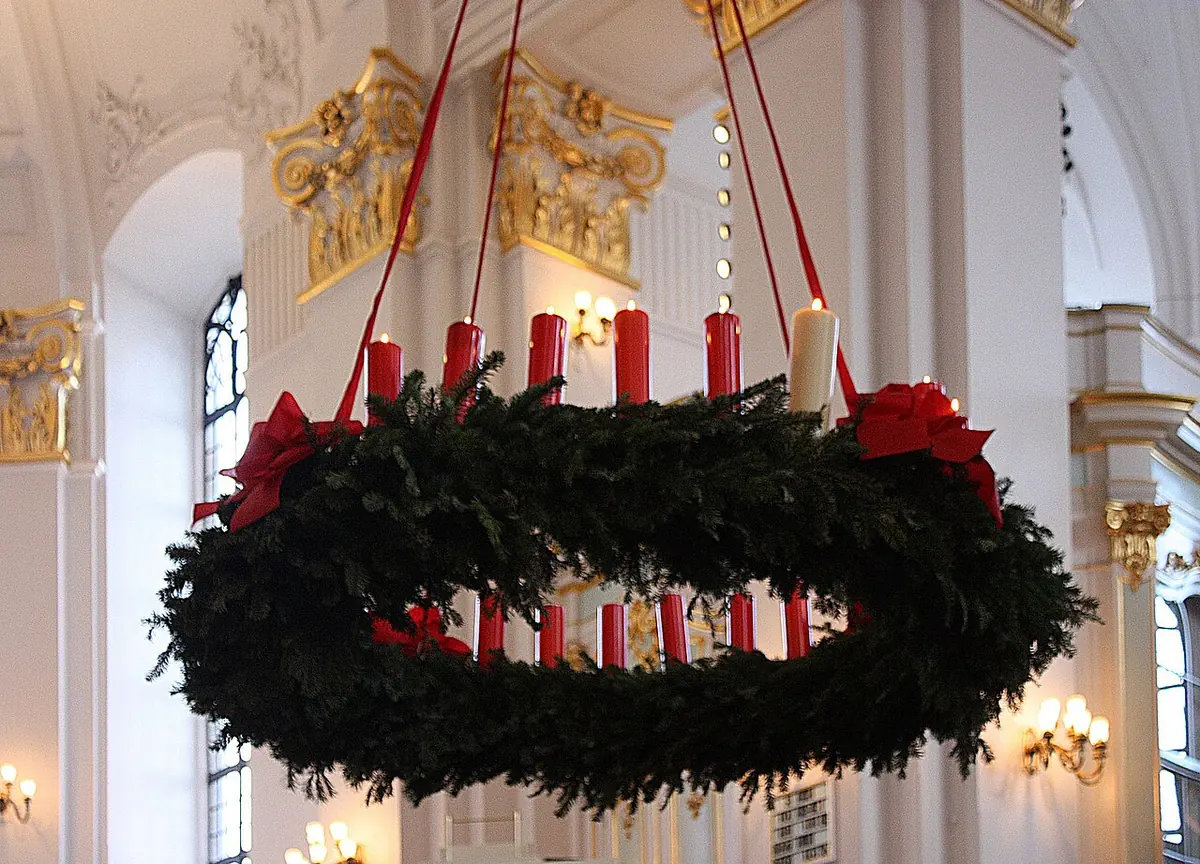
When the custom moved into ordinary living rooms in the early twentieth century, the wheel was too big for a family table, so it shrank to a wreath with four candles, one for each Sunday. Catholic Germany took it up next. According to the Austrian Catholic news agency Kathpress, the first Advent wreath in a Catholic church hung in Cologne in 1925, and in Austria the custom spread fully only after 1945. Catholics in southern Germany and Austria gave it the liturgical colors of three violet candles and one rose.

By the end of the twentieth century the Church had made the wreath her own. The Book of Blessings approved for the United States in 1989 gave it an official blessing, and the 2001 Directory on Popular Piety noted that it had become "a symbol of Advent in many Christian home[s], especially in the Germanic countries and in North America." Hamburg still keeps the original form. Wichern-style wreaths with a candle for every day hang each December in the Rauhes Haus, in the city hall and in St. Michael's Church.
How to keep the Advent wreath at home
- Set it up before the First Sunday of Advent (November 29 in 2026) and bless it that Sunday or the evening before.
- Light it at a meal. Supper is the easiest time for a family to be together. Light the right number of candles for the week, pray the Sunday collect and a short reading, and sing a verse of a hymn.
- Pray every day, not only on Sundays. On weekdays, light that week's candles again and repeat the Sunday prayer. From December 17, add the O Antiphon for the day.
- Let the children help. The youngest can carry the matches to the oldest, and an older child can read the Scripture. Wichern's wreath was made to help children count the days. Ours can do the same.
- Keep it going into Christmas. Some families swap the violet candles for white ones on Christmas Eve and keep the wreath lit through the Christmas season.
The wreath fits well beside the other Advent devotions on this site: the St. Andrew Christmas novena, which begins on November 30; St. Nicholas Day on December 6; the feast of the Immaculate Conception on December 8; Our Lady of Guadalupe on December 12; St. Lucy on December 13; and Las Posadas from December 16. For the dates of the four Sundays this year, see Advent 2026, and for every feast of the season, the feast days calendar.
Let us light the first candle with the Church's own prayer: "Exert, we beseech thee, O Lord, thy power and come."
Frequently asked questions
What prayer do you say when lighting the Advent wreath?
The Book of Blessings (no. 1515) says that at home "the opening prayer of the Sunday Mass is recited when the candles are lighted." The four traditional Sunday prayers are printed at the top of this page. Many families add a short Scripture reading, an Advent hymn such as "O Come, O Come, Emmanuel," and the Hail Mary.
Who can bless an Advent wreath?
A priest, a deacon or a lay minister may bless it (Book of Blessings, no. 1516). At home the book says it is fitting for a parent or another member of the family to bless the wreath, using the shorter rite. Many parishes also bless wreaths that families bring to Mass on the First Sunday of Advent.
What do the Advent candle colors mean?
Three candles are violet, the color of Advent, a season of waiting and turning back to God. The fourth is rose, lit on the Third Sunday, Gaudete Sunday, when the Mass opens with "Rejoice in the Lord always" (Philippians 4:4). The Book of Blessings also allows four violet or four white candles.
What are the names of the four Advent candles?
The Church's books give them no names: the candles stand for the four weeks of Advent. The names you see on many wreath cards, Hope, Peace, Joy and Love, or the Prophets', Bethlehem, Shepherds' and Angels' candles, are later devotional customs. They are fine to use at home, but they aren't part of the liturgy.
Who invented the Advent wreath?
Johann Hinrich Wichern, a Lutheran theologian who ran a home for poor children in Hamburg, hung the first known Advent wreath in its prayer hall in 1839. It was a wooden wheel with a candle for every day until Christmas. The first Catholic church known to use one was in Cologne in 1925.
What is the white candle in the middle of the Advent wreath?
Some families add a white candle in the center, often called the Christ candle, and light it on Christmas Eve or Christmas Day. It's a popular custom, not part of the Book of Blessings, and it's a lovely way to carry the wreath into the Christmas season.
Sources
- Das Rauhe Haus: Das Rauhe Haus und der Adventskranz (history of the foundation). Wichern's first wreath in the prayer hall in 1839, one candle for each day until Christmas Eve
- evangelisch.de: Neuigkeiten vom Adventskranz (2020). No evidence that the first wreath had separate Sunday and weekday candles; greenery from about 1860; first Catholic church in Cologne, 1925
- Kathpress (katholisch.at): Kranz und Kalender, Adventbräuche bereiten auf Weihnachten vor (2015). Cologne 1925; in Austria widespread only after 1945; three violet candles and one rose
- Congregation for Divine Worship, Directory on Popular Piety and the Liturgy (2001), no. 98
- Book of Blessings, Order for the Blessing of an Advent Wreath, nos. 1509-1516 (Catholic Culture)
- Prosper Guéranger, The Liturgical Year, vol. 1, Advent, tr. Laurence Shepherd (Dublin, 1870), pp. 51-53. Latin and English text of the four Sunday collects of Advent and the Advent collect of Our Lady
- Douay-Rheims Bible: Isaias (Isaiah), chapter 9