Chaplet of St. Jude

The chaplet of St. Jude is a string of nine beads between a St. Jude medal and a crucifix, used to pray a St. Jude novena. On the medal we pray the St. Jude prayer, on each bead a Hail Mary and an invocation, and at the crucifix the Our Father, Hail Mary and Glory Be three times.
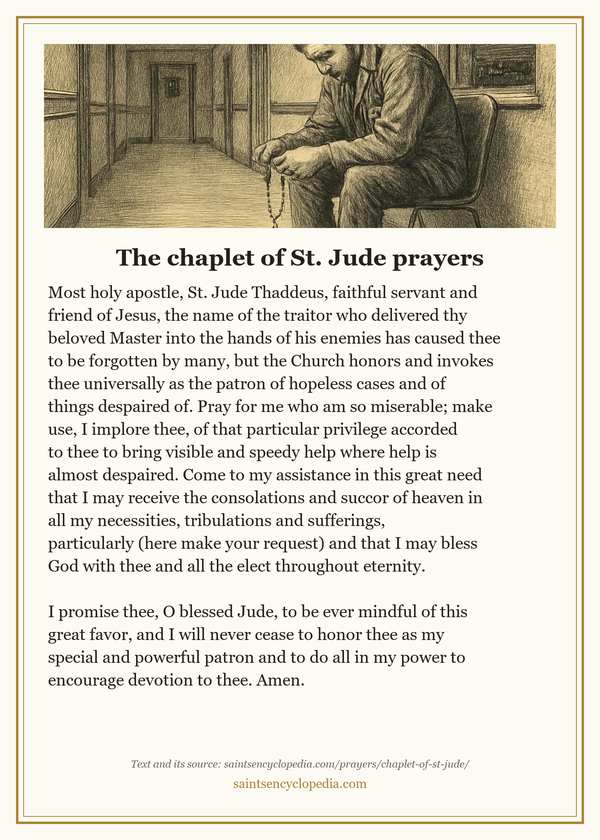 Free printable prayer card 5 × 7 inch PDF, ready to print, frame or tuck in a missal.
The chaplet of St. Jude is a small thing to carry: nine beads, a medal and a crucifix that fit in a coat pocket or a hospital-bag zipper. People reach for it when the news is bad and the waiting is long. Below are the prayers to say on it, taken from a Chicago shrine booklet of 1929, with the steps bead by bead and what is known of where the chaplet comes from.
The chaplet of St. Jude prayers
There is no single official text for this chaplet, so we give the prayers of Life of St. Jude Thaddeus, "Helper in Despaired of Cases" by the Dominican Fr. William A. Marchant, printed in 1929 by the Shrine of St. Jude Thaddeus at St. Pius V Church in Chicago with the imprimatur of George Cardinal Mundelein. The booklet is in the public domain, and its spelling is kept as printed. It doesn't mention a chaplet; we place its prayers on the beads in the way chaplets are commonly prayed.
On the St. Jude medal, the St. Jude prayer from the booklet's first novena form:
Most holy apostle, St. Jude Thaddeus, faithful servant and friend of Jesus, the name of the traitor who delivered thy beloved Master into the hands of his enemies has caused thee to be forgotten by many, but the Church honors and invokes thee universally as the patron of hopeless cases and of things despaired of. Pray for me who am so miserable; make use, I implore thee, of that particular privilege accorded to thee to bring visible and speedy help where help is almost despaired. Come to my assistance in this great need that I may receive the consolations and succor of heaven in all my necessities, tribulations and sufferings, particularly (here make your request) and that I may bless God with thee and all the elect throughout eternity.
I promise thee, O blessed Jude, to be ever mindful of this great favor, and I will never cease to honor thee as my special and powerful patron and to do all in my power to encourage devotion to thee. Amen.
On each of the nine beads, a Hail Mary, then the invocation that the booklet's litany repeats three times:
St. Jude, help of the hopeless, aid me in my distress!
At the crucifix, as the booklet directs after the St. Jude prayer: "Our Father, Hail Mary, Glory be to the Father, etc., three times." Then:
V. St. Jude Thaddeus, pray for us. R. And for all who invoke thy aid.
How to pray the chaplet of St. Jude, step by step
- Hold the medal, make the Sign of the Cross, and pray the St. Jude prayer. Name your request where the prayer says "(here make your request)." Be honest and specific.
- On the first bead, say a Hail Mary and "St. Jude, help of the hopeless, aid me in my distress!"
- Continue on all nine beads the same way.
- At the crucifix, say the Our Father, Hail Mary and Glory Be three times.
- Close with "St. Jude Thaddeus, pray for us," "And for all who invoke thy aid," and the Sign of the Cross.
The chaplet takes about ten minutes. If you have a little more time, the 1929 booklet's second prayer, "O glorious apostle, St. Jude Thaddeus, true relative of Jesus and Mary," makes a fine opening before the St. Jude prayer; you'll find it with the other texts on our St. Jude prayer page.
Notice what the Hail Marys do. Every bead of a St. Jude chaplet passes through the Mother of God. The 1929 booklet's litany calls Jude the "relative of Jesus and Mary," and his devotion has always gone hand in hand with hers.
Other ways it is prayed
Chaplet makers print different instructions on the little cards that come with the beads. Two patterns are common. In one, each bead carries a Hail Mary and a short invocation, as above. In the other, the nine beads are treated as three groups of three, with an Our Father, a Hail Mary and a Glory Be in each group. Both are good. Neither is official. Pray the way that helps you pray.
Why nine beads
Nine is the number of a novena, and the St. Jude chaplet is a novena on a string. The custom of nine days goes back to the apostles themselves, and Jude was there. After the Ascension, St. Luke writes, the eleven went up into the upper room, "Peter and John, James and Andrew, Philip and Thomas, Bartholomew and Matthew, James of Alpheus, and Simon Zelotes, and Jude the brother of James. All these were persevering with one mind in prayer with the women, and Mary the mother of Jesus, and with his brethren" (Acts 1:13–14, Douay-Rheims). Those days of prayer before Pentecost are the model of every novena.
So the chaplet can be prayed:
- Nine days in a row, for any urgent need.
- On nine Thursdays. The 1929 Chicago booklet says, "Start your novena on one particular Thursday or Sunday and persevere for nine consecutive Thursdays or Sundays." The Dominicans held novena services at the shrine every Thursday evening at eight and every Sunday afternoon at three.
- Before his feast, from October 19 to 27, so that the ninth day falls on the eve of October 28, the feast of Sts. Simon and Jude.
For the full St. Jude novena prayers and the solemn novenas at the Chicago shrines, see our St. Jude novena page.

Where the chaplet comes from
Prayer beads are very old. The Catholic Encyclopedia tells of the desert abbot Paul, who died in 341 and counted his three hundred daily prayers with pebbles, and of strings of beads found in the tombs of St. Gertrude of Nivelles, St. Norbert and St. Rosalia. By the late Middle Ages, the encyclopedia says, the old "paternoster" beads had come to be called "Rosary, chaplet, or crown," and many chaplets in honor of particular mysteries and saints followed.
The St. Jude chaplet is much younger. Devotion to Jude as the patron of hopeless cases grew strongly in the 20th century, especially after the Dominicans opened their shrine at St. Pius V Church in Chicago in 1929 and the Claretians opened the National Shrine of St. Jude at Our Lady of Guadalupe Church in South Chicago the same year. Their booklets taught novenas, litanies and prayers. Neither the Dominican booklet of 1929 nor the Claretian novena book of 1954 describes a chaplet. The nine-bead strand appears to have grown up later among chaplet makers and the faithful who wanted a simple way to count a novena. We found no author, no date and no Church document for it.
That is no mark against it. Many of our dearest devotions began this way, with ordinary people who wanted to pray and needed something to hold.
Who St. Jude is
St. Jude, also called Thaddeus, is one of the Twelve. He is named in the lists of the apostles and in Acts as "Jude the brother of James," and he speaks once in the Gospels, at the Last Supper (John 14:22). The Church has long held him to be the author of the short Epistle of Jude, which opens: "Jude, the servant of Jesus Christ, and brother of James." Its closing counsel could be the motto of anyone praying his chaplet: "But you, my beloved, building yourselves upon your most holy faith, praying in the Holy Ghost, keep yourselves in the love of God, waiting for the mercy of our Lord Jesus Christ, unto life everlasting" (Jude 1:20–21, Douay-Rheims).
Tradition holds that he preached with St. Simon the Zealot and that the two were martyred together, which is why the Church keeps their feast on the same day, October 28.

The medal on the chaplet
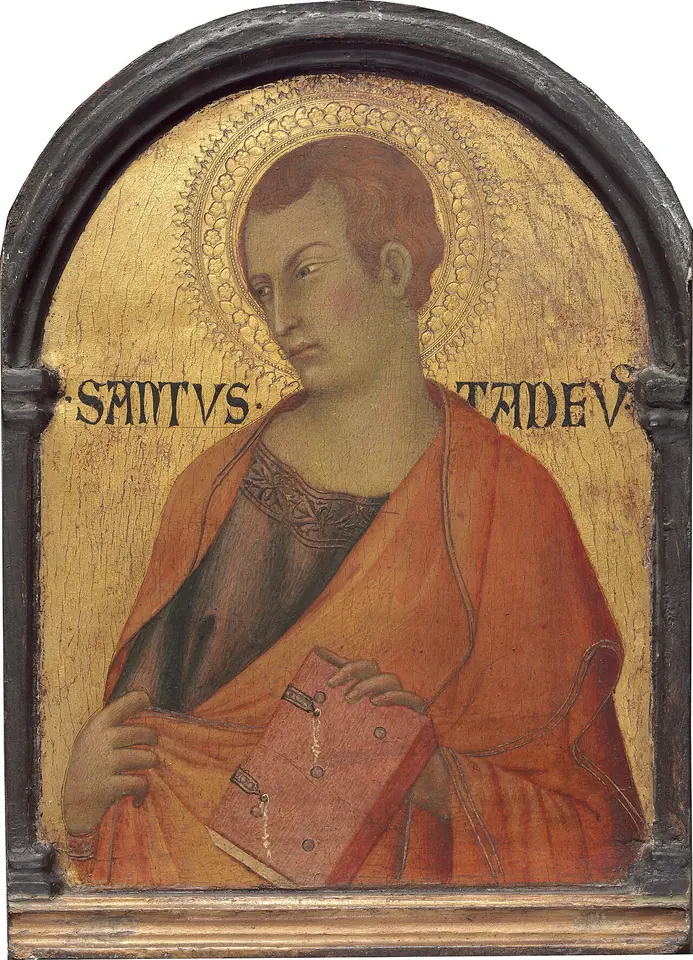
The medal at the end of a St. Jude chaplet usually shows his traditional symbols, and they help us pray:
- A flame over his head, for the Holy Spirit at Pentecost.
- An image of Christ's face on a medallion at his chest, from the Eastern tradition that links Thaddeus to the healing of King Abgar of Edessa and the holy image of Christ.
- A club, axe or halberd, the instrument of his martyrdom in the old accounts.
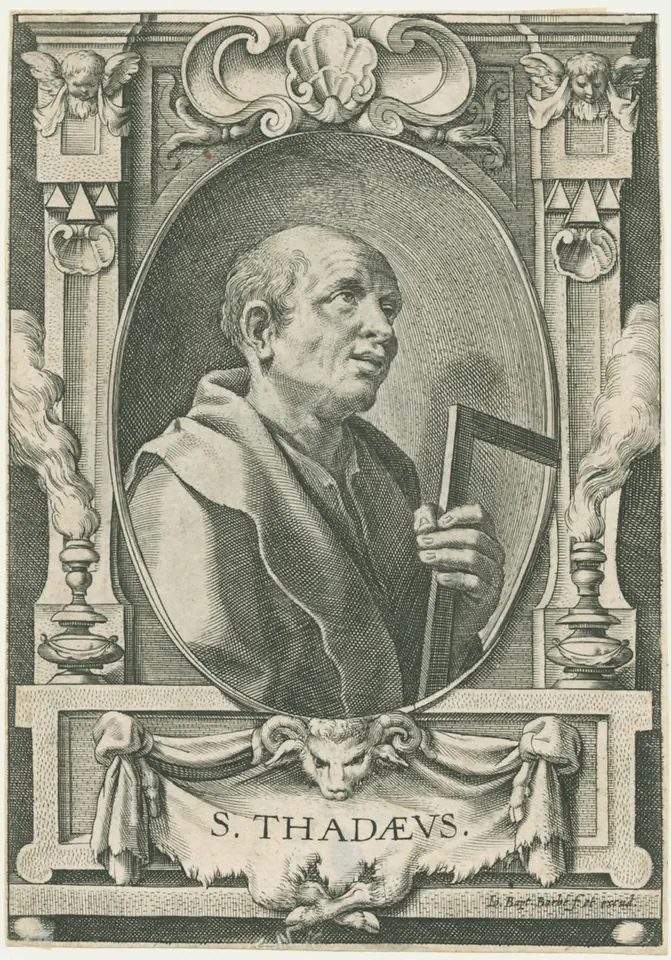
- A carpenter's square in some older Western art, as in the Antwerp engraving below.
Why we ask St. Jude's help in hopeless cases
The 1929 prayer itself gives the old explanation: "the name of the traitor who delivered thy beloved Master into the hands of his enemies has caused thee to be forgotten by many." Because his name sounded like Judas Iscariot's, the faithful seldom called on him, and so, the tradition goes, he was glad to help anyone who did, even in the most desperate cases. Whatever its origin, the faithful have kept coming to him for a century with sick children, lost jobs and broken families, and the newspapers still carry their small notes of "Thank you, St. Jude."
He doesn't grant favors by his own power. He prays for us, as the apostles prayed with Mary in the upper room, and he brings our need to the One whose face he carries on his medal.
Related prayers and saints
- The St. Jude prayer: the full 1929 texts and their history.
- The St. Jude novena, with the solemn novenas before October 28.
- St. Jude and St. Simon the Apostle, who share his feast.
- The Chaplet of St. Michael and the Divine Mercy chaplet, two chaplets with long documented histories.
- Catholic chaplets: every chaplet on the site.
- Feast days, for October 28.

Frequently asked questions
How do you pray the St. Jude chaplet?
Hold the medal and pray the St. Jude prayer ("Most holy apostle, St. Jude Thaddeus"), naming your request. On each of the nine beads, say a Hail Mary and "St. Jude, help of the hopeless, aid me in my distress!" At the crucifix, say the Our Father, Hail Mary and Glory Be three times, then "St. Jude Thaddeus, pray for us. And for all who invoke thy aid." It takes about ten minutes.
How many beads are on a St. Jude chaplet?
Most St. Jude chaplets have nine beads on a straight strand, one for each day of a novena, with a St. Jude medal at one end and a crucifix at the other. Some makers group them as three sets of three. The number isn't fixed by any Church document.
Who created the St. Jude chaplet?
No one knows. The 1929 prayer booklet of the Dominican shrine of St. Jude in Chicago, one of the earliest American St. Jude manuals, has novena prayers and a litany but no chaplet. The nine-bead chaplet seems to be a 20th-century devotional object, and its prayers vary from maker to maker.
Can I pray the chaplet of St. Jude as a novena?
Yes, that is what it is for. Pray it for nine days in a row, or on nine Thursdays (the 1929 Chicago booklet suggests nine Thursdays or Sundays), or in the nine days from October 19 to 27, ending on the eve of his feast on October 28.
Is the St. Jude chaplet approved by the Church?
There is no single approved text, as there is for the rosary or the Chaplet of St. Michael. The prayers we suggest saying on it come from a 1929 booklet printed with the imprimatur of Cardinal Mundelein of Chicago. Like any private devotion, the chaplet is a help to prayer, not a formula that guarantees a result.
Sources
- Wm. A. Marchant, O.P., Life of St. Jude Thaddeus, "Helper in Despaired of Cases": Devotional Exercises and Novena Prayers (Chicago: Shrine of St. Jude Thaddeus, Dominican Fathers, 1929; imprimatur George Cardinal Mundelein), Internet Archive. Source of every prayer text on this page and of the nine Thursdays novena
- John Volz, "Use of Beads at Prayers," Catholic Encyclopedia (1907)
- Acts of the Apostles 1:13–14, Douay-Rheims Bible
- Epistle of St. Jude, Douay-Rheims Bible
- Shrine of St. Jude Thaddeus, St. Pius V Church, Chicago: History of our Shrine