Catholic chaplets
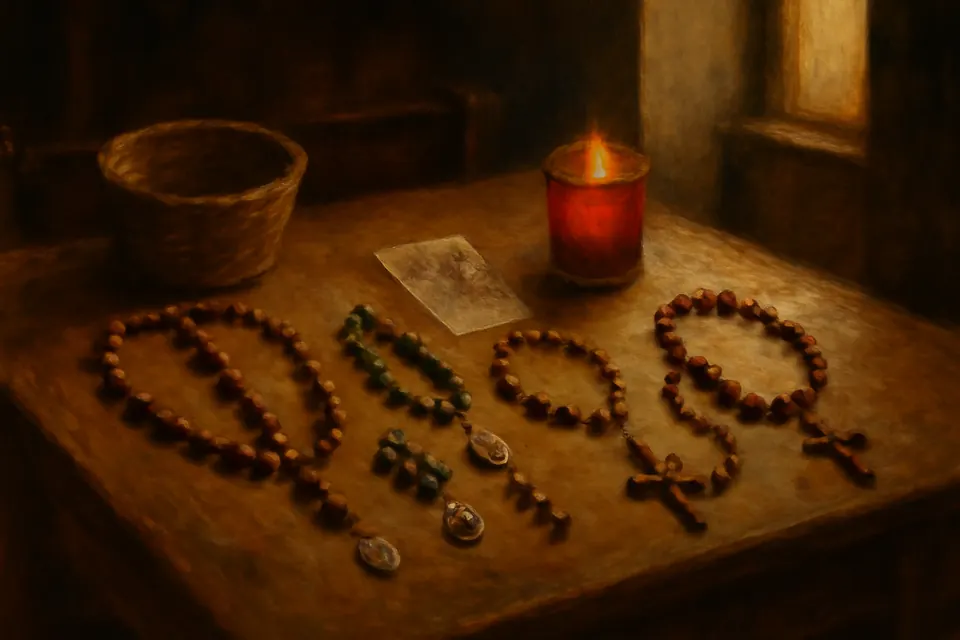
Catholic chaplets are strings of prayers, usually counted on beads, that honor a particular mystery or saint: the Divine Mercy chaplet, the Chaplet of St. Michael, the Seven Sorrows rosary and many more. What is a chaplet? The word means "little crown," and the rosary itself is the best-known chaplet. Each has its own prayers and number of beads.
Catholic chaplets are some of the humblest prayers we have. They need no book, no church and no priest, only a few beads or ten fingers and a little time. This guide explains what a chaplet is, where prayer beads came from, and how each chaplet on this site is prayed, with links to the full prayers.
What is a chaplet?
A chaplet is a fixed pattern of prayers, usually counted on a string of beads, that honors a particular mystery of the faith or a particular saint. The word comes from the Old French chapelet, a little crown or wreath of flowers, and the idea behind it is lovely: each prayer is a flower, and the finished chaplet is a crown offered to Our Lord, to Our Lady or to a saint. That is why some chaplets are still called "crowns," like the Franciscan Crown or the "Angelical Crown" of St. Michael.
The rosary is a chaplet too, the greatest of them. The Catholic Encyclopedia explains that from the late 1400s the old name "paternoster beads" fell out of use "and was replaced by the name ave beads and Rosary, chaplet, or crown." Today we usually keep "rosary" for the Dominican rosary of Hail Marys and "chaplet" for the others.

How a chaplet differs from the rosary
- The prayers. The rosary is built on the Our Father, the Hail Mary and the Glory Be. Other chaplets add their own prayers: the Divine Mercy chaplet's "Eternal Father, I offer You," the salutations of the Chaplet of St. Michael, the invocations of the Holy Wounds.
- The number of beads. A chaplet's beads match its prayers. The Seven Sorrows rosary has seven groups of seven; the Chaplet of St. Michael has nine groups, one for each choir of angels; the old Chaplet of Our Lord has 33 Our Fathers for the years of Christ's life.
- The meditation. The rosary walks through the mysteries of Christ and Mary. A chaplet usually stays with one subject: the mercy of God, the angels, the sorrows of Mary, the wounds or the Heart of Jesus.
Many chaplets can be prayed on an ordinary rosary, and all of them can be prayed on your fingers. The beads only help us count, so that the mind is free to pray.
Where prayer beads come from
The Catholic Encyclopedia gives a short history. The desert abbot Paul, who died in 341, carried three hundred pebbles in his lap and dropped one for each prayer. In the 700s the penitentials, the rule books for confessors, assigned penances of twenty, fifty or more Our Fathers, and the strings used to count them came to be called "paternosters." The encyclopedia mentions fragments of prayer beads found in the tomb of St. Gertrude of Nivelles, who died in 659, and in the tombs of St. Norbert and St. Rosalia in the 12th century.
In the medieval monasteries, lay brothers and lay sisters said a fixed number of Our Fathers at the canonical hours in place of the Divine Office the choir monks sang, counting them on beads. By the 1400s, wearing beads at the belt marked a member of a confraternity or third order, and beads that had touched a saint's relics were treasured.
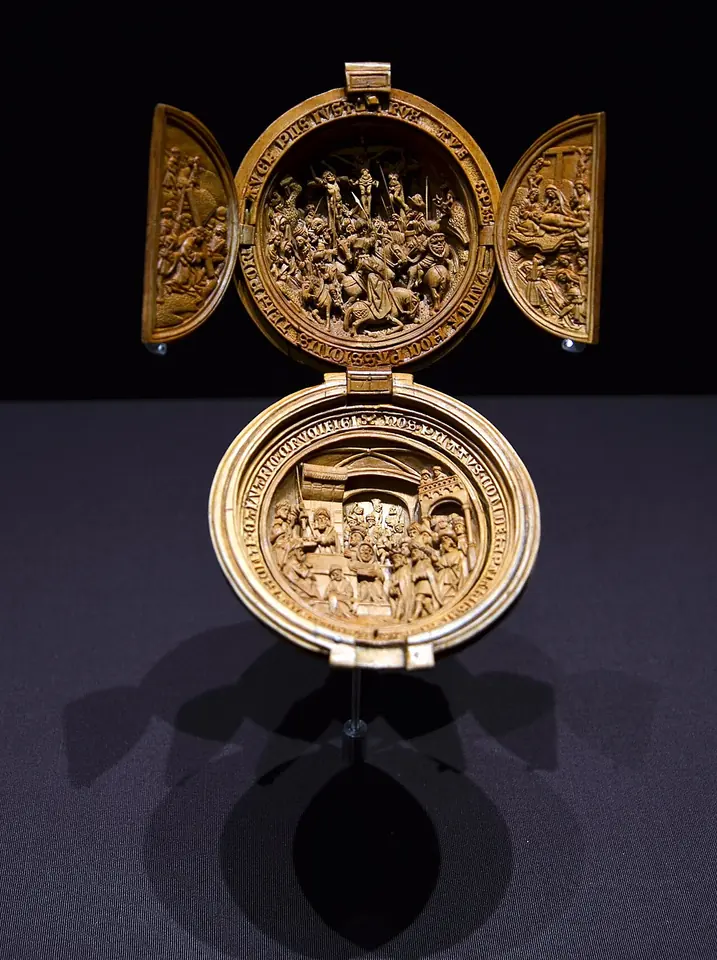
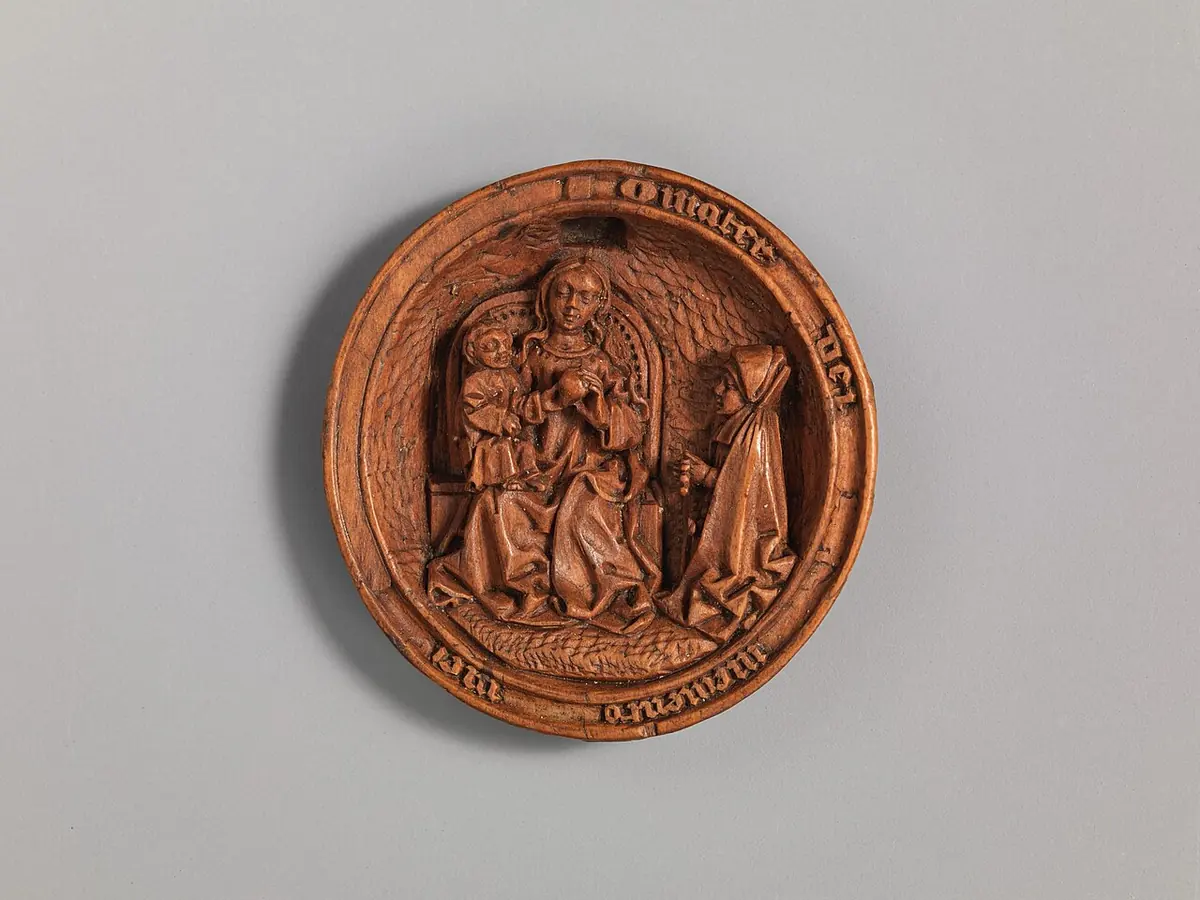
Craftsmen in the Low Countries made some of the most astonishing beads ever carved: boxwood spheres no bigger than a walnut, hinged to open on whole scenes of the Passion, worn at the end of a string of prayer beads.
The chaplets on this site
Each of these has its own page with the full prayers, how to pray it bead by bead, and its documented history.
The Divine Mercy chaplet
The Divine Mercy chaplet is prayed on ordinary rosary beads: "Eternal Father, I offer You the Body and Blood, Soul and Divinity" on the large beads, "For the sake of His sorrowful Passion, have mercy on us and on the whole world" on the small ones. St. Faustina recorded it in her Diary in Vilnius in 1935. After the rosary it is the chaplet people look for most, and many pray it at three in the afternoon, the hour of Christ's death.

The Chaplet of St. Michael
The Chaplet of St. Michael, the "Angelical Crown," has nine salutations to the nine choirs of angels, each with an Our Father and three Hail Marys, then four Our Fathers to St. Michael, St. Gabriel, St. Raphael and the guardian angel. Pius IX indulgenced it in 1851. Many people pray it as a novena before Michaelmas, September 29.

The Seven Sorrows rosary
The Seven Sorrows rosary, or Servite chaplet, has seven groups of seven Hail Marys, each begun with an Our Father, for the seven sorrows of Mary, from Simeon's prophecy to the burial of Jesus. The Servite order spread it, and the approved apparitions at Kibeho in Rwanda revived it in the 1980s.
The Franciscan Crown
The Franciscan Crown rosary has seven decades for the seven joys of Mary, from the Annunciation to her Assumption and Coronation. Franciscan tradition dates it to 1422, and its 72 Hail Marys honor the years Mary is said to have lived.

The Chaplet of the Sacred Heart
The Chaplet of the Sacred Heart sets five short offerings to the loving, humble, patient, gentle and generous Heart of Jesus, each with one Our Father, five Glory Bes and the couplet "O sweetest heart of Jesus! I implore / That I may ever love thee more and more." Pius VII indulgenced it in 1815.
The Chaplet of the Holy Wounds
The Chaplet of the Holy Wounds is prayed on a rosary: "Eternal Father, I offer Thee the Wounds of our Lord Jesus Christ" on the large beads, "My Jesus, pardon and mercy, by the merits of Thy Holy Wounds" on the small ones. It comes from Sr. Mary Martha Chambon, a Visitation lay sister of Chambéry who died in 1907. Her visions are private revelation; the prayers were indulgenced for all the faithful in 1924.
The chaplet of St. Jude
The chaplet of St. Jude is a straight strand of nine beads between a St. Jude medal and a crucifix, used to count a St. Jude novena. It has no single official text; our page gives the prayers of a 1929 Chicago shrine booklet to say on it.
The rosary itself
For the chaplet behind all the others, see how to pray the rosary, and for the long rosary devotion of Pompeii, the 54 day rosary novena.

Older chaplets of the Church
The 1878 Raccolta, the Church's collection of indulgenced prayers, lists many chaplets that are less known today. A few deserve to be prayed again.
- The Chaplet of Our Lord: 33 Our Fathers "in remembrance and veneration of the thirty-three years which he lived on earth," five Hail Marys for his five wounds, and the Creed. Clement X indulgenced it in 1674, and the beads were blessed by the Camaldolese monks.
- The Chaplet of the Five Wounds: five groups of five Glory Bes for the wounds of Christ, each followed by a Hail Mary to Our Lady of Sorrows. Leo XII indulgenced it in 1823, and the beads were blessed by the Passionists, the order of St. Paul of the Cross.
- The Chaplet of the Precious Blood: seven meditations on the seven times Christ shed his blood, from the Circumcision to the piercing of his side, with 33 Our Fathers in all. Pius VII indulgenced it in 1815.
- The Chaplet of St. Bridget: six decades and three more Hail Marys for the 63 years that, "as it is said," Our Lady lived on earth, with seven Our Fathers for her seven sorrows or joys. The Raccolta says St. Bridget of Sweden "first conceived of it and spread its use," and Leo X indulgenced it in 1515.
- The Chaplet of Twelve Stars, which the Raccolta says was composed by St. Joseph Calasanz, praises the Trinity for Mary "clothed with the sun, with the moon beneath her feet, and on her head a mystic crown of twelve stars." Gregory XVI indulgenced it in 1838.
- The Little Chaplet of the Immaculate Conception: three sets of an Our Father, four Hail Marys and a Glory Be, each opened with "Blessed be the holy and immaculate conception of the most blessed Virgin Mary." Pius IX indulgenced it in 1855, the year after he defined the dogma.
The indulgences counted in days and years belong to the old system, which Paul VI reformed in Indulgentiarum doctrina in 1967. The prayers themselves are as good as ever.
Praying a chaplet well
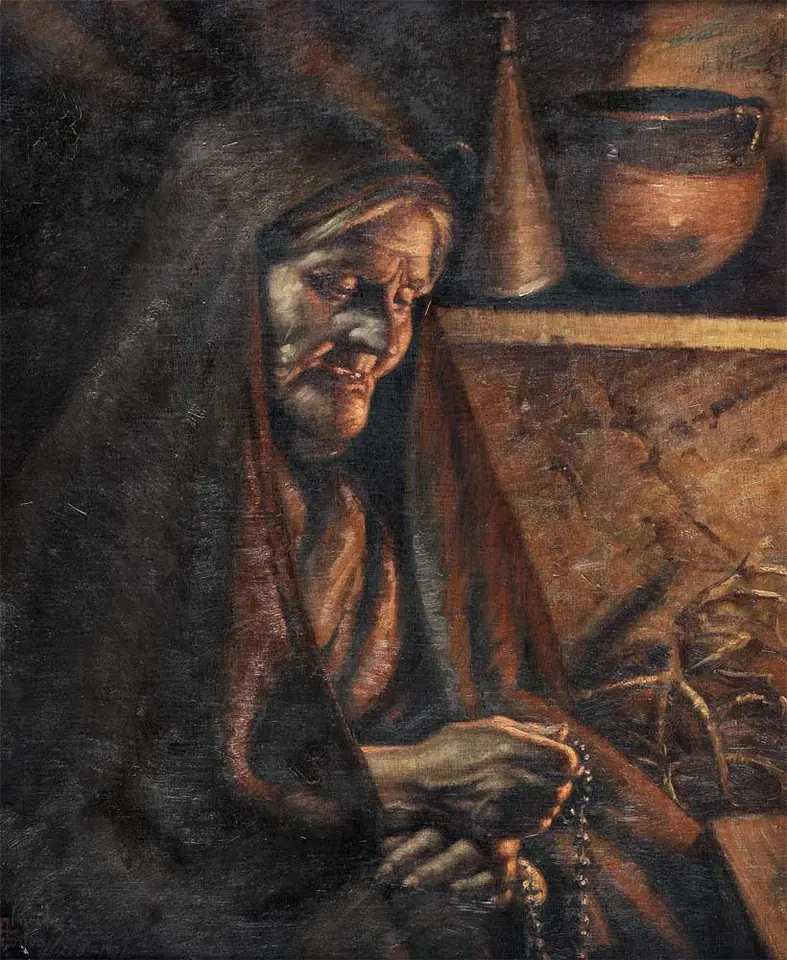
A chaplet is not a charm, and the number of beads is not a magic formula. The beads are a sacramental once blessed: a sacred sign of the Church's prayer that disposes us to receive grace, not a source of power on its own. What matters is the heart. Some simple counsel:
- Pick one and stay with it for a while. A chaplet prayed every day for a month teaches more than ten chaplets tried once.
- Go slowly. Say the words as if someone were listening, because Someone is.
- Bring an intention. Most chaplets were born in need: plague, war, sickness, sin. Name yours at the start.
- Let the repetition quiet you. The repeated words are like waves on a shore. You don't have to think hard about each one.
- Finish with thanks. A Glory Be, a Hail Holy Queen, or simply "thank you."
Let us pray them, then, as the faithful have for centuries, one bead at a time.
Frequently asked questions
What is a chaplet?
A chaplet is a set form of prayer, usually counted on a string of beads, that honors a particular mystery of the faith or a particular saint. The word comes from the Old French for a little crown or wreath. The Catholic Encyclopedia notes that from about 1500 prayer beads were called "Rosary, chaplet, or crown" more or less interchangeably.
What is the difference between a chaplet and a rosary?
The rosary is one particular chaplet: five (or fifteen, or twenty) decades of Hail Marys while meditating on the mysteries of Christ and Mary. Other chaplets have their own prayers and their own number of beads, such as the Chaplet of St. Michael's nine groups or the Seven Sorrows rosary's seven groups of seven. Many chaplets can also be prayed on ordinary rosary beads.
Can you pray a chaplet on a rosary?
Yes. The Divine Mercy chaplet and the Chaplet of the Holy Wounds were made for ordinary rosary beads, and others, like the Chaplet of St. Michael, can be adapted to them. Fingers work too. The beads only help you count.
Do chaplets need to be blessed?
No chaplet needs a blessing to be prayed. A blessing by a priest makes the beads a sacramental, a sacred sign that disposes us to receive grace through the Church's prayer. In the past certain indulgences required beads blessed by a particular order, such as the Passionists for the Chaplet of the Five Wounds.
What is the most popular chaplet?
Judging by how often people search for them, the Divine Mercy chaplet, revealed to St. Faustina in 1935, is the most popular after the rosary, followed by the Seven Sorrows rosary and the Chaplet of St. Michael.
Are chaplets approved by the Church?
Some have strong approval: the Church indulgenced the Chaplet of St. Michael, the Precious Blood, the Five Wounds and others, and the Divine Mercy chaplet is tied to a feast of the universal Church. Others, like many saints' chaplets sold today, are private devotions with no single official text. Any chaplet built from approved prayers is a good way to pray.
Sources
- John Volz, "Use of Beads at Prayers," Catholic Encyclopedia (1907)
- The Raccolta, or Collection of Prayers and Good Works (Woodstock College, 1878): Chaplet of Our Lord (no. 21), Chaplet of the Five Wounds (no. 59), Chaplet of the Precious Blood (no. 67), Chaplet of St. Bridget, Chaplet of Twelve Stars (no. 118)
- Frederick Holweck, "The Five Sacred Wounds," Catholic Encyclopedia (1912)
- Paul VI, Apostolic Constitution Indulgentiarum Doctrina (January 1, 1967)