St. Patrick's Breastplate
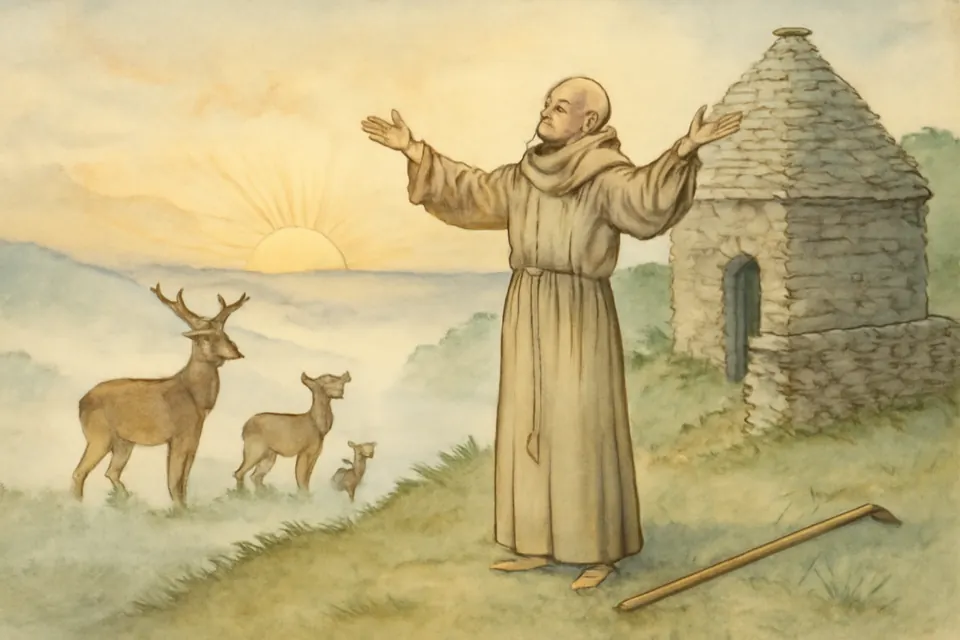
St. Patrick's Breastplate is an ancient Irish prayer for God's protection, also called the Lorica of St. Patrick or the Deer's Cry. It begins "I arise to-day, through a mighty strength, the invocation of the Trinity" and includes the famous lines "Christ with me, Christ before me, Christ behind me." Irish tradition gives it to St. Patrick; its Old Irish points to the 7th or 8th century.
St. Patrick's Breastplate is the great protection prayer of Ireland. It is long, strong and very old, and once you have prayed it you won't forget its rhythm: "I arise to-day..." Below is the full text in Kuno Meyer's translation, then the much-loved hymn version, "I bind unto myself today," and after that the story of where the prayer came from.
The St. Patrick's Breastplate prayer
This is Kuno Meyer's English translation of the Old Irish, published in his Selections from Ancient Irish Poetry (1911) under the title "The Deer's Cry." Meyer based it on the translation in Whitley Stokes and John Strachan's Thesaurus Palaeohibernicus. It is in the public domain, and we print it word for word, with Meyer's spellings.
I arise to-day Through a mighty strength, the invocation of the Trinity, Through belief in the threeness, Through confession of the oneness Of the Creator of Creation.
I arise to-day Through the strength of Christ's birth with His baptism, Through the strength of His crucifixion with His burial, Through the strength of His resurrection with His ascension, Through the strength of His descent for the judgment of Doom.
I arise to-day Through the strength of the love of Cherubim, In obedience of angels, In the service of archangels, In hope of resurrection to meet with reward, In prayers of patriarchs, In predictions of prophets, In preachings of apostles, In faiths of confessors, In innocence of holy virgins, In deeds of righteous men.
I arise to-day Through the strength of heaven: Light of sun, Radiance of moon, Splendour of fire, Speed of lightning, Swiftness of wind, Depth of sea, Stability of earth, Firmness of rock.
I arise to day Through God's strength to pilot me: God's might to uphold me, God's wisdom to guide me, God's eye to look before me, God's ear to hear me, God's word to speak for me, God's hand to guard me, God's way to lie before me, God's shield to protect me, God's host to save me From snares of devils, From temptations of vices, From every one who shall wish me ill, Afar and anear, Alone and in a multitude.
I summon to-day all these powers between me and those evils, Against every cruel merciless power that may oppose my body and soul, Against incantations of false prophets, Against black laws of pagandom, Against false laws of heretics, Against craft of idolatry, Against spells of women and smiths and wizards, Against every knowledge that corrupts man's body and soul.
Christ to shield me to-day Against poison, against burning, Against drowning, against wounding, So that there may come to me abundance of reward. Christ with me, Christ before me, Christ behind me, Christ in me, Christ beneath me, Christ above me, Christ on my right, Christ on my left, Christ when I lie down, Christ when I sit down, Christ when I arise, Christ in the heart of every man who thinks of me, Christ in the mouth of every one who speaks of me, Christ in every eye that sees me, Christ in every ear that hears me.
I arise to-day Through a mighty strength, the invocation of the Trinity, Through belief in the threeness, Through confession of the oneness Of the Creator of Creation.
In the 11th-century manuscript the Irish text ends with a short Latin verse, which Meyer leaves out. It is printed in the 1898 edition of the Liber Hymnorum:
Domini est salus, Domini est salus, Christi est salus; Salus tua, Domine, sit semper nobiscum.
In English: "Salvation is of the Lord, salvation is of the Lord, salvation is of Christ. May your salvation, O Lord, be always with us." The first words come from Psalm 3, which the Douay-Rheims renders "Salvation is of the Lord: and thy blessing is upon thy people."

"Christ with me": the short form
Many people pray only the heart of the Breastplate, the lines that wrap Christ around us on every side. This is the section most often printed on holy cards and said as a quick prayer for protection:
Christ with me, Christ before me, Christ behind me, Christ in me, Christ beneath me, Christ above me, Christ on my right, Christ on my left, Christ when I lie down, Christ when I sit down, Christ when I arise, Christ in the heart of every man who thinks of me, Christ in the mouth of every one who speaks of me, Christ in every eye that sees me, Christ in every ear that hears me.
You can say it walking out the door, at a hospital bedside or before a hard conversation. It takes less than a minute, and it asks for the one thing that matters: that Christ be present everywhere we go and in everyone we meet.
"I bind unto myself today": the hymn
Most English speakers first meet the Breastplate as a hymn. Cecil Frances Alexander (1818–1895), the Irish poet who also gave us "Once in Royal David's City" and "There Is a Green Hill Far Away," wrote it for St. Patrick's Day 1889. H. H. Dickinson, Dean of the Chapel Royal in Dublin, had asked her for a version that could be sung, and sent her "a carefully collated copy of the best prose translations." He wrote later, in the preface to her collected Poems (1896), that "within a week she sent me that exquisitely beautiful as well as faithful version." Her poem is a free paraphrase in rhyme, not a translation, so its wording differs from Meyer's. The text below is from that 1896 edition and is in the public domain.
I bind unto myself to-day The strong Name of the Trinity, By invocation of the same, The Three in One and One in Three.
I bind this day to me for ever, By pow'r of faith, Christ's Incarnation; His baptism in Jordan river; His death on Cross for my salvation; His bursting from the spiced tomb; His riding up the Heav'nly way; His coming at the day of doom; I bind unto myself to-day.
I bind unto myself the power Of the great love of Cherubim; The sweet "Well done" in judgment hour; The service of the Seraphim, Confessors' faith, Apostles' word, The Patriarchs' prayers, the Prophets' scrolls, All good deeds done unto the Lord, And purity of virgin souls.
I bind unto myself to-day The virtues of the star-lit heaven, The glorious sun's life-giving ray, The whiteness of the moon at even, The flashing of the lightning free, The whirling wind's tempestuous shocks, The stable earth, the deep salt sea, Around the old eternal rocks.
I bind unto myself to-day The pow'r of God to hold, and lead, His eye to watch, His might to stay, His ear to hearken to my need. The wisdom of my God to teach, His hand to guide, His shield to ward; The word of God to give me speech, His heavenly host to be my guard.
Against the demon snares of sin, The vice that gives temptation force, The natural lusts that war within, The hostile men that mar my course; Or few or many, far or nigh, In every place, and in all hours, Against their fierce hostility, I bind to me these holy powers.
Against all Satan's spells and wiles, Against false words of heresy, Against the knowledge that defiles, Against the heart's idolatry, Against the wizard's evil craft, Against the death-wound and the burning, The choking wave, the poisoned shaft, Protect me, Christ, till Thy returning.
Christ be with me, Christ within me, Christ behind me, Christ before me, Christ beside me, Christ to win me, Christ to comfort and restore me, Christ beneath me, Christ above me, Christ in quiet, Christ in danger, Christ in hearts of all that love me, Christ in mouth of friend and stranger.
I bind unto myself the Name, The strong Name of the Trinity; By invocation of the same, The Three in One, and One in Three. Of Whom all nature hath creation: Eternal Father, Spirit, Word: Praise to the Lord of my salvation, Salvation is of Christ the Lord.
The hymn is usually sung to the Irish melody called St. Patrick, with a second Irish air, Deirdre, for the "Christ be with me" stanza, which has a different meter. According to the Hymnology Archive, Charles Villiers Stanford harmonized both tunes for The English Hymnal of 1906, and the pairing has stayed ever since.

What the Breastplate asks
A lorica was a Roman soldier's breastplate. The prayer takes St. Paul's picture literally and puts it on: "Stand therefore, having your loins girt about with truth, and having on the breastplate of justice... In all things taking the shield of faith" (Ephesians 6:14, 16, Douay-Rheims). Paul uses the image again in 1 Thessalonians 5:8, "having on the breastplate of faith and charity, and for a helmet the hope of salvation."
The prayer moves in a clear order. First we stand in the Trinity, the strongest name there is. Then we stand in the whole life of Christ, from His birth and baptism to His coming again in judgment. Then in the company of heaven: the Cherubim, angels and archangels, patriarchs, prophets, apostles, confessors, virgins and "righteous men." Then, strikingly, in creation itself: sun, moon, fire, lightning, wind, sea, earth and rock, all of them God's handiwork and none of them gods. Only after all that does the prayer name the dangers, and it ends by asking Christ to stand on every side of us and to live in the hearts and mouths of everyone around us.
That last turn is worth slowing down for. The Breastplate doesn't ask only to be shielded from other people. It asks that Christ be in "the heart of every man who thinks of me" and "the mouth of every one who speaks of me." Protection, in this prayer, ends in the conversion of the people we fear.
"Spells of women and smiths and wizards"
Readers today sometimes stop at this line. In the Old Irish it is brichta ban ocus goband ocus druad: "spells of women and smiths and druids," as the 1898 Liber Hymnorum translates it. In pagan Ireland certain women, the smiths who worked iron and the druids were all credited with magical powers. The prayer isn't speaking against women or craftsmen. It asks Christ's protection against sorcery of every kind, in the terms a 7th- or 8th-century Irish Christian knew.
The Old Irish original
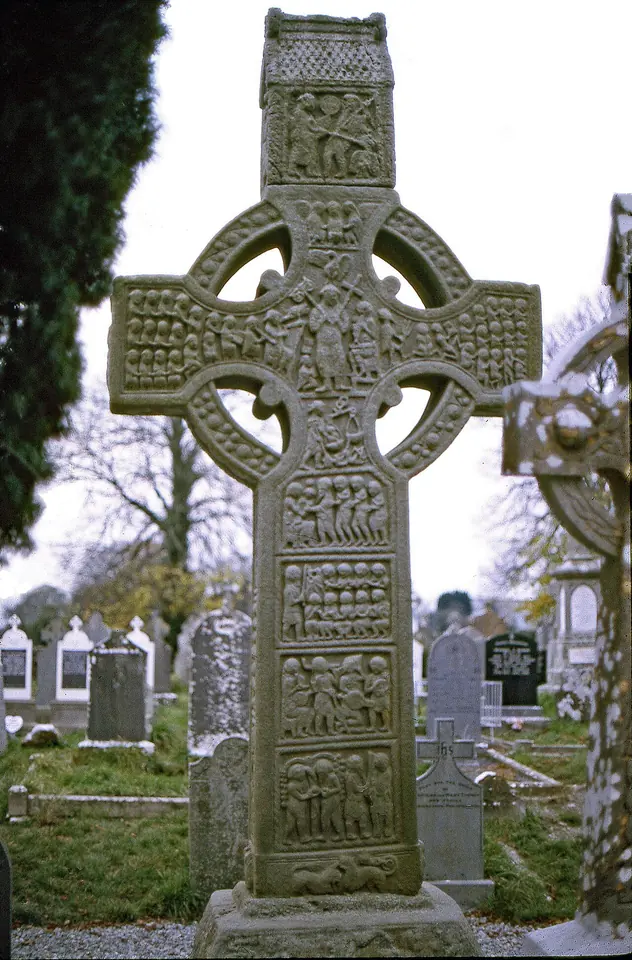
The Breastplate was composed in Old Irish, not Latin, which places it among the oldest prayers in the Irish language. Each of the first five sections opens with the same verb, Atomriug indiu, "I arise today." This is the opening as printed from the manuscript by J. H. Bernard and Robert Atkinson in The Irish Liber Hymnorum (1898):
Atomriug indiu niurt tren togairm trinoit cretim treodataid foisin oendatad in duilemain dail.
And here are the first lines of the "Christ with me" section in the same edition:
Crist lim, Crist rium, Crist i'm degaid, Crist innium, Crist issum, Crist uasum, Crist dessum, Crist tuathum.
The word atomriug is difficult. Alexander followed the older reading "I bind (to myself)," which gave her hymn its first line. Meyer and most later translators prefer "I arise," and the Hymnology Archive notes that "I arise today" is now generally considered the better rendering. Atkinson also noticed that the piece isn't written in regular meter, though it is built with care, and he wondered whether it had first been written out on the page in a shape like a real breastplate.
The Liber Hymnorum and the oldest copies
The oldest full copy of the Breastplate is in the Liber Hymnorum, the "Book of Hymns," an 11th-century vellum manuscript in the Library of Trinity College Dublin (MS 1441, formerly E.4.2). Bernard and Atkinson describe it as a collection of "hymns and prayers in Latin and Irish which were used in the worship of the early Celtic Church," copiously glossed by its scribes. A second Liber Hymnorum, kept by the Irish Franciscans in Dublin and a little later in date, has many of the same hymns, but not this one. A partial text also survives in an Oxford manuscript of the Tripartite Life of Patrick (Bodleian Library, Rawlinson B 512).
The Trinity copy opens with a preface in Irish that tells us how the medieval Irish Church understood the prayer. In Bernard and Atkinson's translation:
Patrick made this hymn; in the time of Loegaire mac Neill, it was made, and the cause of its composition was for the protection of himself and his monks against the deadly enemies that lay in ambush for the clerics. And it is a lorica of faith for the protection of body and soul against demons and men and vices.
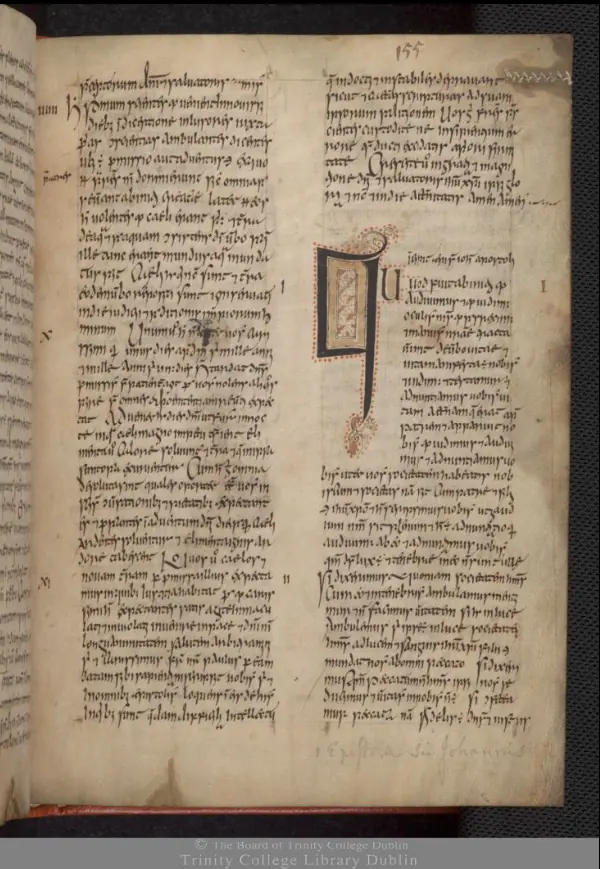
An even earlier witness may exist. The Book of Armagh, written in 807, preserves a 7th-century list of four honors owed to Patrick by every church and monastery in Ireland. The fourth is canticum eius scotticum semper canere, "always to sing his Irish canticle." Bernard and Atkinson thought this canticle "is probably the Lorica of St. Patrick." If they are right, the Breastplate was already being sung across Ireland in Patrick's name within two or three centuries of his death.
The prayer came back into print in modern times through George Petrie, who published it in 1839 in his study of Tara Hill. Whitley Stokes made a much better translation, and Meyer's 1911 version followed from his work.
Did St. Patrick write it? The honest answer
Irish tradition has always called it Patrick's prayer, and the Church in Ireland has prayed it in his name for well over a thousand years. The Catholic Encyclopedia of 1911, in its article on St. Patrick, went further and said the "Lorica of St. Patrick" was "now universally accepted as genuine." Robert Atkinson, a careful Irish scholar, thought in 1898 that it was "probably a genuine relic of St. Patrick," because its rough grammar looked so archaic.
Other scholars have weighed the evidence differently, and their view has prevailed. Kuno Meyer judged that "the hymn in the form in which it has come down to us cannot be earlier than the eighth century." Atkinson's own co-editor, J. H. Bernard, pointed out that Muirchú's 7th-century life of Patrick tells the story of the ambush on the road to Tara without ever mentioning a hymn, which he called "undoubtedly unfavourable" to the claim that Patrick composed it. Patrick's two genuine writings, the Confessio and the Letter to Coroticus, are in Latin.
So the authorship is traditional: the language points to the 7th or 8th century, a couple of centuries after Patrick's death in the 5th century. What we can say with confidence is that the prayer grew up among the communities Patrick founded, that it breathes the same faith in the Trinity that fills his Confessio, and that the Irish Church gave it his name out of love. You can read his own story in our entry on St. Patrick.
The legend of the Deer's Cry
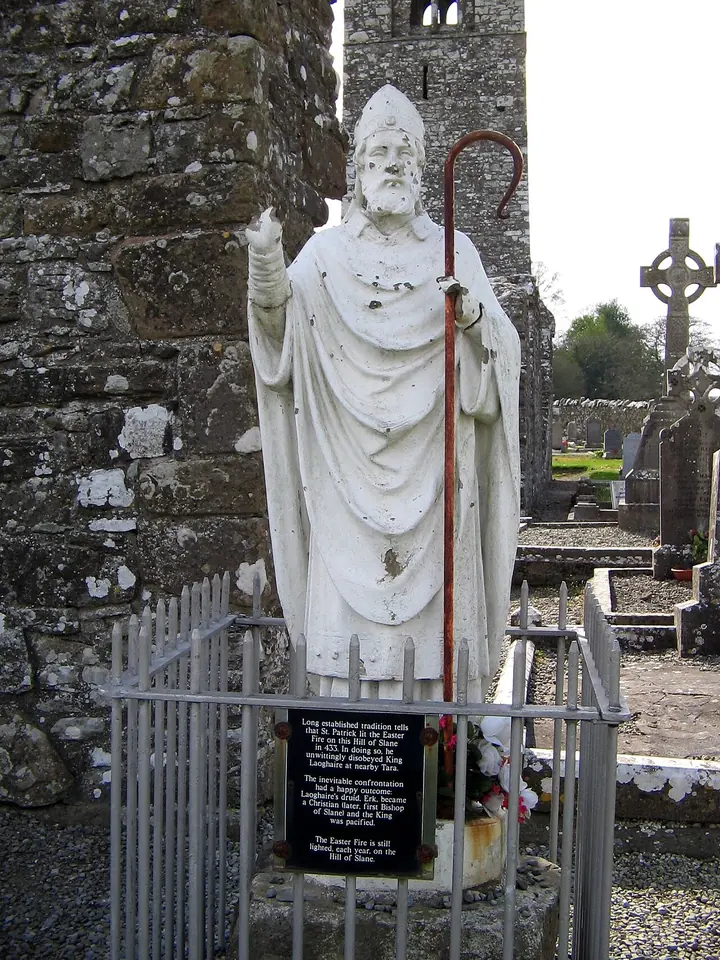
The prayer's other name comes from a story, and the story is traditional. The medieval lives say that on Easter Eve Patrick lit the Paschal fire on the Hill of Slane, within sight of Tara, where the High King Lóegaire had forbidden any fire before his own. The king tried to stop the newcomer. The Liber Hymnorum preface finishes the tale:
Patrick sang it when the ambuscades were laid for him by Loegaire, in order that he should not go to Tara to sow the Faith, so that on that occasion they were seen before those who were lying in ambush as if they were wild deer having behind them a fawn, viz. Benen; and 'Deer's Cry' is its name.
Benén, or St. Benignus, was the boy who followed Patrick; tradition holds that he later succeeded him at Armagh. In the story, Patrick and his eight companions walked through the ambush as eight deer, with the boy as the fawn behind them.
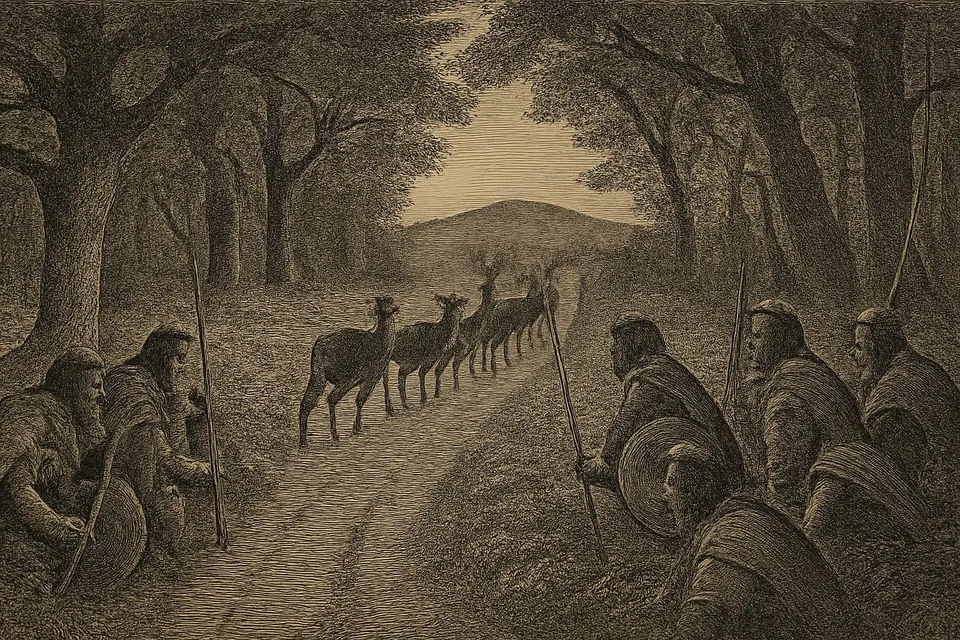
There is a scholarly twist here too. The Old Irish title, Faeth Fiada, doesn't translate neatly as "Deer's Cry." Bernard and Atkinson noted that the manuscripts read faeth, which may mean "calm," and that the 19th-century scholar Eugene O'Curry described feth fiadha as an old Irish phrase for a covering of invisibility. On that reading the title may first have meant a prayer for being hidden from enemies, and the deer story may have grown to explain it. Either way, the legend says something true about the prayer: those who wear Christ as their breastplate pass through danger under His protection.
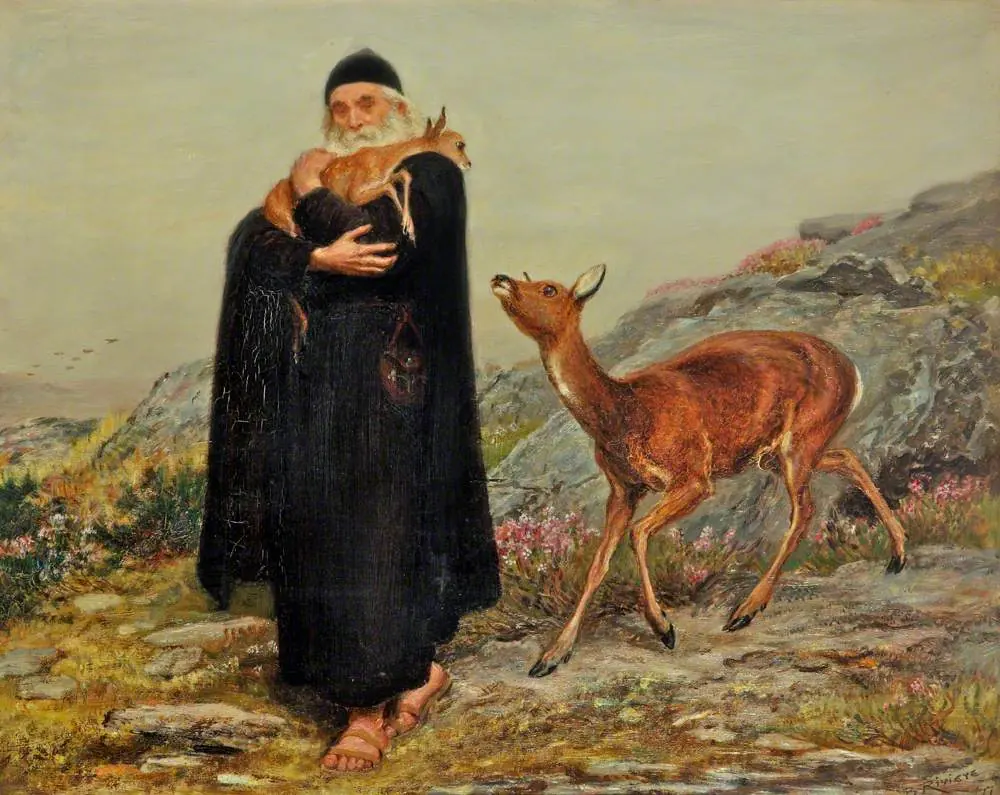
Briton Rivière painted another, gentler Patrick legend in 1877, showing the saint carrying a fawn while its mother walks beside him. The deer has stayed with Patrick in Christian art ever since.
A prayer in the lorica tradition
The Breastplate is the most famous of a whole family of early Irish loricae, protection prayers that list the parts of the body or the powers of heaven and ask God to guard each one. The 1898 edition of the Liber Hymnorum prints several. The Latin "Lorica of Gildas," which it adds as an appendix, asks the Trinity to shield every limb from head to foot. An Irish hymn attributed to St. Colmán mac Uí Chluasaigh, according to its preface, was made against the "Yellow Plague" that swept Ireland in the 660s. Bernard and Atkinson describe it as a lorica too.
These prayers come from monks who lived with real dangers: plague, raids, wild country and long journeys by sea. They took Ephesians 6 at its word. Patrick's Breastplate stands out among them for its order and its sweep, from the Trinity to the stars to the faces of the people around us.

The promises in the preface
The medieval preface adds a promise. Whoever recites the prayer daily "with pious meditation on God," it says, will find that "demons shall not dare to face him, it shall be a protection to him against all poison and envy, it shall be a guard to him against sudden death, it shall be a lorica for his soul after his decease." This promise belongs to the preface's own tradition. The Church has never attached it to the Breastplate, and it isn't an indulgence. We pray the Breastplate as an act of trust in Christ, not as a charm that works by itself. Its power is the power of the One it names.
How to pray St. Patrick's Breastplate today
The prayer suits mornings, as its first words say. Here are some of the ways the faithful use it:
- As a morning prayer. Say the full text, or the opening and the "Christ with me" section, as you get up. It fits well beside the Morning Offering.
- On St. Patrick's Day, March 17. Many parishes sing "I bind unto myself today" at Mass, and families pray the Breastplate together before the day's celebrations. Patrick's feast is on our feast days calendar.
- Before travel or danger. The prayer names fire, water and wounding, and it has long been a traveler's and a worker's prayer, said by fishermen and soldiers alike.
- In sickness. The "Christ with me" lines are a gentle prayer to say with someone who is ill or dying.
- With the angels. The Breastplate stands "in obedience of angels" and "in the service of archangels." It pairs naturally with the Guardian Angel Prayer and the St. Michael Prayer.

Let us pray it slowly, the way it was written, one section at a time. When we reach "Christ before me, Christ behind me," let us picture the people we will meet today and ask that Christ be in their hearts as well as ours.
Saints of the Breastplate
The Breastplate belongs first to St. Patrick, but it was carried by the Irish monks who came after him: St. Brigid, who shares with Patrick and St. Columba the title of patron of Ireland, and missionaries like St. Columbanus and St. Aidan, who took Irish prayer to Europe and to England. Its call on the archangels makes it a natural companion to devotion to St. Michael the Archangel, defender in battle.

On his feast, and on any morning that needs it, let us ask St. Patrick to pray for us, and let us arise today with him, through a mighty strength, the invocation of the Trinity.
Frequently asked questions
What is St. Patrick's Breastplate?
A long Old Irish prayer for protection, also called the Lorica of St. Patrick (lorica is Latin for "breastplate") and the Deer's Cry. The one praying "arises" clothed in the power of the Trinity, the life of Christ, the angels and saints, and creation itself, and asks Christ to surround them on every side. Its oldest copy is in the 11th-century Irish Liber Hymnorum.
Did St. Patrick really write the Breastplate?
Irish tradition says he did, and the 11th-century preface in the Liber Hymnorum says "Patrick made this hymn." The language of the Old Irish text, though, belongs to a later period. Kuno Meyer wrote in 1911 that in the form we have it the hymn "cannot be earlier than the eighth century." We honor it as Patrick's prayer in the sense that it carries his faith and his name, while the authorship itself is traditional.
What are the words \"Christ with me, Christ before me\"?
They are the best-known lines of St. Patrick's Breastplate: "Christ with me, Christ before me, Christ behind me, Christ in me, Christ beneath me, Christ above me, Christ on my right, Christ on my left..." (Kuno Meyer's translation). Many people pray this section by itself, and in the hymn version it begins "Christ be with me, Christ within me."
Why is it called the Deer's Cry?
The medieval preface says Patrick sang it when King Lóegaire's men lay in ambush to stop him reaching Tara, and that the ambushers saw only "wild deer having behind them a fawn," and "'Deer's Cry' is its name." The story is traditional. The Old Irish title, Faeth Fiada, is hard to translate, and the 1898 editors of the Liber Hymnorum thought it might first have meant a prayer for being hidden from enemies.
Who wrote \"I bind unto myself today\"?
Cecil Frances Alexander (1818–1895), the Irish hymn writer who also wrote "Once in Royal David's City." She made the rhymed version for St. Patrick's Day 1889 at the request of H. H. Dickinson, Dean of the Chapel Royal in Dublin, who later wrote that she sent it to him "within a week." It is a free paraphrase, not a word-for-word translation.
When should I pray St. Patrick's Breastplate?
Any morning, as the words "I arise to-day" suggest, and especially on St. Patrick's Day, March 17. People also pray it before travel, in danger or illness, before a hard day's work, and the short "Christ with me" section as a quick prayer for protection at any hour.
Are there promises attached to praying the Breastplate?
The medieval Irish preface says that whoever recites it daily "with pious meditation on God" will be guarded from demons, poison and sudden death. That promise belongs to the preface's own tradition. The Church has never attached it to the prayer, and no special indulgence is listed for it. We pray the Breastplate because it is a beautiful act of trust in Christ, not as a charm.
Sources
- Kuno Meyer, Selections from Ancient Irish Poetry (1911): The Deer's Cry, with notes on its date (Project Gutenberg)
- J. H. Bernard and R. Atkinson, The Irish Liber Hymnorum, vol. 1: Text and Introduction (Henry Bradshaw Society, 1898), Old Irish text of the Lorica and its preface
- J. H. Bernard and R. Atkinson, The Irish Liber Hymnorum, vol. 2: Translations and Notes (1898), the preface, the Faeth Fiada title, the Book of Armagh honors
- Cecil Frances Alexander, Poems, ed. William Alexander (1896), St. Patrick's Breastplate, with H. H. Dickinson's preface
- Hymnology Archive: St. Patrick's Hymn (manuscripts, editions, Alexander's 1889 version and its tunes)
- Catholic Encyclopedia (1911): St. Patrick
- Douay-Rheims Bible: Ephesians 6 (the armor of God)