The Black Madonna
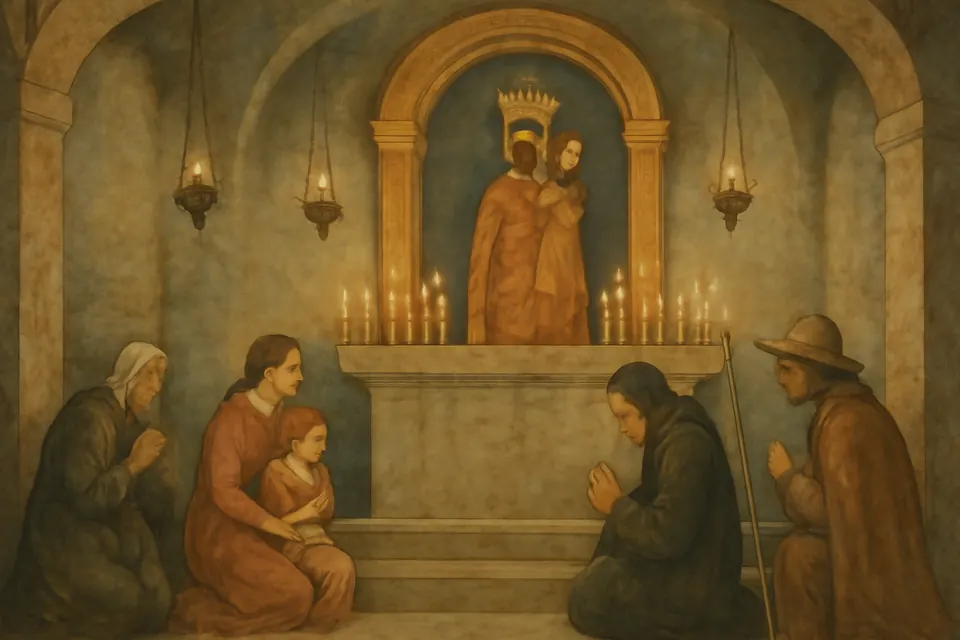
A Black Madonna is a statue or painting of the Virgin Mary, usually medieval, in which the faces and hands of Mary and the Child Jesus are dark or black. Several hundred exist, many at great shrines such as Częstochowa, Montserrat, Einsiedeln, Le Puy and Altötting. Most were darkened by centuries of candle smoke and aging paint or varnish, some were later repainted black, and the faithful read them through the Song of Songs: "I am black but beautiful."
In a dim chapel in Poland, a scarred icon looks out from a silver frame. On a mountain in Catalonia, pilgrims climb a narrow stair to touch the wooden orb in the hand of a small, dark-faced statue. In a Swiss abbey church, monks process every evening to sing the Salve Regina before a Madonna whose face is black. These are the Black Madonnas, and they stand at the center of some of the oldest Marian shrines in the world. This page explains what a Black Madonna is, why the images are dark, what the dark color means, and the story and feast of each of the great ones, so that we can come before them as pilgrims always have: to ask the Mother of God to lead us to her Son.
What is a Black Madonna?
A Black Madonna (or Black Virgin) is a statue or painting of the Virgin Mary in which the faces and hands of Mary and the Child Jesus are dark brown or black. Most are medieval. Many are small, seated wooden statues of the type called the "Throne of Wisdom," with Mary sitting upright and the Child on her lap facing outward. Others are standing Gothic statues, and the most famous of all, at Częstochowa, is a painted icon.
They are not a separate devotion or a different Mary. A Black Madonna shows the same Blessed Virgin Mary, Mother of God, that every other Catholic image shows. What sets them apart is history: many of these images became the chief pilgrimage shrines of their countries. The historian Monique Scheer points out that before the 19th century, the most venerated image of Mary in a Catholic country was more often than not a black one: Le Puy for the French, Guadalupe and Montserrat for the Spanish, Einsiedeln for the Swiss, Loreto for Italy and far beyond, and Altötting for Bavaria.

Most Black Madonnas are dressed. Since the 16th and 17th centuries many have worn stiff, bell-shaped robes of silk and gold that cover everything but the faces and hands, which is one reason the dark faces stand out so strongly. Many are also crowned, some with a papal or canonical crowning, the Church's formal honor for an image that has drawn the faithful for centuries.
Why is the Black Madonna black?
This is the question most people ask, and the honest answer is that there is no single reason. Each image has its own history. The explanations below are the ones with real evidence behind them, followed by the theories that don't hold up.
Candle smoke, soot and aging paint
The plainest reason is physical. These images stood for centuries in small, closed chapels where candles and oil lamps burned day and night. Soot settled on them, and the lead-based pigments and varnishes used by medieval painters darken as they age.
Montserrat gives the clearest evidence. When La Moreneta was restored in 2001, the restorers confirmed both her 12th-century date and the cause of her color: the oxidation of the original paint and the smoke of lamps and candles, according to the Gran Enciclopèdia Catalana. At Altötting, the shrine itself says the Madonna was blackened "above all" by the candle soot of the centuries, along with the natural darkening of the wood. The Einsiedeln monks say the same of their statue, whose face and hands were first painted in natural colors and turned dark, "finally silver-black," over the decades.
For most of the 20th century this was the explanation scholars preferred. Scheer sums up the consensus: the color "is not intentional but rather the result of discoloration due to the soot and smoke of candles and incense as well as chemical reactions in the paint."
Einsiedeln: repainted black on purpose
The story does not end with soot, and Einsiedeln shows why. In May 1798 French revolutionary troops occupied the abbey and tore down the old Chapel of Grace. The monks had already carried the statue away. It was hidden, buried for some weeks on a mountain pass, and taken through Tyrol as far as Trieste before reaching the abbey's priory of St. Gerold in Vorarlberg. There, in 1799, a painter named Johann Adam Fuetscher restored the battered figure.
His report survives. In Scheer's translation he wrote:
The face was thoroughly black; yet this color is not attributable to the paintbrush, but rather the smoke of the candles and lamps that have been burning constantly in the holy chapel of Einsiedeln for so many centuries; for I found and saw it obviously that the paint on the face had been flesh-colored in the beginning.
At the request of a monastery official, Fuetscher then repainted the faces black, "as it was before." The abbey confirms that since the summer of 1799 the skin of Mother and Child has been painted fully black. By then the color was how pilgrims knew her. A Madonna with a pink face would not have looked like Our Lady of Einsiedeln at all.

Einsiedeln was not alone. Scheer found that pilgrims' painted thank-you tablets at Altötting begin to show the Madonna as black only in the 1690s. She also notes speculation that the Altötting image may have been darkened on purpose in the late 16th century to look more like the Madonna of Loreto, though that remains unproven.
"I am black but beautiful": the Song of Songs
Once the images were dark, the faithful asked what the color meant, and they found the answer in Scripture. In the Song of Songs the bride says, in the Douay-Rheims translation (Canticle 1:4–5):
I am black but beautiful, O ye daughters of Jerusalem, as the tents of Cedar, as the curtains of Solomon. Do not consider me that I am brown, because the sun hath altered my colour.
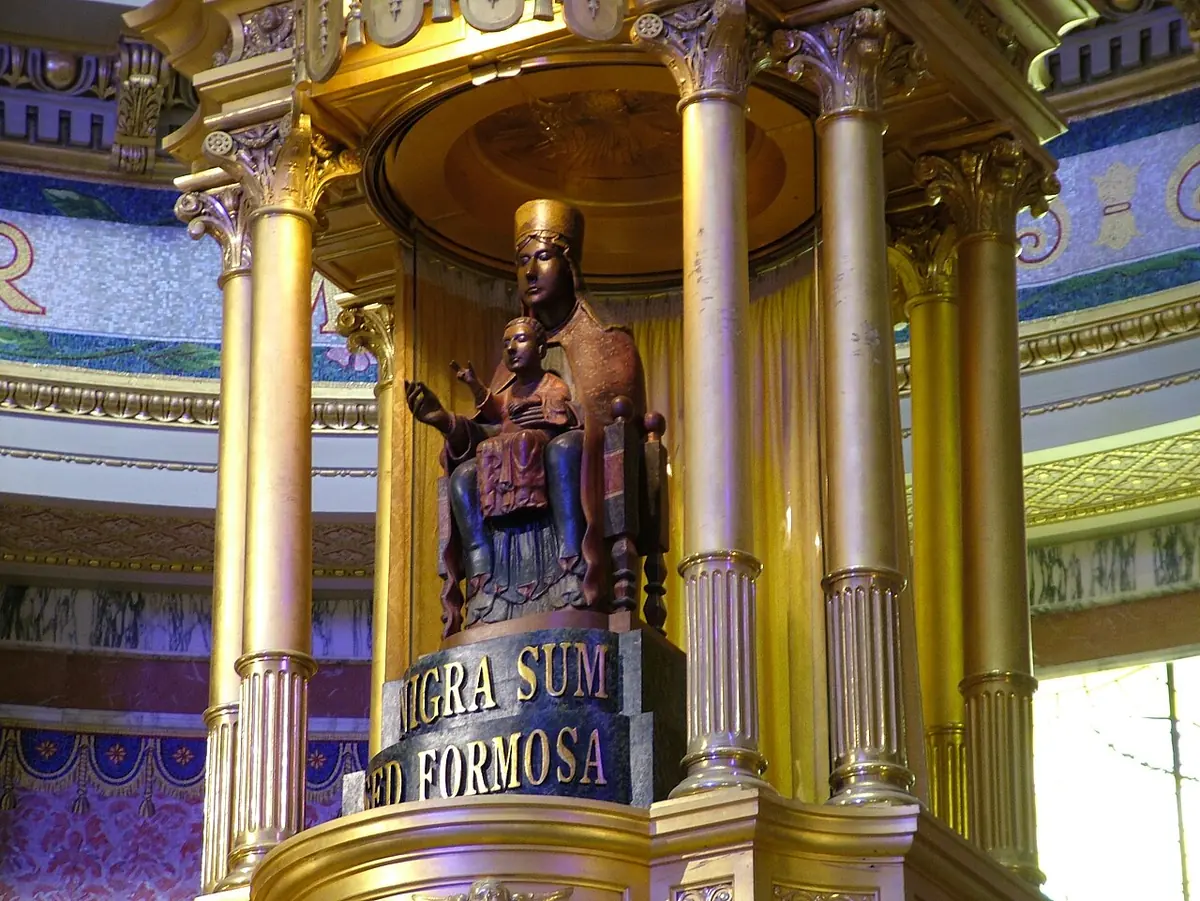
In Latin the first words are Nigra sum sed formosa. The Fathers and medieval preachers, St. Bernard of Clairvaux among them in his sermons on the Song of Songs, read the bride as the Church and the soul, and the Church has long applied the bride's words to Mary. Bishop Challoner's note in the Douay Bible gives the classic reading: the Church appears "outwardly afflicted, and as it were black and contemptible; but inwardly, that is, in its doctrine and morality, fair and beautiful."
Preachers applied this verse to the Black Madonnas themselves from at least the late 17th century. The earliest surviving reference to the blackness of the Einsiedeln image is a sermon of 1698, and a sermon of 1726 at a Bavarian copy of the Einsiedeln chapel used the Song of Songs to explain the dark face. Today the Einsiedeln monks still describe their Madonna with the bride's words: "Black am I and beautiful."
At Tindari in Sicily the words are carved into the base of the statue for every pilgrim to read.
A sign of age and of prayer
There is one more meaning, quieter but just as real. A darkened image was plainly an old one, and an old image was a trusted one. Scheer argues that in the centuries after the Reformation, the dark faces became a mark of authenticity: proof that this was the ancient image, the one generations had knelt before. By the 19th century the candle-smoke explanation had itself become part of the devotion at Altötting. What better witness to centuries of prayer, she asks, than a face darkened by millions of candles?
The goddess theory, and why it doesn't hold up
Some writers since the mid-20th century have claimed that Black Madonnas continue pre-Christian cults of dark mother goddesses such as Isis, Cybele, Demeter or Diana of Ephesus. The American anthropologist Leonard Moss proposed this at a scholarly conference in 1952. Later books by Ean Begg and others built on it, and some added that the statues were Egyptian or African imports.
These ideas are unsupported. The statues are recognizably medieval Christian works: the Throne of Wisdom type, Gothic standing Madonnas, a Byzantine-style icon. Where the dates are known, as at Montserrat, Einsiedeln and Altötting, they fit ordinary Christian workshops of the 12th to 15th centuries. Scheer shows that there is "no evidence" they were widely seen as black in the Middle Ages at all. As for churches built on old temple sites, she answers simply that "many sites of Christian worship, to Mary and other saints, black and not black, were formerly non-Christian." A church built where a temple once stood is a sign of conversion, not of disguise.
The famous Black Madonnas
Below are the best-known Black Madonnas, with what is known of each, the stories told about them, and their feast days. Miracles and legends are labeled: approved (formally examined by the Church), reported (documented claims, not formally approved) and traditional (legend and long-held tradition). The healings at these shrines are reported or traditional; the Church has honored the images themselves with papal crownings and feasts.
Our Lady of Częstochowa (Poland)
The Black Madonna of Częstochowa is a painted icon of Mary holding the Child, about 48 by 32 inches, kept by the Pauline Fathers at the Jasna Góra monastery since 1382 or 1384. Her faces are painted dark, and centuries of smoke darkened them further. At Easter 1430 raiders stripped the icon and slashed Mary's face; the painters who restored it kept the two scars on her right cheek, and they are still there. When a small garrison and the monks held the monastery against a Swedish army in 1655, the Poles saw the hand of Mary in it, and she became the Queen of Poland.
- The tradition that St. Luke painted the icon on a tabletop from the Holy Family's home is traditional.
- Healings recorded in the monastery's book of graces since 1402 are reported.
- Feast: August 26. St. John Paul II prayed before her many times as pope.
The full story, the scars, the siege and the novena are on the page for Our Lady of Częstochowa.
Our Lady of Montserrat, La Moreneta (Spain)
High on the jagged mountain of Montserrat near Barcelona, the Benedictine abbey keeps La Moreneta, "the little dark one," a seated Romanesque statue of carved and painted wood from the 12th century, a little over three feet tall. Mary sits facing straight ahead with the Child on her lap. In her right hand she holds a sphere, and pilgrims climb behind the altar to touch it. In 1881 she was crowned and proclaimed patroness of Catalonia, with her own feast on April 27. During the Spanish Civil War the monks hid the statue, and in 1947 she was enthroned in the silver altarpiece where she sits today.
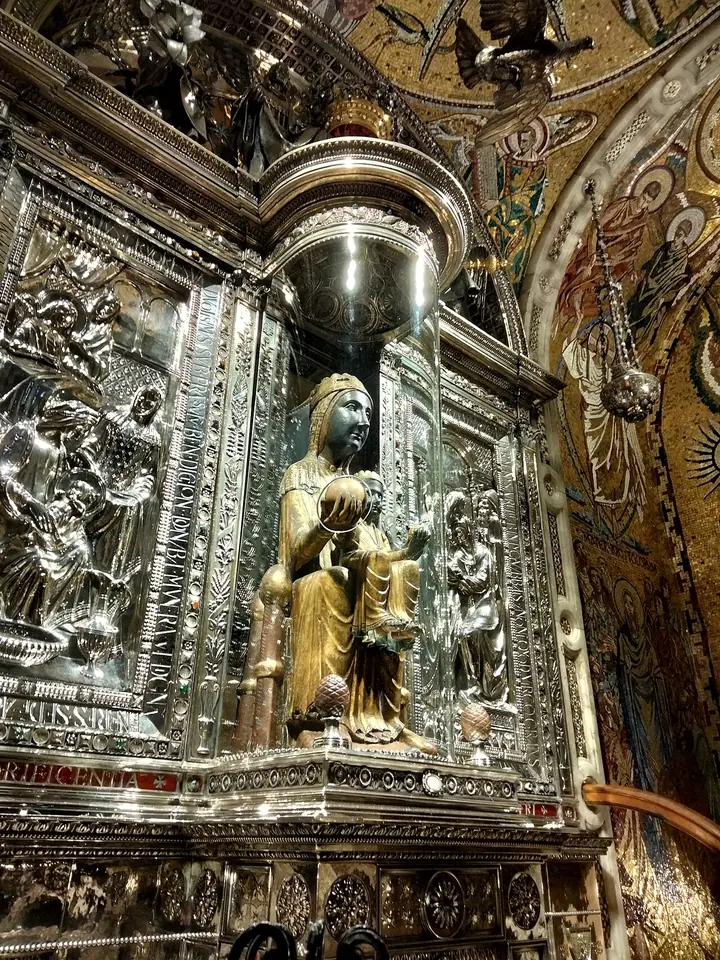
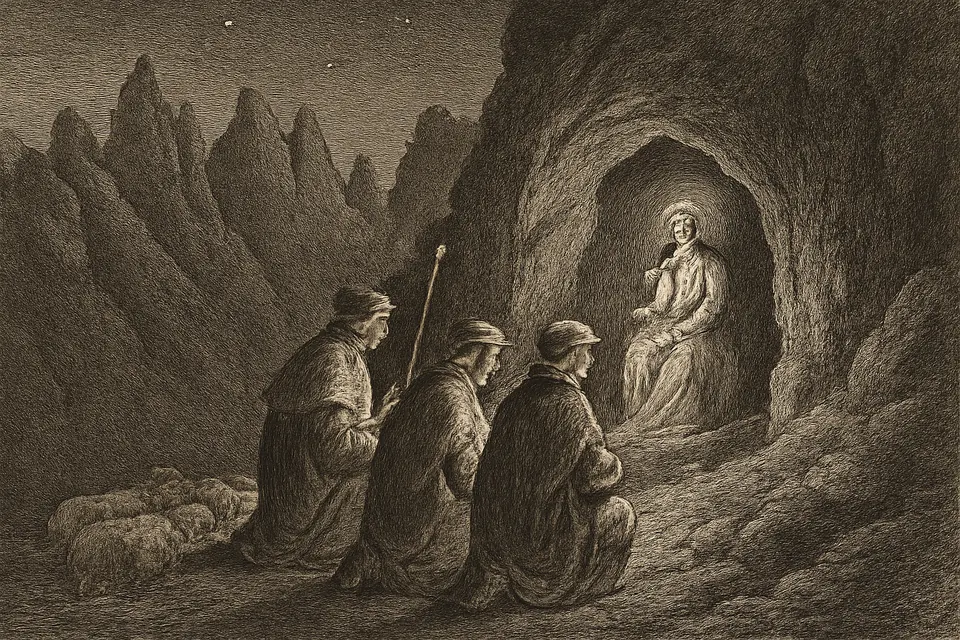
- Traditional: the legend that St. Luke carved the image, that Christians hid it in a mountain cave from the Moors, and that shepherds found it centuries later, led by a light at night. When the bishop tried to carry it to Manresa, the statue could not be moved, and so it stayed on the mountain.
- In March 1522 St. Ignatius of Loyola kept an all-night vigil before Our Lady of Montserrat and laid his sword at her altar, the start of his new life. Opus Dei reports that St. Josemaría Escrivá was suddenly cured of diabetes on April 27, 1954, the feast of Our Lady of Montserrat (reported).
- Feast: April 27.
Our Lady of Einsiedeln (Switzerland)
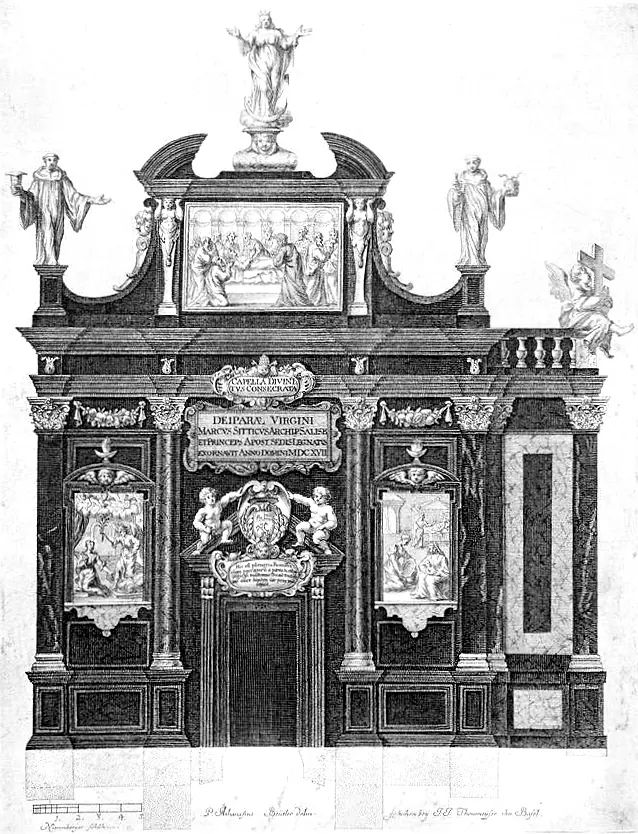
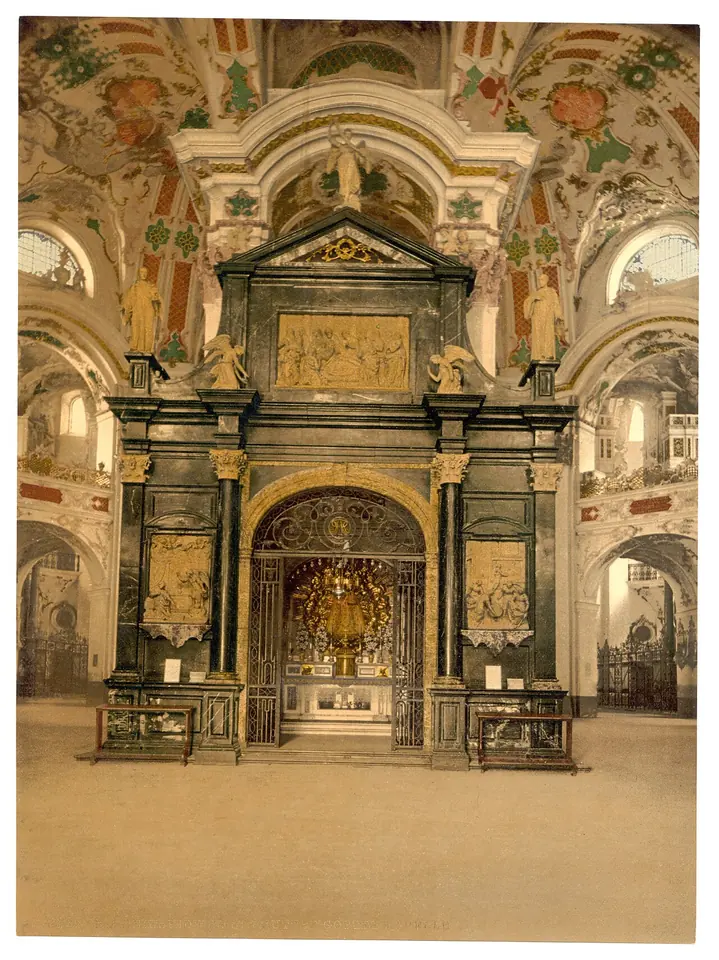
Einsiedeln, the great Benedictine abbey south of Zurich, grew up at the hermitage of St. Meinrad, who was murdered there in 861. The present statue is a slender standing Madonna of linden wood, about 46 inches tall, carved in southern Germany between 1440 and 1465 in the circle of the sculptor Hans Multscher. It came into the Holy Chapel in the summer of 1466, after a fire in 1465 destroyed the older image. Its story through the French invasion and its repainting in 1799 is told above. It returned to Einsiedeln in 1803 and has stood since 1817 in the rebuilt Chapel of Grace, a marble shrine inside the abbey church.
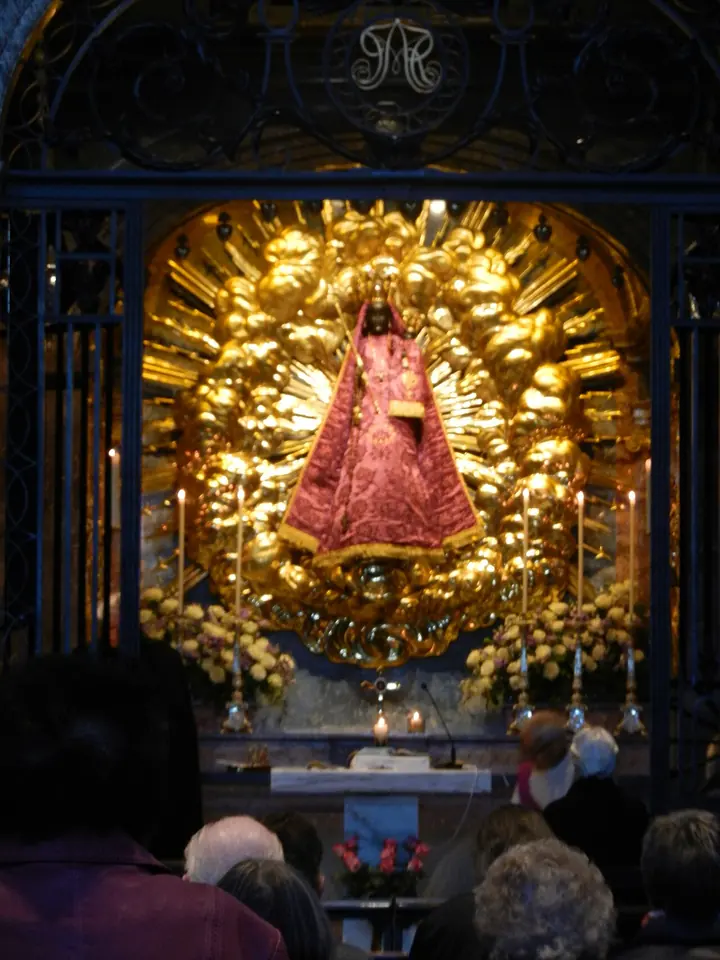
The Madonna owns 37 robes, cut in the style of the Spanish court since the 17th century. Every evening after Vespers (except during the Triduum) the monks walk in procession to the chapel and sing the Salve Regina before her, a custom founded in 1547.
- Traditional: the "Angelic Dedication" (Engelweihe). Legend holds that when the bishop came to consecrate the chapel in 948, Christ himself had already consecrated it, with angels assisting. Einsiedeln still keeps the anniversary on September 14.
- St. Peter Canisius made a pilgrimage to Einsiedeln in 1584.
- Feast: the Solemnity of Our Lady of Einsiedeln, July 16.
Our Lady of Le Puy (France)
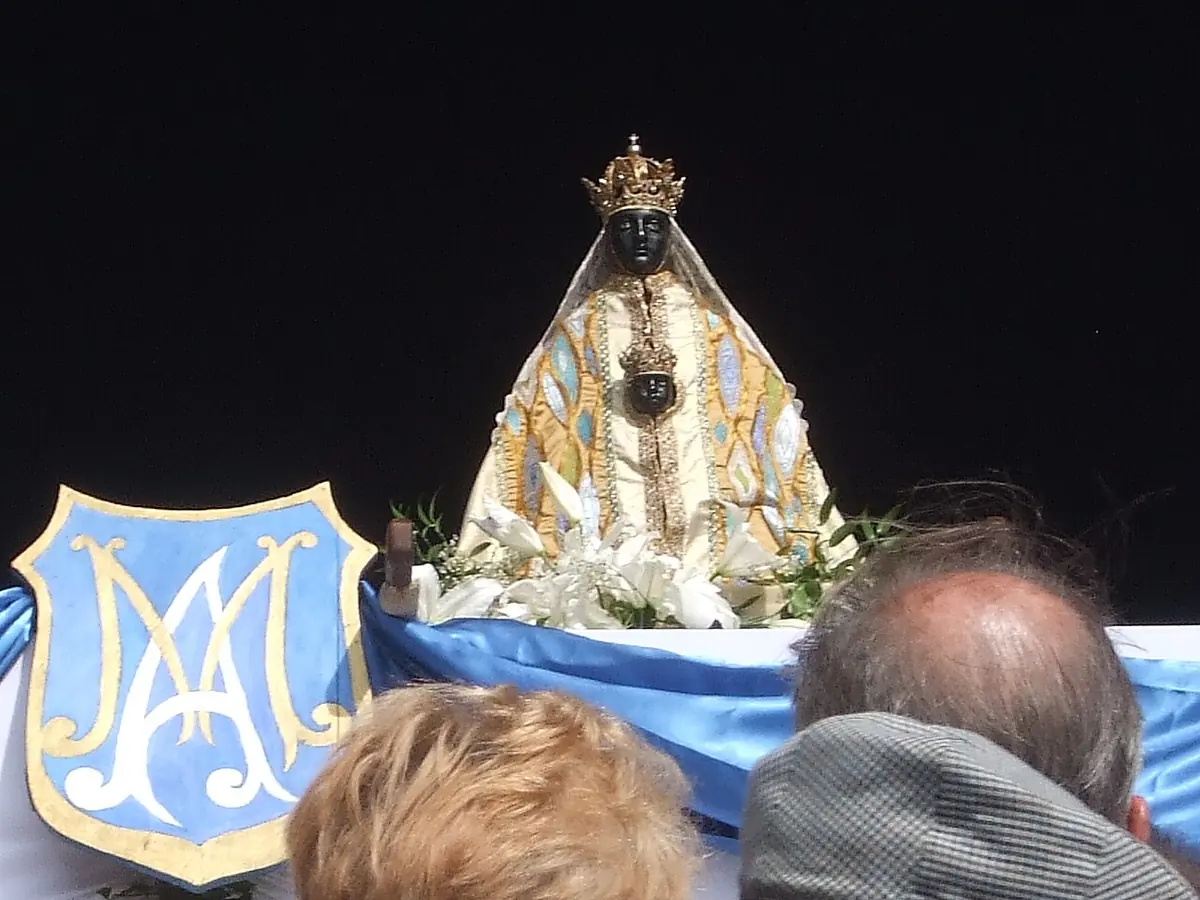
The cathedral of Le Puy-en-Velay, built on a volcanic rock in the Auvergne, was one of the great Marian shrines of medieval Europe, and it is still the starting point of the Via Podiensis, the most traveled French road to Santiago de Compostela. Its original Black Virgin was, according to legend, the gift of St. Louis IX on his return from the crusade. Revolutionaries tore it from its shrine and burned it in the public square; Scheer dates the burning to June 8, 1794. The statue on the high altar today replaced it.

- Traditional: the cathedral's founding story. Tradition says Mary appeared to a sick woman who lay down to pray on a dolmen stone on the hill and cured her, and asked for a church there. The "fever stone" is still kept in a chapel beside the Marian choir.
- Le Puy has its own Jubilee, kept whenever the Annunciation (March 25) falls on Good Friday, the day Christ was conceived meeting the day he died. It was last held in 2016; the next will be in 2157.
- Feast days: the Black Virgin is honored most of all on March 25 and on August 15, when the faithful carry her through the streets.
Our Lady of Rocamadour (France)
Rocamadour clings to a cliff above a gorge in the Lot. In the Chapel of Notre-Dame, reached by pilgrims' stairs, sits a small dark Virgin and Child of carved wood, generally dated to the 12th century. In the Middle Ages the shrine drew kings and bishops, and its monks kept a written collection of the miracles reported there, which scholars edited and translated in 1907.

- Reported: the 12th-century miracles recorded by the shrine's monks.
- Traditional: the legend that the shrine's founder, St. Amadour, was Zacchaeus of the Gospel and the husband of St. Veronica. The Catholic Encyclopedia explains plainly that the Acts of St. Amadour are no older than the 12th century and that the legend cannot stand. It still adds that a spot "hallowed by the prayers of innumerable multitudes of pilgrims, is worthy of our veneration."
- Traditional: an old iron bell hangs in the chapel, and tradition holds that it rang by itself whenever Our Lady of Rocamadour saved sailors at sea.
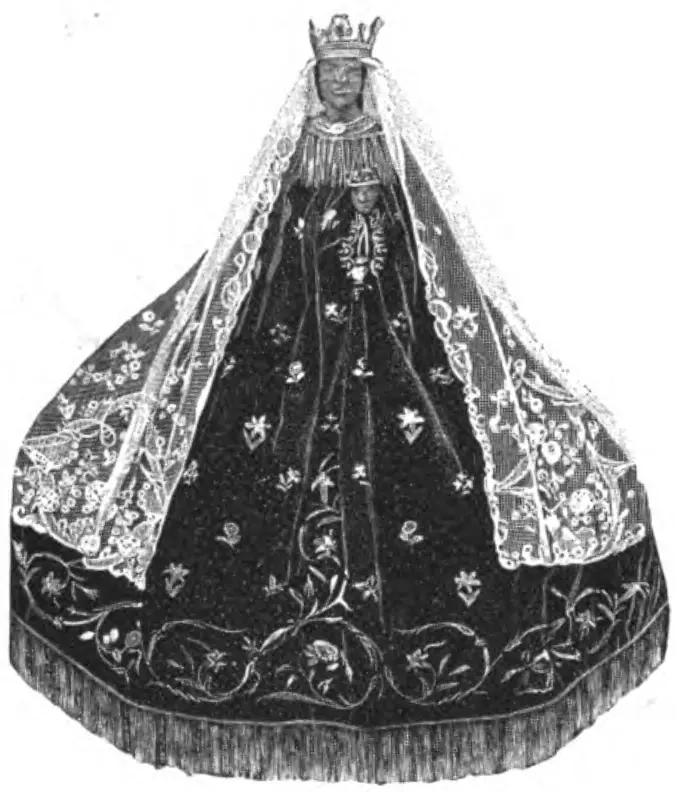
In 1936, after praying at Rocamadour, the composer Francis Poulenc returned to the faith and wrote his Litanies à la Vierge noire for women's choir and organ.
Our Lady of Loreto (Italy)
Loreto, on the Adriatic coast of Italy, keeps the Holy House, which Catholic tradition holds was Mary's home in Nazareth. Above its altar stands a dark statue of the Virgin and Child wrapped in a jeweled, bell-shaped robe. The 15th-century original was destroyed in a fire in 1921, and a new statue carved of cedar was crowned in 1922. Copies of the Loreto Madonna spread across Italy, Bavaria and Austria in the 17th century, and with them the image of a dark-faced Mary.

- Traditional: the carrying of the Holy House from Nazareth by angels, dated by legend to 1294.
- Feast: December 10. Our Lady of Loreto is patroness of aviators. See Our Lady of Loreto and the Litany of Loreto.
Our Lady of Altötting (Germany)
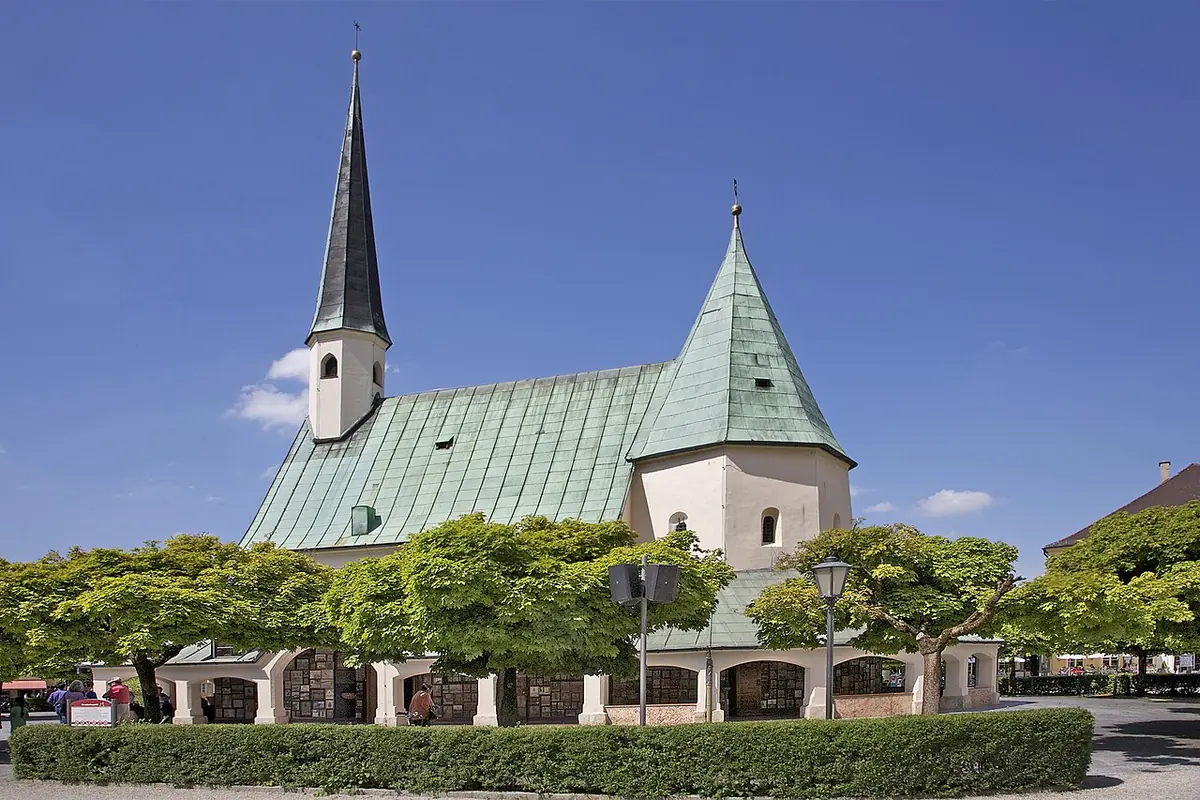
Altötting is the greatest Marian shrine in the German-speaking world, with about a million pilgrims a year. In the octagonal Chapel of Grace stands a small standing Madonna, about 26 inches tall, carved around 1330 on the Upper Rhine and blackened, the shrine says, by candle soot and the natural darkening of the wood. Mary holds a lily scepter; the Child on her arm holds the globe. She has worn robes since 1518, and Bavarian princesses often gave their wedding dresses to be made into new ones. On September 11, 2006, Pope Benedict XVI, a Bavarian himself, left his episcopal ring at her shrine, and it now adorns her scepter.

- Reported: at the end of the 15th century, the shrine says, a child who had already died came back to life when the mother begged Our Lady's help. Pilgrims flocked to the chapel afterward, and miracle booklets from Altötting survive from as early as 1492. More than 2,000 painted thank-you tablets now cover the walkway around the chapel.
- St. Conrad of Parzham, a Capuchin brother, spent over 40 years as porter of the friary beside the shrine, welcoming its pilgrims.
Guadalupe in Spain, Tindari and others
The Royal Monastery of Guadalupe in Extremadura keeps a small, dark seated Madonna, the patroness of Extremadura, whose feast is September 8. Traditional: a cowherd named Gil Cordero found the buried image by the Guadalupe River after Mary appeared to him. Spaniards carried her name to the New World.

Other Black Madonnas include Our Lady of Tindari in Sicily, Our Lady of Oropa in Piedmont, and Our Lady of the Underground (Notre-Dame-sous-Terre) in the crypt of Chartres Cathedral. Copies of the great images, especially of Częstochowa, Einsiedeln, Altötting and Montserrat, stand in parish churches all over the world, including the United States.
Is Our Lady of Guadalupe a Black Madonna?
Not in the usual sense, though the two are connected. Our Lady of Guadalupe in Mexico is the image that appeared on the cloak of St. Juan Diego in December 1531 (see the tilma of Guadalupe). It was not darkened by smoke or repainted; Mary is shown with a brown complexion, and Mexicans call her lovingly La Morenita, "the little dark one." Her title, though, is the same as that of the Black Madonna of Guadalupe in Spain, the most loved Marian shrine of the Spanish who came to Mexico.
What the Black Madonna means for us
It is tempting to treat the Black Madonnas as a puzzle to be solved. The pilgrims who have knelt before them for centuries knew better. A Black Madonna is first of all an image of the Mother of God, honored with the special veneration the Church gives to Mary and never with the worship that belongs to God alone. Every honor paid to her passes, as the Church teaches of all holy images, to the one she represents, and from her to her Son, whom she always holds out to us.
The dark face does say something too. It tells of age: of the generations who lit candles here, the soldiers and farmers and mothers who brought their griefs to this chapel before us. It tells of the bride of the Song of Songs, darkened by the sun of hard labor and still beautiful in the eyes of the Bridegroom, an image of the Church and of every soul that God loves. And to many Catholics today it tells of a Mother who belongs to every people, as she does in truth.
Praying before a Black Madonna
There is no special prayer to the Black Madonna as such; we pray to Our Lady under her title at each shrine, and with the prayers the whole Church uses. At Einsiedeln the monks end each day by singing the Salve Regina before their Black Madonna, as they have since 1547. Let us join them. This is the traditional English text, as printed in the Raccolta, the Holy See's collection of indulgenced prayers (English edition of 1878):
Hail, holy queen, mother of mercy, our life, our sweetness, and our hope; to thee do we cry, poor banished sons of Eve, to thee do we send up our sighs, mourning and weeping in this valley of tears. Turn then, most gracious advocate, thine eyes of mercy toward us, and after this, our exile, show unto us the blessed fruit of thy womb, Jesus. O clement, O loving, O sweet Virgin Mary!
The history and Latin text of this prayer are on the page for the Hail Holy Queen. If you visit one of these shrines, do as pilgrims always have: light a candle, add your own intention to the centuries of prayers already offered there, and ask Our Lady to pray for you and to show you Jesus.
Feast days of the Black Madonnas
- Our Lady of Montserrat: April 27
- Our Lady of Einsiedeln: July 16
- Our Lady of Częstochowa: August 26
- Our Lady of Guadalupe (Extremadura): September 8
- Our Lady of Loreto: December 10
- Our Lady of Le Puy: honored especially on March 25 and August 15
For more Marian feasts through the year, see the feast-day calendar and the page on the Blessed Virgin Mary.
Frequently asked questions
What is a Black Madonna?
A Black Madonna is an image of the Virgin Mary, usually a medieval wooden statue or painted icon, in which Mary and the Child have dark or black faces and hands. They are honored at some of the oldest Marian shrines in Europe, among them Częstochowa in Poland, Montserrat in Spain, Einsiedeln in Switzerland, Le Puy and Rocamadour in France, Loreto in Italy and Altötting in Germany. They show the same Mary, Mother of God, as every other image of her.
Why is the Black Madonna black?
There is no single answer. At Montserrat, a 2001 restoration found the dark color came from the oxidation of the original paint and from the smoke of lamps and candles. At Einsiedeln the face was flesh-colored at first, turned dark from candle smoke, and was then deliberately repainted black in 1799 so pilgrims would recognize it. Altötting credits candle soot and the natural darkening of the wood. Since at least the 17th century, preachers have explained the dark color with the Song of Songs, "I am black but beautiful."
What does the Black Madonna symbolize?
For centuries the dark face has been read in light of the Song of Songs, where the bride says, "I am black but beautiful." The Church has long seen the bride as an image of the Church and of Mary. The dark color also became a sign of age and authenticity, the mark of an image that generations of pilgrims had prayed before. Today many people also see in her a Mother who belongs to every people.
What is the Black Madonna of Częstochowa?
It is a painted icon of Mary holding the Child Jesus, kept at the Jasna Góra monastery in Częstochowa, Poland, since 1382 or 1384. It bears scars from a raid in 1430, and the monastery's defense against a Swedish army in 1655 made it a national symbol. She is honored as Queen of Poland, and her feast is August 26.
Are Black Madonnas pagan goddesses in disguise?
No serious evidence supports that idea. Some 20th-century writers claimed the images continued the cults of goddesses such as Isis, Cybele or Diana, often because a church stood where a temple had once been. The historian Monique Scheer answers that "many sites of Christian worship, to Mary and other saints, black and not black, were formerly non-Christian." The statues themselves are ordinary medieval Christian images of Mary and her Son.
Is Our Lady of Guadalupe a Black Madonna?
Not in the usual sense. Our Lady of Guadalupe in Mexico is the image on St. Juan Diego's tilma from 1531, and Mexicans affectionately call her La Morenita, "the little dark one," for her brown complexion. Her title, though, comes from a true Black Madonna, the medieval statue of Our Lady of Guadalupe in Extremadura, Spain.
How many Black Madonnas are there?
Counts vary with the definition. The anthropologist Leonard Moss collected about 100 examples, and Ean Begg's gazetteer lists over 500 in Europe and the Americas. Counts differ because it is hard to say where a dark Madonna ends and a Black Madonna begins. Copies multiply the number further. One 1972 study counted 272 copies of the Altötting Madonna alone.
When is the feast of the Black Madonna?
Each image has its own day. Our Lady of Częstochowa is August 26, Our Lady of Montserrat April 27, Our Lady of Einsiedeln July 16, Our Lady of Loreto December 10, and Our Lady of Guadalupe in Spain September 8. Le Puy honors its Black Virgin most of all on March 25 and August 15.
Sources
- Monique Scheer, From Majesty to Mystery: Change in the Meanings of Black Madonnas from the Sixteenth to Nineteenth Centuries, American Historical Review 107 (2002). Fuetscher's 1799 restoration report, the Le Puy statue burned June 8, 1794, the goddess theories and the counts by Moss and Begg
- Kloster Einsiedeln: Schwarze Madonna (the Black Madonna of Einsiedeln)
- Kloster Einsiedeln: Salve Regina (the daily procession to the Chapel of Grace)
- Enciclopèdia.cat (Gran Enciclopèdia Catalana): Mare de Déu de Montserrat. The 2001 restoration and the cause of the dark color
- Stadt Altötting: Die Altöttinger Madonna
- Cathédrale Notre-Dame du Puy-en-Velay: History of the Cathedral
- Catholic Encyclopedia (1912): Rocamadour
- Douay-Rheims Bible with Challoner's notes: Canticle of Canticles, chapter 1
- The Raccolta, or Collection of Prayers and Good Works (1878 English edition), Salve Regina