Gaudete Sunday 2026
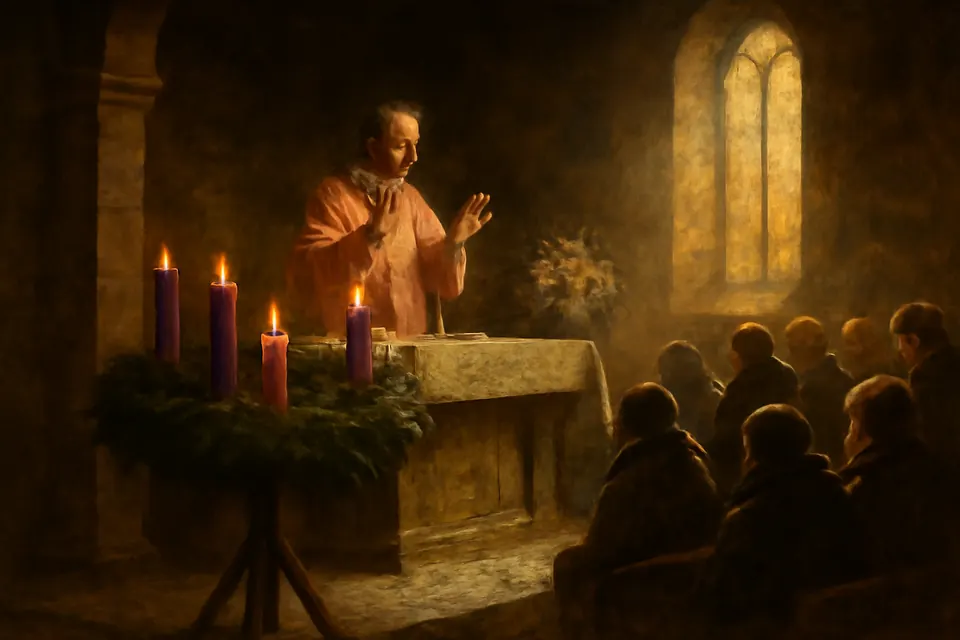
Gaudete Sunday 2026 is Sunday, December 13, 2026, the Third Sunday of Advent. Its name comes from the first word of the entrance antiphon, Gaudete, "Rejoice," from Philippians 4:4. Halfway through Advent the Church lightens the violet of the season to rose: we light the rose candle on the Advent wreath, and the priest may wear rose vestments.
Gaudete Sunday 2026 falls on Sunday, December 13, the Third Sunday of Advent. It is the Sunday of joy. After two weeks of violet, the Church lets a little light in: the rose candle on the Advent wreath is lit for the first time, and in many parishes the priest wears rose vestments. Christmas is twelve days away, and the first word of the Mass says why we can already be glad: Gaudete, "Rejoice."
Here is everything about Gaudete Sunday 2026: what the name means, where the rose color comes from, the readings we hear this year, how the day falls together with St. Lucy, and how to keep it at home.
Gaudete Sunday 2026 at a glance
- Date: Sunday, December 13, 2026. Vigil Masses on Saturday evening, December 12, use the Sunday's readings.
- Place in the season: the Third Sunday of Advent 2026, which began on November 29.
- Color: violet or rose. Rose is permitted "where it is the practice."
- Advent wreath: two violet candles and the rose candle.
- Readings (Year B): Isaiah 61:1-2a, 10-11; the Magnificat (Luke 1:46-54) as the psalm; 1 Thessalonians 5:16-24; John 1:6-8, 19-28.
- Also December 13: the feast day of St. Lucy, which gives way to the Sunday at Mass this year.
- Next: the Fourth Sunday of Advent on December 20, and Christmas on Friday, December 25.
What does Gaudete mean?
Gaudete is the Latin for "Rejoice," a command addressed to more than one person: rejoice, all of you. It is the first word of the Introit, the entrance antiphon of the Mass, and as with Laetare Sunday in Lent, the Sunday has taken its name from that first word.
The text comes from St. Paul's letter to the Philippians, written from prison. The Douay-Rheims renders it: "Rejoice in the Lord always; again, I say, rejoice. Let your modesty be known to all men. The Lord is nigh" (Philippians 4:4-5). The old Latin chant goes on with the next verse, "Be nothing solicitous; but in every thing, by prayer and supplication, with thanksgiving, let your petitions be made known to God," and then a verse from Psalm 84, "Lord, thou hast blessed thy land."
Notice the reason St. Paul gives. We rejoice because "the Lord is nigh": he is close, and he is coming. Gaudete Sunday is not a break from Advent. It is Advent's own joy, the gladness of people who know that the one they're waiting for is near.

Why the Third Sunday of Advent is different
Advent was once a much longer and stricter season. The Catholic Encyclopedia explains that it "originated as a fast of forty days in preparation for Christmas, commencing on the day after the feast of St. Martin (12 November), whence it was often called 'St. Martin's Lent.'" By the ninth century it had been shortened to four weeks, and by the twelfth the fast had been replaced by simple abstinence.
Even after it was shortened, Advent kept the feel of a penitential season, a kind of counterpart to Lent. Its middle Sunday became the counterpart of Laetare, the Fourth Sunday of Lent. On both days, the Catholic Encyclopedia notes, "the organ and flowers, forbidden during the rest of the season," were allowed, and "rose-coloured vestments were allowed instead of purple." In the old Roman custom, even the cardinals wore rose on this day.
That is still the logic of Gaudete Sunday. Advent today is not a season of fasting, and the General Norms for the Liturgical Year call it "a period for devout and joyful expectation." But it keeps a certain sobriety: violet vestments, no Gloria at Sunday Mass, fewer flowers. On the Third Sunday the Church relaxes that sobriety for a day, because the Lord is near.
Rose vestments on Gaudete Sunday
The General Instruction of the Roman Missal, which governs the celebration of Mass, says plainly in no. 346: "Rose may be used, where it is the practice, on Gaudete Sunday (Third Sunday of Advent) and on Laetare Sunday (Fourth Sunday of Lent)." That makes Gaudete and Laetare the only two days of the year for rose.
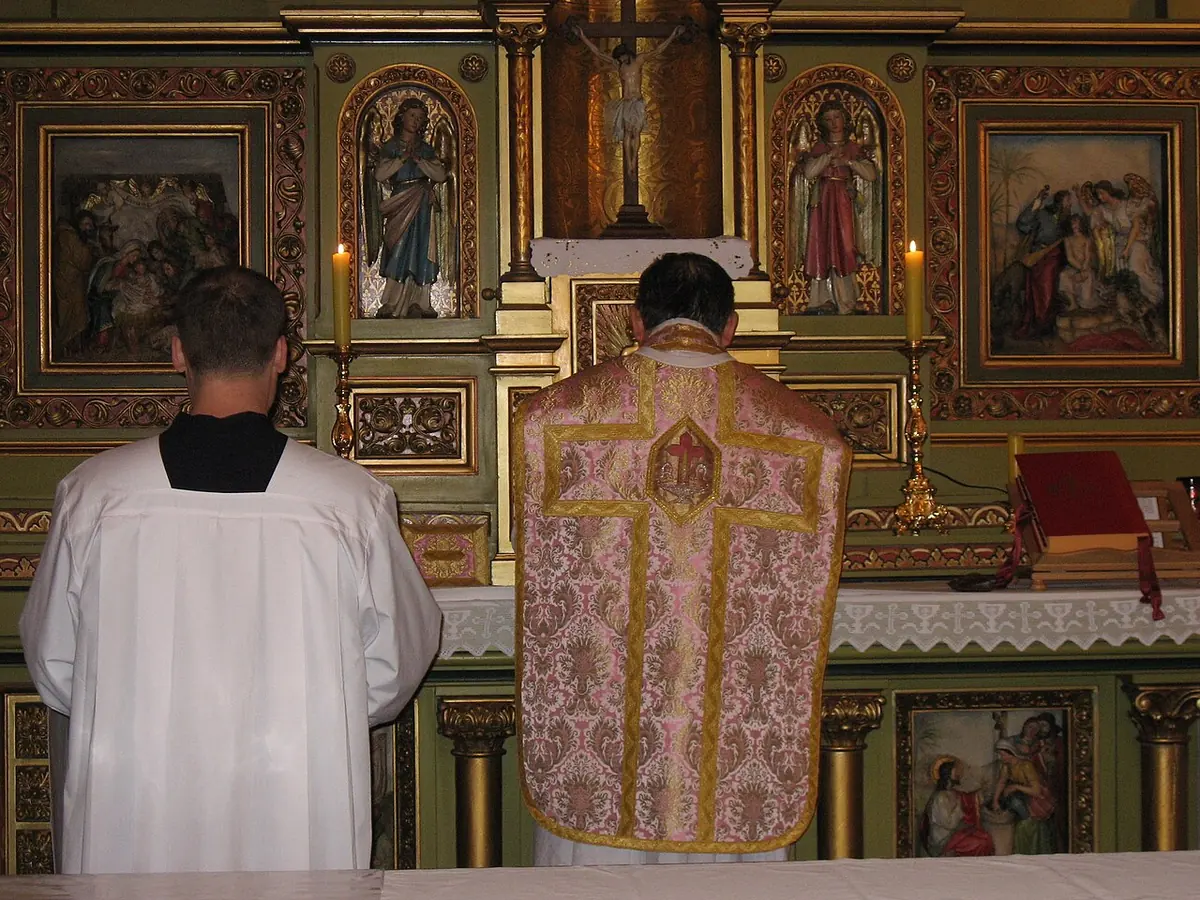
Two things follow from that sentence. First, rose is allowed, not required, so don't be surprised if your parish stays in violet. Many parishes don't own rose vestments, and in that case violet is perfectly correct. Second, the color is rose, not pink. A good rose chasuble is a muted, dusky color, the violet of Advent warmed and lightened, like the sky just before sunrise. That is a fitting image for the day: the night isn't over yet, but the dawn is showing.
The rose candle on the Advent wreath
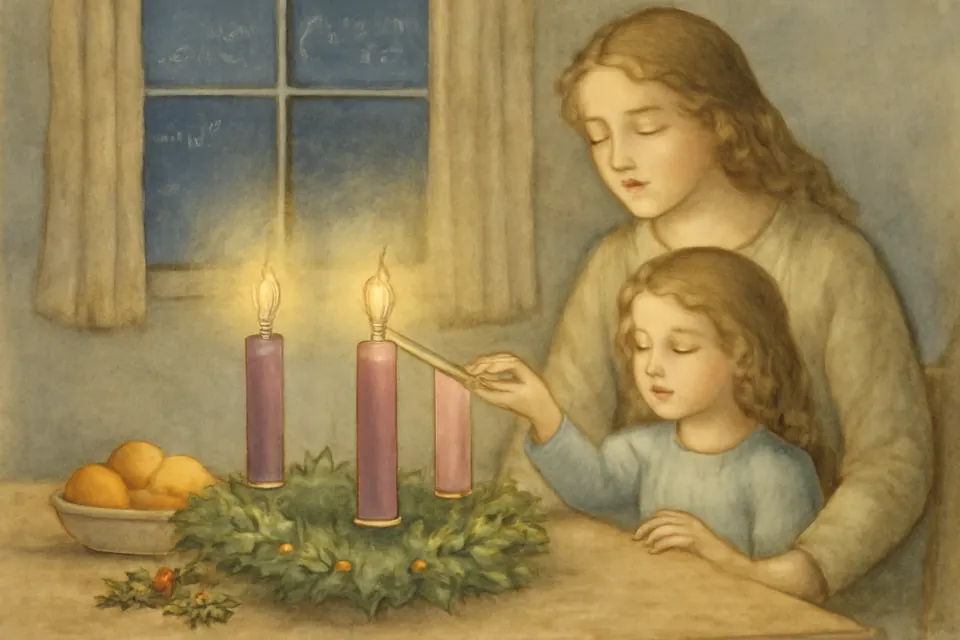
The family Advent wreath follows the vestments. Most wreaths have three violet candles and one rose, and the rose candle is lit for the first time on Gaudete Sunday. On December 13, 2026, we light the two violet candles of the first two Sundays and then the rose one. On the Fourth Sunday, December 20, the last violet candle joins them.
Many families call the rose candle the candle of joy, or the shepherds' candle, since the shepherds were the first to hear the "good tidings of great joy" (Luke 2:10, Douay-Rheims). These names are devotional customs rather than part of the liturgy, but this one has good reason behind it: of the four Advent candles, the rose candle is the only one whose meaning comes from the Church's own texts. For the blessing of the wreath and a prayer for each week, see Advent wreath prayers.

The readings for Gaudete Sunday 2026
The First Sunday of Advent 2026 opened Year B of the Sunday Lectionary, so the readings on December 13 are those of Year B. The US bishops' 2026 calendar lists them as Isaiah 61:1-2a, 10-11; 1 Thessalonians 5:16-24; and John 1:6-8, 19-28. Every one of them is about joy, and every one points to Christ.
First reading: Isaiah 61:1-2a, 10-11
"The spirit of the Lord is upon me, because the Lord hath anointed me: he hath sent me to preach to the meek, to heal the contrite of heart, and to preach a release to the captives, and deliverance to them that are shut up. To proclaim the acceptable year of the Lord" (Isaiah 61:1-2, Douay-Rheims).
This is the passage Jesus himself read aloud in the synagogue at Nazareth at the start of his ministry. He rolled up the scroll, sat down, and said, "This day is fulfilled this scripture in your ears" (Luke 4:21, Douay-Rheims). The second part of the reading is the joy of the one who is clothed by God "with the garments of salvation," like a bridegroom or a bride in her jewels.

Responsorial psalm: the Magnificat
On this Sunday in Year B the psalm isn't a psalm at all. It is Mary's song from St. Luke's Gospel, the Magnificat: "My soul doth magnify the Lord. And my spirit hath rejoiced in God my Saviour" (Luke 1:46-47, Douay-Rheims). Mary is the first to rejoice at the coming of Christ, and she rejoices from the inside, carrying him. She shows us what Advent joy looks like. The full text and its history are on our page on the Magnificat.

Second reading: 1 Thessalonians 5:16-24
St. Paul's earliest letter, by most reckonings, gives us the shortest rule of life in the New Testament: "Always rejoice. Pray without ceasing. In all things give thanks; for this is the will of God in Christ Jesus concerning you all" (1 Thessalonians 5:16-18, Douay-Rheims). It closes with a promise worth carrying into the last days of Advent: "He is faithful who hath called you, who also will do it."
Gospel: John 1:6-8, 19-28
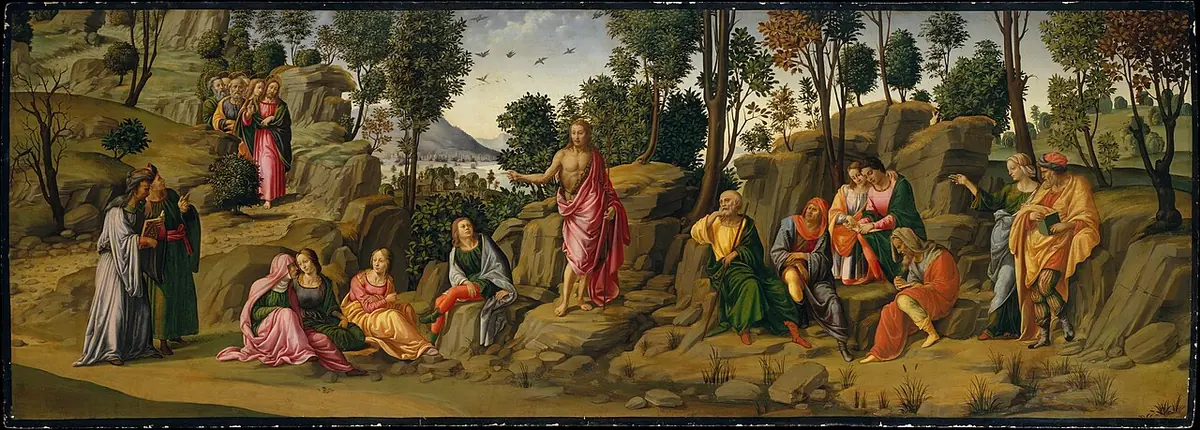
The Gospel returns to St. John the Baptist, as it does every year on the Second and Third Sundays of Advent. This year it comes from St. John's Gospel, where "there was a man sent from God, whose name was John. This man came for a witness, to give testimony of the light." Priests and Levites come out from Jerusalem to ask him who he is. He tells them he is not the Christ, not Elijah, not the prophet. He is only a voice: "I baptize with water; but there hath stood one in the midst of you, whom you know not" (John 1:26, Douay-Rheims).
That is the hinge of Gaudete Sunday. The Messiah is not far away in some distant future. He is already standing among us, and we may not have noticed him.
In the traditional Latin Mass
Where the 1962 Missal is used, the Mass of the Third Sunday of Advent has the same Introit, Gaudete in Domino semper. Its Epistle is Philippians 4:4-7, the passage the Introit quotes, and its Gospel is John 1:19-28, the questioning of John the Baptist. Rose vestments, the organ and flowers on the altar are all allowed on this day in that form of the Mass too.
Gaudete Sunday and St. Lucy, December 13, 2026
In 2026 Gaudete Sunday falls on December 13, the feast day of St. Lucy, the young martyr of Syracuse whose name means light. Because a Sunday of Advent outranks a memorial, her Mass is not celebrated this year. Still, it is a lovely coincidence. St. Lucy's Day has always been a feast of candles in the dark of December, and in Sweden and much of Scandinavia a girl in a white dress and a crown of candles leads the morning procession and carries breakfast to the family. Families that keep both customs can light the rose candle and the Lucy candles on the same evening.
The next morning, Monday, December 14, belongs to St. John of the Cross, the Carmelite poet of the dark night. Between them, the two saints tell the same truth as Gaudete Sunday: the light comes in the darkness.

What kind of joy is Gaudete joy?
St. Paul wrote "Rejoice in the Lord always" from a prison cell, not a party. The joy of Gaudete Sunday is not the forced cheer of a shopping season. It is the gladness of people who know three things: that God has kept his promises, that Christ is coming, and that he is already near.
That joy doesn't depend on how December is going. Many of us come to the Third Sunday of Advent tired, grieving, short of money or worried about someone we love. The Church still says Gaudete, because the reason for joy is not in us but in him. "The Lord is nigh." Isaiah's anointed one comes precisely "to heal the contrite of heart" and "to comfort all that mourn."
Mary is our model here, as she is in all of Advent. She rejoiced while she was still waiting, on the road to Bethlehem, with no room yet prepared. Let us ask her to teach us that kind of waiting.
How to keep Gaudete Sunday at home
- Light the rose candle at the evening meal, with the wreath prayer for the third week. Let the youngest child light it.
- Put out flowers. In the old custom, flowers returned to the altar on this one Sunday of Advent. A few winter flowers or rose-colored ones on the table make the day feel different.
- Sing. "Rejoice! Rejoice! Emmanuel shall come to thee, O Israel." Gaudete Sunday is the day to bring out the Advent hymns.
- Go to confession if you haven't yet. Many parishes hold an Advent penance service in the week after Gaudete Sunday, and there is no better preparation for Christmas joy.
- Give something away, since Isaiah's anointed one is sent "to preach to the meek." Gaudete Sunday is a good day to deliver a parish giving-tree gift or to visit someone who is alone.
- Pray with the day's Scripture. Read Philippians 4:4-7 slowly at the table and talk about what one worry each of you can hand over to God this week.
For families keeping a Jesse Tree, the ornament for this day in our list is Solomon and the Temple, the house of God that Christ, standing in our midst, now fulfills.
A prayer for Gaudete Sunday
The Church's own prayers for the Third Sunday of Advent are in the Roman Missal, and you'll hear them at Mass. Here is a short prayer for the family table as the rose candle is lit:
Lord Jesus, you are near. You stand in our midst, though we do not always see you. As we light this rose candle, fill our home with the joy of your coming: joy in our work and in our waiting, joy in our sorrows, joy that does not depend on what we have but on you. Give us hearts like Mary's, which rejoiced in God her Savior, and voices like John's, which pointed others to you. Come, Lord Jesus. Amen.
Pastor Lyvers wrote this prayer for this page.
Is the "Gaudete" carol for Gaudete Sunday?
The lively carol that begins "Gaudete, gaudete! Christus est natus" is a different thing. It is a Christmas song, not an Advent one: its refrain announces that Christ is born of the Virgin Mary. It was printed in Piae Cantiones, a collection of Latin songs for the schools and churches of Finland and Sweden published in 1582, and became widely known again in the twentieth century. It shares only its first word with the Introit of the Third Sunday of Advent. Save it for Christmas.
Gaudete Sunday in 2027 and beyond
- Gaudete Sunday 2027: Sunday, December 12, 2027. It falls on the feast of Our Lady of Guadalupe, and since a Sunday of Advent outranks a feast, the Sunday Mass is of the Third Sunday of Advent in the United States. See Advent 2027.
- Gaudete Sunday 2028: Sunday, December 17, 2028, the day the O Antiphons begin.
- Laetare Sunday 2027, the other rose Sunday: March 7, 2027. See Laetare Sunday 2027.
The rule is simple: Gaudete Sunday is always the third of the four Sundays of Advent, two weeks before the last Sunday before Christmas. It can fall as early as December 11 and as late as December 17.
For the rest of the season, see Advent 2026, the O Antiphons, Simbang Gabi, Las Posadas and Christmas 2026. Rejoice in the Lord always; again, I say, rejoice.
Frequently asked questions
When is Gaudete Sunday 2026?
Gaudete Sunday 2026 is Sunday, December 13, 2026, the Third Sunday of Advent. The Saturday vigil Masses on the evening of December 12 already use its readings. In 2026 it falls on the feast day of St. Lucy.
What does Gaudete mean?
Gaudete is Latin for "Rejoice." It is the first word of the entrance antiphon of the Mass for the Third Sunday of Advent, taken from St. Paul's letter to the Philippians, 4:4-5. The Douay-Rheims translation reads, "Rejoice in the Lord always; again, I say, rejoice. Let your modesty be known to all men. The Lord is nigh."
Why is the third Advent candle pink?
The third candle is rose because Gaudete Sunday is the Sunday of joy, when the Church allows rose vestments in place of violet. The rose candle on the wreath matches them. The color is the violet of penance lightened by the joy of Christ's coming, now close at hand.
Which candle do you light on Gaudete Sunday?
On Gaudete Sunday we light the two violet candles from the first two Sundays and then the rose candle for the first time. On the Fourth Sunday of Advent, December 20, 2026, the last violet candle is lit too.
Do priests wear pink on Gaudete Sunday?
The proper name of the color is rose. The General Instruction of the Roman Missal (no. 346) says rose may be used, where it is the practice, on Gaudete Sunday and on Laetare Sunday in Lent. It is allowed, not required, so many parishes keep violet. These are the only two days of the year for rose vestments.
What are the readings for Gaudete Sunday 2026?
In 2026 the Church reads Year B. The first reading is Isaiah 61:1-2a, 10-11; the responsorial psalm is the Magnificat from Luke 1; the second reading is 1 Thessalonians 5:16-24; and the Gospel is John 1:6-8, 19-28, John the Baptist's witness to Christ.
Is Gaudete Sunday a holy day of obligation?
Every Sunday is a day of obligation, so we go to Mass on Gaudete Sunday as on any Sunday. It isn't an extra holy day. The holy day of obligation in Advent 2026 is the Immaculate Conception on Tuesday, December 8.
When is Gaudete Sunday 2027?
Gaudete Sunday 2027 is Sunday, December 12, 2027, the same day as the feast of Our Lady of Guadalupe. Gaudete Sunday 2028 is December 17.
Sources
- USCCB: Liturgical Calendar for the Dioceses of the United States of America, 2026 (PDF). December 13, 2026, Third Sunday of Advent, violet or rose; readings Is 61:1-2a, 10-11 / 1 Thes 5:16-24 / Jn 1:6-8, 19-28 (Lectionary 8)
- Catholic Encyclopedia (1909): Gaudete Sunday
- General Instruction of the Roman Missal, no. 346 (vestment colors), via vatican.va
- Douay-Rheims Bible, Philippians 4 (the Gaudete text)
- Douay-Rheims Bible, Isaias 61
- Douay-Rheims Bible, 1 Thessalonians 5
- Douay-Rheims Bible, John 1