Jesse Tree
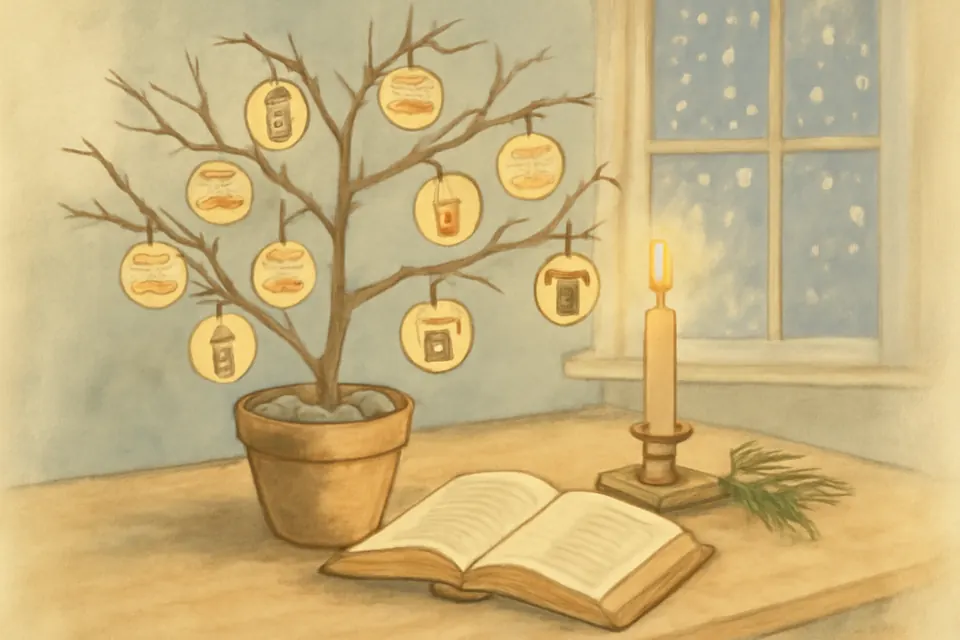
The Jesse Tree is an Advent custom in which a family hangs one ornament a day on a branch or small tree, each with a symbol and a Scripture reading that tells the story of salvation from Creation to the birth of Jesus. It is named for Isaiah 11:1, the prophecy of a shoot from the root of Jesse, King David's father.
The Jesse Tree is an Advent custom that tells the whole story of salvation, one ornament at a time, from the first day of Creation to the night Christ was born. Each evening of Advent the family reads a short Scripture passage and hangs a small ornament with its symbol: an ark, a ladder, a burning bush, a harp, a lily. By Christmas Eve the bare branch is full, and the children have walked through the family tree of Jesus with their own hands.
Below you'll find what the Jesse Tree means, where the image comes from, how to make one at home, and a complete day-by-day list of readings and ornament symbols for Advent 2026, from Sunday, November 29, to Christmas Eve.
What is a Jesse Tree?
A Jesse Tree is a branch, a small tree or a drawing of a tree on which a family hangs one ornament a day through Advent. Each ornament stands for a person or event in the Old Testament that prepared the way for Christ, and the last ones bring us to the New Testament: Zechariah and Elizabeth, St. Joseph, the Blessed Virgin Mary, St. John the Baptist and the Christ Child.
The tree does two things at once. It is a family tree, tracing the human ancestry of Jesus through Abraham, Judah, Ruth, Jesse and David. And it is a map of the promises God made and kept across thousands of years. When we hang Noah's rainbow or Abraham's stars, we're remembering a covenant. When we hang the lily on the Fourth Sunday of Advent, we see all those promises arrive in Nazareth.
The meaning of the Jesse Tree
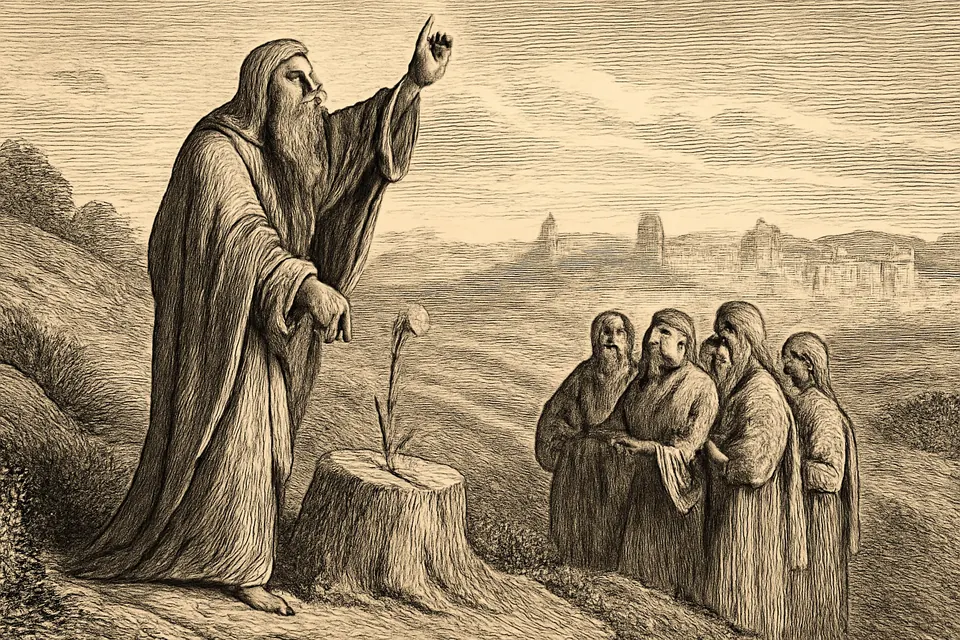
The name comes from the prophet Isaiah, who wrote at a dark time for the kingdom of Judah. Isaiah 11:1 reads, in the Douay-Rheims: "And there shall come forth a rod out of the root of Jesse, and a flower shall rise up out of his root."
Jesse was a farmer and shepherd of Bethlehem, the grandson of Ruth and Boaz and the father of King David. By Isaiah's day David's royal house had become weak and faithless, and later it was cut down altogether when Babylon carried the kings into exile. It looked like a stump. Isaiah saw past that. From the old root God would raise up a new shoot, a king on whom "the spirit of the Lord shall rest," and under whom "the wolf shall dwell with the lamb."
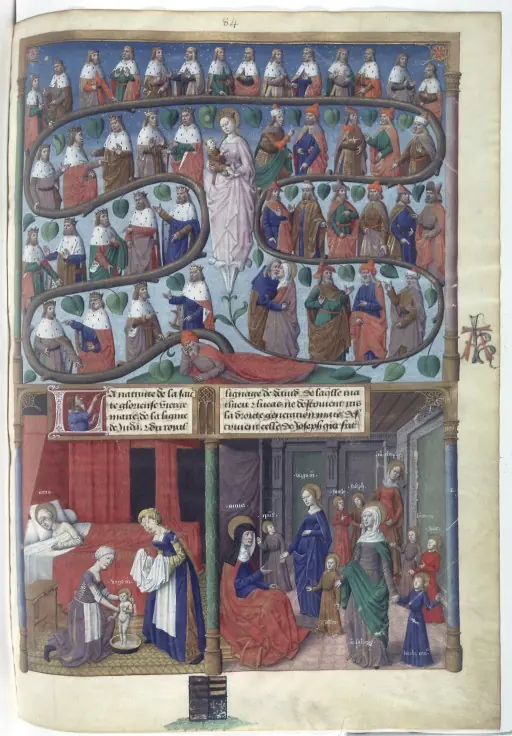
The Church has always read this as a prophecy of Christ. St. Matthew's Gospel opens with "The book of the generation of Jesus Christ, the son of David, the son of Abraham," and its list names him plainly: "And Obed begot Jesse. And Jesse begot David the king" (Matthew 1:5-6, Douay-Rheims). Many medieval writers also saw the Blessed Virgin in the "rod" (virga in Latin, close to virgo, virgin) and Christ in the flower that blooms from it. That is why so many Jesse Trees in old manuscripts and windows place Mary near the top, holding her Son.
We still sing this prophecy every Advent. On December 19 the Church's evening prayer uses the antiphon O Radix Jesse, "O Root of Jesse," and the hymn "O Come, O Come, Emmanuel" has a verse for the "Rod of Jesse." See the O Antiphons for the full texts.
The Tree of Jesse in Christian art
Long before anyone hung paper ornaments on a branch, the Tree of Jesse was one of the great subjects of Christian art. The usual pattern is easy to recognize: Jesse lies asleep at the bottom, a vine or tree grows out of his side, and in its branches sit his royal descendants, rising one above another to the Virgin Mary and Christ at the top. Prophets often stand at the sides holding scrolls, and sometimes the seven doves of the Holy Spirit, the "spirit of wisdom, and of understanding" from Isaiah 11:2, circle Christ's head.
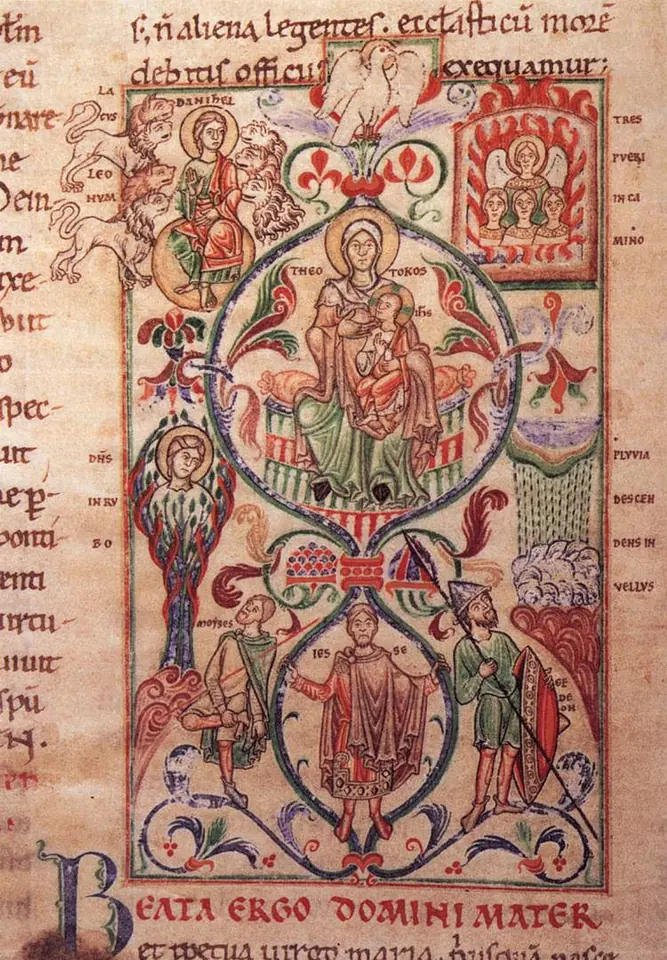
The Victoria and Albert Museum in London dates the earliest known Jesse Trees to the eleventh century, in manuscripts. One of the loveliest early examples was painted at the Cistercian abbey of Cîteaux, in Burgundy, about 1130. In it Jesse stands at the bottom and the stem grows up into a great circle with the Virgin and Child, with the dove of the Holy Spirit above. Around them the painter set Old Testament signs of the virgin birth: Moses before the burning bush that was not consumed, Gideon with his fleece wet with dew, Daniel unharmed among the lions and the three young men unharmed in the furnace.
Saint-Denis and Chartres
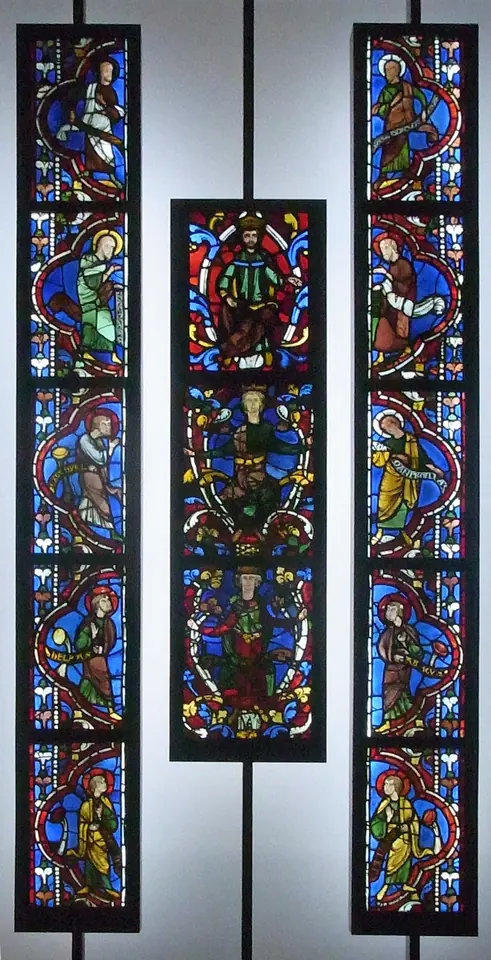
The Tree of Jesse moved into stained glass in the 1140s, in the abbey church of Saint-Denis outside Paris, where Abbot Suger rebuilt the choir in the new Gothic style. The window in its Lady Chapel is one of the oldest Jesse windows we have, though much of it is not original: the V&A notes it was restored in 1848 and holds both twelfth- and nineteenth-century glass. Some original panels were removed in 1799 and are now in museums; the Musée des Beaux-Arts in Lyon has a crowned king from it, dated about 1145.
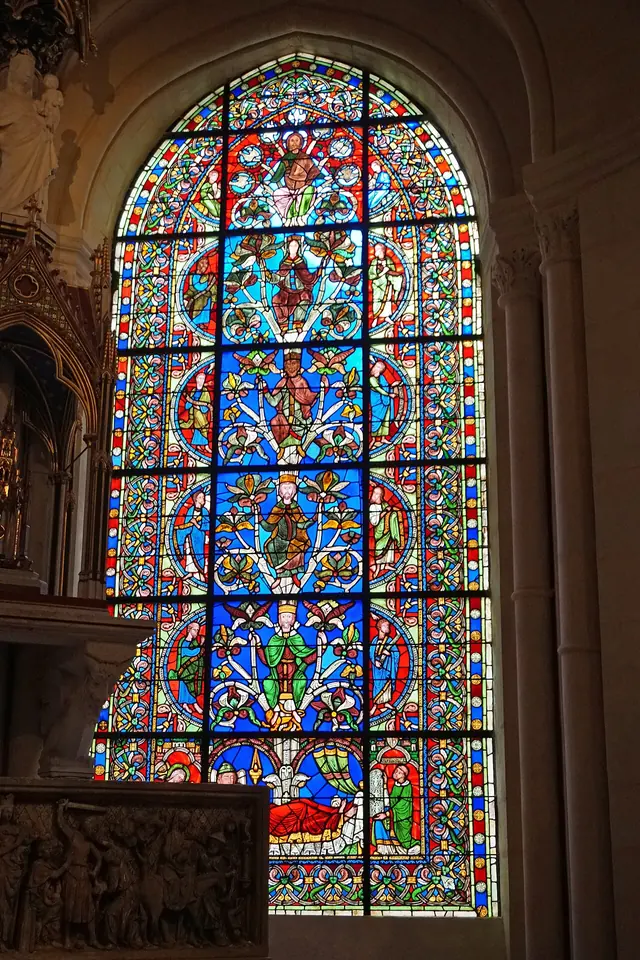
A few years later the same design appeared in the west front of Chartres Cathedral, in one of the three great lancet windows that survived the fire of 1194. It is about 1150. Pilgrims still stand under it and trace the line from Jesse at the bottom, through the crowned kings, to the Virgin and then Christ at the top, ringed by doves for the gifts of the Holy Spirit. Prophets in half-circles line both sides.
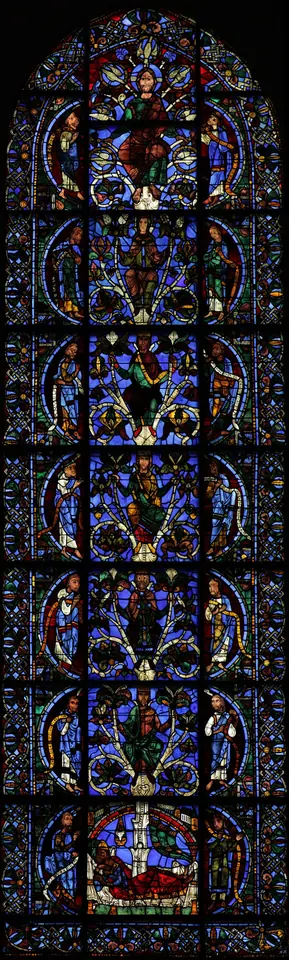
From Saint-Denis and Chartres the subject spread across Europe: windows in hundreds of churches in France, England and Germany, carved stone doorways, embroidered vestments, and pages in books of hours. The Eastern churches painted it too. In an Armenian Gospel book of 1455, now in the Walters Art Museum in Baltimore, the tree is a straight trunk that branches into neat diamond frames, each holding an ancestor of Christ.
How to make a Jesse Tree
You don't need anything expensive. The best Jesse Trees are homemade, and the making is part of the prayer.
Choose your tree
- A bare branch. Take a branch with several twigs from the yard, about two or three feet tall, and stand it in a pot or vase filled with sand, gravel or stones. A bare branch suits the season: it looks like the stump Isaiah saw, and it fills up as Christmas comes near.
- A small tabletop tree. A plain artificial tree, without lights or tinsel, works well, especially in apartments.
- A felt or paper tree on the wall. Cut a tree from green felt and pin it to a wall or door, or draw one on poster board. Ornaments attach with tape, Velcro or pins. This is the easiest choice with toddlers.
Make the ornaments
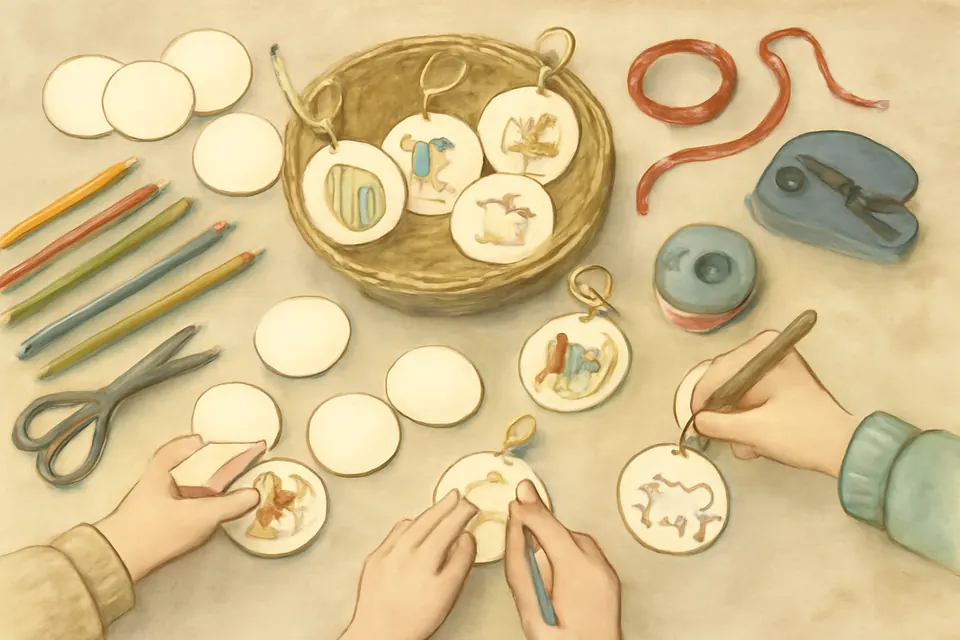
Each ornament is a simple picture of one symbol. Cut circles about three inches across from card stock, felt or thin wood, and draw or paint the symbol on the front. Write the Bible reference on the back so the ornament teaches even when it's packed away. Punch a hole and thread a ribbon loop.
Older children can draw the symbols themselves. Younger ones can color outlines a parent draws. Some families make salt-dough ornaments, others embroider felt, others buy a wooden set and paint it together. If the family is large, give each child certain days, so that each one has an ornament to hang and a story to know.
Keep it each evening
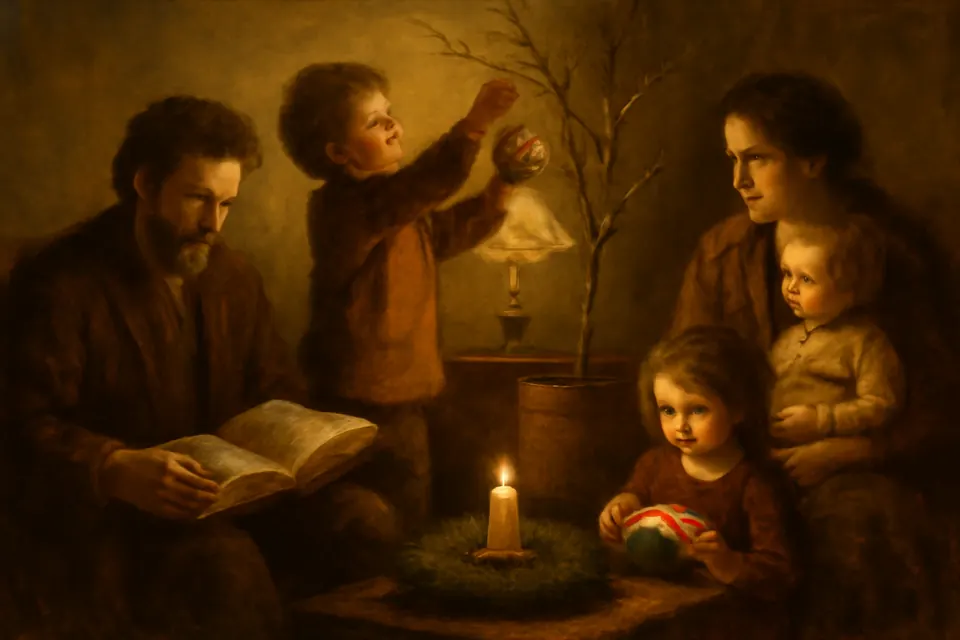
The custom works best as a short, fixed routine, the same every night:
- Gather at the table after dinner or before bed. Light the Advent wreath if you have one.
- Read the day's passage from the Bible. For small children, tell the story in your own words, or read only a few verses.
- Let the child whose turn it is hang the ornament and say what it shows.
- Ask one question: "What did God promise?" or "How does this point to Jesus?"
- Pray together, and if you like, sing a verse of "O Come, O Come, Emmanuel."
Ten minutes is plenty. Missed a night? Read two stories the next evening. The point is to walk toward Christmas with the Scriptures, not to keep a perfect record.
Jesse Tree readings and ornaments for Advent 2026
There is no single official list of Jesse Tree readings, and sets you buy will differ a little. The list below is our own, made for the 26 days of Advent 2026, from the First Sunday of Advent on November 29 to Christmas Eve. It follows the family tree of Jesus through the Old Testament, then from December 17 matches the Gospels the Church reads at Mass on each of the last days of Advent, so the family's reading at home and the parish's Gospel at Mass tell the same story.
If your set starts on December 1, begin on that line and add the first three stories on a weekend.
Week 1: the beginning and the promise
- Sunday, November 29: Creation. Genesis 1:1-2:3. Ornament: the sun and moon over the earth. God made all things good, and he made us for himself.
- Monday, November 30: Adam and Eve. Genesis 3:1-15. Ornament: an apple with a serpent. After the fall, God already promises a Redeemer: "I will put enmities between thee and the woman, and thy seed and her seed: she shall crush thy head" (Genesis 3:15, Douay-Rheims). The Church has always heard Mary and her Son in that verse, and it is read again at Mass on December 8, the Immaculate Conception.
- Tuesday, December 1: Noah. Genesis 6:11-22; 8:6-12; 9:8-17. Ornament: the ark, a dove with an olive branch, or a rainbow. God saves a remnant and makes a covenant with all creation. (At Mass today the first reading is Isaiah 11:1-10, the Jesse prophecy itself.)
- Wednesday, December 2: Abraham. Genesis 12:1-3; 15:1-6. Ornament: a night sky full of stars, or a tent. God promises that Abraham's descendants will be as many as the stars, and that in him all nations will be blessed.
- Thursday, December 3: Isaac. Genesis 22:1-18. Ornament: a ram caught in a thicket, or a bundle of firewood. The beloved son carries the wood up the mountain, and God provides the sacrifice.
- Friday, December 4: Jacob. Genesis 28:10-17. Ornament: a ladder. Jacob dreams of a ladder joining heaven and earth; Jesus later tells Nathanael that the angels will ascend and descend upon the Son of Man (John 1:51).
- Saturday, December 5: Joseph, son of Jacob. Genesis 37:3-4, 23-28; 45:3-8. Ornament: a coat of many colors. Sold by his brothers, Joseph saves them in the famine: "God sent me before you" (Genesis 45:5).
Week 2: the people of God
- Sunday, December 6: Moses. Exodus 3:1-12. Ornament: the burning bush. God reveals his name and calls Moses to lead his people out of slavery. (Also St. Nicholas Day; see St. Nicholas Day.)
- Monday, December 7: The Passover. Exodus 12:1-14. Ornament: a lamb. The blood of the lamb saves Israel on the night of the Exodus, a sign of Christ, "the Lamb of God."
- Tuesday, December 8: The Law. Exodus 20:1-17. Ornament: two stone tablets. God gives his people the Ten Commandments at Sinai. Today is also the Solemnity of the Immaculate Conception, a holy day of obligation.
- Wednesday, December 9: Joshua and Rahab. Joshua 2:1-21; 6:22-25. Ornament: a scarlet cord. Rahab of Jericho hides Israel's spies and is saved by the cord in her window, and St. Matthew names her among the ancestors of Christ (Matthew 1:5).
- Thursday, December 10: Ruth. Ruth 1:16-17; 2:1-12; 4:13-17. Ornament: a sheaf of grain. The foreign widow who says "thy people shall be my people" becomes the great-grandmother of King David.
- Friday, December 11: Jesse. Isaiah 11:1-10; 1 Samuel 16:1. Ornament: a stump with a green shoot. This is the ornament that gives the tree its name.
- Saturday, December 12: David. 1 Samuel 16:1-13; 2 Samuel 7:8-16. Ornament: a harp, a shepherd's crook or a crown. The shepherd boy from Bethlehem is anointed king, and God promises that his throne will last forever. Today is also the feast of Our Lady of Guadalupe.
Week 3: kings and prophets
- Sunday, December 13 (Gaudete Sunday): Solomon. 1 Kings 3:5-14; 8:10-13. Ornament: the Temple. David's son asks God for wisdom and builds the house of the Lord. See Gaudete Sunday 2026.
- Monday, December 14: Elijah. 1 Kings 18:20-39. Ornament: an altar with flames. The prophet calls down fire on Mount Carmel, and Malachi promises Elijah will come again before the day of the Lord, a promise Jesus applies to St. John the Baptist.
- Tuesday, December 15: Isaiah. Isaiah 6:1-8; 7:14; 9:2, 6-7. Ornament: tongs holding a burning coal. A seraph touches the prophet's lips with "a live coal, which he had taken with the tongs off the altar" (Isaiah 6:6, Douay-Rheims), and Isaiah foretells the virgin who will conceive and the child called Wonderful, Counsellor, God the Mighty.
- Wednesday, December 16: Micah. Micah 5:2-4. Ornament: a small walled town on a hill. "And thou, Bethlehem Ephrata, art a little one among the thousands of Juda: out of thee shall he come forth unto me that is to be the ruler in Israel" (Micah 5:2, Douay-Rheims). Simbang Gabi and Las Posadas begin tonight.

The last days: December 17 to 24
From December 17 the Church's Advent readings turn straight to the coming of Christ. These ornaments follow the weekday Gospels at Mass in 2026.
- Thursday, December 17: The family tree of Jesus. Matthew 1:1-17, the Gospel at Mass today. Ornament: a scroll, or a small tree with its roots showing. Read the names aloud and listen for the ones you've already hung. The first O Antiphon, O Sapientia, is sung tonight.
- Friday, December 18: St. Joseph. Matthew 1:18-25, today's Gospel. Ornament: a carpenter's square and hammer. The angel tells St. Joseph in a dream to take Mary as his wife. Today's first reading, Jeremiah 23:5-8, promises a just branch raised up for David.
- Saturday, December 19: Zechariah and Elizabeth. Luke 1:5-25, today's Gospel. Ornament: a censer with smoke rising. The angel Gabriel appears to St. Zechariah as he offers incense in the Temple. Tonight's antiphon is O Radix Jesse, O Root of Jesse.
- Sunday, December 20 (Fourth Sunday of Advent): Mary. Luke 1:26-38, the Sunday Gospel. Ornament: a white lily. The Annunciation: "Behold the handmaid of the Lord; be it done to me according to thy word." See the Blessed Virgin Mary.
- Monday, December 21: The Visitation. Luke 1:39-45, today's Gospel. Ornament: a little house on a hill. Mary "went into the hill country with haste" to St. Elizabeth, and the child in Elizabeth's womb leaped for joy.
- Tuesday, December 22: The Magnificat. Luke 1:46-56, today's Gospel. Ornament: a bowl full of bread. Mary sings that God "hath filled the hungry with good things; and the rich he hath sent empty away." See the Magnificat.
- Wednesday, December 23: John the Baptist. Luke 1:57-66, today's Gospel. Ornament: a writing tablet, or a scallop shell. Mute since the angel's visit, Zechariah "demanding a writing table, he wrote, saying: John is his name," and his tongue was loosed.
- Thursday, December 24: Jesus Christ. Luke 1:67-79 in the morning; Luke 2:1-14 at night. Ornament: a manger with the Christ Child, or the Chi-Rho, the first two Greek letters of "Christ." Zechariah's song greets "the Orient from on high," the rising sun, and that night he is born in Bethlehem. Hang this ornament last, after Mass or before bed on Christmas Eve.
Other figures that many sets include, if you want to swap or add: Jonah (a great fish), Daniel (a lion), Jeremiah (a potter's jar or a heart), Esther (a crown), Samuel (a lamp), Hezekiah, and the angel Gabriel.
A prayer for the Jesse Tree
There is no traditional prayer that belongs to the Jesse Tree. Many families pray the Our Father or the day's O Antiphon after hanging the ornament. Here is a short prayer you can use every night:
Lord God, faithful Father, you kept every promise you made to our fathers in faith, from Adam to Abraham, from Jesse to David, from the prophets to the Virgin Mary. As we hang this sign of your love tonight, open our hearts to your word, and make us ready to welcome your Son, the shoot from the root of Jesse, when he comes. Mary, Mother of Jesus, pray for us. St. Joseph, son of David, pray for us. Amen.
Pastor Lyvers wrote this prayer for this page.
Tips for different ages
- Toddlers and preschoolers: keep it to two or three sentences and one picture. Let them hang the ornament and say its name. They'll remember the lamb and the ladder long before the references.
- Grade-school children: read the passage straight from a children's Bible or a few verses from the full text. Ask them to find the ornament's symbol in the story.
- Teens and adults: read the full passages, then look up the matching line in Matthew's genealogy or the New Testament passage that fulfills it. The Catechism and the Church Fathers love to show how the Old Testament points to Christ, and the Jesse Tree is a good way into that habit.
- Parishes and schools: a large Jesse Tree in the classroom or church hall, with a different family or student bringing the ornament each day, works well. Some parishes put one in the narthex for the whole season.
The Jesse Tree and the other customs of Advent
The Jesse Tree sits well beside the other Advent customs. The wreath marks the Sundays; the Jesse Tree marks the days. The St. Andrew Christmas novena begins on November 30 and fits in the same ten minutes at the table. And from December 17 the O Antiphons and the Jesse Tree tell the same story: Wisdom, the Lord who gave the Law to Moses, the Root of Jesse, the Key of David, the Rising Dawn, the King of the Nations, Emmanuel.
Above all, the Jesse Tree keeps Advent from turning into an early Christmas. The branch begins bare and fills slowly, the way Israel waited for the Messiah across the centuries. When the Christ Child goes up on Christmas Eve, the waiting is over. For the dates of the season, see Advent 2026 and Christmas 2026.
Frequently asked questions
What is a Jesse Tree?
A Jesse Tree is a branch, small tree or wall banner that a family decorates through Advent with one ornament a day. Each ornament is a simple picture of a person or event in the Bible, from Creation to the birth of Christ, and the family reads the matching Scripture passage as it goes up. It is a family tree of Jesus and a short course in salvation history at the same time.
What is the meaning of the Jesse Tree?
The name comes from Isaiah 11:1, "And there shall come forth a rod out of the root of Jesse, and a flower shall rise up out of his root" (Douay-Rheims). Jesse was the father of King David. The line of David seemed cut down like a stump, but God kept his promise, and from that root came Christ. The tree shows that Jesus is the fulfillment of everything God promised his people.
When do you start a Jesse Tree?
Most families begin on the First Sunday of Advent, which in 2026 is November 29, and hang the last ornament on Christmas Eve. That gives 26 ornaments in 2026. Some printed sets start on December 1 and have 24 or 25 ornaments; if you use one of those, simply begin on December 1 or double up on a couple of evenings.
What are the symbols on Jesse Tree ornaments?
There is no single official list, but most sets include the same core symbols. A globe or sun and moon for Creation, an apple and serpent for Adam and Eve, an ark or rainbow for Noah, stars for Abraham, a ladder for Jacob, a colorful coat for Joseph, a burning bush for Moses, a lamb for the Passover, stone tablets for the Law, a sheaf of grain for Ruth, a stump with a shoot for Jesse, a harp or crown for David, a lily for Mary, a carpenter's square for St. Joseph and a manger or Chi-Rho for Jesus.
Is the Jesse Tree a Catholic tradition?
The image of the Tree of Jesse is Catholic through and through. It fills medieval manuscripts and the stained-glass windows of Chartres and Saint-Denis, and the Church reads Isaiah 11:1-10 at Mass on the first Tuesday of Advent. The home custom of hanging ornaments day by day is a modern family devotion built on that old image, and Catholic and other Christian families both keep it.
What is the difference between a Jesse Tree and an Advent wreath?
The Advent wreath marks the four Sundays of Advent with candles, three violet and one rose. The Jesse Tree marks every day of the season with a Bible story. Many families use both at the evening meal. They light the wreath, read the day's passage, hang the ornament and pray.
Where do you put a Jesse Tree?
Anywhere the family gathers in the evening. A bare branch set in a pot of sand or stones on the dining table is the simplest. A small tabletop tree, a felt tree on the wall or a tree drawn on poster board all work too. Some families give the Jesse Tree its own spot and save the Christmas tree for Christmas Eve.
What happens to the Jesse Tree at Christmas?
The last ornament, the Christ Child, goes up on Christmas Eve. Many families leave the finished tree up through the Christmas season, until the Baptism of the Lord on January 10, 2027, and pack the ornaments away carefully to use again next Advent.
Sources
- Douay-Rheims Bible, Isaias 11 (the rod out of the root of Jesse)
- Douay-Rheims Bible, Matthew 1 (the genealogy of Jesus Christ)
- USCCB: Liturgical Calendar for the Dioceses of the United States of America, 2026 (PDF). Mass readings for Advent 2026, including Isaiah 11:1-10 on December 1 and Matthew 1:1-17 on December 17
- Victoria and Albert Museum: King from a Tree of Jesse. Early Jesse Trees from the eleventh century; the Saint-Denis Lady Chapel window restored in 1848 and holding both twelfth- and nineteenth-century glass
- Musée des Beaux-Arts de Lyon: Stained glass window, King from the Tree of Jesse. A panel from the Saint-Denis Jesse window, about 1145, removed in 1799
- Douay-Rheims Bible, Micheas 5 (Bethlehem Ephrata)