The Jesus Prayer
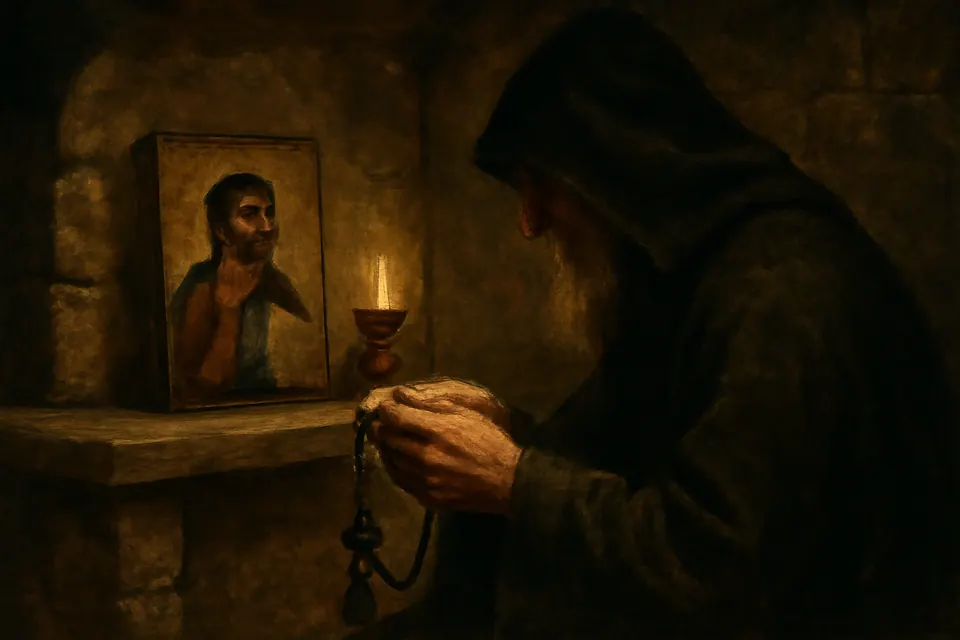
The Jesus Prayer is the short prayer "Lord Jesus Christ, Son of God, have mercy on me, a sinner," repeated slowly and often, many times a day. It joins the cry of the blind man and the publican in the Gospels with the holy name of Jesus. Taught by the Desert Fathers and Eastern monks, it is praised by the Catechism of the Catholic Church (2616, 2667–2668).
 Free printable prayer card 5 × 7 inch PDF, ready to print, frame or tuck in a missal.
The Jesus Prayer
Lord Jesus Christ, Son of God, have mercy on me, a sinner.
That single line is the whole prayer. It is said slowly, quietly, again and again: in the morning before the day begins, on the bus, at the kitchen sink, in a hospital waiting room, at night when sleep won't come. The Catechism of the Catholic Church gives it in the plural, as the Church prays it together:
Lord Jesus Christ, Son of God, have mercy on us sinners.
Shorter forms are just as old and just as good. Many people begin with "Lord Jesus Christ, have mercy on me," and the shortest of all is "Lord Jesus, have mercy." What matters is the holy name of Jesus, said with faith, and the cry for mercy.
In Latin, Greek and Slavonic
The prayer was born in Greek and came to the Slavic peoples in Church Slavonic. These are the traditional forms:
- Latin: Domine Iesu Christe, Fili Dei, miserere mei peccatoris.
- Greek: Κύριε Ἰησοῦ Χριστέ, Υἱὲ τοῦ Θεοῦ, ἐλέησόν με τὸν ἁμαρτωλόν (Kyrie Iesou Christe, Yie tou Theou, eleison me ton hamartolon).
- Church Slavonic: Gospodi Iisuse Khriste, Syne Bozhiy, pomiluy mya greshnago.
The Greek eleison, "have mercy," is the same word we sing at Mass in the Kyrie eleison.

Where the Jesus Prayer comes from
Two cries from the Gospel of Luke
Every word of the Jesus Prayer is in the Gospels. The Catechism says it "combines the Christological hymn of Philippians 2:6-11 with the cry of the publican and the blind men begging for light" (2667).
The first cry is the publican's, the tax collector Jesus describes in a parable. A proud Pharisee thanked God that he was "not as the rest of men." Then (in the Douay-Rheims translation):
And the publican, standing afar off, would not so much as lift up his eyes towards heaven; but struck his breast, saying: O God, be merciful to me a sinner. (Luke 18:13)
Jesus said that this man, not the Pharisee, "went down into his house justified" (Luke 18:14). The Jesus Prayer borrows his humility and his very words: a sinner.
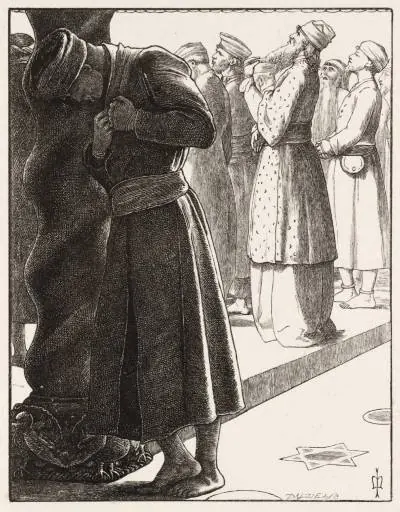
The second cry is the blind man's at Jericho. As Jesus passed by, the man by the road shouted, "Jesus, son of David, have mercy on me" (Luke 18:38). When the crowd told him to be quiet, "he cried a great deal the more" (Mark 10:48). St. Mark gives his name, Bartimaeus. Jesus stopped, called him and opened his eyes.
The Catechism draws the line straight from that roadside to our prayer: the urgent request of the blind men "has been renewed in the traditional prayer to Jesus known as the Jesus Prayer" (2616). When we pray it, we stand where Bartimaeus stood, asking the Lord who is passing by to stop for us.
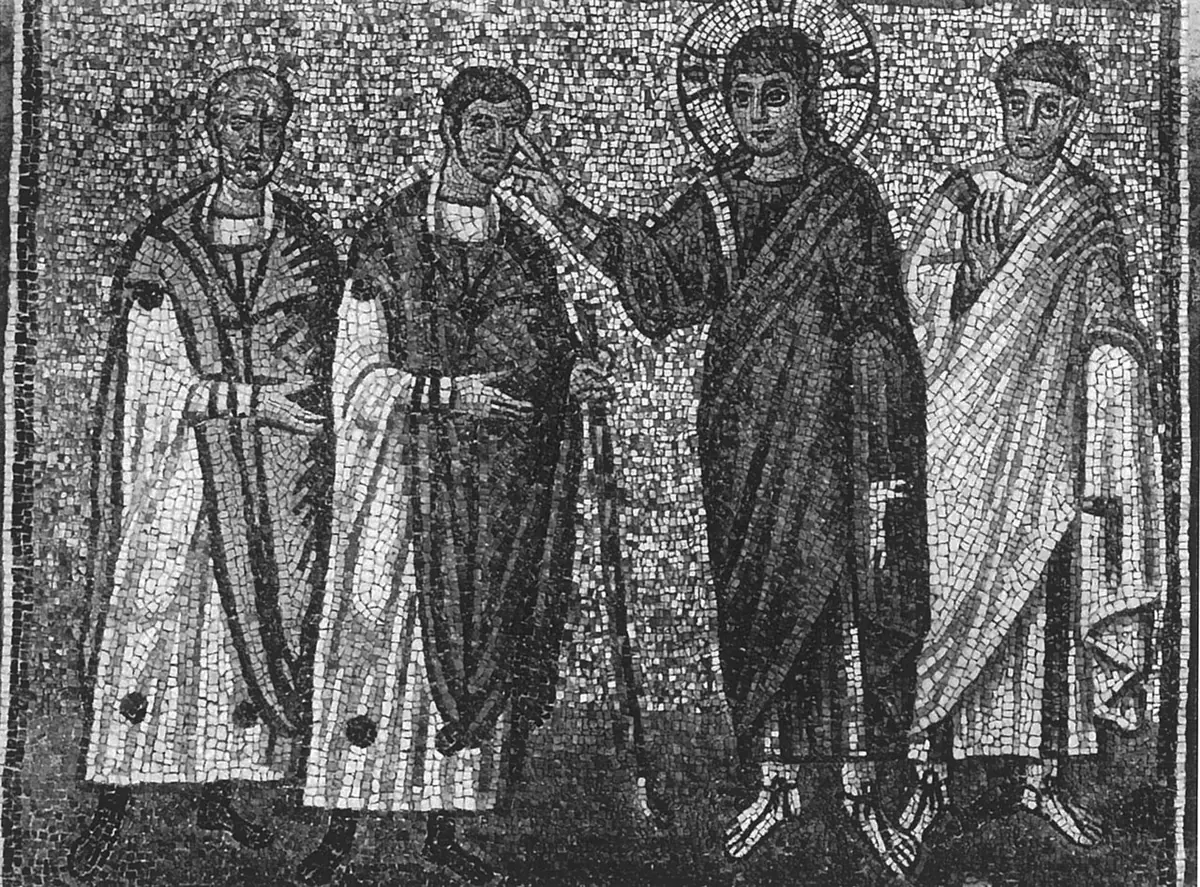
The name above every name
The prayer begins with titles St. Paul uses in the great hymn of Philippians: God gave Jesus the name above every name, "that in the name of Jesus every knee should bow... and that every tongue should confess that the Lord Jesus Christ is in the glory of God the Father" (Philippians 2:10–11, Douay-Rheims). To say "Lord Jesus Christ" is already to make that confession.
The Catechism explains why the name itself carries so much. "Jesus" means "YHWH saves," and "the name 'Jesus' contains all: God and man and the whole economy of creation and salvation. To pray 'Jesus' is to invoke him and to call him within us. His name is the only one that contains the presence it signifies" (2666).
"Pray without ceasing"
The last root is a command. St. Paul wrote to the Thessalonians, "Pray without ceasing" (1 Thessalonians 5:17), and Jesus told a parable "that we ought always to pray, and not to faint" (Luke 18:1). Christians have always asked how anyone can do that while working, eating and sleeping. The Jesus Prayer is the East's long answer: a prayer so short that it can go with us everywhere.
The Desert Fathers and the prayer of the heart
In the 4th century, thousands of men and women went out into the deserts of Egypt, Palestine and Syria to give their whole lives to God. The Desert Fathers and Mothers, from St. Anthony the Great on, worked with their hands, weaving baskets and ropes, and tried to keep a short prayer on their lips the whole time. Different monks used different words. Many repeated a verse of the Psalms.
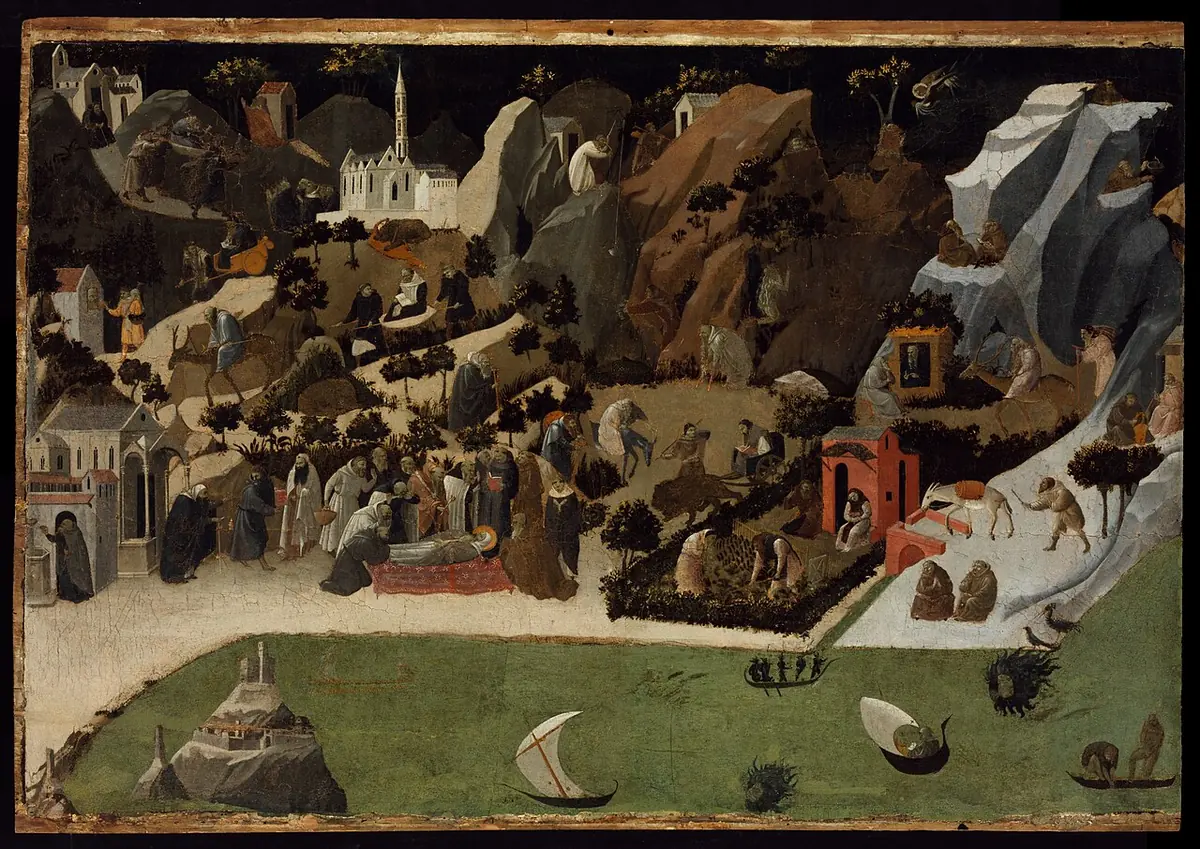
John Cassian, who visited the monks of Egypt around the year 400 and brought their teaching to the West, records the formula Abba Isaac gave him, a verse from Psalm 69 (70): "O God, make speed to save me: O Lord, make haste to help me." Abba Isaac told him to say it at work and on journeys, at table and in bed, until "you grow accustomed to repeat it even in your sleep" (Conferences 10.10). St. Benedict later began every hour of the monastic Office with the same verse, and the Church still opens the Liturgy of the Hours with it. So the West has its own form of this one-line prayer.
In the East, the name of Jesus came to the center. Writers of the 5th to 7th centuries, such as St. Diadochus of Photice, the elders Barsanuphius and John of Gaza and St. John Climacus of Sinai, taught the faithful to call on the Lord Jesus in short, repeated prayer. St. John Climacus, abbot of Mount Sinai, wrote in his Ladder of Divine Ascent that the remembrance of Jesus should be joined to every breath. A short text about Abba Philemon, an Egyptian hermit, later printed in the Philokalia, is often named as an early witness to the full wording, "Lord Jesus Christ, Son of God, have mercy on me." This is why the Catechism says the usual formulation was "transmitted by the spiritual writers of the Sinai, Syria, and Mt. Athos" (2667).
Hesychasm and St. Gregory Palamas
On Mount Athos, from the 11th to the 14th centuries, monks practiced the Jesus Prayer in stillness, hesychia in Greek, and so were called hesychasts. They prayed it with the mind gathered into the heart, sometimes with the head bowed and the breathing slowed, so that the prayer would sink from the lips into the heart. That is why it is also called the prayer of the heart.
In the 1330s a learned monk from Calabria, Barlaam, mocked their methods. St. Gregory Palamas, a monk of Athos and later archbishop of Thessaloniki, defended them, and councils at Constantinople in 1341 and 1351 upheld his teaching. The Orthodox Church honors him on November 14 and again on the Second Sunday of Great Lent, as many Byzantine Catholics do.
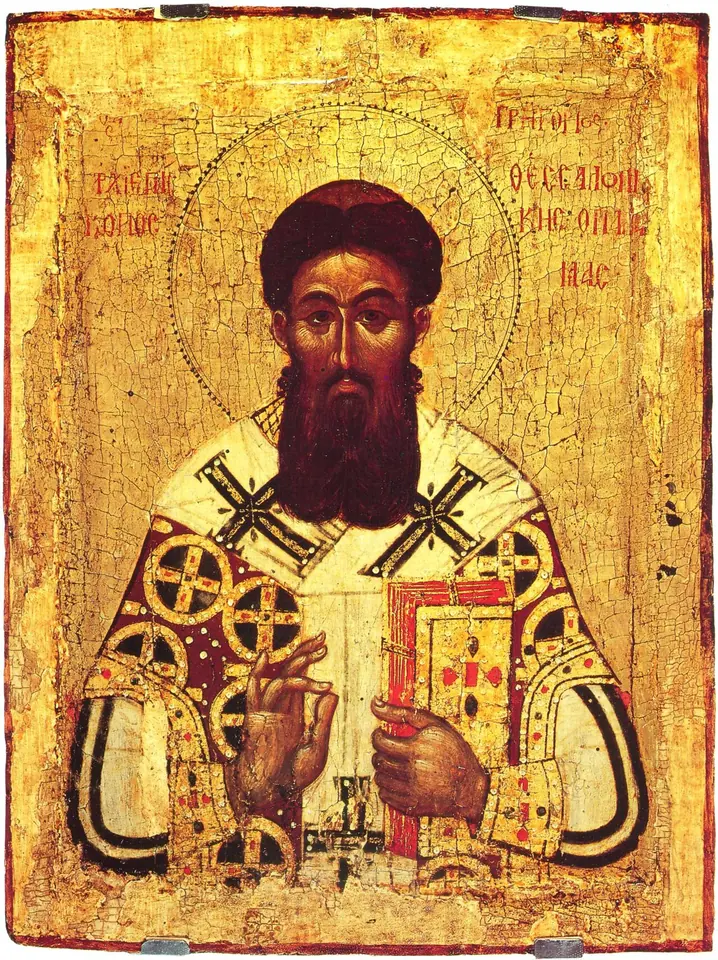
St. John Paul II spoke of this chapter of Eastern history at the Angelus of August 11, 1996. He granted that some aspects of the method had caused tensions with Catholic theology, but said it was right to recognize the good intention behind its defense: to show that a person can truly be united with the triune God in the depth of the heart.
The Philokalia and The Way of a Pilgrim
The Philokalia (1782)
For centuries the teaching on the Jesus Prayer lived in manuscripts scattered across the monasteries of the East. In 1777 St. Makarios Notaras, metropolitan of Corinth, found a manuscript collection of these writings at the Vatopedi monastery on Mount Athos and gave it to a young monk, St. Nicodemus the Hagiorite, to edit, according to the Orthodox Church in America's life of St. Nicodemus. Nicodemus wrote its preface and short lives of its authors. The book was printed in Venice in 1782 as the Philokalia, "love of the beautiful": over a thousand pages of writings on prayer and watchfulness from the 4th to the 15th centuries. John Paul II, in his 1996 Angelus, named this celebrated collection as the book through which the East's experience of prayer was set before the Church anew.

St. Paisius Velichkovsky and the Slavonic Philokalia
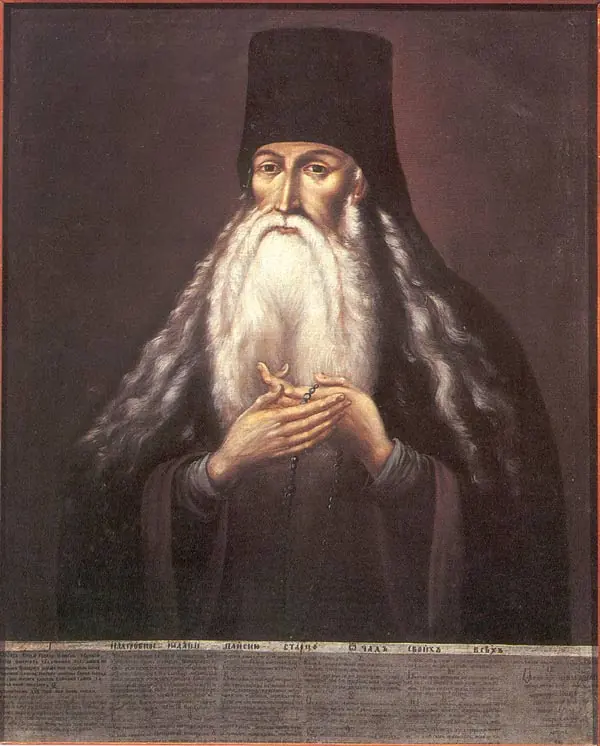
At almost the same time, a Ukrainian monk, St. Paisius Velichkovsky, was copying Greek patristic texts on Athos and translating them into Church Slavonic. At the Neamț monastery in Moldavia, where he gathered about a thousand monks, he taught "the unceasing prayer of the heart." His Slavonic Philokalia, the Dobrotolubie, was printed in Moscow in the 1790s. The Orthodox Church in America says his disciples sparked the spiritual revival of 19th-century Russia, and that St. Herman of Alaska carried a copy of the Slavonic Philokalia to America. St. Theophan the Recluse later made a fuller Russian translation.

The Way of a Pilgrim
The book that made the Jesus Prayer famous far beyond the monasteries is a small anonymous Russian narrative, The Way of a Pilgrim, first printed in Kazan in the 1880s. Its narrator is a poor wanderer with a crippled arm who hears the words "Pray without ceasing" read in church and cannot stop wondering how to obey them. He goes from church to church asking, until an old monk, a starets, teaches him the Jesus Prayer and reads to him from the Philokalia. The starets gives him a prayer rope and a rule: several thousand prayers a day, and then more. In time the prayer begins to pray itself in his heart, and he sets off across Russia and Siberia with only a knapsack, a Bible and the Philokalia, meeting soldiers, innkeepers, peasants and priests along the way.
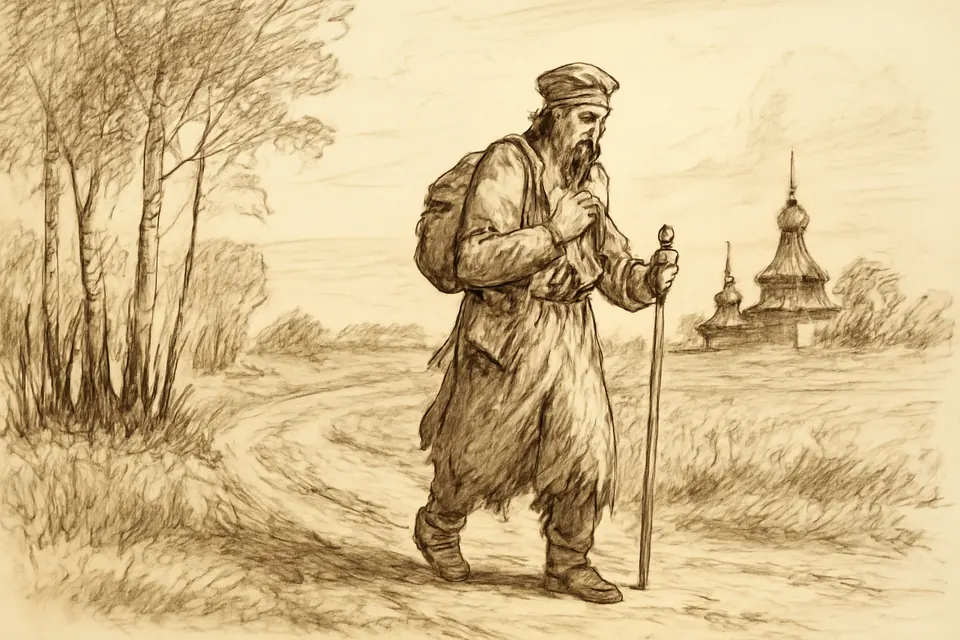
The book was translated into English by R. M. French in 1930 and has been read by Catholics, Orthodox and many others ever since. Whether its pilgrim was one real man or a composite is unknown. Its message is simple: anyone, not only monks, can learn to pray always.
How to pray the Jesus Prayer
Here is a simple way to begin, drawn from the Eastern tradition and from the Church's guidance. No technique is required. What the Fathers ask for is attention, humility and perseverance.
- Choose a time and a place. Sit or stand before an icon or a crucifix if you can, morning or evening, for ten or fifteen minutes. Make the Sign of the Cross.
- Quiet yourself. Ask the Holy Spirit to help you pray. Let the day's noise settle for a moment.
- Say the prayer slowly. "Lord Jesus Christ, Son of God, have mercy on me, a sinner." Say it aloud at first, then in a whisper, then silently. Mean each word.
- Keep your attention on the words. When your mind wanders, and it will, simply come back to the name of Jesus, without anger at yourself.
- Use a prayer rope to keep count gently, one prayer for each knot, so you don't have to think about numbers.
- Carry it into the day. Repeat the prayer while walking, driving, waiting or working, as the Desert Fathers did while weaving their baskets.
- End with thanksgiving and a sign of the Cross.
The Church's teachers add a caution. The Congregation for the Doctrine of the Faith wrote in 1989 that the Jesus Prayer, "which adapts itself to the natural rhythm of breathing can, at least for a certain time, be of real help to many people," but noted that "not everyone is equally suited" to bodily methods of prayer. Breathing techniques and long rules of hundreds or thousands of prayers belong with a confessor or spiritual father. The simple prayer itself is for everyone.

Praying with a prayer rope (chotki or komboskini)
The prayer rope is the Eastern counterpart of the rosary. Russians call it a chotki, Greeks a komboskini, Serbs a brojanica. It is a loop of knotted wool, usually black, the monastic color of repentance, and each knot is tied with small crosses woven into it. A cross of knots, often with a tassel, marks the beginning and end.
- Common sizes: 33 knots (the years of Christ's life), 50, 100 and 300. Short ones are worn on the wrist.
- Beads: many ropes have a bead after every 10 or 25 knots to help keep count, as on the Russian chotki pictured here.
- How to use it: hold the rope in your left hand, begin at the cross, and say the prayer once on each knot, moving the knots toward you with your thumb. Many people make the Sign of the Cross or a small bow at each bead.
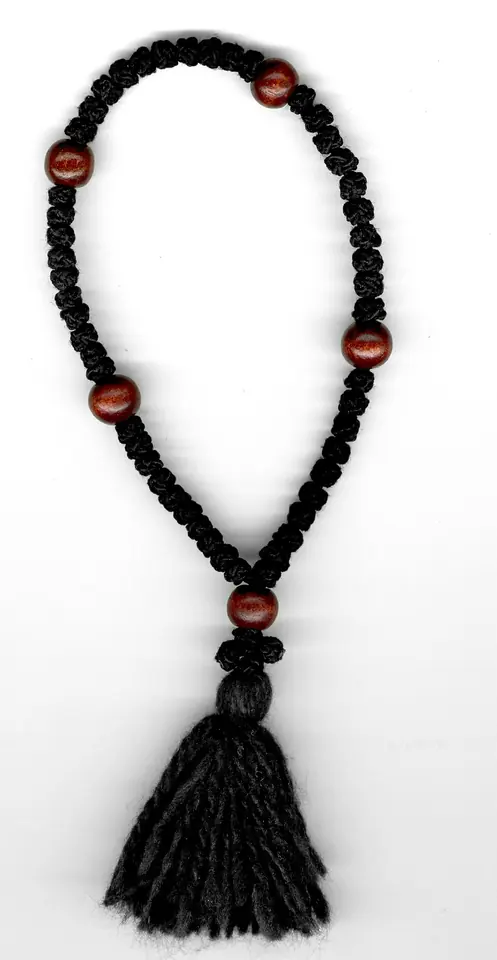
Tradition credits the first knotted prayer rope to St. Pachomius, a father of Egyptian monasticism. The story told on Athos is that he tied simple knots to count his prayers, but the devil kept untying them, so an angel taught him to weave the small crosses into each knot, and the devil could no longer undo them. This is a traditional story, a pious explanation of the knots rather than history.

The Jesus Prayer in the Catholic Church
The Jesus Prayer belongs to the whole Church, East and West. The Catechism of the Catholic Church presents it in its section on Christian prayer as the simplest way of praying always:
The invocation of the holy name of Jesus is the simplest way of praying always. When the holy name is repeated often by a humbly attentive heart, the prayer is not lost by heaping up empty phrases, but holds fast to the word and "brings forth fruit with patience." (CCC 2668)
The Catechism goes on to say that this prayer is possible "at all times" because it is not one occupation among others "but the only occupation: that of loving God, which animates and transfigures every action in Christ Jesus."
Eastern Catholics, Ukrainian, Ruthenian, Melkite, Romanian and others, pray the Jesus Prayer and use the prayer rope as their Orthodox brothers and sisters do, and St. Josaphat Kuntsevych, the Ukrainian Catholic martyr, prayed it with prostrations. In the West the love of the holy name took other forms that rhyme with it: St. Bernardine of Siena preached the name of Jesus and spread the monogram IHS across Italy, and the rosary and the Divine Mercy Chaplet also teach us to pray by gentle repetition, with the same cry, "have mercy on us." Many Catholics today keep a prayer rope beside their rosary.
St. Seraphim of Sarov gave the laypeople who came to him a short daily rule that included the Jesus Prayer during the day's work, and in our own time St. Paisios of Mount Athos urged everyone who visited him to keep the prayer always.
Related prayers and saints
- The Divine Mercy Chaplet, a Catholic prayer of repeated pleas for mercy.
- How to pray the rosary, the West's great prayer of repetition and meditation.
- Prayer for forgiveness and prayer for peace, where the Jesus Prayer also appears.
- The Desert Fathers, whose way of prayer it grew from.
- Saints of the prayer of the heart: St. Anthony the Great, St. Gregory Palamas, St. Seraphim of Sarov and St. Paisios.
Let us pray it now, once, slowly, with the publican and the blind man of Jericho: Lord Jesus Christ, Son of God, have mercy on me, a sinner.
Frequently asked questions
What are the words of the Jesus Prayer?
The usual form is "Lord Jesus Christ, Son of God, have mercy on me, a sinner." The Catechism of the Catholic Church gives it as "Lord Jesus Christ, Son of God, have mercy on us sinners" (2667). Shorter forms are just as traditional: "Lord Jesus Christ, have mercy on me," or even "Lord Jesus, have mercy."
Where does the Jesus Prayer come from?
From the Gospels. It joins the cry of the blind man at Jericho, "Jesus, son of David, have mercy on me" (Luke 18:38), with the prayer of the publican, "O God, be merciful to me a sinner" (Luke 18:13). The monks of the Egyptian and Sinai deserts shaped it into a short prayer to be repeated constantly, and the monks of Mount Athos handed it on.
Is the Jesus Prayer Catholic?
Yes. It belongs to the whole Church. The Catechism of the Catholic Church teaches it in paragraphs 2616 and 2665–2668, Eastern Catholics pray it daily, and the Congregation for the Doctrine of the Faith wrote in 1989 that it "can, at least for a certain time, be of real help to many people."
What is the prayer of the heart?
Another name for the Jesus Prayer when it is prayed attentively, with the mind gathered into the heart, until it becomes the steady background of a person's inner life. The monks who practiced it in stillness were called hesychasts, from the Greek hesychia, "stillness."
How many times should you say the Jesus Prayer?
There is no fixed number. Beginners often pray one prayer rope of 33, 50 or 100 knots each day, slowly, and let the prayer come back to them during the day. Monks may have a rule of several hundred or more, given by their spiritual father. Attention and humility matter more than the count.
What is a prayer rope?
A loop of knotted wool, usually black, called a chotki in Russian and a komboskini in Greek. You say the Jesus Prayer once on each knot. Common lengths are 33, 50, 100 and 300 knots, and each knot is tied with small crosses woven into it.
Do I need a spiritual director to pray the Jesus Prayer?
Not to say it simply and slowly, as any Christian may. The Eastern Fathers and the Church do urge guidance before taking up breathing methods or long rules of repetition, since not everyone is suited to them.
What is The Way of a Pilgrim?
An anonymous Russian book from the 19th century in which a wandering pilgrim, trying to obey St. Paul's command to "pray without ceasing," learns the Jesus Prayer from a monk who teaches him from the Philokalia. It made the prayer known around the world.
Sources
- Catechism of the Catholic Church, 2665–2669: The way of prayer, prayer to Jesus
- Catechism of the Catholic Church, 2616: Prayer to Jesus answered (the Jesus Prayer)
- Congregation for the Doctrine of the Faith, Letter on Some Aspects of Christian Meditation (Orationis formas), 1989, no. 27 and notes 32–33
- John Paul II, Angelus of August 11, 1996 (hesychasm and the Philokalia; Italian)
- Douay-Rheims Bible, Luke 18 (the Pharisee and the publican; the blind man of Jericho)
- John Cassian, Conferences, Conference 10 (Abba Isaac on continual prayer), Nicene and Post-Nicene Fathers translation
- Orthodox Church in America: Repose of Venerable Nikodemos the Hagiorite
- Orthodox Church in America: Venerable Paisios Velichkovsky