St. John Climacus, Author of the Ladder of Divine Ascent
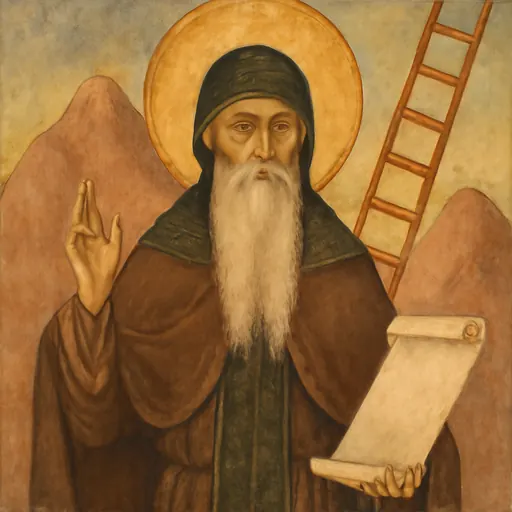
St. John Climacus ("John of the Ladder") was a monk and abbot of Mount Sinai in the late 6th and 7th centuries who wrote The Ladder of Divine Ascent, a guide to the spiritual life in thirty steps. His feast day is March 30, and the Byzantine churches also honor him on the Fourth Sunday of Great Lent. Monks have read his book for fourteen centuries, and lay Christians still use it as a map for conversion.
Who was St. John Climacus?
St. John Climacus, also called St. John of the Ladder, was a monk of Mount Sinai who wrote one of the most loved books in Christian history, The Ladder of Divine Ascent. He spent most of his life in the desert below the mountain where Moses met God, first as a disciple, then as a hermit for some forty years, and finally as abbot of the monastery we now know as St. Catherine's. His book gave him his name: klimax is Greek for "ladder."
He is a saint of the undivided Church. The Orthodox and Eastern Catholic churches keep his feast on March 30 and give him a Sunday of Great Lent as well. The Roman Martyrology lists him on March 30, and Pope Benedict XVI devoted a whole general audience to him in 2009, calling the steps of the Ladder "the most important treatise of spiritual strategy that we possess."
The life of St. John Climacus
Almost everything we know comes from a short Life by a monk named Daniel of Raithu, a monastery on the Red Sea coast of Sinai. It gives few dates, and scholars disagree about them. The Catholic Encyclopedia (1910) placed his birth around 525 and his death around 606. Benedict XVI, following more recent study, said he was born around 575 and died "after the year 650." The Orthodox life says only that one tradition makes him a native of Constantinople, born around 570. He was well educated, which is why some manuscripts call him John Scholasticus, "the learned."
A disciple at sixteen
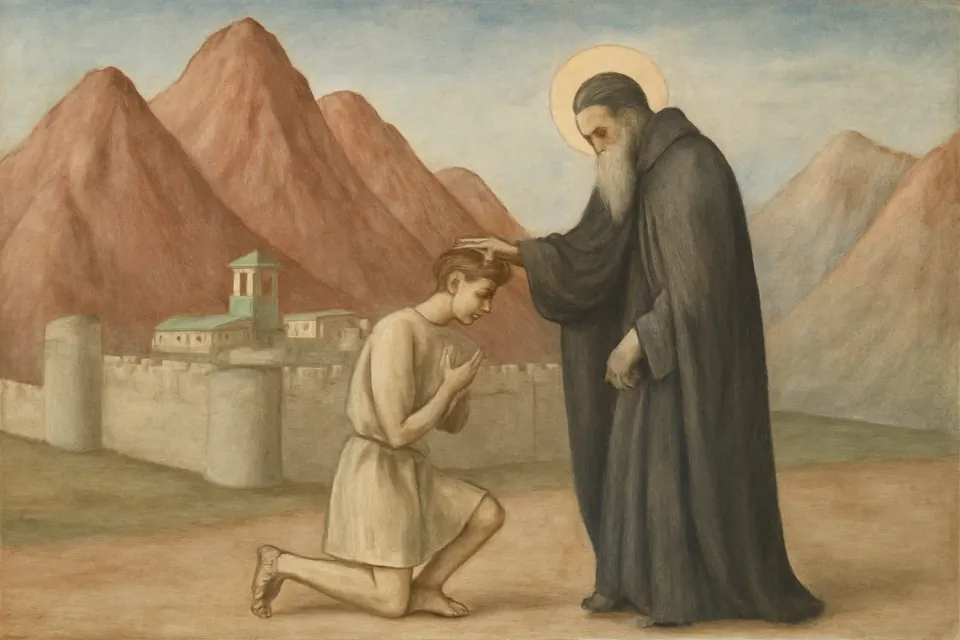
John came to Sinai at sixteen and put himself under an elder named Abba Martyrius. The Orthodox life says he was tonsured a monk four years later, and that an Abba Strategios, who was present, foretold that the young man would become "a great luminary in the Church of Christ." He stayed with his spiritual father for nineteen years.
Forty years at Tholas
After Martyrius died, John withdrew to a place called Tholas, about eight kilometers from the present monastery, according to Benedict XVI. There he spent about forty years in silence, fasting, prayer and tears. He was no recluse in the cold sense. People came to him for counsel, and he visited monasteries near Alexandria. Benedict XVI noted that his solitude "led to ardent love for others" and for God.
The Orthodox life tells two stories of these years. Some monks, jealous of the crowds who came to him, accused him of talking too much, so John kept silence for a whole year, until the same monks begged him to speak again. He also had a disciple named Moses. One hot afternoon John was dozing in his cell when a figure woke him and asked why he slept while Moses was in danger. John prayed at once. That evening Moses told him he had been sleeping under a great rock, had heard John calling him and moved, and the rock fell where he had been lying. The story is traditional.

John also spoke plainly about his own moderation. "I do not fast excessively," the Orthodox life quotes him, "nor do I give myself over to intense all-night vigil, nor lay upon the ground, but I restrain myself..., and the Lord soon saved me."
Abbot of Sinai
When John was about seventy-five, the monks of Sinai chose him as their abbot (in Greek, hegumen). The Catholic Encyclopedia says his reputation reached Rome, and that St. Gregory the Great wrote asking for his prayers and sent money for the hospice where pilgrims to Sinai stayed. The dates are hard to reconcile with Benedict XVI's later chronology, so we hold that story more loosely. After about four years, John handed the community to his brother, a monk of the same house, and went back to his hermitage to prepare for death.
The Ladder of Divine Ascent
John wrote the Ladder because another John, abbot of Raithu, asked him to set down what monks needed for salvation. The Orthodox life says he thought the task beyond him and agreed only out of obedience. He took his image from Jacob's dream in Genesis 28:12, "a ladder fixed on the earth" reaching to heaven, and divided the book into thirty steps, one for each year of Christ's hidden life before his public ministry.
Benedict XVI described the climb in three stages:
- Renunciation, which returns us to a kind of spiritual childhood. "A good foundation of three layers and three pillars is: innocence, fasting and temperance," John writes in step 1.
- Combat against the passions, step by step, each with its diagnosis and its cure. John is clear that the passions are not evil in themselves. They become so through the misuse of our freedom.
- Christian perfection, in the last seven steps: simplicity, humility, discernment, stillness (hesychia), prayer, and finally faith, hope and love.
John's prayer of the heart is one of the earliest witnesses to the Jesus Prayer, the repeated calling on the name of Jesus. In step 27 he writes: "May your remembrance of Jesus become one with your breathing, and you will then know the usefulness of hesychia." At the top of the ladder God himself speaks, quoting St. Paul: "So faith, hope, love abide, these three; but the greatest of these is love."
The book is written in short, sharp sayings, and it can be blunt. Step 22, on vainglory, catches the way pride follows us everywhere: "When I fast, I am vainglorious; and when I permit myself food in order to conceal my fasting from others I am again vainglorious about my prudence." Readers have recognized themselves in that sentence for fourteen hundred years.
The Ladder became a handbook for monks East and West. The Orthodox life names St. Theodore the Studite, St. Sergius of Radonezh and St. Joseph of Volokolamsk among those who relied on it. Ambrogio Traversari translated it into Latin, printed in Venice in 1531, and Louis of Granada put it into Spanish in 1551. John also wrote a shorter work, the Book to the Shepherd, for the abbot of Raithu on how to guide souls.
Can a book written by a desert hermit speak to us? Benedict XVI answered that monastic life shows "in capital letters what we write day after day in small letters." Faith, hope and charity, the top rungs, are gifts given to every baptized Christian.
The miracles of St. John Climacus
John is remembered for his teaching more than for wonders, and his miracles are few and modest.
- The warning that saved his disciple Moses: traditional, from his early Life and the Orthodox synaxarion.
- Clairvoyance and healing late in life: traditional. The Orthodox life says that "toward the end of his life, the Lord granted him the gifts of clairvoyance and wonderworking," without giving details.
- Graces through his intercession: reported. Christians who pray the Ladder and ask his prayers speak of help in temptation, but none of these has been formally investigated.
His troparion sums up the Church's memory of him: he made the desert fertile "by a flood of tears."
Is St. John Climacus a patron saint?
He has no formal patronage. Monks and nuns regard him as one of their great teachers, and in the Byzantine churches he is the saint of Lent, since his Sunday falls in the middle of the fast. Spiritual directors and anyone trying to break a bad habit turn to the Ladder, because it treats the passions one at a time with a physician's care. Browse other saints on our patron saints page.
Symbols of St. John Climacus in art
John appears almost only in Eastern art, and he is easy to recognize once you know the signs:
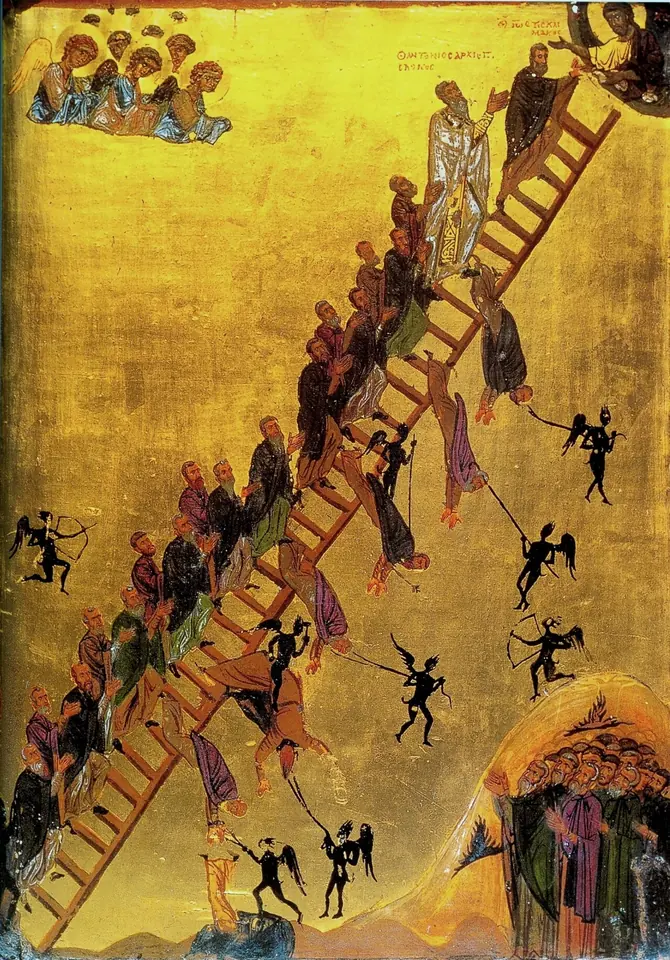
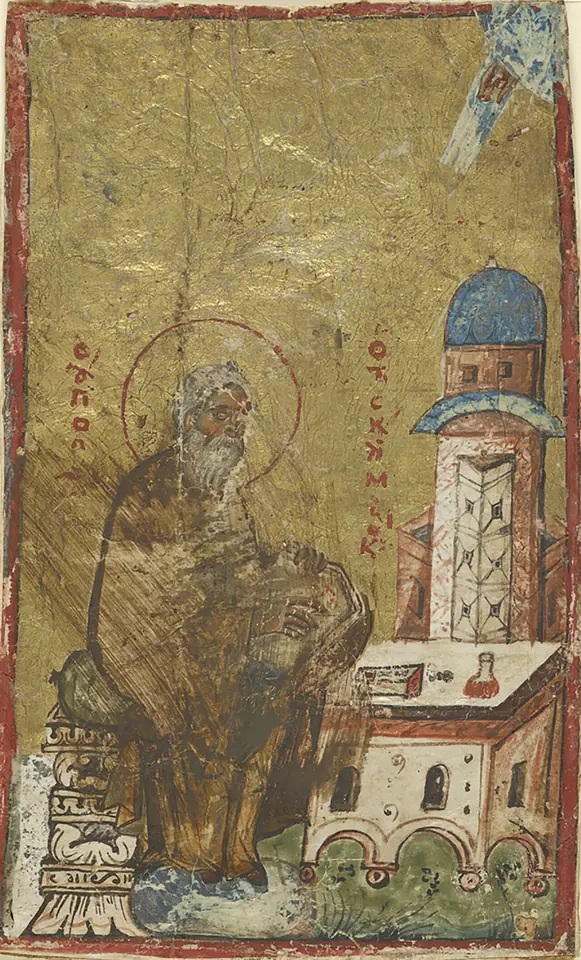
- A ladder reaching to heaven: his own symbol, from his book. In the full Heavenly Ladder icon, monks climb toward Christ, angels encourage them and black demons shoot arrows or pull them off with ropes. John sometimes stands near the top, or sits writing in a cave below.
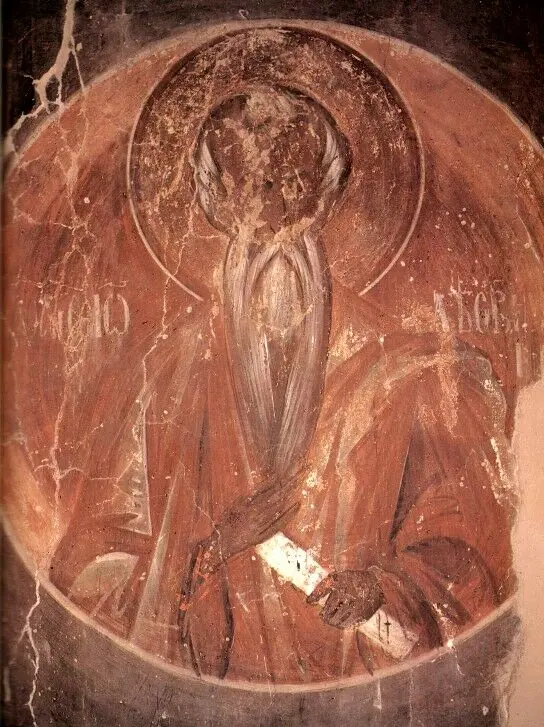
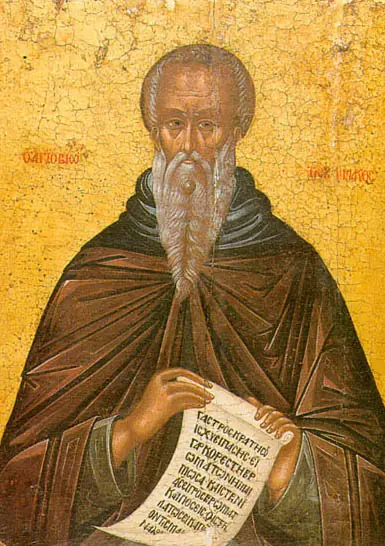
- A scroll or book: the Ladder itself. Russian icons often show a scroll with a line from his writings.
- A long white beard and monastic habit: the sign of the desert elder. In Russian icons he usually wears a brown habit, sometimes with the black schema of the great monastic vow.
- A hand raised in blessing, as in many icons of holy monks.
The Sinai icon at the top of this page, painted in the 12th century for his own monastery, is the most famous image of the Ladder. A 13th-century Novgorod icon makes John the main figure, with St. George and St. Blaise small at his feet. In 1663 the Cretan painter Emmanuel Tzanes combined the two traditions, putting John in his cave beside the ladder.


Feast day and the Sunday of St. John Climacus
The feast of St. John Climacus is March 30. The Byzantine churches also keep the Fourth Sunday of Great Lent in his honor; the next Sunday belongs to St. Mary of Egypt. Putting John in the middle of Lent is a teaching in itself: halfway through the fast, the Church shows us the ladder and reminds us to keep climbing. Many Orthodox monasteries read the Ladder aloud during Lent. Find his neighbors on the calendar on our feast days page.
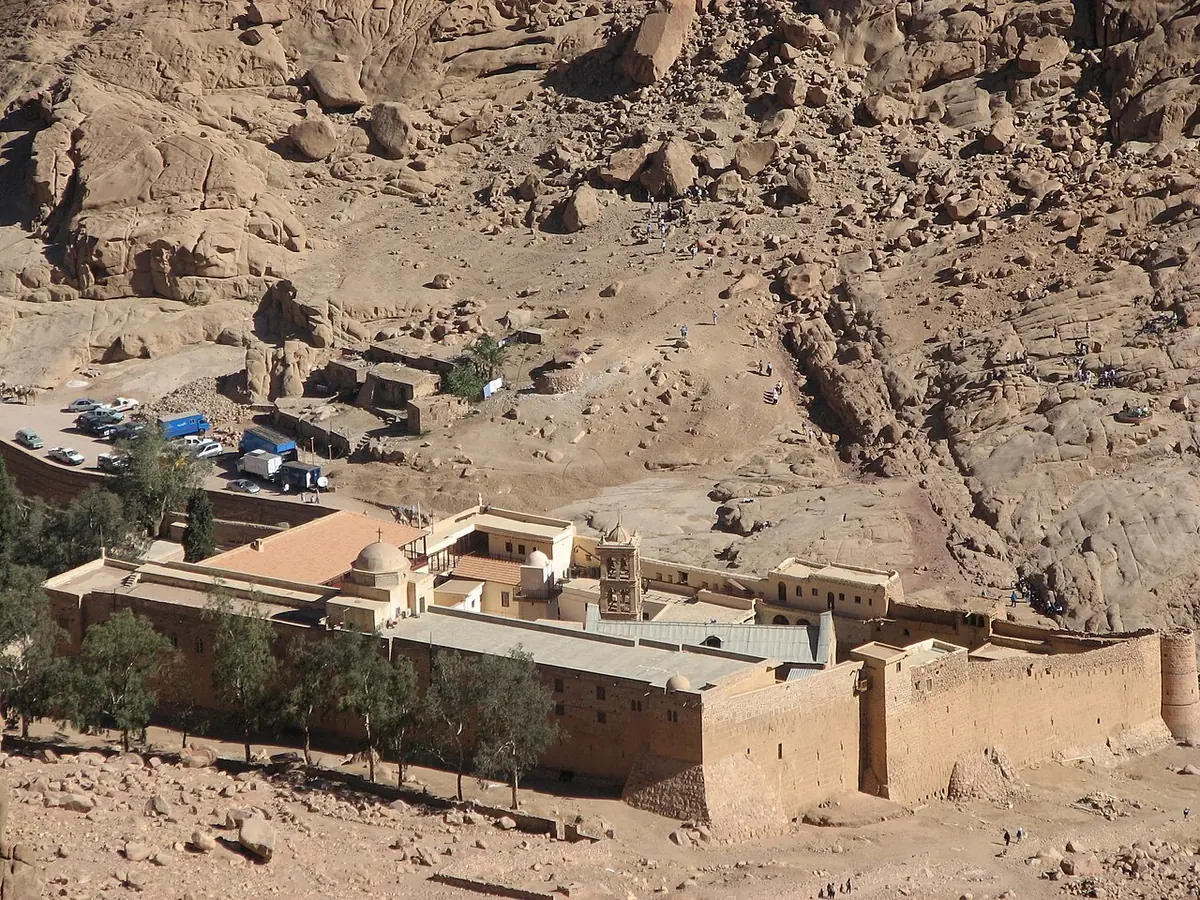
The place most bound to him is the Holy Monastery of St. Catherine at the foot of Mount Sinai, which still keeps the icon of the Ladder and early manuscripts of his book. Its name honors St. Catherine of Alexandria, whose relics the monks keep. An Orthodox church in Warsaw is dedicated to him, and Russian Christians know him as St. John Lestvichnik.
Prayer to St. John Climacus
We know of no prayer composed by John himself, but the Orthodox Church sings these hymns on his feast. This is the troparion (Tone 8), in the translation of the Orthodox Church in America:
By a flood of tears you made the desert fertile / and by your longing for God you brought forth fruits in abundance. / By the radiance of miracles you illuminated the whole universe. / O our holy Father John Climacus, pray to Christ our God to save our souls.
And the kontakion (Tone 1):
You offered us your teachings as fruits of everlasting freshness, / to sweeten the hearts of those who receive them with attention. / O blessed and wise John, they are the rungs of a ladder, / leading the souls of those who honor you from earth to Eternal glory in Heaven!
Let us ask St. John of the Ladder to pray for us, especially in Lent, that we may climb one step at a time and not lose heart when we slip. His own advice for prayer is simple enough for anyone: let the name of Jesus become one with our breathing.
Frequently asked questions
Who was St. John Climacus?
He was a monk of Mount Sinai who lived as a hermit for about forty years, then served as abbot of the great monastery there, now called St. Catherine's. He wrote The Ladder of Divine Ascent, and the book gave him his name, since klimax is the Greek word for ladder.
What is The Ladder of Divine Ascent?
A guide to the Christian life in thirty "steps," written at the request of John, abbot of the nearby monastery of Raithu. It starts with renunciation of the world, moves through the struggle against the passions, and ends with faith, hope and love. The thirty steps recall the thirty years of Christ's hidden life.
When is the feast of St. John Climacus?
March 30, in both the Roman Martyrology and the Orthodox calendar. The Byzantine churches also dedicate the Fourth Sunday of Great Lent to him, so his book is read and preached on in the middle of Lent.
Why is St. John Climacus shown with a ladder?
Because of his book. The icon called the Heavenly Ladder shows monks climbing toward Christ while demons try to pull them off, with John often at the top or writing in his cave below. It is a picture of the spiritual life as a daily climb.
What did St. John Climacus say about the Jesus Prayer?
In step 27 of the Ladder he wrote, in Benedict XVI's translation, "May your remembrance of Jesus become one with your breathing, and you will then know the usefulness of hesychia." It is one of the earliest witnesses to the Jesus Prayer.
Sources
- Benedict XVI, General Audience of 11 February 2009: John Climacus
- Catholic Encyclopedia (1910): St. John Climacus
- Orthodox Church in America: Venerable John Climacus of Sinai, Author of the Ladder
- Orthodox Church in America: Troparion and Kontakion of St. John Climacus
- Daniel of Raithu, Life of John Climacus (Patrologia Graeca 88, 596-608)