New year prayer
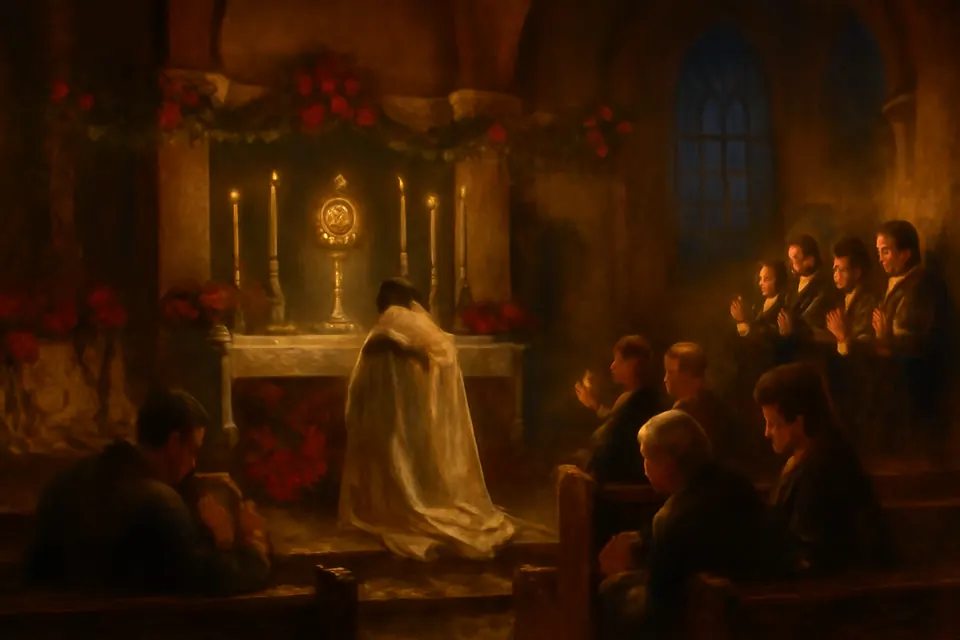
A Catholic new year prayer has two parts: on New Year's Eve we thank God for the past year with the Te Deum, and on New Year's Day we ask His help for the year ahead with the Veni Creator Spiritus. The Church grants a plenary indulgence for each, and the blessing of Numbers 6, "The Lord bless thee, and keep thee," is read at Mass on January 1.
A new year prayer, for a Catholic, is a turning point in two directions. We look back over the year that is ending and thank God for it, the good and the hard, and we look ahead and ask Him to bless the year we cannot yet see. The Church gives us a hymn for each: the Te Deum on New Year's Eve and the Veni Creator on New Year's Day. Here are both in full, with a short prayer and a family blessing for the new year.
A new year prayer
Pray this at midnight, at the first meal of the year, or on your knees before bed on January 1:
Lord God, Lord of time and of eternity, You have brought us to the end of one year and the beginning of another. For every gift of the year that is past, we thank You. For every sin of the year that is past, we ask Your mercy. Into Your hands we place the year that is coming: its work and its rest, its joys and its sorrows, the people we will meet and the decisions we must make. Send us Your Holy Spirit to guide us. Keep us close to Your Son in His Church and His sacraments, and if this should be our last year on earth, let it end in Your friendship. Holy Mary, Mother of God, on your feast we begin this year; take us under your mantle and lead us to Jesus. St. Joseph, guardian of the Holy Family, protect our home. Amen.
Pastor Lyvers wrote this prayer for this page.
A blessing for the new year
The first reading at Mass on January 1 is the oldest blessing in Scripture. God gave it to Moses for Aaron and his sons, the priests of Israel, to speak over the people. In the Douay-Rheims translation:
The Lord bless thee, and keep thee. The Lord shew his face to thee, and have mercy on thee. The Lord turn his countenance to thee, and give thee peace. (Numbers 6:24-26)
The next verse gives the promise: "And they shall invoke my name upon the children of Israel, and I will bless them." The Church sets this blessing at the head of the year so that the first word we hear in the new year is God's name spoken over us.
It makes a good family custom. On New Year's morning, before breakfast, a father or mother traces the Sign of the Cross on each child's forehead with a thumb and says the blessing over them, one by one. Grandparents can bless grandchildren, and children can bless their parents in turn. Our page on the priestly blessing explains its history in the Bible and the liturgy.

New Year's Eve prayer: the Te Deum
On the last night of the year the Church sings her great hymn of thanksgiving, the Te Deum. This is the traditional translation printed beside the Latin in the 1888 Manual of Prayers:
We praise Thee, O God: we acknowledge Thee to be the Lord. All the earth doth worship Thee: the Father everlasting. To Thee all Angels: to Thee the Heavens and all the Powers therein: To Thee the Cherubim and Seraphim: cry with unceasing voice: Holy, Holy, Holy: Lord God of Hosts. The heavens and the earth are full: of the majesty of Thy glory. Thee the glorious choir: of the Apostles, Thee the admirable company: of the Prophets, Thee the white-robed army of Martyrs: praise. Thee the Holy Church throughout all the world: doth acknowledge. The Father: of infinite Majesty. Thine adorable, true: and only Son. Also the Holy Ghost: the Paraclete. Thou art the King of Glory: O Christ. Thou art the everlasting Son: of the Father. Thou having taken upon Thee to deliver man: didst not abhor the Virgin's womb. Thou having overcome the sting of death: didst open to believers the kingdom of heaven. Thou sittest at the right hand of God: in the glory of the Father. We believe that Thou shalt come: to be our Judge. We beseech Thee, therefore, help Thy servants: whom Thou hast redeemed with Thy precious Blood. Make them to be numbered with Thy Saints: in glory everlasting. O Lord, save Thy people: and bless Thine inheritance. Govern them: and lift them up for ever. Day by day: we bless Thee. And we praise Thy name for ever: and world without end. Vouchsafe, O Lord, this day: to keep us without sin. Have mercy on us, O Lord: have mercy on us. Let Thy mercy, O Lord, be upon us: as we have hoped in Thee. O Lord, in Thee have I hoped: let me never be confounded.
It is the custom to kneel at "We beseech Thee, therefore, help Thy servants." Listen to the last lines with the year in mind. "Day by day: we bless Thee" sums up the year we are ending, and "Vouchsafe, O Lord, this day: to keep us without sin" is the prayer for the one we are beginning. The story of who wrote the Te Deum, and the old legend of St. Ambrose and St. Augustine singing it at Augustine's baptism, is on our Thanksgiving prayer page.
The New Year's Eve indulgence
The Church's Manual of Indulgences grants a plenary indulgence to the faithful who, in a church or oratory, devoutly take part in the solemn singing or recitation of the Te Deum "on the last day of the year, to give thanks to God for the benefits received over the whole course of the year" (grant 26, our translation from the Latin). The usual conditions apply: sacramental confession, Holy Communion and prayer for the pope's intentions, with no attachment to any sin, even venial. Praying the Te Deum at home is a partial indulgence. Read about what an indulgence is, and what it is not, on our indulgences page.
Many parishes keep a holy hour on New Year's Eve before the Blessed Sacrament, sometimes running across midnight, and close it with the Te Deum and Benediction. In Rome the pope celebrates First Vespers of the Solemnity of Mary, Mother of God, on the evening of December 31 and leads the Te Deum in St. Peter's Basilica. If your parish has no service, gather the family, light a candle before the crib, and say it together.
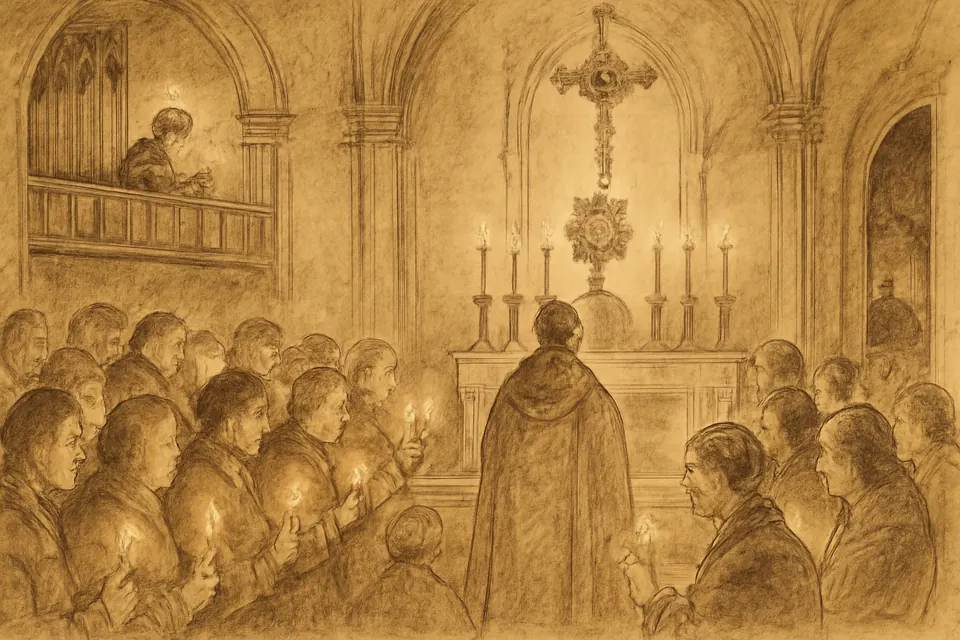
December 31, 2026
In 2026 New Year's Eve is a Thursday, the seventh day of the octave of Christmas. The Gospel at Mass that morning is the prologue of St. John: "In the beginning was the Word." It is a fitting text for the last day of a year, because it begins before time itself. The Church also remembers Pope St. Sylvester I that day, the bishop of Rome when the persecutions ended and the emperor Constantine built the first great basilicas. In much of central Europe New Year's Eve is still called "Sylvester."
A Mass on the evening of December 31 fulfills the obligation for New Year's Day in 2027.

Looking back before God
Before the Te Deum, take a quiet quarter hour with the year's calendar or your phone's photographs and look back. Where was God this year? What are you grateful for? Where did you fail, and whom did you hurt? Thank Him for the first, ask His forgiveness for the second, and make a firm purpose to go to confession early in the new year. Our examination of conscience and act of contrition pages can help. Then end with the words of the prophet that the Church has always loved at the turning of the year:
The mercies of the Lord that we are not consumed: because his commiserations have not failed. They are new every morning, great is thy faithfulness. (Lamentations 3:22-23)
New Year's Day prayer: the Veni Creator
On January 1 we turn from thanks to petition. The Church asks the Holy Spirit to guide the new year with the Veni Creator Spiritus, the hymn she sings at Pentecost, at ordinations, at the opening of councils and before a conclave. The Manual of Indulgences grants a plenary indulgence, on the usual conditions, to those who devoutly take part in its solemn singing or recitation in a church or oratory "on the first day of the year, to implore divine help for the whole course of the year" (grant 26, our translation), and also on Pentecost. Here it is in the Latin and in the English version of the 1888 Manual of Prayers:
Veni, Creator Spiritus, Mentes tuorum visita, Imple superna gratia, Quae tu creasti, pectora.
Qui diceris Paraclitus, Altissimi donum Dei, Fons vivus, ignis, charitas, Et spiritalis unctio.
Tu septiformis munere, Digitus paternae dexterae, Tu rite promissum Patris, Sermone ditans guttura.
Accende lumen sensibus: Infunde amorem cordibus: Infirma nostri corporis Virtute firmans perpeti.
Hostem repellas longius, Pacemque dones protinus: Ductore sic te praevio Vitemus omne noxium.
Per te sciamus da Patrem, Noscamus atque Filium, Teque utriusque Spiritum Credamus omni tempore.
Deo Patri sit gloria, Et Filio, qui a mortuis Surrexit, ac Paraclito, In saeculorum saecula. Amen.
Come, Holy Ghost, Creator, come, From Thy bright heavenly throne! Come, take possession of our souls, And make them all Thine own!
Thou who art called the Paraclete, Best Gift of God above, The Living Spring, the Living Fire, Sweet Unction, and True Love!
Thou who art sevenfold in Thy grace, Finger of God's right hand, His Promise, teaching little ones To speak and understand!
O guide our minds with Thy blest light, With love our hearts inflame, And with Thy strength, which ne'er decays, Confirm our mortal frame.
Far from us drive our hellish foe, True peace unto us bring, And through all perils guide us safe Beneath Thy sacred wing.
Through Thee may we the Father know, Through Thee the Eternal Son, And Thee the Spirit of them both, Thrice-blessed Three in One.
Now to the Father, and the Son Who rose from death, be glory given, With Thee, O holy Comforter, Henceforth by all in earth and heaven. Amen.
Read the fifth verse again at the start of a year: "Far from us drive our hellish foe, true peace unto us bring, and through all perils guide us safe." We don't know what the year holds. The Holy Spirit does.
Who wrote the Veni Creator?
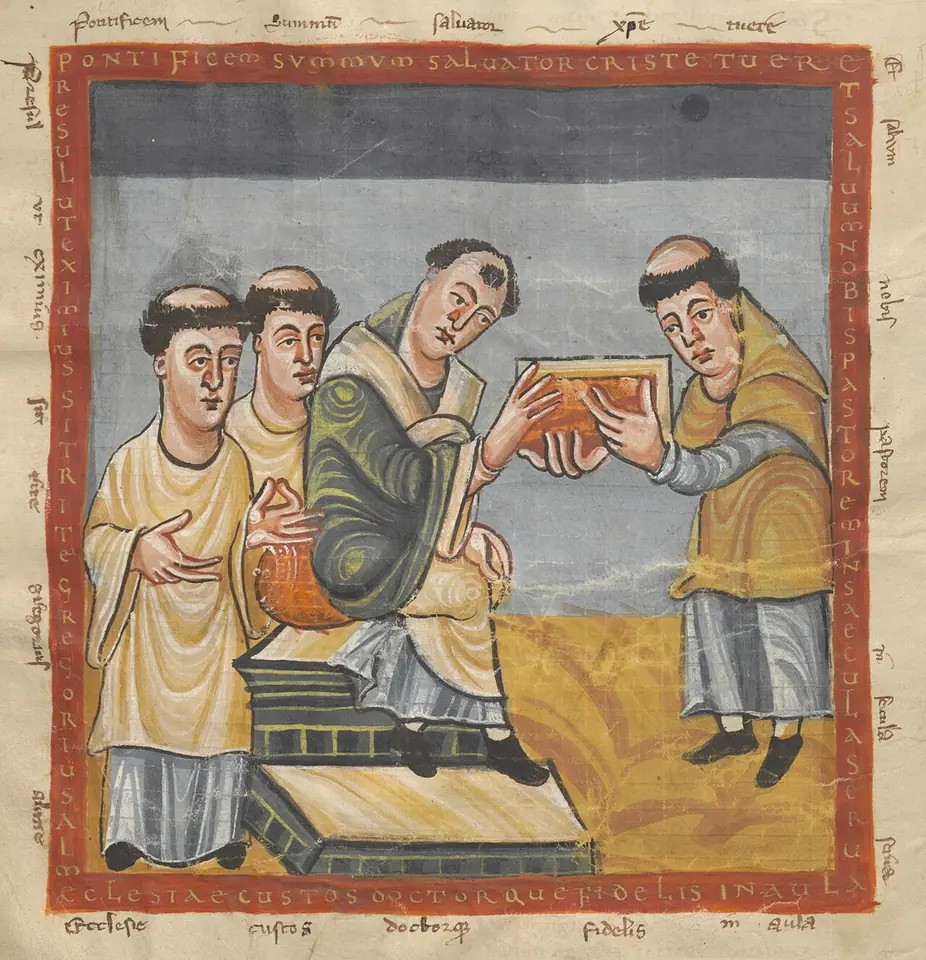
The hymn is at least eleven hundred years old. The Catholic Encyclopedia judges that the manuscript evidence favors Rabanus Maurus (Hrabanus), abbot of Fulda and later archbishop of Mainz, who died in 856. Older attributions to St. Ambrose, to St. Gregory the Great and to Charlemagne have, in its words, "slight ground" or no real evidence. The last verse, the doxology, is a later addition. Another English version of the hymn, Edward Caswall's "Come, Holy Ghost, Creator blest," is on our prayer to the Holy Spirit page, with the short prayer "Come, Holy Ghost, fill the hearts of Thy faithful."

January 1: Mary, Mother of God
The Church begins the civil year on the octave day of Christmas with the Solemnity of Mary, the Holy Mother of God. On Friday, January 1, 2027, it is a holy day of obligation in the United States, and because it is a solemnity, Friday abstinence is lifted. It is also the World Day of Peace. Its history, its Mass and the oldest prayer to Mary, the Sub tuum praesidium, are on our Mary, Mother of God 2027 page.
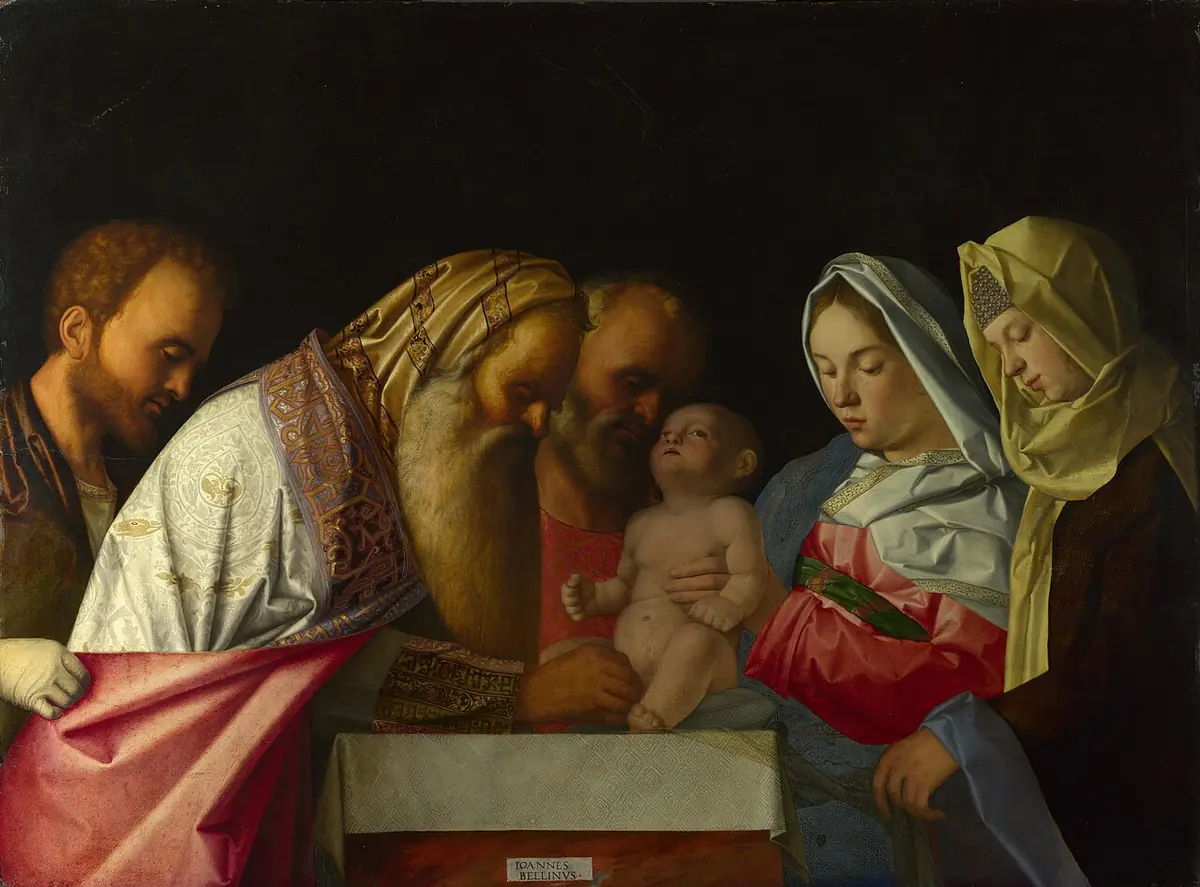
Before 1969 the Roman calendar kept January 1 as the Circumcision of the Lord, and the Gospel of the day still tells how the Child was circumcised on the eighth day and given the name Jesus (Luke 2:21). The 1888 Manual of Prayers gives the collect that the Church prayed on New Year's Day for centuries. It is a prayer to begin any year with Mary:
O God, who, by the fruitful virginity of Blessed Mary, hast given unto mankind the rewards of eternal salvation; grant, we beseech Thee, that we may feel that she intercedes for us, through whom we have been made worthy to receive the Author of life, our Lord Jesus Christ, Thy Son. Amen.
Begin the year with the name of Jesus
On the eighth day the Child received His name, and on January 3 the Church keeps the optional memorial of the Most Holy Name of Jesus. (In the United States in 2027, the Epiphany falls on that Sunday and takes its place.) There is no better first word for a new year than the name that means "God saves." Say it slowly at midnight, write it at the top of the new calendar, and pray the Litany of the Holy Name in the first week of January. Read more on our Holy Name of Jesus page.
Catholic customs for the new year
A patron saint for the year
Many Catholic families and religious houses draw a patron saint for the year on New Year's Day. Write saints' names on slips of paper, fold them, and let each person draw one from a bowl. Learn your saint's story, keep the feast day, and ask for that saint's prayers all year. Children love it, and the saint you didn't choose often turns out to be the one you needed. Our how to choose a patron saint page has a longer list of ideas.

Resolutions that are prayers
A Catholic new year's resolution can be small and concrete: a morning offering every day, a Sunday Mass that is never skipped, confession once a month, a decade of the rosary in the car, a chapter of the Gospel each night. Start with one. Write it down. Ask the saint you drew to pray for you when you forget, because you will. Our morning offering and how to pray the rosary pages are good places to begin.
The house blessing at Epiphany
The Christmas season isn't over on January 1. At the Epiphany, many families bless their homes and chalk the year over the front door: 20 + C + M + B + 27, for the new year and the initials of the Magi, or of Christus mansionem benedicat, "May Christ bless this house." See the Epiphany house blessing and Epiphany 2027.
Short new year prayers
For a text message, a card or a single breath at midnight:
Thou shalt bless the crown of the year of thy goodness. (Psalm 64:12, Douay-Rheims; Psalm 65 in other Bibles)
Come, Holy Ghost, Creator, come.
Jesus, Mary and Joseph, bless us in this new year.
The Lord bless thee, and keep thee, and give thee peace.
Happy and holy new year. May the Lord who brought us safely to its beginning bring us safely to its end, and one day to the year that never ends.
Frequently asked questions
What is a good Catholic new year prayer?
The Church's own answer is two hymns. On December 31 we thank God for the year with the Te Deum ("We praise Thee, O God"), and on January 1 we ask the Holy Spirit's help for the new year with the Veni Creator Spiritus ("Come, Holy Ghost, Creator, come"). Both are given in full on this page, with a short new year prayer you can pray at home.
What is the Catholic blessing for the new year?
The priestly blessing from Numbers 6:24-26, which is the first reading at Mass on January 1: "The Lord bless thee, and keep thee. The Lord shew his face to thee, and have mercy on thee. The Lord turn his countenance to thee, and give thee peace." Parents can pray it over their children on New Year's Day while tracing a cross on their foreheads.
Is there a plenary indulgence on New Year's Eve?
Yes. The Manual of Indulgences (grant 26) grants a plenary indulgence to those who devoutly take part in the solemn singing or recitation of the Te Deum in a church or oratory on the last day of the year, to thank God for the year's blessings, under the usual conditions. Praying it privately earns a partial indulgence.
Is there a plenary indulgence on New Year's Day?
Yes. The same grant gives a plenary indulgence to those who devoutly take part in the solemn singing or recitation of the Veni Creator in a church or oratory on January 1, to ask God's help for the whole year, under the usual conditions. It is also granted on Pentecost.
Is New Year's Day a holy day of obligation?
January 1 is the Solemnity of Mary, Mother of God. In the United States the obligation is lifted when it falls on a Saturday or a Monday. On Friday, January 1, 2027, it is a holy day of obligation, and a Mass on the evening of December 31 counts.
What do Catholics do on New Year's Eve?
Many parishes hold a holy hour, Mass or Eucharistic adoration that runs up to midnight and ends with the Te Deum. December 31 is also the feast of Pope St. Sylvester I. At home, families thank God for the year, look back honestly at it before God, and go to bed with a blessing rather than a hangover.
Who wrote the Veni Creator Spiritus?
Most likely Rabanus Maurus, abbot of Fulda and archbishop of Mainz, who died in 856. The Catholic Encyclopedia says the manuscript evidence favors him; older attributions to St. Ambrose, St. Gregory the Great and Charlemagne have no real support.
Sources
- Apostolic Penitentiary, Enchiridion Indulgentiarum, 4th edition (Latin), grant 26: the Veni Creator on January 1 and the Te Deum on December 31
- Manual of Prayers for the Use of the Catholic Laity, ordered by the Third Plenary Council of Baltimore (1888), Internet Archive. The Te Deum, the Veni Creator in Latin and English, and the collect of New Year's Day
- Catholic Encyclopedia (1912): Veni Creator Spiritus
- USCCB: Liturgical Calendar for the Dioceses of the United States of America, 2027 (PDF). December 31, 2026, and January 1, 2027, with their readings
- Douay-Rheims Bible: Numbers 6
- Douay-Rheims Bible: Lamentations 3