Seamless Robe of Jesus
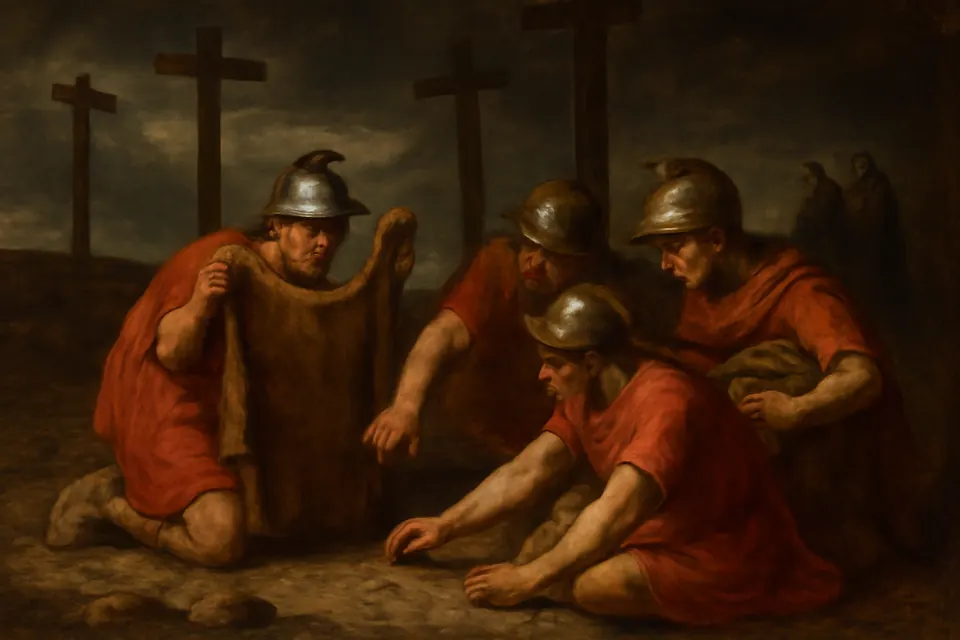
The seamless robe of Jesus is the tunic "without seam, woven from the top throughout" that the soldiers at the Cross would not tear, but cast lots for (John 19:23–24). Two churches claim it: Trier Cathedral in Germany, whose Holy Robe has drawn millions of pilgrims since 1512, and the basilica of Argenteuil near Paris. Neither relic's origin can be proven.
Before they nailed him to the Cross, the soldiers stripped Jesus of his clothes. St. John, who stood nearby, remembered what happened to them afterward:
The soldiers therefore, when they had crucified him, took his garments, (and they made four parts, to every soldier a part,) and also his coat. Now the coat was without seam, woven from the top throughout. They said then one to another: Let us not cut it, but let us cast lots for it, whose it shall be; that the scripture might be fulfilled, saying: They have parted my garments among them, and upon my vesture they have cast lots. And the soldiers indeed did these things.
That is John 19:23–24 in the Douay-Rheims translation. The "coat" is the seamless robe of Jesus, a tunic woven in one piece on the loom, worn next to the body under the outer cloak. The soldiers could have cut it into four like everything else; they gambled for it whole instead. This page tells how two churches came to claim that garment, the Holy Robe of Trier and the Holy Tunic of Argenteuil, what their history really shows, and why the faithful still go to pray before them.

The robe in the Gospel and the Fathers
All four Gospels say the soldiers divided Christ's clothing, and all of them hear in it the words of Psalm 21 (22 in modern numbering): "They parted my garments amongst them; and upon my vesture they cast lots." Only John notices that the tunic had no seam and that the soldiers kept it whole.
The Fathers of the Church read a lesson in that detail. St. Cyprian, bishop of Carthage, saw in it a picture of the unity of the Church. In On the Unity of the Church, written around 251, he says:
That coat bore with it an unity that came down from the top, that is, that came from heaven and the Father, which was not to be at all rent by the receiver and the possessor... He cannot possess the garment of Christ who parts and divides the Church of Christ.
The soldiers who gambled for the tunic kept it whole without knowing why. Cyprian's point is that Christians, who do know, should never tear what even they would not.
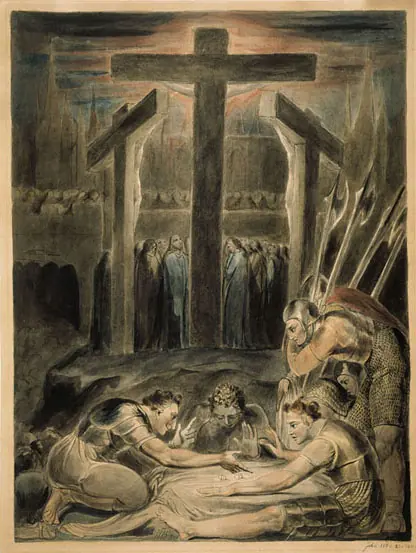
The Gospel tells us nothing about the robe after Good Friday. Everything later comes from tradition, and the honest place to begin is with the dates the records give us.
The Holy Robe of Trier
The Helena tradition
Trier, on the Moselle in western Germany, was an imperial capital in the days of Constantine, and his mother St. Helena lived there for a time. Trier's tradition holds that after her pilgrimage to the Holy Land, around 327 to 328, Helena sent the Lord's tunic to the city's church.
The Diocese of Trier is candid about what can and can't be shown. Helena's journey is historical; her link with the robe is not documented. The oldest written witnesses are the Gesta Treverorum, the chronicle of Trier's bishops from the early 1100s, and the Life of St. Agritius written a little before 1072. The Catholic Encyclopedia adds that a document once used to support the claim, the "Sylvester Diploma," "cannot be considered genuine in its present form." The diocese calls the early accounts legends.
1196 to 1512
The first firm date is May 1, 1196, when Archbishop Johann I moved the robe into the high altar of the newly built east choir of the cathedral. There it stayed, sealed and unseen, for more than three hundred years.
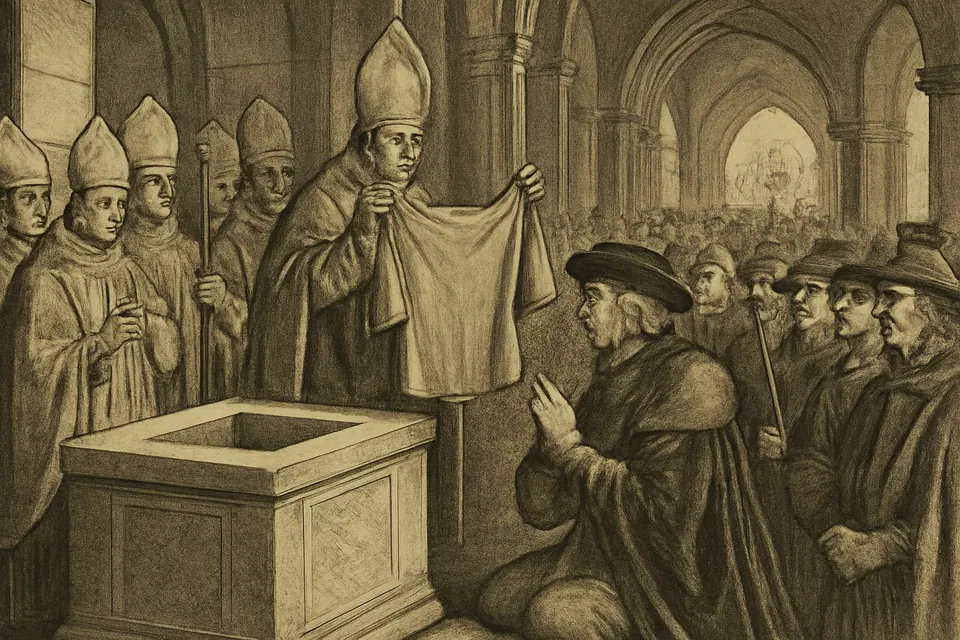
On April 14, 1512, at the wish of Emperor Maximilian I, who had come to Trier for an imperial diet, Archbishop Richard von Greiffenklau opened the altar and showed the robe to the emperor, the princes and the people. Word spread fast. Pilgrims came every year until 1517, and from 1524 to 1545 the robe was shown every seven years.
Wars and wanderings
The robe had a hard few centuries. During the wars of the 17th century it was kept at the fortress of Ehrenbreitstein near Koblenz and in Cologne. When French armies crossed the Rhine in the 1790s, it went to Würzburg, Bamberg, Bohemia and Augsburg, and came home to Trier only in September 1810. In 1939 it was taken to Limburg for safety, and it spent the last part of the Second World War in a bunker beneath the cathedral.
The great pilgrimages
From the 19th century on, Trier has shown the robe only on special occasions, each one a great pilgrimage. The diocese gives these numbers:
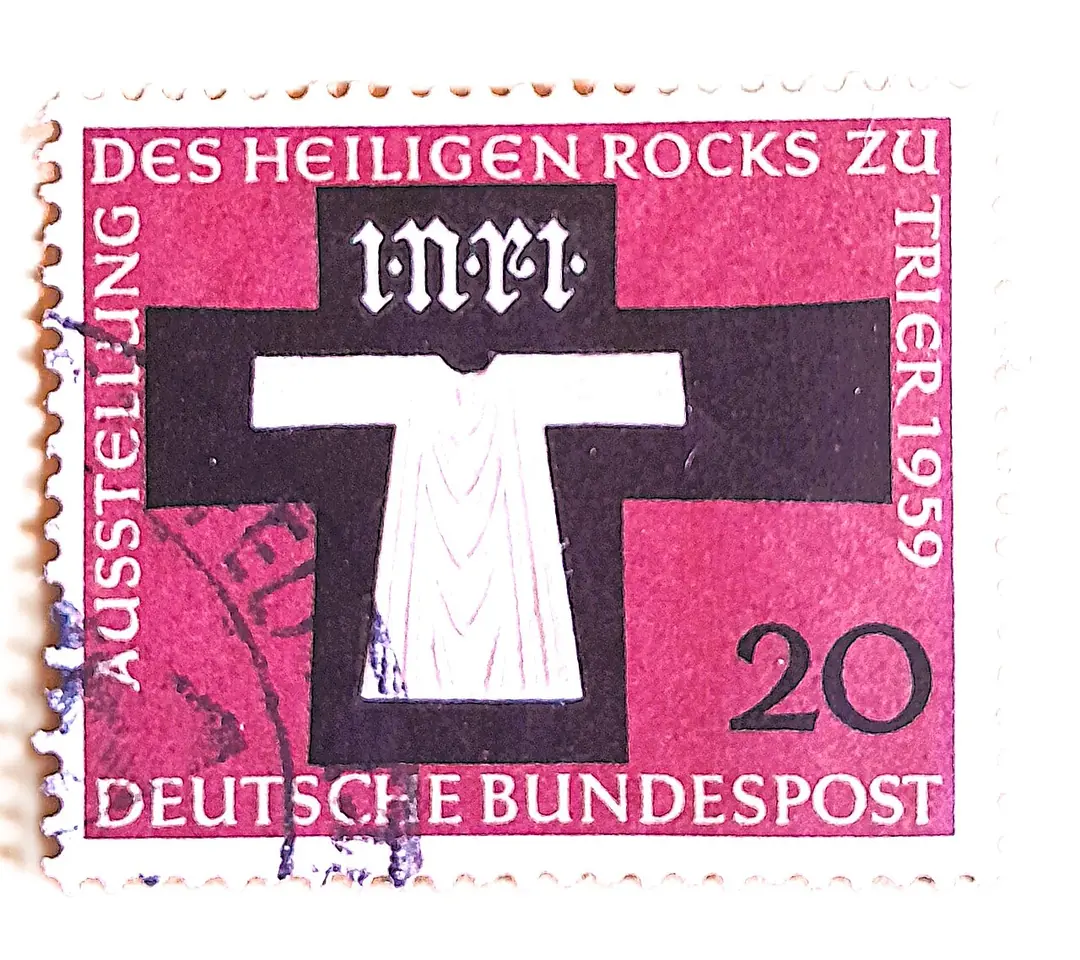
| Year | Dates | Pilgrims | |---|---|---| | 1810 | September 9–27 | almost 230,000 | | 1844 | August 17 – October 6 | over 500,000 | | 1891 | September 20 – October 4 | over 1,000,000 | | 1933 | July 23 – September 10 | over 2,000,000 | | 1959 | July 19 – September 20 | 1,800,000 | | 1996 | spring | over 1,000,000 | | 2012 | April 13 – May 13 | over 500,000 |
The 1933 pilgrimage, the largest of all, was held during the Holy Year of the Redemption proclaimed by Pope Pius XI. The diocese notes that it was announced on January 25, 1933, before the Nazis took power. The 2012 pilgrimage marked five hundred years since 1512 and had a strong ecumenical accent under the motto und führe zusammen, was getrennt ist, "and bring together what is divided," which takes up St. Cyprian's reading of the undivided tunic.


What the robe is like
What pilgrims see in the glass case is a brown, T-shaped garment. It has been repaired and reinforced at almost every showing, and the diocese explains that what we see is really a textile shell around the relic. A detailed study by the Abegg Foundation in Switzerland in 1973 found the oldest material, a felted wool, sandwiched in the middle of the layers. The diocese says those oldest parts could date back to the first century. Earlier examinations in 1890 and 1891 could find no original seams, because the relic is covered on both sides.

The robe today and in 2033
The robe is kept in an airtight glass shrine in the Holy Robe Chapel (Heilig-Rock-Kapelle), behind the high altar in the east choir of Trier Cathedral. Since the late 1990s the diocese has held the Heilig-Rock-Tage, the Holy Robe Days, its yearly diocesan festival, when the chapel is opened to pilgrims.
On September 27, 2026, Bishop Stephan Ackermann announced that the Holy Robe will be shown again in 2033: "We will show the Holy Robe again in 2033, as Trier's contribution to the Jubilee of the Redemption." The year marks two thousand years since the death and resurrection of the Lord, and a hundred years since the great pilgrimage of 1933.
The Holy Tunic of Argenteuil
Argenteuil, on the Seine just northwest of Paris, keeps its own claimant, the Sainte Tunique. Its tradition holds that the Byzantine empress Irene gave the garment to Charlemagne around the year 800, and that Charlemagne entrusted it to the convent at Argenteuil, where his daughter Theodrada was prioress.
The oldest surviving document is the Charta Hugonis of 1156, in which Archbishop Hugh of Rouen vouched for the relic. He called it, interestingly, the cappa pueri Jesu, the cloak of the child Jesus, not a tunic. The Catholic Encyclopedia explains that medieval writers later merged the two ideas, helped by a pious legend that the Virgin's weaving grew with her Son.
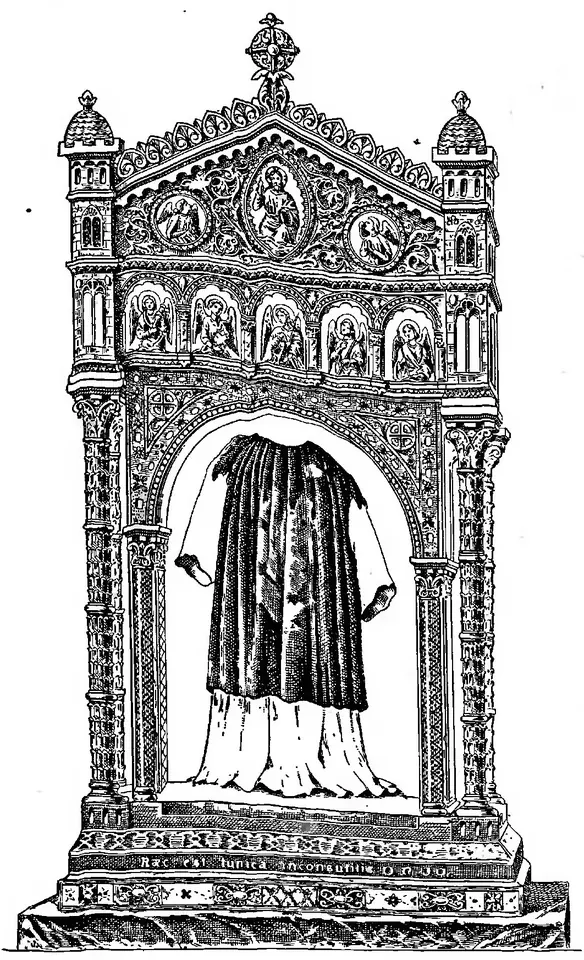
The French Revolution nearly destroyed it. In 1793 the parish priest cut the tunic into pieces and hid them so that it would not be burned. Four pieces, one large and three small, were recovered later. The relic was moved into the new basilica of Saint-Denys in 1865.
The Argenteuil tunic is a fine reddish-brown wool. According to Aleteia's 2025 account, tests carried out in 1998 and 2004 reported sheep's wool, a weave and a madder dye known from the ancient Near East, and bloodstains of group AB. Carbon dating gave a medieval date, which the tunic's defenders dispute. The Church has made no judgment.
Argenteuil shows its tunic fully only rarely: in 1934, in 1984, for the Jubilee of Mercy from March 25 to April 10, 2016, when Vatican News counted more than 200,000 pilgrims, and again in the spring of the 2025 Jubilee. At other times it rests folded in its reliquary in the basilica, where the faithful can pray before it.

The robe in the Eastern Churches
The Orthodox churches keep a different tradition. According to the Orthodox Church in America's life for July 10, Georgian tradition holds that the tunic of the Lord (the chiton) was carried from Jerusalem to Mtskheta by a Jewish rabbi named Elioz and lies beneath the foundations of Svetitskhoveli Cathedral. A robe of the Lord was also kept in the cathedral's treasury until the Persian Shah Abbas I carried it off in the 17th century and sent it in 1625 as a gift to Patriarch Philaret and Tsar Michael of Moscow. It was placed in the Dormition Cathedral of the Kremlin on March 29, 1625, and the Russian Church still keeps a feast of the Placing of the Robe of the Lord on July 10.
Two robes and one Lord
Trier and Argenteuil cannot both hold the same tunic, and Catholic writers have long known it. The Catholic Encyclopedia's 1910 article sets out how each side has tried to explain the other's relic, as tunic and outer garment, and gives its own view that nothing in Trier's examinations contradicted its ancient tradition. The Church herself has never ruled on either relic. The Diocese of Trier says plainly that the robe's authenticity can be proven neither historically nor scientifically, and invites pilgrims to come anyway, as to a sign that points to Christ.
That is how to approach the seamless robe. We don't venerate wool and thread for their own sake. We honor the Lord who was stripped of everything for us, and we pray, as Trier's pilgrims did in 2012, for the unity of his Church, which, like his tunic, ought never to be torn.
For the other relics of the Passion, see the True Cross, the Holy Lance, the Veil of Veronica, the Shroud of Turin, the Sudarium of Oviedo and the Scala Sancta, and pray the Stations of the Cross, whose tenth station is the stripping of Jesus' garments.
Frequently asked questions
Where is the seamless robe of Jesus today?
Two churches in the West claim it. Trier Cathedral in Germany keeps the Holy Robe (Heiliger Rock), by tradition sent there by St. Helena. The Basilica of Saint-Denys in Argenteuil, near Paris, keeps the Holy Tunic, by tradition given by Charlemagne. In the East, Georgian tradition holds that the Lord's tunic is buried beneath Svetitskhoveli Cathedral at Mtskheta, and the Russian Church honors a part of the Robe of the Lord brought to Moscow in 1625.
What does the Bible say about the seamless robe?
"The soldiers therefore, when they had crucified him, took his garments, (and they made four parts, to every soldier a part,) and also his coat. Now the coat was without seam, woven from the top throughout. They said then one to another: Let us not cut it, but let us cast lots for it, whose it shall be" (John 19:23–24, Douay-Rheims). St. John says this fulfilled Psalm 21 (22): "They parted my garments amongst them; and upon my vesture they cast lots."
When will the Holy Robe of Trier be shown again?
On September 27, 2026, Bishop Stephan Ackermann announced that the Diocese of Trier will show the Holy Robe again in 2033, the Jubilee of the Redemption, 2,000 years after the death and resurrection of Christ and a century after the Holy Year of 1933. The last showing was in 2012. Each year the diocese also holds the Heilig-Rock-Tage (Holy Robe Days), when the chapel that keeps the relic is open to pilgrims, though the robe itself stays in its shrine.
Is the Holy Robe of Trier authentic?
No one can prove it either way. The Diocese of Trier says plainly that its authenticity can be demonstrated neither historically nor scientifically. The Helena tradition is first written down in the early 12th century, and the robe's documented history begins in 1196. The diocese says a 1973 examination found that the oldest fabric, a felted wool at the center of many layers of later protective textiles, could go back to the first century.
What is the difference between the robe of Trier and the tunic of Argenteuil?
Both are venerated as the garment of John 19, so they cannot both be the same piece of cloth. The Catholic Encyclopedia notes that each side has offered a way to keep both: defenders of Argenteuil came to say that theirs is Christ's outer garment and Trier's the tunic, while defenders of Trier described the Argenteuil relic as a cloak. The oldest document from Argenteuil, of 1156, calls its relic the "cappa pueri Jesu," the cloak of the child Jesus.
What does the seamless robe symbolize?
The Fathers of the Church saw in the undivided tunic a sign of the unity of the Church. St. Cyprian, writing in the 3rd century, said: "That coat bore with it an unity that came down from the top, that is, that came from heaven and the Father." Trier's 2012 pilgrimage took up the same theme under the motto "and bring together what is divided."
Sources
- Catholic Encyclopedia (1910): Holy Coat (of Trier and Argenteuil)
- Bistum Trier: Geschichte der Tunika (history of the Holy Robe)
- Bistum Trier: Der Heilige Rock (the relic, the 1973 examination, the Holy Robe Days)
- Bistum Trier: Der Heilige Rock wird 2033 wieder gezeigt (September 27, 2026)
- Vatican News: La Sainte Tunique d'Argenteuil exposée à la vénération des fidèles (March 17, 2024)
- Aleteia: Le retour en grâce de la Sainte-Tunique d'Argenteuil (April 18, 2025)
- Orthodox Church in America: The Placing of the Honorable Robe of the Lord at Moscow
- St. Cyprian, On the Unity of the Church (New Advent)