Sudarium of Oviedo

The Sudarium of Oviedo is a bloodstained linen cloth, about 34 by 21 inches, kept in the Cámara Santa of Oviedo Cathedral in Spain and venerated as the cloth that covered Jesus' head after his death (John 20:7). Its history is documented from 1075. It bears no image, and its carbon dates (7th to 9th century) are disputed. The faithful see it on Good Friday, September 14 and September 21.
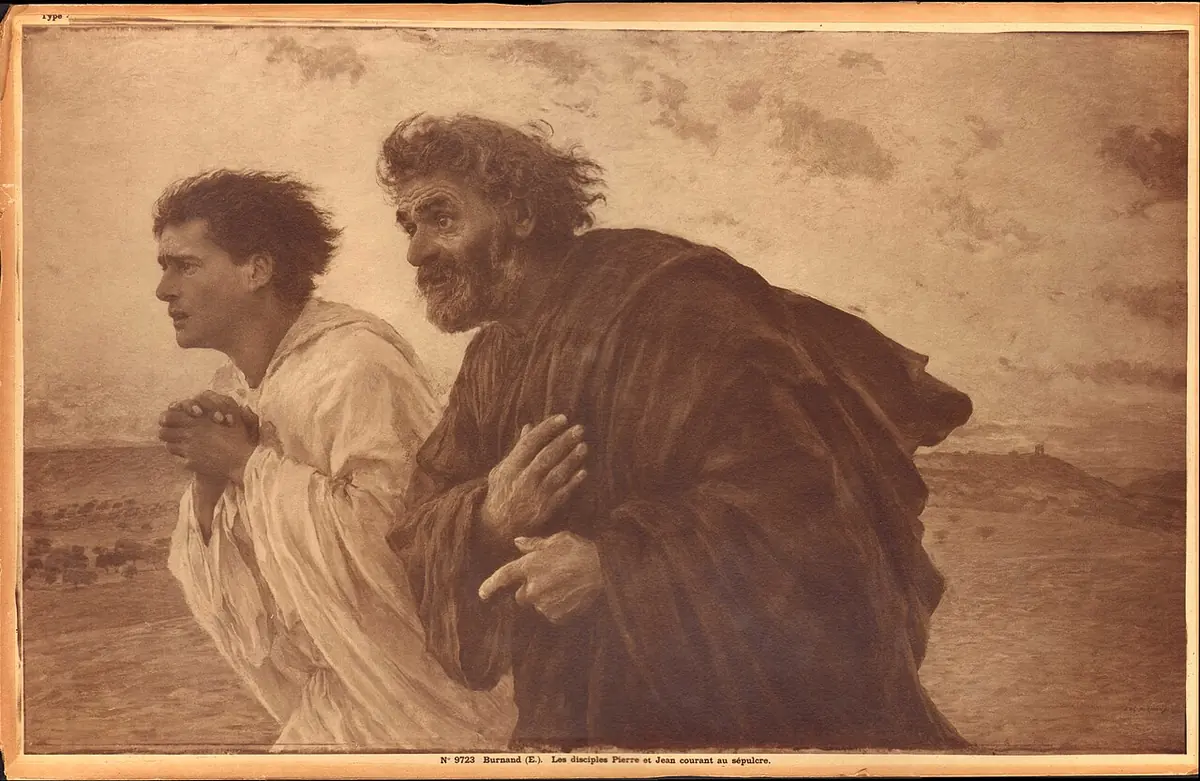
On Easter morning, Peter and John ran to the tomb. John looked in first and saw the linen cloths lying there. Then Peter went in, "and saw the linen cloths lying, and the napkin that had been about his head, not lying with the linen cloths, but apart, wrapped up into one place" (John 20:6–7, Douay-Rheims). That napkin, in Latin sudarium, is the cloth the cathedral of Oviedo in northern Spain has venerated for more than nine centuries. The Sudarium of Oviedo is a small, plain piece of linen with dark stains of blood. It has no image on it. Its history, its journey across the Mediterranean and the questions science has raised about it are told below, as honestly as the sources allow.
What the Sudarium is
The Sudarium is a rectangle of linen measuring 85.5 by 52.6 centimeters, roughly 34 by 21 inches. The cathedral describes the weave as a simple taffeta (plain) weave of Z-twisted thread. It is creased and worn. Across its middle runs a set of stains, pale brown now, that repeat in fainter copies because the cloth was folded when they soaked through.
Tradition holds that this cloth was laid over the face of Jesus after he died on the Cross, while his body was taken down and carried to the tomb, and then removed before the body was wrapped in the shroud. Jewish custom, as defenders of the relic point out, covered a face that had been disfigured in death. In the tomb, the cloth was set apart, which is just where St. John says he saw it.

The word sudarium means a cloth for wiping sweat. In the Middle Ages the same word was used for the Veil of Veronica, which bore a likeness of the Holy Face. The two relics are different: Veronica's veil is linked with the road to Calvary, and the Oviedo cloth with the burial.
From Jerusalem to Oviedo
The early history of the Sudarium comes from Pelayo, bishop of Oviedo in the early 1100s, who wrote it down in the Book of the Testaments of Oviedo and his chronicle of the kings of León. Pelayo was a great promoter of his cathedral, and the story he tells is a traditional one, written down centuries after the events it describes. Here is how it runs.
The cloth stayed in the Holy Land until shortly before 614, when the Persian king Chosroes II took Jerusalem. A priest named Philip carried it, with other relics, to Alexandria in a chest. When the Persians reached Alexandria in 616, the chest went west along the coast of North Africa and crossed to Spain at Cartagena with Christians fleeing the war. Bishop Fulgentius of Écija received it and handed it to St. Leander, bishop of Seville. It stayed at Seville in the time of Leander's brother St. Isidore of Seville, and when Isidore's student St. Ildephonsus became archbishop of Toledo, the chest went with him to Toledo.
In 711 the Muslim armies crossed into Spain. The chest was taken north to the mountains of Asturias, the one corner of the peninsula that held out, and hidden in a cave on Monte Monsacro, about ten kilometers from Oviedo. When King Alfonso II made Oviedo his capital, he brought the chest down into the city.

The Cámara Santa and the opening of 1075
The relics were kept in a small chapel beside the cathedral, the Cámara Santa or "Holy Chamber." Tradition credits Alfonso II with building it. The cathedral notes that archaeology points instead to the reign of Alfonso III (866–910), when it served as the bishop's chapel. It has two floors: the crypt of St. Leocadia below and the chapel of St. Michael above, where the relics are kept.

For centuries the chest stayed shut. The firm history of the Sudarium begins in March 1075, when the Arca Santa was solemnly opened in the presence of King Alfonso VI, his sister Doña Urraca, Rodrigo Díaz de Vivar, the knight known to history as El Cid, and several bishops. Most accounts give the date as March 14; the cathedral gives March 13. A list of the relics was drawn up, and among them was a cloth described as de sudario Domini, "of the sudarium of the Lord." A copy of that record is still kept at Oviedo.

The cathedral says the king was so moved by what he saw that he had the oak chest covered with embossed silver plates. That is the Arca Santa you see today, with Christ in glory and the apostles on its front. The 1911 Catholic Encyclopedia adds a story about a 16th-century bishop of Oviedo, Cristóbal de Sandoval y Rojas, who wanted to open the chest again "but could not, being overcome with religious fear."
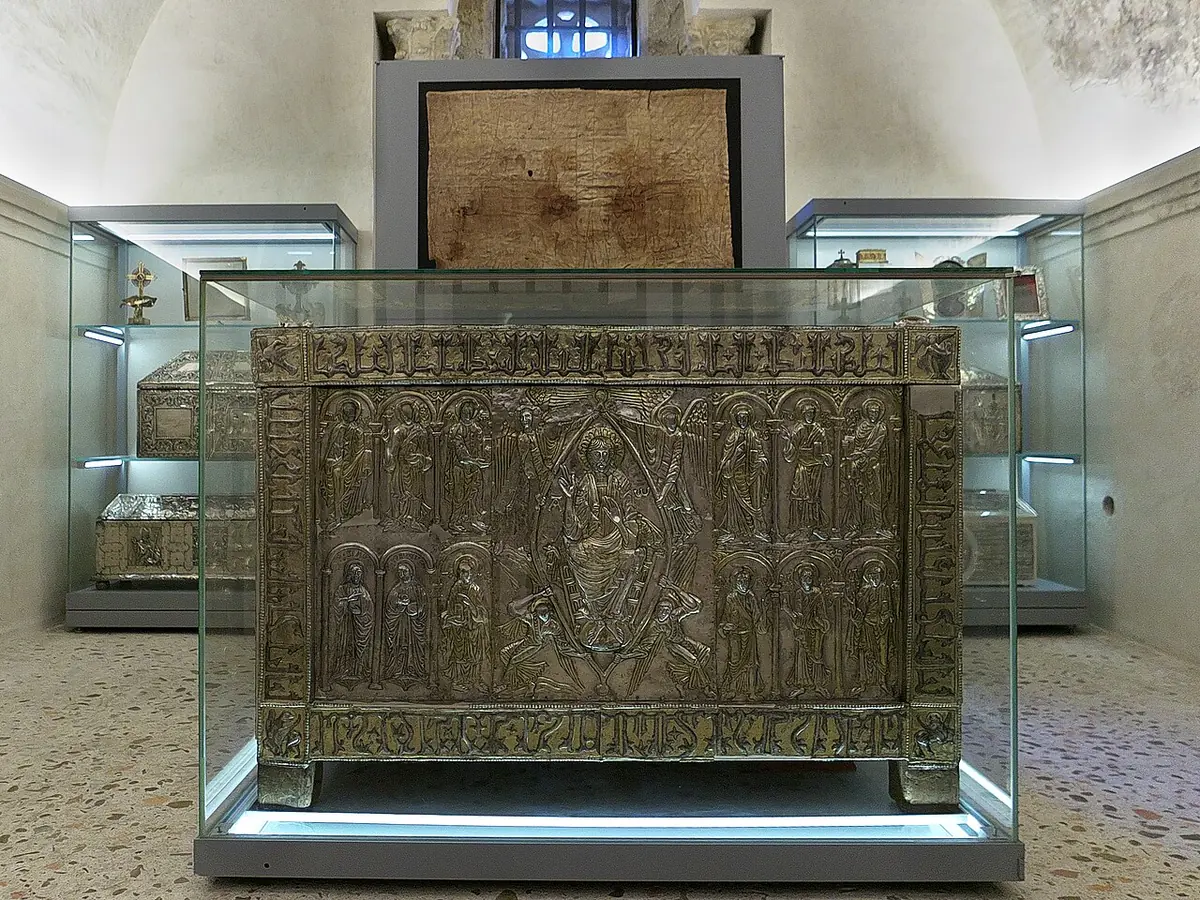
The 20th century nearly destroyed it all. In October 1934, during the revolutionary uprising in Asturias, dynamite blew up the Cámara Santa. The chest was badly damaged, but the Sudarium survived. The chapel was rebuilt between 1939 and 1942.
The Sudarium and the Shroud of Turin
Since the 1980s the Spanish Center for Sindonology (CES) has studied the cloth closely, led by Guillermo Heras with the forensic doctor José Villalaín. Mark Guscin, who worked with them, summarized their findings in 1997. These are the main reported results:
- The main stains are about one part blood to six parts of a watery fluid. The CES team took this as the fluid that collects in the lungs of a crucified man who dies of asphyxia.
- The way the stains overlap suggests the cloth was held to the face of a man who died upright, then stayed on during a short time on the ground and while the body was carried.
- Smaller stains at the back of the head look like wounds from sharp points, and marks near the nose look like the fingers of someone pressing the cloth to the face.
- The cathedral states that the blood is human and of group AB, the same group researchers have reported for the Shroud of Turin.
- Using an overlay method, the American researcher Alan Whanger counted about 70 points where the front stains matched the face on the Shroud, and about 50 on the back.
- The Swiss criminologist Max Frei reported pollen from Oviedo, Toledo, North Africa and Jerusalem, matching the route Pelayo describes.
If these results hold, the two cloths covered the same face, and the Sudarium's documented history, which goes back further than the Shroud's, would argue for the Shroud's antiquity as well. That is why the Sudarium is always part of the Shroud of Turin debate.
Honesty requires two cautions. Most of this work comes from researchers who believe the cloths are authentic, and few of the results have been repeated by independent laboratories. Frei's pollen work has been questioned for the Shroud as well. None of it has been formally examined or endorsed by the Church.
The carbon dating dispute
The Sudarium has been carbon-dated more than once, and the results do not agree with the tradition. Felipe Montero Ortego of the CES team, a chemical engineer, set them out in full:
- Samples sent by the Italian researcher Mario Moroni were tested at the University of Arizona in Tucson (result reported October 31, 1990) and at IsoTrace in Toronto (September 11, 1991). They gave radiocarbon ages of 1292 ± 53 and 1300 ± 40 years, which calibrate to about 642–869 AD and 653–786 AD.
- In 2007 the CES sent a new sample to Beta Analytic in Miami, which reported 660–890 AD.
On the face of it, the cloth is from the 7th to the 9th century. Montero and his colleagues argue that the threads carry black, oily contamination, perhaps from candles, lamp smoke and the 1934 explosion, which would make the cloth look younger than it is. Others accept the dates. Taken at face value, the dates would also mean the linen was made after the year 614, when Pelayo says it left Jerusalem. The question stays open, and this page leaves it there.
When the Sudarium is shown
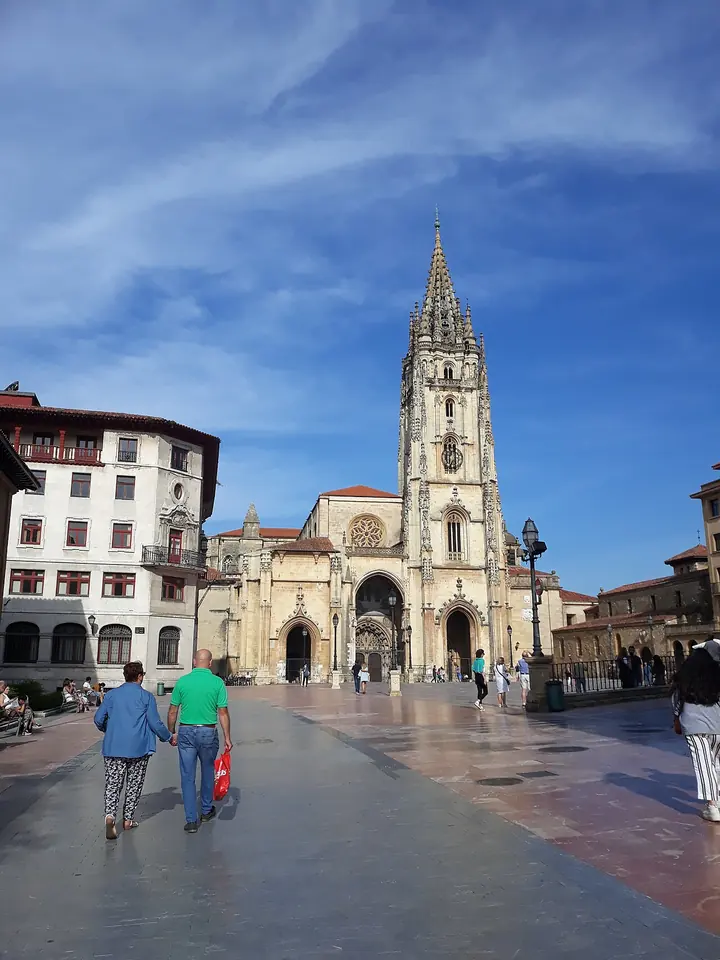
The Sudarium is kept in the upper chapel of the Cámara Santa. The cathedral gives these times:
- Good Friday: after the afternoon liturgy of the Lord's Passion, the faithful are blessed with the Sudarium from the high altar.
- September 14, the Exaltation of the Holy Cross, at the opening of the Jubilee of the Holy Cross, known locally as La Perdonanza.
- September 21, the feast of St. Matthew, when the Jubilee closes with a second blessing.
During Holy Week, Easter Week and the Jubilee week, the cloth can also be seen in the Cámara Santa itself. A facsimile is on show every day. In the Jubilee week, the archdiocese announces each year that a plenary indulgence may be gained in the cathedral under the usual conditions: sacramental confession, Holy Communion and prayer for the intentions of the Holy Father.
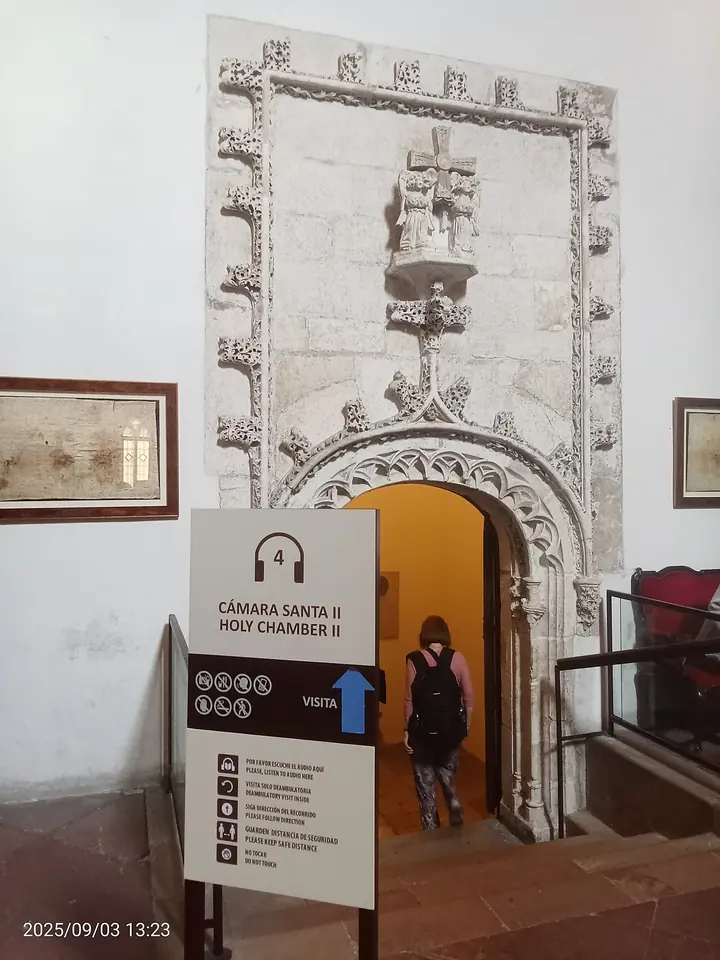
Pilgrims on the Camino Primitivo, the oldest road to St. James at Compostela, traditionally start here, after praying in the Cámara Santa. An old Spanish saying captures it: whoever goes to Santiago and not to San Salvador visits the servant and not the Lord.
What the Church says
The Church has never declared the Sudarium to be the face cloth of Christ, just as it has made no such declaration for the Shroud. It allows the faithful to venerate the cloth as a holy relic of the Passion, and the Archdiocese of Oviedo honors it publicly each year. As with every relic, the honor goes not to linen and stains but to the Lord whose death and burial they recall.
When we stand before the Sudarium on Good Friday, let us remember the quiet work of the women and of St. Joseph of Arimathea and Nicodemus, who cared for the body of Jesus when he could do nothing for himself. And let us remember Easter morning, when St. John saw the cloths set aside in the empty tomb, "and he saw, and believed."
For the other relics of the Passion, see the Shroud of Turin, the Veil of Veronica, the True Cross, the Holy Lance, the seamless robe of Jesus and the Scala Sancta, and read how the Church honors relics.
Frequently asked questions
What is the Sudarium of Oviedo?
It is a small linen cloth, 85.5 by 52.6 cm by the cathedral's measurement, with stains of human blood on it and no image. Tradition holds that it was laid over the face of Jesus after he died and before he was wrapped in the shroud, and that it is the "napkin that had been about his head" which St. John saw in the empty tomb. It is kept in the Cámara Santa of the Cathedral of San Salvador in Oviedo, Spain.
Is the Sudarium of Oviedo the same as the Shroud of Turin?
No. The Shroud of Turin is a long linen burial cloth, more than 14 feet, that bears the faint image of a whole man. The Sudarium is a much smaller cloth with bloodstains and no image. Researchers who compare them say the stains on the Sudarium fit the face on the Shroud, but the Church has made no judgment on either cloth's authenticity.
When is the Sudarium of Oviedo shown to the public?
Three days a year the cathedral blesses the faithful with the Sudarium from the high altar, on Good Friday, on September 14 (the Exaltation of the Holy Cross) and on September 21, the close of the Jubilee of the Holy Cross. It can also be seen in the Cámara Santa during Holy Week, Easter Week and the Jubilee week. A facsimile is on show every day.
How old is the Sudarium of Oviedo?
The written record begins with the opening of the Arca Santa in March 1075, when the cloth was listed among the relics in the chest. Earlier history comes from the 12th-century chronicles of Bishop Pelayo of Oviedo. Carbon tests at Tucson and Toronto (1990–1991) and at Beta Analytic (2007) gave dates between about the mid-600s and late 800s AD; researchers who defend the cloth's antiquity argue the samples were contaminated.
What blood type is on the Sudarium of Oviedo?
The cathedral states that the blood is human, type AB. Researchers of the Spanish Center for Sindonology report the same group for the Shroud of Turin. Blood typing of very old stains is difficult, and these results have not been confirmed by independent laboratories.
Can you visit the Sudarium of Oviedo?
Yes. The Cámara Santa is part of the cultural visit to Oviedo Cathedral, and the reliquary chamber is the traditional starting point of the Camino Primitivo to Santiago. To see the cloth itself, come in Holy Week, Easter Week or September 14 to 21, and check the cathedral's schedule first.
Sources
- Catedral de Oviedo: Cámara Santa (the Arca Santa and the Santo Sudario)
- Archdiocese of Oviedo: Jubileo de la Santa Cruz en Oviedo (press release, 2025)
- Mark Guscin, The Sudarium of Oviedo: Its History and Relationship to the Shroud of Turin (1997)
- Felipe Montero Ortego, The Date of the Linens by C14: The Particular Case of the Sudarium of Oviedo (EDICES)
- Catholic Encyclopedia (1911): Oviedo
- Gospel of John, chapter 20 (Douay-Rheims)