Thurible
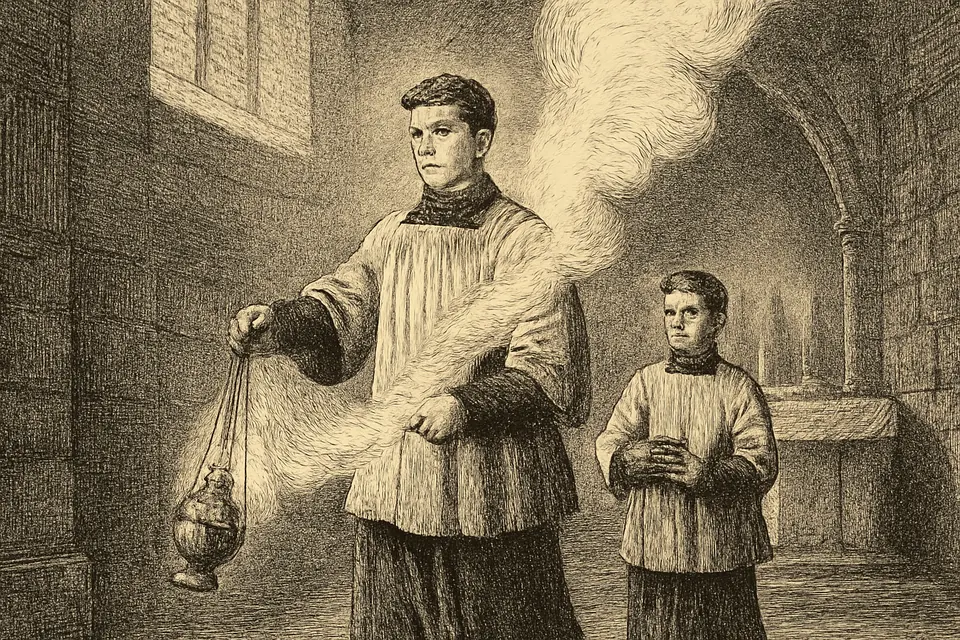
A thurible is the metal censer, hung on chains, in which incense is burned on hot charcoal during Catholic worship. Swung by the priest or deacon toward the altar, the Gospel, the gifts, the Blessed Sacrament and the people, it sends up fragrant smoke as a sign of reverence and of our prayer rising to God.
A thurible is the censer of the Catholic Church: a metal bowl hung on chains, in which grains of incense are sprinkled on burning charcoal and swung so that their fragrant smoke rises before the altar. If you have ever walked into a church on Easter morning and caught the sweet, heavy smell of incense hanging in the air, you have met the thurible. "Let my prayer be directed as incense in thy sight," prays the Psalmist, "the lifting up of my hands, as evening sacrifice" (Psalm 140:2, Douay-Rheims). Every time the thurible swings, the Church acts out that verse. This page explains the thurible and its parts, the servers who carry it, why the Church burns incense, its roots in Scripture, how and when it is used, and the most famous thurible in the world, the Botafumeiro of Santiago de Compostela.
What is a thurible?
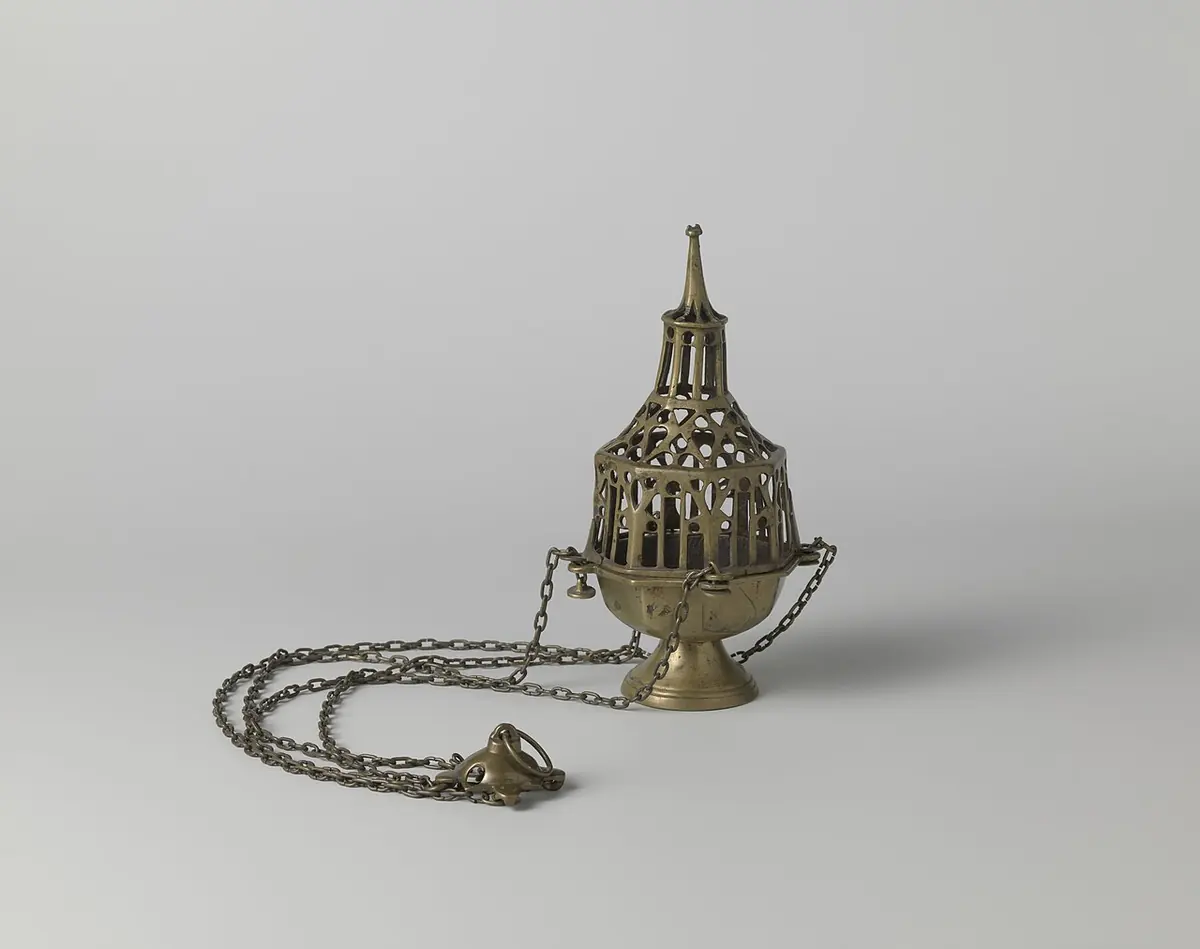
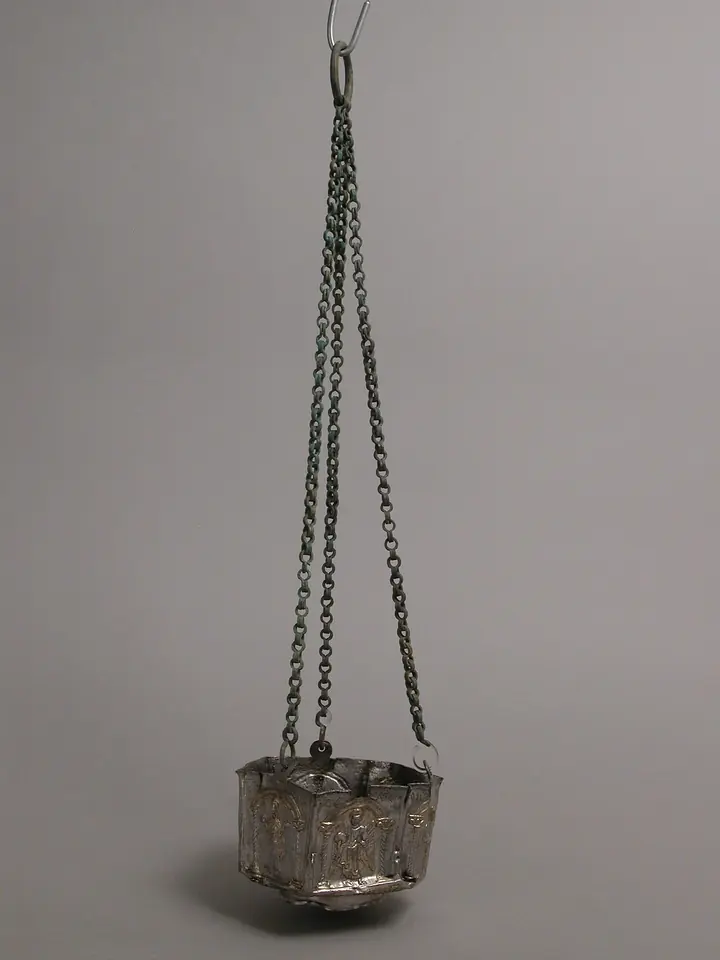
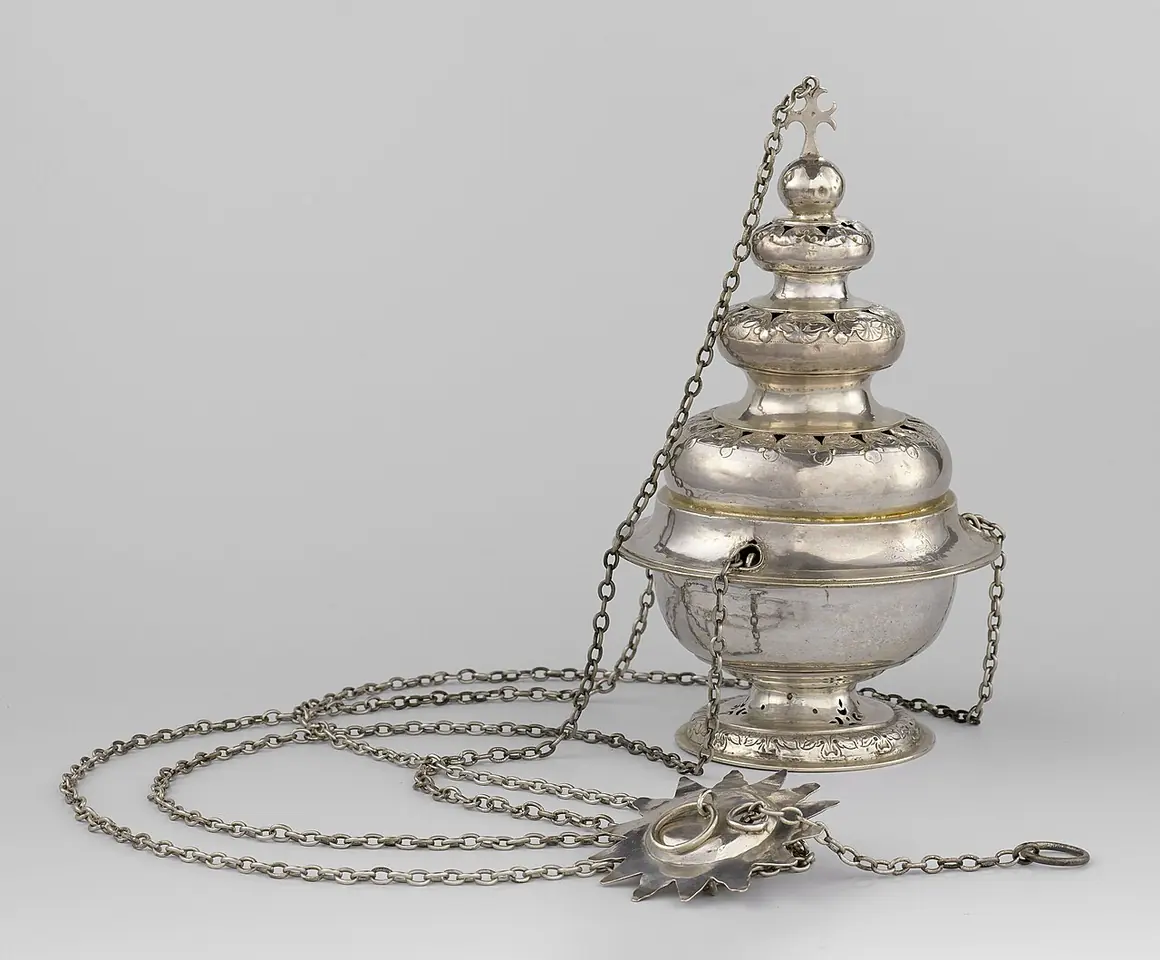
The word comes from the Latin thuribulum, from thus, incense; the older English name is censer. The Catholic Encyclopedia describes it as "a vessel suspended by chains, and used for burning incense at solemn Mass, Vespers, Benediction, processions, and other important offices of the Church." Its parts:
- The bowl, set on a firm foot, often lined with a removable metal pan that holds the burning charcoal.
- The lid, pierced with openings so the smoke can escape, often shaped like a dome, a tower or a little church.
- The chains, usually three or four, about three feet long. Three join the bowl to a disc at the top; the fourth runs through the disc to raise and lower the lid.
- The top ring or disc, held in the left hand.
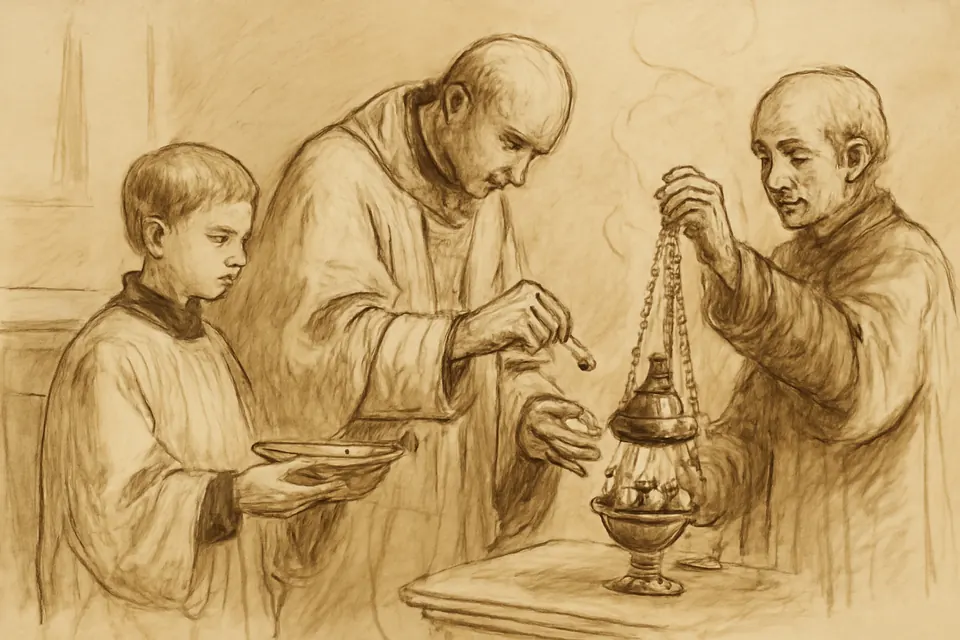
The thurible has a companion, the incense boat (in Latin navicula, "little ship," from its shape), a small covered dish that holds the grains of incense, with a little spoon.
The thurifer and the boat-bearer
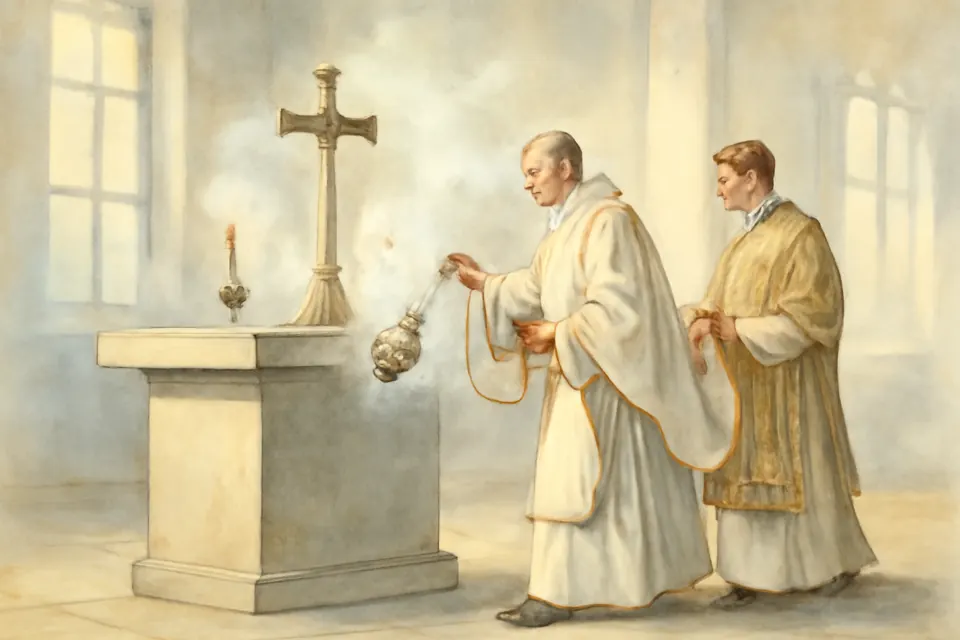
The server who carries the thurible is the thurifer, and it is one of the most honored jobs for an altar server. The thurifer lights the charcoal in the sacristy before Mass, leads the entrance procession with the thurible swinging gently at his side, kneels and brings it to the priest when incense is needed, and keeps the coals alive throughout the liturgy. A second, often younger server, the boat-bearer, walks beside him with the incense boat. The Catholic Encyclopedia notes that the thurifer carries the boat "in the disengaged hand" when there is no boat-bearer.
When the time comes, the thurifer opens the lid and holds up the thurible; the priest takes a spoonful of incense from the boat and sprinkles it on the coals, then blesses it with the sign of the cross. Today he does this "without saying anything" (General Instruction of the Roman Missal, no. 277); in the older form of the Mass he blessed it with a short Latin prayer.
Our page on priest vestments explains what the priest and deacon wear on the solemn days when incense is used.
Why the Church uses incense
The General Instruction gives the reason in one line: "Thurification or incensation is an expression of reverence and of prayer, as is signified in Sacred Scripture (cf. Ps 141 [140]:2, Rev 8:3)" (no. 276). Four meanings run together in the rising smoke.
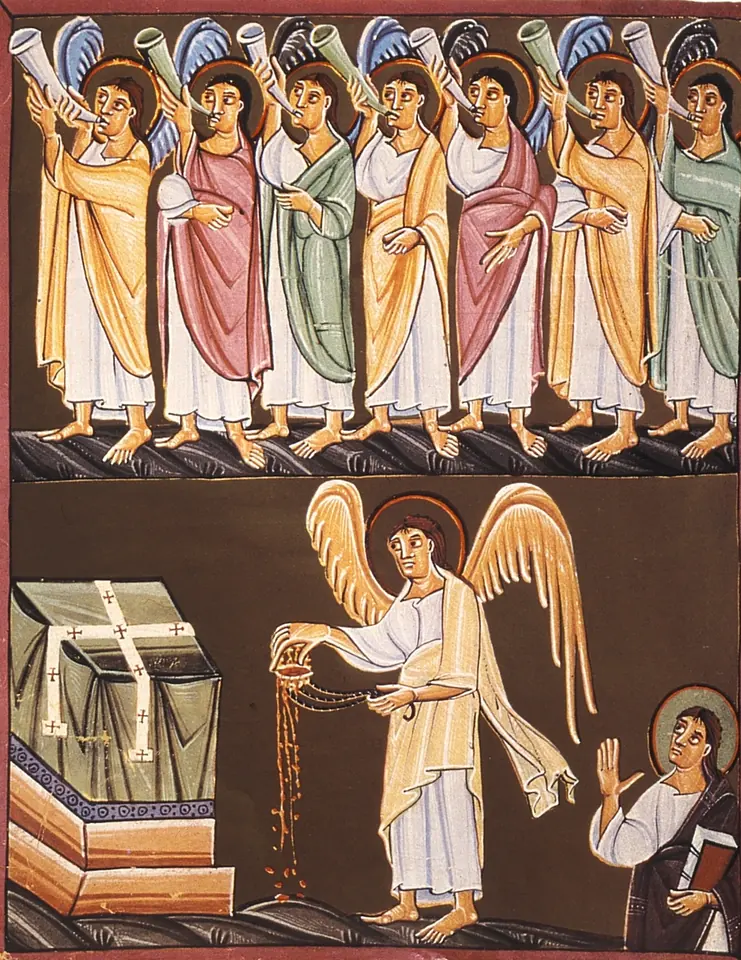
Prayer. The smoke rises, and so do our prayers. In the Book of Revelation St. John saw an angel at the heavenly altar "having a golden censer; and there was given to him much incense, that he should offer of the prayers of all saints upon the golden altar, which is before the throne of God. And the smoke of the incense of the prayers of the saints ascended up before God from the hand of the angel" (Apocalypse 8:3-4, Douay-Rheims). The Catholic Encyclopedia, following the ninth-century liturgist Amalarius, calls incense "typical of the good Christian's prayer, which, enkindled in the heart by the fire of God's love and exhaling the odour of Christ, rises up a pleasing offering in His sight."
Sacrifice. Incense is burned up entirely. Nothing is kept back. In the Temple it was offered with the sacrifices, and at Mass it surrounds the one Sacrifice of Christ. The prophet Malachi foretold that "in every place there is sacrifice, and there is offered to my name a clean oblation" (Malachias 1:11), and the Church has always read that verse as a prophecy of the Mass.
Honor. We incense what is holy: Christ in the Blessed Sacrament, the altar that stands for Christ, the cross, the Book of the Gospels, relics and images of the saints, and also the priest and the people, because each baptized Christian is a temple of the Holy Spirit.
Blessing and setting apart. Incense marks something as belonging to God: a new altar at its dedication, a church, a body laid to rest. Blessed incense is also a sacramental, one of the holy signs described on our sacramentals page.
Incense in Scripture
Incense runs through the whole Bible.
The altar of incense. God commanded Moses to build a golden altar of incense before the veil of the Holy of Holies: "And Aaron shall burn sweet smelling incense upon it in the morning... and when he shall place them in the evening, he shall burn an everlasting incense before the Lord throughout your generations" (Exodus 30:7-8, Douay-Rheims). Exodus 30 also gives the recipe for the holy incense, forbidden for any other use.
The evening prayer of the Psalms. "Let my prayer be directed as incense in thy sight; the lifting up of my hands, as evening sacrifice" (Psalm 140:2). The Church still sings this Psalm at Vespers, and in the Byzantine rite it is sung at every evening service while the church is censed.
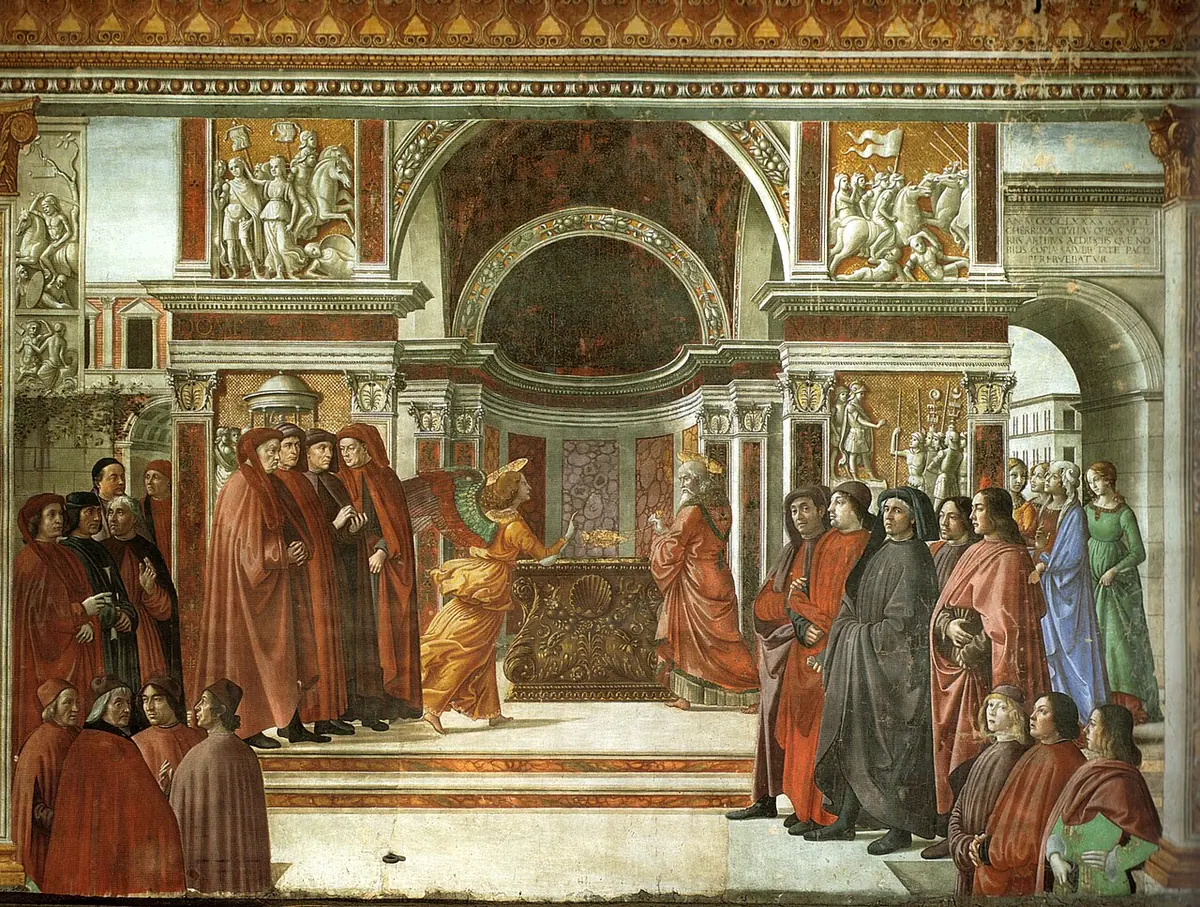
Zechariah in the Temple. The New Testament opens at the altar of incense. The priest Zechariah, father of St. John the Baptist, was chosen by lot "to offer incense, going into the temple of the Lord. And all the multitude of the people was praying without, at the hour of incense. And there appeared to him an angel of the Lord, standing on the right side of the altar of incense" (Luke 1:9-11). The good news of our salvation was first announced in a cloud of incense. Read more about St. Zechariah.
The gift of the Magi. The Magi "opening their treasures, they offered him gifts; gold, frankincense, and myrrh" (Matthew 2:11). The Fathers of the Church read the frankincense as homage to the Child's divinity, since incense is offered to God.
The heavenly liturgy. In Revelation the elders hold "golden vials full of odours, which are the prayers of saints" (Apocalypse 5:8), and the angel stands at the altar with the golden censer (8:3-5). When we swing the thurible at Mass, we join the worship of heaven.
Incense in the history of the Church
The first Christians were cautious about incense, and for a good reason: the Roman state used it as a test of loyalty. Under the Emperor Decius in 250, every citizen was ordered to sacrifice to the gods, and burning a little incense on a pagan altar counted as sacrifice. Those who gave in were called thurificati, "incense-burners," and they could be reconciled to the Church only after long penance, as the Catholic Encyclopedia records in its article on the lapsed. The martyrs died rather than offer that pinch of incense.
So the Catholic Encyclopedia finds "no evidence" of incense in Christian worship during the first four centuries, though it adds that the use of incense in the Temple and in the New Testament "would suggest an early familiarity with it." Once the persecutions ended, incense entered the liturgy quickly. The pilgrim Egeria saw it at the Sunday vigil in Jerusalem in the late fourth century; the Eastern liturgies of St. James and St. Mark use it at the Holy Mysteries; and a seventh-century Roman book of ceremonies shows it carried before the bishop in procession. In Rome, incense at the Gospel came early, at the Offertory in the 11th century, at the Introit in the 12th, and at the Elevation of the Host about the 14th.
When incense is used today
Incense may be used at any Mass, says the General Instruction (no. 276), at five moments:
- During the entrance procession, with the thurifer leading.
- At the beginning of Mass, to incense the cross and the altar.
- At the Gospel procession and the Gospel itself.
- At the Preparation of the Gifts, to incense the bread and wine, the cross, the altar, the priest and the people.
- At the elevations of the Host and chalice after the consecration.
Our guide to the order of the Mass explains each of these moments in the Mass.
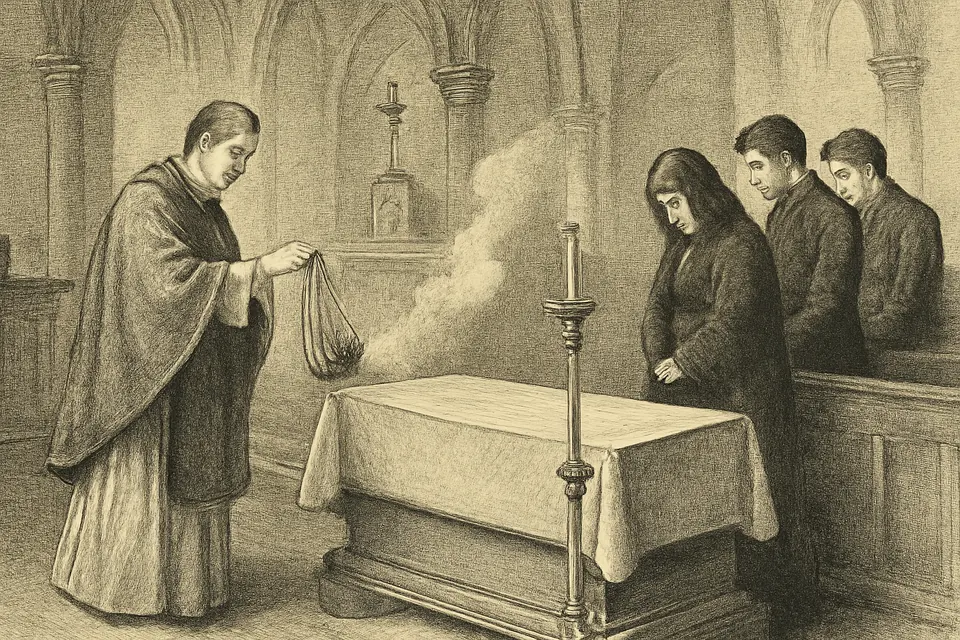
Outside Mass the thurible appears at Benediction and exposition of the Blessed Sacrament, when the priest incenses the Host in the monstrance during the Tantum ergo; at solemn Vespers during the Magnificat; in processions such as Corpus Christi; at the dedication of a church or altar, when incense is burned on the altar itself; and at funerals, where the coffin is incensed at the final commendation. The body that was a temple of the Holy Spirit is honored as it is entrusted to God. At the Easter Vigil five grains of incense are pressed into the paschal candle in the form of a cross, recalling the five wounds of the risen Christ; this, and the grains sealed in an altar's relic tomb, are the two cases the Catholic Encyclopedia names where incense is used without being burned.
How to swing a thurible
The Roman Missal fixes how many swings each person or object receives (General Instruction, no. 277):
- Three swings: the Most Blessed Sacrament, a relic of the Holy Cross and images of the Lord exposed for veneration, the offerings on the altar, the altar cross, the Book of the Gospels, the paschal candle, the priest and the people.
- Two swings: relics and images of the saints exposed for veneration, and only at the beginning of Mass.
- Single swings: the altar, incensed as the priest walks around it.
A profound bow is made before and after incensing a person or object, except the altar and the gifts.
The Catholic Encyclopedia describes the old technique: the thurible is held in the right hand at the height of the breast, grasped by the chains near the lid, while the left hand holds the top ring against the chest. "The censer is then raised upwards to the height of the eyes, given an outward motion and slightly ascending towards the object to be incensed, and at once brought back to the starting point. This constitutes a single swing." A double swing repeats the outward motion, the second more pronounced. A good thurifer keeps the swing smooth so the coals stay lit and the chains never tangle.
The traditional incensing prayers
In the older form of the Mass the priest prayed aloud as he incensed. These prayers, with the English of a 1903 Catholic book on the Mass by Father M. Gavin, S.J., are a treasury for anyone who loves incense.
Blessing the incense at the Offertory, the priest invoked the angel who stands by the altar of incense:
By the intercession of blessed Michael the Archangel, standing on the right hand of the altar of incense, and of all His elect, may the Lord vouchsafe to bless this incense, and to receive it in the odour of sweetness, through Christ our Lord.
(Father Gavin notes that Luke 1:11 says this of the angel Gabriel, and some old Missals used Gabriel's name here.) Incensing the bread and wine, he said: Incensum istud a te benedictum ascendat ad te, Domine, et descendat super nos misericordia tua, "May this incense blessed by Thee ascend to Thee, O Lord, and may Thy mercy descend upon us." Incensing the altar, he prayed the verses of Psalm 140, here in the Douay-Rheims:
Let my prayer be directed as incense in thy sight; the lifting up of my hands, as evening sacrifice. Set a watch, O Lord, before my mouth: and a door round about my lips. Incline not my heart to evil words; to make excuses in sins.
Handing back the thurible, he said: "May our Lord enkindle within us the fire of His love, and the flame of eternal charity."
What incense is made of
Church incense is mostly frankincense, the dried sap of Boswellia trees that grow in southern Arabia, the Horn of Africa and India. The Catholic Encyclopedia names the Boswellia of "Arabia Felix" and of India as the two ancient sources. Frankincense is often blended with other resins and fragrant gums, such as myrrh, benzoin and styrax, and sometimes with essential oils of rose or other flowers, so that each blend has its own scent. The grains are burned on small round charcoal tablets that light quickly and burn for about an hour.
A few practical notes for parishes and servers: light the charcoal well before Mass so it is glowing gray, not black; use only a small spoonful of incense at a time in small or crowded churches; open a door or window if anyone is sensitive to smoke; and empty the ashes only when cold, into the ground rather than a trash can, since the incense was blessed.
The Botafumeiro of Santiago de Compostela
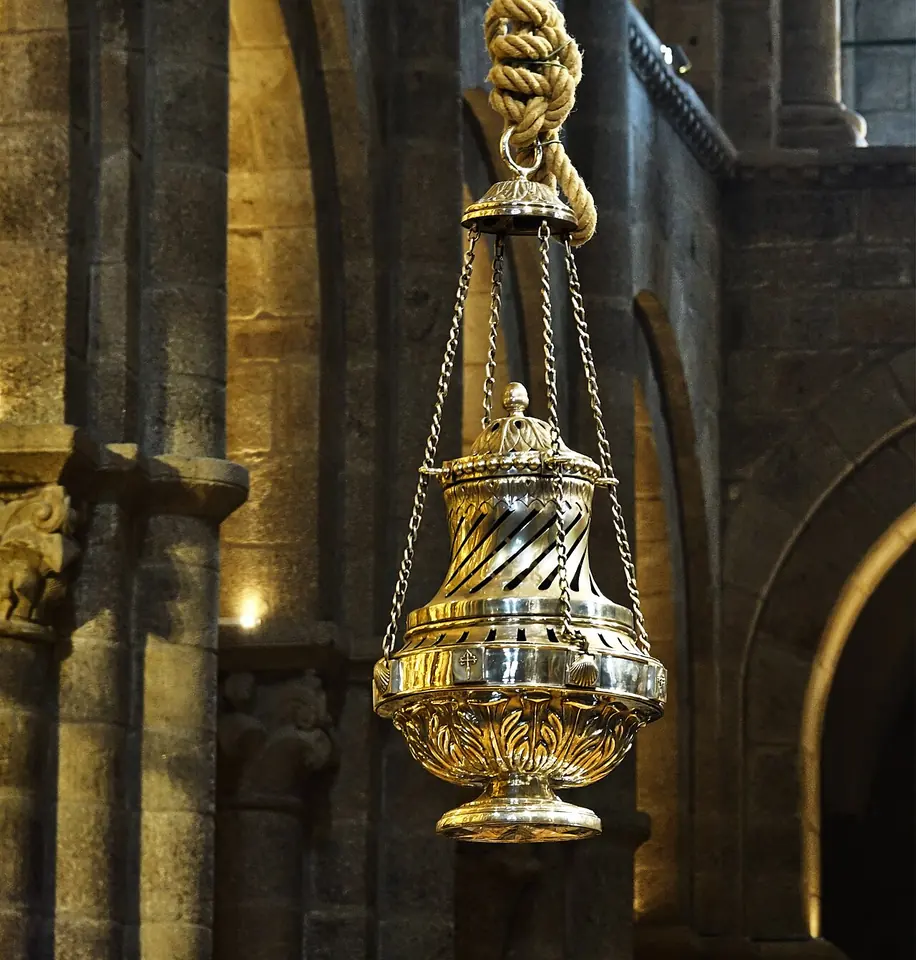
The most famous thurible in the world hangs in the Cathedral of Santiago de Compostela in Galicia, Spain, above the tomb of St. James the Greater. Its Galician name, Botafumeiro, means "smoke-spreader."
The cathedral's own description: it is "a large thurible that hangs by means of a system of pulleys from the main dome of the Cathedral and swings toward the side naves. It takes eight men to move it, who are known as 'tiraboleiros'. It weighs 53 kg and measures 1.50 metres; it hangs from a height of 20 metres and can pick up great speed." Once the tiraboleiros give the first push and haul rhythmically on the rope, the great censer swings higher and higher until it nearly brushes the vaults of the transept, trailing smoke and sparks over the pilgrims below.
Its history is long. The cathedral points to the first documented reference in the 12th-century Codex Calixtinus, which calls it the Turibulum Magnum, the great censer. The wooden machinery that swings it, called the ingenio, was designed by Juan Bautista Celma of Aragon in 1602 and still turns today; it was fully restored in 2024. The censer itself has been replaced more than once. The one normally used is of silver-plated brass, made in 1851 by the goldsmith José Losada to replace one carried off during the French occupation; a solid silver copy, given to the cathedral in 1971, is kept in the chapter library. A story told in Santiago (traditional, not documented by the cathedral) says that in 1499, during a Mass attended by the young Princess Catherine of Aragon, the censer broke loose and flew out through a door.
The cathedral explains the meaning plainly: as the smoke rises to the top of the naves, "so must the prayers of the pilgrims rise to reach the heart of God," and as its fragrance fills the basilica, so Christians must fill the world "with the good scent of Christ." The Botafumeiro swings on the cathedral's great solemnities, including Epiphany, Easter, Pentecost, the feast of St. James on July 25, the Assumption, All Saints, Christ the King, the Immaculate Conception and Christmas, and for pilgrim groups who request it. It is sometimes stopped for maintenance, so pilgrims who hope to see it should check the cathedral's schedule. More shrines worth the journey are on our Catholic pilgrimage sites page.
Incense in the Eastern churches
The Byzantine churches, Orthodox and Eastern Catholic, use incense even more than the Roman Rite. Their censer is lighter, with shorter chains and usually twelve small bells, which tradition links to the twelve Apostles' preaching. The priest or deacon censes the whole church, the icons and every person in it at Vespers, Matins and the Divine Liturgy. In many Eastern homes, families burn a little incense before the icon corner during evening prayer.
Incense at home
Catholics may use blessed incense at home in prayer. A small charcoal burner before a crucifix or icon during the family rosary, or on the feast of the Epiphany, is an old custom; in German-speaking lands families still walk through the house with incense during the Epiphany house blessing. Take care with the coals.
When you next smell incense at Mass, let it remind you of what it means. Lift your heart, and pray with the Psalmist: Dirigatur, Domine, oratio mea sicut incensum in conspectu tuo. Let my prayer be directed as incense in thy sight.
Frequently asked questions
What is a thurible?
A thurible (also called a censer) is a metal vessel hung on chains in which incense is burned over hot charcoal during the liturgy. The word comes from the Latin thus, incense. The priest or deacon swings it to incense the altar, the cross, the Book of the Gospels, the bread and wine, the Blessed Sacrament, the priest and the people.
Why do Catholics use incense?
Incense is a sign of reverence and of prayer. Psalm 140 says, "Let my prayer be directed as incense in thy sight" (Douay-Rheims), and in Revelation the smoke of incense rises before God with the prayers of the saints. Its fragrance and rising smoke honor what is holy, mark something as set apart for God, and lift our hearts with our prayer.
What is a thurifer?
The thurifer is the altar server (or acolyte) who carries the thurible, keeps the charcoal burning, leads processions, and hands the thurible to the priest or deacon. A second server, the boat-bearer, often carries the incense boat with its spoon.
How many times do you swing a thurible?
The Roman Missal says three swings (each a double swing in practice) for the Blessed Sacrament, a relic of the True Cross, images of the Lord, the gifts on the altar, the altar cross, the Book of the Gospels, the paschal candle, the priest and the people; two swings for relics and images of the saints; and single swings while walking around the altar.
What is Catholic incense made of?
Mostly frankincense, the dried resin of Boswellia trees from Arabia, Somalia and India, often blended with other resins and fragrant gums such as myrrh, benzoin or styrax. It is burned on small self-lighting charcoal tablets inside the thurible.
What is the Botafumeiro?
The Botafumeiro (Galician for "smoke-spreader") is the giant thurible of the Cathedral of Santiago de Compostela in Spain. The cathedral gives its weight as 53 kilograms and its height as 1.5 meters; it hangs from 20 meters up and takes eight men, the tiraboleiros, to set it swinging across the transept on great solemnities.
Is incense used at every Mass?
No. Incense may be used at any Mass, but it is usually kept for Sundays, solemnities, funerals and other solemn celebrations. It is also used at Benediction, solemn Vespers, processions, the dedication of churches and altars, and blessings.
Sources
- General Instruction of the Roman Missal (2002, with U.S. adaptations), nos. 276–277: Incensation
- Catholic Encyclopedia (1910): Incense. When incense entered Christian worship, and how incensing is done
- Catholic Encyclopedia (1908): Censer
- Catholic Encyclopedia (1910): Lapsi. The thurificati of the Decian persecution
- M. Gavin, S.J., The Sacrifice of the Mass (3rd ed., London, 1903), pp. 165–168: The incensing at the Offertory. English of the traditional incensing prayers
- Psalm 140, Douay-Rheims Bible
- Cathedral of Santiago de Compostela: Liturgy, Botafumeiro
- Cathedral of Santiago de Compostela: restoration of the Botafumeiro mechanism (February 12, 2025). The 1602 mechanism by Juan Bautista Celma