Monstrance
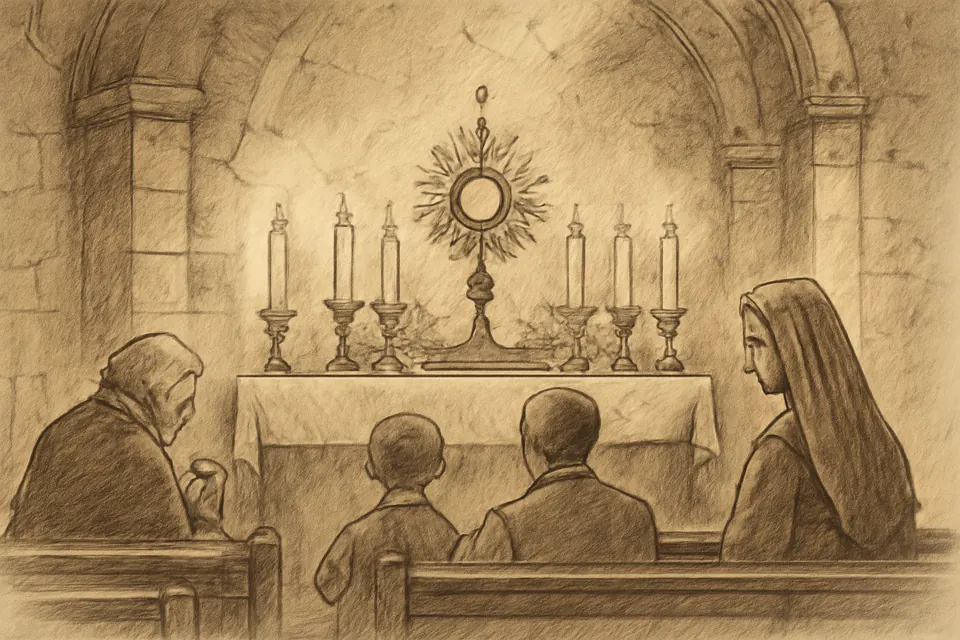
A monstrance is the sacred vessel in which the Church shows the consecrated Host to the faithful for adoration. The Host stands in a small glass-fronted holder called the luna, set in a frame that is usually shaped like a golden sun. We use it for exposition of the Blessed Sacrament, for Benediction and for Eucharistic processions.
A monstrance is the sacred vessel that holds the consecrated Host so that we can see Our Lord and adore him. Most people know it at a glance: a golden sun on a tall stand, with a circle of glass at its heart and a small white Host inside. If you have knelt at a holy hour, walked in a Corpus Christi procession or been blessed at Benediction, you have prayed before a monstrance. This page explains what a monstrance is, what each part is called, how it came to be, how the Church uses it, and why so many saints are painted holding one.
What is a monstrance?
The word comes from the Latin monstrare, "to show." Its older and more formal name, ostensorium, comes from ostendere, which means the same. In Spanish the vessel is a custodia, the guardian. The Catholic Encyclopedia notes that the words were once used for any glass-fronted vessel of gold or silver, including reliquaries that showed a saint's bones, but that English usage came to reserve them for "vessels intended for the exposition of the Blessed Sacrament."
That is the whole purpose of a monstrance. Every day the Lord is present in the tabernacle of a Catholic church, hidden behind a closed door. In the monstrance the same Lord is shown openly, set on the altar so that our eyes can rest on him while we pray. The monstrance adds nothing to the Host. Christ is no more present in a jeweled custodia than in a plain ciborium. It exists so that we can look, and keep looking.
The parts of a monstrance
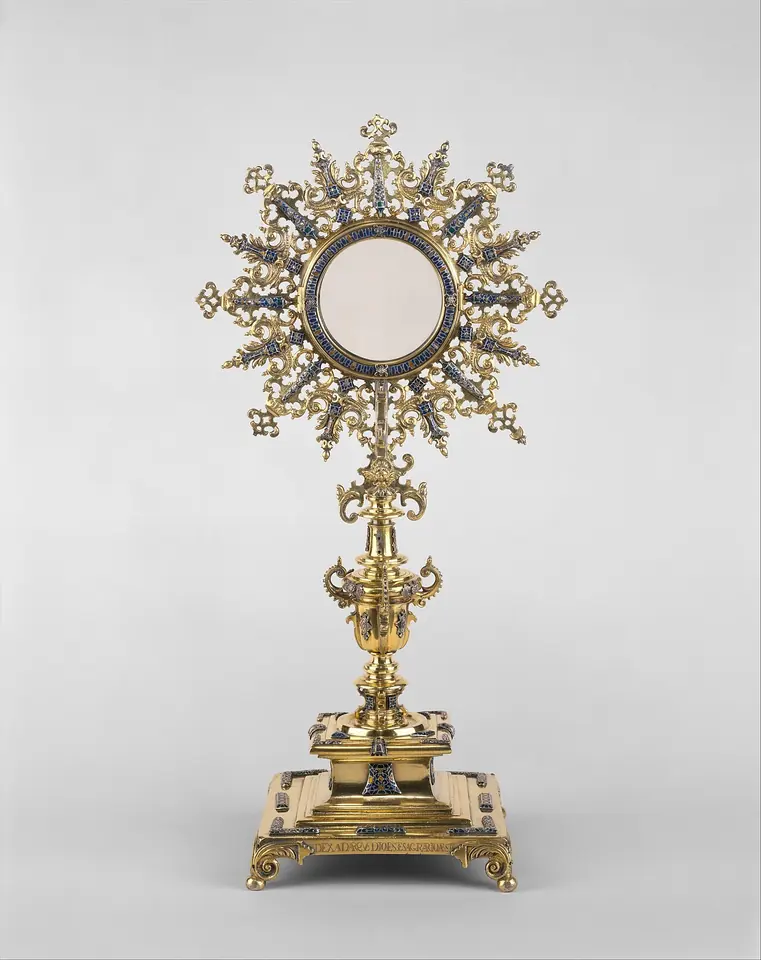
A monstrance can be a simple brass sun a foot high or a silver tower taller than a man, but the parts are the same:
- The foot or base, wide and heavy so the vessel stands firmly on the altar. On older pieces it is often lobed or footed and engraved with scenes of the Passion or the Last Supper.
- The stem, with a knob (the node) in the middle so the priest can grip it safely.
- The luna or lunette, a small gilded holder, round or crescent-shaped, that grips the Host upright. Its name is Latin for "moon." When the Host is not exposed, the luna with the Host is kept in the tabernacle in a small case.
- The window or glass case, the opening at the center into which the luna slides, closed by glass on both sides.
- The rays or frame, usually a sunburst of gold, sometimes with angels, wheat and grapes, or jewels.
- The cross at the top. The Catholic Encyclopedia notes that the Church recommends that a monstrance "should be surmounted by a cross," and that its orb and rays be at least of silver or silver gilt.
Why we adore the Host in the monstrance
The monstrance makes sense only in the light of what it holds. The Church believes, as Christ said at the Last Supper, that the consecrated Host is his Body. The Catechism teaches that in the Eucharist "the body and blood, together with the soul and divinity, of our Lord Jesus Christ and, therefore, the whole Christ is truly, really, and substantially contained." The change of bread into his Body is what the Church calls transubstantiation, and its presence lasts "as long as the Eucharistic species subsist." The Host in the monstrance is not a picture of Jesus. It is Jesus.
That is why we adore. The Council of Trent taught in 1551 that the faithful "render in veneration the worship of latria, which is due to the true God, to this most holy sacrament," the same worship we give to God alone. The Catechism, quoting St. Paul VI, adds that the Church "has always offered and still offers to the sacrament of the Eucharist the cult of adoration, not only during Mass, but also outside of it, reserving the consecrated hosts with the utmost care, exposing them to the solemn veneration of the faithful, and carrying them in procession." The monstrance is the vessel of the last two: exposing and carrying. For the whole teaching, see What is the Eucharist?
The history of the monstrance
Before there were monstrances
For the first thousand years the Church reserved the Eucharist above all for the sick and the dying, and she did not yet show the Host for adoration outside Mass. The Catholic Encyclopedia dates the practice of exposing the Blessed Sacrament and carrying it in procession to no earlier than the 13th century. There were forerunners. Lanfranc's rule for the monks of Christ Church, Canterbury, about 1070, directs that on Palm Sunday two priests carry a portable shrine "in which also the Body of the Lord ought to be deposited." At St. Albans, Abbot Simon (1166–83) gave a costly ark-shaped shrine for the same procession, so "that the faithful might see with what honour the most holy Body of Christ should be treated." In those shrines, though, the Host was carried closed, not shown.
Corpus Christi and the first monstrances
The change came with the feast of Corpus Christi. St. Juliana of Liège, a Belgian canoness, spent years asking for a feast in honor of the Blessed Sacrament; the Diocese of Liège first kept it in 1246, and Pope Urban IV extended it to the whole Church in 1264, with an Office written by St. Thomas Aquinas. The feast brought processions, and processions brought a new desire: to see the Lord being carried.
At first, the Catholic Encyclopedia suggests, the ciborium itself was used, its cup lengthened by a cylinder of crystal or glass so the Host could be seen. One early record is the bequest of Archbishop Robert Courtney of Reims, who died in 1324: "a golden cross set with precious stones and having a crystal in the middle, in which is placed the Body of Christ, and is carried in procession upon the feast of the most holy Sacrament." The old inventories tell the rest of the story. St. Paul's in London lists nothing like a monstrance in 1245 or 1298, but in 1402 it records a "cross of crystal to put the Body of Christ in and to carry it upon the feast of Corpus Christi and at Easter." By the 15th century monstrances were found in all larger churches.
From Gothic towers to the sunburst
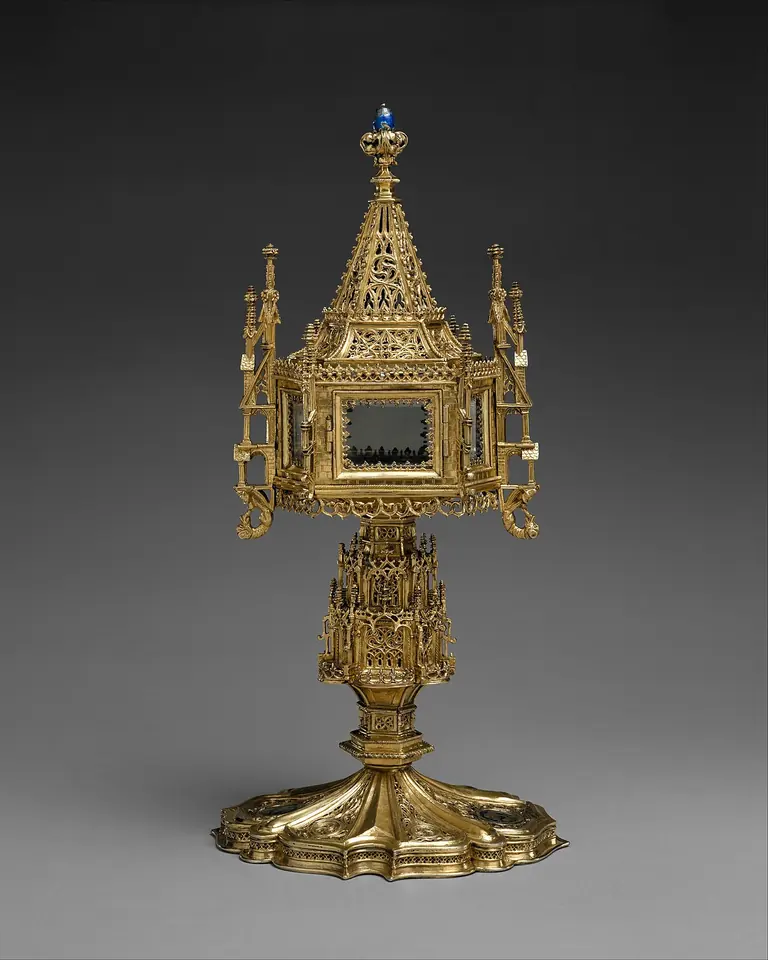
The first monstrances looked like little churches. Goldsmiths placed the crystal cylinder inside a frame of buttresses, pinnacles and niches with tiny saints, as though the Host were enthroned in a cathedral of its own. Engravers in the Low Countries and the Rhineland published designs for such pieces, and goldsmiths copied them across Europe.
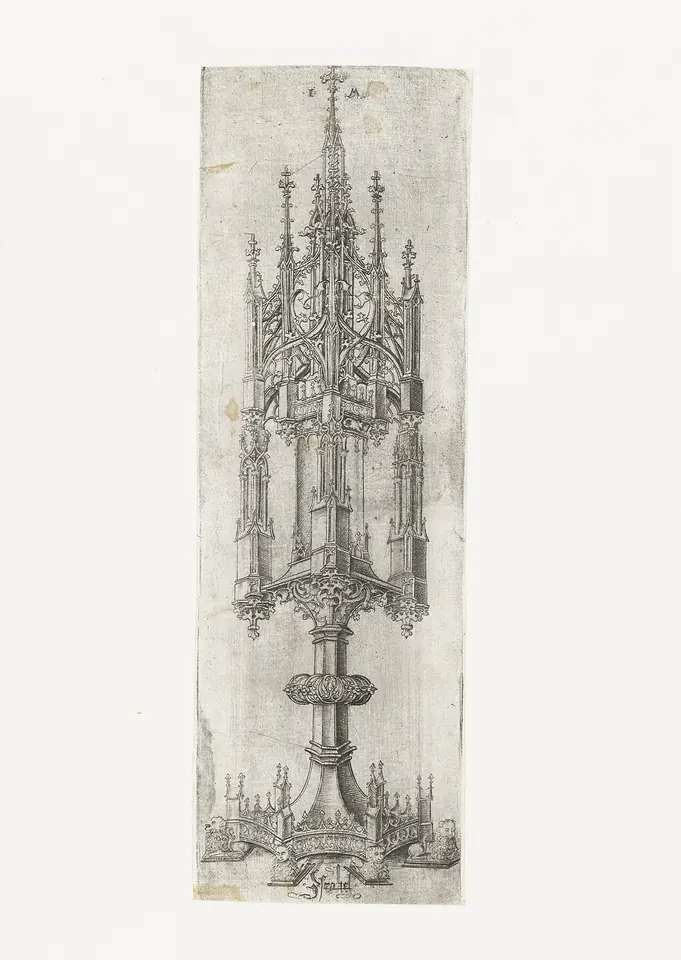
Then the form simplified. As the Catholic Encyclopedia puts it, "it became clear that the ostensorium could be better adapted to the object of drawing all eyes to the Sacred Host itself by making the transparent portion of the vessel just of the size required, and surrounded, like the sun, with rays." Sunburst monstrances appear from the 15th century, and for several hundred years they have been the usual shape. The image fits the faith it serves. The prophet Malachi foretold that "the Sun of justice shall arise" (Malachi 4:2), and we sing of Christ as the light of the world.
England had its own custom. Durham Cathedral carried a gilded "Corpus Christi Shrine" with "a four-square box all of crystal wherein was enclosed the Holy Sacrament of the Altar," and in Lincoln, Salisbury and other great churches the monstrance was sometimes a statue of Our Lord with the Host set behind a crystal door in his breast. All of it was lost at the Reformation.
Where the faith had to hide, the monstrance hid with it. In the Dutch Republic Catholics worshiped for two centuries in house churches tucked behind ordinary façades, and still they had monstrances made for Benediction.
The great Spanish custodias
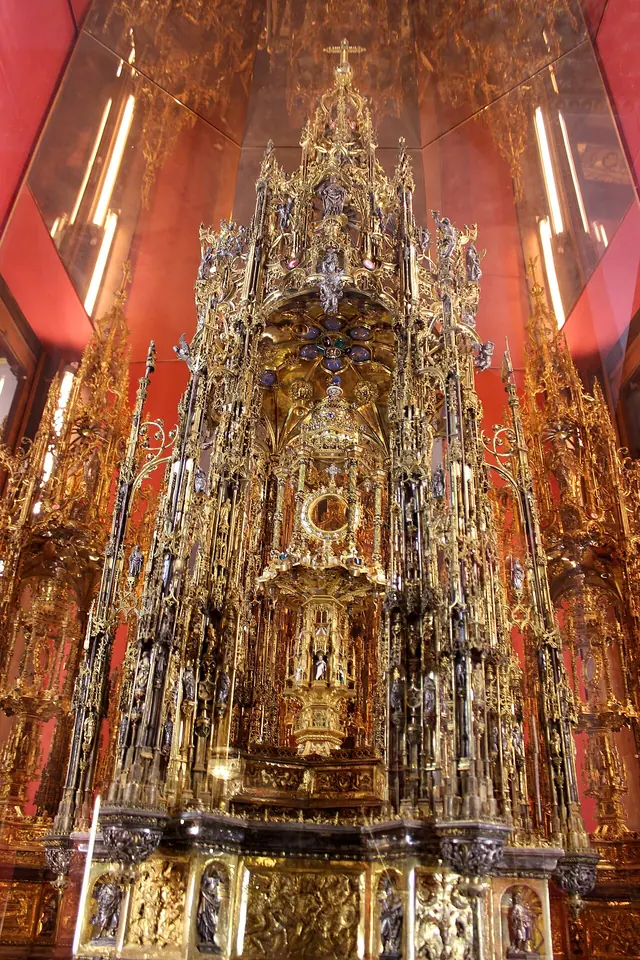
Spain took the monstrance to its limit. In the 16th century Spanish cathedrals commissioned processional custodias six, seven or eight feet high, the Catholic Encyclopedia says, weighing "many hundreds pounds," with a smaller monstrance inside that could be taken out for Benediction. The most famous is the custodia of Toledo Cathedral, the work of the goldsmith Enrique de Arfe in the early 1500s. The Encyclopedia describes it as more than twelve feet high, with 260 statuettes, and records the tradition that one part is made "of the gold brought by Columbus from the New World." Every year on Corpus Christi it is still carried through the streets of Toledo.
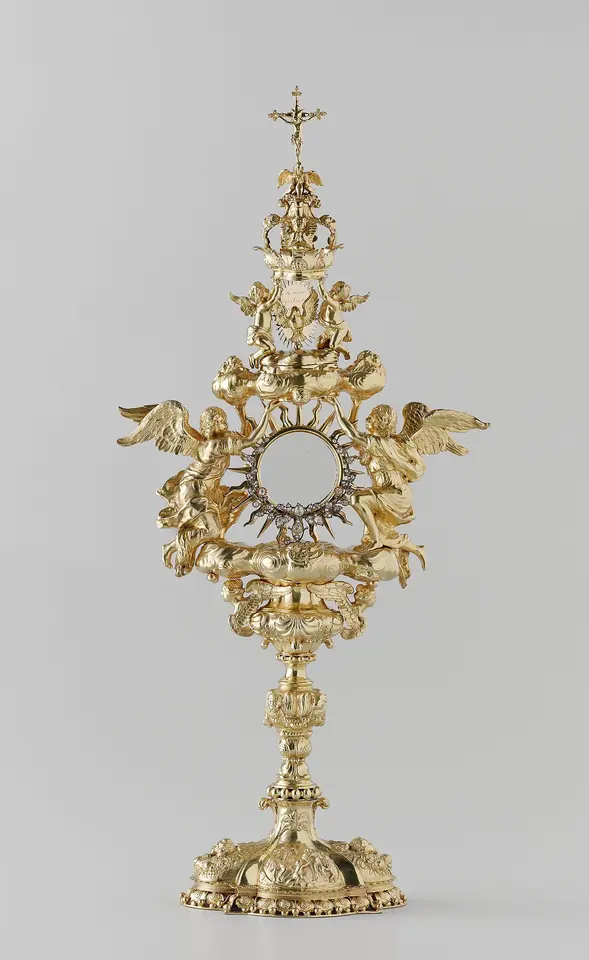
The custom crossed the ocean. In Mexico, Peru and the Philippines silversmiths made some of the most splendid monstrances in the world, like the Lima sunburst at the top of this page.
How the Church uses the monstrance
Exposition and Eucharistic adoration
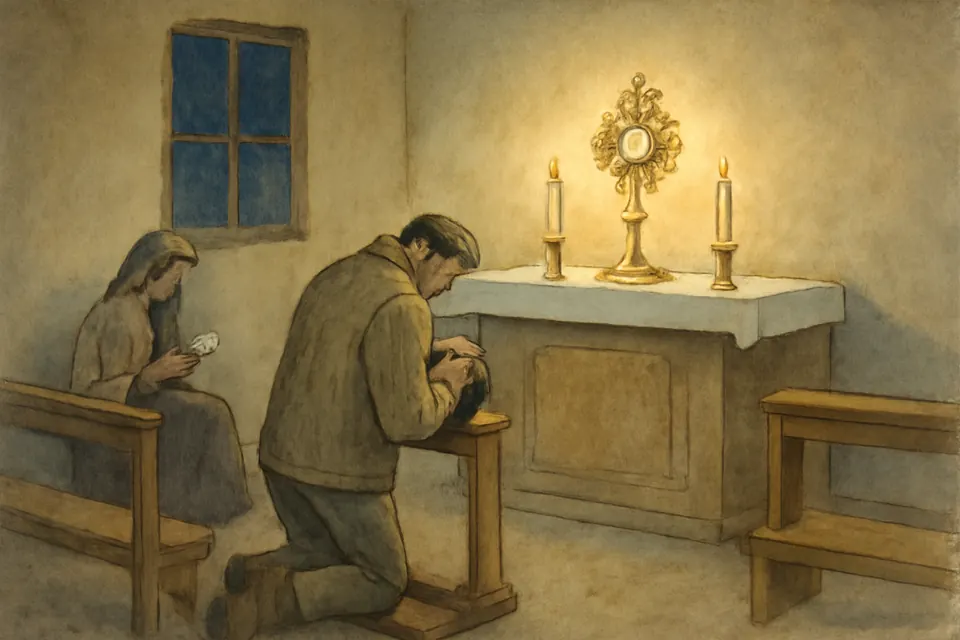
Exposition is the simplest use. A priest or deacon takes the Host from the tabernacle, places the luna in the monstrance and sets it on the altar, often on a raised throne, with candles burning. He incenses the Blessed Sacrament, and the faithful pray in silence or with hymns and readings. The Code of Canon Law allows "expositions with the pyx or the monstrance" in churches where the Eucharist is reserved, following the liturgical books, and it adds that exposition is not to take place in the same part of the church while Mass is being celebrated (canon 941). It also recommends "an annual solemn exposition" of the Blessed Sacrament for a suitable time (canon 942), the custom many parishes keep as Forty Hours.
Some chapels keep perpetual adoration, with the Lord exposed day and night and the faithful signed up for every hour, so that he is never left alone. For how to make a holy hour and the prayers used in adoration, see our guide to Eucharistic adoration.
Benediction of the Blessed Sacrament
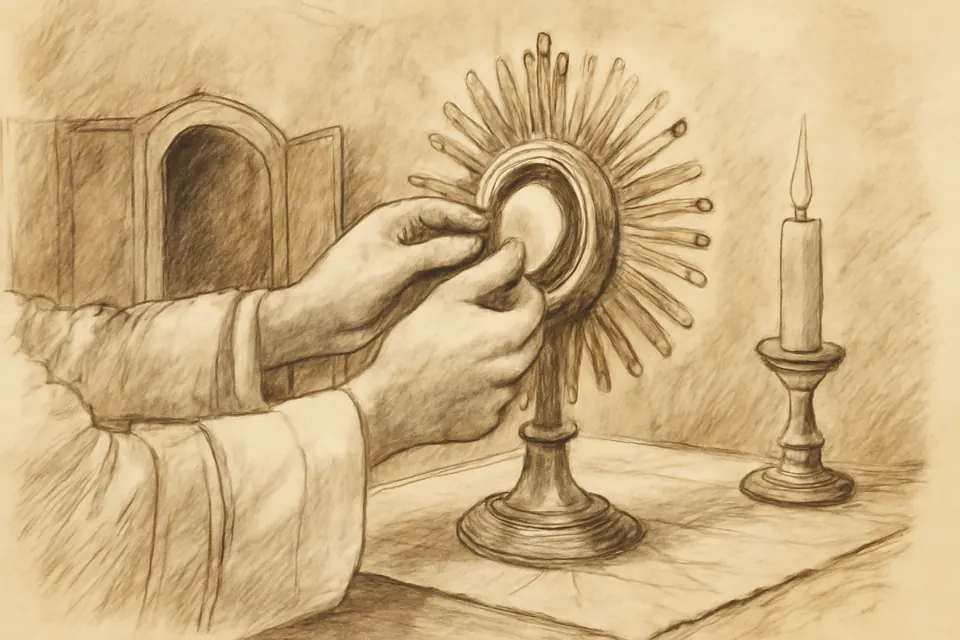
Benediction is the short service that gives the monstrance its most beloved moment. The Catholic Encyclopedia calls it "one of the most generally popular of Catholic services," and describes its heart: at the end, "the priest, his shoulders enveloped in a humeral veil, takes the monstrance into his hands and with it makes the sign of the cross ... in silence over the kneeling congregation." It is Christ himself who blesses us.
Benediction usually follows this order. The Blessed Sacrament is exposed while the people sing a hymn of adoration, often the O salutaris Hostia. A time of prayer follows, with readings, a litany or silence. Then the priest incenses the Host while all sing the Tantum ergo, the last two verses of St. Thomas Aquinas's Pange lingua. He says the prayer of the Blessed Sacrament, puts on the humeral veil and blesses the people with the monstrance. The Divine Praises ("Blessed be God, blessed be his holy name...") are said, and the Host is returned to the tabernacle while a closing hymn is sung.
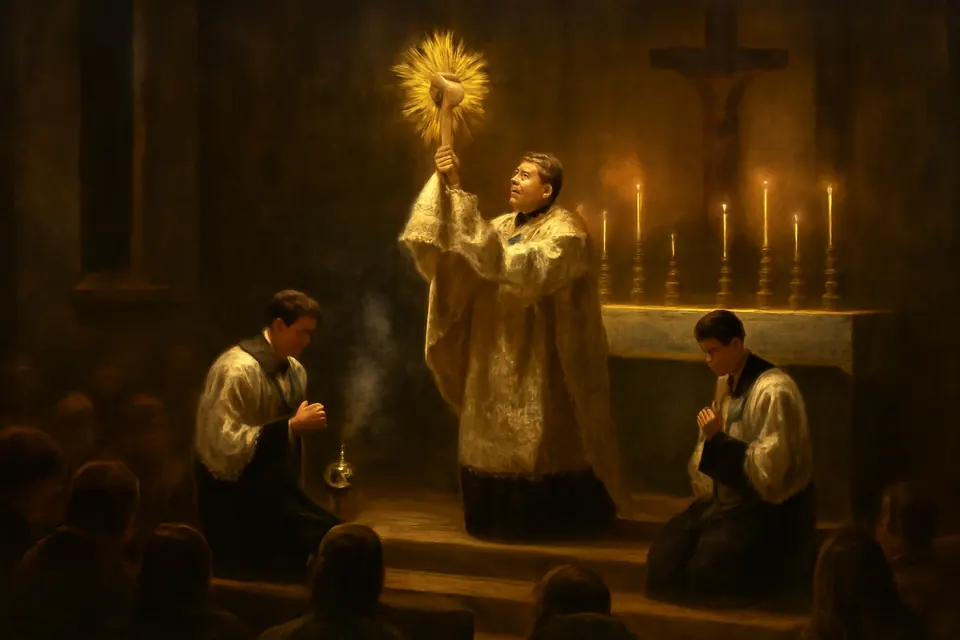
Here is the Tantum ergo in Latin and in the English of Edward Caswall's Lyra Catholica (1849), a translation now in the public domain:
Tantum ergo Sacramentum Veneremur cernui: Et antiquum documentum Novo cedat ritui: Praestet fides supplementum Sensuum defectui.
Genitori, Genitoque Laus et iubilatio, Salus, honor, virtus quoque Sit et benedictio: Procedenti ab utroque Compar sit laudatio. Amen.
Down in adoration falling, Lo! the sacred Host we hail; Lo! o'er ancient forms departing, Newer rites of grace prevail; Faith, for all defects supplying, Where the feeble senses fail.
To the Everlasting Father, And the Son who reigns on high, With the Holy Ghost proceeding Forth from Each eternally, Be salvation, honour, blessing, Might, and endless majesty.
The line "Faith, for all defects supplying, where the feeble senses fail" is the whole reason for the monstrance in two lines. Our eyes see bread. Faith sees the Lord. The full Pange lingua is printed on our Corpus Christi 2027 page.
Eucharistic processions
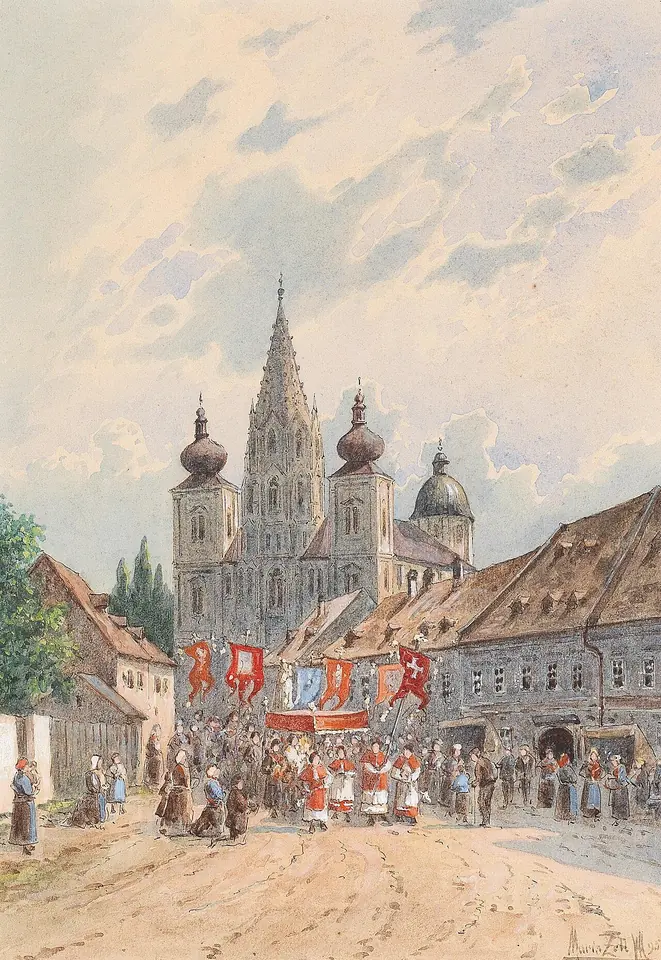
On Corpus Christi the monstrance leaves the church. The priest carries it under a canopy, flanked by candles, with children scattering flower petals before the Lord, and the procession stops at outdoor altars along the way for Benediction. In many towns the route is carpeted with flowers or colored sawdust. Processions are also held at the end of Forty Hours, at Eucharistic congresses and on pilgrimages.
How to pray before the monstrance
You do not need a book. You need only to come and to stay. A few customs help:
- Kneel or genuflect. When you enter a church where the Lord is exposed, kneel, or genuflect, and bow your head. Many still kneel on both knees for a moment, the old custom before the exposed Sacrament.
- Keep silence. Adoration is a place for quiet. Leave conversation for outside.
- Look at him. The Catechism recalls a peasant of Ars who explained his long prayer before the tabernacle to his parish priest, St. John Vianney, in one line: "I look at him and he looks at me." The monstrance is made for exactly that.
- Bring Scripture or a prayer, if it helps. The Gospel of John, chapter 6, the Anima Christi or a decade of the Rosary are good companions. If you cannot receive Communion, make a spiritual communion.
A prayer before the monstrance, written for this page by Pastor Lyvers:
Lord Jesus, hidden in the Host and shown to us in this monstrance, we adore you. You are the same Lord who was born in Bethlehem, who died for us and rose again, and you have stayed with us to the end of the age. Look on us as we look on you. Heal what is wounded in us, forgive what is sinful, and make our hearts a dwelling fit for you. Let the light that shines from this altar go home with us, into our families and our work, until the day we see you face to face. Amen.
Saints shown with a monstrance
In churches and museums a monstrance in a saint's hands is a sign of special love for the Blessed Sacrament. Some of the saints you will meet holding one:
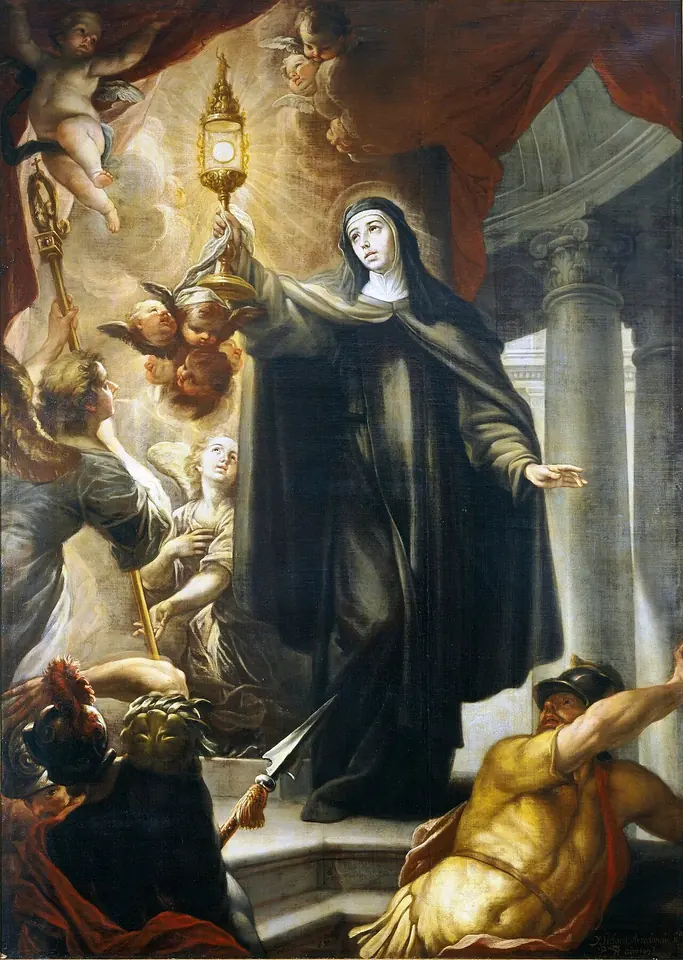
- St. Clare of Assisi. Her Life tells how, when soldiers in the army of Emperor Frederick II scaled the walls of San Damiano, she had the Blessed Sacrament carried before her in "a silver casket enclosed in ivory," prayed, and the soldiers fled. The account is traditional. Baroque painters gave her a monstrance, which did not yet exist in her day, and it became her usual emblem.
- St. Norbert, founder of the Norbertines, called the Apostle of Antwerp: when he preached there in the 1120s against the followers of Tanchelm, who rejected the sacraments, many returned the consecrated Hosts they had taken.
- St. Juliana of Liège, whose vision and persistence gave the Church the feast of Corpus Christi.
- St. Paschal Baylon, the Spanish Franciscan lay brother who spent every free moment before the tabernacle; Leo XIII named him patron of Eucharistic congresses.
- St. Hyacinth of Poland, the Dominican missionary who, as tradition tells it, carried the Blessed Sacrament and a statue of Our Lady out of burning Kyiv.
- St. Peter Julian Eymard, founder of the Congregation of the Blessed Sacrament, devoted to perpetual exposition.
Monstrance, ciborium, pyx and tabernacle
These four words are easy to mix up:
- Monstrance: shows the Host for adoration, at exposition, Benediction and in procession.
- Ciborium: the covered cup, like a chalice with a lid, that holds many small Hosts for Communion and for reservation in the tabernacle.
- Pyx: a small round case, often gold, used to carry Communion to the sick. Canon law also allows exposition in a pyx, in a simpler form.
- Tabernacle: the locked box, fixed in a worthy place in the church, where the Blessed Sacrament is reserved. The Catechism explains that it was "first intended for the reservation of the Eucharist in a worthy place so that it could be brought to the sick and those absent outside of Mass," and that it should be built to show "the truth of the real presence of Christ in the Blessed Sacrament."
For the faith behind all of them, read What is the Eucharist? and Transubstantiation. For the times when God has given a visible sign of the same truth, see our page on Eucharistic miracles, including Lanciano, whose relics are kept in a silver monstrance above the altar. And the next time the bell rings and the priest lifts the golden sun over the kneeling church, bow low: it is the Lord who blesses us.
Frequently asked questions
What is a monstrance?
A monstrance is the sacred vessel in which the consecrated Host is placed so the faithful can see it and adore Our Lord in the Blessed Sacrament. It is used for exposition of the Blessed Sacrament, for Benediction and for Eucharistic processions such as the one on Corpus Christi. It is also called an ostensorium.
What does the word monstrance mean?
It comes from the Latin monstrare, "to show." The other name, ostensorium, comes from ostendere, which means the same thing. In Spain and Latin America the usual word is custodia. The Catholic Encyclopedia notes that before the Reformation the Scots called it a "eucharist" and the English a "monstre."
What is the round glass part of a monstrance called?
The small holder that grips the Host is the luna or lunette, from the Latin for "moon," because of its crescent or round shape. It is gilded and fits into the window at the center of the monstrance, behind a glass. When it is not in use the luna, with the Host, is kept in the tabernacle in a small case.
Why is a monstrance shaped like the sun?
The rays draw every eye to the Host at the center, and they speak of Christ as the light of the world and the "Sun of justice" foretold by the prophet Malachi. Early monstrances were shaped like little Gothic towers; the sunburst form spread in the 15th century and became the most common shape.
What is the difference between a monstrance and a tabernacle?
The tabernacle is the locked box where the Blessed Sacrament is reserved in a church, behind a closed door. The monstrance shows the Host openly on the altar for adoration. A Host exposed in the monstrance is returned to the tabernacle when exposition ends.
Is a monstrance a sacramental?
A monstrance is a sacred vessel, set apart for the Blessed Sacrament, and the Pontifical has a special blessing for it. We honor it because of what it holds. What we adore is not the gold but Christ himself, truly present in the Host.
Who carries the monstrance?
A priest or deacon. For Benediction and in procession he wears a humeral veil, a long shawl over the shoulders whose ends cover his hands, so that the hands holding the Lord are themselves veiled.
Which saints are shown holding a monstrance?
St. Clare of Assisi, St. Norbert, St. Juliana of Liège, St. Paschal Baylon, St. Hyacinth of Poland and St. Peter Julian Eymard are the saints most often painted with a monstrance. In Clare's case the image is a little anachronistic: her Life speaks of a silver and ivory casket, since the monstrance did not yet exist.
Sources
- Catholic Encyclopedia (1911): Ostensorium (Monstrance). History from Lanfranc's Palm Sunday shrine to the Toledo custodia; names in Scotland and England
- Catholic Encyclopedia (1907): Benediction of the Blessed Sacrament
- Council of Trent, Session XIII (1551), chapter V: the worship due to the Blessed Sacrament
- Catechism of the Catholic Church, 1373–1381: the presence of Christ and the worship of the Eucharist
- Code of Canon Law, canons 934–944: reservation and veneration of the Most Holy Eucharist
- Catechism of the Catholic Church, 2715: "I look at him and he looks at me"
- Edward Caswall, Lyra Catholica (1849): Tantum ergo. Public-domain translation, p. 112