Priest vestments

Priest vestments are the sacred garments a Catholic priest wears to celebrate Mass and the sacraments. In the order he puts them on: the amice (a linen neck cloth), the alb (a white tunic), the cincture (a cord belt), the stole (a long band around the neck) and the chasuble (the outer vestment in the color of the day).
Priest vestments are the sacred garments a Catholic priest puts on to celebrate the Mass and the sacraments. They hide the man and show the office: when the priest stands at the altar in alb, stole and chasuble, he acts not in his own name but in persona Christi, in the person of Christ. Every piece has a history going back to the Roman world and a meaning the Church has prayed over for more than a thousand years. This guide explains each vestment in the order the priest puts it on, with the prayer the old Missal gave him to say, then the deacon's vestments, the cope and other garments, the everyday Catholic priest clothing (cassock and collar), the liturgical colors, and how the Eastern churches vest.
Priest vestments at a glance
For Mass, in the order the priest puts them on:
- Amice: a rectangle of white linen worn around the neck and shoulders.
- Alb: the long white tunic, from the Latin alba, white.
- Cincture: a cord tied at the waist over the alb.
- Maniple: a short band worn on the left forearm (now used only in the older form of the Mass).
- Stole: a long, narrow band worn around the neck, the sign of the ordained.
- Chasuble: the large outer vestment, in the color of the day.
For the deacon: alb, stole worn diagonally, and the dalmatic.
For other rites: the cope (processions, Benediction, solemn Vespers), the humeral veil (for carrying or blessing with the Blessed Sacrament), the surplice over the cassock (sacraments and blessings outside Mass).
Clerical dress outside the liturgy: the cassock, or the clerical shirt with the Roman collar.
The General Instruction of the Roman Missal sets the basic rule: "The sacred garment common to ordained and instituted ministers of any rank is the alb," and "the vestment proper to the priest celebrant at Mass... is... the chasuble, worn over the alb and stole" (nos. 336–337).
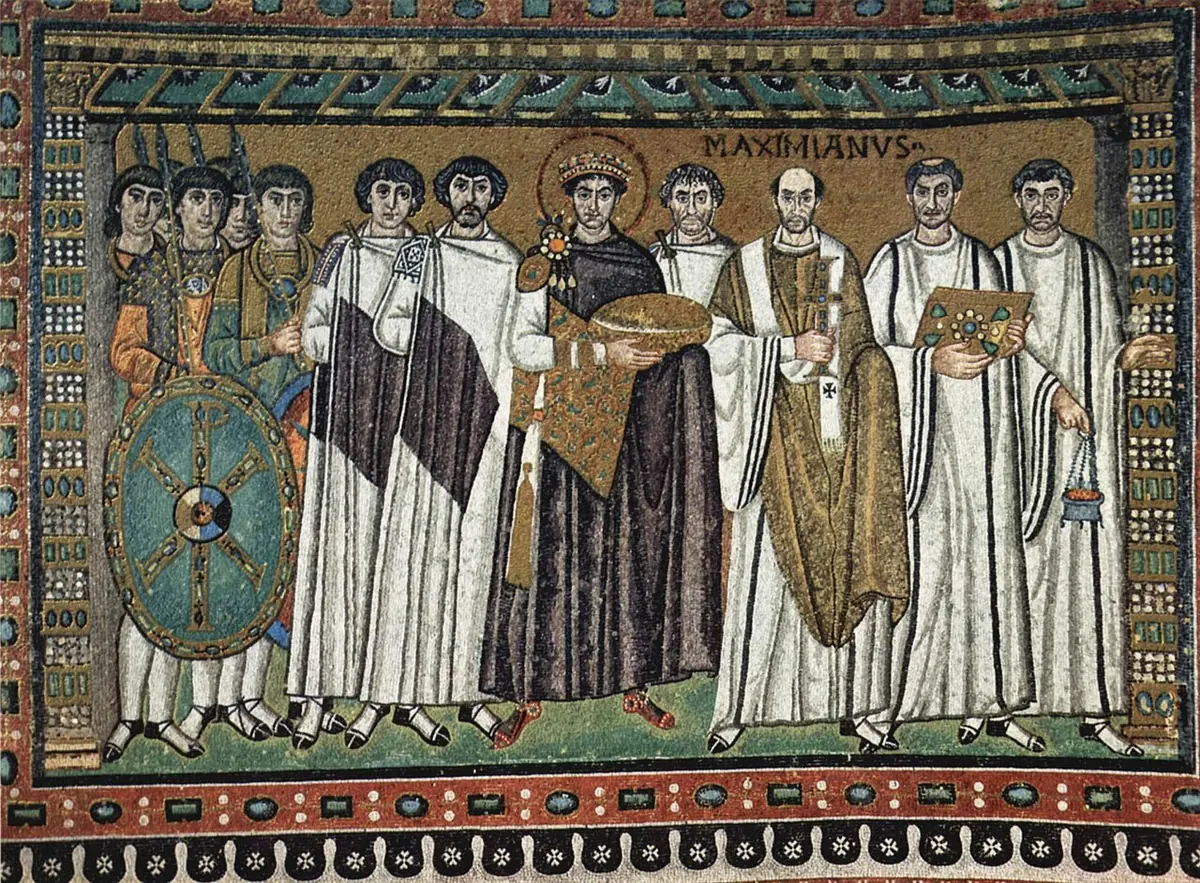
Where vestments come from
It is sometimes said that the Church copied the vestments of the Jewish priests in the Temple. The Catholic Encyclopedia corrects this: "The Christian vestments did not originate in the priestly dress of the Old Testament; they have, rather, developed from the secular dress of the Graeco-Roman world." In the age of the martyrs the priest wore ordinary clothing at the altar, though surely his best, kept for the Sacred Mysteries.
After the peace of Constantine, while fashions in the street changed, the Church kept the old Roman garments for worship. The long tunic became the alb; the traveling cloak, the paenula, became the chasuble; the scarves and napkins of officials became the stole and maniple. By the Carolingian age of the ninth century, the set of Mass vestments was fixed, reserved only for worship, and blessed before use. The vestments link every Mass to the Church of the early centuries. When a priest vests, he puts on the clothes of St. Ambrose and St. Augustine.
The vestments of the Mass, one by one
Before the 1970 Missal, the Roman Missal gave the priest a short Latin prayer to say as he washed his hands and put on each vestment. The prayers are no longer required, but many priests still say them, and they are the best key to what each vestment means. We give each prayer in Latin with the English of a 1909 Catholic book on the Mass, M. C. Nieuwbarn's The Holy Sacrifice and Its Ceremonies.
Before vesting, the priest washes his hands, praying: Da, Domine, virtutem manibus meis ad abstergendam omnem maculam; ut sine pollutione mentis et corporis valeam tibi servire. Give strength to my hands, Lord, to wipe away every stain, so that I may serve you without defilement of mind or body.
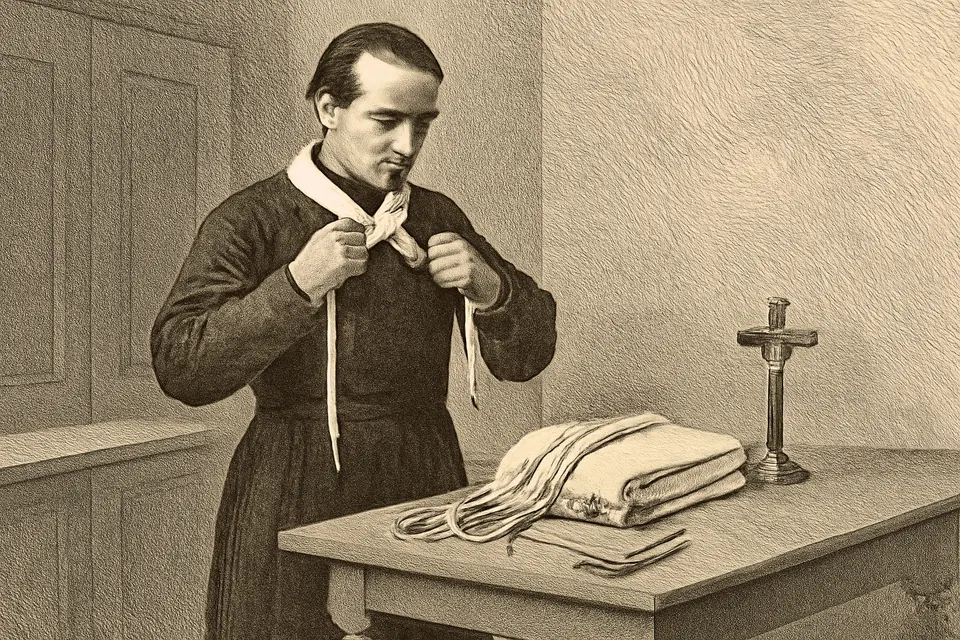
The amice
The amice is a rectangle of white linen with two long strings. The priest touches it to his head, lays it over his neck and shoulders, crosses the strings over his chest and ties them around his waist. Its practical job is to cover the collar of his everyday clothes. Some religious orders, Franciscans and Dominicans among them, still wear it over the head like a hood as they walk to the altar and then push it back, which explains the prayer:
Impone, Domine, capiti meo galeam salutis, ad expugnandos diabolicos incursus.
>
Place on my head, O Lord, the helmet of salvation to ward off the attacks of the evil one.
The "helmet of salvation" comes from St. Paul's armor of God (Ephesians 6:17). At ordination in the old rite, the bishop gave the amice to new subdeacons with the words, as the Catholic Encyclopedia records, "Receive the amice, by which is signified the discipline of the voice."
The alb
The alb is the long white linen tunic reaching to the ankles, from the Latin alba, white. It is the baptismal garment of every Christian made solemn, and servers, lectors and other ministers may wear it too (General Instruction, nos. 336, 339). Its whiteness recalls the saints in Revelation who "have washed their robes, and have made them white in the blood of the Lamb" (Apocalypse 7:14, Douay-Rheims). The vesting prayer says it plainly:
Dealba me, Domine, et munda cor meum; ut, in sanguine Agni dealbatus, gaudiis perfruar sempiternis.
>
Make me white, O Lord, and cleanse my heart, that, sanctified by the Blood of the Lamb, I may attain everlasting joy.
A surplice (or cotta) is a shorter, wide-sleeved version of the alb, worn over the cassock by priests outside Mass and by altar servers and choirs. It may not replace the alb under a chasuble (General Instruction, no. 336).
The cincture
The cincture, or girdle, is a cord of linen or wool tied at the waist to gather the alb, with tassels at the ends. It may be white or the color of the day. Christ told his disciples, "Let your loins be girt, and lamps burning in your hands" (Luke 12:35, Douay-Rheims), and the vesting prayer turns the belt into a prayer for chastity:
Praecinge me, Domine, cingulo puritatis, et exstingue in lumbis meis humorem libidinis; ut maneat in me virtus continentiae et castitatis.
>
Gird me, O Lord, with the girdle of purity, and extinguish in me the fire of concupiscence, that there may remain in me the virtue of continence and chastity.
The maniple
The maniple is a short band of the same cloth as the chasuble, worn over the left forearm. It began as a linen napkin carried by Roman officials and was used to wipe the hands and the sacred vessels. It was the sign of the subdeacon. It was dropped from the ordinary form of the Mass in the reforms after the Second Vatican Council, but it is still worn at the traditional Latin Mass. Nieuwbarn connected it to the Psalm verse about the sower who goes out weeping and comes home rejoicing, "carrying their sheaves" (manipulos suos, Psalm 125:7, Douay-Rheims):
Merear, Domine, portare manipulum fletus et doloris; ut cum exsultatione recipiam mercedem laboris.
>
Let me merit, O Lord, to bear the maniple of weeping and sorrow, that I may receive the reward of my labour with joy.
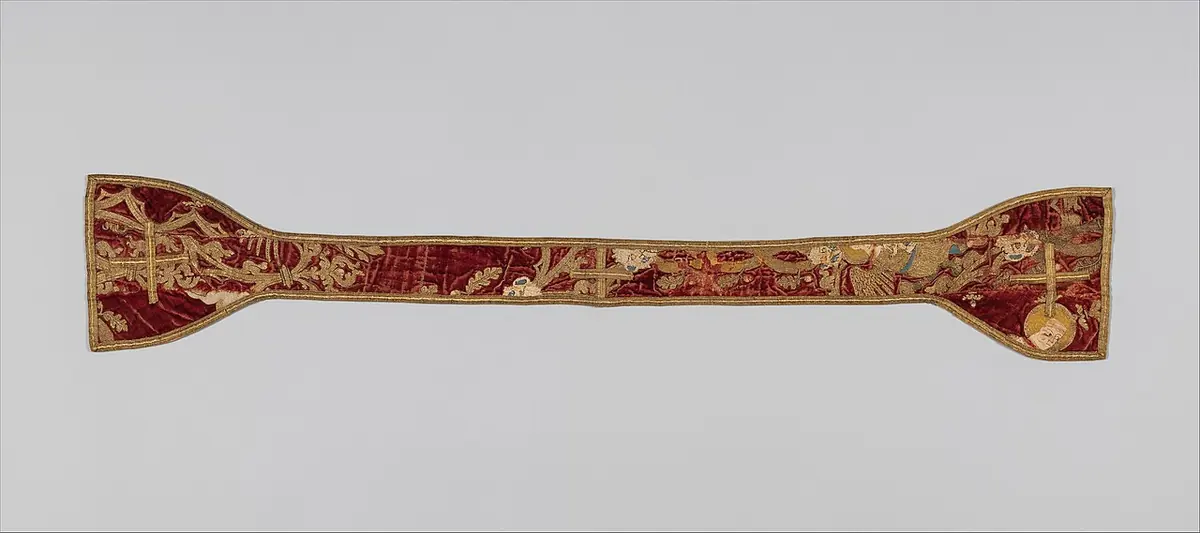
The stole
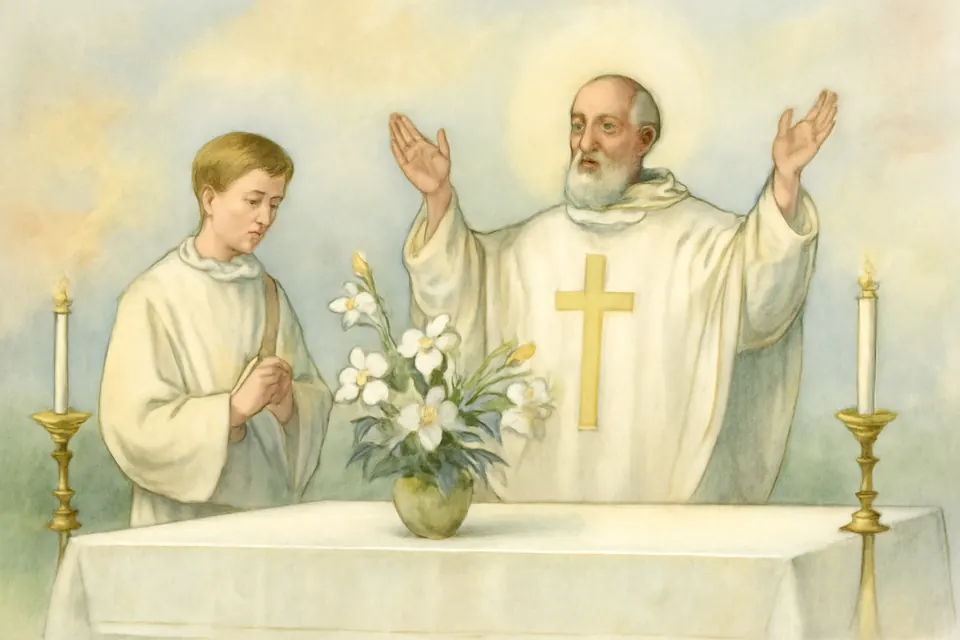
The stole is the long, narrow band that marks a man as ordained. A priest wears it around his neck, hanging straight down in front (General Instruction, no. 340); in the older form of the Mass he crossed it over his chest under the chasuble. A bishop wears it hanging straight. A deacon wears it over his left shoulder, drawn across his chest to his right side. A priest puts on a stole for every sacrament: Confession (often a violet stole), Baptism, the Anointing of the Sick, a wedding, a funeral blessing, and for exposition of the Blessed Sacrament.
Its vesting prayer recalls the robe of grace Adam lost:
Redde mihi, Domine, stolam immortalitatis, quam perdidi in praevaricatione primi parentis: et, quamvis indignus accedo ad tuum sacrum mysterium, merear tamen gaudium sempiternum.
>
Give me back, O Lord, the stole of immortality, which I have lost through the prevarication of our first parents; and although I am unworthy to approach Thy holy mysteries, may I nevertheless deserve to attain everlasting joy.
Before putting it on, the priest kisses the small cross at its center. The stole is the vestment of the yoke of Christ, laid on the shoulders of the man who has given his life to serve.
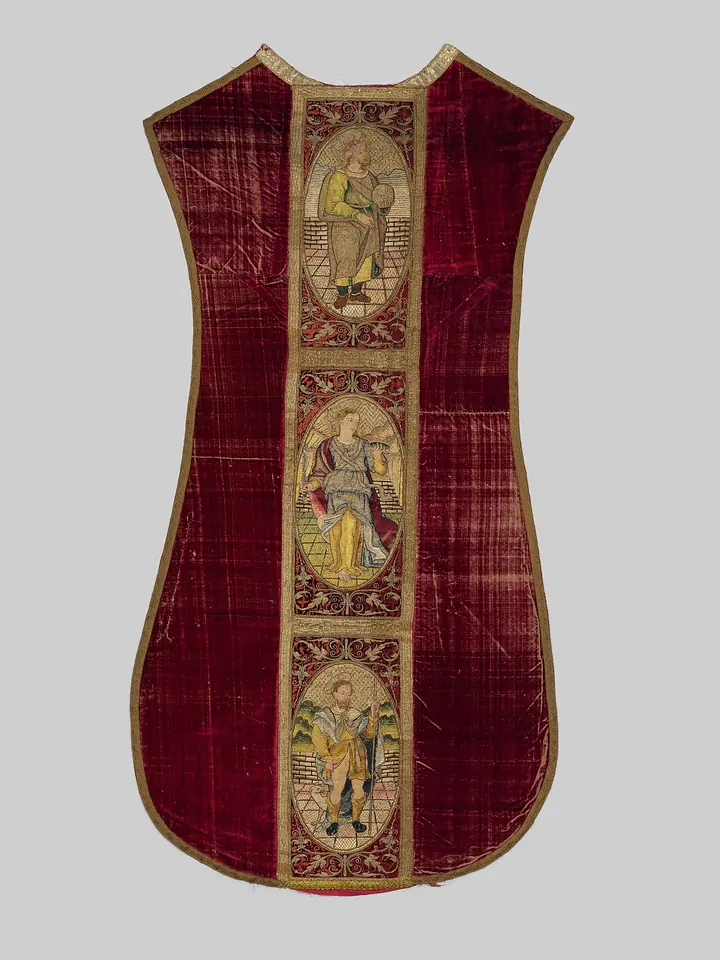
The chasuble
The chasuble is the vestment proper to the priest celebrating Mass, a large garment of fine cloth that covers all the others. Its name comes from the Latin casula, "little house." St. Isidore of Seville explained that, "like a small cottage or hut, it covers the entire person." In the early centuries it was a wide cloak, round or bell-shaped. Over the late Middle Ages and into the Baroque era the sides were cut away to free the arms, until the stiff "fiddleback" or Roman chasuble appeared. Since the 20th century many chasubles have returned to the fuller "Gothic" shape. Both shapes are lawful.
The chasuble usually carries an embroidered band, the orphrey, down the front and back, often in a cross or a Y shape. At ordination the bishop gives it to the new priest with the words "Receive the priestly vestment, by which is signified charity," as Nieuwbarn records. The vesting prayer speaks of Christ's yoke:
Domine, qui dixisti: Iugum meum suave est, et onus meum leve: fac, ut istud portare sic valeam, quod consequar tuam gratiam. Amen.
>
O God, who hast said, My yoke is sweet and My burden light, grant that I may be made strong to bear this yoke, and so obtain Thy grace.
The deacon's vestments: stole and dalmatic
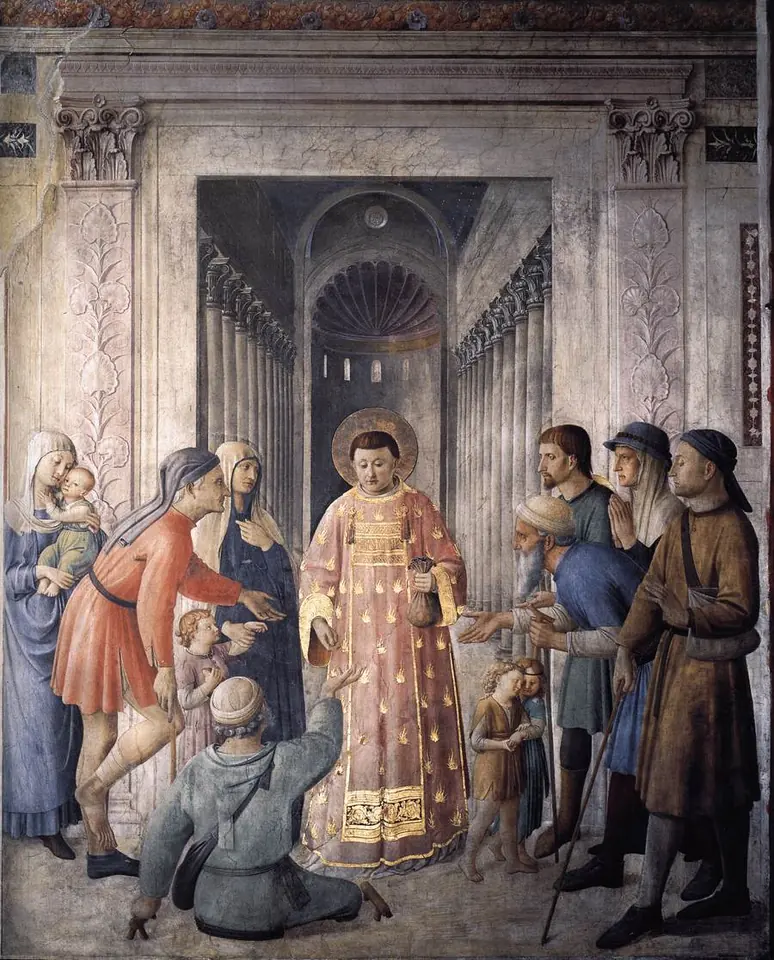
The deacon wears the alb and cincture, his stole across the chest from the left shoulder, and over them the dalmatic, a tunic with short, wide sleeves, open at the sides and decorated with two vertical bands. "The vestment proper to the deacon is the dalmatic," says the General Instruction (no. 338). The name comes from Dalmatia on the Adriatic coast, where the garment was first made, and the Catholic Encyclopedia traces it in the mosaics of Ravenna and Milan of the fifth and sixth centuries.
The great deacons of the early Church, St. Stephen, St. Lawrence and St. Vincent of Saragossa, are always painted in the dalmatic. Before the 1970s the subdeacon wore a nearly identical vestment called the tunicle. Bishops may wear a light dalmatic under the chasuble on solemn days, to show that the bishop holds the fullness of all three orders.
The cope and the humeral veil
The cope is a long semicircular cloak, open in front and fastened at the chest with a clasp called the morse. The Catholic Encyclopedia describes it as "a long liturgical mantle." Its Latin name, pluviale, means rain cloak: it began as an outdoor cape for processions, and the little shield on its back is what remains of a real hood. "The cope is worn by the priest in processions and other sacred actions" (General Instruction, no. 341): at Benediction, solemn Vespers, the sprinkling with holy water, weddings and funerals outside Mass, and processions such as Corpus Christi.
The humeral veil is a long scarf of silk worn over the shoulders, with pockets or flaps that cover the hands. The priest or deacon wears it whenever he lifts the monstrance to bless the people at Benediction or carries the Blessed Sacrament in procession. His hands are covered so that the blessing comes from Christ, not from the man.


Catholic priest clothing outside Mass
When people search for "Catholic priest clothing," they are often thinking not of vestments but of what a priest wears every day. This is clerical dress, not a liturgical vestment.
The cassock (in Latin vestis talaris, the ankle-length garment) is the traditional robe of the clergy, fitted at the chest, falling to the ankles, with a long row of buttons. Pious tradition counts 33 buttons for the years of Christ's life, though not every cassock has them. A priest's cassock is black, or white in tropical countries. A bishop's is black with amaranth-red piping and buttons and a purple sash; a monsignor's has similar trim; a cardinal's is trimmed in scarlet; and the pope wears white. The cassock is worn under the surplice for many celebrations, and under the alb by many priests at Mass.
The clerical shirt and Roman collar are the everyday working dress of most priests in the English-speaking world: a black (or gray or white) shirt with a white band or tab at the throat, worn with dark trousers. The white collar stands for a life consecrated to God.
Other pieces of clerical dress include the biretta, a square hat with three ridges worn with the cassock; the zucchetto, a small skullcap (purple for bishops, red for cardinals, white for the pope); and for bishops the miter, the crosier, the pectoral cross and the episcopal ring. Archbishops wear the pallium, a white wool band with black crosses, a sign of their unity with the pope. It is woven from the wool of lambs blessed each year on the feast of St. Agnes and given by the pope on the feast of Sts. Peter and Paul.
Liturgical colors
"The purpose of a variety in the color of the sacred vestments is to give effective expression even outwardly to the specific character of the mysteries of faith being celebrated" (General Instruction, no. 345). The chasuble and stole, and the dalmatic and cope, follow the color of the day:
- Green: Ordinary Time, the green season of growth.
- Violet (purple): Advent and Lent, seasons of waiting and penance; it may also be worn at Masses for the dead.
- White: Christmas and Easter seasons; feasts of the Lord (except of his Passion), of Mary, of the angels, and of saints who were not martyrs; All Saints' Day. Gold or silver may replace white on solemn days in the United States.
- Red: Palm Sunday, Good Friday, Pentecost, the feasts of the Apostles and Evangelists, and the martyrs, for the blood of witness and the fire of the Spirit.
- Rose: twice a year, on Gaudete Sunday in Advent and Laetare Sunday in Lent, to mark the halfway point with a little joy.
- Black: funerals and Masses for the dead, permitted in the United States together with violet or white; also in the old rite on All Souls' Day and Good Friday.
The colors took centuries to settle. The Catholic Encyclopedia notes that Pope Innocent III, writing around 1200, already named white, red, green and black as the main colors, with violet used occasionally; violet came into regular use in the 13th century. Blue and yellow appeared in some medieval churches but "may not be used without very special authorization." For the full meaning of each color and a calendar of when it is worn, see our page on liturgical colors and the feast days and Church calendar.

Vestments in the Eastern churches
The Eastern Catholic and Orthodox churches kept the same Roman roots but developed their own forms. A Byzantine priest wears the sticharion (the long tunic, like the alb), the epitrachelion (the stole, joined in front into one wide band), the zone (belt), the epimanikia (cuffs laced at the wrists) and the phelonion (the full, bell-shaped outer vestment, like a Gothic chasuble). Before the Divine Liturgy the priest blesses and kisses each piece and says a verse of Scripture over it, much as the Latin priest said his vesting prayers. Eastern deacons wear the sticharion and the long orarion over the left shoulder, which they lift with three fingers to call the people to prayer.
The blessing and care of vestments
Vestments are blessed before their first use, and the Church asks that their beauty come "not from abundance of overly lavish ornamentation, but rather from the material that is used and from the design" (General Instruction, no. 344). Many parishes have an altar guild of volunteers who wash and press the albs and linens and mend the vestments. When a blessed vestment wears out, it is not thrown away. By long custom it is burned and the ashes buried, or the good cloth is reused for another sacred purpose.
For a priest, vesting is a quiet moment of prayer in the sacristy before the noise of the procession. It is good to pray for him there. Here is a short prayer for priests by Pastor Lyvers:
Lord Jesus, eternal High Priest, clothe our priests in your grace as they clothe themselves for your altar. Keep them pure as the white of the alb, faithful under the yoke of the stole, and generous with the charity of the chasuble. Strengthen them when they are tired, protect them from every attack of the evil one, and let them find their joy in you. Amen.
For more on what the priest does in these vestments, see our step-by-step guide to the order of the Mass, the page on the thurible used on solemn days, and our prayer before Mass.
Frequently asked questions
What are the vestments of a Catholic priest called?
For Mass a priest wears the amice, the alb, the cincture, the stole and the chasuble. Outside Mass he may wear a cope (for processions, Benediction and solemn Vespers), a surplice over a cassock (for many sacraments and blessings) and a humeral veil (when carrying or blessing with the Blessed Sacrament).
What is the difference between a chasuble and a stole?
The stole is a long, narrow band worn around the neck and hanging down in front; it is the sign of ordained ministry, and a priest wears it for every sacrament. The chasuble is the large outer vestment worn over the stole only for Mass. Both are usually in the color of the day.
What is a dalmatic?
The dalmatic is the deacon's outer vestment: a tunic with wide, short sleeves, worn over the alb and the stole, which a deacon wears across his chest from the left shoulder. Bishops may also wear a dalmatic under the chasuble on solemn occasions.
What does a priest wear under his vestments?
Usually his clerical clothing: a cassock, or a clerical shirt with a Roman collar and dark trousers. The amice covers the collar at the neck so that only the white of the alb shows.
Why do priests wear different colors?
The colors follow the liturgical year: green in Ordinary Time, violet in Advent and Lent, white or gold at Christmas, Easter and feasts of the Lord, Mary and saints who were not martyrs, red for the Passion, Pentecost, the Apostles and martyrs, rose on Gaudete and Laetare Sundays, and black (or violet or white) for the dead.
What is a cassock?
The cassock is the long, close-fitting robe with many buttons that is the traditional street and choir dress of the clergy. It is not a Mass vestment. A priest's cassock is black (white in hot climates); a bishop's is trimmed in amaranth red with a purple sash, a cardinal's in scarlet, and the pope's is all white.
Are vestments blessed?
Yes. The Church blesses the sacred vestments before they are used, setting them apart for worship. A worn-out vestment is not thrown in the trash; by custom it is burned or buried, or its cloth is reused for another sacred purpose.
Sources
- General Instruction of the Roman Missal (2002, with U.S. adaptations), nos. 335–347: Sacred vestments and their colors
- M. C. Nieuwbarn, O.P., The Holy Sacrifice and Its Ceremonies (London: Burns & Oates, 1909), pp. 95–100. English translation of the traditional vesting prayers quoted on this page
- Catholic Encyclopedia (1912): Vestments
- Catholic Encyclopedia (1908): Chasuble
- Catholic Encyclopedia (1907): Amice
- Catholic Encyclopedia (1908): Cope
- Catholic Encyclopedia (1908): Colours, Liturgical. Innocent III's list of colors and the history of violet, blue and yellow