Hail Mary prayer

The Hail Mary prayer is the Church's greeting to the Blessed Virgin: "Hail Mary, full of grace, the Lord is with thee..." Its first half joins the angel Gabriel's words (Luke 1:28) to St. Elizabeth's (Luke 1:42); the second half, "Holy Mary, Mother of God," was added by the Church. Its full form was fixed in the Roman Breviary of 1568.
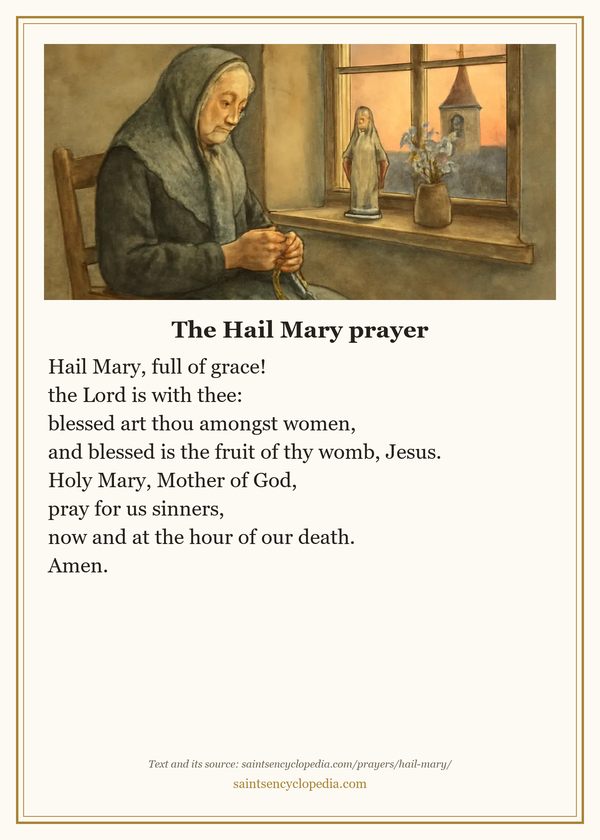 Free printable prayer card 5 × 7 inch PDF, ready to print, frame or tuck in a missal.
The Hail Mary is usually the second prayer a Catholic child learns, right after the Our Father, and often the last one on our lips. It is a greeting first and a plea second: we greet Mary with the angel's own words, and then we ask her to pray for us. Here is the full text in English and Latin, the verses of Scripture it comes from, and how it slowly took the shape we know.
The Hail Mary prayer
This is the traditional English text as printed in the Baltimore Catechism of 1885, where it carries its old name, the Angelical Salutation:
Hail Mary, full of grace! the Lord is with thee: blessed art thou amongst women, and blessed is the fruit of thy womb, Jesus. Holy Mary, Mother of God, pray for us sinners, now and at the hour of our death. Amen.
Most prayer books today say "among women" in the third line, and many parishes and families pray it with "you" and "your." The words are otherwise the same everywhere English-speaking Catholics pray.
The Hail Mary in Latin (Ave Maria)
The Latin is the form the whole Western Church prays, as printed in the appendix of common prayers in the Compendium of the Catechism of the Catholic Church (2005). The accent marks used there as a reading aid are left out here:
Ave Maria, gratia plena, Dominus tecum. Benedicta tu in mulieribus, et benedictus fructus ventris tui, Iesus. Sancta Maria, Mater Dei, ora pro nobis peccatoribus, nunc et in hora mortis nostrae. Amen.
Older Latin prayer books spell the Holy Name Jesus; the pronunciation is the same. For a pronunciation guide and the other common prayers in Latin, see Latin prayers.
The Hail Mary in the Bible
The first half of the Hail Mary is Scripture, word for word, from the first chapter of St. Luke's Gospel.
When the angel Gabriel came to Nazareth, Luke writes, "the angel being come in, said unto her: Hail, full of grace, the Lord is with thee: blessed art thou among women" (Luke 1:28, Douay-Rheims). Those are the opening words of the Annunciation, the moment the Son of God took flesh. We add only her name.

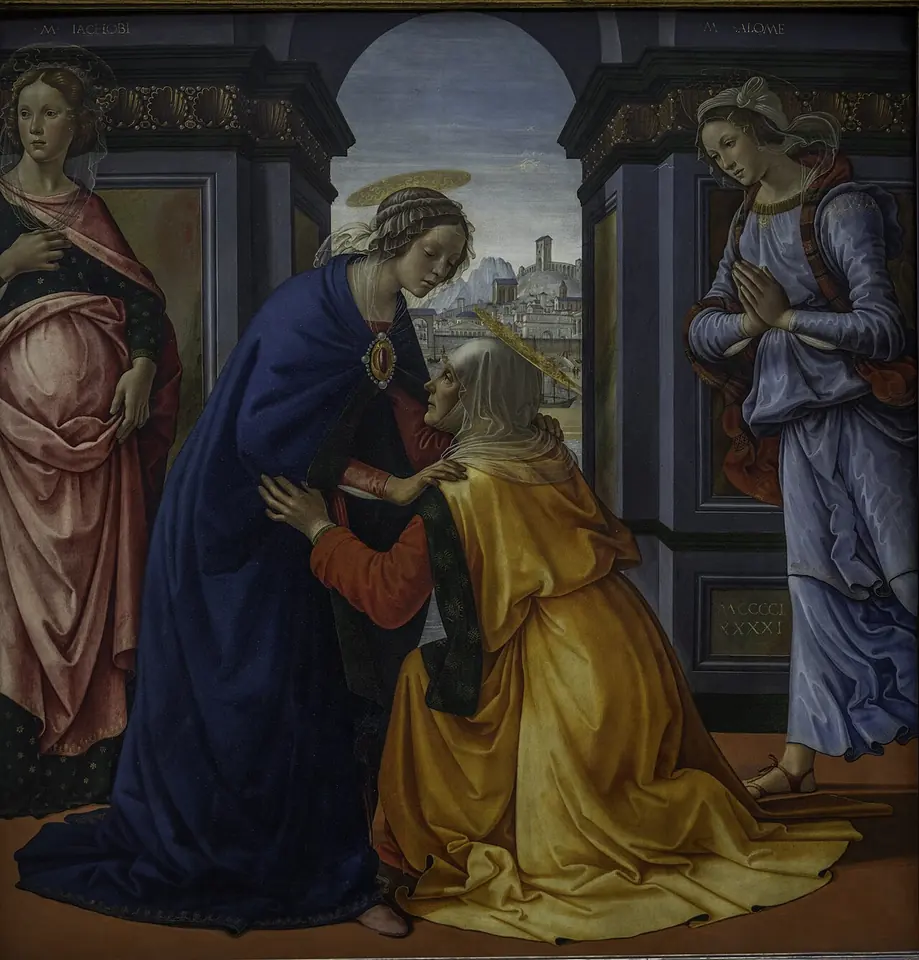
A few verses later Mary hurries to the hill country to visit her cousin, and St. Elizabeth, filled with the Holy Ghost, "cried out with a loud voice, and said: Blessed art thou among women, and blessed is the fruit of thy womb" (Luke 1:42). Elizabeth's greeting repeats the angel's "blessed art thou among women," which is why the two verses join so easily. The Church adds the name of the fruit of her womb: Jesus.
The second half is not Scripture. The Catechism of the Council of Trent (1566), quoted in the Catholic Encyclopedia, says it was framed by the Church itself: "Most rightly has the Holy Church of God added to this thanksgiving, petition also and the invocation of the most holy Mother of God." The Baltimore Catechism puts it simply: the first part, "made by the Angel Gabriel and St. Elizabeth, contains the praises of the Mother of God; and the second part, added by the Church, begs her intercession for sinners."
What the Hail Mary means, line by line
The old catechisms taught the prayer phrase by phrase, and their answers are still a good way to pray it slowly. These come from the Baltimore Catechism No. 3.
- "Hail" is "an exclamation of respectful greeting." It means, the catechism says, "I wish you health."
- "Full of grace": we address Mary this way "because she was never guilty of the slightest sin; was endowed with every virtue, and blessed with a constant increase of grace in her soul."
- "The Lord is with thee": God is with all his creatures, but "He is with Mary in a very special manner on account of her dignity as Mother of His Son."
- "Blessed art thou among women": for "her personal holiness, her great dignity as Mother of God, and her freedom from original sin."
- "Jesus": the name at the center. St. John Paul II called it "the hinge as it were which joins its two parts" (Rosarium Virginis Mariae, 33).
- "Holy Mary, Mother of God": the title the Council of Ephesus defended in 431, Theotokos, God-bearer. Everything we ask of her rests on it.
- "Pray for us sinners, now and at the hour of our death": we ask her intercession for the present moment and for the last one. "At that time," the catechism explains, "our salvation is in greatest danger, and our spiritual enemies most anxious to overcome us."
We do not ask Mary to save us. We ask her to pray for us, as we would ask any friend in Christ, and she is the friend closest to him.
How the Hail Mary grew
A greeting, before it was a prayer (about 1050)
It would be natural to imagine the first Christians praying the Hail Mary as we do. The evidence says otherwise. Herbert Thurston, the Jesuit historian who wrote the Catholic Encyclopedia article on the prayer in 1910, found Gabriel's words used in ancient liturgies, including an offertory chant for the fourth Sunday of Advent, but "little or no trace of the Hail Mary as an accepted devotional formula before about 1050."
It grew out of the Little Office of the Blessed Virgin, a short daily office then spreading through the monasteries. Two Anglo-Saxon manuscripts in the British Museum, one perhaps from about 1030, show the words "Ave Maria" and "benedicta tu in mulieribus et benedictus fructus ventris tui" in almost every part of that office. Soon after, monks and lay people were saying the joined verses on their own.
Because it was a greeting, people greeted her with their bodies too. Thurston gathers the examples: St. Aybert in the 12th century said 150 Hail Marys a day, a hundred of them with genuflections and fifty with prostrations, and St. Louis IX of France knelt fifty times every evening, saying an Ave each time. Around 1196, Bishop Eudes de Sully of Paris told his clergy to make sure their people knew the Salutation of the Blessed Virgin as well as the Creed and the Our Father. The Synod of Durham did the same in England in 1217.
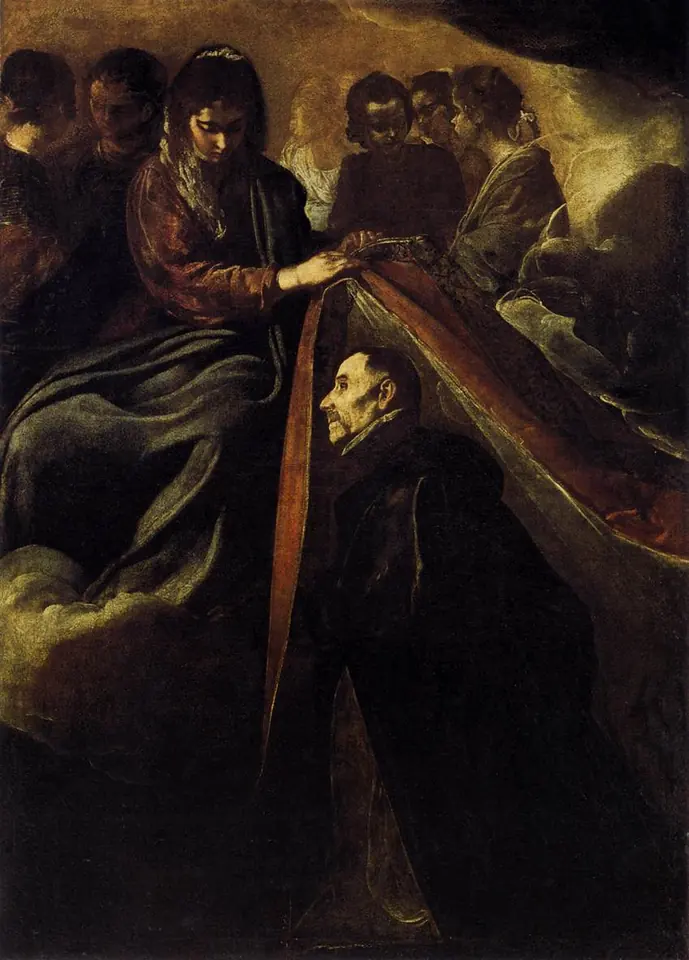
A well-loved story says St. Ildephonsus of Toledo, in the 7th century, honored Mary by repeating the angel's words with a genuflection at each, and that she rewarded him with a chasuble. This is traditional: Thurston notes that the story in this form cannot be traced before Hermann of Laon in the early 12th century.
The Holy Name is added
In the time of St. Louis IX the prayer still ended at "the fruit of thy womb." The name "Jesus," often "Jesus Christus, Amen," came next. Late medieval tradition credited Pope Urban IV (1261) and Pope John XXII with adding and indulgencing it, though Thurston judged the evidence too thin to say so for certain. A German manual of 1474 divided the prayer among four authors: Gabriel, Elizabeth, the popes for the Holy Name, and the Church for the Amen.
"Holy Mary, Mother of God" (late 1400s to 1568)
Through the 14th and 15th centuries people often added their own endings, almost always asking Mary's help for sinners and at the hour of death. A printed Ave identical to ours, except for the single word nostrae, stands at the head of a little work by Savonarola issued in 1495. The final form, "Holy Mary, Mother of God, pray for us sinners, now and at the hour of our death," was made official in the Roman Breviary of 1568 under Pope St. Pius V. It has not changed since.
How we pray the Hail Mary today
- In the rosary. Ten Hail Marys make each decade, prayed while we hold one mystery of Christ's life before our eyes. St. John Paul II called them "the most substantial element in the Rosary." The full method is on how to pray the rosary.
- In the Angelus, three times a day, after each of its three versicles. See the Angelus.
- As a short prayer at any moment: before a test, in traffic, in a hospital corridor, at a bedside. The "three Hail Marys" said at night for purity and perseverance is an old family custom.
- At the hour of death. Many of us first learn the full weight of the words "now and at the hour of our death" when we pray them beside someone we love.
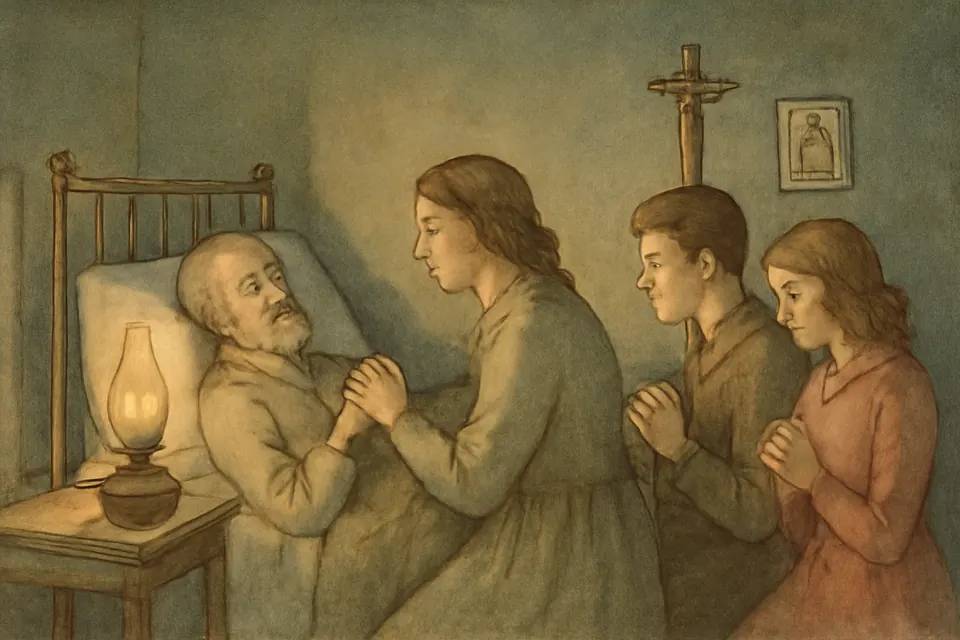
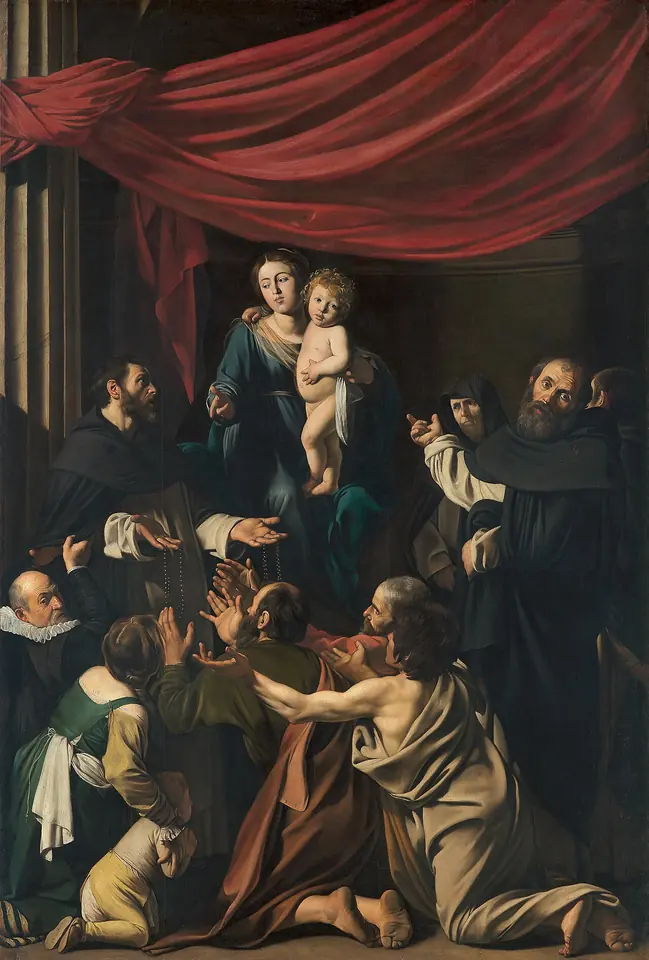
When the words become automatic, the old monks' answer still works: slow down and greet her. Let us pray it now, once, slowly, letting the name of Jesus sit at its center.
For more about Our Lady herself, see the Blessed Virgin Mary and St. Gabriel the Archangel. The other prayers of the rosary have their own pages: the Our Father, the Glory Be, the Fatima prayer and the Hail Holy Queen. Another short Marian prayer of confidence is the Memorare.
Frequently asked questions
What are the words of the Hail Mary?
"Hail, Mary, full of grace, the Lord is with thee. Blessed art thou among women and blessed is the fruit of thy womb, Jesus. Holy Mary, Mother of God, pray for us sinners, now and at the hour of our death. Amen." This is the traditional English text as the Vatican prints it in the Compendium of the Catechism (2005).
Is the Hail Mary in the Bible?
The first half is. "Hail, full of grace, the Lord is with thee: blessed art thou among women" is the angel Gabriel's greeting in Luke 1:28, and "blessed is the fruit of thy womb" is St. Elizabeth's in Luke 1:42 (Douay-Rheims). The names Mary and Jesus were added to make the greeting clear. The second half, "Holy Mary, Mother of God," is the Church's own petition.
What is the Hail Mary in Latin?
Ave Maria, gratia plena, Dominus tecum. Benedicta tu in mulieribus, et benedictus fructus ventris tui, Iesus. Sancta Maria, Mater Dei, ora pro nobis peccatoribus, nunc et in hora mortis nostrae. Amen.
Who wrote the Hail Mary?
No single person. The greeting comes from St. Luke's Gospel. Herbert Thurston, writing in the Catholic Encyclopedia (1910), found little trace of it as a set prayer before about 1050, when it grew out of verses in the Little Office of Our Lady. The name Jesus was added in the later Middle Ages, and the closing petition took its present form in Italy in the late 1400s. Pope St. Pius V's Roman Breviary made the full form official in 1568.
Why do Catholics pray the Hail Mary so many times in the rosary?
Because the Hail Mary began as a greeting, and a greeting of love bears repeating. Medieval Christians said 50 or 150 Aves to match the Psalms, often kneeling at each one. St. John Paul II wrote that the repetition gives us "a share in God's own wonder" at the Incarnation, and that the name of Jesus is "the hinge" that joins its two halves.
Why does the Hail Mary ask Mary to pray for us at the hour of our death?
Because death is the moment we most need help. The Baltimore Catechism explains that "at that time our salvation is in greatest danger," so we ask the Mother of God, all through life, to pray for us then. It is one of the two moments the prayer names: now, and at the hour of our death.
Sources
- Herbert Thurston, Hail Mary, Catholic Encyclopedia, vol. 7 (1910)
- Douay-Rheims Bible, Luke chapter 1 (verses 28 and 42)
- A Catechism of Christian Doctrine, No. 3 (Baltimore Catechism, 1885/1891), Angelical Salutation, Q. 27–42, Project Gutenberg
- Compendium of the Catechism of the Catholic Church (2005), Appendix A: Common Prayers (Latin text)
- John Paul II, Rosarium Virginis Mariae (2002), no. 33