Novena de Aguinaldos
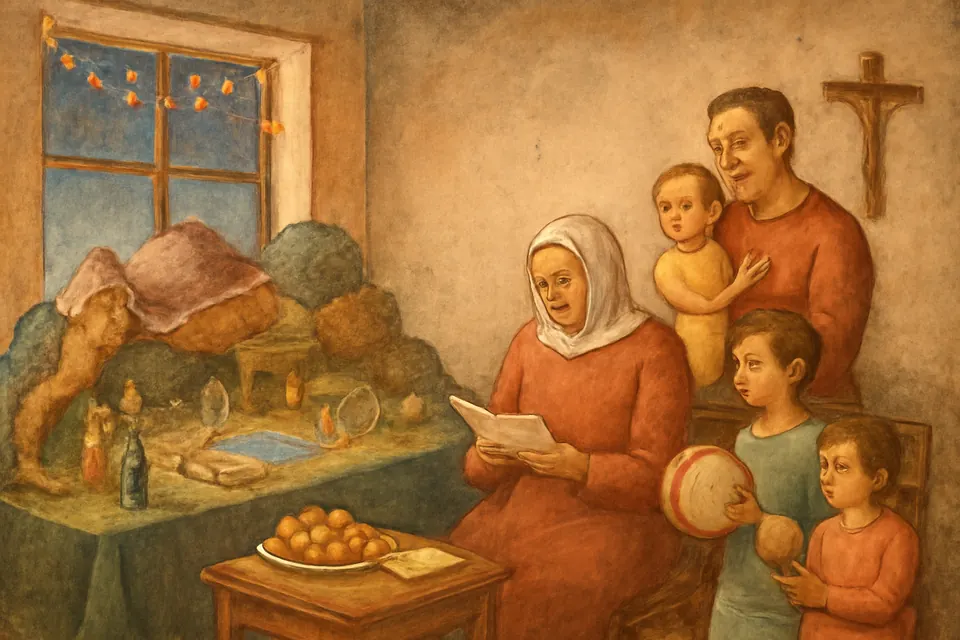
The Novena de Aguinaldos is the Christmas novena of Colombia and Ecuador, prayed by families around the crib each evening from December 16 to December 24. It was written in the 18th century by Fray Fernando de Jesús Larrea, a Franciscan from Quito, and revised about 1910 by Mother María Ignacia (Bertilda Samper) of Bogotá. Its sung refrain is "Ven a nuestras almas."
 Free printable prayer card 5 × 7 inch PDF, ready to print, frame or tuck in a missal.
The Novena de Aguinaldos prayers
The Novena de Aguinaldos has six parts, prayed in the same order every evening. We give the Spanish below from the oldest edition we could read in full, printed in Bogotá in 1843, with its old spelling kept word for word. The English translations are our own. At the end of this section we explain which parts of the modern booklet we have described rather than printed, and why.
1. Oración para todos los días (prayer for every day)
Every day opens with a prayer to God the Father. In the familiar modern booklet it begins:
Benignísimo Dios de infinita caridad, que tanto amasteis a los hombres...
"Most kind God of infinite charity, who so loved mankind..." It thanks the Father for giving us His Son, born in a manger, and offers Him in return the poverty, humility and virtues of the Child Jesus. Three Glory Bes follow.
2. Consideración (the reflection for the day)
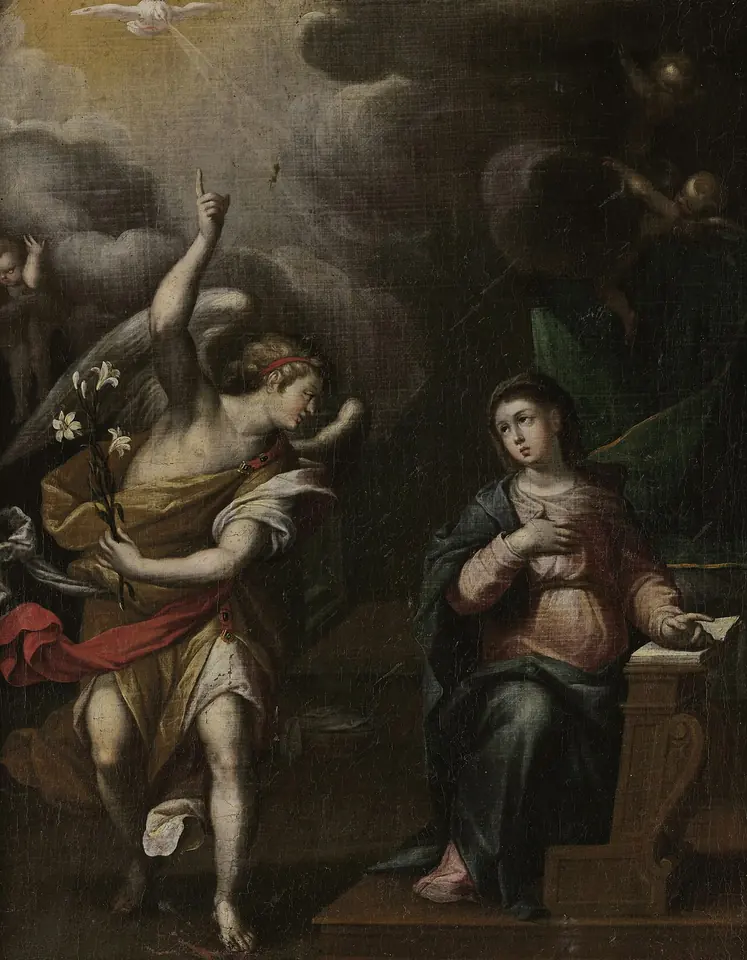
Each of the nine days has its own reading, a meditation on one step of the mystery: the eternal Word with the Father, the Annunciation at Nazareth, Mary's months of waiting, the journey to Bethlehem, the closed doors of the inn and, on December 24, the birth in the cave. One person reads it aloud while the others listen.
3. Oración a la Santísima Virgen (prayer to the Blessed Virgin)
Soberana Maria, que por vuestras grandes virtudes principalmente por tu humildad, mereciste que todo un Dios se hiciese hombre en tu sagrado vientre; infinitas gracias doi al mismo Señor, porque te escojió por madre y para tan alta dignidad te adornó con infinitos dones de naturaleza y gracia; suplícote, Señora, nos alcanceis ardientes deseos de ver al hermoso niño, y heroicas virtudes para recibirlo en nuestras almas, por aquellos actos de amor con que diste á luz el fruto de tu vientre, y por la dulce ternura que sintió tu alma, al tenerlo en tus brazos, aplicarlo á tus pechos, besarle su divino rostro, y adorarlo como á vuestro Dios y vuestro Hijo. Amen.
Our translation:
Sovereign Mary, who by your great virtues, and above all by your humility, merited that God Himself should become man in your sacred womb: I give infinite thanks to the same Lord, because He chose you for His mother and adorned you for so high a dignity with countless gifts of nature and grace. I beg you, Lady, obtain for us an ardent desire to see the beautiful Child, and heroic virtues to receive Him into our souls, by those acts of love with which you brought forth the fruit of your womb, and by the sweet tenderness your soul felt as you held Him in your arms, nursed Him at your breast, kissed His divine face and adored Him as your God and your Son. Amen.
Larrea asks for nine Hail Marys "in memory of the nine months" Mary carried the Son of God. Many families today say three.
4. Oración a San José (prayer to St. Joseph)
O Santísimo José Esposo de María, y Padre putativo de Jesús! Infinitas gracias doi á Dios, porque os escojió para tan altos ministerios, y os adornó de todos los dones proporcionados á tan exelente grandeza; por el inesplicable gozo que tuviste al ver nacido al Niño Dios, y por las encendidas lágrimas que virtieron tus ojos al verle nacido en un establo; te suplico me alcances de este Señor fervorosas ansias de verlo y recibirlo. Amen.
Our translation:
O most holy Joseph, spouse of Mary and foster father of Jesus! I give infinite thanks to God, who chose you for such high offices and adorned you with every gift fitting so great an honor. By the joy beyond words you felt when you saw the Child God born, and by the burning tears your eyes shed to see Him born in a stable, I beg you to obtain for me from this Lord a fervent longing to see Him and receive Him. Amen.
An Our Father, a Hail Mary and a Glory Be follow, in honor of St. Joseph.

5. Gozos (the sung verses)
This is the part every Colombian child knows by heart. One voice reads or sings each verse, and everyone answers with the refrain. In Larrea's 1843 edition they are called "Afectos y aspiraciones por la venida del Niño Dios," longings for the coming of the Child God:
Dulce Jesús mio,
Mi Niño adorado.
*Ven a nuestras almas,
Ven, no tardes tanto.*
Del seno del Padre
Bajaste á humanaros,
Deja ya el materno
Para que te veamos.
De montes y valles
Ven ó deseado!
Rompe ya los Cielos,
Brota flor del campo.
Raiz de Jessé,
Adonaí Sagrado,
Sapiensa del Padre,
Y de su luz rayo.
Llave de David,
Legislador Sabio,
Guia de tu Pueblo,
Y Rey Soberano.
Ven, que ya María
Previene sus brazos,
En que pueda al mundo
Visible mostraros.
Ven, que ya José
En tierra postrado,
Amante te espera,
Con anhelo sacro.
Ven, Salvador nuestro
Por quien suspiramos.
Ven a nuestras almas,
Ven, no tardes tanto.
Our translation:
Sweet Jesus of mine,
my adored Child.
*Come to our souls,
come, do not delay so long.*
From the Father's bosom
You came down to become man;
leave now Your mother's womb
so that we may see You.
Over mountains and valleys
come, O Desired One!
Break open the heavens,
spring up, flower of the field.
Root of Jesse,
holy Adonai,
Wisdom of the Father
and ray of His light.
Key of David,
wise Lawgiver,
Guide of Your people
and sovereign King.
Come, for Mary now
makes ready her arms,
in which she may show You
visible to the world.
Come, for Joseph now,
bowed down to the ground,
waits for You in love
with holy longing.
Come, our Savior,
for whom we sigh.
Come to our souls,
come, do not delay so long.
We have printed eight of the twelve verses in the 1843 edition. Notice the titles: Wisdom, Adonai, Root of Jesse, Key of David, and in a verse not printed here, "Manuel Divino," Emmanuel. They are the titles of the great O Antiphons the Church sings at Vespers from December 17 to 23. Mother María Ignacia later rewrote the verses into the stanzas sung today ("¡Oh Sapiencia suma del Dios soberano...!"), which follow the O Antiphons even more closely. The refrain stayed Larrea's.
6. Oración al Niño Jesús (prayer to the Child Jesus)
The modern novena closes with a prayer added by María Ignacia. It begins "Acordaos, ¡oh dulcísimo Niño Jesús!, que dijisteis a la venerable Margarita del Santísimo Sacramento..." (Remember, O sweetest Child Jesus, that You said to the venerable Margaret of the Blessed Sacrament...). It recalls the promise Margaret reported, that whatever is asked through the merits of the Holy Childhood will not be refused, and then the family puts its own petitions before the crib.
Venerable Margaret of the Blessed Sacrament (Marguerite Parigot) was a Discalced Carmelite of Beaune, in Burgundy, born in 1619 and dead in 1648, who spread devotion to the Infant Jesus as the "Little King of Grace." The Church declared her virtues heroic in 1905. The promise she reported is private revelation: a source of trust, not a guarantee the Church has defined. We pray it the way a child asks a good father, sure of being heard and content with whatever He gives.
Larrea's own edition ends instead with this short prayer, which follows the old Latin collect of the Fourth Sunday of Advent, Excita, quaesumus, Domine, potentiam tuam, et veni:
Excíta, Señor, tu gran poder; ven, y socórrenos con tan eficaces aucilios de tu gracia, que aunque lo impidan nuestras culpas, acelere tu piedad nuestro remedio. Amen.
Our translation:
Stir up Your great power, Lord, and come; help us with such powerful aid of Your grace that, though our sins hold it back, Your mercy may hasten our healing. Amen.
What we have printed, and why
Larrea died in 1773, and the 1843 edition is long in the public domain, so its texts appear here in full. Mother María Ignacia died in 1910, and her edition of that year is old enough to be free as well, but the booklets sold today are often re-edited, with modern spelling, tú in place of vos, and "padre adoptivo" for "padre putativo." Because we cannot be sure which changes are recent, we quote only the openings of the prayer for every day and the prayer to the Child Jesus and describe the rest. Your parish booklet will have them complete.
How to pray the Novena de Aguinaldos
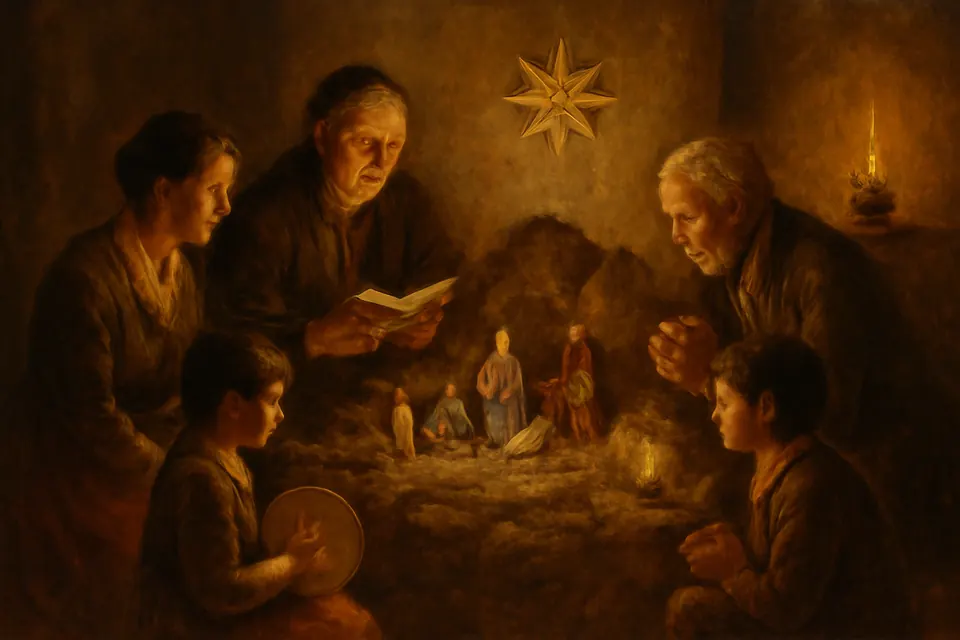
- Gather at the crib. The novena is prayed in front of the pesebre, the family's nativity scene, with the manger left empty until Christmas Eve.
- Pray the six parts in order: the prayer for every day and three Glory Bes; the day's consideración; the prayer to the Virgin and Hail Marys; the prayer to St. Joseph; the gozos, sung; the prayer to the Child Jesus with your own petitions.
- Take turns. One person usually leads, and each part can be given to a different reader, often a child.
- Sing the villancicos and share the food.
- On December 24, after the ninth day, lay the Child Jesus in the manger. In many homes the children find their gifts then, brought by the Niño Dios.
Larrea added a small devotion to each day, and families who want more than the booklet can try them. On the first day, "in reverence of the Child's little shirts," a hundred acts of love of God; on the third, silence; on the fourth, all fifteen decades of the rosary; on the fifth, the Way of the Cross; on the seventh, an alms to a poor person and a visit to someone sick; on the ninth, to adore Him seven times on your knees and, if you can, to fast on bread and water. He added plainly: "Todo lo que se encarga hacer en esta Novena no es obligatorio; y así cada uno hará lo que pueda según su devoción." (Nothing asked in this novena is obligatory, so let each one do what he can according to his devotion.)
The 1843 edition also notes that the Bishop of Popayán, Salvador Jiménez, granted forty days' indulgence for each of its prayers. Since 1967 the Church no longer counts partial indulgences in days, so that grant is a piece of history.
Who wrote it: Larrea and María Ignacia
Fray Fernando de Jesús Larrea
Fernando de Jesús Larrea was born in Quito in 1700 and ordained a priest in 1725. He was a Franciscan preacher of popular missions, which he began giving across New Granada (today's Colombia) in 1742. He founded the missionary college of San Joaquín in Cali in 1757, wrote a vocabulary of the indigenous languages of the Putumayo and Caquetá, and died in Cali in 1773.
He wrote the Novena para el aguinaldo for María Clemencia Caycedo, a devout woman of Bogotá who longed to found a school for girls. The date of the gift is unknown. Sources disagree about the first printing: Radio Nacional de Colombia gives an edition in Lima in 1788, and El Tiempo one from the Imprenta Real in Santa Fe de Bogotá in 1784. The Banco de la República library keeps the Bogotá edition of 1843 quoted above.
Caycedo's foundation, the Monastery and College of La Enseñanza, opened in 1783, the first school for girls in the New Kingdom of Granada. The novena became the house devotion of La Enseñanza, and from there it spread to Bogotá's families.
Mother María Ignacia (Bertilda Samper)
A century later the novena found its second author. Bertilda Samper Acosta was born in Bogotá in 1856, the daughter of the writers José María Samper and Soledad Acosta de Samper, and a poet herself. She entered La Enseñanza in 1886 and took the name María Ignacia.
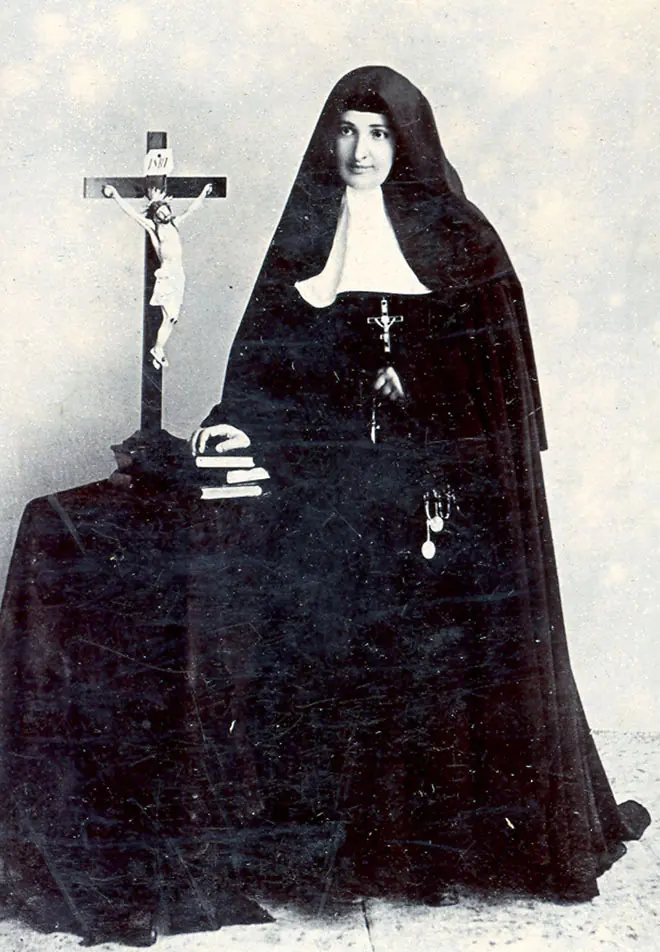
She revised Larrea's text "considerably," in the words of Radio Nacional. According to the novena collector Gonzalo Suárez, quoted by El Colombiano, she added "nuevos gozos, la Oración al Niño Jesús, una traducción de una versión francesa" (new gozos, and the prayer to the Child Jesus, translated from a French version). Archbishop Bernardo Herrera Restrepo of Bogotá approved her edition in 1910 as the Novena del Niño Dios, the year she died. Her version has outlasted every modern rewrite.
Villancicos, natilla and buñuelos: how Colombia keeps the novena
The Novena de Aguinaldos is the heart of Christmas in Colombia. Families take turns hosting, and the same nine evenings are kept in parishes, schools, apartment buildings, offices and even police stations. When the prayers end, the party begins.
The children bring out tambourines, maracas and little drums, and everyone sings villancicos, Christmas carols: "Tutaina," "Los peces en el río," "A la nanita nana," "Mi burrito sabanero" and many more. The night's food is natilla, a soft corn and panela custard cut in squares, with buñuelos, round cheese fritters, and often hojuelas and a cup of hot chocolate or aguapanela.

The name itself is about gifts. An aguinaldo is a Christmas present, and the novena is the season of the juegos de aguinaldos, playful wagers kept through the nine days: "pajita en boca" (keep a straw in your mouth whenever you meet the other player), "sí y no" (never say yes or no), "dar y no recibir" (give without accepting anything). The loser owes the winner a small gift on Christmas.
The novena in Ecuador and beyond
Larrea was a son of Quito, and Ecuadorian families pray the novena from December 16 to 24 as Colombians do, at home and in parishes, often with Ecuador's own carols. In Cuenca the season ends on Christmas Eve with the Pase del Niño Viajero, a day-long procession in honor of the Child Jesus with children dressed as the Holy Family, shepherds and angels.
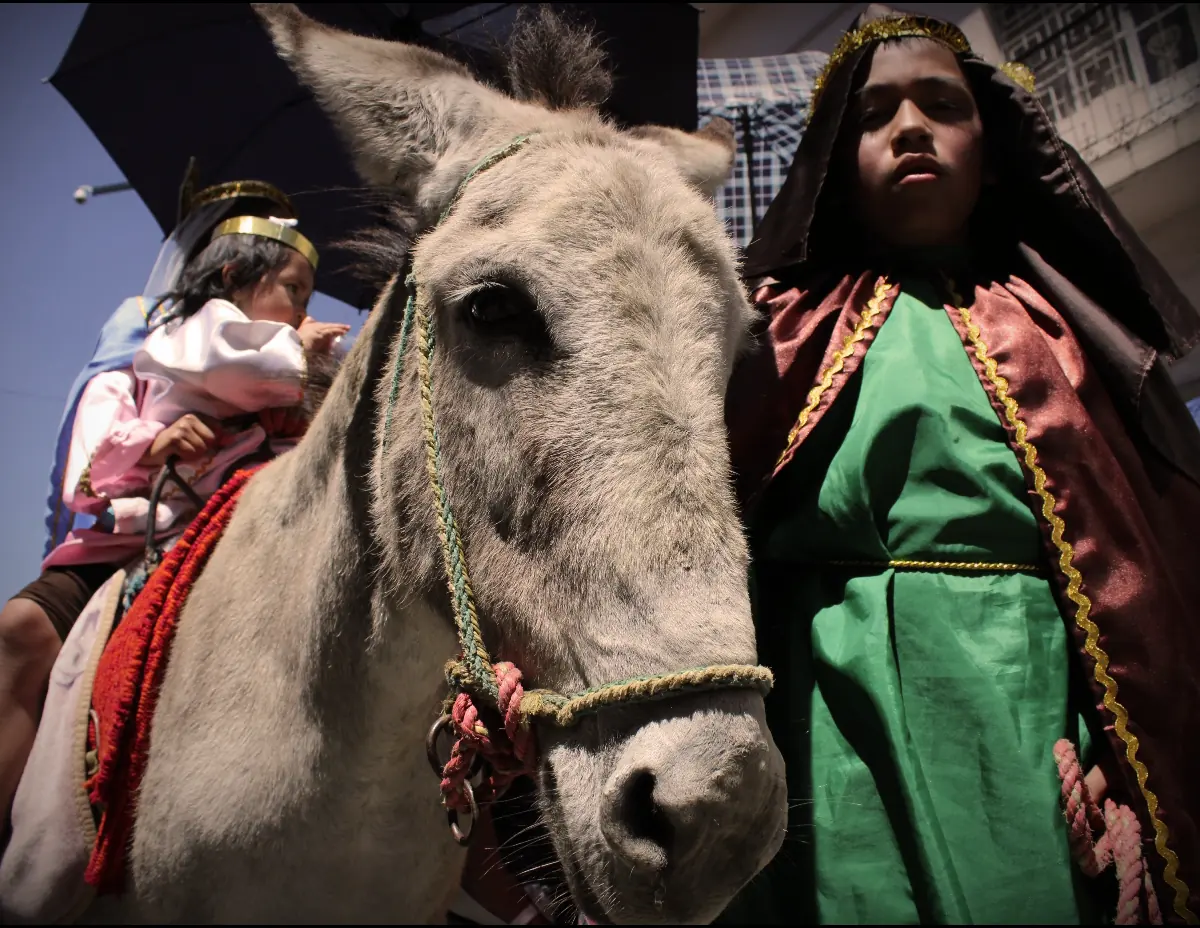
The novena is also kept in parts of Venezuela, and by Colombian and Ecuadorian communities wherever they have settled, in New York, Miami, Houston and Madrid. Its sisters are Mexico's Las Posadas, on the same nine nights, and the Philippines' Simbang Gabi. The Church's Directory on Popular Piety and the Liturgy says the Christmas novena "began as a means of communicating the riches of the Liturgy to the faithful." In Colombia it has done that for two and a half centuries, one family room at a time.
Let us pray it this year with the words that children have sung for so long: Dulce Jesús mío, ¡ven a nuestras almas! Sweet Jesus, come to our souls.
Related prayers and saints
See also the St. Andrew Christmas novena, the O Antiphons, our novenas page, and the saints of the season: the Blessed Virgin Mary, St. Joseph, the Magi, Our Lady of Guadalupe St. Rose of Lima and St. Peter Claver, the apostle of Cartagena. Every December saint is on our feast days calendar.
Frequently asked questions
When do you pray the Novena de Aguinaldos?
From December 16 to December 24, one day each evening, ending on Christmas Eve. In 2026 it begins on Wednesday, December 16. Families, neighbors, schools, parishes and even offices gather for it, often taking turns hosting.
Who wrote the Novena de Aguinaldos?
Fray Fernando de Jesús Larrea (1700–1773), a Franciscan born in Quito, wrote the original Novena para el aguinaldo at the request of María Clemencia Caycedo, who later founded the Colegio de La Enseñanza in Bogotá. About 1910 Mother María Ignacia, born Bertilda Samper Acosta (1856–1910), a nun of La Enseñanza, revised it and added new gozos and the prayer to the Child Jesus. Her version is the one most families use.
What are the gozos of the Novena de Aguinaldos?
The gozos are the sung part of the novena: verses addressed to the coming Christ, each answered by the refrain "Dulce Jesús mío, mi Niño adorado, ¡ven a nuestras almas! ¡Ven, no tardes tanto!" The refrain is already in Larrea's text. The verses call Christ by the titles of the O Antiphons of Advent: Wisdom, Adonai, Root of Jesse, Key of David, Emmanuel.
What is the order of the Novena de Aguinaldos?
The prayer for every day, followed by three Glory Bes; the reflection (consideración) for that day; the prayer to the Blessed Virgin and Hail Marys; the prayer to St. Joseph with an Our Father, Hail Mary and Glory Be; the gozos, sung; and the prayer to the Child Jesus. Then come the villancicos and the food.
Is the Novena de Aguinaldos only Colombian?
No. Its author was from Quito, and it is prayed in Ecuador as well as Colombia, and in parts of Venezuela. Colombian and Ecuadorian families abroad, from New York and Miami to Madrid, keep it every December.
Does the prayer to the Child Jesus promise that every request is granted?
The prayer recalls words Venerable Margaret of the Blessed Sacrament, a 17th-century Carmelite of Beaune, reported hearing from the Child Jesus: whatever is asked through the merits of His infancy will not be refused. That is a private revelation, not a promise defined by the Church. We pray it with trust in Christ's goodness, leaving the answer to Him.
Sources
- Fernando de Jesús Larrea, Novena para el aguinaldo (Bogotá: Imprenta de J. A. Cualla, 1843), transcription on Wikisource. Source of the Spanish texts printed here and of the daily practices of the original
- El Colombiano: El Dulce Jesús Mío suena hace 200 años (December 15, 2020). Larrea's authorship of the refrain; María Ignacia's new gozos and her translation of the prayer to the Child Jesus from a French version
- Radio Nacional de Colombia: ¡Te contamos la historia detrás de la tradicional novena de aguinaldos!, by María Fernanda Sánchez Melo (December 16, 2023). Larrea's life; a Lima edition of 1788 and a Bogotá edition of 1807; María Ignacia's entry into La Enseñanza in 1886
- El Tiempo: La novena no se inventó en Colombia (December 16, 2024). A 1784 edition from the Imprenta Real in Santa Fe; approval of the revised novena in 1910 by Archbishop Bernardo Herrera Restrepo
- Directory on Popular Piety and the Liturgy (2001), no. 103: The Christmas Novena
- Postulación General OCD: Venerable Margaret of the Blessed Sacrament