Prayer for cancer

A Catholic prayer for cancer asks Christ the healer for strength and, if it is His will, a cure, through the prayers of St. Peregrine, the friar whose wounded leg, tradition holds, Christ healed the night before it was to be cut off. Below: an 1865 Servite prayer to him, the Church's prayer for someone with cancer, Psalm 90 and the Anointing of the Sick.
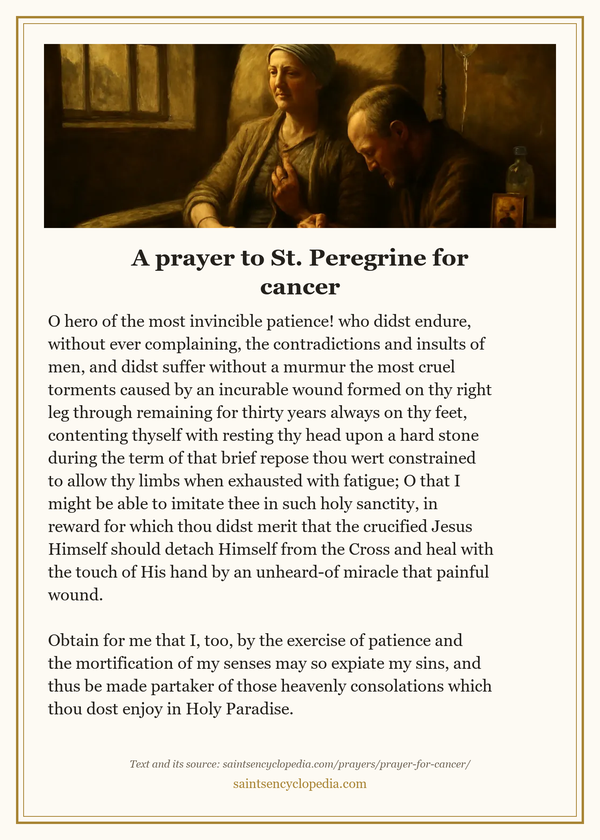 Free printable prayer card 5 × 7 inch PDF, ready to print, frame or tuck in a missal.
A prayer for cancer usually begins on the day of the diagnosis, in a parked car outside the doctor's office or at the kitchen table that night. Then it goes on for months: through scans and waiting rooms, surgery, chemotherapy and radiation, good reports and bad ones. Whether you are praying for yourself or for someone with cancer, the Church walks with you. Here are the oldest prayer to St. Peregrine we could find in English, the Church's own prayers for the sick, the Psalm the Church prays every night against fear, the sacrament Christ gave for serious illness, and the saints who knew this cross. Every text is in the public domain and printed word for word, with its source.
A prayer to St. Peregrine for cancer
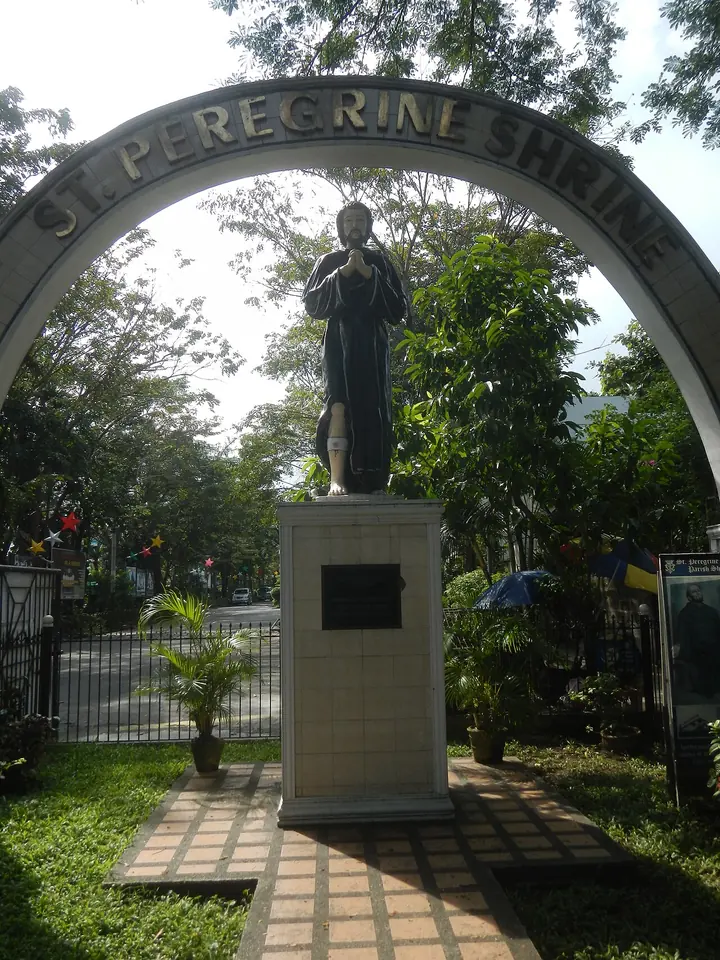
St. Peregrine Laziosi was a Servite friar of Forlì, in northern Italy, who died in 1345. In his sixties a wound on his right leg became so bad that the surgeon decided to amputate. The night before, tradition holds, he prayed before the crucifix in the chapter room, saw Christ reach down from the cross and touch his leg, and woke healed. His order, the Servants of Mary, has always called the illness cancer, and he has become the patron of everyone who suffers from it.
In 1865 a little book printed in London gave the "septenaries" of the Servite saints "as practised in the churches" of the order: seven prayers to be said on seven days in honor of each saint. The one for "St. Pellegrino" (the Italian form of his name) was to be prayed "every Tuesday," or "for seven days before his feast," to obtain "patience in tribulations, and the divine assistance in every bodily infirmity." This is the sixth prayer, the one about his illness, word for word:
O hero of the most invincible patience! who didst endure, without ever complaining, the contradictions and insults of men, and didst suffer without a murmur the most cruel torments caused by an incurable wound formed on thy right leg through remaining for thirty years always on thy feet, contenting thyself with resting thy head upon a hard stone during the term of that brief repose thou wert constrained to allow thy limbs when exhausted with fatigue; O that I might be able to imitate thee in such holy sanctity, in reward for which thou didst merit that the crucified Jesus Himself should detach Himself from the Cross and heal with the touch of His hand by an unheard-of miracle that painful wound.
Obtain for me that I, too, by the exercise of patience and the mortification of my senses may so expiate my sins, and thus be made partaker of those heavenly consolations which thou dost enjoy in Holy Paradise.
The book has the faithful add an Our Father, a Hail Mary and a Glory Be after each prayer, and it closes the septenary with this collect:
O God who hast wonderfully granted to the blessed Pellegrino an angel as his guardian, the Mother of God as his teacher, and Jesus as the healer of a grievous ulcer; grant, we beseech thee, by his merits, that we may worship with a special love and praise on earth and in heaven the same Angel, Virgin, and Saviour, through the same Jesus Christ our lord. Amen.
In the English of 1865, "worship" here still carries its older sense of "honor": we adore God alone, and we honor the angels and Our Lady. Notice too that this old book never says "cancer." It speaks of "an incurable wound" and "a grievous ulcer." The name came later, but the prayer is the same: the sick man who could not be helped by surgeons, and Christ who helped him.
The modern St. Peregrine prayer and novena, the one most parishes use, is on our St. Peregrine prayer page, and the full story of his life is in his entry.

The Church's prayer for someone with cancer
When a priest visits the sick, the Roman Ritual gives him a set of prayers, each after a Gospel reading of Christ healing. These are in the 1889 Manual of Prayers, the official prayer book of the Third Plenary Council of Baltimore. Anyone can pray them for someone with cancer; put in the person's name, and change "he" to "she" as needed.
After a reading from the last chapter of St. Mark's Gospel, where Christ promises that His followers "shall lay their hands upon the sick," the priest prays:
O God of the Heavenly Virtues, who from the bodies of men drivest forth all sickness and all infirmity by the power of Thy word: draw graciously nigh unto this Thy servant, N., that with weakness put to flight, and health and strength continually renewed, he may ever bless Thy Holy Name. Amen.
Cancer frightens the mind as much as it weakens the body, and the Ritual's prayers ask for both to be made whole. On our prayer for the sick page you'll find the rest of the rite, with the short versicles a family can pray together at the bedside.
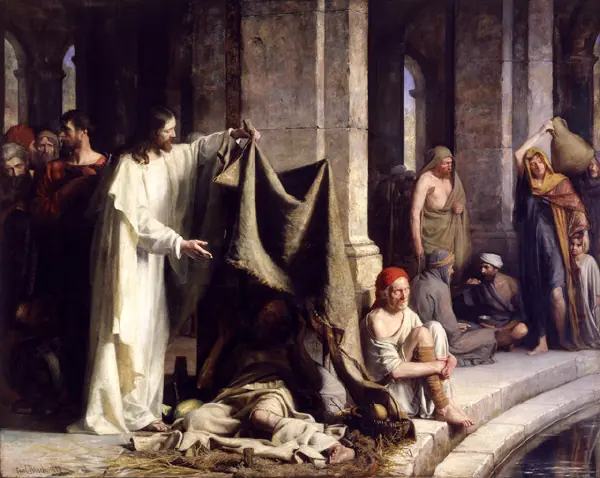
The leper in the Gospel gives us the shortest prayer for healing there is, and Jesus' shortest answer (Mark 1:40–41):
If thou wilt, thou canst make me clean. And Jesus having compassion on him, stretched forth his hand; and touching him, saith to him: I will. Be thou made clean.
Psalm 90 for the long nights
For centuries the Church has prayed Psalm 90 at Compline, her last prayer of the day, because it is the great psalm of trust against fear in the dark. Pray it before scans, the night before surgery, or in the hours when sleep won't come. From the Douay-Rheims:
He that dwelleth in the aid of the most High, shall abide under the protection of the God of Jacob. He shall say to the Lord: Thou art my protector, and my refuge: my God, in him will I trust. ... His truth shall compass thee with a shield: thou shalt not be afraid of the terror of the night. Of the arrow that flieth in the day, of the business that walketh about in the dark: of invasion, or of the noonday devil. ... For he hath given his angels charge over thee; to keep thee in all thy ways. ... He shall cry to me, and I will hear him: I am with him in tribulation, I will deliver him, and I will glorify him.
"I am with him in tribulation." God does not promise that the tribulation will not come. He promises to be in it with us.
Two lines from St. Paul for the hardest days of treatment: "My grace is sufficient for thee; for power is made perfect in infirmity" (2 Corinthians 12:9), and "neither death, nor life ... nor any other creature, shall be able to separate us from the love of God, which is in Christ Jesus our Lord" (Romans 8:38–39).
The Anointing of the Sick and cancer
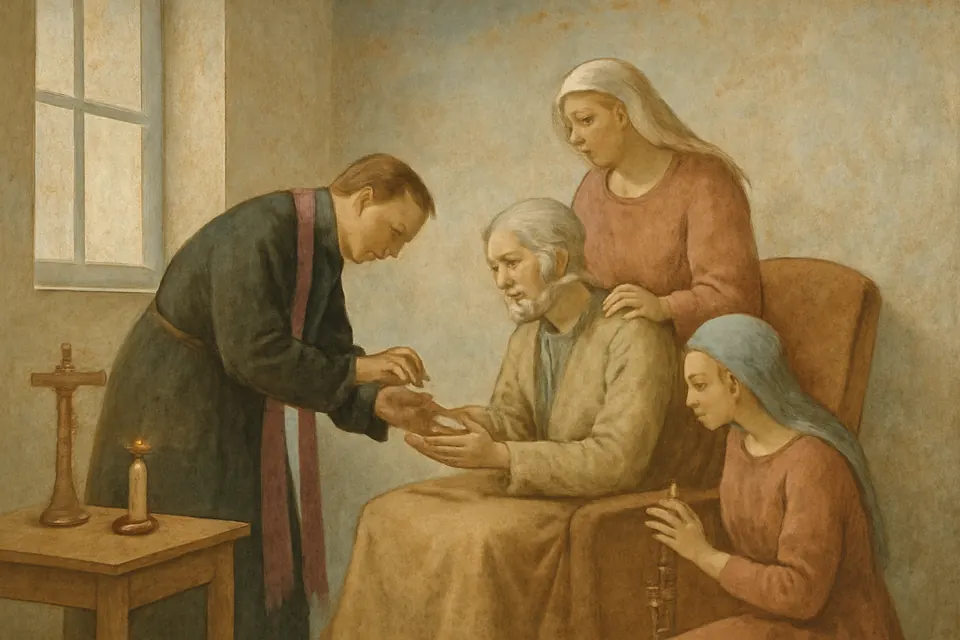
Christ gave His Church a sacrament for exactly this. Many Catholics still think of the Anointing of the Sick as "last rites" for the final hour, but the Catechism of the Catholic Church (no. 1514) says that "as soon as anyone of the faithful begins to be in danger of death from sickness or old age, the fitting time for him to receive this sacrament has certainly already arrived." A cancer diagnosis is reason enough to call a priest. So is a serious surgery. And if the illness grows worse, the sacrament can be received again (no. 1515).
The priest lays his hands on the sick person, anoints the forehead and hands with the oil of the sick, and prays for healing of soul and, if God wills, of body. He can also hear confession and bring Holy Communion. Call your parish, or ask for the chaplain at the cancer center. Don't wait.
How to pray for someone with cancer
- Name them to God every day, plainly. "Lord, You know [name]. Please heal her, and give her strength today."
- Have a Mass offered for them at your parish. It is the greatest prayer of all.
- Pray a novena to St. Peregrine, or a Rosary for them with family or friends. Many parishes keep a St. Peregrine novena, and the National Shrine of St. Peregrine in Chicago, run by the Servite friars, accepts petitions.
- Pray for their caregivers: the spouse who drives to every appointment, the children, the oncologists and nurses.
- Do something. Bring a meal, sit with them through an infusion, mow the lawn. Prayer and practical help belong together.
- Ask them how they want you to pray. Some want healing above all; some want peace; some want only company. Pray for what they ask.
The saints who knew cancer
We ask the saints to pray for the sick because they love us; it is God who heals.
- St. Peregrine, patron of cancer patients. His healing is traditional: it is told in his early life and has been at the center of his cult ever since, though no medical record survives from 1325.
- St. Agatha, the virgin martyr of Catania, invoked by women with breast cancer.
- St. Nektarios of Aegina, the Greek Orthodox bishop who died in 1920 after an illness Orthodox sources describe as cancer, whom the Orthodox faithful ask to pray for cancer patients; many healings have been reported.
- St. John of God, whose hospital in Granada took in, as he wrote in a letter the Church still reads on his feast, "people with useless limbs, the maimed, the lepers, the dumb, the insane, paralytics, and some who are suffering from cancer."
- St. John XXIII, the "good pope," who died of cancer on June 3, 1963, during the Second Vatican Council.
- Our Lady of Lourdes, Health of the Sick, and St. Raphael the Archangel, whose name means "God heals."
The full stories of the cancer patrons are on our patron saint of cancer page.
When the cure doesn't come
We pray for healing without fear of asking too much. Jesus healed the sick wherever He went, and He told us to ask. But we should also say honestly that many faithful people, praying with great faith, have died of cancer. Their prayers were not too weak. God gave them, often, the grace the 1865 prayer asks for: "patience," and "those heavenly consolations" that no illness can take away.
If the time comes, ask for the sacraments again, and pray our prayer for the dying. For the families, there is our prayer for grief. For the days of treatment, see our prayer for healing, prayer for the sick, prayer for surgery and prayer for strength. Let us pray tonight for everyone with cancer, by name: St. Peregrine, pray for them.
Frequently asked questions
Who is the patron saint of cancer?
St. Peregrine Laziosi (about 1265–1345), a Servite friar of Forlì, Italy. Tradition holds that Christ healed a wound on his leg, which his order has always called cancer, the night before the leg was to be amputated. St. Agatha is invoked by women with breast cancer, and in the Orthodox Church St. Nektarios of Aegina is asked to pray for cancer patients.
What is a good prayer for someone with cancer?
Pray the Church's own prayer from the Roman Ritual: "O God of the Heavenly Virtues, who from the bodies of men drivest forth all sickness and all infirmity by the power of Thy word: draw graciously nigh unto this Thy servant, N., that with weakness put to flight, and health and strength continually renewed, he may ever bless Thy Holy Name." Add, "St. Peregrine, pray for him."
Should a person with cancer receive the Anointing of the Sick?
Yes. The Catechism (no. 1514) says the right time for the sacrament has already come as soon as a person begins to be in danger of death from sickness. A cancer diagnosis, a major surgery or a hard round of treatment is reason enough to call a priest, and the sacrament can be repeated if the illness grows worse (no. 1515).
Is there a novena for cancer patients?
Yes. The best-known is the St. Peregrine novena; many parishes pray it together, and you can pray it at home with the prayer on our St. Peregrine prayer page. The older Servite form, printed on this page, is a septenary: seven short prayers said on seven Tuesdays or on the seven days before his feast.
Does God always heal cancer when we pray?
God always hears and always answers, but not always with a cure. Many people have been healed; many holy people, St. John XXIII among them, died of cancer. We pray boldly for healing, as Jesus told us to, and we also pray for strength, peace, good doctors and, at the end, a holy death. No prayer offered in faith is wasted.
Sources
- Septenaries in Honor of Several Saints of the Order of Servites (London: Frederick Bell, 1865), Devout Exercise in honor of St. Pellegrino Laziosi, pp. 15-20, Internet Archive. Source of the 19th-century prayers to St. Peregrine
- A Manual of Prayers for the Use of the Catholic Laity, prepared by order of the Third Plenary Council of Baltimore (New York, 1889), The Visitation of the Sick, pp. 494-499, Internet Archive. Source of the Roman Ritual's prayers for the sick
- Douay-Rheims Bible: Psalm 90 (drbo.org)
- Catechism of the Catholic Church, nos. 1514-1516: who receives and who administers the Anointing of the Sick
- St. John of God, letter to Gutierre Lasso: "Christ is faithful and provides all things" (Vatican)
- Servite Friars, USA Province: St. Peregrine devotions