Catholic prayer for wisdom

The great Catholic prayer for wisdom is King Solomon's prayer in the Book of Wisdom, chapter 9: "Give me wisdom, that sitteth by thy throne, and cast me not off from among thy children." Pray it with St. Thomas Aquinas's prayer for "wisdom to find Thee," and ask Mary, Seat of Wisdom, to pray for you.
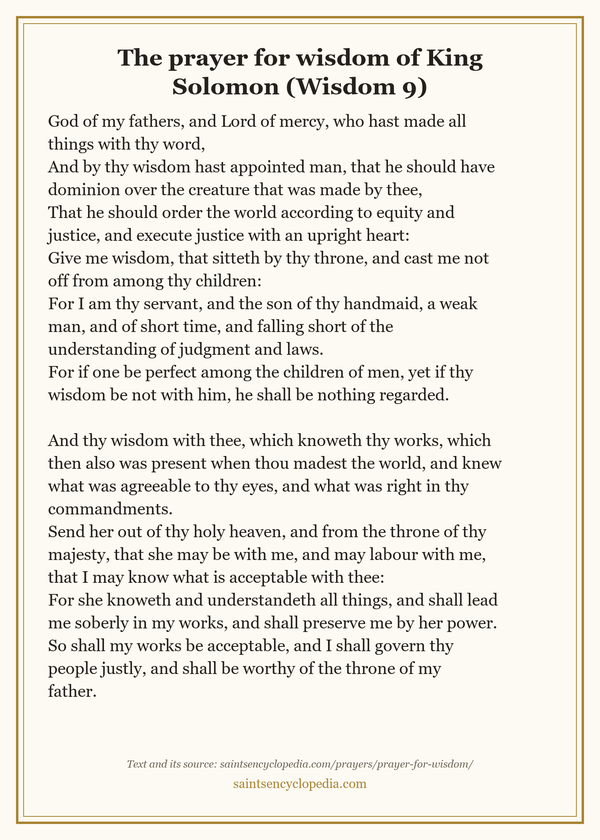 Free printable prayer card 5 × 7 inch PDF, ready to print, frame or tuck in a missal.
Some decisions can't be solved with more information. Whom to marry, whether to take the job, how to answer a child's hard question, what to say at a deathbed: these need wisdom, and wisdom is a gift. Scripture says so plainly: "if any of you want wisdom, let him ask of God, who giveth to all men abundantly, and upbraideth not; and it shall be given him" (James 1:5, Douay-Rheims). Here are the Catholic prayers for wisdom that the Church has prayed longest, beginning with Scripture's own prayer, word for word and with their sources.
The prayer for wisdom of King Solomon (Wisdom 9)
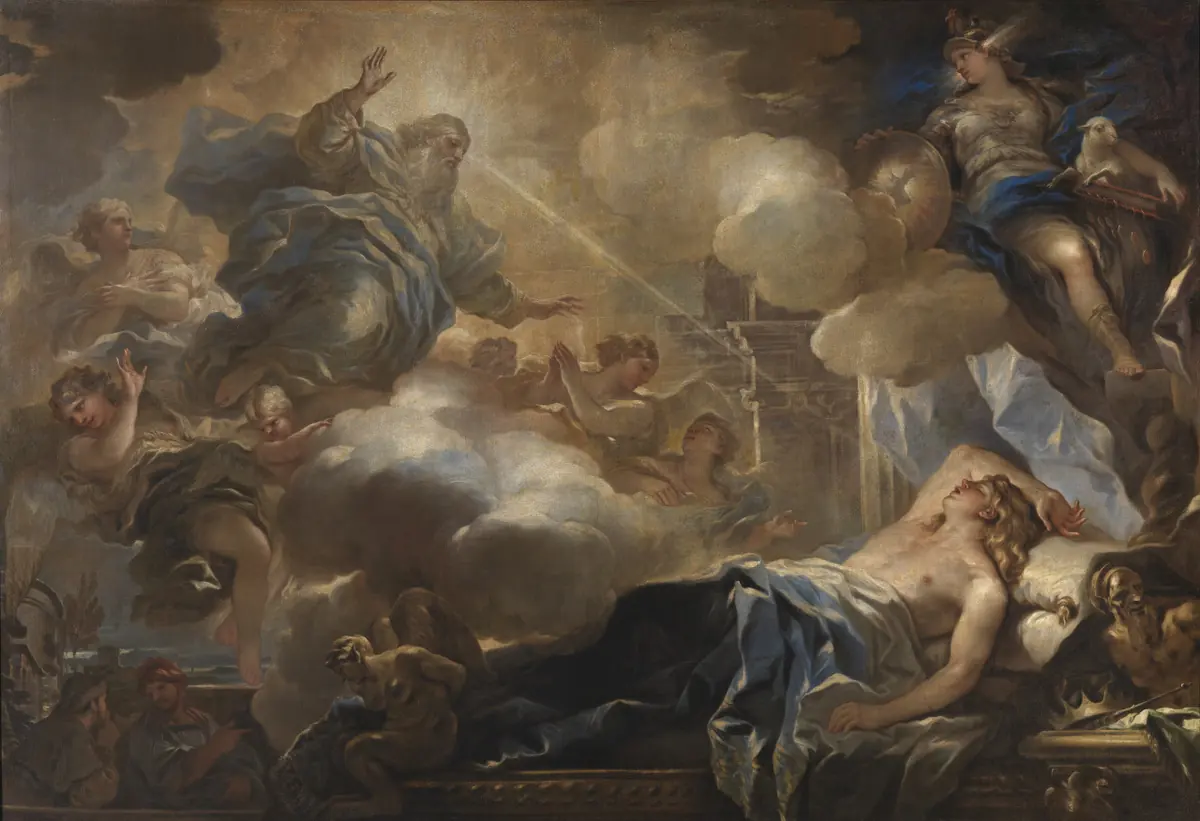
When young Solomon became king, God appeared to him in a dream at Gabaon and told him to ask for whatever he wished. He asked for "an understanding heart, to judge thy people, and discern between good and evil" (3 Kings 3:9). God was pleased that he "hast not asked for thyself long life or riches," and gave him a "wise and understanding heart" besides everything else.
The Book of Wisdom, written in Solomon's voice, expands that request into a full prayer. This is Wisdom 9:1–6 and 9–12 in the Douay-Rheims:
God of my fathers, and Lord of mercy, who hast made all things with thy word, And by thy wisdom hast appointed man, that he should have dominion over the creature that was made by thee, That he should order the world according to equity and justice, and execute justice with an upright heart: Give me wisdom, that sitteth by thy throne, and cast me not off from among thy children: For I am thy servant, and the son of thy handmaid, a weak man, and of short time, and falling short of the understanding of judgment and laws. For if one be perfect among the children of men, yet if thy wisdom be not with him, he shall be nothing regarded.
And thy wisdom with thee, which knoweth thy works, which then also was present when thou madest the world, and knew what was agreeable to thy eyes, and what was right in thy commandments. Send her out of thy holy heaven, and from the throne of thy majesty, that she may be with me, and may labour with me, that I may know what is acceptable with thee: For she knoweth and understandeth all things, and shall lead me soberly in my works, and shall preserve me by her power. So shall my works be acceptable, and I shall govern thy people justly, and shall be worthy of the throne of my father.
The verses we left out (7–8) speak of his calling to be king and build the Temple. When you pray it, you can put your own calling in their place: to raise these children, to run this business, to teach this class. The chapter ends with the reason we need to ask at all: "who shall know thy thought, except thou give wisdom, and send thy Holy Spirit from above" (Wisdom 9:17).
St. Thomas Aquinas's prayer for wisdom
St. Thomas Aquinas (1225–1274) knew more than almost anyone of his age, and he prayed constantly for wisdom. This prayer, Concede mihi, misericors Deus, has been printed under his name for centuries. Pope Leo XIII indulgenced it in 1888, and the 1910 Raccolta (no. 455) gives it as the "Prayer of St Thomas Aquinas for grace to lead a holy life":
O merciful God, grant that I may eagerly desire, carefully search out, truthfully acknowledge, and ever perfectly fulfil all things which are pleasing to Thee. Order, O my God, all my state and grant me to know what Thou dost require me to do, and give me to do it as is fitting and profitable to my soul.
Grant, O Lord my God, that I may not fail either in prosperity or adversity, that I be not lifted up by the one or cast down by the other. Let me joy in nothing but what leads to Thee, nor grieve for anything but what leads away from Thee; let me neither seek to please, nor fear to displease any but Thee alone.
May all transitory things grow vile in my eyes, O Lord, and may all that is eternal be dear to me. May all joy be irksome to me that is without Thee, nor may I desire anything that is apart from Thee. May all labour and toil delight me which is for Thee, and all rest be weariness which is not in Thee.
Grant me, O Lord, continually to lift up my heart towards Thee, and to bring sorrowfully to mind my many shortcomings with full purpose of amendment.
Make me, O Lord, obedient without demur, poor without repining, chaste without stain, patient without murmur, humble without pretence, joyous without frivolity, fearful without abjectness, truthful without disguise, given to good works without presumption, faithful to rebuke my neighbour without arrogance, and ever careful to edify him by word and example without pretension.
Give me, O Lord, an ever watchful heart, which no subtle speculation may lure from Thee. Give me a noble heart, which no unworthy affection can draw downwards to the earth. Give me an upright heart, which no insincere intention can warp aside. Give me a firm heart, which no tribulation can crush or quell. Give me a free heart, which no perverted or impetuous affection can claim for its own.
Bestow on me, O Lord, my God, understanding to know Thee, diligence to seek Thee, wisdom to find Thee, a life and conversation which may please Thee, perseverance in waiting patiently for Thee, and a hope which may embrace Thee at the last. Grant me to be pierced with compunction by thy sorrows through true repentance, to improve all thy gifts and benefits during this my pilgrimage through thy grace, and so in glory to rejoice together with Thee in the heavenly country. Who livest and reignest God, for ever and ever. Amen.
Notice what Thomas means by wisdom. It is not cleverness. The prayer asks for "an ever watchful heart, which no subtle speculation may lure from Thee," a striking request from the greatest speculative mind in the Church, and it ends with "wisdom to find Thee." For Thomas, the wise man is the one who knows what matters and orders his life by it.

St. Thomas Aquinas's prayer before study
For students and anyone whose work is thinking, Thomas's Oratio ante studium asks for wisdom in the practical form we need at a desk. Pius XI printed it at the end of his encyclical Studiorum Ducem in 1923. The English is the Raccolta's:
Ineffable Creator, who, of the treasures of thy wisdom hast formed the nine choirs of Angels, and set them on high above the heavens in a wonderful order, and hast exquisitely fashioned and knit together all parts of the universe; do Thou, who art the true fountain and one principle of light and wisdom, deign to shed the brightness of thy light upon the darkness of my understanding, and thus to disperse the twofold darkness of sin and ignorance wherein I was born. O Thou, who makest eloquent the tongues of babes, instruct my tongue, and pour forth on my lips the grace of thy blessing. Grant me acuteness in understanding what I read, power to retain it, subtlety to discern its true meaning, and clearness and ease in expressing it. Do Thou order my beginnings, direct and further my progress, complete and bless my ending; Thou who art true God and true Man, who livest and reignest world without end. Amen.
Its Latin, its history and the other student prayers are on our prayers before an exam page.
The Church's own prayer on Thomas's feast, March 7 in the old calendar, asks for the same grace. From the 1916 missal:
O God, who didst enlighten thy Church by the marvellous learning of thy blessed Confessor Thomas, and enrich it by his holy labor, grant us we beseech thee understanding to master what he taught and success in imitating what he did. Through Jesus Christ, thy Son our Lord, who liveth and reigneth with thee in the unity of the Holy Ghost, God world without end. Amen.
The Church's prayer to the Holy Spirit for wisdom
Wisdom is the first of the seven gifts of the Holy Spirit, which the Catechism (no. 1831) lists as "wisdom, understanding, counsel, fortitude, knowledge, piety, and fear of the Lord." The 1910 Catholic Encyclopedia describes the gift in a single line: "The gift of wisdom, by detaching us from the world, makes us relish and love only the things of heaven."
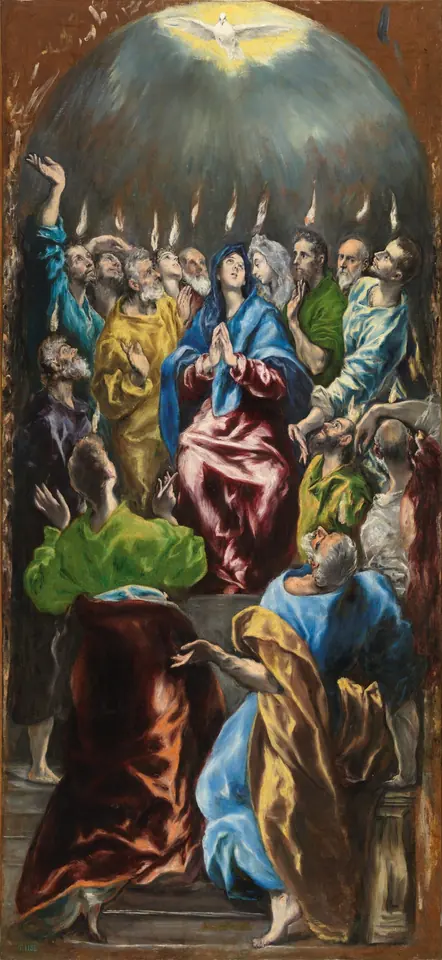
That word "relish" comes from the Church's prayer on Pentecost. The Latin asks recta sapere, to "taste" what is right, and sapere is the root of sapientia, wisdom. This is the collect of Pentecost Sunday in the 1916 missal:
O God, who on this day didst teach the hearts of the faithful by the light of the Holy Spirit, grant us in the same Spirit to relish what is right, and ever to rejoice in his consolation. Through Jesus Christ, thy Son our Lord, who liveth and reigneth with thee in the unity of the same Holy Ghost, God world without end. Amen.
Pray it before any hard choice. Wisdom, in this prayer, is a kind of taste for the good, the way a cook knows when something is right.
Mary, Seat of Wisdom
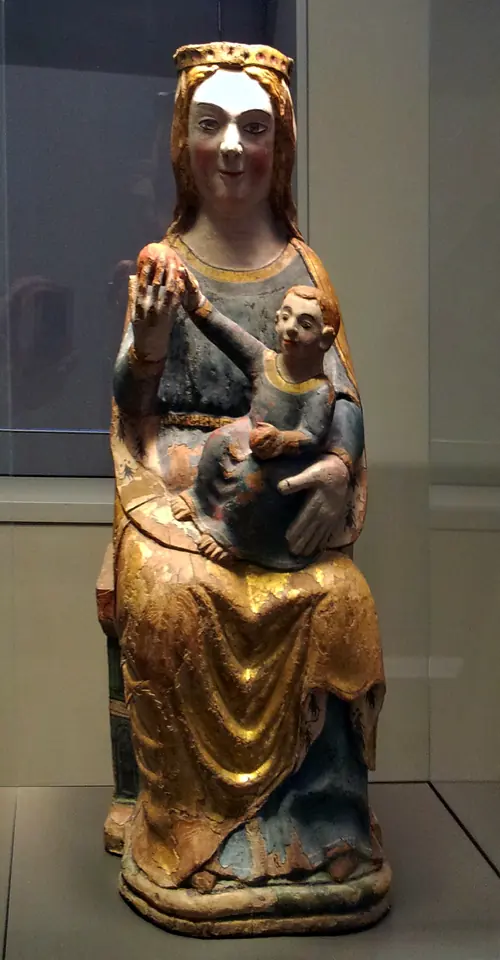
In the Litany of Loreto, the Church calls the Blessed Virgin Sedes Sapientiae, "Seat of Wisdom." Christ is the Wisdom of God (1 Corinthians 1:24), and Mary held Him on her lap as a king sits on a throne. Medieval carvers made that title visible in wooden statues of the Virgin seated upright with the Child on her knees, facing the viewer like a king on his throne. The prayer is the litany's single line:
Seat of wisdom, pray for us.
The saints to ask for wisdom
- The Blessed Virgin Mary, Seat of Wisdom, who "kept all these words, pondering them in her heart."
- St. Thomas Aquinas, the Angelic Doctor, patron of Catholic schools.
- St. Catherine of Alexandria, patron of philosophers. Her legend, which is traditional, says the young Christian of Alexandria answered the emperor's fifty philosophers in debate and won them to Christ.
- St. Albert the Great, Thomas's teacher, patron of scientists.
- St. Augustine, who looked for wisdom everywhere before he found it in Christ.
- St. Catherine of Siena, who had almost no schooling and is a Doctor of the Church.
- St. Joseph, whom God guided in dreams and who always knew what to do next.
- The Doctors of the Church, the saints the Church honors for the wisdom of their teaching.

What Scripture says about wisdom
The wisdom books return to one starting point (Proverbs 9:10, Douay-Rheims):
The fear of the Lord is the beginning of wisdom: and the knowledge of the holy is prudence.
St. James describes what real wisdom looks like when it shows up in a person (James 3:17):
But the wisdom, that is from above, first indeed is chaste, then peaceable, modest, easy to be persuaded, consenting to the good, full of mercy and good fruits, without judging, without dissimulation.
That is a good examination of conscience for anyone who thinks himself wise.
How to pray for wisdom before a decision
- Ask plainly. "If any of you want wisdom, let him ask of God." Pray Wisdom 9 or the Pentecost prayer by name.
- Ask with a willing heart. Solomon was praised because he didn't ask for riches. Pray to know God's will, not for a blessing on what you've already decided.
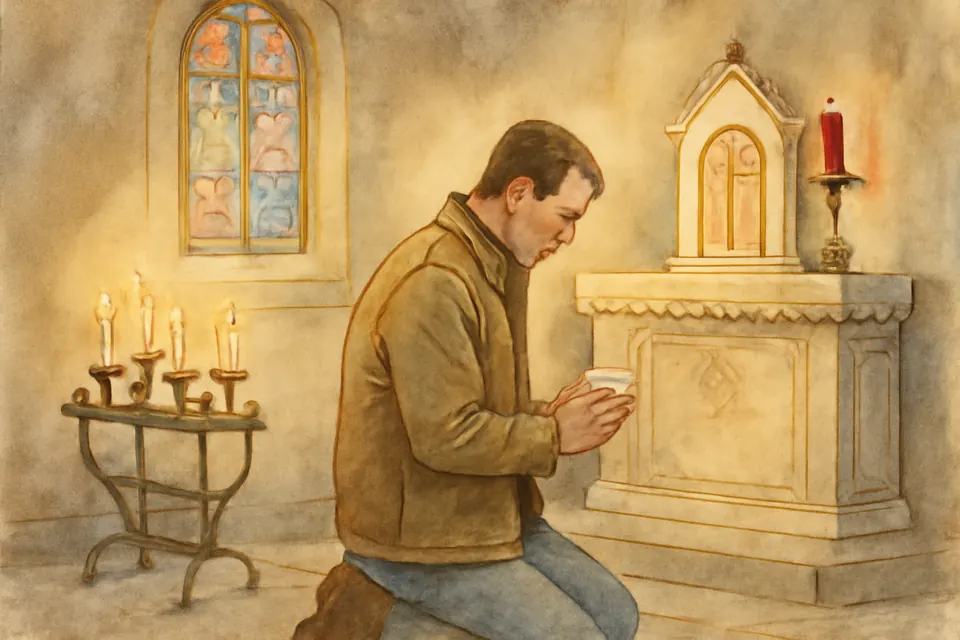
- Go to the Eucharist. Make a visit to the Blessed Sacrament and lay the question before Him.
- Ask for counsel. Counsel is also a gift of the Spirit, and it often comes through a priest, a spouse or an honest friend.
- Give it time. St. James says the wise man is "easy to be persuaded," and haste is rarely wise.
- Then act in peace. Thomas's prayer asks God to "grant me to know what Thou dost require me to do, and give me to do it."
Let us ask with Solomon tonight: "Give me wisdom, that sitteth by thy throne." For related prayers, see our prayer for humility, our prayer for teachers, and all our Catholic prayers.
Frequently asked questions
What is the best Catholic prayer for wisdom?
Solomon's prayer in Wisdom 9:1–12 is the classic, because it is Scripture itself: "Give me wisdom, that sitteth by thy throne." St. Thomas Aquinas's prayer that asks for "understanding to know Thee, diligence to seek Thee, wisdom to find Thee" is the best-loved prayer of the saints for wisdom.
What Bible verse says to ask God for wisdom?
James 1:5, in the Douay-Rheims: "But if any of you want wisdom, let him ask of God, who giveth to all men abundantly, and upbraideth not; and it shall be given him." The next verse adds, "But let him ask in faith, nothing wavering."
Who is the patron saint of wisdom?
There is no single official patron of wisdom. The Church calls the Blessed Virgin Mary "Seat of Wisdom" in the Litany of Loreto. St. Thomas Aquinas is patron of Catholic schools and students, and St. Catherine of Alexandria is patron of philosophers and of studies.
Is wisdom a gift of the Holy Spirit?
Yes. The Catechism (no. 1831) lists seven gifts of the Holy Spirit: "wisdom, understanding, counsel, fortitude, knowledge, piety, and fear of the Lord." Wisdom is the first. The Catholic Encyclopedia describes it as the gift that "makes us relish and love only the things of heaven."
What is a short prayer for wisdom?
"Give me wisdom, that sitteth by thy throne" (Wisdom 9:4), or Mary's invocation from the Litany of Loreto, "Seat of Wisdom, pray for us." Before a decision, pray the Pentecost prayer's line: "grant us in the same Spirit to relish what is right."
What is the difference between wisdom and knowledge?
Knowledge is knowing many things; wisdom is seeing them in their right order, in the light of God. Proverbs 9:10 says, "The fear of the Lord is the beginning of wisdom." A person of little schooling can be truly wise, as St. Catherine of Siena, a Doctor of the Church, shows.
Sources
- Douay-Rheims Bible, Wisdom chapter 9 (drbo.org)
- Douay-Rheims Bible, 3 Kings (1 Kings) chapter 3 (drbo.org)
- The Raccolta, or Collection of Indulgenced Prayers and Good Works (Burns & Oates, 1910), no. 455, the prayer of St. Thomas Aquinas for grace to lead a holy life, Internet Archive
- Pius XI, Encyclical Studiorum Ducem (1923), Latin text with the Oratio before study (Vatican)
- The Mass Every Day of the Year: The Roman Missal (New York: Home Press, 1916), Pentecost Sunday; March 7, St. Thomas Aquinas, Internet Archive
- Catechism of the Catholic Church, nos. 1830-1832: the gifts and fruits of the Holy Spirit
- Catholic Encyclopedia (1910): Holy Ghost, on the seven gifts