The sacrament of Confirmation

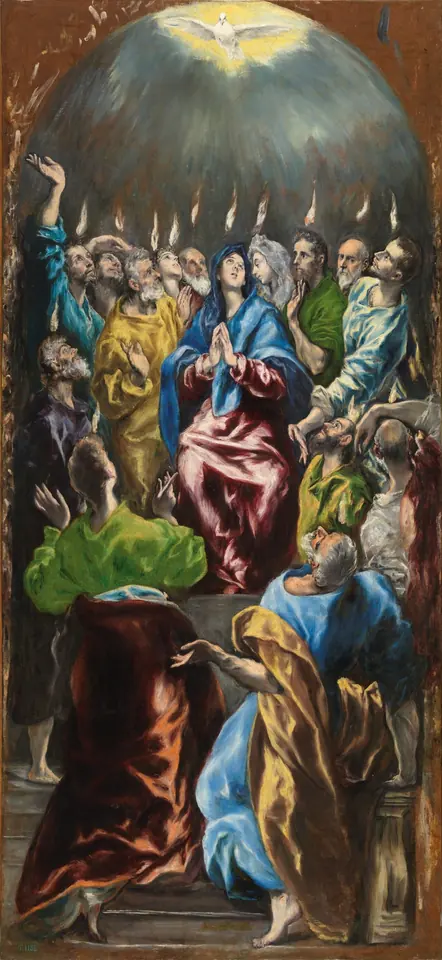
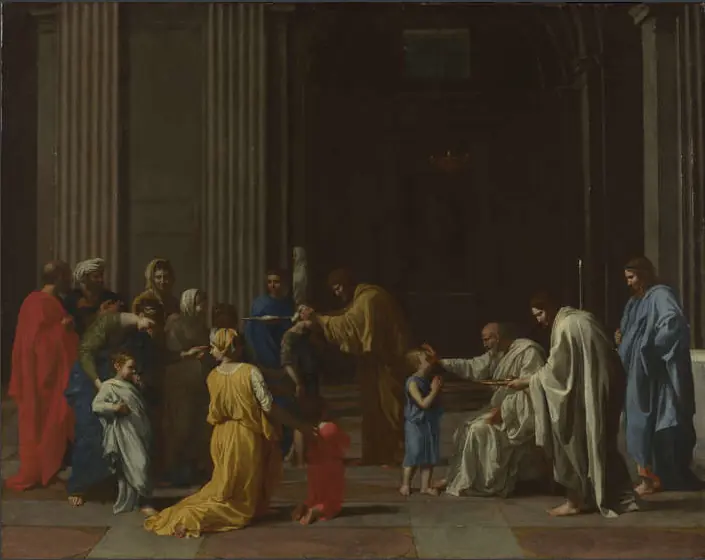
The sacrament of Confirmation completes the grace of Baptism by a special outpouring of the Holy Spirit, as at Pentecost. The bishop anoints the forehead with sacred chrism, laying on his hand, and says, "Be sealed with the Gift of the Holy Spirit." It roots us more deeply in Christ, strengthens the gifts of the Spirit, and makes us witnesses. It is received only once.
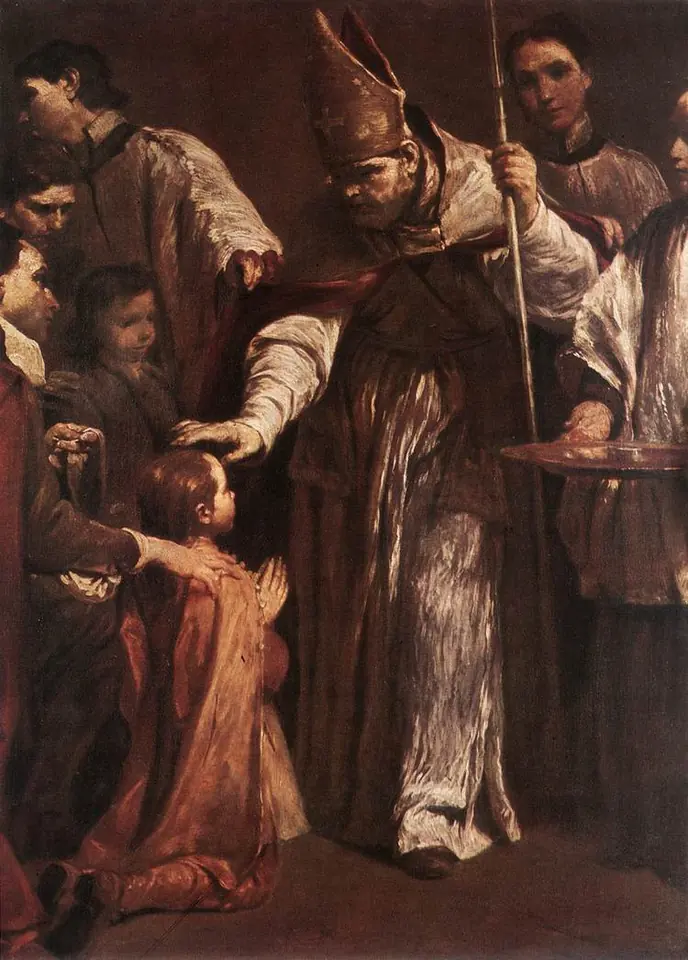
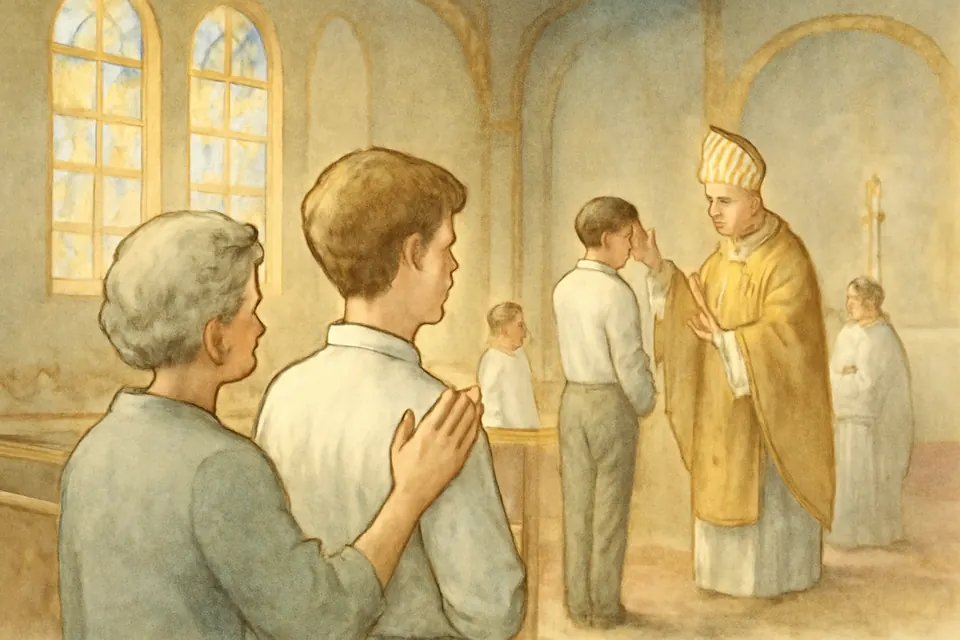
The bishop stands before the altar and stretches out his hands over the people kneeling before him. The church goes quiet. Then, one by one, each candidate comes forward with a sponsor's hand on the shoulder, and the bishop traces a cross of fragrant oil on the forehead. It takes a few seconds. What happens in those seconds is the sacrament of Confirmation: the same Holy Spirit who came down on the apostles at Pentecost comes to seal a Christian for life.
What is the sacrament of Confirmation?
Confirmation is one of the seven sacraments, and the second of the three sacraments of Christian initiation, with Baptism and the Eucharist. The Catechism sums it up:
Confirmation perfects Baptismal grace; it is the sacrament which gives the Holy Spirit in order to root us more deeply in the divine filiation, incorporate us more firmly into Christ, strengthen our bond with the Church, associate us more closely with her mission, and help us bear witness to the Christian faith in words accompanied by deeds.
That is no. 1316. The Church insists that Confirmation is not a separate add-on, nor a graduation from religious education. It belongs with Baptism. "Baptism, the Eucharist, and the sacrament of Confirmation together constitute the 'sacraments of Christian initiation,' whose unity must be safeguarded," and "the reception of the sacrament of Confirmation is necessary for the completion of baptismal grace" (no. 1285).
Catholic confirmation meaning: where the sacrament comes from
Promised by the prophets, fulfilled at Pentecost
The prophets foretold that the Spirit of the Lord would rest on the Messiah, and the Spirit came down on Jesus at his baptism in the Jordan. Jesus then promised that the same Spirit would be poured out on all his followers. He kept that promise on Easter evening, when he breathed on the apostles, and "more strikingly at Pentecost" (no. 1287). Our page on Pentecost tells that day's story.
The apostles laid on hands
The Acts of the Apostles shows the apostles passing on the gift of the Spirit to the newly baptized by laying their hands on them. When Philip the deacon had baptized the people of Samaria, the apostles in Jerusalem sent Peter and John:
Who, when they were come, prayed for them, that they might receive the Holy Ghost. For he was not as yet come upon any of them; but they were only baptized in the name of the Lord Jesus. Then they laid their hands upon them, and they received the Holy Ghost.
That is Acts 8:15–17 in the Douay-Rheims. St. Paul did the same at Ephesus (Acts 19:5–6), and the Letter to the Hebrews counts "the doctrine of baptisms, and imposition of hands" among the first things a Christian learns (Hebrews 6:2). Pope St. Paul VI, quoted in the Catechism, says this laying on of hands "is rightly recognized by the Catholic tradition as the origin of the sacrament of Confirmation, which in a certain way perpetuates the grace of Pentecost in the Church" (no. 1288).

The anointing with chrism
"Very early," the Catechism says, an anointing with perfumed oil was added to the laying on of hands, "the better to signify the gift of the Holy Spirit." The word Christian itself means "anointed one," after Christ, whom "God anointed with the Holy Spirit" (no. 1289, citing Acts 10:38). Around the year 350, St. Cyril of Jerusalem explained the anointing to the newly baptized in his city:
But beware of supposing this to be plain ointment. For as the Bread of the Eucharist, after the invocation of the Holy Ghost, is mere bread no longer, but the Body of Christ, so also this holy ointment is no more simple ointment, nor (so to say) common, after invocation, but it is Christ's gift of grace.
That is his twenty-first Catechetical Lecture, in the New Advent translation.
Chrism and the seal of the Spirit
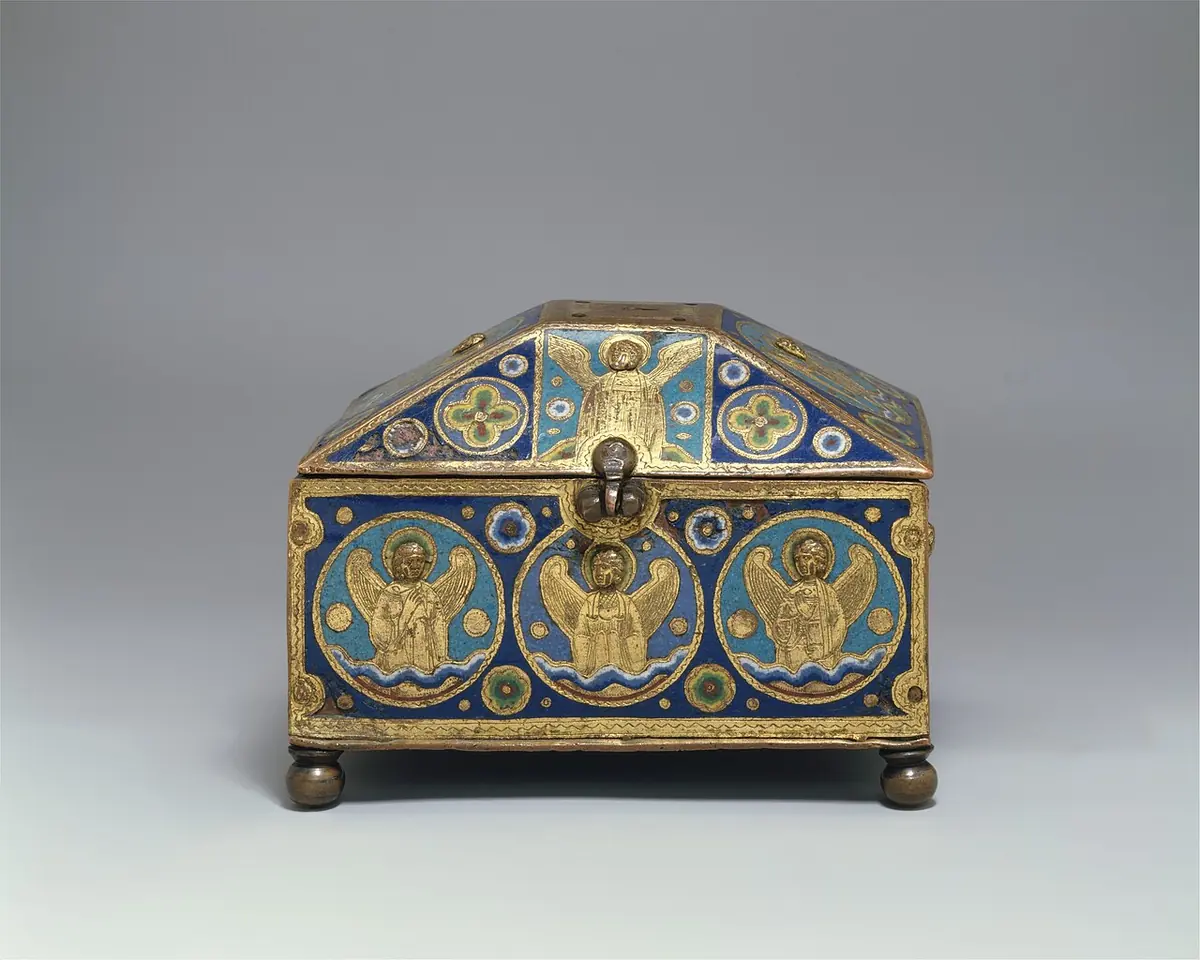
Chrism is olive oil (or another plant oil) mixed with balsam, which gives it its sweet smell. Only a bishop consecrates it. He does so once a year for his whole diocese, at the Chrism Mass, usually on the morning of Holy Thursday, with all his priests around him. The same chrism is used at Baptism, at Confirmation and at the ordination of priests and bishops, and to consecrate altars and churches. In some Eastern Churches only the patriarch consecrates it (no. 1297).
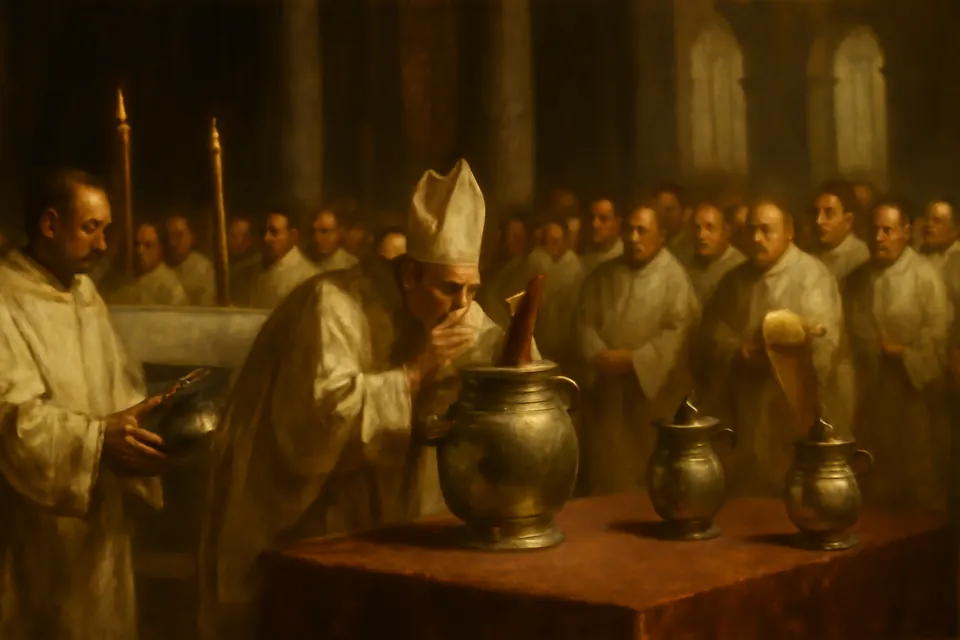
The Catechism draws out what oil meant in the ancient world: abundance and joy, cleansing, the limbering of athletes and wrestlers, the healing of wounds, and beauty and strength (no. 1293). In Confirmation the anointing is "the sign of consecration," so that our lives "may give off 'the aroma of Christ'" (no. 1294, quoting 2 Corinthians 2:15).
By this anointing the confirmed person receives a seal. In the ancient world a seal marked ownership and authority; soldiers bore their leader's seal. "This seal of the Holy Spirit marks our total belonging to Christ, our enrollment in his service for ever, as well as the promise of divine protection in the great eschatological trial" (no. 1296).
The rite of Confirmation
In the Roman Rite, Confirmation is usually celebrated during Mass, and the bishop is the ordinary minister. We won't reprint the liturgical texts here, which belong to the official Order of Confirmation, but the shape of the celebration is simple, and the Catechism describes it (nos. 1298–1301).
- Presentation and homily. After the Gospel, the candidates are called forward or stand, and the bishop preaches.
- Renewal of baptismal promises. The candidates reject Satan and profess the faith of the Church aloud, in their own voices. Many were baptized as infants, when parents and godparents answered for them; now they answer for themselves. "This clearly shows that Confirmation follows Baptism" (no. 1298).
- The laying on of hands. The bishop, with the priests who assist him, extends his hands over all the candidates together, a gesture that "since the time of the apostles... has signified the gift of the Spirit," and prays that God send the Holy Spirit with his seven gifts (no. 1299).
- The anointing. Each candidate comes forward with the sponsor, who places a right hand on the candidate's shoulder. The bishop dips his thumb in chrism and traces a cross on the forehead, saying the candidate's name and the words "Be sealed with the Gift of the Holy Spirit" (in Latin, Accipe signaculum doni Spiritus Sancti). The newly confirmed answers "Amen." This anointing with the laying on of the hand and these words is the essential rite (no. 1300).
- The sign of peace. The bishop says "Peace be with you," and the confirmed person answers. This "signifies and demonstrates ecclesial communion with the bishop and with all the faithful" (no. 1301).
The Mass then continues, and the newly confirmed receive the Eucharist, the third sacrament of initiation.
What changed in 1971
Older Catholics remember a different form of words and a light tap on the cheek. The Catholic Encyclopedia of 1908 gives the formula then used: "I sign thee with the sign of the cross and confirm thee with the chrism of salvation, in the name of the Father and of the Son and of the Holy Ghost." Then the bishop gave "a slight blow on the cheek saying: 'peace be with thee,'" a reminder that the confirmed Christian must be ready to suffer for Christ.
In his apostolic constitution Divinae consortium naturae of August 15, 1971, Pope St. Paul VI kept the anointing at the center of the rite but chose a new form of words. He explained that he preferred the antiquissimam formulam ritus Byzantini propriam, the most ancient formula of the Byzantine rite, which expresses the Gift of the Spirit himself and recalls the outpouring at Pentecost. The old rite could be used until the end of 1972; from January 1, 1973, the new one became the rule. So the words a Latin Catholic hears today are a translation of the words Eastern Christians have heard for well over a thousand years.
The effects of Confirmation
"The effect of the sacrament of Confirmation is the full outpouring of the Holy Spirit as once granted to the apostles on the day of Pentecost" (no. 1302). The Catechism lists what this does in us (no. 1303):
- it roots us more deeply in our adoption as God's children, so that we cry "Abba! Father!";
- it unites us more firmly to Christ;
- it increases the gifts of the Holy Spirit in us;
- it makes our bond with the Church more perfect;
- it gives us a special strength of the Spirit "to spread and defend the faith by word and action as true witnesses of Christ, to confess the name of Christ boldly, and never to be ashamed of the Cross."
The gifts it strengthens are the seven listed in Isaiah 11:2: wisdom, understanding, counsel, fortitude, knowledge, piety and fear of the Lord. We explain each one on our page on the gifts of the Holy Spirit, and what grows from them on our page on the fruits of the Holy Spirit.
St. Ambrose put it this way to the newly confirmed of Milan in the 4th century:
And then remember that you received the seal of the Spirit; the spirit of wisdom and understanding, the spirit of counsel and strength, the spirit of knowledge and godliness, and the spirit of holy fear, and preserved what you received. God the Father sealed you, Christ the Lord strengthened you, and gave the earnest of the Spirit in your heart.
That is On the Mysteries, chapter 7, in the New Advent translation. Like Baptism, Confirmation imprints a permanent "character," the sign that Christ has marked a Christian "with the seal of his Spirit by clothing him with power from on high so that he may be his witness." For this reason it is never repeated (no. 1304).
Confirmation in the East and the West
In the first centuries, Baptism and Confirmation were normally one celebration, which St. Cyprian called a "double sacrament." As infant baptisms multiplied and dioceses grew, the bishop could no longer be present at every baptism. Here East and West went different ways (no. 1290).
The Eastern Churches kept the sacraments together. The priest who baptizes chrismates the child immediately, using myron consecrated by the bishop or patriarch, and then gives Holy Communion. He anoints the forehead, eyes, nose, ears, lips, breast, back, hands and feet, saying each time, "The seal of the gift that is the Holy Spirit" (no. 1300). This is the practice of the Orthodox and of the Eastern Catholic Churches.

The Latin Church reserved the completion of Baptism to the bishop, and so Confirmation came to be given later, when he visited. The Catechism sees a gift in each practice: the East "gives greater emphasis to the unity of Christian initiation," while the West "more clearly expresses the communion of the new Christian with the bishop" and through him with the apostles (no. 1292).

What age is Confirmation?
The Church's universal law sets the age of discretion, around seven, as the norm for the Latin Church: Confirmation "is to be conferred on the faithful at about the age of discretion unless the conference of bishops has determined another age, or there is danger of death, or in the judgment of the minister a grave cause suggests otherwise" (canon 891).
In the United States, the bishops' conference used that permission. Its norm, in force since July 1, 2002, says Confirmation in the Latin Rite is conferred "between the age of discretion and about sixteen years of age, within the limits determined by the diocesan bishop." So the age depends on where you live. Many dioceses confirm in middle school or high school. A growing number have gone back to what is often called the "restored order," confirming children at seven or eight, just before their First Communion, so that the three sacraments come in their original sequence. This is not new: in 1897 Pope Leo XIII warmly commended a French bishop for confirming children before First Communion, as "more in accord with the ancient usage of the Church," the Catholic Encyclopedia records.
Whatever the age, the Catechism warns against treating Confirmation as a reward for growing up. It may be called the "sacrament of Christian maturity," but "we must not confuse adult faith with the adult age of natural growth" (no. 1308). St. Thomas Aquinas, quoted there, reminds us that "age of body does not determine age of soul," and that many children, strengthened by the Spirit, "have bravely fought for Christ even to the shedding of their blood."
Adults who are baptized at the Easter Vigil are confirmed at once by the priest who baptizes them, and so are baptized Christians from other communities who are received into full communion. Our guide to how to become Catholic explains that path. A child in danger of death should be confirmed by any priest, for "the Church desires that none of her children, even the youngest, should depart this world without having been perfected by the Holy Spirit" (no. 1314).
Preparing for Confirmation
Canon law asks that a candidate who has the use of reason be "suitably instructed, properly disposed, and able to renew the baptismal promises" (canon 889). Parish preparation programs teach the faith, but the goal, the Catechism says, is "a more intimate union with Christ and a more lively familiarity with the Holy Spirit," and a sense of belonging to the whole Church and to the parish (no. 1309).
Three things matter most:
- Confession. "To receive Confirmation one must be in a state of grace," so we go to the sacrament of Penance beforehand (no. 1310). Our guide to how to go to confession and our examination of conscience can help.
- Prayer. The apostles prepared for Pentecost by praying with Mary in the upper room for nine days, and the Catechism asks for "more intense prayer" before Confirmation (no. 1310). Many candidates pray a novena to the Holy Spirit in the days before.
- A sponsor. "Insofar as possible, there is to be a sponsor" (canon 892), whose job is to help the confirmed person live as "a true witness of Christ."
St. Thérèse of Lisieux, confirmed on June 14, 1884, a few weeks after her First Communion, made a retreat beforehand:
I prepared myself with the greatest care for the coming of the Holy Ghost; I could not understand anyone not doing so before receiving this Sacrament of Love.
She remembered that on the day itself "I did not feel the mighty wind of the first Pentecost, but rather the gentle breeze which the prophet Elias heard on Mount Horeb. On that day I received the gift of fortitude in suffering." That is from The Story of a Soul, chapter 4, in the 1912 translation by Thomas Taylor. Read more about her on our page for St. Thérèse of Lisieux.
Choosing a sponsor
The sponsor must meet the same conditions as a baptismal godparent (canon 893, referring to canon 874). He or she must be at least sixteen unless the bishop sets another age, a confirmed Catholic who has received the Eucharist and "leads a life of faith in keeping with the function to be taken on," free of any canonical penalty, and not the candidate's own father or mother. The Church recommends choosing one of your baptismal godparents, to show that Confirmation completes Baptism (canon 893; Catechism no. 1311).
Choosing a confirmation name
Many candidates choose a saint as a patron and take the saint's name. The custom is old but optional; keeping your baptismal name is a fine choice too. Our page on confirmation saints explains the custom and suggests saints for every kind of life, from athletes to artists.
After Confirmation
Confirmation is a beginning. The Catechism says the confirmed "are more perfectly bound to the Church and are enriched with a special strength of the Holy Spirit. Hence they are, as true witnesses of Christ, more strictly obliged to spread and defend the faith by word and deed" (no. 1285). Keep going to Mass, keep going to Confession, keep praying to the Holy Spirit, and stay close to your sponsor. Ask the saint you chose to help you.
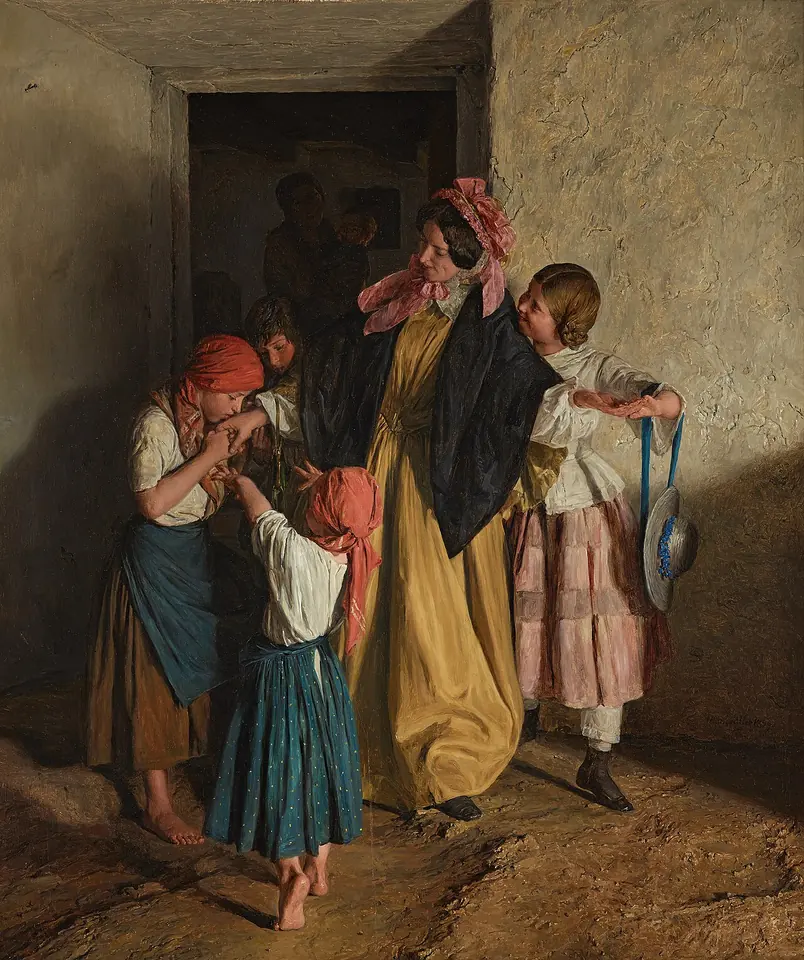
In many villages, Confirmation day was also a day of family celebration, with gifts from the godparents and a festive meal.
Confirmation prayer
The traditional prayer to the Holy Spirit is the one every candidate should know. This is the text from the Raccolta, the Church's collection of indulgenced prayers, in the English edition of 1910:
Come, O Holy Ghost, fill the hearts of thy faithful, and kindle in them the fire of thy love.
V. Send forth thy Spirit, and they shall be created.
R. And Thou shalt renew the face of the earth.
Let us pray.
O God, who didst instruct the hearts of the faithful by the light of the Holy Spirit, grant us in the same Spirit to be truly wise and ever to rejoice in His consolation, through Jesus Christ our Lord. Amen.
Its history, the Latin text, the Veni Creator Spiritus and a novena are on our page prayer to the Holy Spirit.
A prayer for those preparing for Confirmation
Come, Holy Spirit. You came down on the apostles in tongues of fire, and they went out without fear to speak of Jesus. Come to me now as I prepare to be sealed with your gift.
Give me wisdom to love what is truly good, understanding to grasp what I believe, counsel to choose rightly, courage to stand up for Christ, knowledge to see the world as God sees it, piety to pray as a child of the Father, and holy fear, so that I may never want to leave him.
Bless my sponsor, my family and everyone who has taught me the faith. Mary, Spouse of the Holy Spirit, pray for me. Amen.
Pastor Lyvers wrote this prayer for this page.
Frequently asked questions
What is the sacrament of Confirmation in simple words?
Confirmation is the sacrament in which a baptized person receives the Holy Spirit in a new fullness, as the apostles did at Pentecost. The bishop anoints the forehead with chrism and says, "Be sealed with the Gift of the Holy Spirit." It completes Baptism, binds us more closely to the Church and strengthens us to live and defend the faith.
What does Confirmation mean in the Catholic Church?
The word comes from the Latin confirmatio, a strengthening or making firm. The Catechism says that in the West the name suggests both the ratification of Baptism, which completes Christian initiation, and the strengthening of baptismal grace (CCC 1289). The Eastern Churches call it Chrismation, from the chrism used to anoint.
What age do Catholics get confirmed?
Church law says about the age of discretion (around seven) unless the bishops' conference sets another age (canon 891). In the United States the bishops set a range from the age of discretion to about sixteen, and each diocesan bishop chooses within it; many dioceses confirm in middle school or high school, while some confirm at seven or eight before First Communion. Adults entering the Church are confirmed when they are baptized or received. Eastern Catholics are confirmed as infants.
Can you be confirmed twice?
No. Confirmation, like Baptism, imprints a permanent spiritual mark, the character, so it is received only once in a lifetime (CCC 1304, 1317). A Catholic who drifted away and comes back renews his faith through Confession, not a second Confirmation.
What are the requirements for Confirmation?
Outside the danger of death, a person who has the use of reason must be baptized and not yet confirmed, suitably instructed, properly disposed and able to renew the baptismal promises (canon 889). The Catechism adds that one must be in the state of grace, so we go to Confession beforehand (CCC 1310). A sponsor is chosen where possible.
Who can be a Confirmation sponsor?
A sponsor must be at least sixteen (unless the bishop sets another age), a confirmed Catholic who has received the Eucharist and leads a life of faith fitting the role, not under a canonical penalty, and not the candidate's own father or mother (canons 893 and 874). The Church recommends choosing one of your baptismal godparents.
Do you have to choose a Confirmation name?
No. Taking a saint's name is a custom, not part of the sacrament, and keeping your baptismal name is a fine choice. Our page on confirmation saints explains the custom and how to choose a patron.
Is Confirmation necessary for salvation?
Baptism is valid and effective without it, but the Catechism teaches that without Confirmation and the Eucharist, Christian initiation remains incomplete, and that the faithful are obliged to receive Confirmation at the proper time (CCC 1306; canon 890). A child in danger of death should be confirmed by any priest.
Sources
- Catechism of the Catholic Church, nos. 1285–1301: Confirmation in the economy of salvation; the signs and the rite. Eastern and Western practice (1290–1292); the essential rite (1300)
- Catechism of the Catholic Church, nos. 1302–1311: The effects of Confirmation; who can receive it
- Code of Canon Law, canons 879–896 (Confirmation) and 912–923 (Holy Communion)
- Paul VI, apostolic constitution Divinae consortium naturae (August 15, 1971), Latin text. Adopts the ancient Byzantine formula; the old rite allowed until the end of 1972
- USCCB, Complementary norm on canon 891: Age for Confirmation (effective July 1, 2002)
- Catholic Encyclopedia (1908): Confirmation. The pre-1971 formula and the blow on the cheek; Leo XIII's 1897 letter to the bishop of Marseilles
- Cyril of Jerusalem, Catechetical Lecture 21 (Mystagogic 3), On Chrism (New Advent)
- Thérèse of Lisieux, The Story of a Soul, trans. Thomas N. Taylor (1912), chapter 4, Project Gutenberg