First Communion
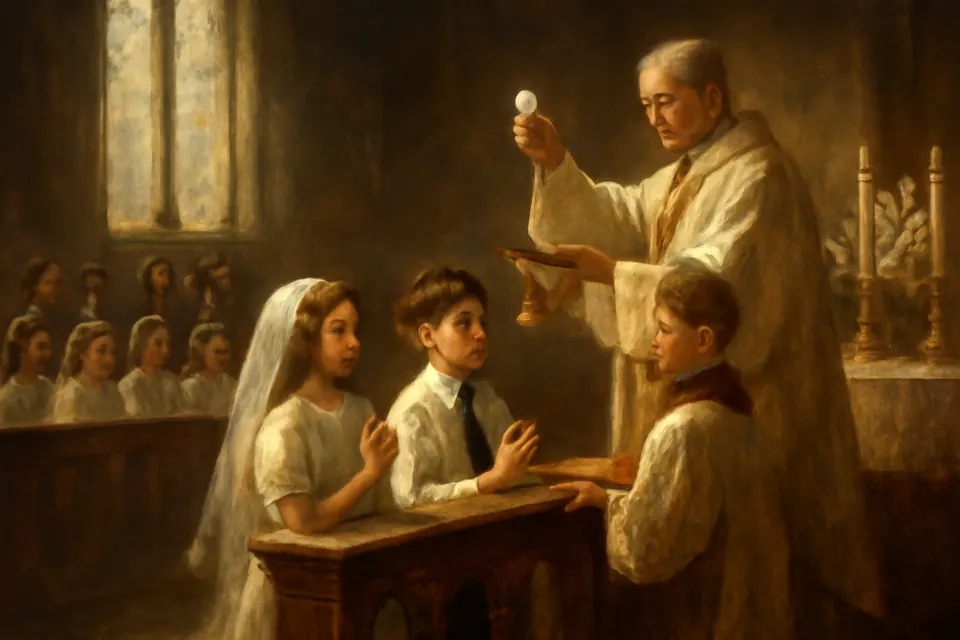
First Communion is the first time a Catholic receives Jesus in the Eucharist. In the Latin Church, children usually make their First Holy Communion at about seven or eight, the age of reason, after preparation and their first Confession. Adults receive it when they enter the Church. Its patrons are Bl. Imelda Lambertini, St. Tarcisius and St. Pius X.
Most Catholics remember the day. The white dress or the new tie, the candle, the walk up the aisle with the rest of the class, the moment the priest held up the Host and said "The Body of Christ," and the strange, quiet joy of kneeling back down afterward. First Communion is the day a child receives Jesus in the Eucharist for the first time, and for many of us it was the first time we understood that God wanted to come close.
What is First Communion?
First Communion, or First Holy Communion, is a Catholic's first reception of the Eucharist, the Body and Blood of Christ. It completes the three sacraments of Christian initiation: Baptism makes us children of God, Confirmation seals us with the Holy Spirit, and the Eucharist feeds us. The Catechism says simply: "To receive communion is to receive Christ himself who has offered himself for us" (no. 1382).
We believe that at Mass the bread and wine truly become the Body, Blood, soul and divinity of Jesus, though they still look and taste like bread and wine. Our page what is the Eucharist explains that teaching and its roots in Scripture, and our page on the seven sacraments shows where the Eucharist fits among them. This page is about the first time.
What age is First Communion?
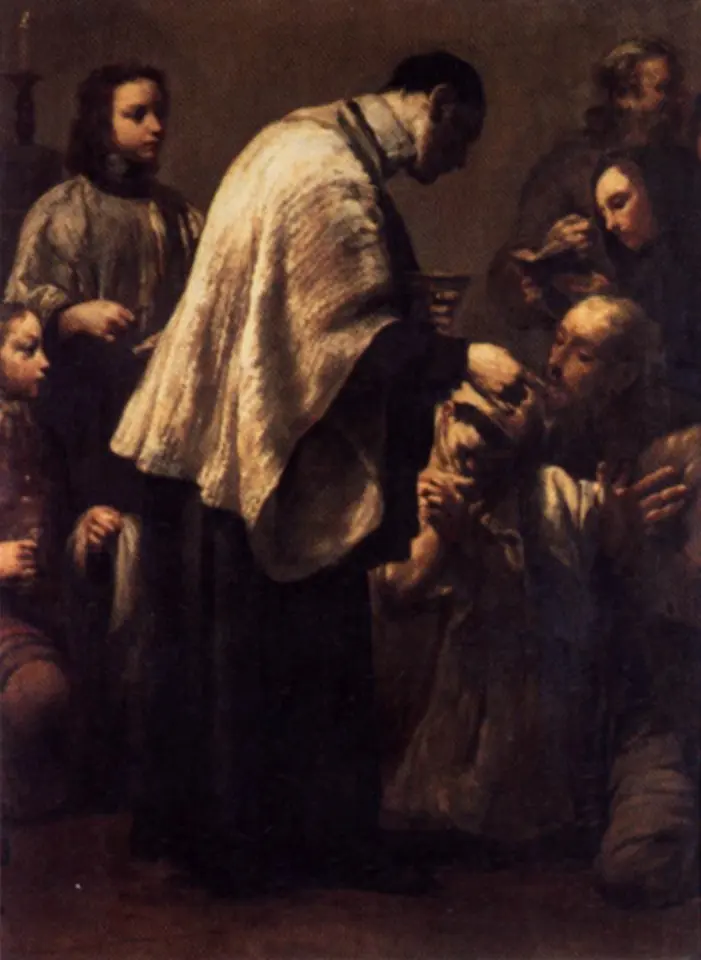
In the Latin Church, children make their First Communion when they reach the age of reason, around seven. Church law asks that children "who have reached the use of reason are prepared properly and, after they have made sacramental confession, are refreshed with this divine food as soon as possible" (canon 914). In most American parishes that means second grade, at seven or eight.
It was not always so, and the story is worth knowing.
Infants at the altar
In the early Church, babies often received Communion right after Baptism. St. Cyprian mentions it in the 3rd century. The Catholic Encyclopedia explains that infants received a few drops of the Precious Blood from the priest's finger, dipped in the chalice. The Eastern Churches still give Communion to infants at their Baptism, and in many Eastern Catholic Churches children receive the Eucharist from their first days. In the West the custom faded, and a Council of Tours in 813 allowed young children to receive only in danger of death.
The Fourth Lateran Council
In 1215 the Fourth Lateran Council required every Catholic, "after reaching the years of discretion," to confess at least once a year and to receive Communion at least at Easter. That law, which the Council of Trent confirmed, is still the root of our Easter duty (canon 920).
Kept waiting until twelve or fourteen
Over the following centuries, many places pushed First Communion later and later. St. Pius X's decree describes how "the age determined for the reception of First Communion was placed at ten years or twelve, and in places fourteen years or even more." The decree blamed the "errors of the Jansenists who contended that the Most Holy Eucharist is a reward rather than a remedy for human frailty."
St. Pius X and Quam Singulari
On August 8, 1910, with the approval of St. Pius X, the Vatican congregation for the sacraments issued the decree Quam Singulari. Its first rule settled the question:
The age of discretion, both for Confession and for Holy Communion, is the time when a child begins to reason, that is about the seventh year, more or less. From that time on begins the obligation of fulfilling the precept of both Confession and Communion.
The decree begins with the Gospel: Christ's love for children, and his words "Let the little children come to me, and do not hinder them." Within a few years, millions of children were receiving the Eucharist years earlier than their parents had. Pius X is remembered as the pope of the Eucharist for this reason, and he is one of the patrons of first communicants.
How children prepare for First Communion
Preparation is above all the parents' work, with the parish's help. Canon law says "it is primarily the duty of parents and those who take the place of parents, as well as the duty of pastors," to prepare children (canon 914). Most parishes run a one- or two-year program, often in first and second grade, with classes for the children and meetings for parents.
What does a seven-year-old need to know? Less than we might think. Quam Singulari insists that "a full and perfect knowledge of Christian doctrine is not necessary either for First Confession or for First Communion." The child should understand, according to his age, the main mysteries of the faith, and should "distinguish between the Bread of the Eucharist and ordinary, material bread, and thus... receive Holy Communion with a devotion becoming his years." Canon 913 asks for the same: that children "understand the mystery of Christ according to their capacity and are able to receive the body of Christ with faith and devotion."
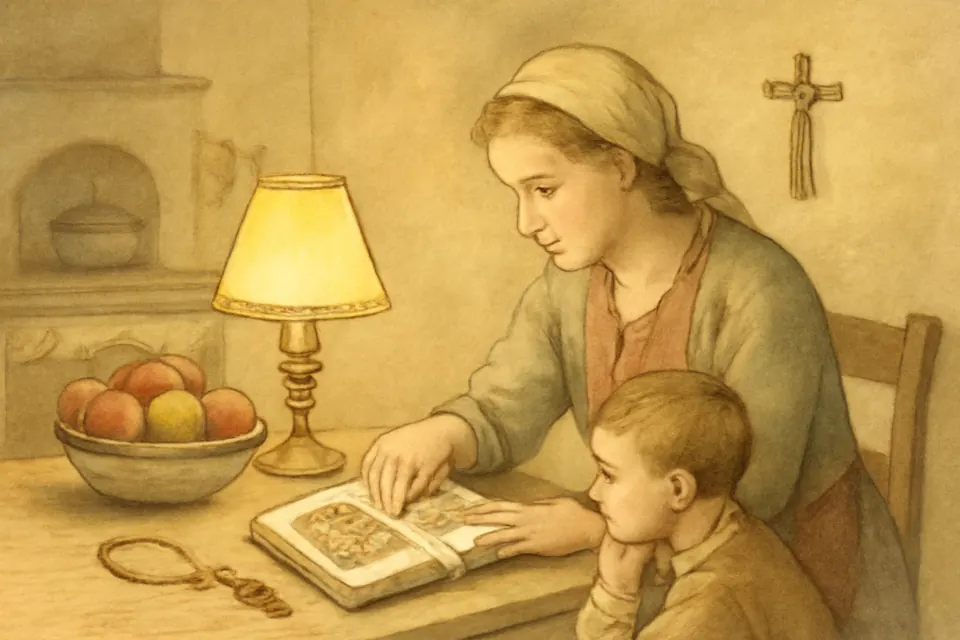
At home, the best preparation is simple:
- Pray together every day: the Sign of the Cross, the Our Father, the Hail Mary, the Glory Be, grace at meals and a short prayer at bedtime.
- Go to Mass every Sunday as a family, and sit where the child can see the altar. Explain what is happening at the consecration.
- Talk about Jesus as a friend who is really present in the tabernacle. Stop into church for a short visit on an ordinary afternoon.
- Read the Gospel stories of the Last Supper, the feeding of the five thousand and the disciples at Emmaus.
First Confession comes first
In the Latin Church, a child makes a first Confession, often called First Reconciliation, before First Communion. Quam Singulari condemned the old custom of keeping children who had reached the age of reason from Confession, and canon 914 places Confession before First Communion. For a seven-year-old, the sins are small, but the meeting with Christ's mercy is real, and it starts a lifelong habit. Our guide to how to go to confession walks through the steps, our examination of conscience includes one for children, and every child should learn an Act of Contrition.
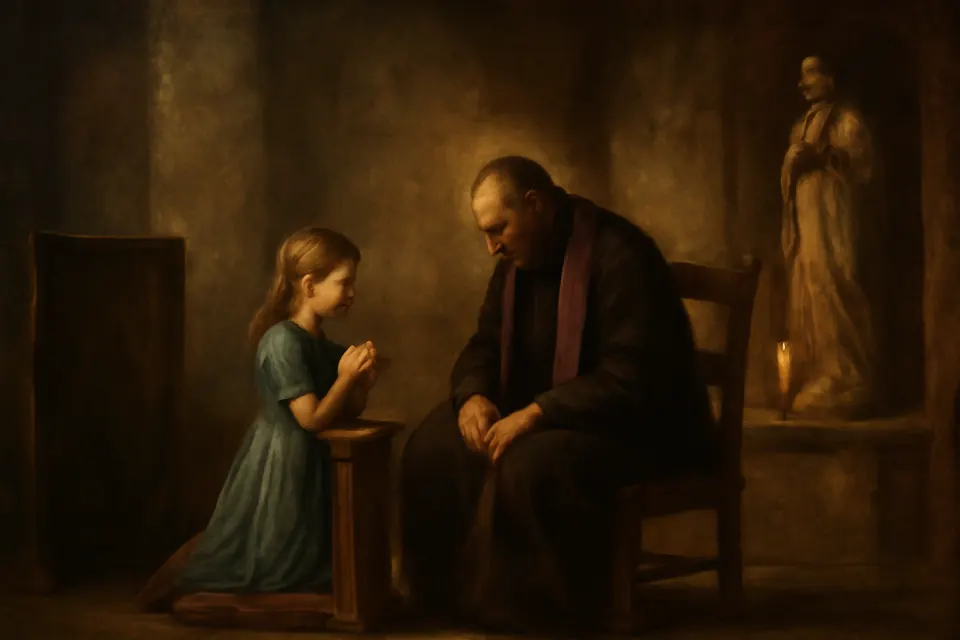
What happens on First Communion day
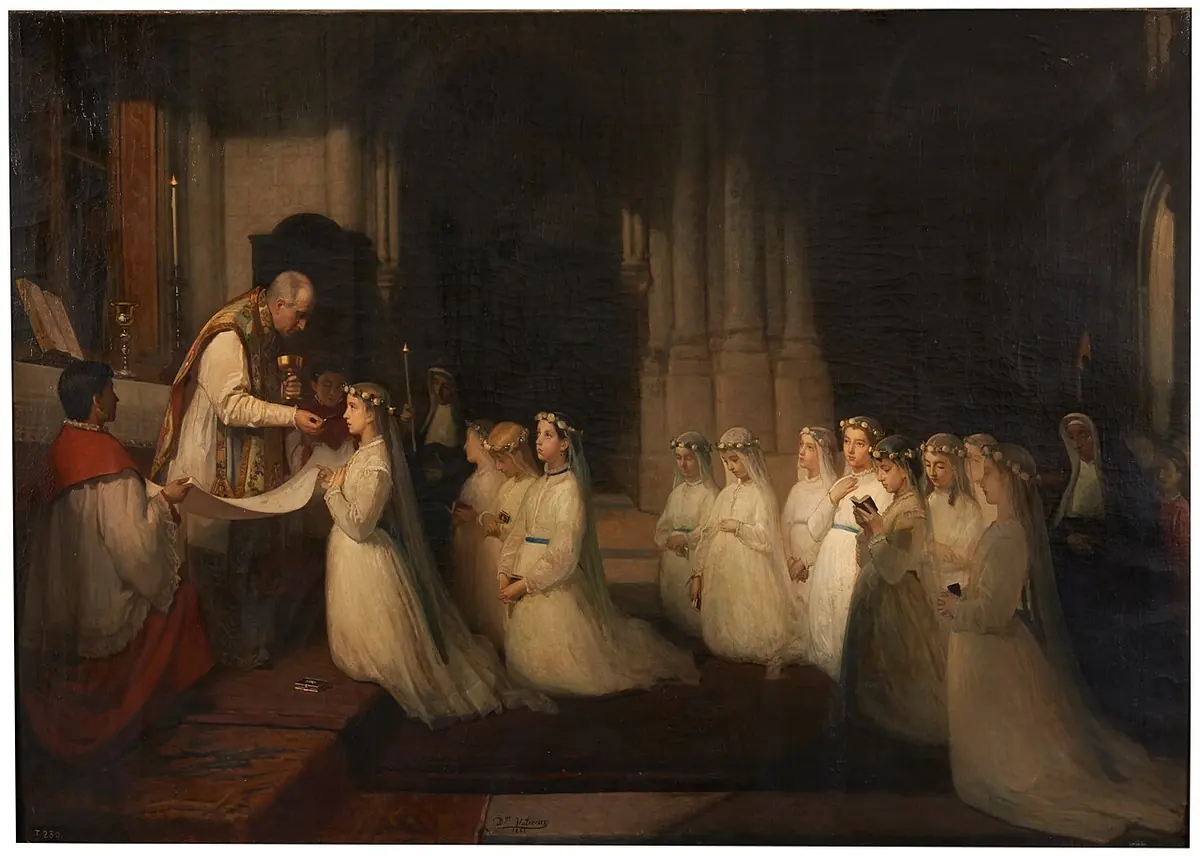
First Communion is usually given at a Sunday Mass in the Easter season, often in late April or May, the month of Mary. The Catholic Encyclopedia noted more than a century ago that it should take place in the Easter season and that "no effort should be spared to fix the occasion indelibly on the mind of the young communicant." Customs vary by parish, but the day often looks like this:
- The fast. Like everyone, the child fasts from food and drink, except water and medicine, for one hour before Communion (canon 919).
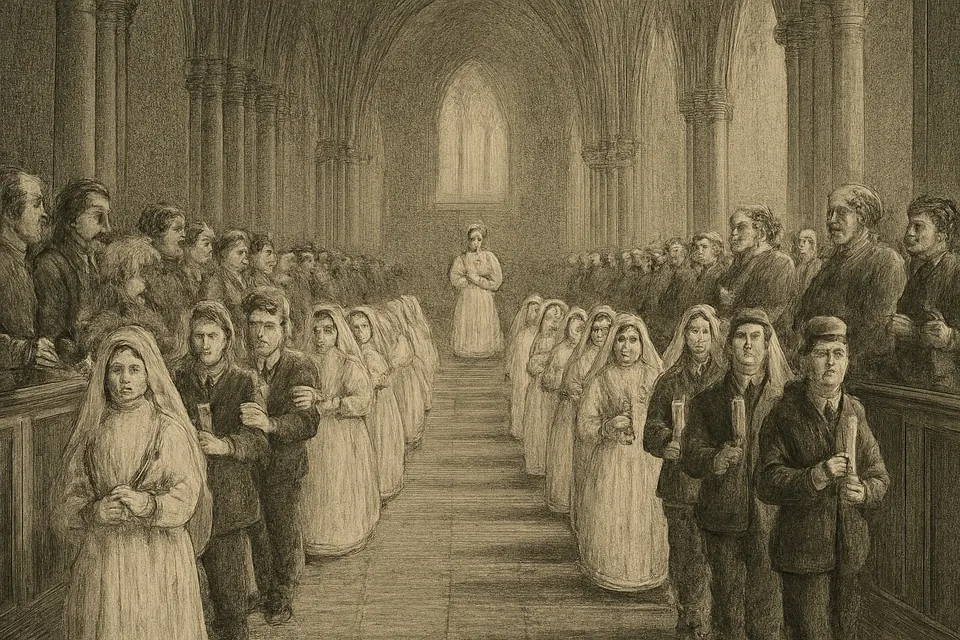
- The procession. The children may process into church together, sometimes carrying candles, and sit near the front with their families behind them.
- The Mass. The children may read the readings, bring up the gifts or lead the prayers of the faithful.
- Holy Communion. Each child comes forward, bows before the Host, and hears the priest say, "The Body of Christ." The child answers, "Amen," and receives, either on the tongue or in the hand. Where the chalice is offered, the child may also receive the Precious Blood.
- Thanksgiving. Back in the pew, the child kneels and talks to Jesus quietly. This is the most important minute of the day.
- Photos and celebration. After Mass come pictures, the blessing of rosaries and gifts, and often a family meal.
St. Thérèse of Lisieux, who made her First Communion on May 8, 1884, at eleven, remembered "the room filled with snow-white frocks, where each child was dressed in turn," and then the moment itself:
How sweet was the first embrace of Jesus! It was indeed an embrace of love. I felt that I was loved, and I said: "I love Thee, and I give myself to Thee for ever."
That is The Story of a Soul, chapter 4, in Thomas Taylor's 1912 translation. Read more about her on our page for St. Thérèse of Lisieux.
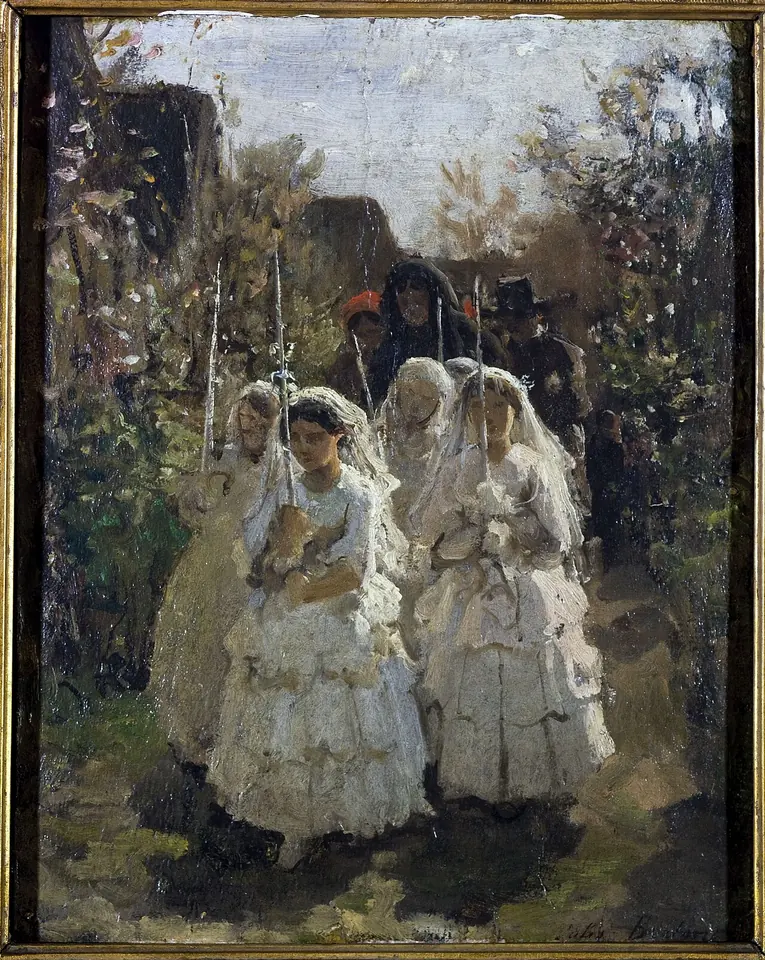
First Communion traditions
The white dress and the suit
White recalls the white garment each of us received at Baptism, when the priest told our parents to keep it "unstained" until we come before the Lord. Girls traditionally wear a white dress and often a veil, and boys a white shirt and tie with a white or dark suit. In some countries, and in some parishes in the United States, all the children wear simple white albs or robes so that no one is set apart by what the family can afford. The dress is not the point, but it helps a child sense that this day is different.
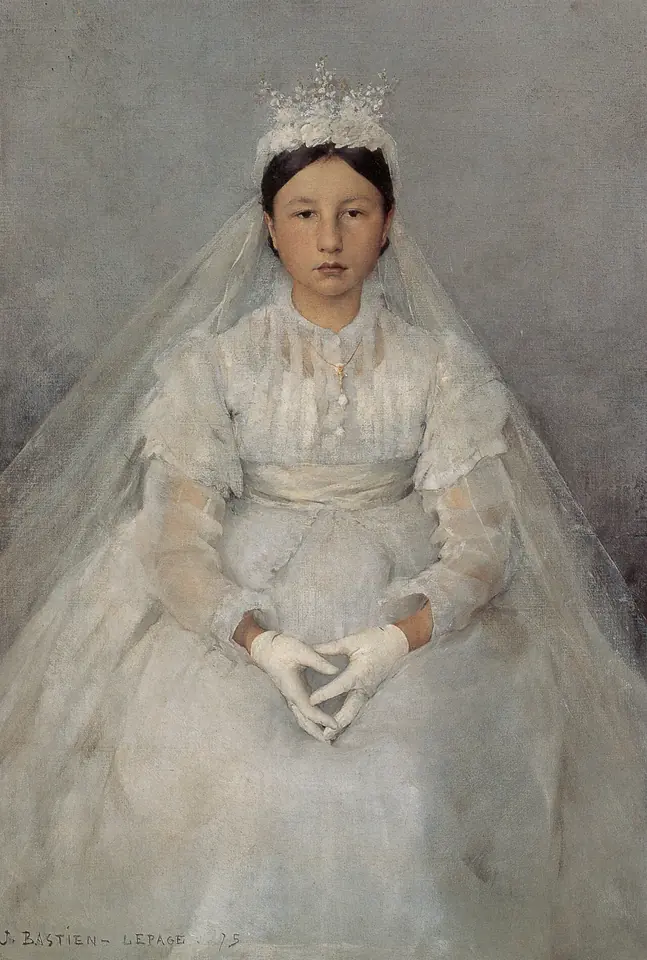
Candles, rosaries and holy cards
The candle recalls the baptismal candle and Christ, the Light of the world. In many places children receive a First Communion rosary, a prayer book, a crucifix or a saint's medal, and parishes often give a certificate and a holy card printed with the date. Ask the priest to bless these gifts after Mass; once blessed, they become sacramentals, to be treated with reverence. The best First Communion gifts are ones a child will use to pray.
Processions and family feasts
In much of Europe and Latin America, First Communion is one of the great family feasts of the year, with processions, music, special clothes and a meal for the whole extended family. In the United States the day often ends with a party at home. Parishes in many places also hold a Corpus Christi procession a few weeks later, where first communicants walk in their First Communion clothes, scattering flower petals before the Blessed Sacrament. See Corpus Christi.
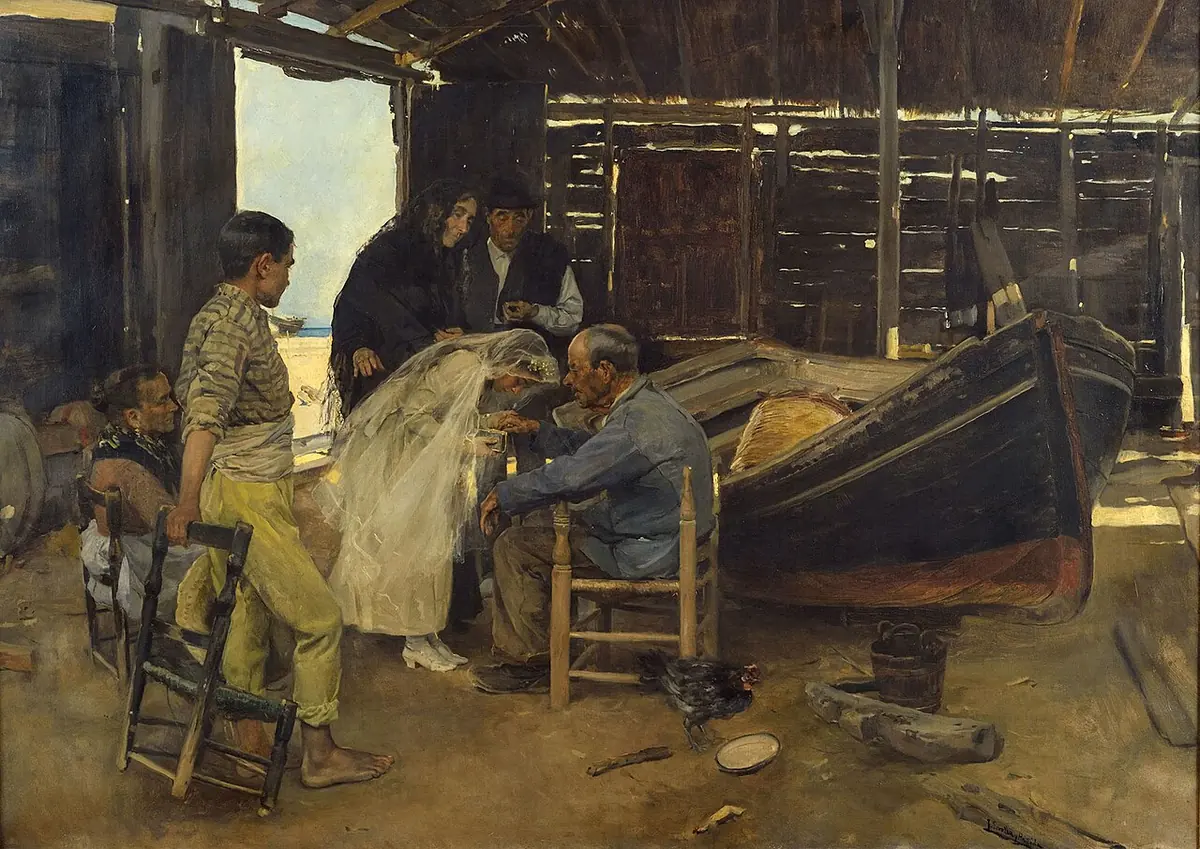
Patron saints of First Communion
Bl. Imelda Lambertini is the patroness of first communicants. She was a girl of a noble family in Bologna who lived with the Dominican nuns and longed to receive Communion, though she was too young by the custom of her time. Tradition holds that on May 12, 1333, when she was about eleven, a Host rose from the altar and hovered over her as she prayed, the priest gave it to her as her First Communion, and she died in ecstasy soon afterward. St. Pius X named her patroness of first communicants.
St. Tarcisius was a young Christian of Rome in the 3rd century who was killed by a mob because he would not give up the Eucharist he was carrying; later tradition says he was taking it to Christians in prison. He is the patron of altar servers and of first communicants.
St. Pius X, as we have seen, opened the altar to young children in 1910.
Three more saints made their First Communion young and never forgot it:
- St. Dominic Savio received it at seven, on April 8, 1849, when children in his region usually waited until twelve. That day he wrote four resolutions in his prayer book, which St. John Bosco copied into his life of the boy. In the 1914 English translation they read: "I will go to Confession often, and as frequently to Holy Communion as my confessor allows. I wish to sanctify the Sundays and festivals in a special manner. My friends shall be Jesus and Mary. Death rather than sin."
- St. Carlo Acutis made his First Communion at seven, on June 16, 1998, with special permission, and went to Mass every day afterward. He called the Eucharist his highway to heaven.
- St. Thérèse of Lisieux, quoted above, kept the anniversary of her First Communion all her life.
Our page on young saints has more saints for children to know.

First Communion prayers
A prayer before First Communion
Jesus, today you are coming to me for the first time. I believe that you are really here in the Holy Eucharist, the same Jesus who was born in Bethlehem, died on the Cross and rose on Easter morning.
I am small, and I am not worthy, but you love me and you want to be my friend. Make my heart clean and ready for you. Help me to keep you close every day, to obey my parents, to be kind and to tell the truth.
Mary, my mother, help me to welcome your Son. My guardian angel, stay beside me. Amen.
Pastor Lyvers wrote this prayer for this page.
Before receiving, every Catholic can echo the centurion of the Gospel, whose words the Church places on our lips at every Mass. In the Douay-Rheims they read: "Lord, I am not worthy that thou shouldst enter under my roof: but only say the word, and my servant shall be healed" (Matthew 8:8).
A prayer after First Communion
Thank you, Jesus, for coming to me. You are in my heart now, and I love you.
Stay with me today and always. Bless my mom and dad, my brothers and sisters, my godparents and everyone who helped me get ready for this day. Bless the children who made their First Communion with me, and the children all over the world who are hungry or alone.
Help me to come back to you every Sunday. I give you my whole self. Amen.
Pastor Lyvers wrote this prayer for this page.
Older children and adults can pray the traditional thanksgivings on our page prayer after Communion, which includes short acts of faith, love and thanks written for children, and the Anima Christi. On days when we cannot receive, there is the spiritual communion prayer.
A prayer for parents
Lord Jesus, today our child receives you for the first time. Thank you for this gift, and for the grace of Baptism that led to this day. Forgive us where we have been poor teachers of the faith, and make us better ones. Let our home be a place where you are loved, and let our child never forget the joy of this morning. Keep our child close to your altar all the days of life. Amen.
Pastor Lyvers wrote this prayer for this page.
After First Communion
First Communion is a first, not a once. Quam Singulari asked that children afterward "frequently approach the Holy Table, even daily if possible, as Jesus Christ and Mother Church desire." The Church obliges every Catholic to receive Communion at least once a year, in the Easter season, and to keep Sunday holy, but she "strongly encourages the faithful to receive the holy Eucharist on Sundays and feast days, or more often still, even daily" (Catechism, no. 1389). Anyone conscious of a grave sin goes to Confession first (no. 1385).
The next step in Christian initiation is the sacrament of Confirmation, which in many places follows a few years later and in some dioceses comes just before First Communion. Adults who are still waiting for their First Communion can find their path in how to become Catholic.
Let us pray for every child receiving Jesus for the first time this year: Bl. Imelda, St. Tarcisius and St. Pius X, pray for them.
Frequently asked questions
What age is First Communion?
In the Latin Church, children normally make their First Communion at the age of reason, about seven. St. Pius X's 1910 decree Quam Singulari set "about the seventh year, more or less," and in most U.S. parishes children receive it in second grade, at seven or eight. Older children and adults who were not yet initiated receive it when they are ready. In the Eastern Churches, babies receive Communion right after Baptism.
Do you have to go to Confession before First Communion?
Yes. A child who has reached the use of reason makes a first Confession before First Communion; canon 914 says children are to receive Communion as soon as possible "after they have made sacramental confession." Parishes usually schedule First Reconciliation a few weeks or months before First Communion.
What does a child need to know for First Communion?
Not everything. St. Pius X wrote that "a full and perfect knowledge of Christian doctrine is not necessary." The child should know, according to his age, the main truths of the faith and be able to tell the Eucharist from ordinary bread, believing that it is Jesus, and receive Him with devotion (canon 913).
What do you wear for First Communion?
Girls traditionally wear a white dress, often with a veil; boys wear a white shirt and tie with a dark or white suit, or a white suit. White recalls the baptismal garment. Many parishes set their own guidelines, and some ask all children to wear simple robes, so check with yours. Modesty and simplicity matter more than expense.
Can you eat before First Communion?
Catholics fast from food and drink for at least one hour before receiving Communion, except water and medicine (canon 919). For an ordinary Sunday Mass that usually means a light breakfast an hour or more before Communion. The sick and elderly are exempt.
What do you say when you receive First Communion?
The priest or minister holds up the Host and says, "The Body of Christ." You answer, "Amen," which means yes, I believe. If the chalice is offered, the minister says, "The Blood of Christ," and you again answer "Amen." Then you receive, return to your place and spend a few minutes in quiet prayer.
Can adults make their First Communion?
Yes. Adults who are baptized at the Easter Vigil receive Baptism, Confirmation and First Communion on the same night, and baptized Christians who come into full communion with the Catholic Church receive Communion when they are received. Catholics baptized as infants who never made their First Communion can prepare with their parish at any age.
Who is the patron saint of First Communion?
Bl. Imelda Lambertini, the girl of Bologna who, tradition holds, died in ecstasy after her First Communion in 1333, is the patroness of first communicants. St. Tarcisius, the boy martyr who died protecting the Eucharist, and St. Pius X, who opened First Communion to young children, are also invoked.
Sources
- Sacred Congregation of the Discipline of the Sacraments, Quam Singulari (August 8, 1910), on First Communion (Papal Encyclicals Online). The history of children's Communion and the eight rules, including the age of about seven
- Code of Canon Law, canons 912–923 (Holy Communion). Preparation of children (913–914), the one-hour fast (919), the Easter duty (920)
- Catechism of the Catholic Church, nos. 1382–1401: The Paschal banquet
- Catholic Encyclopedia (1908): Communion of Children (Patrick Morrisroe). Infant Communion in the early Church; Council of Tours (813); First Communion customs
- Thérèse of Lisieux, The Story of a Soul, trans. Thomas N. Taylor (1912), chapter 4, Project Gutenberg
- John Bosco, The Life of Dominic Savio (English translation, Salesian Press, London, 1914), Internet Archive. Dominic's First Communion resolutions