Gifts of the Holy Spirit
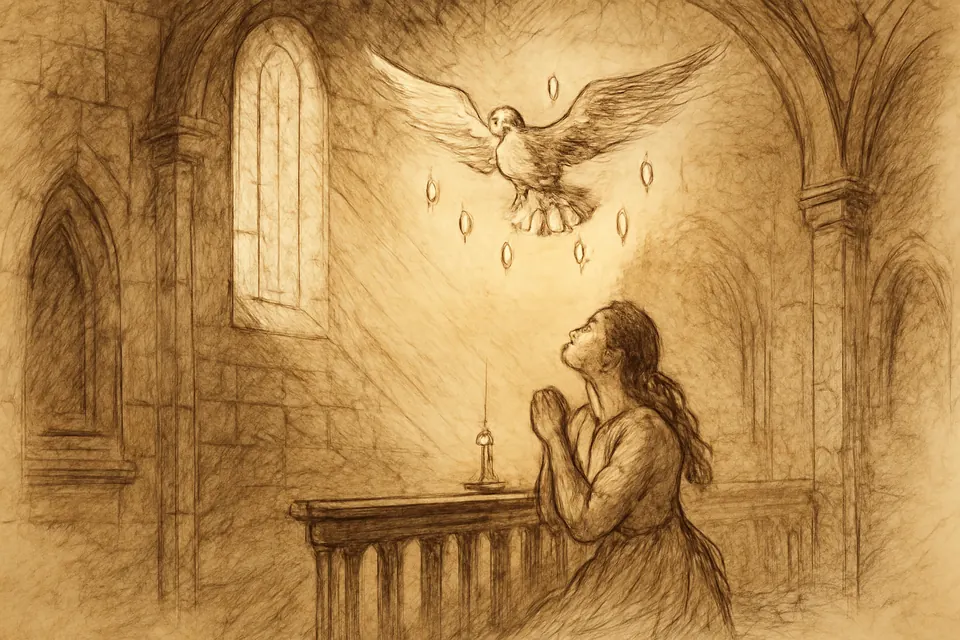
The gifts of the Holy Spirit are seven: wisdom, understanding, counsel, fortitude, knowledge, piety and fear of the Lord (Isaiah 11:2–3). We receive them at Baptism, and Confirmation increases them. The Catechism calls them "permanent dispositions" that make us docile to the Spirit's promptings. Their harvest is the twelve fruits of the Spirit, from charity to chastity.
The gifts of the Holy Spirit are seven: wisdom, understanding, counsel, fortitude, knowledge, piety and fear of the Lord. They come to us in Baptism, Confirmation strengthens them, and they stay with us as long as we live in grace, quietly making us ready to hear and follow God. This page explains each gift in plain words, shows where the list comes from, introduces saints in whom each gift shines, and ends with the twelve fruits the gifts bear in an ordinary Christian life.
The seven gifts of the Holy Spirit at a glance
- Wisdom: seeing and loving everything as God sees it, and relishing the things of heaven.
- Understanding: grasping the truths of the faith from within, not just repeating them.
- Counsel: knowing what to do here and now, in this choice, for God's glory and our salvation.
- Fortitude: the courage to do good and to endure when it costs us.
- Knowledge: judging created things rightly, so that they lead us to God rather than away from him.
- Piety: the tender, trusting love of a child for the Father, and reverence for all that belongs to him.
- Fear of the Lord: awe before God's greatness and a loving dread of offending him.
Where the seven gifts come from
The list is a prophecy about Christ. Isaiah foresaw a shoot springing from the root of Jesse, King David's father, and described the Spirit who would rest on him. In the Douay-Rheims translation:
And the spirit of the Lord shall rest upon him: the spirit of wisdom, and of understanding, the spirit of counsel, and of fortitude, the spirit of knowledge, and of godliness. And he shall be filled with the spirit of the fear of the Lord. (Isaias 11:2–3)
Godliness is the gift the Church calls piety. The Catechism draws the line from Isaiah to us: the seven gifts "belong in their fullness to Christ, Son of David," and "they complete and perfect the virtues of those who receive them" (CCC 1831). What the Messiah has without measure, he shares with his members. When we are baptized into Christ, the Spirit who rested on him comes to rest on us.
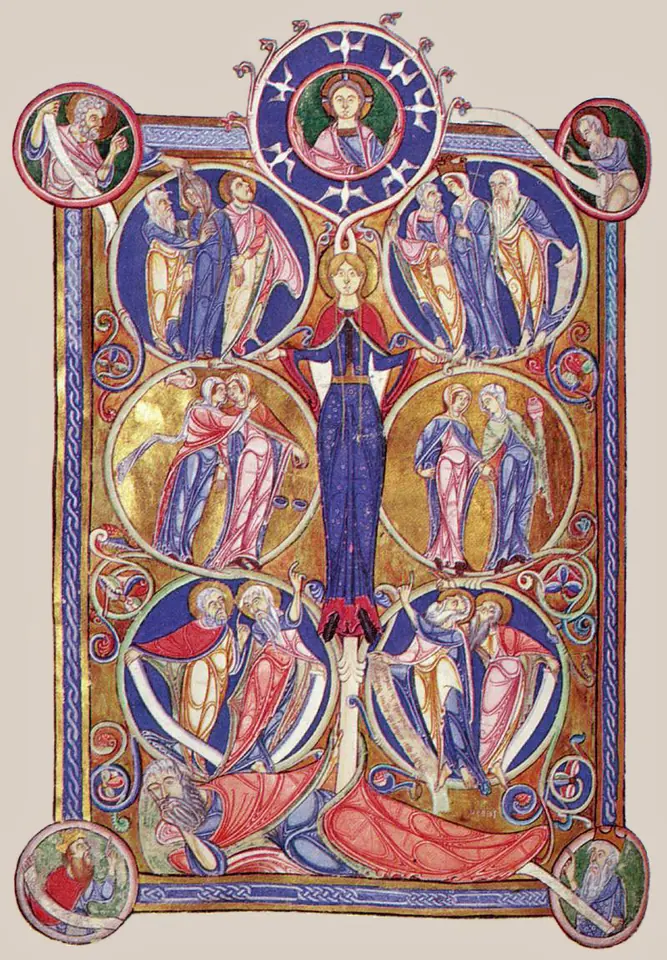
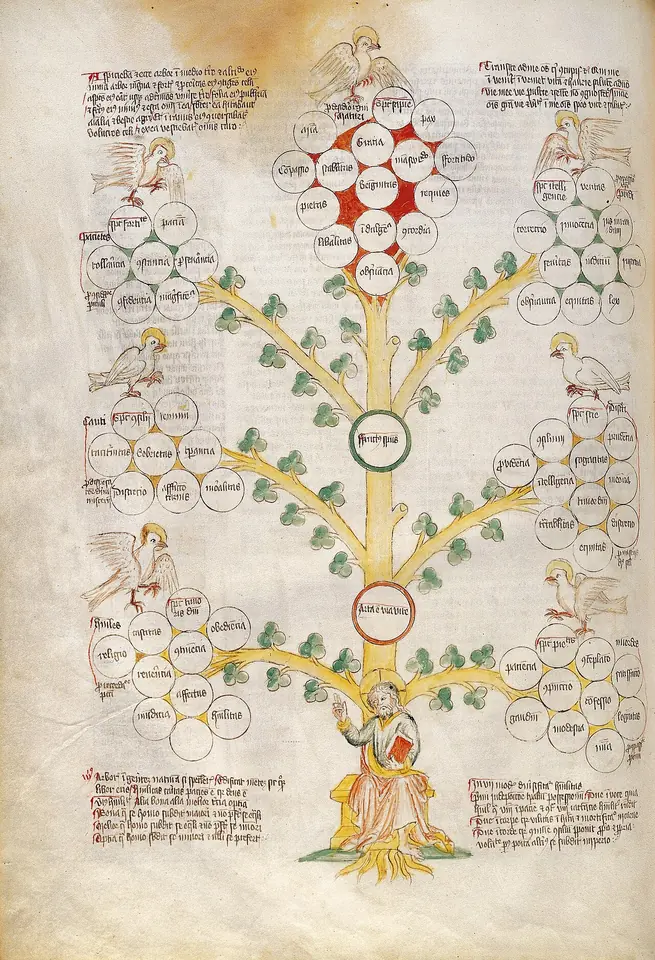
Medieval artists loved this text. They painted the Tree of Jesse growing from the sleeping patriarch, with the Virgin Mary in its trunk and her Son at its crown, and they ringed Christ with seven doves, one for each gift.
What the gifts are, and how they differ from the virtues
The Catechism gives the definition in one sentence: "The moral life of Christians is sustained by the gifts of the Holy Spirit. These are permanent dispositions which make man docile in following the promptings of the Holy Spirit" (CCC 1830).
St. Thomas Aquinas explains the difference between the gifts and the virtues with a comparison. The moral virtues make our desires obey reason promptly. In the same way, he says, "the gifts of the Holy Ghost are habits whereby man is perfected to obey readily the Holy Ghost" (Summa Theologiae I-II, q. 68, a. 3). The virtues are good habits we exercise with our own reasoning, helped by grace. The gifts make us movable by a higher guide. A soul with the virtues rows well. A soul alive in the gifts has its sails up, and the wind of the Spirit carries it farther than rowing could.
St. Thomas also teaches that all seven gifts are necessary for salvation, not optional extras for mystics. He quotes St. Gregory the Great, who named the weakness each gift heals: "the Holy Ghost gives wisdom against folly, understanding against dullness, counsel against rashness, fortitude against fears, knowledge against ignorance, piety against hardness of our heart, and fear against pride." That list is worth keeping by a mirror. Each of us knows which of those seven weaknesses is most our own.

Gifts, charisms and talents
Three different things are often called "gifts," and it helps to keep them apart.
- The seven gifts are given for our own holiness. Every Christian in a state of grace has them.
- Charisms are what St. Paul lists in 1 Corinthians 12: prophecy, healing, tongues, discernment of spirits and others. The Catholic Encyclopedia calls them "extraordinary favours granted for the help of another," which "do not sanctify by themselves." God gives them freely, to whom he wills, to build up the Church.
- Natural talents, like a good singing voice or a head for numbers, are gifts of the Creator. They become holy when we offer them back to him.
Each gift, with a saint who shows it
The Catholic Encyclopedia of 1910 describes each gift in a single sentence, and its lines appear below with a saint in whom we can see the gift at work. The saints did not have the gifts in some way we do not. They let the Spirit use them.
Wisdom
"The gift of wisdom, by detaching us from the world, makes us relish and love only the things of heaven." Wisdom is the highest gift because it touches the highest things. It is less a matter of knowing facts about God than of tasting him. Pope Francis began his catechesis on the gifts with this one in April 2014: wisdom "is the grace of being able to see everything with the eyes of God," and "this cannot be learned: this is a gift of the Holy Spirit."
St. Catherine of Siena had little schooling, yet her Dialogue earned her a place among the Doctors of the Church. She saw popes, wars and plague as God sees them, and she spoke to all of them with the freedom of someone who loved heaven first. For a prayer for this gift, see our prayer for wisdom.
Understanding
"The gift of understanding helps us to grasp the truths of religion as far as is necessary." It is the light that lets a familiar truth suddenly open from within: the Creed we have said a thousand times, a Gospel we thought we knew. Understanding does not make the mysteries less mysterious. It makes them luminous.
St. Thomas Aquinas wrote the clearest theology the Church has, and he prayed before every page. Near the end of his life, according to his companion Reginald of Piperno, he stopped writing after an experience at Mass and said that all he had written seemed like straw compared with what he had seen. Understanding had carried him past words.
Counsel
"The gift of counsel springs from supernatural prudence, and enables us to see and choose correctly what will help most to the glory of God and our own salvation." Prudence weighs; counsel listens. It is the gift for the hard choice, the one between two good things, or the one no rule book settles.
St. Joseph is the model. Four times the Gospel of St. Matthew tells us he received God's guidance in a dream, and four times he rose and acted at once: he took Mary into his home, fled to Egypt by night, came back, and settled in Nazareth. Counsel is not only hearing God. It is getting up and doing what he says. Our prayer for guidance is a good place to begin.
Fortitude
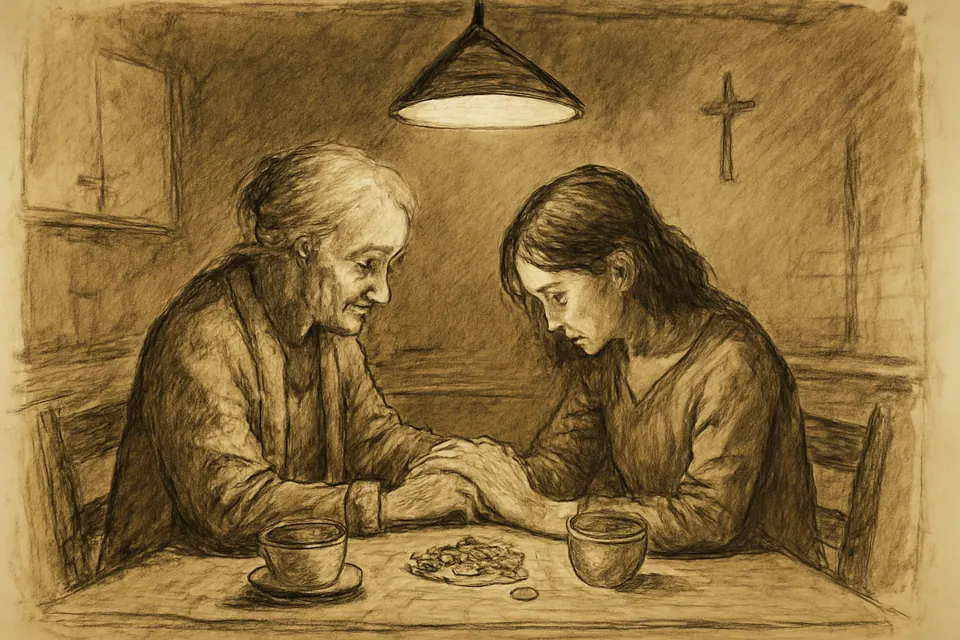
"By the gift of fortitude we receive courage to overcome the obstacles and difficulties that arise in the practice of our religious duties." Fortitude is not a temperament. Timid people receive it and become brave; brave people receive it and become patient. It works in the martyr's great moment and in the long, unseen faithfulness of caregivers, parents and the chronically ill.
St. Maximilian Kolbe stepped out of a line at Auschwitz in 1941 and offered to die in place of a man with a family. He spent his last two weeks in a starvation bunker leading the other condemned men in prayer and hymns. Our prayer for courage asks for the same gift in smaller trials.

Knowledge
"The gift of knowledge points out to us the path to follow and the dangers to avoid in order to reach heaven." If wisdom judges by the highest causes, knowledge judges created things rightly. It sees what the world is for, and so it is not fooled by it. It shows us the emptiness of things we were chasing and the worth of things we were ignoring.
St. Francis of Assisi is the saint of this gift. He gave up wealth without despising creation; he called the sun his brother and the earth his sister because he knew whose they were. He loved creatures as signs pointing past themselves.
Piety
"The gift of piety, by inspiring us with a tender and filial confidence in God, makes us joyfully embrace all that pertains to His service." Piety is the gift that lets us cry "Abba, Father." It warms religion from duty into love: prayer becomes conversation with a Father, Mass becomes a family meal, and the saints become our relatives.
St. Thérèse of Lisieux built her whole "little way" on it. She went to God as a small child goes to her father, sure of his love, unworried about her own weakness. Piety also turns outward, toward everyone who shares the same Father.
Fear of the Lord
"Lastly, the gift of fear fills us with a sovereign respect for God, and makes us dread, above all things, to offend Him." This is not the fear of a slave before a cruel master. It is the awe of a child who loves a great father and would hate to grieve him. Scripture calls it "the beginning of wisdom" (Psalm 110:10, Douay-Rheims), and St. Gregory sets it against pride, the root of every sin.
St. Thomas More was Lord Chancellor of England, a loving father and a man who enjoyed a good joke. He went to the scaffold in 1535 rather than take an oath against his conscience. He feared offending God more than losing his head, and that holy fear left him strangely cheerful at the end.

The gifts and the Sacrament of Confirmation
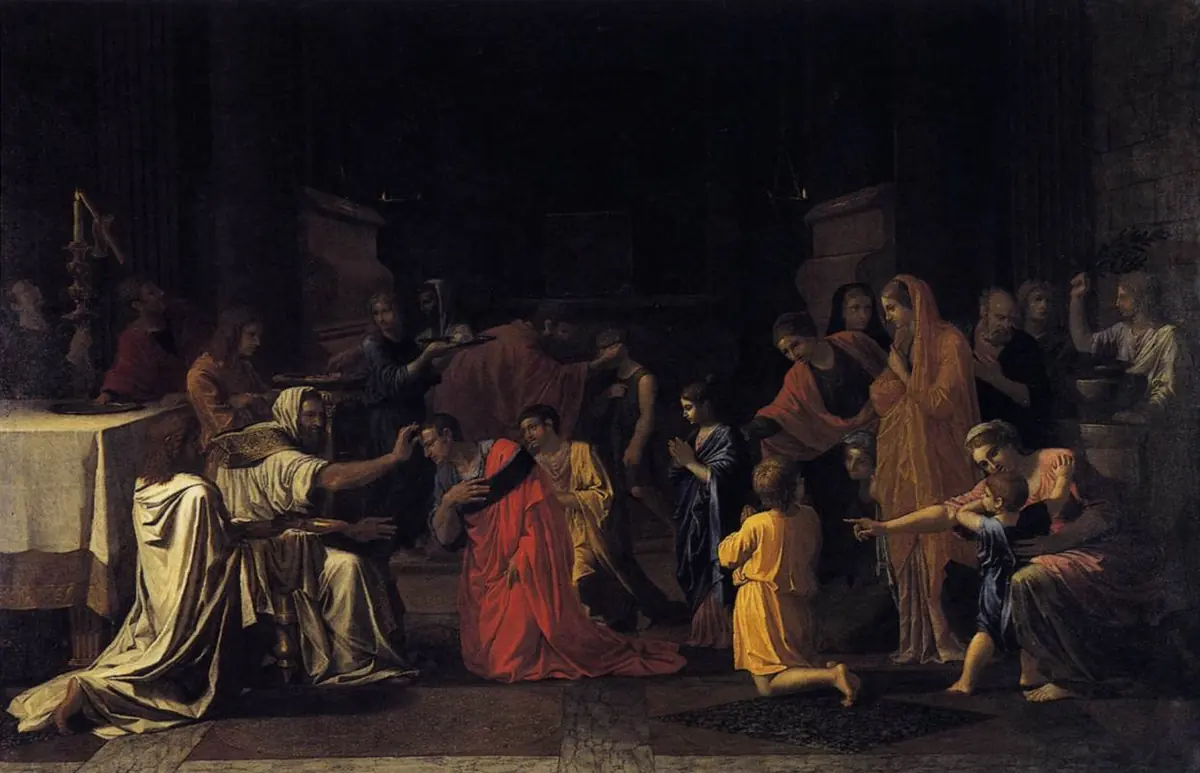
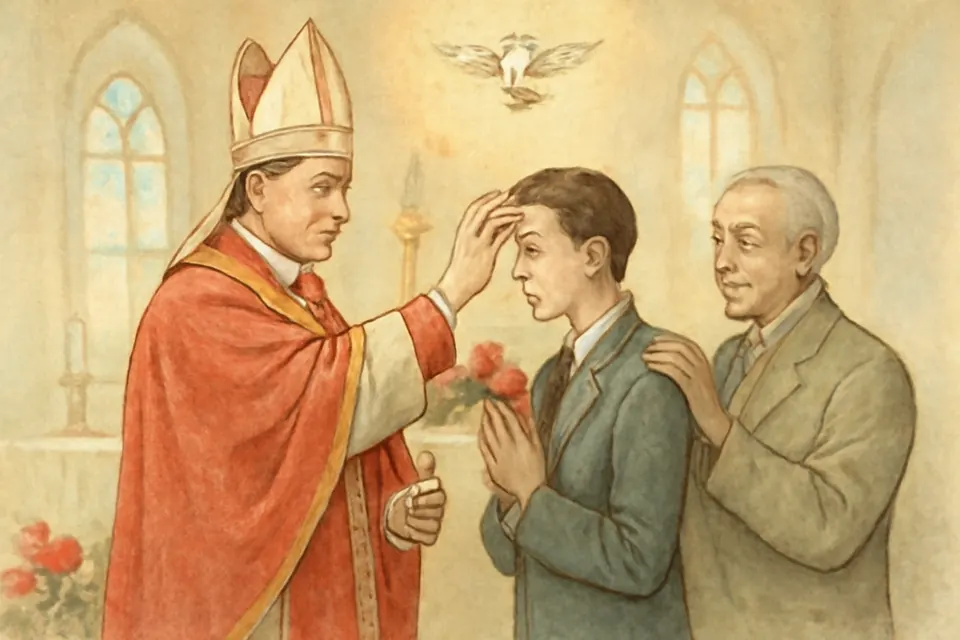
We first receive the gifts at Baptism, but the Church links them most closely with Confirmation. In the rite, the bishop extends his hands over those to be confirmed and prays that the Father will send the Holy Spirit upon them, naming the seven gifts one by one. Then he anoints each forehead with chrism and says, "Be sealed with the Gift of the Holy Spirit" (CCC 1300). The Catechism lists what the sacrament does, and one of its effects is that "it increases the gifts of the Holy Spirit in us" (CCC 1303).
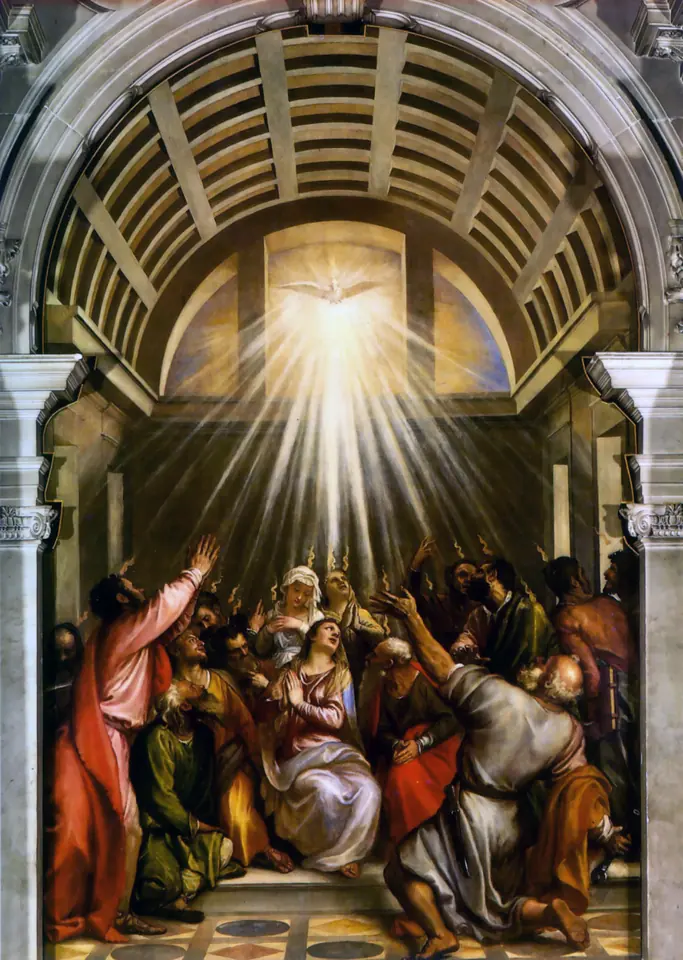
St. Ambrose, writing to the newly baptized of Milan, put it in words the Catechism repeats: "Recall then that you have received the spiritual seal, the spirit of wisdom and understanding, the spirit of right judgment and courage, the spirit of knowledge and reverence, the spirit of holy fear in God's presence." Confirmation is not graduation from the faith. It is a fresh outpouring of the same Spirit who came at Pentecost, so that we can bear witness. For the whole sacrament, see our sacrament of Confirmation guide and the seven sacraments; for choosing a patron, confirmation saints.
The twelve fruits of the Holy Spirit
The gifts are the roots; the fruits are what the Spirit grows from them. The Catechism defines them as "perfections that the Holy Spirit forms in us as the first fruits of eternal glory," and gives the Church's traditional list of twelve: "charity, joy, peace, patience, kindness, goodness, generosity, gentleness, faithfulness, modesty, self-control, chastity" (CCC 1832).
The list comes from St. Paul's letter to the Galatians. The Douay-Rheims, translating the Latin Vulgate, reads: "But the fruit of the Spirit is, charity, joy, peace, patience, benignity, goodness, longanimity, mildness, faith, modesty, continency, chastity. Against such there is no law" (Galatians 5:22–23). The older English words map onto the Catechism's list this way:
- Charity and joy and peace: the same in both.
- Patience and longanimity: patience under trials, and the long-suffering the Catechism renders "generosity."
- Benignity: kindness.
- Goodness: the same.
- Mildness: gentleness.
- Faith: faithfulness.
- Modesty, continency and chastity: modesty, self-control and chastity.
Why twelve, when some Bibles print nine? The Catholic Encyclopedia notes that three of the twelve "are omitted in several Greek and Latin manuscripts," and that the list is not meant to be closed in any case. St. Thomas, who explains the twelve one by one, saw in them the "tree bearing twelve fruits" beside the river of life in the Apocalypse (22:2).
The fruits are acts, not habits. That is what makes them fruits: good deeds done with ease and joy instead of grim effort. "Every virtuous act which man performs with pleasure is a fruit," as the Catholic Encyclopedia sums up St. Thomas. When kindness comes more naturally than irritation, when we are at peace in a storm that would once have undone us, the Spirit is harvesting what he planted. Our page on the fruits of the Holy Spirit explores each one.
How to grow in the gifts
The gifts are already ours if we are in grace. What grows is our docility to them. A few simple practices help.
- Ask for them by name. One simple, old devotion is the Glory Be prayed seven times, once for each gift. Our prayer to the Holy Spirit page gives that devotion, the Veni Creator and the Veni Sancte Spiritus, and the novena before Pentecost, which in 2027 runs from May 7 to May 15, the eve of Pentecost 2027.
- Stay in grace. The gifts dwell with charity. Mortal sin drives charity out, and the Sacrament of Penance brings it back; our guide to Catholic confession walks through it.
- Make room for silence. The Spirit's promptings are quiet. A few minutes of prayer before a decision is how counsel gets a hearing.
- Act on good inspirations. When the thought comes to call someone, to forgive, to go to Mass on a weekday, do it. Gifts grow with use.
- Know your weakness. Look again at St. Gregory's list. If rashness is your fault, pray for counsel; if fear, for fortitude; if pride, for holy fear.
A prayer for the seven gifts
Come, Holy Spirit, who rested on Jesus at the Jordan and came down on Mary and the apostles at Pentecost. You live in me since my Baptism; make me ready to follow you. Give me wisdom to love what lasts, understanding to see the truths I believe, counsel when I do not know the way, fortitude when the way is hard, knowledge to use the world without being used by it, piety to trust the Father like a child, and holy fear, so that I may never wish to grieve you. Let your gifts bear fruit in me, for the glory of the Father and the Son, with whom you live and reign, one God, for ever and ever. Amen.
Pastor Lyvers wrote this prayer for this page.
Let us ask Our Lady, the spouse of the Holy Spirit, who waited with the apostles in prayer for the first Pentecost, to pray that the gifts we have received will not lie unused in us.
Frequently asked questions
What are the 7 gifts of the Holy Spirit?
Wisdom, understanding, counsel, fortitude, knowledge, piety and fear of the Lord. The list comes from Isaiah 11:2–3, where the prophet says the Spirit of the Lord will rest on the Messiah. The Catechism (1831) teaches that the gifts belong in their fullness to Christ and that he shares them with those who belong to him.
When do we receive the gifts of the Holy Spirit?
At Baptism, together with sanctifying grace and the theological virtues. Confirmation does not give them for the first time; the Catechism says it "increases the gifts of the Holy Spirit in us" (1303), sealing and strengthening what Baptism began.
What is the difference between the gifts and the fruits of the Holy Spirit?
The gifts are lasting dispositions in the soul that make us ready to follow the Spirit's lead. The fruits are what grows from that docility: good acts done with ease and joy. The Catholic Encyclopedia puts it simply: the fruits are distinguished from the gifts "as the effect is from its cause, or the stream from its source."
What are the 12 fruits of the Holy Spirit?
Charity, joy, peace, patience, kindness, goodness, generosity, gentleness, faithfulness, modesty, self-control and chastity (CCC 1832). The list follows the Latin Vulgate text of Galatians 5:22–23; some Greek and Latin manuscripts name nine.
Are the gifts of the Holy Spirit the same as charisms like tongues or healing?
No. The seven gifts are given for the holiness of the person who receives them, and every baptized person in a state of grace has them. Charisms, such as prophecy, healing or tongues (1 Corinthians 12), are special graces given for the good of others, and God gives them to whom he wills.
Which gift of the Holy Spirit is the greatest?
Wisdom. St. Thomas Aquinas ranks wisdom highest and fear of the Lord lowest, though he calls every one of them necessary for salvation (Summa Theologiae I-II, q. 68). Fear of the Lord is the first step, "the beginning of wisdom" (Psalm 110:10, Douay-Rheims), and wisdom is the summit.
Can you lose the gifts of the Holy Spirit?
The gifts dwell in the soul with sanctifying grace and charity, so mortal sin, which drives out charity, also loses them. They return with grace in the Sacrament of Penance. Venial sin does not take them away, but it dulls our attention to the Spirit's voice.
How can I grow in the gifts of the Holy Spirit?
Ask for them by name, every day. Pray, especially before decisions; go to Mass and to confession; read Scripture; and act on the good inspirations you receive. The gifts grow as we use them, the way a sail is useful only when it is raised to the wind.
Sources
- Catechism of the Catholic Church, 1830–1832 (The gifts and fruits of the Holy Spirit)
- Catechism of the Catholic Church, 1302–1305 (The effects of Confirmation)
- St. Thomas Aquinas, Summa Theologiae I-II, q. 68: The gifts. Gifts as habits "whereby man is perfected to obey readily the Holy Ghost"; St. Gregory's list of the gifts and their opposites
- St. Thomas Aquinas, Summa Theologiae I-II, q. 70: The fruits of the Holy Ghost
- Catholic Encyclopedia (1910): Holy Ghost (sections on the gifts and the fruits). Gifts versus charismata; fruits as acts; three fruits missing in some manuscripts
- Douay-Rheims Bible: Galatians, chapter 5
- Pope Francis, General Audience of 9 April 2014 (catechesis on the gift of wisdom)