St. Cyril of Jerusalem
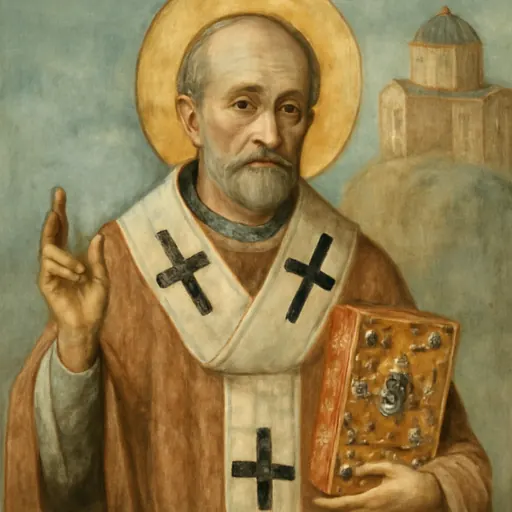
St. Cyril of Jerusalem (about 315–387) was the bishop of Jerusalem who taught the faith to new Christians a few steps from the tomb of Christ. His 24 Catechetical Lectures, given around 350, are the oldest complete course of instruction on the Creed and the sacraments that has come down to us. He was exiled three times during the Arian crisis and was named a Doctor of the Church. His feast day is March 18.
Who was St. Cyril of Jerusalem?
St. Cyril of Jerusalem was bishop of the Holy City in the middle of the 4th century, a generation after the emperor Constantine built the great basilica over Golgotha and the tomb of Christ. Every Lent he taught the adults who would be baptized at Easter, and in Easter week he explained to them what had happened at the font and the altar. Someone wrote those talks down. They survive as the Catechetical Lectures, and they let us sit, sixteen centuries later, among the first Christians of Jerusalem as their bishop walks them through the Creed and the sacraments.
His years as bishop were anything but peaceful. The Arian controversy over the divinity of Christ split the Eastern Church, and Cyril was driven from his see three times. He outlived his enemies, took part in the Council of Constantinople in 381, and died in Jerusalem around 387. Pope Leo XIII named him a Doctor of the Church in the early 1880s; the Catholic Encyclopedia lists the year as 1883.
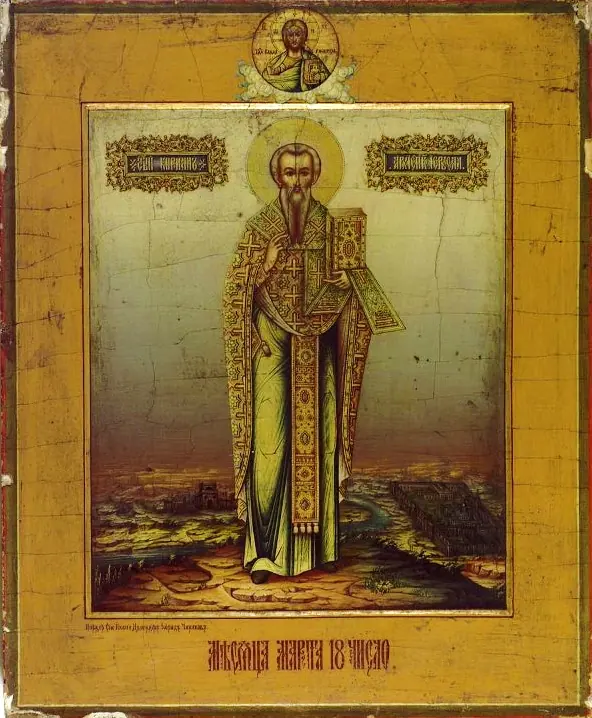
The life of St. Cyril of Jerusalem
Priest and bishop of the Holy City
Cyril was born around 315, in or near Jerusalem, and received a good education, especially in the Scriptures. Bishop Maximus ordained him a priest. When Maximus died, or was pushed aside, around 348 to 350, Cyril became bishop. The man who consecrated him was Acacius, metropolitan of Caesarea, who leaned toward the Arian party. For that reason some ancient writers suspected Cyril of having bought his see with concessions, and St. Jerome repeats the charge. Pope Benedict XVI, reviewing the evidence in 2007, pointed to the bishops' synodal letter of 382, which affirmed the legitimacy of his ordination and his sound faith.
Three exiles
The trouble with Acacius began over jurisdiction. Jerusalem was a small see in rank, under Caesarea, yet it held the holiest places in Christendom, and Cyril would not be treated as a subordinate. In 357 Acacius had him deposed. The charge, recorded in the Catholic Encyclopedia, was that Cyril had sold church furnishings during a famine. The Orthodox life adds that he had already spent his own money feeding the poor before he pawned the church's vessels to buy them wheat.
He was restored, exiled again in 360, and allowed home in 361 under Julian. In 367 the Arian emperor Valens banished him a third time, and that exile lasted eleven years, until Valens died in 378.
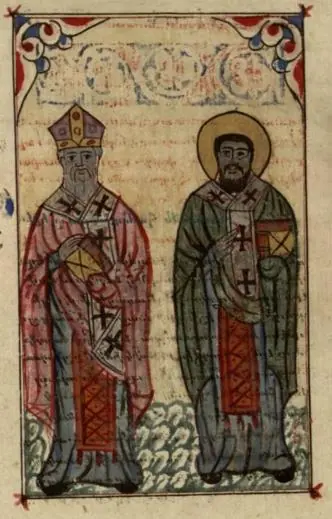
Back in Jerusalem
Around 380, St. Gregory of Nyssa visited Jerusalem and found its faith sound, though he grieved over the morals of the city. In 381 Cyril went to the Council of Constantinople, which completed the Nicene Creed we still pray at Mass. He accepted the word homoousios, "of one substance," which he had avoided for years because he feared it could be misread. He died in Jerusalem, probably in 386 or 387, after more than thirty years as bishop, many of them spent in exile.
The Catechetical Lectures
The Catechetical Lectures are an introductory talk, eighteen instructions given during Lent to the photizomenoi, "those who are to be enlightened," and five "mystagogical" talks for the newly baptized in Easter week. Pope Benedict XVI dates them to about 350; the Catholic Encyclopedia puts them a little earlier, around 347. They were preached in Constantine's basilica on Golgotha, and Cyril keeps pointing to the place itself. Speaking of the Cross, he says: "here is Golgotha to confute me, near which we are now assembled."
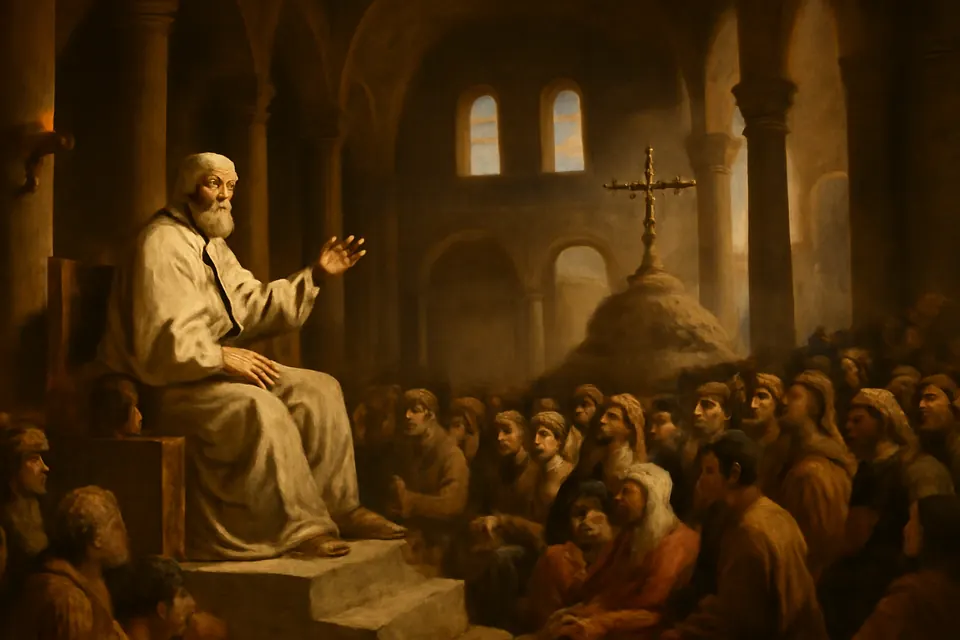
He tells the candidates what lies ahead in plain, joyful words:
Great is the Baptism that lies before you: a ransom to captives; a remission of offenses; a death of sin; a new-birth of the soul; a garment of light; a holy indissoluble seal; a chariot to heaven; the delight of Paradise; a welcome into the kingdom; the gift of adoption!
He teaches them to sign themselves with the Cross "over the bread we eat, and the cups we drink; in our comings in, and goings out; before our sleep, when we lie down and when we rise up." He tells travelers not to ask simply where the church is, since heretics call their meetings churches too, "but where is the Catholic Church."
His teaching on the Eucharist is unmistakable. "Do not think it mere bread and wine," he says, for it is the Body and Blood of Christ according to the Lord's own word. He even teaches the newly baptized how to receive:
In approaching therefore, come not with your wrists extended, or your fingers spread; but make your left hand a throne for the right, as for that which is to receive a King. And having hollowed your palm, receive the Body of Christ, saying over it, Amen.
He also describes the Eucharistic prayer as it was said in Jerusalem, including the prayer for the dead, offered "believing that it will be a very great benefit to the souls" for whom the sacrifice is offered.

The lectures are also among the oldest witnesses to the relics of the True Cross. Cyril speaks of "the wood of the Cross," which "was afterwards distributed piecemeal from hence to all the world," only about twenty years after it was found in the reign of Constantine. Read more on our pages on St. Helena and the True Cross.
The miracles of St. Cyril of Jerusalem
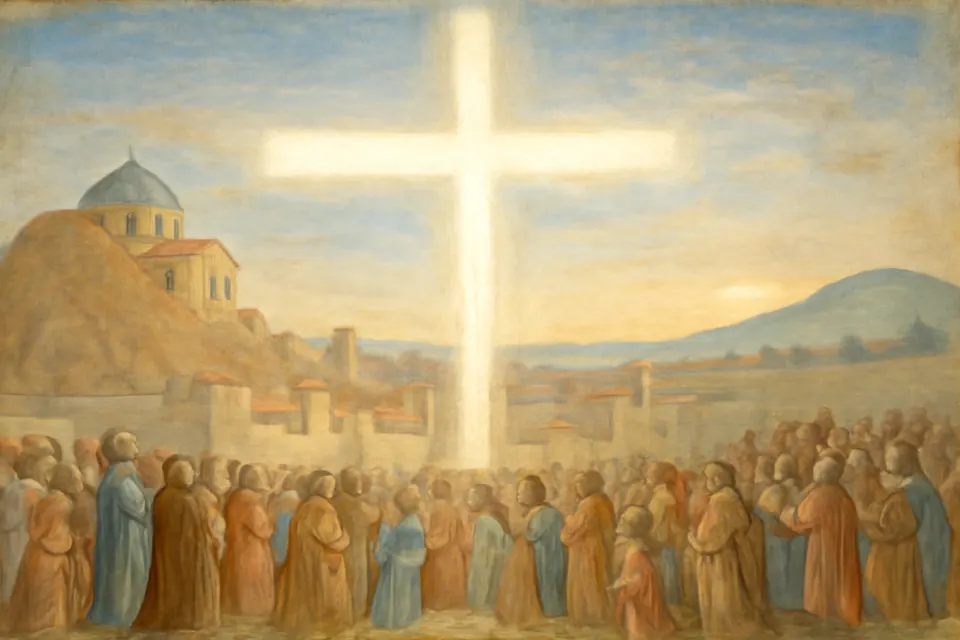
The cross of light over Jerusalem (351)
Early in his time as bishop, Cyril wrote to the emperor Constantius II about a sign the whole city had seen on May 7, 351. In the translation the Antiochian Patriarchate uses:
At about the third hour of the day, an enormous Cross, formed of light, appeared in the heaven above holy Golgotha and reaching to the holy Mount of Olives, being seen not by one or two only, but manifest with perfect clarity to the whole multitude of the city.
This is a reported sign. Cyril was writing as an eyewitness to the emperor, and he says thousands saw it. The Orthodox Church remembers it every year on May 7.
The Temple that was not rebuilt (363)
In 363 the emperor Julian, who had abandoned Christianity, ordered the Jewish Temple in Jerusalem rebuilt. The church historian Socrates, writing about seventy years later, says Cyril told many people the work would fail, recalling Christ's words that not one stone would be left on another. Socrates reports that an earthquake shook the foundations and that fire broke out among the builders' tools, and the work stopped; Julian died in Persia that same year. The prediction and the signs are reported by the ancient church historians, and the Orthodox life of St. Cyril tells the same story.

Why St. Cyril of Jerusalem is a patron of catechists
Cyril has no ancient patronages. Catholics today often call him a patron of catechists, and it is easy to see why. No one in the early Church left a fuller model of how to prepare adults for Baptism: the Creed explained article by article, the moral life, and then the sacraments unfolded after the candidates had received them. Pope Benedict XVI called it "an integral catechesis which, involving body, soul and spirit - remains emblematic for the catechetical formation of Christians today." Catechists and RCIA teams still learn from him. See more on our patron saints page.
Symbols of St. Cyril of Jerusalem in art
Cyril appears most often in Eastern icons and frescoes, among the holy bishops painted around the altar. Look for:
- Bishop's vestments with the omophorion: in Byzantine and Slavic art, a white stole marked with large black crosses, as in the Serbian fresco below.
- A book: the Gospels, or his own Catecheses, since he is honored as a teacher.
- A hand raised in blessing: the gesture of a bishop and teacher.
- Gray hair and a short beard: Eastern painters usually show him as an older man with a rounded gray beard, which helps tell him from Cyril of Alexandria, often shown with a longer beard and a distinctive hood.
- A cross in the sky or the city of Jerusalem: in some Western prints, pointing to the sign of 351.
In Western art he is rarer and shown simply as a bishop with miter, pallium and book. Francesco Bartolozzi's engraving has him pointing upward, a likely nod to the cross of light.


Feast day and devotion
We keep the feast of St. Cyril of Jerusalem on March 18, almost always in Lent, which suits a bishop who spent his Lents preparing people for Easter. In the General Roman Calendar it is an optional memorial. The Orthodox and Eastern Catholic churches keep the same date. See the neighboring saints on our feast days page, including St. Joseph the next day.
No relics of Cyril are known today. The place most closely tied to him is the Church of the Holy Sepulchre, the successor of the basilica where he preached.

Prayer to St. Cyril of Jerusalem
The Roman Missal gives this collect for his memorial on March 18:
O God, who through the Bishop Saint Cyril of Jerusalem led your Church in a wonderful way to a deeper sense of the mysteries of salvation, grant us, through his intercession, that we may so acknowledge your Son as to have life ever more abundantly. Through our Lord Jesus Christ, your Son, who lives and reigns with you in the unity of the Holy Spirit, God, for ever and ever.
The Orthodox Church sings this troparion on his feast, in the translation of the Orthodox Church in America:
You were seen in Zion clothed in a robe of godliness as an illustrious pillar of the Apostles' faith. You became an heir to their grace, setting forth their pious doctrines and dispensing their talents of wisdom. O Cyril, our Father and hierarch, pray for us.
Let us ask St. Cyril to pray for everyone preparing for Baptism this Easter, and for the catechists who teach them.
Frequently asked questions
What is St. Cyril of Jerusalem known for?
For his Catechetical Lectures, 24 talks given in Jerusalem around 350 to adults preparing for Baptism at Easter and to the newly baptized. They explain the Creed, Baptism, Confirmation and the Eucharist, and they are among the most valuable writings of the early Church on how Christians were formed and how they worshiped.
When is St. Cyril of Jerusalem's feast day?
March 18, both in the Catholic Church's General Roman Calendar, where it is an optional memorial, and in the Eastern Orthodox and Eastern Catholic churches.
What did St. Cyril of Jerusalem teach about the Eucharist?
That the bread and wine become the Body and Blood of Christ. "Do not think it mere bread and wine," he told the newly baptized, and he taught them to make "your left hand a throne for the right, as for that which is to receive a King" when receiving Communion.
Why was St. Cyril of Jerusalem exiled?
He was driven out three times in about twenty years, in 357, 360 and 367, during the struggles over Arianism. His metropolitan, Acacius of Caesarea, accused him of selling church property to feed the poor during a famine. His last exile, under the emperor Valens, lasted eleven years.
Is St. Cyril of Jerusalem the same as St. Cyril of Alexandria?
No. Cyril of Alexandria was a later bishop of Egypt (died 444) who defended Mary's title Mother of God at the Council of Ephesus. Cyril of Jerusalem died about 387. Both are Doctors of the Church, and neither is the St. Cyril who evangelized the Slavs with his brother Methodius.
Keep exploring
- Appears in
- Doctors of the ChurchChurch Fathers
- Feast-day calendar
- Saints remembered in MarchSaint of the day
- More
- Saints A to ZPatron saints A to ZExplore every section
Sources
- Catholic Encyclopedia (1908): St. Cyril of Jerusalem
- Pope Benedict XVI, General Audience of June 27, 2007: Saint Cyril of Jerusalem
- Cyril of Jerusalem, Catechetical Lecture 13 (New Advent, Nicene and Post-Nicene Fathers)
- Cyril of Jerusalem, Catechetical Lecture 23, On the Mysteries V (New Advent)
- Greek Orthodox Patriarchate of Antioch: Commemoration of the Precious Cross that appeared in the sky over Jerusalem in 351 A.D.
- Socrates Scholasticus, Church History, Book III, ch. 20 (New Advent)
- Catholic Encyclopedia (1909): Doctors of the Church
- Catholic Culture: Collect for the Optional Memorial of St. Cyril of Jerusalem, March 18