Theotokos
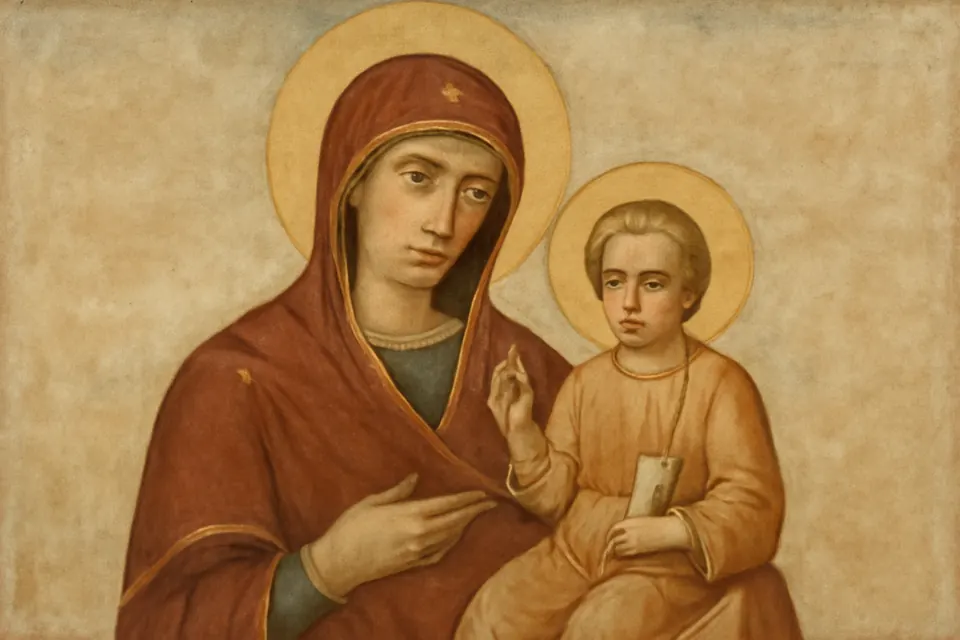
Theotokos is Greek for "God-bearer," the one who gave birth to God; in English we say Mother of God. It is the Church's title for the Virgin Mary, solemnly confirmed by the Council of Ephesus in 431 against Nestorius. The title is first about Jesus: the child Mary bore is the eternal Son of God made man, one divine person.
Theotokos is the oldest and greatest of the Virgin Mary's titles. The Greek word means "God-bearer," the one who gave birth to God, and we say it in English as Mother of God. The Church has prayed it since the early centuries, defended it at the Council of Ephesus in 431, and sings it at every Divine Liturgy of the Byzantine churches to this day. Before it tells us anything about Mary, it tells us who her Son is.
Theotokos at a glance
- Greek: Θεοτόκος, Theotokos, from Theos, God, and tokos, childbirth
- Latin: Dei Genetrix or Deipara
- English: Mother of God, God-bearer, Birth-giver of God
- Defined: Council of Ephesus, 431, against Nestorius; repeated at Chalcedon, 451
- Champion: St. Cyril of Alexandria
- Oldest prayer using it: the Sub tuum praesidium, "We fly to thy protection, O holy Mother of God"
- On icons: the letters ΜΡ ΘΥ, Meter Theou, "Mother of God"
- Feasts: January 1 in the Roman calendar, the Solemnity of Mary, Mother of God; December 26 in the Byzantine calendar, the Synaxis of the Most Holy Theotokos
What Theotokos means
A mother is not the mother of a nature. She is the mother of a person, the one she conceives, carries and brings into the world. The person Mary conceived by the Holy Spirit is not a man to whom God later attached himself. He is the eternal Son of the Father, who took flesh in her womb. So Mary is truly the Mother of God.
The Catechism says it in a single line: the One whom she conceived "was none other than the Father's eternal Son, the second person of the Holy Trinity. Hence the Church confesses that Mary is truly 'Mother of God' (Theotokos)" (CCC 495). Elizabeth had already said it at the Visitation, when she greeted her young cousin as "the mother of my Lord" (Luke 1:43).
The title does not mean that Mary is the source of God or older than God. St. Cyril of Alexandria explained this to Nestorius in 430. The holy Fathers, he wrote, "ventured to call the Holy Virgin, the Mother of God, not as if the nature of the Word or his divinity had its beginning from the Holy Virgin, but because of her was born that holy body with a rational soul, to which the Word being personally united is said to be born according to the flesh." Mary gave the Son of God his human nature. He has his divinity from the Father, from all eternity.
St. John of Damascus, writing three centuries later, put it most simply: "Hence it is with justice and truth that we call the holy Mary the Mother of God. For this name embraces the whole mystery of the dispensation." If she who bore him is the Mother of God, then he who was born of her is truly God and truly man. Deny the title, and the Incarnation comes apart.
Theotokos before Ephesus
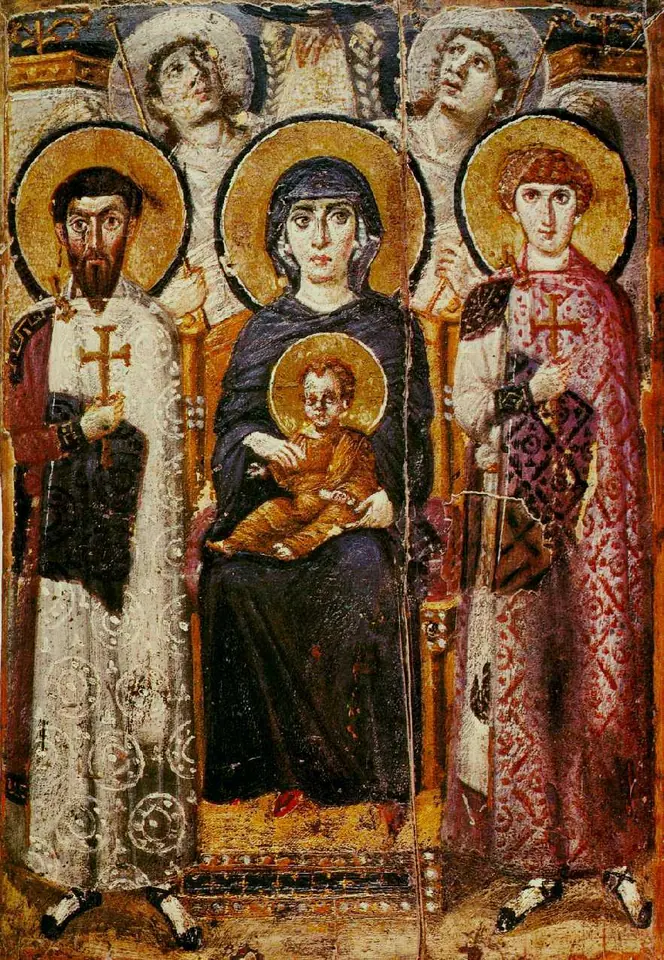
The title was not invented in 431. It was already in the mouths of the faithful, which is why its rejection caused such an uproar.
- The bishops of Alexandria. About 324, writing against Arius, St. Alexander of Alexandria confessed that the Lord "bore a Body, in truth, not in semblance, derived from Mary the mother of God." Theodoret preserved the letter in his Ecclesiastical History.
- Origen and the older writers. The historian Socrates, who lived through the controversy, says that Origen gave "an ample exposition of the sense in which the term Theotocos is used" in his commentary on Romans, and that "the ancients" had used it freely. Origen's commentary survives only in part, so we know this through Socrates.
- The Cappadocians. St. Gregory of Nazianzus, in the 380s, wrote that anyone who "does not believe that Holy Mary is the Mother of God" is cut off from the Godhead.
- The prayer of the faithful. The Sub tuum praesidium, the oldest known prayer to Mary, calls on her as Theotokos. Its Greek text survives on a papyrus from Egypt now in the John Rylands Library in Manchester. Scholars still debate how old the papyrus is, but the prayer was already in common use when the controversy broke out.
Nestorius and the Council of Ephesus
In 428 Nestorius, a famous preacher from Antioch, became archbishop of Constantinople. Socrates tells how the trouble began. A priest Nestorius had brought with him, Anastasius, preached: "Let no one call Mary Theotocos: for Mary was but a woman; and it is impossible that God should be born of a woman." The people of Constantinople were shocked. They had been "taught to acknowledge Christ as God," and they heard in the sermon an attack on him. Nestorius defended his priest in a series of sermons and proposed "Mother of Christ" instead.
Behind the quarrel over one word lay a question about Christ himself. If Mary is only the mother of a man in whom God dwelt, then there are two subjects in Christ, a human one and a divine one, loosely joined. The Church had always confessed one Lord. As the Catechism puts it, the Nestorian heresy "regarded Christ as a human person joined to the divine person of God's Son" (CCC 466).
St. Cyril, archbishop of Alexandria, wrote to Nestorius and then appealed to Rome. On August 11, 430, Pope St. Celestine I charged Cyril to act in his name and gave Nestorius ten days to recant. Cyril's third letter ended with twelve anathemas. The first goes straight to the point:
If anyone will not confess that the Emmanuel is very God, and that therefore the Holy Virgin is the Mother of God (Θεοτόκος), inasmuch as in the flesh she bore the Word of God made flesh [as it is written, The Word was made flesh] let him be anathema.
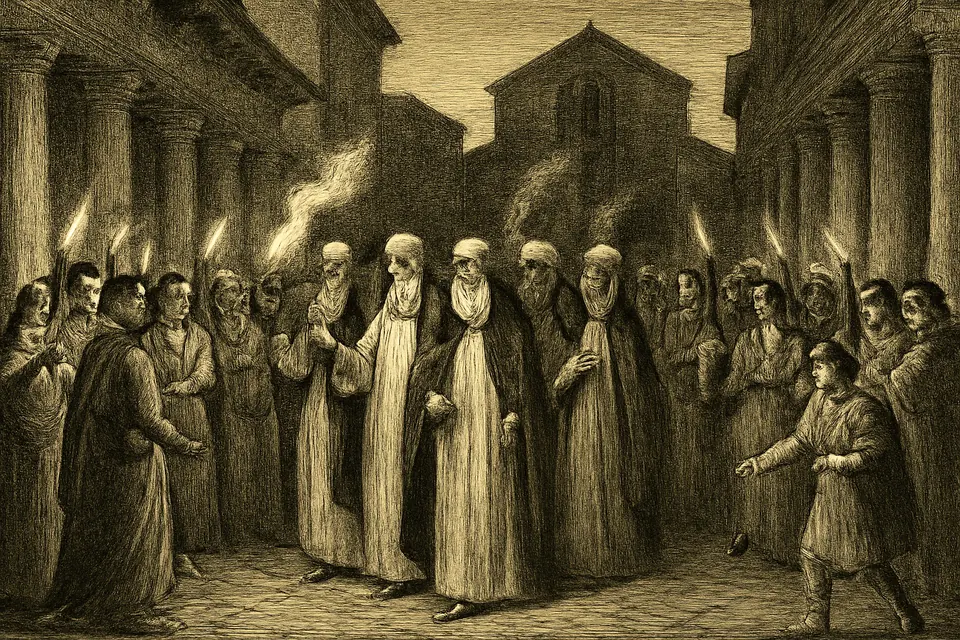
The emperor Theodosius II summoned a council to Ephesus. It opened on June 22, 431, in the cathedral there, a church dedicated to Mary. In one long session the bishops read the letters, approved Cyril's teaching and deposed Nestorius. The Catholic Encyclopedia describes the end of the day: "it was evening when the result was known. The people of Ephesus, full of rejoicing, escorted the fathers to their houses with torches and incense."
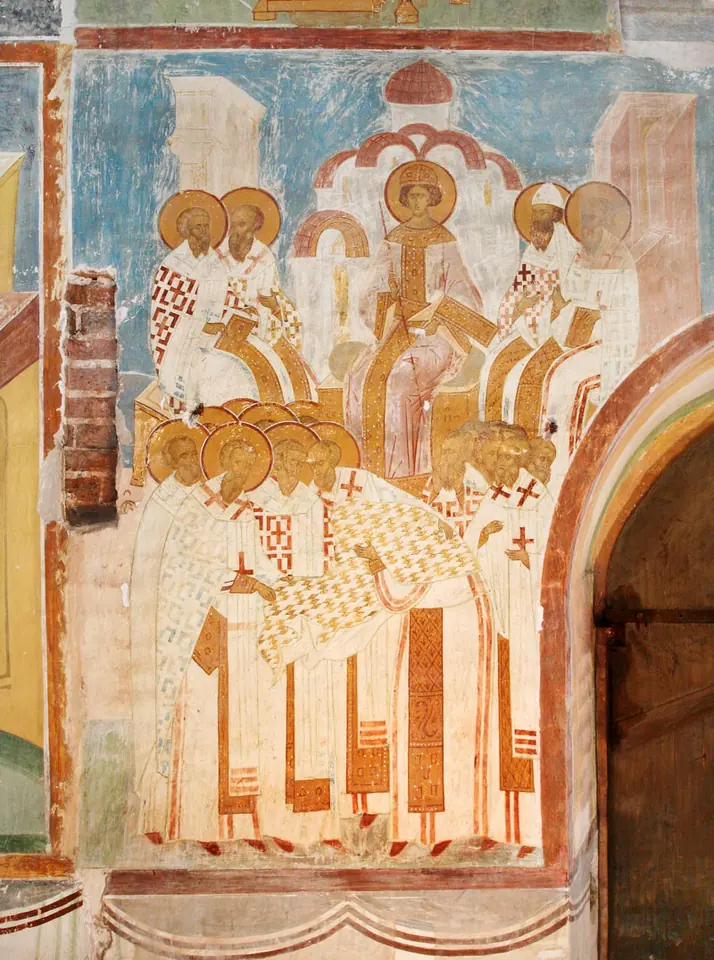
The controversy did not end that night. John of Antioch and his bishops arrived late and held a rival meeting, and it took two years of letters before John and Cyril were reconciled in 433. Nestorius was sent into exile. Socrates records that, as things fell apart around him, he cried out, "Let Mary be called Theotocos, if you will, and let all disputing cease." Twenty years later, the Council of Chalcedon confirmed the title in its own definition: Christ was born "of the Virgin Mary, the Mother of God according to his manhood."
How Rome answered: Santa Maria Maggiore
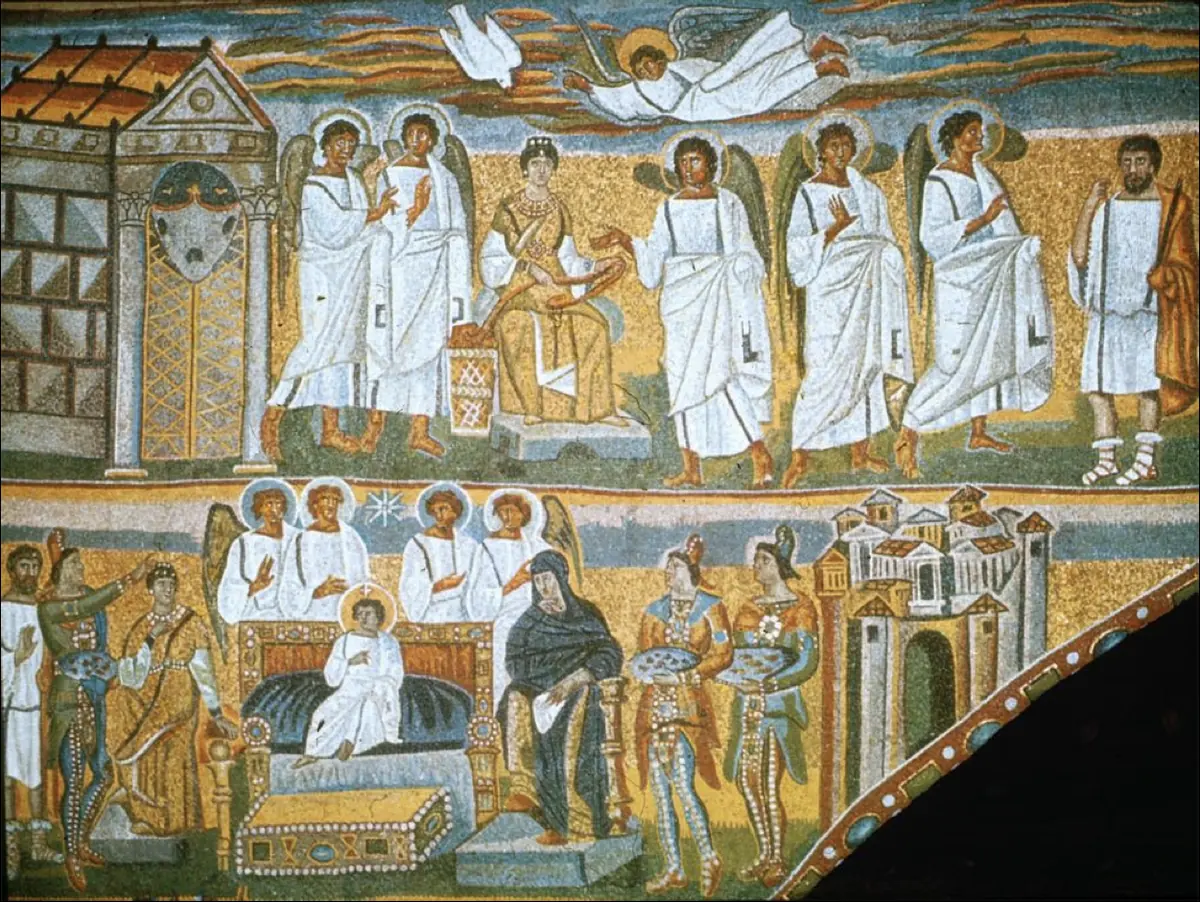
Right after Ephesus, Pope Sixtus III rebuilt the great basilica of Mary on the Esquiline Hill in Rome, Santa Maria Maggiore. The mosaics he set on the arch over the altar between 432 and 440 tell the story of Christ's infancy, and they present Mary dressed in the jeweled robes of a royal lady. Rome's oldest feast of Our Lady, on January 1, was first kept at this basilica; our page on the Solemnity of Mary, Mother of God tells that story.
The Theotokos in the Byzantine Liturgy
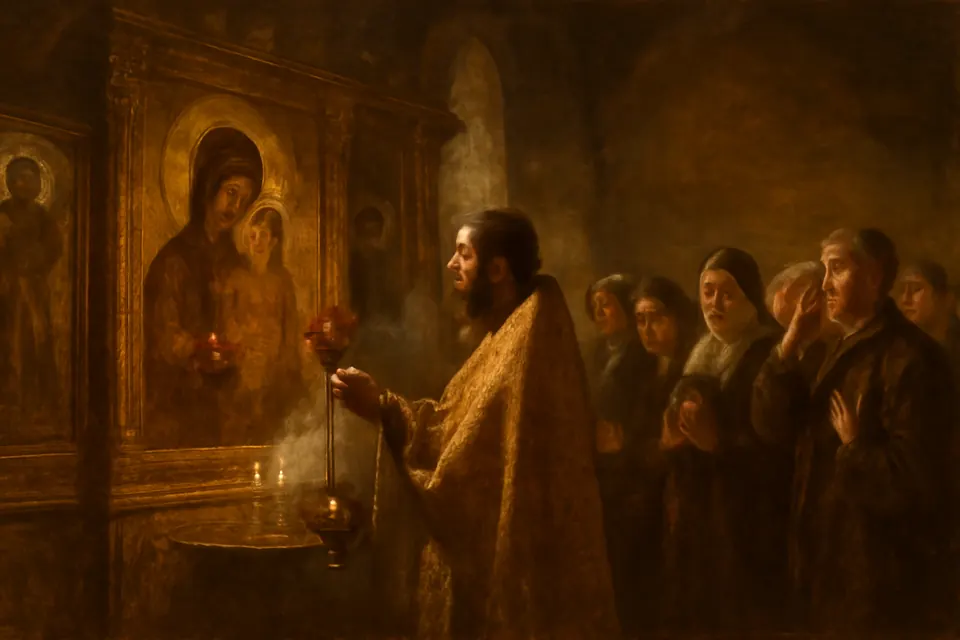
In the Western Church the title most often appears in the second half of the Hail Mary: "Holy Mary, Mother of God, pray for us sinners." In the Byzantine churches, Orthodox and Eastern Catholic alike, it is woven through every service. The Ukrainian, Ruthenian and Melkite Greek Catholic churches, and the other churches of the Byzantine tradition, pray the same texts as the Orthodox, and the Theotokos is named again and again.
Each litany of the Divine Liturgy closes by remembering her. In Isabel Hapgood's public-domain translation of 1906:
Calling to remembrance our most holy, undefiled, most blessed and glorious Lady, the Birth-giver of God and ever-virgin Mary, with all the Saints, let us commend ourselves, and each other, and all our life unto Christ our God.
After the consecration, the faithful sing her hymn, Axion estin, in Hapgood's version:
Meet is it in very truth to bless thee, O Birth-giver of God, ever-blessed and all-undefiled One, and the Mother of our God. More honourable than the Cherubim, and beyond compare more glorious than the Seraphim, thou who without defilement barest God the Word, true Birth-giver of God, we magnify thee.
Many hymns of the Byzantine services end with a short verse to Mary called a theotokion. The great Akathist hymn, sung standing, greets her with long chains of praises, each beginning "Rejoice." The Byzantine calendar honors her the day after Christmas with the Synaxis of the Most Holy Theotokos, and it keeps her falling asleep in the Lord, the Dormition, on August 15, the same day the Latin Church celebrates the Assumption. For the saints of the East, see our guide to Orthodox saints.
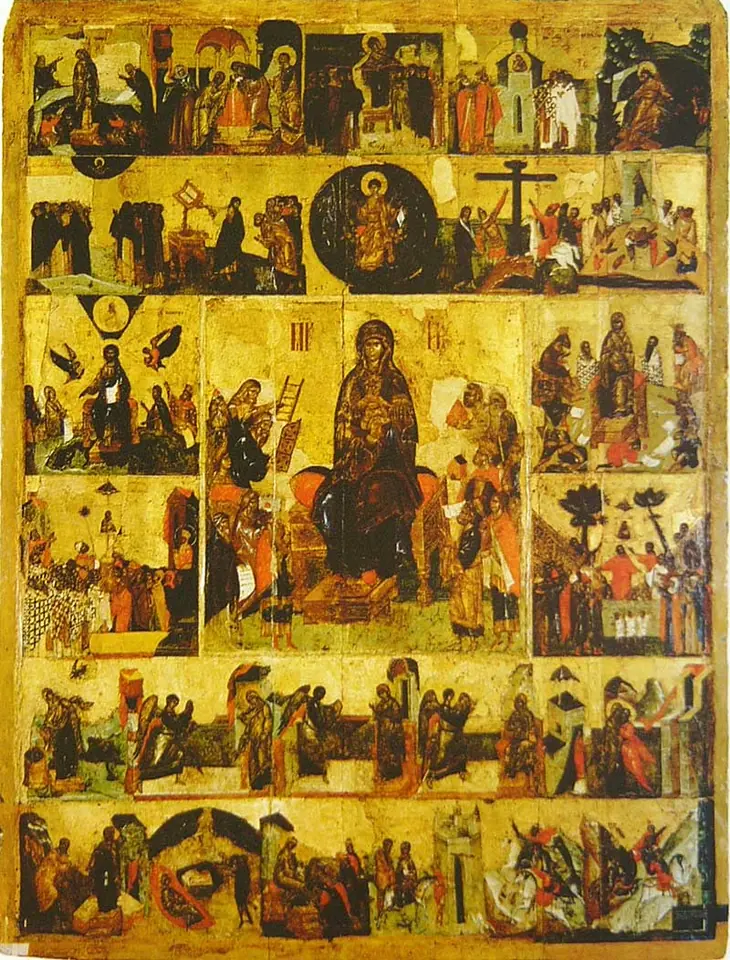
Theotokos icons: how to read them
An icon of the Theotokos almost never shows Mary alone. She holds her Son or points to him, because her title exists for his sake. A few signs help you read any of them:
- ΜΡ ΘΥ on either side of her head abbreviate Meter Theou, Mother of God; IC XC by the Child abbreviate Jesus Christ.
- Three stars on her veil, one on the forehead and one on each shoulder, are traditionally read as her virginity before, during and after the birth of Christ.
- Her colors are usually a dark red or purple mantle over a blue dress. The Child often wears gold, the color of divinity.
- The Child is drawn with an adult face and a scroll, because he is the eternal Word, not an ordinary baby.
Three types are especially common.
Hodegetria, "she who shows the way"
Mary holds the Child on one arm and points to him with her other hand. Tradition traces this type to an icon venerated in Constantinople, which legend attributed to St. Luke. The legend is traditional; the meaning is plain. She shows us the way, and the way is Christ.
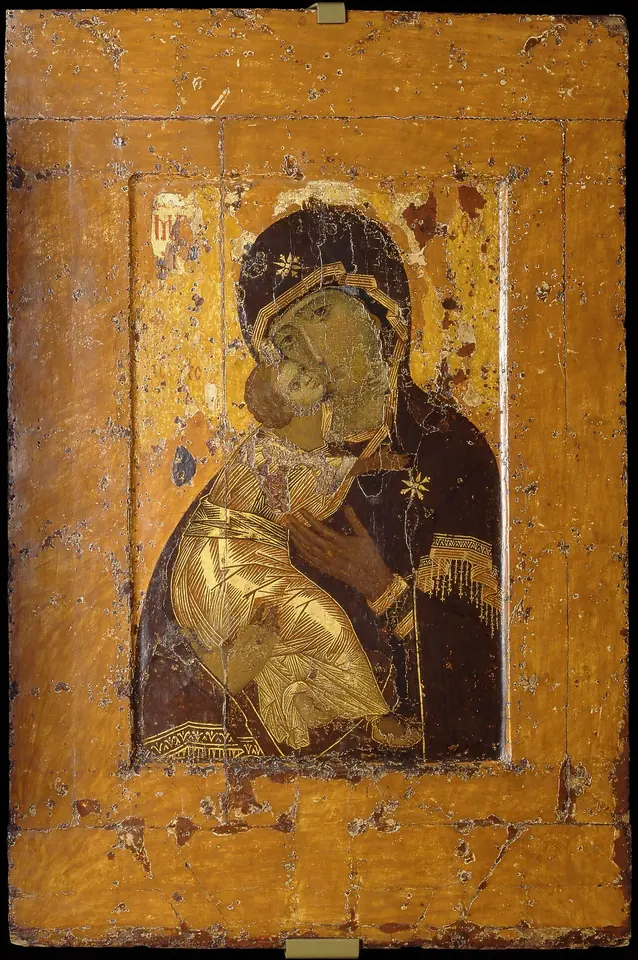
Eleousa, "tender mercy"
The Child presses his cheek to his Mother's, and she holds him close. The most famous is the Theotokos of Vladimir, painted in Constantinople in the 12th century and brought to Kyiv and then to Vladimir and Moscow. Its sad, tender gaze looks past the Child, as though Mary already sees the Cross.
Platytera and the Sign
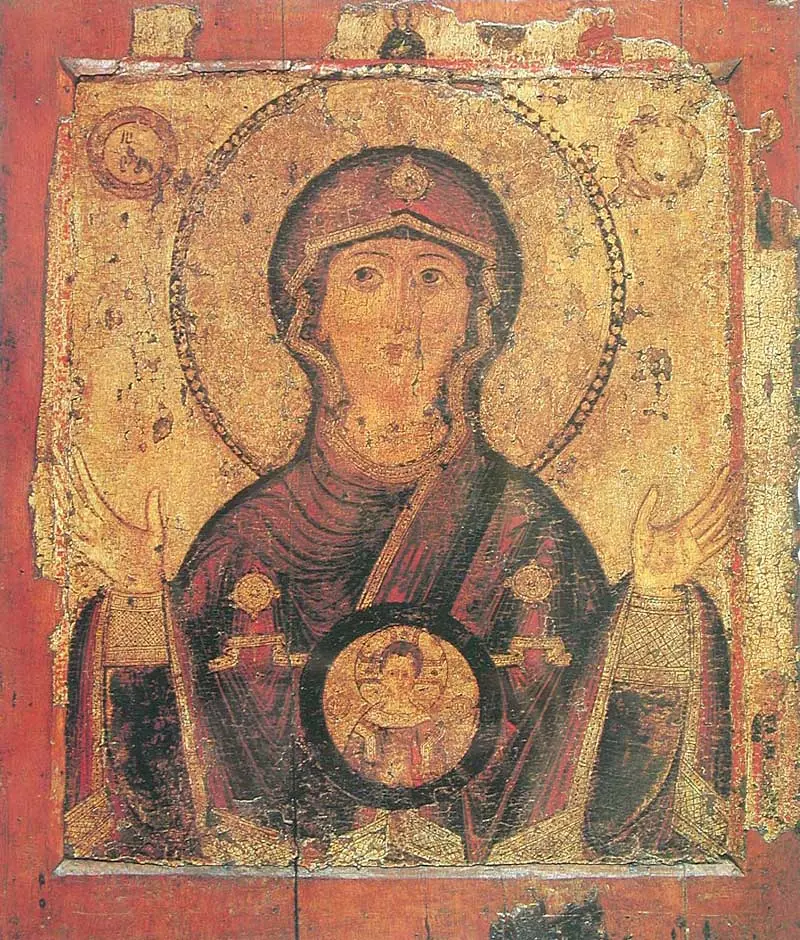
Mary stands or sits with her arms raised in prayer, and the Child appears in a circle on her breast. The title Platytera, "wider than the heavens," comes from a hymn: she held in her womb the One whom the heavens cannot contain. This is the icon often painted in the apse above the altar of a Byzantine church. The Russian form is called Our Lady of the Sign, after Isaiah 7:14: "Behold a virgin shall conceive, and bear a son."
Praying to the Theotokos
The simplest prayer is the oldest. The Compendium of the Catechism gives the Sub tuum praesidium in English:
We fly to thy protection, O holy Mother of God. Despise not our petitions in our necessities, but deliver us always from all dangers O glorious and blessed Virgin.
And in Latin:
Sub tuum praesidium confugimus, sancta Dei Genetrix; nostras deprecationes ne despicias in necessitatibus; sed a periculis cunctis libera nos semper, Virgo gloriosa et benedicta.
Learn it by heart and pray it whenever you are afraid. Other prayers to Mary that use her title include the Memorare, the Hail Holy Queen and the Litany of Loreto, whose first Marian invocation after "Holy Mary" is "Holy Mother of God."
Why the title matters for us
To call Mary the Theotokos is to confess that God really became one of us. He did not visit a human being from outside; he was conceived, carried for nine months, born, nursed and taught to walk. Every Christmas crèche says the same thing the bishops of Ephesus said.
It also tells us what Mary is to us. The Mother of the Head is the Mother of the members. When we fly to her protection, we come to the one who held God in her arms and who brings every need she hears to him. For all her titles, feasts and dogmas, see the Blessed Virgin Mary; for the history of praying to her, Marian apparitions and consecration to Mary.
Holy Mary, Theotokos, Mother of God, pray for us, and show us your Son.
Frequently asked questions
What does Theotokos mean?
It is Greek for "God-bearer" or "she who gave birth to God," from Theos (God) and tokos (childbirth). In English the Church renders it Mother of God; in Latin, Dei Genetrix or Deipara. It is pronounced thee-oh-TOH-kos.
Why is Mary called the Theotokos?
Because the child she conceived and bore is God the Son made man. A mother is mother of a person, not of a nature, and the person born of Mary is the eternal Word. The Catechism says the Church "confesses that Mary is truly 'Mother of God' (Theotokos)" (CCC 495).
Does calling Mary the Mother of God mean she existed before God?
No. St. Cyril of Alexandria answered this in 430: the Fathers called her Mother of God "not as if the nature of the Word or his divinity had its beginning from the Holy Virgin," but because the Word united to himself the body born of her. Mary is a creature, saved by her Son; she gave him his human nature, not his divinity.
When was Mary declared Theotokos?
Christians called her Theotokos long before, but the Council of Ephesus confirmed the title in 431, deposing Nestorius, who had refused it. The Council of Chalcedon in 451 repeated it in its definition: Christ was born "of the Virgin Mary, the Mother of God according to his manhood."
What do the letters MP ΘY on icons mean?
They abbreviate the Greek Meter Theou, "Mother of God." Icons of the Virgin carry them on either side of her head. IC XC beside the Child abbreviates Iesous Christos, Jesus Christ.
Is Theotokos only an Orthodox word?
No. It is the common title of Catholics and Orthodox alike. The Latin Church uses it in the Catechism and in the Sub tuum praesidium, and Eastern Catholics, such as the Ukrainian, Ruthenian and Melkite Greek Catholic churches, say Theotokos at every Divine Liturgy, just as the Orthodox do.
What is the oldest prayer to the Theotokos?
The Sub tuum praesidium, "We fly to thy protection, O holy Mother of God," is the oldest known prayer addressed to Mary. Its Greek text survives on an Egyptian papyrus in the John Rylands Library in Manchester; scholars still debate the papyrus's date.
Sources
- Catechism of the Catholic Church, 466–467 (St. Cyril and the Council of Ephesus)
- Catechism of the Catholic Church, 495 (Mary's divine motherhood)
- Council of Ephesus (A.D. 431): St. Cyril's letters to Nestorius and the Twelve Anathemas (NPNF translation)
- Catholic Encyclopedia (1909): Council of Ephesus. Opening on 22 June 431; Pope Celestine's charge to Cyril; the torches and incense
- Socrates Scholasticus, Church History, Book VII, chapters 32–34. The sermon of Anastasius, Origen's use of the title, and Nestorius's later words
- Theodoret, Ecclesiastical History, Book I (letter of Alexander of Alexandria)
- St. Gregory of Nazianzus, Letter 101, to Cledonius
- St. John of Damascus, An Exposition of the Orthodox Faith, Book III, chapter 12
- Isabel F. Hapgood, Service Book of the Holy Orthodox-Catholic Apostolic (Greco-Russian) Church (1906), Internet Archive. Public-domain English of the litany commemoration, "More honourable than the Cherubim" and "Meet is it in very truth"
- Compendium of the Catechism of the Catholic Church, Appendix: Common prayers (Sub tuum praesidium)