St. John of Damascus
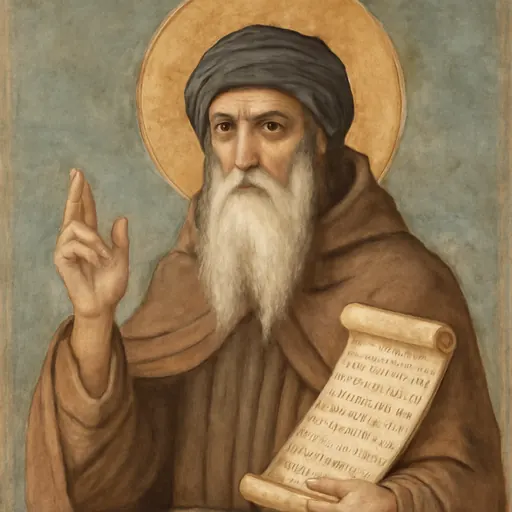
St. John of Damascus, also called St. John Damascene, was a Syrian Christian who left a high post at the Umayyad caliph's court to become a monk at Mar Saba near Jerusalem. In the 720s and 730s he wrote the most famous defense of icons against the Byzantine iconoclasts. His feast day is December 4, and Pope Leo XIII named him a Doctor of the Church in 1890.
Who was St. John of Damascus?
John was a Christian civil servant of the Umayyad caliphs in Damascus who became a monk, a theologian and a poet. He is best known for his defense of icons during the iconoclast controversy, the 8th-century crisis in which Byzantine emperors ordered holy images removed and destroyed. Benedict XVI, in a 2009 audience, called him "a personage of prime importance in the history of Byzantine Theology, a great Doctor in the history of the Universal Church." The Catholic Encyclopedia calls him "the last of the Greek Fathers."
He is also called St. John Damascene, which means the same thing. His family name was Mansur.

One caution about the sources. Almost everything told about his life comes from a single biography written in the 10th century by a Patriarch John of Jerusalem, two hundred years after his death. The Catholic Encyclopedia complains of its "exasperating lack of detail" and "pronounced legendary tendency." Even his dates are uncertain: he was born around 675 and died sometime between about 749 and the 780s, depending on the source.
The life of St. John of Damascus
A Christian at the caliph's court
John grew up in Damascus a generation after the Arab conquest of Syria, when the city was the capital of the Umayyad caliphate. His father, probably named Sergius Mansur, was a Christian who served as chief financial officer to the caliph Abd al-Malik. The Orthodox life says his father bought the freedom of a learned Sicilian monk named Cosmas, a captive in the Damascus slave market, and made him tutor to John and to an orphan boy he had adopted, also named Cosmas. The 10th-century biographer claims young John soon matched Diophantus in algebra and Euclid in geometry.
After his father's death John held high office himself. The Catholic Encyclopedia calls him chief councilor of Damascus; Benedict XVI says he became "Treasurer of the Caliphate."
The defense of the icons
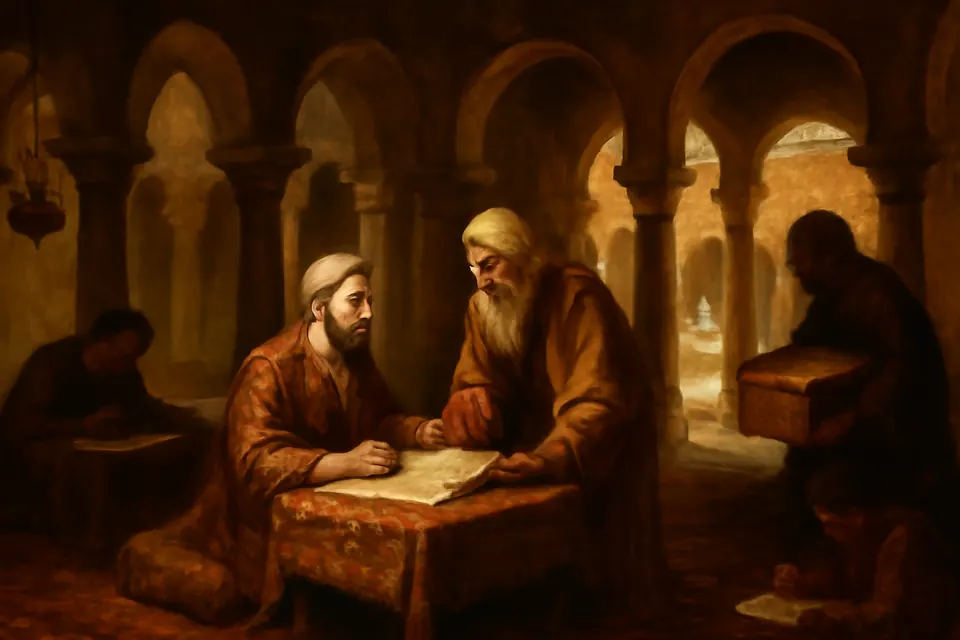
In 726 the Byzantine emperor Leo III issued his first edict against the veneration of images, over the protests of Germanus, Patriarch of Constantinople. A second edict in 730 went further. John lived outside the empire, safe from Leo's police, and answered with three treatises, usually called Against Those Who Attack the Divine Images. They are the classic Christian argument for icons.
His central argument is the Incarnation. God, who has no body, could not be pictured; but God the Son took flesh and was seen. In the 1898 translation by Mary H. Allies:
Of old, God the incorporeal and uncircumscribed was never depicted. Now, however, when God is seen clothed in flesh, and conversing with men, I make an image of the God whom I see. I do not worship matter, I worship the God of matter, who became matter for my sake, and deigned to inhabit matter, who worked out my salvation through matter.
He drew a careful line, Benedict XVI explained, between latreia, the worship owed to God alone, and proskynesis, the veneration that "can make use of an image to address the one whom the image represents."
The severed hand
According to the 10th-century life, Leo III got hold of a letter in John's handwriting and had a forgery made, in which John seemed to offer to betray Damascus to the emperor. Leo sent it to the caliph. The caliph refused to believe John's denials and ordered his right hand cut off. The Orthodox life says John begged for the hand back, pressed it to his wrist, and prayed before an icon of the Theotokos. He fell asleep and heard her voice telling him he was healed and should go on writing with the restored hand. When he woke the hand was whole, with only a thin red line around the wrist. The story is traditional.

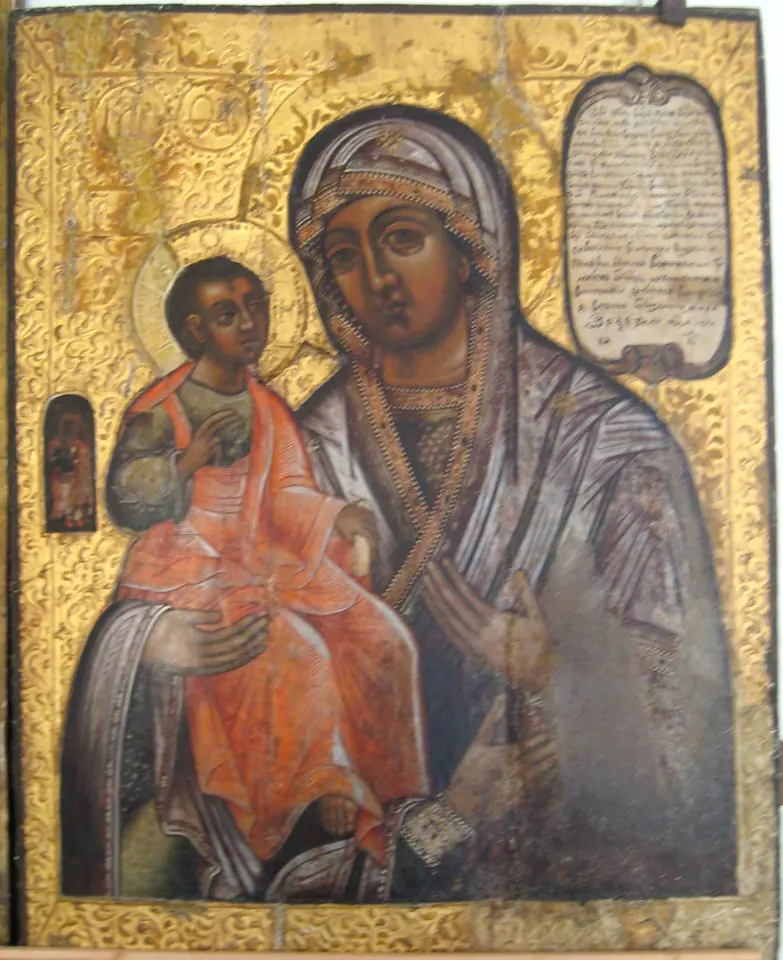
In thanksgiving, the tradition continues, John fastened a silver hand to the icon. That icon became known as the Tricherousa, the Mother of God "of the Three Hands." The Orthodox life notes that "some unlearned painters" later gave the Virgin three hands instead of painting the silver ex-voto. The original is honored at the Serbian monastery of Hilandar on Mount Athos, and copies are found across the Orthodox world.
Monk of Mar Saba
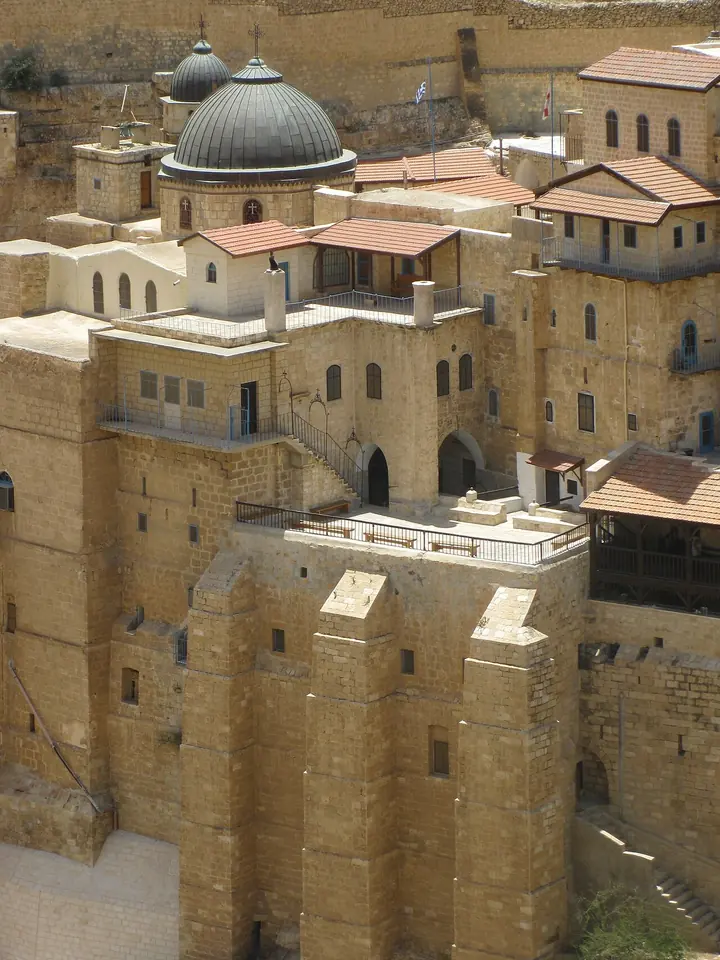
The caliph, convinced of John's innocence, offered him his old post. In the traditional account John refused, gave his wealth to the poor and went with his adopted brother Cosmas to the Lavra of St. Sabbas, the great monastery clinging to the cliffs of the Kidron Valley between Jerusalem and the Dead Sea. Benedict XVI dates his entry around 700, before the iconoclast crisis, which shows how unsure the chronology is.
The Orthodox life tells of his hard novitiate. An old monk agreed to guide him on condition that John do nothing by his own will. Once he sent John, dressed in rags, to sell the monastery's baskets in Damascus at an absurd price. No one recognized the former official except his old house steward, who bought them all out of pity. Another time John wrote funeral verses for a grieving monk without permission and was punished by being made to clean the latrines with his bare hands, which he did gladly.

The Patriarch of Jerusalem ordained him a priest. John spent the rest of his life at Mar Saba, writing and composing hymns. In 754 the iconoclast Council of Hieria condemned him by name. The Catholic Encyclopedia lists its insults: "cursed favourer of Saracens," "traitorous worshiper of images," "teacher of impiety." The Second Council of Nicaea in 787, which restored the icons, cleared his name.
The writings of St. John of Damascus
John's great work is the Fount of Knowledge, in three parts: philosophical chapters, a catalog of heresies and An Exact Exposition of the Orthodox Faith. He said himself that he wanted to add nothing of his own but to gather the teaching of the Fathers into one place, and he leaned most on St. Gregory of Nazianzus, St. Basil, Gregory of Nyssa, Cyril of Alexandria and St. John Chrysostom. The Catholic Encyclopedia calls it "the first attempt at a summa theologica that has come down to us." Burgundio of Pisa translated the Orthodox Faith into Latin around 1150, and Peter Lombard and St. Thomas Aquinas both used it.
The section on heresies ends with chapters on Iconoclasm and on Islam. It is one of the earliest Christian discussions of Islam, written by a man who had served at the caliph's court.
He was also a great preacher on Mary. He preached three sermons on the Dormition (the Assumption) of the Virgin, and he defended her title Theotokos, "Mother of God," against those who would call her only "Mother of Christ."
The medieval romance Barlaam and Josaphat circulated under his name for centuries, but the Catholic Encyclopedia doubts it is his.
The hymns of St. John of Damascus
The Catholic Encyclopedia reports that the hymn translators John Mason Neale and Richard Littledale both considered John "the prince of Greek hymnodists." His canon for Easter, sung in every Orthodox and Byzantine Catholic church at the Paschal midnight service, is what the Catholic Encyclopedia calls "the 'Te Deum' of the Greek Church." Neale put part of it into English in 1862, and many Protestant hymnals still print his version:
The day of resurrection!
Earth, tell it out abroad;
the passover of gladness,
the passover of God.
From death to life eternal,
from earth unto the sky,
our Christ hath brought us over,
with hymns of victory.
Neale's "Come, ye faithful, raise the strain" also comes from one of John's canons. Tradition, now questioned, credits him with arranging the Octoechos, the book of hymns in eight tones used in Byzantine Sunday worship. The funeral verses that got him in trouble at Mar Saba ("What earthly delight...") are still sung at Orthodox funerals.
The Roman Church borrowed at least one of his hymns. The Catholic Encyclopedia notes that the antiphon Adorna thalamum tuum, Sion, sung in the procession on Candlemas, was composed by John of Damascus.

The miracles of St. John of Damascus
- The restored hand: traditional. It comes from the 10th-century life and the Orthodox tradition of the Three-Handed icon.
- The Theotokos telling his elder to let him write again: traditional, from the Orthodox life.
- Favors through the Three-Handed icon: reported. Orthodox Christians tell of many answered prayers before copies of the icon, which the Church has not examined case by case.
Why St. John of Damascus is a patron saint
Modern Catholic lists name him patron of pharmacists, icon painters and theology students. The last two follow from his life: he defended icons and wrote the Church's first summary of theology. We couldn't find an early source for the pharmacists patronage. In the Orthodox Church, the OCA writes, "since he was known as a hymnographer, we pray to Saint John for help in the study of church singing." See more on our patron saints page.
Symbols of St. John of Damascus in art
In Eastern icons John is easy to spot once you know the signs:
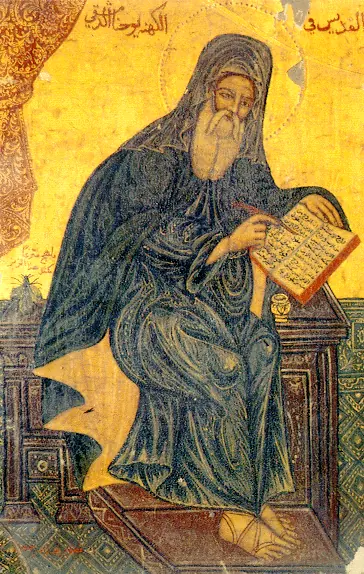
- A wrapped headcloth: most icons show him with a white or dark cloth wound around his head like a turban, a reminder of his Syrian origin, as in the Athos frescoes on this page.
- A long white beard and monk's habit: he is shown as an old monk of Mar Saba.
- An unrolled scroll: usually inscribed with the opening of one of his hymns. In the fresco with Cosmas, both men hold texts, since both were hymn writers.
- The Three-Handed icon: sometimes he holds or kneels before it, or the Virgin is shown restoring his hand.
- A severed or bandaged right hand: in Western prints and paintings of the miracle.
In the 19th-century icon from Damascus below, he sits writing in a book, with an Arabic inscription, a sign that the Arabic-speaking Christians of Syria still honor him as one of their own. Western art shows him less often; when it does, he usually appears as a monk with a book, or in scenes of the Virgin restoring his hand.
St. John of Damascus's feast day
His feast is December 4, an optional memorial in the General Roman Calendar and a feast in the Byzantine calendar, kept on the traditional day of his death. Leo XIII declared him a Doctor of the Church in 1890 and placed his feast on March 27; the 1969 reform moved it to December 4. St. Barbara, whose panegyric is attributed to him, is remembered on the same day. See the rest of December on our feast days page.
Tradition shows his tomb in a cave under the Mar Saba monastery, which Greek Orthodox monks still inhabit.
Prayer to St. John of Damascus
There is no widely used traditional English prayer to St. John of Damascus. The Church honors him with the Mass of a Doctor of the Church on December 4. The Orthodox and Byzantine Catholic faithful sing his troparion and kontakion on the same day, and many ask his prayers before studying theology or church music. Let us ask St. John Damascene to pray for all who paint and venerate holy icons, and for all who study the faith. The most common way Christians of every tradition pray "with" him is by singing his Easter hymn.
Frequently asked questions
Why is St. John of Damascus important?
He wrote the classic Christian defense of holy images, the three treatises Against Those Who Attack the Divine Images, when the Byzantine emperor Leo III banned icons. He also wrote the Fount of Knowledge, the first great summary of Christian doctrine, which later shaped Peter Lombard and St. Thomas Aquinas. And he composed hymns that Eastern Christians still sing every Easter.
What is the Three-Handed icon?
An icon of the Mother of God called Tricherousa, "of the Three Hands." Tradition holds that after John's right hand was cut off and miraculously restored, he fastened a silver model of a hand to the icon in thanksgiving. Later copies painted the silver hand as a third hand. The original is kept at Hilandar Monastery on Mount Athos. The miracle story is traditional.
When is St. John of Damascus's feast day?
December 4, the day of his death, in both the Catholic General Roman Calendar (an optional memorial) and the Byzantine calendar. When Leo XIII added him to the Roman calendar in 1890 his feast was placed on March 27; the 1969 reform moved it to December 4.
Is St. John Damascene the same person as St. John of Damascus?
Yes. "Damascene" simply means "of Damascus." His family name was Mansur, and admirers called him Chrysorrhoas, "flowing with gold," for his eloquence.
What is St. John of Damascus the patron saint of?
Modern Catholic lists name him patron of pharmacists, icon painters and theology students. The Orthodox Church in America says Orthodox Christians ask his help in the study of church singing, because of his hymns. We couldn't find an early source for the pharmacists patronage.
Sources
- Catholic Encyclopedia (1910): St. John Damascene
- Benedict XVI, General Audience of 6 May 2009: John Damascene
- Orthodox Church in America: Venerable John of Damascus
- St. John Damascene, On Holy Images, translated by Mary H. Allies, 1898 (Internet History Sourcebooks, Fordham)
- St. John of Damascus, An Exposition of the Orthodox Faith (New Advent)
- Hymnary.org: The Day of Resurrection (tr. J. M. Neale, 1862)
- Catholic Encyclopedia (1908): Candlemas (on the antiphon Adorna thalamum)