Pope St. Celestine I

Pope St. Celestine I was bishop of Rome from 422 to 432. He condemned the teaching of Nestorius, who denied that Mary is Mother of God, sent his legates to the Council of Ephesus in 431, defended the memory of St. Augustine, and sent missionaries to Ireland. We keep his feast on July 27.
Who was Pope St. Celestine I?
Pope St. Celestine I was the bishop of Rome from 422 to 432, the pope whose judgment against Nestorius led to the Council of Ephesus, where the Church proclaimed Mary the Mother of God. He also defended the memory of his friend St. Augustine and sent the first bishop to the Christians of Ireland. We keep his feast on July 27.
He is not the same man as St. Celestine V, the hermit pope of 1294.
Very little is known of his early life. He was a Roman, and his father was named Priscus. The first clear notice of him is a document of Pope St. Innocent I from 416, which calls him "Celestine the Deacon." Two years later St. Augustine wrote to him in warm and respectful terms.

A pope in stormy years
Celestine succeeded Pope Boniface I in the autumn of 422, elected, the Catholic Encyclopedia notes, without any opposition. Rome had been sacked by the Goths only twelve years before. The empire in the West was weakening, and the Church was troubled by Manicheans, Donatists, Novatians and Pelagians.
He met all of it with what the Catholic Encyclopedia calls a "firm but gentle character." He kept Coelestius, the chief disciple of Pelagius, out of Italy. He wrote to the bishops of Illyria, Gaul, Apulia and Calabria to keep the ancient canons. To the southern Italian bishops he insisted that the clergy must not be ignorant of the canons, and that the people should be taught rather than followed: populus docendus, non sequendus. He also told the bishops of Gaul not to refuse penance to the dying who asked for it.
At home he cared for Rome's churches. He restored Santa Maria in Trastevere after the Gothic pillage, as well as the church of Santa Sabina on the Aventine, and had the Catacomb of Priscilla decorated with paintings.
Friend of St. Augustine
Augustine died in 430 as the Vandals besieged Hippo. When some writers in Gaul began to attack his teaching on grace, Celestine wrote to the bishops there praising Augustine's holiness and learning and forbidding attacks on his memory. The ten short decisions on grace once attached to that letter, the "Capitula Coelestini," are now usually credited to St. Prosper of Aquitaine.
Celestine, Nestorius and the Council of Ephesus
Nestorius became bishop of Constantinople in 428. Reports soon reached Rome that he refused to call Mary Theotokos, God-bearer, and spoke of Christ as if he were two persons. Celestine asked St. Cyril of Alexandria to look into it.
In 430 a Roman synod condemned the teaching. Celestine then gave Cyril authority to act in his name: Nestorius was to be excommunicated and deposed unless he retracted in writing within ten days. On the same day the pope wrote to Nestorius himself, to the clergy and people of Constantinople, and to the bishops of Antioch, Jerusalem, Thessalonica and Philippi.

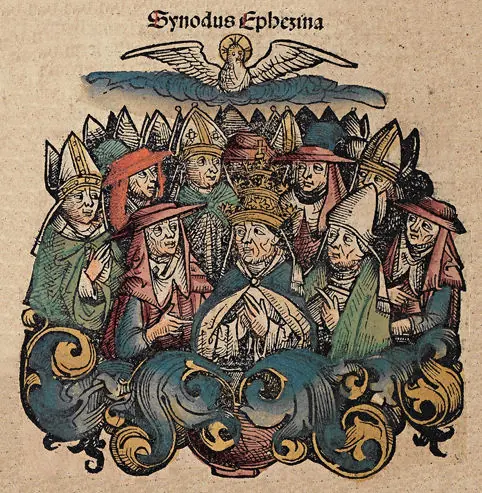
The emperor called a general council at Ephesus for 431. Celestine sent two bishops, Arcadius and Projectus, and the priest Philip as his legates, with orders to judge rather than debate. The council deposed Nestorius and confirmed that the Son of God and the son of Mary are one and the same, so that Mary is truly the Mother of God. The bishops said they had acted, in their own words, "compelled by the sacred canons and the letters of Our Most Holy Father, Celestine, Bishop of the Roman Church."
That is why the Byzantine churches still honor him with special warmth on April 8.
Celestine, Palladius and St. Patrick
The chronicle of St. Prosper, written in those same years, records that in 429, at the urging of the deacon Palladius, Celestine sent St. Germanus of Auxerre to Britain "to root out heresy and direct the Britons to the Catholic Faith." Under 431 Prosper adds: "Palladius was consecrated by Pope Celestine and sent to the Scots believing in Christ, as their first bishop." The Scots here are the Irish.
Palladius did not stay long. Tradition, followed by the Catholic Encyclopedia, holds that St. Patrick then received his commission from Celestine a few days before the pope died. Historians still argue over how Patrick's mission and Rome were connected, but Ireland has long remembered Celestine as the pope who first looked toward her.

Death and relics
Celestine died on July 26, 432, after a reign of nine years and ten months. He was buried in the Catacomb of Priscilla on the Via Salaria, the cemetery he had decorated with paintings of the Council of Ephesus. In 820 Pope St. Paschal I moved his body to the Basilica of Santa Prassede, and the cathedral of Mantua also claims his relics.
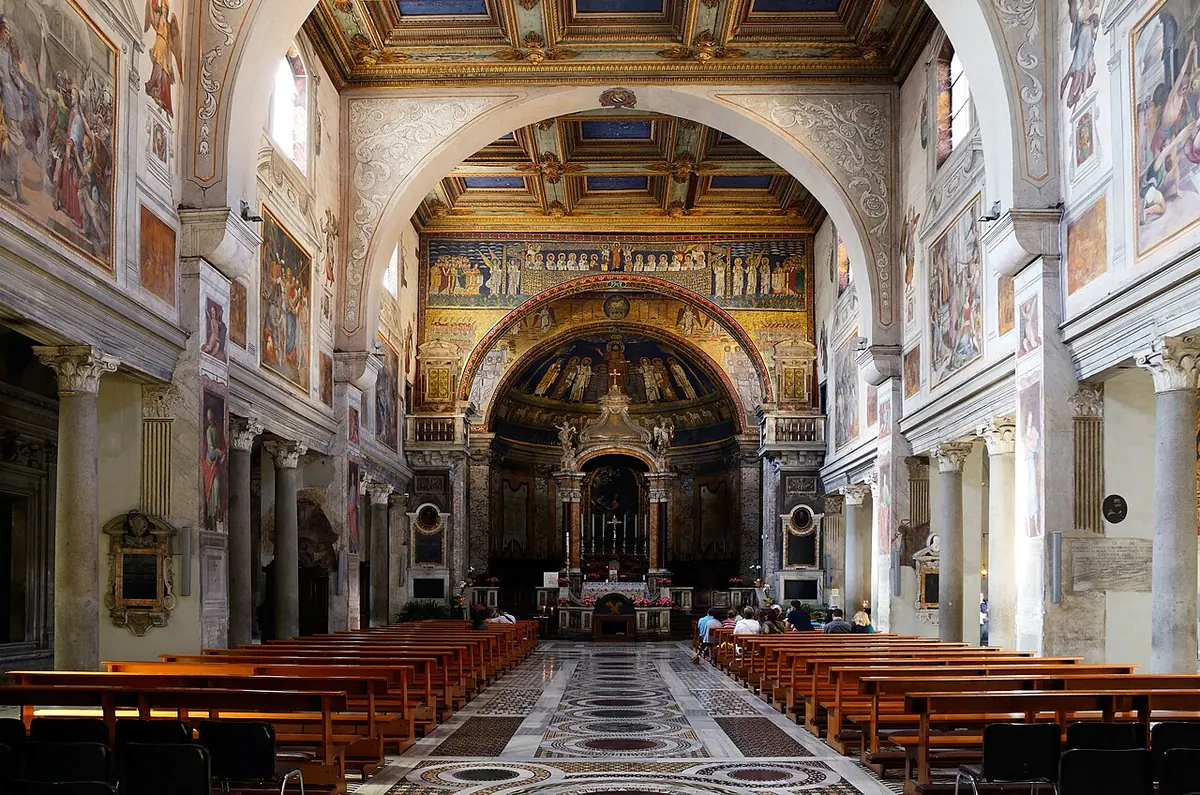
Where the relics of Pope St. Celestine I are kept: see them on the relics map →
Miracles
No particular miracles of Celestine have come down to us. The Church honored him from the fifth century for his faith and his care for the whole flock, long before formal canonization existed.
Symbols of St. Celestine I in art
Celestine is seldom painted on his own. He appears in papal portrait series, like Cavalieri's engravings of 1580, and in scenes of the Council of Ephesus.
- Papal tiara and vestments: later Western artists show him as a pope, though the tiara did not exist in his day.
- Book: his letters, sixteen of which survive.
- Dove: in council scenes, the Holy Spirit guiding the bishops at Ephesus.
In Byzantine and Russian art he stands among the bishops of the Third Ecumenical Council, as in the fresco by Dionisius above. Look for a bishop in a white omophorion beside St. Cyril of Alexandria.

Feast day and prayer
We keep his feast on July 27; see our feast day calendar. There is no traditional prayer to him in English, so let us ask his help in our own words. Holy Pope Celestine, who defended the honor of the Mother of God and sent the Gospel to the ends of the earth, pray for the Church, for her teachers, and for the people of Ireland.
Frequently asked questions
Who was Pope St. Celestine I?
A Roman deacon who became pope in 422 and reigned almost ten years. He is best remembered for condemning Nestorius at a Roman synod in 430 and for sending legates to the Council of Ephesus, which in 431 proclaimed Mary the Theotokos, the Mother of God.
Did Pope Celestine I send St. Patrick to Ireland?
He sent the deacon Palladius as the first bishop "to the Scots believing in Christ" in 431. The Catholic Encyclopedia, following a long tradition, holds that St. Patrick received his commission from Celestine a few days before the pope died in 432; historians still debate that link.
When is the feast of St. Celestine I?
July 27 in the Roman Martyrology. Older calendars kept April 6, and the Byzantine churches honor him on April 8.
Is St. Celestine I the same as St. Celestine V?
No. Celestine V was the hermit Peter of Morrone, who was elected pope in 1294 and resigned after a few months. Celestine I lived nine centuries earlier.
Keep exploring
Sources
- Catholic Encyclopedia (1908): Pope St. Celestine I. His election, the Roman synod of 430, his legates at Ephesus, Patrick's commission, the transfer of his body in 820 and the Mantua claim
- Catholic Encyclopedia (1909): Council of Ephesus
- Catholic Encyclopedia (1911): St. Palladius. Prosper's chronicle on Germanus (429) and Palladius (431)